We are taking a little break from the usual Bible World photos to enjoy a couple of pastoral scenes from the beautiful Emerald Isle.
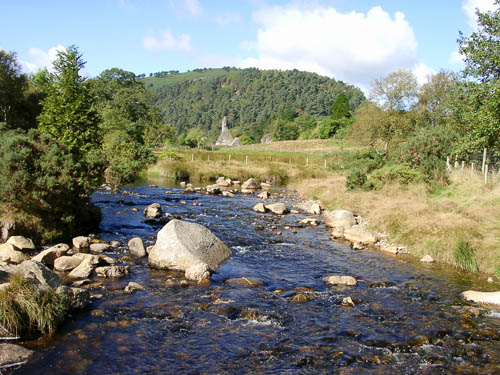
Glendalough, Ireland. Photo by Ferrell Jenkins.
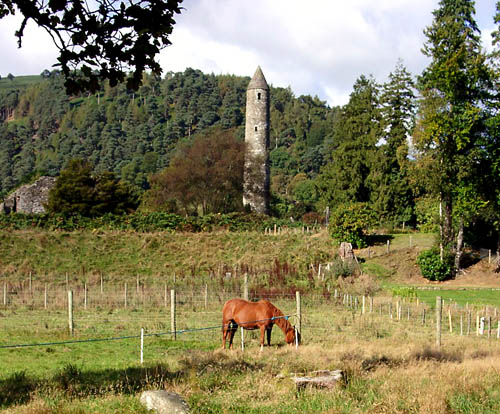
Pastoral scene at Glendalough, Ireland. Photo by Ferrell Jenkins.

We are taking a little break from the usual Bible World photos to enjoy a couple of pastoral scenes from the beautiful Emerald Isle.
Glendalough, Ireland. Photo by Ferrell Jenkins.
Pastoral scene at Glendalough, Ireland. Photo by Ferrell Jenkins.
Tuesday we took our 5-year-old grandson to the Manatee Viewing Center on Tampa Bay (Gulf of Mexico). Our local electric power company (TECO) has provided excellent walkways that allow visitors to see the Manatees who come during the winter months to enjoy the warm water discharged from the power plant.
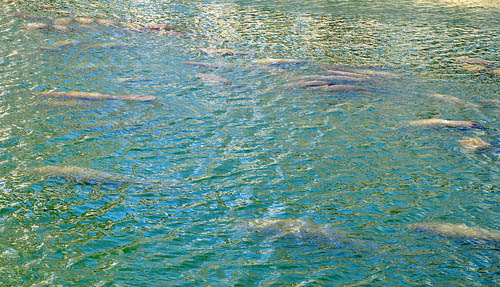
Manatees at the TECO Manatee Viewing Center. Photo by Ferrell Jenkins.
Our grandson enjoyed the visit, especially when he saw a large number of the Manatees moving about in the water. Well, he enjoyed turning $1.53 into three smashed pennies, too. In the learning center there are several exhibits of interest both to children and adults.
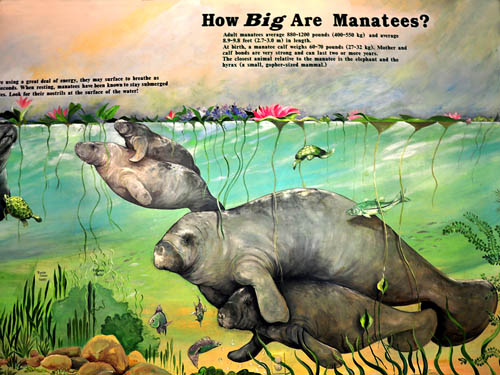
How Big Are Manatees? Photo by Ferrell Jenkins.
How Big Are Manatees? The poster says that adult manatees average 880-1220 pounds and are 8-9 feet long. The last statement under the question is this:
“The closest animal relative to the manatee is the elephant and the hydrax (a small gopher-size mammal.”
You may have wondered how I could relate this visit to traveling in the Bible lands. Well, here it is.
The hydrax is identified with the shaphan of the Hebrew Bible. English translations use some of the following terms:
Fauna and Flora of the Bible identifies this animal as the Syrian Coney (Procavia syriacus).
The rock badger lives among rocks from the Dead Sea valley to Mt. Hermon.
One of the best places to see the rock badgers is at En Gedi on the west shore of the Dead Sea.

Rock Badger at EnGedi. Photo by Ferrell Jenkins.
The Rock Badger is mentioned in the book of Proverbs among things that are small, but exceedingly wise. There is a great lesson here. Even though they are not mighty, they build their homes in secure places. This is similar to the teaching of Jesus in Matthew 7:24-25. Notice the reading of Proverbs 30:26 in a few of the English translations:
The shephanim are not mighty people, Yet they make their houses in the rocks; (NAU)
rock badgers are creatures with little power, but they make their homes in the crags; (NET)
the rock badgers are a people not mighty, yet they make their homes in the cliffs; (ESV)
hyraxes are not a mighty people, yet they make their homes in the cliffs; (CSB)
The headline writers are going wild. Arutz Sheva says, “Dig Supports Biblical Account of King Solomon’s Construction” here. The article includes a short video featuring Dr. Eilat Mazar at the site here.
The Associated Press article is headed “Archaeologist Sees Proof For Bible In Ancient Wall” here. The AP headline at Yahoo News reads, “Archaeologist sees proof for Bible in ancient wall,” here.
The news release from the Israel Ministry of Foreign Affairs reads, “Jerusalem city wall from 10th century B.C.E. uncovered,” here.
A good report in the Trumpet (here) reads, “Solomonic Wall Discovered in Jerusalem.”
Dr. Eilat Mazar, of Hebrew University, has been working for several years in the City of David excavation. For the past three months she has been working in the area north of the City of David next to the street that runs along the south side of the Temple Mount. The area is part of what is called the Ophel. Eilat Mazar worked here with her grandfather, Benjamin Mazar, in the 1980s. You can see the area in this aerial photo I made December 15, 2009. In fact, a portion of the excavation is covered by a tarp.
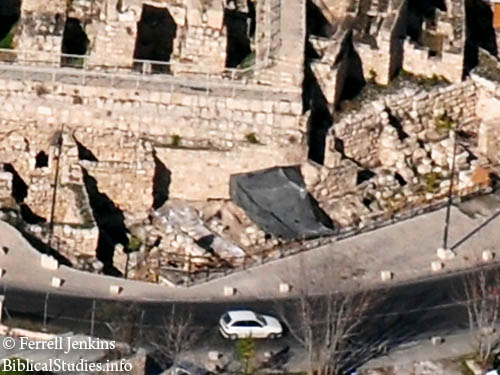
Aerial view of Second Temple excavation. Photo by Ferrell Jenkins.
Thirteen photos are posted on the Hebrew University Facebook album here.
Todd Bolen (here and here and here) and Leen Ritmeyer (here and here) point out that, in spite of the news release, this excavation goes back many years. Dr. Eilat Mazar has spent the past three months working in the area.
Below is a photo of the gate area showing the west chambers that I made in 2005. Benjamin Mazar and his grand daughter Eilat published a report on this area in 1989.

Gate from First Temple Period. Photo by Ferrell Jenkins 2005.
Compare the photo above, and the schematic drawing on the sign below (from 2005), with photos 12 and 13 in the HU Facebook album.
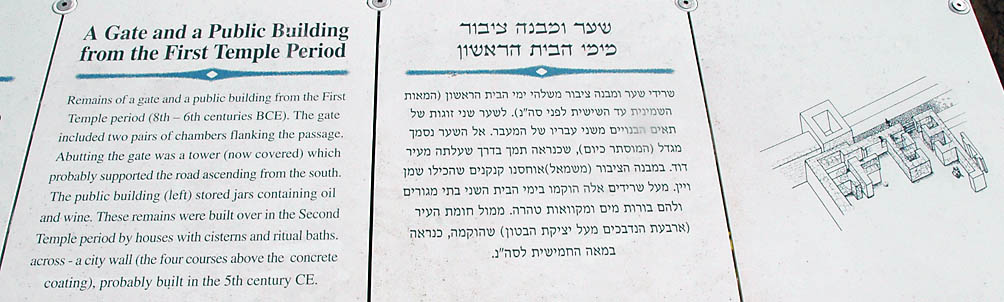
Marker indicated First Temple Period gate. Photo by Ferrell Jenkins 2005.
It seems uncertain whether this gate belongs to the 8th century B.C., 9th century, or 10th century. Eilat Mazar says it belongs to the 10th century B.C. based on pottery and a comparison of the architecture with that in other excavated cities. We must patiently wait to see the evidence. [See the comment by barnea levi selavan on Ritmeyer’s blog. He points out several significant things not included in the news reports.]
I look forward to seeing the area that has been recently cleaned. The news reports, including the video by Prof. Mazar, do not distinguish between what we already knew and what is new.
No one would enjoy seeing an inscription reading “Built in the 950 B.C. by King Solomon, son of David” more than I. Until more evidence is forthcoming we must leave Solomon out of this picture.
And this is the account of the forced labor that King Solomon drafted to build the house of the LORD and his own house and the Millo and the wall of Jerusalem and Hazor and Megiddo and Gezer. (1 Kings 9:15 ESV)
P.S. I was about 5 minutes away from posting this early today when my wife came to say that we must leave to pick up our grandson for the day. I chose the better part!
The Israel Antiquities Authority has provided a higher resolution photo of the Byzantine-period wine press found in the Sorek Valley. Click for a larger image.
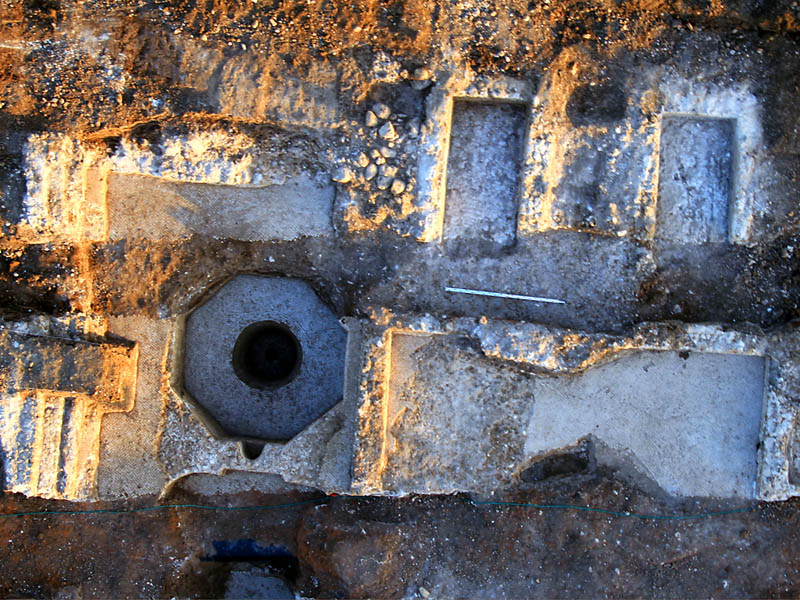
Sorek Wine Press. Aerial view courtesy of IAA.
Todd Bolen calls attention to an article in the Jerusalem Post with a better photo (here). It certainly provides a better view of the octagonal collecting vat. Take a look.
Posted in Archaeology, Bible Places, Culture, Israel, Photography
Travel in Egypt is sometimes hindered by small amounts of rain. In flat areas such as the delta an inch of rain can flood the area and make automobile travel impossible, or at least impractical. In early March, 2005, Elizabeth and I had remained in Egypt for a few days after the tour group returned home. We planned one day to go to Goshen. That morning when we looked from the hotel window in Heliopolis we observed rain. The guide scheduled to go with us on the excursion arrived, but explained that we would not be able to go due to the 1/2 to 1 inch of rain that had fallen during the night. The annual rainfall in the Cairo area is 1 1/2 to 2 inches. In Upper Egypt years may pass with no rainfall.
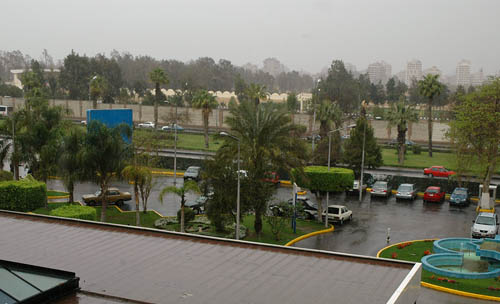
Rain in Cairo - March 9, 2005. Photo by Ferrell Jenkins.
Egypt is less prepared for an inch of rain than many southern USA cities are for an inch of snow.
On another excursion we went to Jebel Musa, the traditional Mount Sinai, in the Sinai Peninsula. As we traveled through the Wadi el-Tor (el-Tur or al-Tur) shortly before arriving at Feiran, I noted that there had been a flash flood in the wadi. Our guide explained that this typically happened at least once each winter. He said that the asphalt paved road could be washed out by less than an inch of rain.

Wadi el Tor in the Sinai Peninsula after a flash flood. Photo by Ferrell Jenkins.
Rocks polished by the winter flood were strewn across the wadi. These stones show the different rocks found in the Sinai. The red stones indicate iron. The green is copper. The black is basalt, indicating a volcanic area.

Rocks in Wadi el Tor of the Sinai Peninsula. Photo by Ferrell Jenkins.
Let us recall that the normally dry wilderness (midbar, desert) once flowed with water for the Israelites.
“He led you through the great and terrible wilderness, with its fiery serpents and scorpions and thirsty ground where there was no water; He brought water for you out of the rock of flint. (Deuteronomy 8:15 NAU)
He split the rocks in the wilderness And gave them abundant drink like the ocean depths. (Psalm 78:15 NAU)
The slide show Digging Up History: The Latest Archaeology News at Fox News includes a several photos of discoveries of interest — including some we have mentioned in previous posts.
See the full show here.
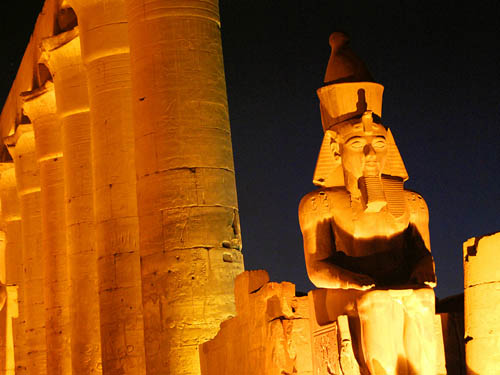
Court of Rameses II in the Luxor Temple. Photo by Ferrell Jenkins.
HT: Brooks C.
The practice of “sitting in the gate” may not be as understandable to our generation as it was to people of Bible times. During many biblical periods the gates were constructed of multiple chambers or rooms. The “Solomonic” Gate at Gezer has six chambers — three on each side of the entry. The photo below was made from inside the city of Gezer. We see a nice bench made of individuals stones in the chamber at the bottom of the photo.

Note the seats (benches) in a gate chamber at Gezer. Photo by Ferrell Jenkins.
The practice of sitting in the gate is mentioned in numerous biblical references. Note a few.
What we see in these references is equivalent to what happens in many of our small towns when men of the city sit on benches around the court house or city center to talk about the weather, politics, religion, and whatever.

Ferrell Jenkins sitting in the gate at Gezer. Photo by Leon Mauldin.
Wisdom is pictured as being beside the gate, at the opening of the city.
Beside the gates, at the opening to the city, At the entrance of the doors, she cries out: (Proverbs 8:3 NAU)
Posted in Archaeology, Bible Places, Israel, Old Testament, Photography
This is the week for the annual Bible lectures at Florida College in Temple Terrace, FL. Even though I retired from teaching in 2001, I have been invited to speak each year. Most of these have been lectures that do not require writing a manuscript for publication. That is my preference, of course.
Yesterday I spoke in Puckett Auditorium on Roads and Seas Less Traveled. For a 45 to 50 minute presentation I had to be very selective. I explained what I meant by the title. I was speaking of places (roads and seas) that tourists rarely visit. I limited myself to the land of Goshen and Malta.
Using a map, I showed the location of the land of Goshen in the eastern Nile Delta. This is where Jacob’s family settled when they went from Canaan to Egypt (Genesis 45:10), and where they grew to a nation and spent time in bondage. This area was also called the “land of Rameses.”
Then Joseph settled his father and his brothers and gave them a possession in the land of Egypt, in the best of the land, in the land of Rameses, as Pharaoh had commanded. (Genesis 47:11 ESV)
Dr. Manfred Bietek of the Austrian Institute in Cairo has excavated since the mid-1960s at Tell el-Dab’a, Ezbet Helmi, and Qantir. All of these sites are located a few miles north of modern Faqus in the eastern Delta. I have taken my tour group to visit sites in Goshen on two tours, but tourists are not allowed to visit Tell el-Dab’a. In fact we were not allowed to get off the bus to make photographs of the canal that follows the path of the ancient Pelusiac branch of the Nile. I have a friend in Egypt who knows the territory and offered to take me to visit some of these places. We went late in the afternoon. In fact, by the time we arrived at Tell el-Dab’a it was already dark.
Here is the original photo:

Tell el-Dab'a in the Eastern Nile Delta. Original Photo by Ferrell Jenkins.
After a little work in Photoshop, the photo looks as if it were taken during a hazy day.
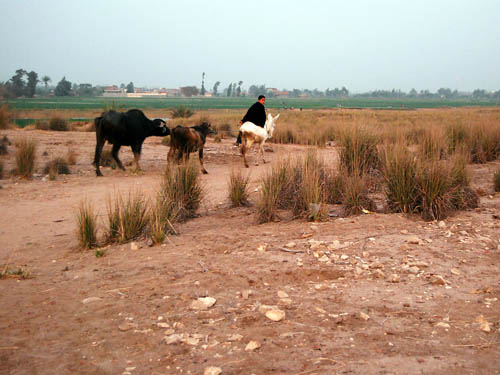
Tell el-Dab'a in the Eastern Nile Delta. Photo by Ferrell Jenkins.
In the original larger photo it is easy to see shards of pottery scattered in the area.
The children of Israel once lived in this flat, fertile area of Egypt. In fact, if this is indeed the land of Rameses, the Israelites departed from this region for the promised land (Exodus 12:37).
A fuller discussion about the Land of Rameses may be read here.
A scholarly article by Dr. Bryant G. Wood about New Discoveries at Rameses is available at the Associates for Biblical Research web site here. I also recommend the article on Israel in Egypt by Gary Byers at the same site (here).
Posted in Archaeology, Bible Places, Bible Study, Egypt, Photography, Travel
From this narrow dirt path one can see the mountains that surround Samaria (Amos 3:9).

A path at Samaria. Photo by Ferrell Jenkins.
Ponder the path of your feet; then all your ways will be sure. Do not swerve to the right or to the left; turn your foot away from evil. (Proverbs 4:26-27 ESV)
Posted in Bible Places, Bible Study, Israel, Old Testament, Photography, Travel
In the last post about the aerial photos (January 18) we showed the mountains of Judea as we approached the central mountain ridge. Today’s photo shows the Old City of Jerusalem from about 3800 feet above sea level. The city itself is about 2400 to 2500 feet above (Mediterranean) sea level. The view is looking southeast across the Wilderness of Judea to the mountains of Moab in the Transjordan tableland.

Old City of Jerusalem - view toward SE. Photo by Ferrell Jenkins.
In this photo one can see the proximity of Jerusalem to the Wilderness of Judea. The distance from Jerusalem to the Dead Sea is not more than 20 miles. The elevation drops from about 2600 at the Mount of Olives to (currently) about 1384 feet below sea level at the surface of the Dead Sea. The Transjordan Tableland is about 3000 above sea level.
As the mountains surround Jerusalem, So the LORD surrounds His people From this time forth and forever. (Psalm 125:2 NAU)
Posted in Bible Places, Israel, Jordan, Old Testament, Photography, Travel


You must be logged in to post a comment.