Category Archives: Photography

Nahal Dan — strongest source of the Jordan

Israel National Parks and Nature Reserves, by Azaria Alon, is a must book for those who plan to visit more than the popular few of the parks and reserves in Israel.  It is published by Carta (Jerusalem), and distributed by Eisenbraun’s in the USA. Click on the link here to go directly to the description and order info.

Here is Alon’s description of the Nahal Dan (Nahr el-Leddan; River Dan):

Nahal Dan is situated in the heart of an area known as “the land of streams and rivers,” and indeed, in the Nahal and along its margins, water and vegetation are present in abundance. The Nahal has a single principal source but it is also fed by dozens of smaller springs. Walking in this environment one has the feeling of springs emerging everywhere. All this water has its origin from the winter snows on Mt. Hermon. The snow melts slowly, seeps into the sponge-like earth of the mountain, and emerges in the foothills. The water flows quietly from the springs, but it continues down an ever-increasing slope, turning into a torrent and generating standing waves and foam. When the stream emerges from the nature reserve, it splits into several rivulets which rejoin when it encounters Nahal Hermon to form the Jordan River.

Nahal Hermon is more commonly known as the Nahr Banias which begins at the site of Caesarea Philippi.

Here is a view of the Nahal Dan within the Tel Dan Nature Reserve.
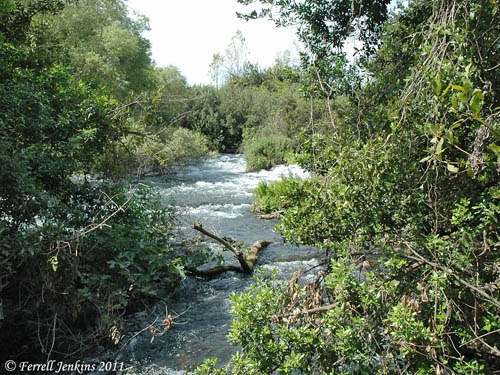
Nahal Dan in the Tel Dan Nature Reserve. Photo by Ferrell Jenkins.

Nahal Dan in the Tel Dan Nature Reserve. Photo by Ferrell Jenkins.

And here is one of the springs. This one is located immediately below the northwest corner of Tel Dan.
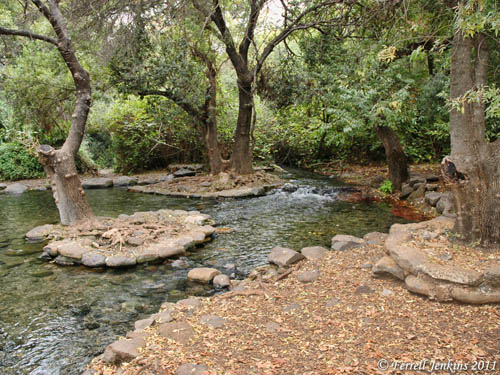
A spring in the Tel Dan Nature Reserve. Photo by Ferrell Jenkins.

A spring in the Tel Dan Nature Reserve. Photo by Ferrell Jenkins.

Dan is Israel’s northernmost city (Judges 18:29).
Something Irish

Many Americans have Irish backgrounds. Something Irish may be appropriate today.

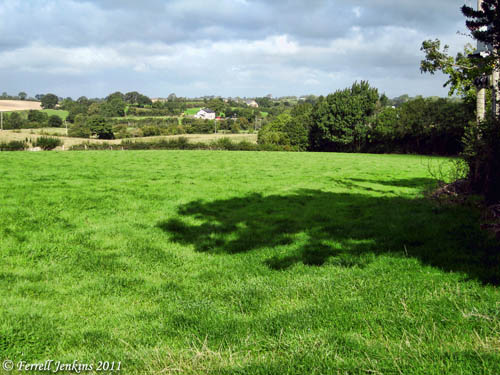
This photo of gently rolling hills of northern Ireland is typical of the northern part of Ireland. The closest large town is Armagh, but it is between Rich Hill and Ahorey.

Farm land near Ahorey Church, near Rich Hill, N. Ireland. Photo by Ferrell Jenkins.

Farm land near Ahorey Church, North Ireland. Photo by Ferrell Jenkins.

Students of the Restoration Movement will recognize this area as the home of Thomas and Alexander Campbell in the early 1800s, prior to their departure for America.

Some time I would like to post several photos of Irish sites associated with the Campbells.

The flea river: Nahr Bareighit or Nahal Iyon

The least known of the sources of the Jordan River is the Nahr Bareighit (flea river) or Nahal Iyon (the name used in Israel). Like the Senir (Hasbani), this river begins in the Beka Valley of Lebanon. It is often overlooked when the sources of the Jordan are named.

Nelson Glueck, The River Jordan, describes the Nahr Bareighit.

The westernmost source of the Jordan is the small mountain stream, Nahr Bareighit. Through a rude gorge, it tumbles down southward from the hilly meadowland of Merj ‘Ayun, which retains in clear part its ancient Biblical name of Ijon (1 Kings 15:20), to add its waters to the formation of the fateful [Jordan] river. The Nahr Bareighit joins the Nahr Hasbani about three quarters of a mile above the point where the Hasbani joins the junction of the Leddan and Banias streams. These last two alone were anciently considered as the sole sources of the Jordan. All found help to form it, and lose their identity in it, as the Jordan starts it flow under its own name.

“Roll, Jordan, roll;
I want to go to heaven when I die
To hear sweet Jordan roll.”

Deni Baly, The Geography of the Bible, devotes a single sentence to this little stream.

The basin of Marj ‘Ayoun to the west is drained by the smaller Bareighit, which leaps over the threshold in a series of charming waterfalls near Metullah and postpones its junction with the Jordan until just before the Huleh marshes. (193)

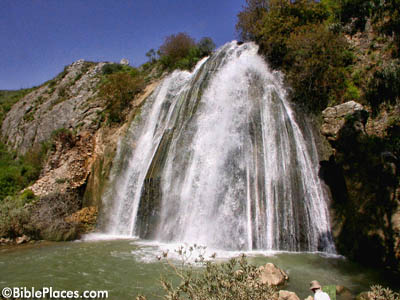
The photo below shows the Iyon Mill Falls. It is one of the beautiful photos of several falls on the river from the Pictorial Library of Bible Lands. Check BiblePlaces.com to purchase the complete set or the DVD of Galilee and the North.

Nahal Iyon Mill Falls. Photo: BiblePlaces.com.

Nahal Iyon Mill Falls. Photo courtesy of BiblePlaces.com.

The Senir, a source of the Jordan River

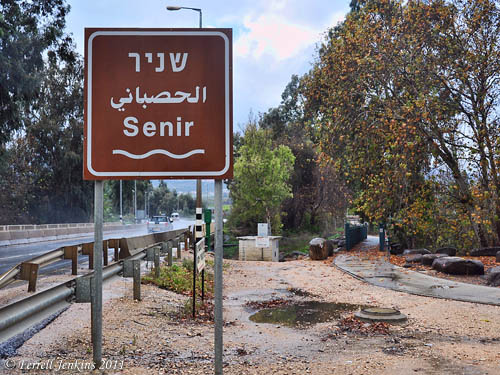
The longest source of the Jordan is the 24-mile-long Nahr Hasbani which begins in the Beka Valley of Lebanon and flows south to join the Jordan. Israel has replaced many of the Arabic names that were commonly used in earlier decades with Hebrew names. The Old Testament says that the Sidonians “call Hermon Sirion, and the Amorites call it Senir” (Deuteronomy 3:9). The river is now designated Senir in Israel.

At the Senir (Hasbani) on Israel Highway 99. Photo by Ferrell Jenkins.

At the Senir (Hasbani) on Israel Highway 99. Photo by Ferrell Jenkins.

Other passages identifying Mount Hermon as Senir are 1 Chronicles 5:23, Song of Solomon 4:8, and Ezekiel 27:5. Nelson Glueck, The River Jordan, calls attention to Psalm 42:6, translating it this way:

O my God, my soul is cast down within me: Therefore am I mindful of thee from the land of the Jordan, and the Hermons” (Psalm 42:6)

The plural of the Hebrew word chermonim is bought out in the English translations by phrases like “peaks of Hermon” or “heights of Hermon.”

Israel Highway 99 runs north east from Kiryat Shmona to the Golan Heights past Tel Dan and Banias (Caesarea Philippi) and two other sources of the Jordan (the River Dan and the River Banias). Because this river begins in the vicinity near Mount Hermon, it is called the Senir.

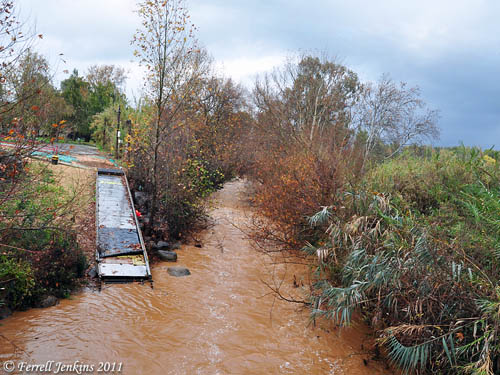
The photo below is the view north from Highway 99.

The Senir River (Hasbani) view north from HWY 99.

The Senir River (Hasbani) view north from HWY 99. Photo by Ferrell Jenkins.

I think the slide on the west side of the river is used to launch kayaks into the river.

Races called off at Caesarea Maritima hippodrome

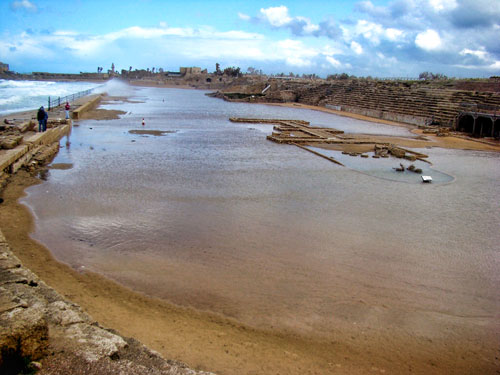
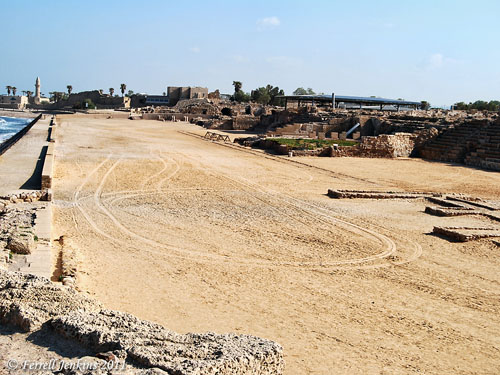
Friend Leon Mauldin is traveling in Israel for a few days. He reports “a mixture of wind, rain, and sunshine” today. He shared a nice photo of the hippodrome at Caesarea Maritima flooded. Note the heavy clouds and the water crashing in from the sea.

Caesarea Maritima Hippodrome standing in water. Photo by Leon Mauldin.

Caesarea Maritima Hippodrome standing in water. Photo by Leon Mauldin.

Our thanks to Leon for sharing this photo with out readers. You may follow the progress of his tour at Leon’s Message Board here.

We know that Israel needs the rain after several years of drought conditions. The archaeological park was closed due to storm damage in mid-December, 2010. See here.

Here is a photo of the same area made during a dry period.

Caesarea Maritima Hippodrome. Photo by Ferrell Jenkins.

Caesarea Maritima Hippodrome Dry. Photo by Ferrell Jenkins.

Herod the Great built a hippodrome along the coast at Caesarea Maritima in 10 B.C. to celebrate the opening of the city. Read more here.

Peter preached to Cornelius at Caesarea (Acts 10,11).

Paul was imprisoned in the city for two years before departing for Rome (Acts 24:27; 27:1).

Camels in biblical times

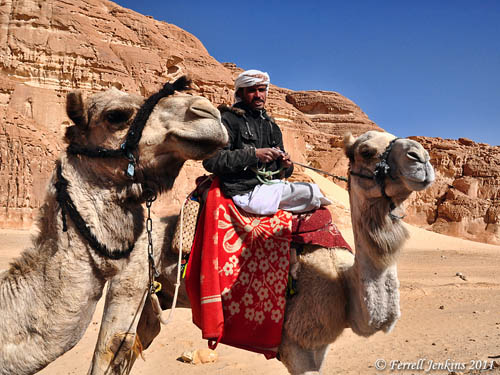
Camels are mentioned in the Bible from the days of Abraham (Genesis 12:16) to New Testament times (Mark 1:6). Recently while traveling in the eastern Sinai peninsula near the Gulf of Aqaba (Eilat) we saw a large number of camels with their riders.

Camels in the Eastern Sinai Peninsula. Photo by Ferrell Jenkins.

Camels in the Eastern Sinai Peninsula. Photo by Ferrell Jenkins.

When the Queen of Sheba visited Jerusalem to quiz Solomon she brought with her a large retinue, with camels carrying valuable gifts for Solomon.

Now when the queen of Sheba heard of the fame of Solomon, she came to Jerusalem to test Solomon with difficult questions. She had a very large retinue, with camels carrying spices and a large amount of gold and precious stones; and when she came to Solomon, she spoke with him about all that was on her heart. Solomon answered all her questions; nothing was hidden from Solomon which he did not explain to her. (2 Chronicles 9:1-2 NAU)

Mahanaim — where Jacob wrestled with an angel

The name Mahanaim is found 13 times in the Old Testament. The site is where Jacob and Laban met and made a covenant. Mahanaim seems to mean “two camps” (Genesis 32:2). This is where Jacob’s name was changed to Israel after he wrestled with a man (angel, Hosea 12:4). When morning came Israel crossed over Penuel (Genesis 32:31).

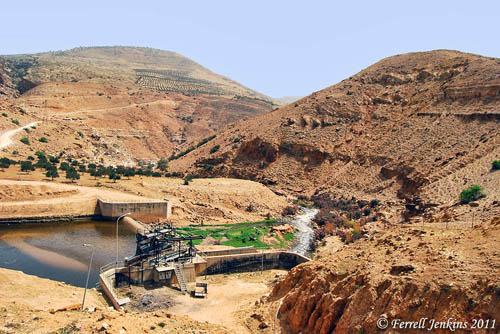
Two large tells face each other and the Jabbok River flows in an S-curve between them. The tells are now named Tall adh-Dhahab East and Tall adh-Dhahab West. These tells are located a few miles east of the Plains of the Jordan and Tell Deir Allah (likely the site of biblical Succoth). Some scholars identify Dhahab West as Mahanaim and Dhahab East as Penuel. Other scholars reverse the identifications.

When Transjordan was divided among the tribes, Mahanaim was located in the territory of Gad on the boundary with East Manasseh (Joshua 13:26, 30). It was one of the cities allotted to the Levites (Joshua 21:38; 1 Chronicles 6:80).

After the death of Saul, Abner made Ishbosheth, the son of Saul, king over all Israel from Mahanaim (2 Samuel 2:8, 12, 29).

When David fled from his rebellious son Absalom he fled across the Jordan to Mahanaim (2 Samuel 17:24, 27; cf. 2 Kings 2:8). Absalom met his death in a nearby forest.

A Gileadite by the name of Barzillai took care of King David while he stayed at Mahanaim (2 Samuel 19:32). The city became one of Solomon’s administrative centers (1 Kings 4:14).

Song 6:13 describes gazing upon the Shulammite girl to be like looking on “the dance of the two camps” or “dance of two companies” (CSB, JPS, NAU, NKJ). Other translations use the expression “the dance of Mahanaim” (ASV, NIV, NJPS, TNIV) or “dance of the Mahanaim” (NET).

Recent excavations at Dhahab West, conducted by a German team, have revealed what they believe to be part of a monumental building of Herod the Great. They think this was the Hellenistic and Roman site described by Josephus as Amathus.

Tall adh-Dhahab East (left) and Tall adh-Dhahab West (right). Photo by Ferrell Jenkins.

Tall adh-Dhahab East (left) and Tall adh-Dhahab West (right). These are thought to be the sites of Mahanaim and Penuel. Photo by Ferrell Jenkins.

Our photo shows both tells. (Tall adh-Dhahab East is on the left. Tall adh-Dhahab West is on the right.) There is a pumping station on the Jabbok to provide agricultural irrigation. The Jabbok continues in the valley separating the two hills and tells.

Click on the photo for an image suitable for use in teaching presentations.

A rooster can wake you up

Having been brought up in the country, I learned early about the annoyance of the rooster as well as his usefulness. His crowing awakened those who wanted to get up early and those who would have preferred sleeping. Without the rooster there would be no more chicks. Bantam roosters were especially known for their strutting. The writer of Proverbs mentioned this attribute:

Three things are stately in their stride, even four are stately in their walk: a lion, which is mightiest among beasts and doesn’t retreat before anything, a strutting rooster, a goat, and a king at the head of his army. If you have been foolish by exalting yourself or if you’ve been scheming, put your hand over your mouth. For the churning of milk produces butter, and twisting a nose draws blood, and stirring up anger produces strife. (Proverbs 30:29-33 CSB)

The rooster strutted as if he owned the yard. Our backyard was barren. Chicken scratch was scattered across the yard and the chickens scurried to get their share.

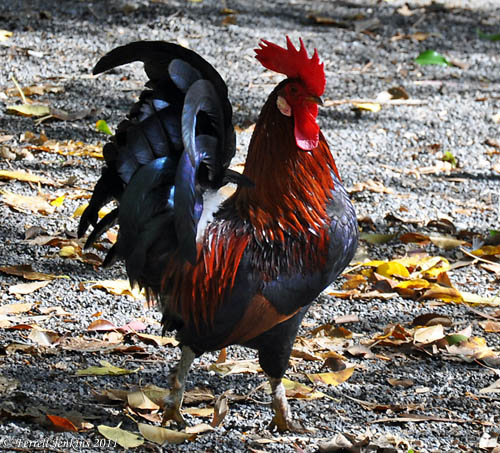
The photo below was made recently at the Jordan River Park north of the Sea of Galilee.

Rooster at Jordan River Park. Photo by Ferrell Jenkins.

Rooster at Jordan River Park. Photo by Ferrell Jenkins.

We especially remember the rooster in connection with Peter’s denial of the Lord. Note first the Lord’s prediction:

“I assure you,” Jesus said to him, “tonight, before the rooster crows, you will deny Me three times!” “Even if I have to die with You,” Peter told Him, “I will never deny You!” And all the disciples said the same thing. (Matthew 26:34-35 CSB)

Matthew records what happened after the denial:

Then he started to curse and to swear with an oath, “I do not know the man!” Immediately a rooster crowed, and Peter remembered the words Jesus had spoken, “Before the rooster crows, you will deny Me three times.” And he went outside and wept bitterly. (Matthew 26:74-75 CSB)

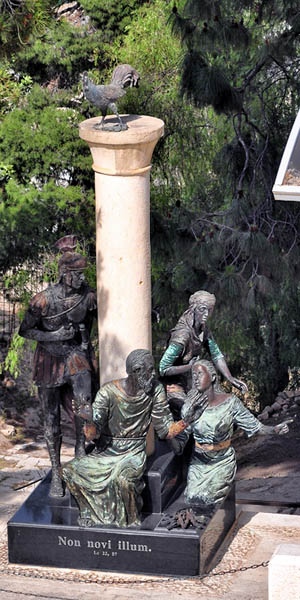
If you have visited St. Peter in Galicantu (St. Peter of the Cock Crowing) in Jerusalem recently, you have seen this sculpture showing Peter saying “I do not know Him.” Note the rooster on the top of the column.

Sculpture at St. Peter in Galicantu. Photo by Ferrell Jenkins.

Sculpture at St. Peter in Galicantu. Photo by Ferrell Jenkins.

Then the Lord turned and looked at Peter. So Peter remembered the word of the Lord, how He had said to him, “Before the rooster crows today, you will deny Me three times.” And he went outside and wept bitterly. (Luke 22:61-62 CSB)

Discovery’s last trip

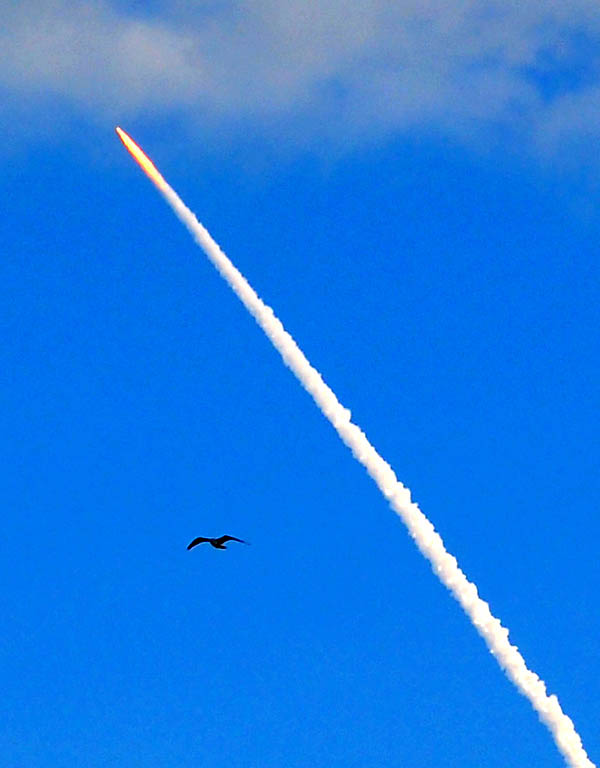
It is not like being at Kennedy Space Center, but we had a nice view of the first few seconds of Discovery’s last trip. We have been at Daytona Beach for the past two days. I think this is about 45 to 50 miles north of the Kennedy Space Center.

Discovery's last trip. Photo by Ferrell Jenkins. Feb. 24, 2011.

Discovery's last trip. Photo by Ferrell Jenkins. Feb. 24, 2011.

We took our two sons to see the Apollo 11 blast-off almost 42 years ago. See photo here.

Trust each of you have your sights set on something higher.

Set your minds on things that are above, not on things that are on earth. (Colossians 3:2 ESV)

The donkey: beast of burden

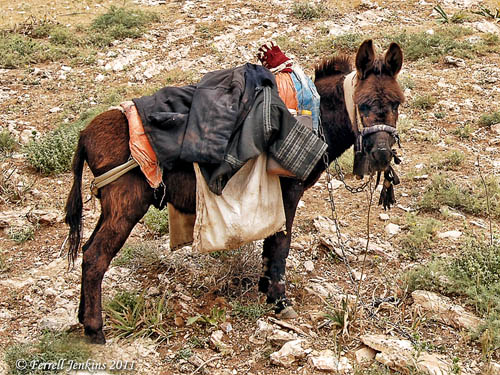
Donkeys are mentioned throughout the Bible beginning in Genesis 16:12. This photo shows the donkey belonging to a shepherd in the area of Gilead in Transjordan.

A donkey in Gilead (Transjordan). Photo by Ferrell Jenkins.

A donkey in Gilead (Transjordan). Photo by Ferrell Jenkins.

Abraham took a donkey when he went to the land of Moriah to offer Isaac.

So Abraham rose early in the morning and saddled his donkey, and took two of his young men with him and Isaac his son; and he split wood for the burnt offering, and arose and went to the place of which God had told him. (Genesis 22:3 NAU)

Jesse loaded a donkey with food supplies to send to Saul when the Israelites fought against the Philistines in the Valley of Elah.

Jesse took a donkey loaded with bread and a jug of wine and a young goat, and sent them to Saul by David his son. (1 Samuel 16:20 NAU)