Category Archives: Old Testament

LMLK jar handles

During the time of the Divided Kingdom, pottery jars with handles bearing the Hebrew letters LMLK seem to have been in common use. T. C. Mitchell comments briefly on these handles:

These handles of pottery jars which had been stamped before baking, with seals show symbols, either a four-winged scarab or a two-winged disc, with lmlk, ‘belonging to the king’ written above it in Hebrew script and a place-name below it. Over eight hundred of these stamped handles have been found at over twenty excavated sites in Palestine, nearly all in the territory to which Judah was confined by about 700 BC. (The Bible in the British Museum, page 55).

Tourists who have an interest in archaeology often pick up shards of pottery as they walk across various tells. It is not uncommon to locate a jar handle or the rim of a bowl. Recently a college student found a LMLK handle at Ramat Rahel, a site between Jerusalem and Bethlehem. Several blogs have commented on it. Todd Bolen has a nice photo of the handle here. A newspaper article about the chance find is here.The LMLK web site has a report here.

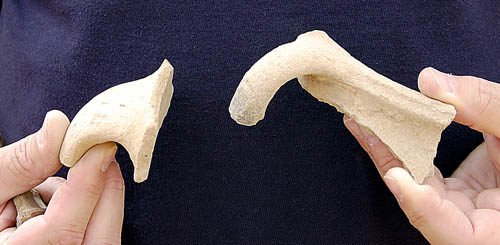
This is a photo of a LMLK jar handle that I made in the British Museum. The handle was found at Lachish. The LMLK handles have the phrase LMLK (“belonging to the king”) and the name of one of the cities that served as a distribution center: HBRN (Hebron), ZP (Ziph), SWKH (Socoh), or MMST. This one has SWKH.
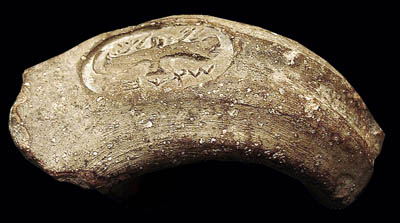
King Hezekiah built “storehouses…for the produce of grain, wine and oil” (2 Chronicles 32:28). Mitchell says that the LMLK vessels “would have been suitable for any of the three staples derived from the land, grain, wine or oil.”

A New, Smaller Bible Atlas

Carta's New Century Handbook and Atlas of the Bible

Carta’s New Century Handbook and Atlas of the Bible
Abridgment of The Sacred Bridge

by Anson F. Rainey and R. Steven Notley
Carta, Jerusalem, 2007
280 pages + full color illustrations and maps, English. Cloth, 9 x 12 inches
ISBN: 9789652207036
List Price: $50.00. Your Price: $45.00

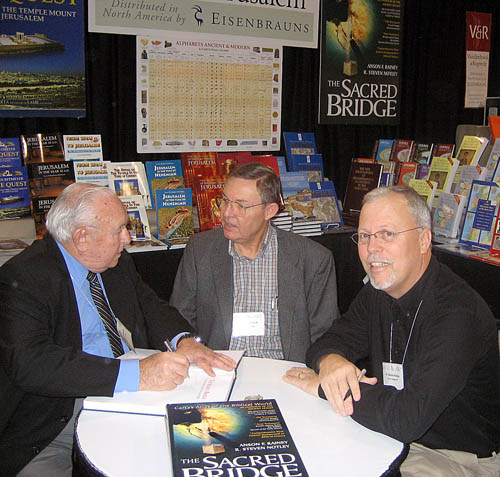
Several times we have mentioned the important of the Bible student having a good atlas. Check here. Two years ago Carta brought out The Sacred Bridge, by Rainey and Notley. The book is large, and the content is more than most students want or need. And the price was $100. In response to a request from many professors, the same authors have prepared Carta’s New Century Handbook and Atlas of the Bible. I have not seen this book, but I have been using the larger atlas, and I plan to get a copy of the abridged edition. Fortunately I was able to get The Sacred Bridge autographed by Rainey and Notley.

Eisenbrauns is the US distributor of Carta books and maps. A click on the title at the top will take you to their web page.

Ramoth in Gilead

Ramoth in Gilead (or Ramoth-gilead) was a town in Gilead that was included in the territory of the Israelite tribe of Gad in Transjordan (Joshua 20:8). It was one of the Levitical cities of refuge for the Israelites (Joshua 21:38). The most memorable associated with Ramoth-gilead recorded in the Bible is the battle with Aram (Syria) in which Ahab was killed (1 Kings 22). Elijah sent one of the sons of the prophets to Ramoth-gilead to anoint Jehu as king of Israel (2 Kings 9:1).

The identity of Ramoth-gilead is uncertain. Two sites are frequently mentioned by scholars: Tall ar-Rumeith and Ar-Ramtha.

Burton MacDonald, in East of the Jordan, says,

There is also archaeological support for choosing Tall ar-Rumeith, situated in the fertile plain area just to the southeast of the junction of the ‘Amman-Damascus and Irbid-Mafraq highways, as the location for Ramothgilead. (page 200)

Paul Lapp excavated at Tall ar-Rumeith in 1967. Little archaeological work has been done at Ar-Ramtha. I have not gone into the Jordanian city of Ramtha, but understand that the mound is covered by the town, thus making it difficult to conduct an excavation.

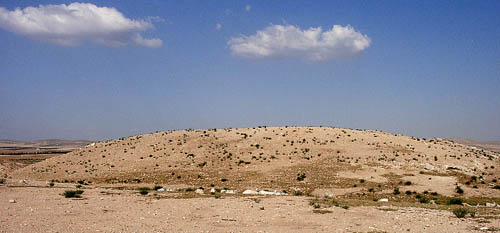
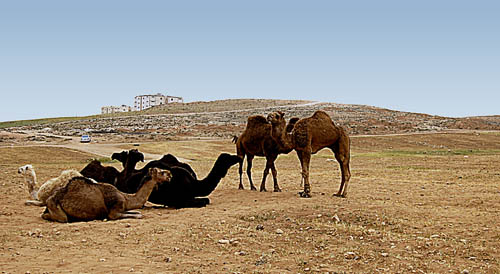
Here is a photo I made at Tall ar-Rumeith in 2002. It is not surprising to see camels here because the desert is near (to the east). From the top of the tell there is a great view looking north across a fertile plain to the border with Syria.

Earlier this year I went back to the site, but found that some modern housing has been built adjacent to the east side of the tell. It appears to be serving as housing for Indian students. I speculate that they attend a nearby university.

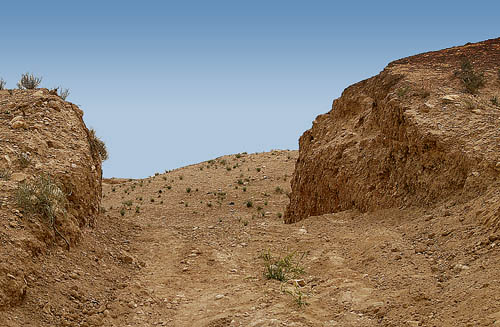
This photo shows a modern trench made to make a road to part of the construction site.

We found some pottery in the road, but can not be certain that it came from the damage to the tell. I did not see any shards along the edge of the cut.

This illustrates a real problem associated with ancient sites in isolated places. In a place like Jordan there are so many sites that it is impossible to excavate, preserve, and guard all of them.

A note on spelling. You may note different spellings of the word describing an archaeological mound. In Israel the term Tel is used. Earlier the term Tell was used throughout the Middle East. In Jordan the term Tall has come into common use.

There is also much variation in the spelling of some of the compound biblical names in scholarly sources, and even in English translation of the Bible. This is illustrated in this post and the previous one on Bethshan.

Bethshan – Bet She’an

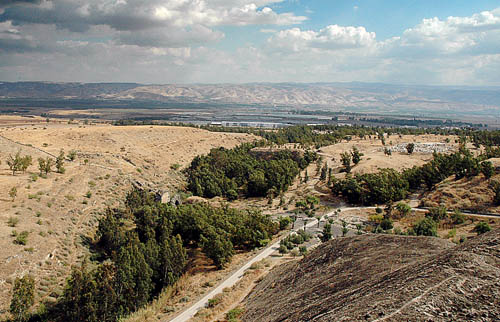
Bethshan is mentioned only a few times in the Old Testament. The New American Standard Bible uses the following spellings for this town: Beth-shean; Beth-shan; Bethshan. Today the modern town and ancient site go by the name Bet-She’an. The site was important because of its location at a major junction of two valleys, the Jordan valley with the Jezreel valley. The tell, called Tell el-Husn or Tel Bet She’an, commands an impressive view of the area, including a great view of the land of Gilead.

Today I am preparing a class dealing with the account of the eastern tribes building an altar “in the region of the Jordan which is in the land of Canaan” (Joshua 22:10). While looking for some photos to illustrate this episode in the history of Israel I thought of the view from the tell of Bethshan. We do not know the exact location, but this view provides a wonderful view of the land of Gilead (now in Jordan) which was given to Gad and Manasseh. You will observe trees below the tell. This is the where the River Harod flows, continuing down to the Jordan. You will notice ruins of a bridge that once crossed the river.

“You cows of Bashan”

Amos of Tekoa is recognized as a straight forward, no nonsense, prophet (Amos 1:1). He called the women of the northern kingdom of Israel cows. Nothing politically correct about that.

Hear this word, you cows of Bashan who are on the mountain of Samaria, Who oppress the poor, who crush the needy, Who say to your husbands, “Bring now, that we may drink!” (Amos 4:1)

The sn (study note) in the NET Bible is worth reading.

The expression cows of Bashan is used by the prophet to address the wealthy women of Samaria, who demand that their husbands satisfy their cravings. The derogatory language perhaps suggests that they, like the livestock of Bashan, were well fed, ironically in preparation for the coming slaughter. This phrase is sometimes cited to critique the book’s view of women.

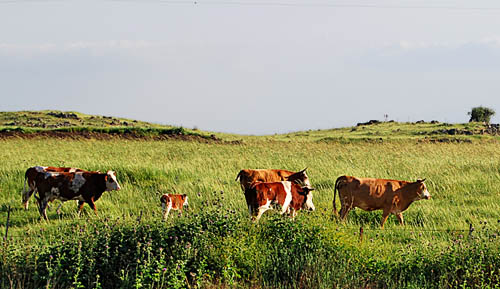
Bashan is in the area we now call the Golan Heights. It is located to the east of the Sea of Galilee and northward. Golan in Bashan was one of the cities of refuge located in the territory of eastern Manasseh (Joshua 20:8). The region was noted as good pasture land.

In the modern state of Israel we notice an attempt to grow crops known from biblical times in the same area where they were grown then. And the same is true of cattle. Here is a photo I made this year of some of the cows grazing in ancient Bashan (modern Golan Heights).

From the mountains of Ararat to the island called Patmos

Or, from Genesis to Revelation. I did not make an intentional plan to do so, but within the past twelve months I have visited areas of the Bible world, from the mountains of Ararat to the island of Patmos. What a blessing to have the opportunity to spend about four weeks in Turkey, covering most of the sites mentioned in the Bible, about 10 days in Greece, more than a week in Israel, and a week in Jordan.

This means that I have been able to visit some of the most significant portions of the Bible world. Better than visiting the area alone, I have been able to share the area with other teachers (both men and women) who will be incorporating this information into their lessons for years to come.

When I first reflected on the past year and realized that I had been to Mount Ararat, in the mountains of Ararat, and on the Island of Patmos, I realized that this covers from Genesis 6 to the book of Revelation. Of course, this doesn’t mean that I have visited every place in between, but it does give a sense of comprehensive overview.

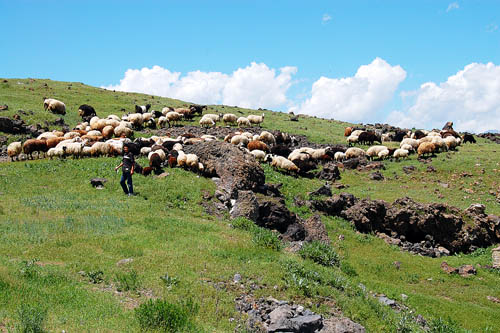
Here are a couple of photos I trust you will find helpful. The first is of a shepherd with his sheep in the mountains of Ararat. Remember that the book of Genesis records that Noah’s ark rested “upon the mountains of Ararat” (Genesis 8:4).

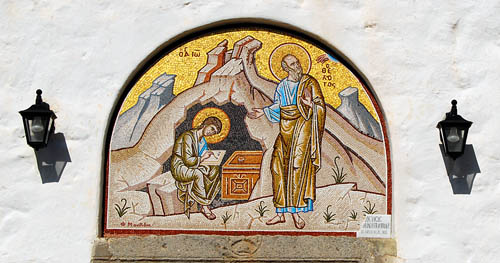
This photo was made at the entry to the cave of the Apocalypse on “the island called Patmos” (Revelation 1:9). John was exiled here during the reign of the Roman emperor Domitian. Whether the book of Revelation was written on Patmos, or after John’s release, we can not say with certainty. The mosaic over the entry to the cave shows John dictating the revelation given to him by the Lord.

It is my conviction that Bible land travel can enhance one’s Bible study and improve one’s understanding of the text. This, in turn, needs to be converted to action in obedience to the will of the Lord, and in service to Him.

Unleash your inner Indy

Anything Indiana Jones is the fad now since the release of the fourth movie featuring the adventuresome archaeologist. The USA Today Travel Newsletter (May 27, 2007) lists 10 great places to unleash your inner Indy. One of the places mentioned is Petra in Jordan. The article says,

“Hike or ride donkey-drawn carts through a slot canyon to arrive at this ancient city carved out of the sandstone cliffs,” [National Geographic’s Boyd] Matson says. “Petra offers the chance to hook up with nomadic tribesmen and do either a one-day or multi-day camel safari in the desert.” Now a UNESCO World Heritage Site, this once-vibrant Nabataean city was an oasis where Greeks, Romans and Arabs met for caravan trading. visitjordan.com

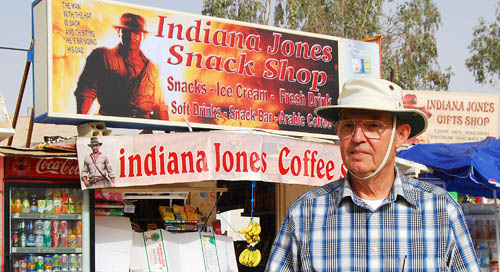
Parts of Indiana Jones and the Last Crusade was filmed at Petra. In this photo we see the snack shop, coffee shop, and gifts shop, all named for Indiana Jones.

The site of Petra is identified as the biblical Sela (rock; 2 Kings 14:7; Isaiah 16:1), and the home of the ancient Edomites (descendants of Esau). From about 300 B.C. the area was inhabited by the Nabataeans from North Africa. G. Ernest Wright once described them as,

one of the most gifted and vigorous peoples in the Near East of Jesus’ time. (Biblical Archaeology, 229).

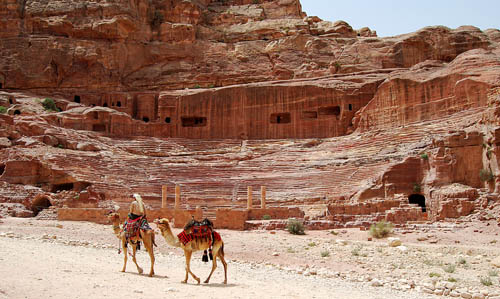
This photo shows the Roman theater at Petra which was cut out of the rock in the 2nd or 3rd century A.D. The theater seated about 3,000.

Several archaeologists have already pointed out that what Indiana Jones does is a far cry from real archaeological work. The real work is sometimes exciting, but always tedious. Bryant Wood is cited here:

“It is rather adventurous in a way, because for the most part, you’re going to some exotic country and delving into their past. But it’s not an adventure with a whip and chasing bad guys and looking for treasure,” said Bryant Wood, an archaeologist with Associates for Biblical Research.

“You’re working at one site tediously, probably for many, many years and spending more time processing the finds and writing reports than you do actually digging at the site. But that wouldn’t make for a very good story, spending 70 percent of the time in a library.”

Significant biblical artfacts in the Istanbul Museum

My favorite place in Istanbul is the Archaeological Museum. There are several buildings. One contains items from the Ancient Orient, that is, from Mesopotamia, Assyria, Babylon, and a collection of Hittite items. Another has numerous items from the Greco-Roman world. On the third floor artifacts from Syria, Palestine, Lebanon, and Cyprus, are displayed.

The Ottoman Empire controlled Palestine in from the 16th to the 20th centuries. The earliest archaeology in Palestine was done at Megiddo, Tanaach, and Gezer. Since the Turks were in charge, many of the artifacts were brought to Istanbul. These items have not always been easy to see. Once or twice, in past years, I had to made a “donation” to the museum in order to get in room where these items are exhibited. Even now, it is difficult (for older visitors) because there are no elevators going to the third floor.

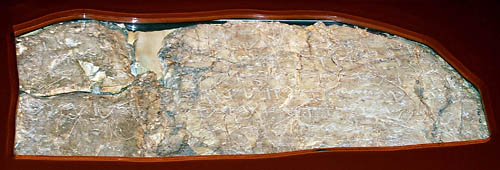
There is not time now to mention all of these items. However, I am pleased to share with you what I consider an unusually good photo made without a tripod and special lighting. It is the famous Siloam Inscription. We sometimes call its the Hezekiah;s tunnel inscription.

This inscription was cut from Hezekiah’s tunnel in Jerusalem shortly after it was discovered in 1880. The tunnel was built to connect Gihon Spring with the Pool of Siloam (ca. 710 B.C.; 2 Kings 20:20; 2 Chronicles 32:30; cf. John 9:7). Palestine was part of the Turkish empire at the time of the discovery and this is how the inscription came to be in Istanbul. The inscription, written in the ancient Hebrew script, describes the completion of the tunnel when the workers met near the middle on the last day of work. It reads, in part:

while there were still three cubits to be cut through, (there was heard) the voice of a man calling to his fellow, for there was an overlap in the rock on the right (and on the left). And when the tunnel was driven through, the quarrymen hewed (the rock), each man toward his fellow, axe against axe; and the water flowed from the spring toward the reservoir for 1,200 cubits, and the height of the rock above the head(s) of the quarrymen was 100 cubits. (Ancient Near Eastern Texts 321)

I have walked through Hezekiah’s tunnel several times and have seen the place from which the inscription was taken.

The Jordan River

The distance from the principal source of the Jordan at the foot of Mt. Hermon to the northern end of the Dead Sea is about 135 miles, but the serpent-like Jordan flows over 200 miles. At the source, the elevation is about 1150 feet above sea level. By the time the river reaches the Sea of Galilee it is about 700 feet below sea level, and when it reaches the Dead Sea it is more than 1300 feet below sea level. These and other unusual physical characteristics make the Jordan a significant river. To the Bible student the importance of the river is found in the events which transpired in it.

Israel crosses the Jordan. The children of Israel crossed the Jordan when the water was out of all its banks during the time of harvest (Josh. 3:15). An American reader might think of this as the fall of the year, but actually it was in the spring, at the time of the latter rain (Joel 2:23). As spring approached in Bible times the Jordan would overflow its banks due to the heavy latter rains (about early April) and the melting snows of Mount Hermon. Conditions are different in modern times. Water that once flowed south from the Sea of Galilee and from tributaries such as the Yarmuk River is now used for irrigation. This makes the Jordan much smaller than in earlier times. The crossing of the Jordan by the Israelites provided the imagery for our hymn, “On Jordan’s Stormy Banks I Stand.”

Elijah and Elisha. Both of these oral prophets crossed the Jordan on dry ground prior to Elijah=s being taken up by a whirlwind into heaven. Elisha later used the mantle of Elijah which had fallen upon him to smite the Jordan so that he was able to return (2 Kings 2:8-14).

Naaman the leper. Naaman, captain of the army of the king of Aram, was told by the prophet Elisha to wash seven times in the Jordan to be cleansed of his leprosy. For a reason not explicitly given, Naaman complained that the Abanah and Pharpar, the rivers of Damascus, were better than all the waters of Israel. When he eventually obeyed the Lord, he was made clean (2 Kings 5:1-14). We understand that it was not in the properties of the water but by the power of the Lord that Naaman was made clean through his obedience.

John and Jesus. John immersed in the Jordan River (Mt. 3:1-6). The last important biblical event and the crowning glory of the Jordan was the baptism of Jesus (Mt. 3:13-17).

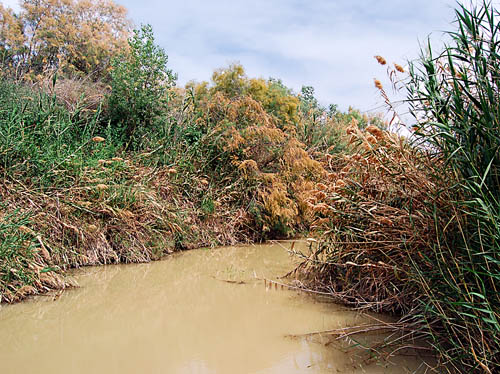
Photographs of the Jordan south of the Sea of Galilee have been difficult to make since 1967 because the river has served, more or less, as the boundary between Israel (or the occupied West Bank) and Jordan. This photograph was made at the site across from Jericho that may be identified as “Bethany beyond the Jordan” (John 1:28), where John the Baptist baptized at first (John 10:40).

My grandparents went to Israel …

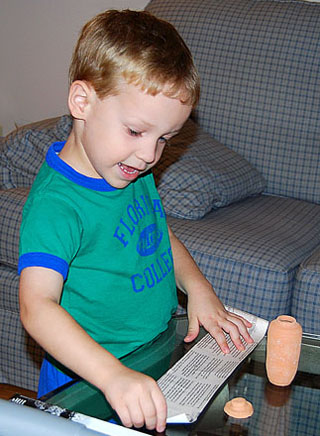
… and all I got was this little Dead Sea Scroll jar. (Of course, anyone acquainted with his grandmother knows differently!) After Grandmother read him the Mystery of the Dead Sea Scrolls, he promptly hid his jar in a secret place [behind the easy chair].

What a wonderful thing to learn about at his age. The Dead Sea Scrolls, discovered in 1947, are of great value to biblical studies.

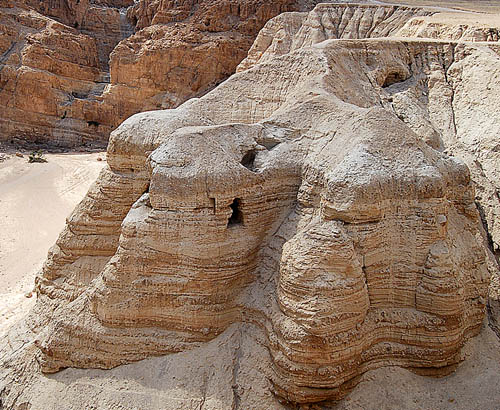
Below is a photograph of Cave 4 at Qumran, on the shores of the Dead Sea. Numerous fragments of the first five books of the Old Testament (Torah) were found in this cave. Qumran was in Jordan at the time of the initial discovery of the scrolls. Some of the scrolls are now displayed at the Shrine of the Book in Jerusalem.