Category Archives: Old Testament

USA sends ambassador back to Syria

For whatever reason(s) the media seems to have overlooked the decision of the Obama administration to send an ambassador back to Syria. Read a little about the decision at CNN.

Syria is an important country historically and politically. The capital city of Damascus is mentioned as early as the time of Abraham (Genesis 14:15), and there is indication that Abraham had considerable contact with the city. He suggests that Eliezer of Damascus might become his heir in the absence of a natural son (Genesis 15:2).

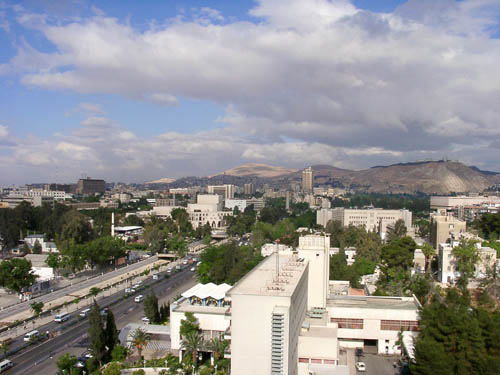
Damascus is situated immediately east of the Anti-Lebanon mountain range on what Rainey calls “the Damascus tableland” (The Sacred Bridge, 32). The River Barada (probably the Abanah of 2 Kings 5:12) runs east from the Anti-Lebanon range through the city of Damascus. The Syrian Desert stretches east of Damascus to the Euphrates River valley. The photo below was made looking west from my hotel balcony to the mountain range. The main part of the city is to the right (north). Go south a few miles and you have a clear view of Mount Hermon.

View of Damascus looking west. Photo by Ferrell Jenkins 2002.

View of Damascus looking west. Photo by Ferrell Jenkins 2002.

The only references to Damascus in the New Testament are those associated with the conversion of Saul of Tarsus (the Apostle Paul). All but two of these are in Acts 9, 22, and 26. The others are in 2 Corinthians 11:32 and Galatians 1:17.

The Syria of today is not the same political entity we read about in the Bible; only the name is the same.

The Hasankef Dam on the Tigris River halted

The Biblical Archaeology Review Daily News for June 26, 2009, reports a halt in the building of the dam on the Tigris River in southeastern Turkey. BAR calls attention to an report by the BBC about the halting of the project. Note this portion of the report:

Insurers have suspended their support for a controversial dam project in southeastern Turkey amid concern about its environmental and cultural impact.Export credit insurers in Austria, Germany and Switzerland said on Tuesday they had told suppliers to suspend work on the Ilisu dam on the Tigris river.

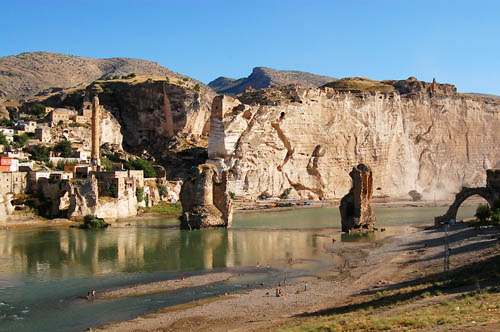
They are giving Ankara 180 days to meet standards set by the World Bank. The ancient Hasankeyf fortress is in the area that would be flooded and more than 50,000 people would have to move.

The hydroelectric project near Turkey’s borders with Syria and Iraq is part of a scheme to develop the mainly Kurdish region, which has suffered for decades from poverty, neglect and conflict.

Environmentalists say the dam would destroy archaeological treasures, including Roman remains. The dam consortium plans to create a culture park on the edge of the reservoir and transfer key monuments from Hasankeyf there.

The full (brief) report may be read here. See information about the history of the site here.

I had the opportunity to visit this area in June, 2007. This is one of the most fascinating places I have visited. The site of ancient Nineveh is less than 125 miles south of Hasankef on the Tigris.

Tigris River at Hasankief. Ruins of Roman bridge. Photo by Ferrell Jenkins.

Tigris River at Hasankef. Note ruins of Roman bridge. Photo by Ferrell Jenkins.

The Tigris River formed the eastern border of Mesopotamia, the land between the rivers (Tigris and Euphrates). It is mentioned by name only twice in the Bible.

  • The Tigris was the third of the rivers flowing from the Garden of Eden. It is said to be east of Assyria (Genesis 2:14). Was this in the north near the source of the river in the mountains of Ararat? Or was it in the south near the Persian Gulf? I don’t know.
  • The prophet Daniel was by the bank of the great river, the Tigris (Daniel 10:4). This would have been further south in present Iraq.

Euphrates River in northern Syria

The photos we post of the Euphrates River are always popular. I suppose this is because of the historic events associated with the river, and because so few people have seen the river. The Euphrates begins in the mountains of eastern Turkey (ancient Urartu/Ararat), flows south through Syria and Iraq before ending at the Persian Gulf.

Some of the great Bible characters are associated with the River, even when it is not named. We can be sure that Abraham crossed the Euphrates when he left Haran and headed south to Canaan (Genesis 11:32 – 12:1-9). I like the account of Jacob fleeing from Laban.

He left with all he owned. He quickly crossed the Euphrates River and headed for the hill country of Gilead. (Genesis 31:21 NET)

This photo was made in northern Syria, northeast of Aleppo in 2002. Here the river is wide because of a series of dams built by the Syrians. This can not be far from the place where the biblical patriarchs crossed the river.

The Euphrates River in northern Syria. Photo by Ferrell Jenkins.

The Euphrates River in northern Syria. Photo by Ferrell Jenkins.

Underground quarry discovered in Jordan Valley

Israeli papers are reporting the discovery of an underground quarry in the Jordan Valley. Prof. Adam Zertal and a team of archaeologists from the University of Haifa are working on the hypothesis that this is the site of biblical Gilgal.
The biblical account in Joshua reads,
Now the people came up from the Jordan on the tenth of the first month and camped at Gilgal on the eastern edge of Jericho. Those twelve stones which they had taken from the Jordan, Joshua set up at Gilgal. (Joshua 4:19-20 NAU)
The report in Ha’aretz gives more information about the discovery.

A spectacular underground quarry has recently been discovered in the Jordan Valley north of Jericho, which archaeologists believe may have marked a biblical site sacred to ancient Christians.

The large cave was discovered by Prof. Adam Zertal and a team from the University of Haifa which has been conducting a survey of the region since 1978. “When we reached the entrance to the cave, two Bedouin approached us and warned us not to go in, because it was cursed and inhabited by wolves and hyenas,” Zertal said yesterday from the site.

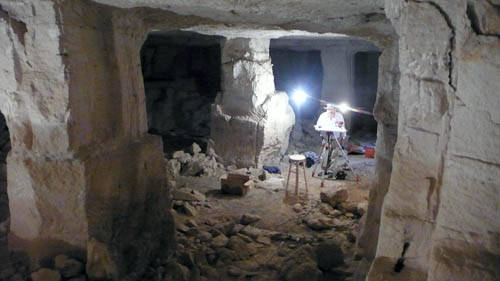
They entered anyway, discovering a ceiling supported by 22 gigantic columns on which various symbols were carved, including 31 crosses, a possible wheel of the Zodiac and a Roman legionary symbol. The columns also had niches for the placement of oil lamps and holes that apparently served as hitching posts.

Jordan Valley cave. Photo courtesy of University of Haifa.

Jordan Valley cave. Photo courtesy of University of Haifa.

The Ha’aretz article continues,

Zertal says their working theory is that the site is Galgala, biblical Gilgal, mentioned on the sixth-century Madaba mosaic map. The cave, buried 10 meters underground, is about 100 meters long, 40 meters wide and 4 meters high, is the largest artificial cave so far discovered in Israel.

Potsherds found in the cave and the carvings on the columns led Zertal to date the first quarrying of the cave to around the beginning of the Common Era. It was used mainly as a quarry for 400 to 500 years, “but other finds give the impression it was used for other purposes, perhaps a monastery or even a hiding place,” Zertal said.

Zertal said scholars wondered why people would dig a quarry underground considering the effort needed just to pull the stones out of the ground.

A possible answer may be in the famous Madaba Map of ancient Palestine, found in Jordan. In it, a place named Galgala is marked and an accompanying Greek word meaning “12 stones.” The map also depicts a church near the site. Archaeologists say they have found two ancient churches near the cave.

According to Zertal, scholars had always assumed that “12 stones” referred to the biblical story of the 12 stones the Israelites set up at Gilgal after they crossed the Jordan. However, the discovery of the quarried cave may mean the reference was to a quarry established where the Byzantines identified Gilgal. Zertal explains that in antiquity sanctuaries were built out of stones from sacred places.

If the Byzantines identified the site as biblical Gilgal, it would have been considered sacred and quarrying would have remained underground to preserve it.

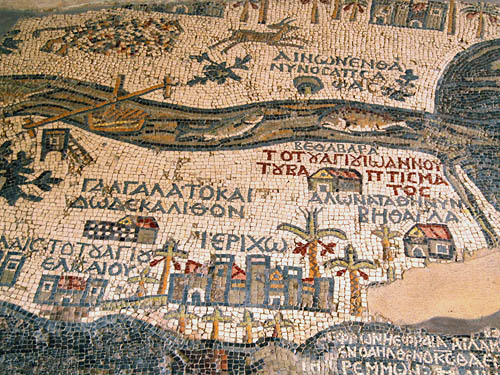
Here is a photo of a portion of the Madaba Map that I made last year.

Madaba Map showing Gilgal, Jericho, Jordan River. Photo by Ferrell Jenkins.

Madaba Map showing Gilgal, Jericho, Jordan River. Photo by Ferrell Jenkins.

This portion of the map shows the northern end of the Dead Sea and the Jordan River. You will notice fish turning around when they reach the Dead Sea. I think everyone can make out the city of palm trees, IERIXW (Jericho, Deuteronomy 34:3). To the north of Jericho, and a little east toward the river, is the site of Gilgal.

The inscription reads “Galgala, also the twelve stones.” Below the inscription is a small church with its entrance hidden by a long structure with 12 white spots on it (two rows of six). The Madaba map is dated to about A.D. 560 to 565. You may read more about the Madaba Mosaic Map here.

HT: Joseph I. Lauer

UPDATE: A short video showing the cave and featuring Dr. Zertal is available from BBC here.

Almond staff in the ark of the covenant

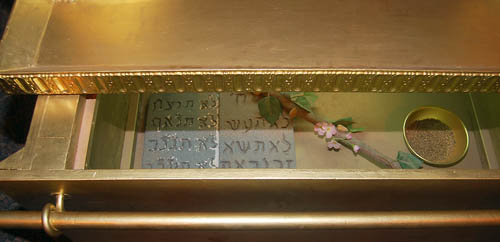
Three items from the period of the wilderness (desert) wandering of the children of Israel were considered significant enough to be included in the ark of the covenant.

Behind the second curtain was a second section called the Most Holy Place, having the golden altar of incense and the ark of the covenant covered on all sides with gold, in which was a golden urn holding the manna, and Aaron’s staff that budded, and the tablets of the covenant. Above it were the cherubim of glory overshadowing the mercy seat. Of these things we cannot now speak in detail. (Hebrews 9:3-5 ESV)

The picture below, made at the model of the Tabernacle in the Wilderness, shows a replica of the Ark of the Covenant with the contents mentioned by the writer of Hebrews. For more information about the model read here.

Replica of Ark of Covenant showing contents. Photo by Ferrell Jenkins.

Replica of the Ark of the Covenant showing contents. Photo by Ferrell Jenkins.

At Jerash in Jordan, young boys were selling small bags of green almonds. Not my preference, but apparently there is a market for them. “Jordan almonds” are famous for use at weddings. The fresh almond is bittersweet in taste, but the sugar coating adds sweetness. The “Jordan almonds” are still “Jordan almonds” even when they come from California!

Green almonds at Jerash, Jordan. Photo by Ferrell Jenkins.

Green almonds at Jerash, Jordan. Photo by Ferrell Jenkins.

Jerash is thought to be the site of Gerasa, one of the cities of the Decapolis (Matthew 4:25). Perhaps it is the city belonging to the country of the Gerasenes (Mark 5:1; Luke 8:26,37).

Almonds – a symbol of watchfulness and old age

Almonds were also among the best products of the land sent by Jacob to the man in Egypt (Genesis 43:11). The Hebrew word for almond (seqedim) comes from the root sqd which means “to watch, wake.” King and Stager tell us that the name was given because,

its splendid white blossoms appear as early as the end of January, a true harbinger of spring. Jeremiah plays on sqd: “The word of Yahweh came to me [Jeremiah], saying, ‘Jeremiah, what do you see?’ And I said, ‘I see a branch of an almond tree (saqed).’ Then Yahweh said to me, ‘You have seen well, for I am watching (soqed) over my word to perform it” (Jer. 1:11-12). (Life in Biblical Israel, 105)

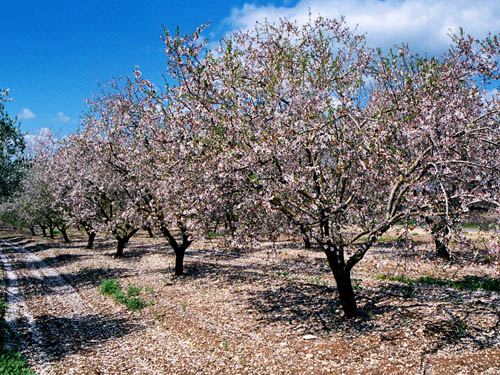
The photo below was made in early March near the north border of the Palestinian West Bank near Jenin. Notice that the falling blossoms turn the ground gray.

Almond trees blooming in the West Bank. Photo by Ferrell Jenkins.

Almond trees blooming in the West Bank near Jenin. Photo by Ferrell Jenkins.

Other biblical references to the almond include the following:

  • The cups of the lampstand for the tabernacle were shaped like almond blossoms (Exodus 25:33).
  • Aaron’s rod sprouted and brought forth buds, produced blossoms, and bore ripe almonds (yummy; Numbers 17:8).
  • Used figuratively of the person growing older (“the almond tree blossoms,” Ecclesiastes 12:5). Matthew Henry says, “The old man’s hair has grown white, so that his head looks like an almond-tree in the blossom. The almond-tree blossoms before any other tree, and therefore fitly shows what haste old age makes in seizing upon men; it prevents their expectations and comes faster upon them than they thought of. Gray hairs are here and there upon them, and they perceive it not.”
Almond blossoms in the West Bank. Photo by Ferrell Jenkins.

Almond blossoms in the West Bank. Photo by Ferrell Jenkins.

Leeks in the land of Goshen

Israel’s experience in the Sinai wilderness might be summarized by the two words complained and murmured. One such account is given in Numbers 11.

We remember the fish we ate in Egypt that cost nothing, the cucumbers, the melons, the leeks, the onions, and the garlic. But now our strength is dried up, and there is nothing at all but this manna to look at.” (Numbers 11:5-6 ESV)

The Land of Goshen, where the Israelites lived, was located in the eastern Nile Delta along the Pelusiac Branch of the Nile. The land is flat and fertile, and their are canals with water. Because water is rare in the wilderness (or desert) crops are also rare.

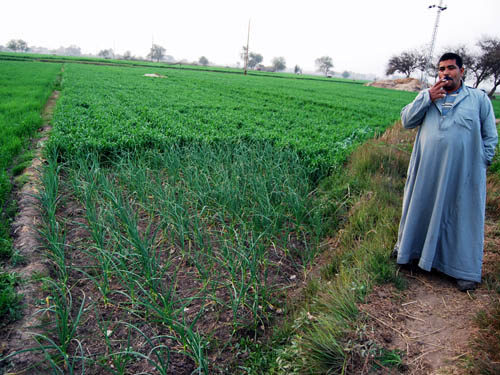
From the wilderness, the great meals of fish and vegetables in Egypt looked good to the Israelites. The hard days of oppression were overlooked. (A lot like the bondage of sin!) I had an opportunity to be in some of the fields in Goshen. The farmers grow crops for the cattle, but they use the corners of the fields to grow vegetables for their own use. I saw leeks and cabbage.

Field in the land of Goshen. Photo by Ferrell Jenkins.

Field in the land of Goshen. Photo by Ferrell Jenkins.

The white object in the field is one of the pieces of the colossal statue of Rameses that we mentioned in an earlier post. Smoking is widespread in Egypt.

The Samaritans

Samaritan Priest with Samaritan Pentateuch Scroll. Photo by Ferrell Jenkins.

Samaritan Priest with Samaritan Pentateuch Scroll. Photo by Ferrell Jenkins.

“Samaritans use modern means to keep ancient faith” is the title of an informative article about the modern Samaritans on Mount Gerizim at Reuters. A slide show of 10 good photos is included. I especially liked the one showing the priest in the museum with a painting of Jesus and the Samaritan woman at the well.

We recently wrote about the meeting of Jesus with the woman of Samaria at Jacob’s Well here. We wrote about Jesus passing through Samaria here.

Todd Bolen’s article on the Samaritan Passover may be read here.

Years back I made black and white photos for use in publications. This one shows a Samaritan priest displaying a copy of the Samaritan Pentateuch. He said it was the oldest book in the world. Textual scholars think it is no older than the 12th century A.D.

A Reuter’s Blog here gives some additional information about how the reporters got to Mount Gerizim. Check the video at the bottom of the page.

HT: Joseph Lauer; Paleojudaica.

New discoveries in the land of Goshen

The storage city of Rameses was identified with Tanis in the past, but it is now identified with Tell el Daba in the eastern Nile Delta. Here is what the Bible says about Rameses in the land of Goshen:

  • It is called the land of Rameses (Genesis 47:11).
  • The Israelites built the storage cities of Pithom and Rameses (Exodus 1:11).
  • Rameses was the starting point of Israel’s exodus from Egypt (Exodus 12:37; Numbers 33:3, 5).

Prof. Dr. Manfred Bietak.

Prof. Dr. Manfred Bietak

Austrian archaeologists, under the direction of Professor Dr. Manfred Bietak and Irene Forstner-Mueller, have been working at Tell el Daba for several years. The history of this area may be divided into three periods:

  • Pre-Hyksos, when the city was named Rowaty (the door of the two roads).
  • Hyksos (about 1663-1555 B.C.), when the city was named Avaris.
  • Post-Hyksos, when the city was named Peru-nefer (happy journey).

The excavators recently uncovered a cuneiform letter written in southern Mesopotamian style. It is thought to date to the time of the Old Babylonian Kingdom of Hammurabi. The news release indicates a date of about 1600-1550 B.C. This illustrates a significant contact between Egypt and Mesopotamia.

Cuneiform Tablet from Tell el Daba.

Babylonian Cuneiform Tablet from Tell el Daba in the land of Goshen.

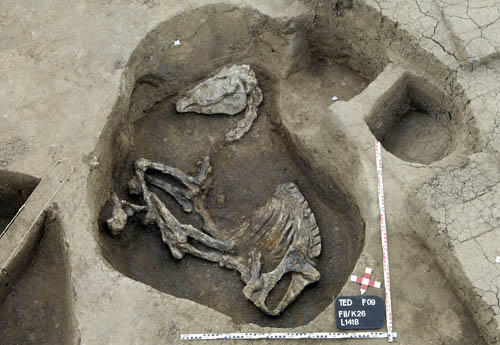
A second discovery was the burial of a horse, a mare likely used for breeding. Horses were introduced into Egypt by the Hyksos. The location of the burial near the palace of the Hyksos king Khayan suggests that this mare was a pet of the king.

Hyksos horse skeleton discovered at Tell el Daba.

Hyksos horse skeleton discovered at Tell el Daba.

The complete news release may be read in German here. Photos Copyright: Österreichisches Archäologisches Institut (ÖAI) Kairo. I had the pleasure of visiting Tell el Daba in January, 2009.

HT: Joseph I. Lauer

The Pool of Siloam

More than 700 years before Christ, the Judean King Hezekiah dug a tunnel to bring the water of the Gihon spring to a new pool which he constructed on the west side of the city of David (2 Kings 20:20; 2 Chron 32:30; Sirach 48:17). This pool would later be known as the pool of Siloam.

One of the great signs of Jesus, recorded in the Gospel of John, is the healing of a man born blind (John 9). Jesus spat on the ground and made clay of the spittle. He then applied the mud to the blind man’s eyes and told him, “Go, wash in the pool of Siloam.” We understand that mud made from saliva and water from Siloam will not normally cause a blind person to see. This sign demonstrates the power of Jesus over blindness and demonstrates the validity of His claim to be “the Light of the world” (9:5). The blind man’s faith to obey Jesus clearly played a role in his healing.

For many years we have been aware of the Pool of Siloam at the southern end of Hezekiah’s tunnel. A church dedicated to “Our Savior, the Illuminator” was built here in the fifth century by the Byzantine Empress Eudokia, but was destroyed in A.D. 614 and never rebuilt. Some columns from the building can still be seen. See Hoade, Guide to the Holy Land, and Murphy-O’Connor, The Holy Land, for details.

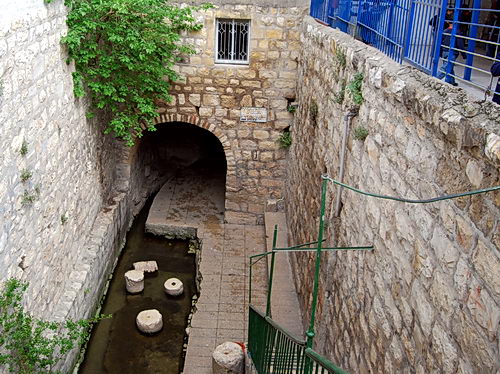
This photo shows the Byzantine pool at the southern end of Hezekiah’s tunnel. Note the present ground level along the blue fence.

Ruins of the Byzantine church at end of Hezekiah's Tunnel. Photo by F. Jenkins.

Ruins of the Byzantine church at end of Hezekiah's Tunnel. Photo by F. Jenkins.

In a post to follow we will discuss the newly discovered Pool of Siloam from the Roman period.