Category Archives: Old Testament

Some thoughts on Father’s Day 2012

About three years ago I wrote a personal post on the occasion of the 30th anniversary of my father’s death. I wanted to share this with new readers who might find it interesting and encouraging.

B. M. JenkinsIt took me about six months to get over being downcast after his death. It wasn’t that I did not not have hope. There were two major factors. (1) It was just the sense of loss that I felt. I could recall our time together, but we would no longer be able to talk and discuss matters of common interest. (2) I began to think of my life. If I lived only to the age of 65 what would I do with these few remaining years? Even though I have passed 65 by several years, I still think about this question.

My father was an intelligent man, but not a formally educated man. He finished the eighth or ninth grade, but he knew how to work and make sound financial decisions for his family. My father spent my earliest years living on the farm where my grandfather was a share-cropper. It was hard on farms in those post-depression years. My father was a good mechanic and carpenter. In 1943 he drove about 60 miles each week from Harvest, Alabama, to Tullahoma, Tennessee. There was some type of building project in progress. After his death I found a receipt showing that he had earned about $13 for the week. From that he paid his gas expenses, stayed in a boarding house for four nights, and paid 13 cents in Old-Age Benefits. This program, now called Social Security, was set up by the Federal government in 1937 to provide retirement benefits. He evidently had enough left to provide whatever store-bought food, and other things, our family needed.

My paternal grandfather was named Joseph Frank. My grandmother was named Mary Magdalene. They had 12 children, and each of them was given a Bible name. My father’s name was Bartholomew (Matthew 10:3). He had no middle name, so he just made up the middle initial when he needed a middle name. His friends called him B.M., or Barley, or Bolly. And, yes, he had brothers named Philip, Thomas, James, Matthew, and John. He had sisters named Ruth, Mary Magdalene, Eunice, Naomi, and Elizabeth. One sibling died young. Only three [two] are still living. My grandfather heard my second sermon. (It was the same as my first one.)

Most of the members of this family had a spirit of independence and entrepreneurship. Several of them ran small businesses and none of them ever got involved with “big business.”

My Father set a good spiritual example for his family. Sometime when I was between six and ten we walked about two miles on a country road to meet with other Christians to worship. One Sunday morning some family members drove up about the time we were to leave for church. They had come from across the county to see us. My Dad invited them to go to church with us. When they demurred, he told them to make themselves at home until we got back. The next time they came in the afternoon.

Dad served for a short time as an elder in a local church, but when the others began to advocate practices he thought were wrong, he resigned and began to worship with brethren who thought as he did.

Perhaps I should somehow relate this post to travel. I was able to take my mother to the Bible lands twice after my Father’s death. About the time I told them that I was going a third time [more than 40 years ago], my Dad said, “Don’t you think you have been enough?” I wish he could have gone with me.

He taught me a lot. I think of him almost daily.

As a father shows compassion to his children, so the LORD shows compassion to those who fear him.   For he knows our frame; he remembers that we are dust. (Psalm 103:13-14 ESV)

The Mausoleum at Halicarnassus

Why would we want to visit Bodrum on the Aegean coast of Turkey? It is located in the area of the Roman province of Caria, and is built over the site of ancient Halicarnassus. It is where Mausolus built a tomb for himself. From this structure we get our word mausoleum.

Only a small city block preserves the remains of the famous Mausoleum. Parking nearby is almost an impossibility, but one of the shopkeepers allowed us to block the entry to his shop for a few minutes.

Halicarnassus. Site of the tomb of King Mausolos. Photo by Ferrell Jenkins.

Halicarnassus. Site of the tomb of King Mausolos. Photo by Ferrell Jenkins.

The small brochure available at the site gives this information about the Mausoleum.

It is one of the Seven Wonders of the Ancient World. Its construction was initiated by Mausolus, a member of the Hekatomnid dynasty appointed by Persians as the Satrap of Caria, before his death, and continued by his wife and sister Artemisia after his death. Mausolus, the then most important administrator, probably decided to build such an important structure to symbolize his eternity and greatness. Its construction was started just before Mausolus’ death, i.e. just before 353 B.C.

Along with a few architectural fragments at the site, there is a nice model suggesting how the Mausoleum looked. According to the brochure, the tomb may have been as high as a 20-story apartment building.

Model of the Tomb of Mausolos at Halicarnassus. Photo by Ferrell Jenkins.

Model of the Tomb of Mausolos at Halicarnassus. Photo by Ferrell Jenkins.

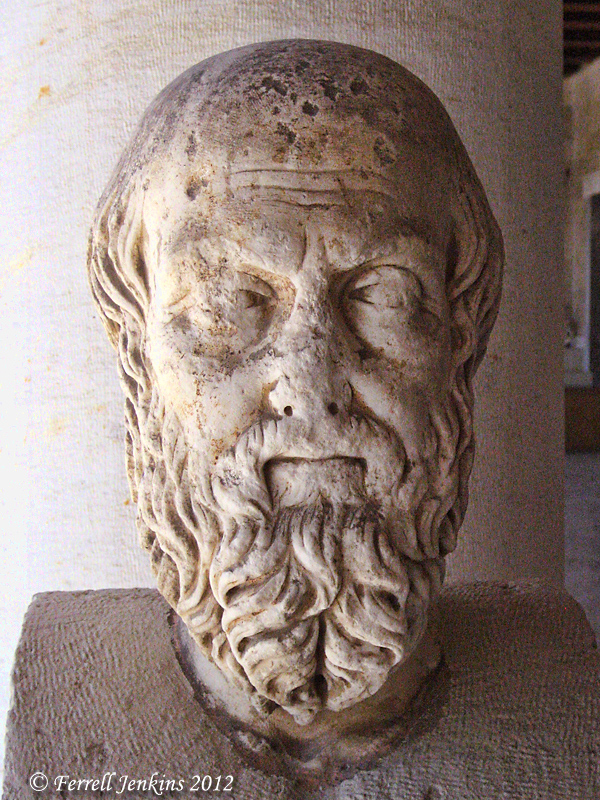
Herodotus Bust displayed in the Stoa of Attalus, Athens Agora

Herodotus Bust displayed in the Stoa of Attalus, Athens Agora. Photo: F. Jenkins.

Is it possible that Paul may have seen this structure when he sailed past Cos (Acts 21:1)? Ferries run between Bodrum (Turkey) and Cos (Greece) today.

Halicarnassus is listed among the towns that were informed by the Romans of their support of the Jews (1 Maccabees 15:23).

The Greek historian Herodotus claimed Halicarnassus as his home.

At least one lesson we learn at Halicarnassus is that monuments built to oneself do not endure for long. Think of Absalom.

Now Absalom in his lifetime had taken and set up for himself the pillar that is in the King’s Valley, for he said, “I have no son to keep my name in remembrance.” He called the pillar after his own name, and it is called Absalom’s monument to this day. (2 Samuel 18:18 ESV)

Major revision of the Pictorial Library of the Bible Lands

Todd Bolen announces the release of a total revision of the Pictorial Library of Bible Lands. This revised and expanded edition is the culmination of 9 years of work. The previous version contained 6000 photographs in 10 volumes. According to the announcement,

This new edition consists of 18 volumes with nearly 18,000 photographs, adding hundreds of new sites and re-visiting the old favorites.

Here are just a few features of the new edition of the Pictorial Library of Bible Lands.

  • Eight new volumes: (Lebanon, Eastern and Central Turkey, The Greek Islands, and more. New subjects include Cultural Images, Signs, and Trees, Plants, and Flowers.
  • New Photos: For example, more than 1000 new photos have been added to the Jerusalem volume.
  • New Photographers. In addition to the photos by Todd Bolen, the work of more than 40 photographers are included in this new set.
  • New Maps. New, original maps have been created to identify the sites.
  • New Indexes. Every photograph is indexed in a list of more than 400 pages.
  • You get the hi-res photos and the photos already in PowerPoint. You can use the presentation as it is or include individual slides in your own lesson.
  • And more…
Pictorial Library Complete Collection. BiblePlaces.Com.

Front cover of the new Pictorial Library Complete Collection.

For those who already own the previous collection, Bible Places is offering the new 18-volume set for the upgrade price of $179. The entire set for new purchasers is $389.

Would you prefer to make your own photos? Try buying a good digital SLR camera starting at about $1500, flying to Israel (not to mention Lebanon, Egypt, Turkey, Greece, the Greek Islands, Italy, et al.), renting a car for a few weeks, buying the gas. Oh, and don’t forget to hire a private plane for a few hours so you can get some good aerial photos. That might cost at least $389. 🙂 And what if the lighting conditions were not right for a good photos the day you were at a site? What if you don’t have time to get your photos organized and write a description of each one? Need I go on to make a point? Did I mention that living and teaching in Israel for a decade helps?

Every church should have a set of this material for the teachers to use in their teaching. Over the years I have found that some short-sighted groups (churches) will not make such an expenditure. The other choice is to buy the set for yourself.

I hear several lessons a week, and every one of them could be improved by the use of photos from this wonderful collection.

Learn more about the new Pictorial Library of Bible Lands in the following places:

Charles Savelle has a good interview with Todd Bolen at the BibleX blog here.

I have profited much from the work of Todd Bolen and am delighted to count him as a friend and to recommend this collection of photographs to every teacher of the Bible.

Follow the BiblePlaces.com Blog here.

Additional Gezer boundary stone discovered

Eric Mitchell and Jason Zan report the discovery of a “previously undiscovered bilingual inscription” at Gezer, and the rediscovery of  an inscription lost for more than a century.

An archaeological survey led by Southwestern Baptist Theological Seminary of Fort Worth, Texas, discovered a previously undiscovered bilingual inscription this week at the ancient site of Tel Gezer, Israel. Gezer, a biblical city, was situated on the border between the Philistine and Israelite territories guarding the route to Jerusalem. The city was given as a dowry to the daughter of Pharaoh, who married king Solomon. Gezer is well known in the later Maccabean period for its boundary stones with inscriptions in both Hebrew and Greek. In addition to the new inscription, the Southwestern Seminary survey team rediscovered a previously known inscription that had been lost to the archaeological community for more than a century.

The boundary inscriptions demonstrate the period of conflict between the Seleucids and Maccabees. They show that the city had agricultural land around it and that the Jewish occupants were concerned over keeping their fields according to Jewish law. These discoveries are significant since the boundary stones have been frequently sought, but with long time frames between new discoveries. According to the scholarship of Ronnie Reich, of the University of Haifa, there are 12 known and published Gezer boundary stones dating to the Maccabean period. These bilingual inscriptions in outcrops of limestone bedrock ring the ancient city of Gezer on the South, East and Northeast. Many of these are two line inscriptions reading “Region of Gezer” on one line in Hebrew and “Belonging to Alkios” on the second line in Greek.

The article may be read in its entirety here.

According to the article, there are now 13 known boundary inscriptions from Gezer.

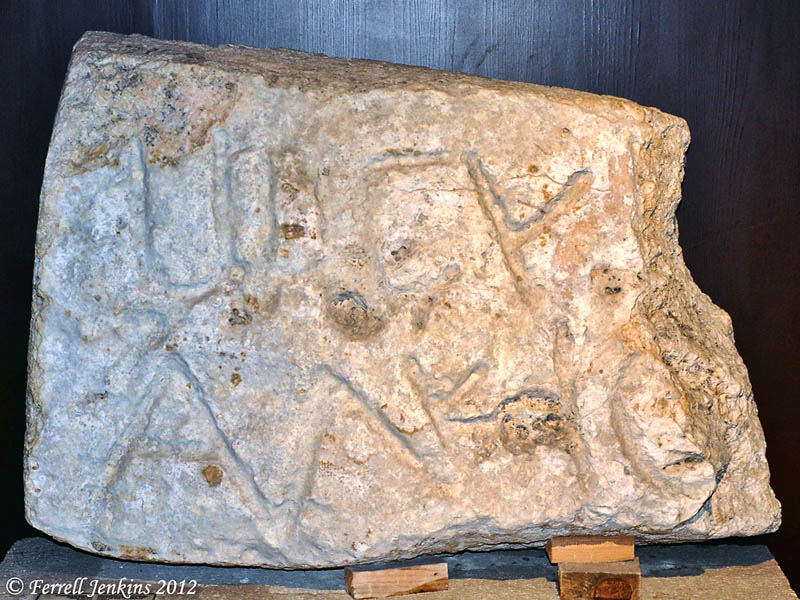
On my recent tour in the Steps of Paul and John, we visited the Istanbul Archaeological Museum where one of these boundary stones is displayed. It is turned so that the Greek letters “Alkio” are visible on the bottom. We would expect the missing letter to be the “s” or “u“. The line at the top, but upside down, is the Aramaic word for boundary or region, and the first letter of Gezer (GZR). Todd Bolen includes a photo here of one of the inscriptions still in place at Gezer.

Gezer Boundary Stone. Istanbul Archaeology Museum. Photo by Ferrell Jenkins.

Gezer Boundary Stone. Istanbul Archaeology Museum. Photo by Ferrell Jenkins.

Biblical references to Gezer include the following:

  • The king of Gezer fought against Joshua and the Israelites during the conquest (Joshua 10:33; 12:12).
  • Gezer was allotted to Ephraim (Joshua 16:3).
  • Gezer became a city of the Levites (Joshua 21:21). It was designated as a city of refuge (1 Chronicles 6:67).
  • Israel failed to drive out the Canaanites who lived in Gezer (Joshua 16:10; Judges 1:29).
  • By the time of David the Philistine seem to be living at Gezer (2 Samuel 5:25; 1 Chronicles 14:16; 20:4).
  • Pharaoh, king of Egypt, captured Gezer, burned it, and gave it as a dowry to his daughter, Solomon’s wife (1 Kings 9:16).
  • Solomon (re)built the cities of Hazor, Megiddo, and Gezer (1 Kings 9:15-17).

The following aerial photograph of Gezer was made in December, 2009.

Gezer Aerial View. Photo by Ferrell Jenkins.

HT: Bible Places Blog.

1400 year old olive press excavated

The Israel Antiquities Authority announces the discovery of a 1400 year old olive press at Modi’in. According to a brief article in Arutz Sheva,

A statement by the IAA called the press the grandest and most complete one found so far.

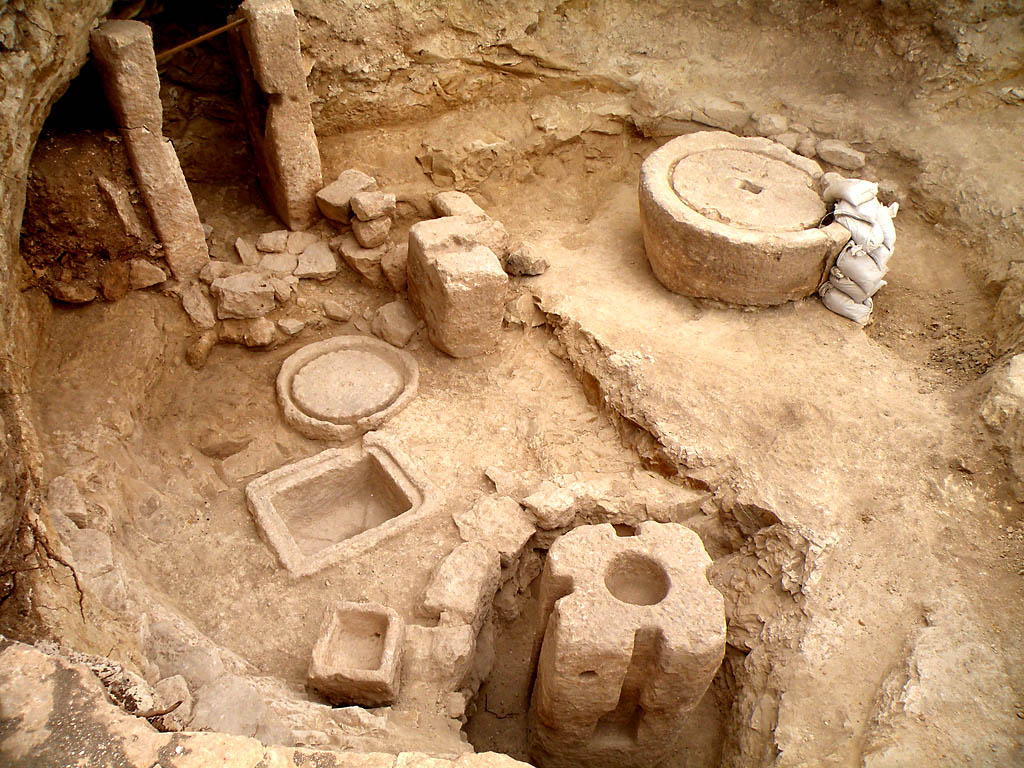
Archaeologist Hagit Torgë, who is directing the dig, said the press, which was used to produce industrial quantities of oil for food and light, about 1,400 years ago, “was preserved surprisingly intact with all its components.”

1400 year old olive press at Modi'in. Credit: Hagit Torgë, Israel Antiquities Authority.

Olive press at Modi’in. Credit: Hagit Torgë, Israel Antiquities Authority.

Click on the photo for a hi-res image.

Olives are mentioned in the Bible from Genesis (8:11) to Revelation (18:13), and are still important in many parts of the world.

HT: Joseph Lauer

Mummies of the World at MOSI in Tampa

Mummies of the World Exhibition opens at MOSI in Tampa, Florida, today. Details here. The exhibition includes mummified humans and animals from several places around the world in addition to those from Egypt.

According to local television reports, the exhibit runs through September 9, 2012.

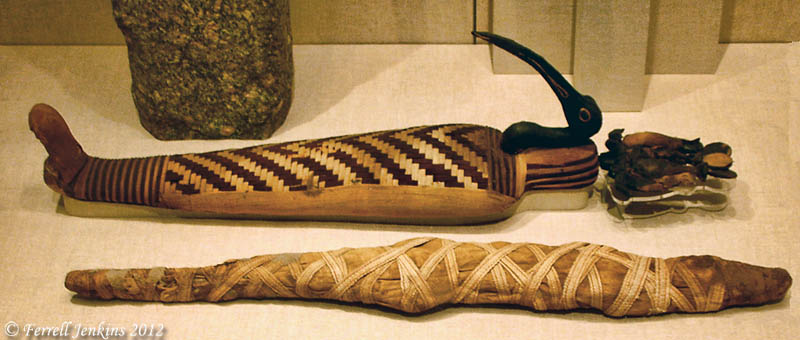
In the photo below we see a mummified Ibis and a mummified Crocodile from the Roman period of Ancient Egypt. The Egyptians considered various animals as gods and mummified them when they died.

Mummiried Ibis and Crocodile from Egypt. Roman Period. Brooklyn Museum.

Mummified Ibis and Crocodile from Egypt. Roman Period. Brooklyn Museum.

The Apostle Paul describes the condition of the Gentiles in the Greco-Roman world in these words:

Claiming to be wise, they became fools,  and exchanged the glory of the immortal God for images resembling mortal man and birds and animals and creeping things. (Romans 1:22-23 ESV)

Two Biblical characters  from the Patriarchal period were mummified in Egypt.

Then Joseph fell on his father’s face and wept over him and kissed him. And Joseph commanded his servants the physicians to embalm his father [Jacob]. So the physicians embalmed Israel. Forty days were required for it, for that is how many are required for embalming. And the Egyptians wept for him seventy days.  (Genesis 50:1-3 ESV)

So Joseph died, being 110 years old. They embalmed him, and he was put in a coffin in Egypt. (Genesis 50:26 ESV)

Scribes kept important records

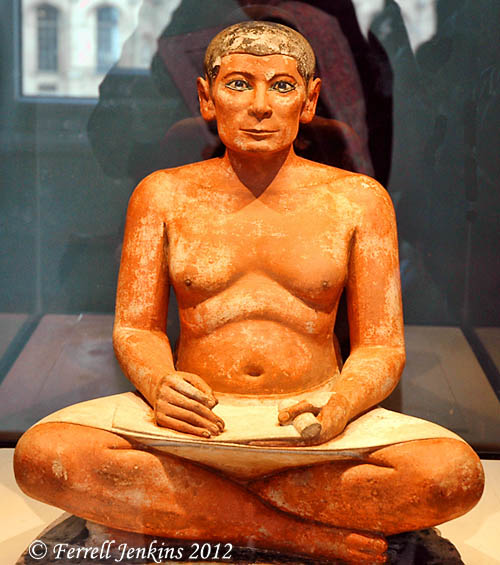
The picture below shows a scribe from ancient Egypt. The statue from Saqqara dates to the 4th or 5th dynasty — about 2600 to 2350 B.C. The limestone statue is painted with encrusted eyes of rock crystal. The statue is on display in the Louvre.

Scribe from Saqqara displayed in the Louvre. Photo by Ferrell Jenkins.

Scribe from Saqqara displayed in the Louvre. Photo by Ferrell Jenkins.

We do not have a great number of examples of writing from ancient Israel, but the Bible is abundant with references to writing and record keeping. The entry on the Hebrew word katab in the Theological Wordbook of the Old Testament says,

katab is the only general word for “write” and it is widely used. Curiously, it is not used in Genesis. Moses wrote on a scroll God’s curse on the Amalekites (Exo 17:14 ). God himself wrote the Ten Commandments (Exo 31:18). Moses also is specifically said to have written the Book of the Covenant (Exo 24:4), the Sinai legislation (Exo 34:27), the names of the leaders of the tribes (Num 17:2-3), the wilderness itinerary (Num 33:2), the law “from beginning to end” (Deut 31:9, 24) and Moses’ final song (Deut 31:22, 24). It is quite possible that the general references of Deut 31:9  and Deut 24 refer to the whole of the Pentateuch (cf. Deut 28:58-61; Deut 29:20-21) although critical scholars refer it only to Deut and question even that.

I think the reference to Moses writing the wilderness itinerary of the Israelites is interesting.

Moses wrote down their starting places, stage by stage, by command of the LORD, and these are their stages according to their starting places. (Numbers 33:2 ESV)

Preliminary report on Khirbet Qeiyafa for 2010-2011

A preliminary report for the 2010-2011 archaeological seasons has been published by the Israel Antiquities Authority in Hadashot Arkheologiyot: Excavations and Surveys in Israel. The report is written by  Yossi Garfinkel, Sa‘ar  Ganor  and Michael Hasel.

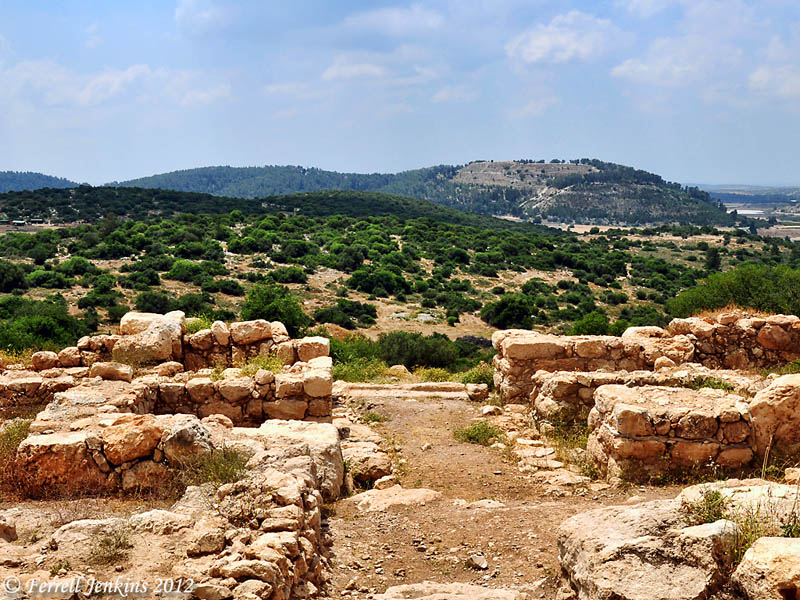
My photo shows the Iron Age, four-chamber, gate with a view toward Tel Azekah.

Iron Age Gate view a view toward Azekah. Photo by Ferrell Jenkins. May, 2011.

Iron Age Gate with a view toward Azekah. Photo by Ferrell Jenkins. May, 2011.

The full report with 11 photographs (or plans) is available here. The report concludes,

The excavations at Khirbat Qeiyafa clearly reveal an urban society that existed in Judah already in the late eleventh century BCE. It can no longer be argued that the Kingdom of Judah developed only in the late eighth century BCE or at some other later date.

The current issue of Biblical Archaeology Review (May/June 2012) carries two article relating to the Qeiyafa ostracon. One is by Christopher A. Rollston who asks the question, “What’s the Oldest Hebrew Inscripton?” He responds that each of four inscriptions he considers (Qeiyafa, Gezer calendar, Tel Zayit, and Izbet Shartah) predate Old Hebrew.

The other article is by Gerard Leval. In “Ancient Inscription Refers to Birth of Israelite Monarchy” he summaries the French-language article by “Emile Puech, the senior epigrapher of the prestigious École Biblique et Archaéologique Française in Jerusalem.” Puech draws the following conclusion:

Moreover, the inscription seems to memorialize (or, in Puech’s words, is “a witness to”18) the transition not from one king to another (from Saul to David), but rather from the period of the judges to the monarchy—thus from Samuel and his sons to Saul.19

If Puech is correct, the Qeiyafa Ostracon is the only archaeological artifact referring to Israel’s first king. And it is the earliest non-Biblical confirmation of the establishment of the Israelite monarchy.

Leval’s article is available online at BAR here.

This information is sure to create a lot of discussion.

HT: Joseph I. Lauer; Bible Places Blog.

James Arthur Hodges — 1930 – 2012

James A. Hodges passed from this life April 10, 2012. A native of Jenkins, Kentucky, he was always an inquisitive person who wanted to understand the world around him. He became interested in the ancient world, too. This led him to studies at David Lipscomb College (B.A.), Harding College (M.A.), and the University of Chicago where he earned a Ph.D. in the Department of New Testament and Early Christian Literature. Jim later earned an M.A. degree and the M.I.S. degree from the University of South Florida.

At the University of Chicago in 1970 Jim completed a dissertation on The Building Program of Herod the Great. He taught in the Biblical Studies department at Florida College for a number of years. His last work at FC was as librarian. I can attest that his work in that position was extremely important in the accreditation of the Biblical Studies program to offer a B.A. degree in the field.

In 1980 Florida College agreed to become a sponsor of the Excavations at Tell Lachish, Israel. We recognized that Lachish had been an important city in the history of ancient Israel. Four professors participated in the dig that year. Jim had already been involved in a dig in Israel, as had Harold Tabor. For Phil Roberts and I it was the first time to participate. Jim worked at several other sites over the years.

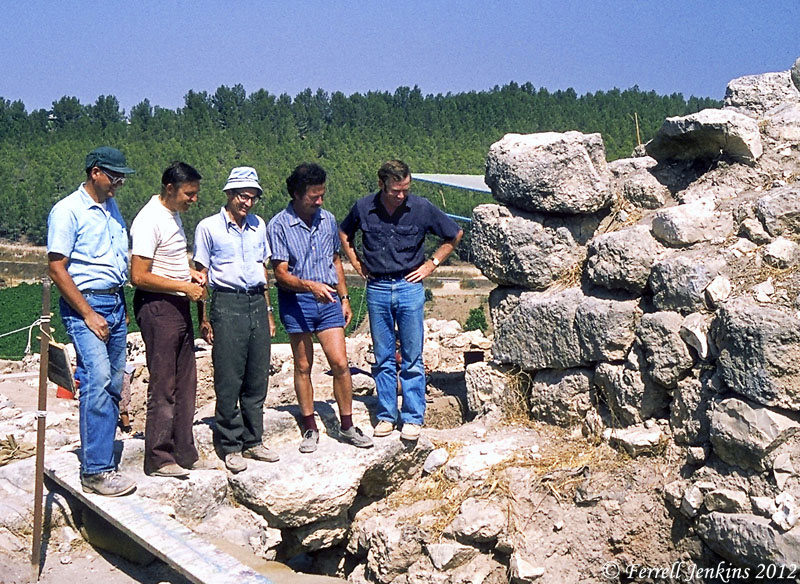
In the photo below from 1980 Jim is in the middle position.

Florida College professors Harold Tabor, Ferrell Jenkins, James Hodges, and Phil Roberts with Prof. David Ussishkin at the Gate of Lachish 1980.

Professor David Ussishkin (second from right) talks about the excavation at the Gate of Lachish with Florida College professors Harold Tabor, Ferrell Jenkins, James Hodges, and Phil Roberts (left to right) in 1980.

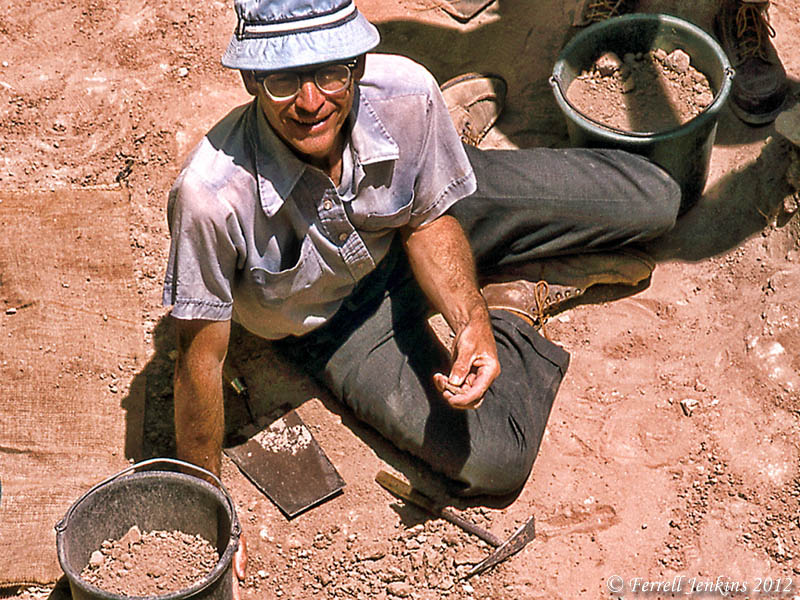
Jim worked in the Section that year. Here is a photo I made of him busy at work.

Dr. James A. Hodges in the Section at Lachish, 1980. Photo by Ferrell Jenkins.

Dr. James A. Hodges in the Section at Lachish, 1980. Photo by Ferrell Jenkins.

Hodges was a quiet and friendly man who sought to follow the example of Christ in his life. I think he was often underestimated by those who did not understand his vast knowledge in Bible, archaeology and Bible history, and the creation-evolution controversy. Several times I have remarked that he was my “go to” man. If I needed some reliable information to get by on until I had time to do a more thorough study, I often called on Jim.

Jim’s hobbies were hiking and fossil collecting. He and Wanda enjoyed traveling throughout the U.S.A. and in various foreign countries. They were part of one of my Israel tours in 1993.

Our condolences are extended to his wife Wanda (Diestelkamp), his children, and other family members.

Akrotiri archaeological site reopens after seven years

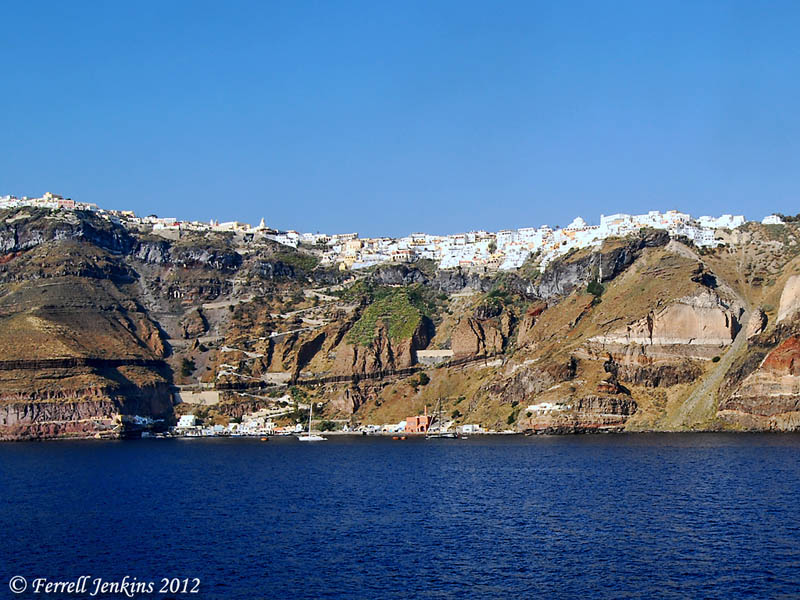
The volcanic island of Santorini, also known as Thira, is a popular stop on Aegean cruises. Eruptions are known to have occurred about 1600 B.C., 1475 B.C., and in the twelfth century B.C. The cruise ships float around in the crater and the passengers are taken by tinder to a place where they have a choice of cable car or donkey to reach the rim.

A view from inside the crater at Santorini. Photo by Ferrell Jenkins.

A view from inside the crater at Santorini. The town of Fira sits perched upon the rim of the volcanic crater. Photo by Ferrell Jenkins.

I have been to Santorini several times on my Steps of Paul and John tours. It is a “necessary” stop on the cruise that allows visits to the biblical sites of Patmos, Rhodes, and Crete. Prior to 2005 a visit to the archaeological site of Akrotiri was worthwhile. A brief description of Akrotiri is given at Wikitravel here.

Akrotiri, in the south, a roughly 3,500 year old Minoan town preserved in volcanic ash like Pompeii, is one of Santorini’s “must-sees”. The excavation site is covered by a roofing system, which makes it something that you can comfortably visit no matter what time of year. The ruins, are extremely well preserved. Streets, buildings, stairs and even second floors of buildings are still visible. Visitors can stand in the ruins and look at Minoan pottery and frescoes, and with a little imagination, feel what it would have been like to live in ancient Greece. Due to an accident in September 2005, the excavation site is still closed to the public.

Word comes from the China Post that the archaeological site reopened last Friday. I look forward to visiting it again next month. I am sure I recall making slides there, but have been unable to locate any in my files.

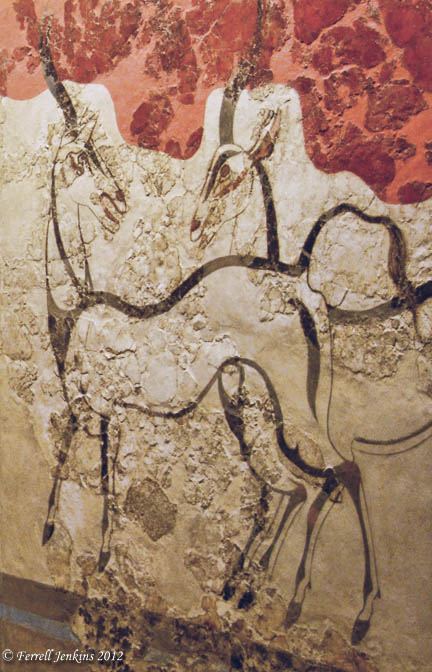
The Athens National Museum has a wonderful exhibit of fresco’s and other artifacts from Akrotiri on the second floor of the museum. The photo here is of the Antelopes fresco.

The Antelopes fresco from Akrotiri. Athens National Museum. Photo by Ferrell Jenkins.

The Antelopes fresco from Akrotiri displayed in the Athens National Museum. Photo by Ferrell Jenkins.

Professor Hans Goedicke proposed that the Exodus and the drowning of the Egyptian army was an historical event in 1477 B.C. According to the theory, a tsunami produced by volcanic eruption in the Mediterranean was responsible for the flooding that drowned the Egyptian Army. See Shanks, “The Exodus and the Crossing of the Red Sea, According to Hans Goedicki.” BAR 07:05 (Sept/Oct 1981). The dating does not fit what I understand to be the date of the Exodus, but I am unable to comment further on the theory at this time.

HT: Jack Sasson