Category Archives: Old Testament

Visiting the Old City of Jerusalem

We left the hotel this morning at 7:15 in order to be at the security line going to the Temple Mount platform as soon as it opened. After that visit we followed the traditional Via Dolorosa. After a visit to the Church of the Holy Sepulchre we went to the Jewish Quarter to see the Broad Wall, the Burnt House (from A.D. 70), and the Herodian Mansion (or perhaps the house of priests).

We came down to the Western Wall Plaza to visit the Western Wall, then the Davidson Center excavations.

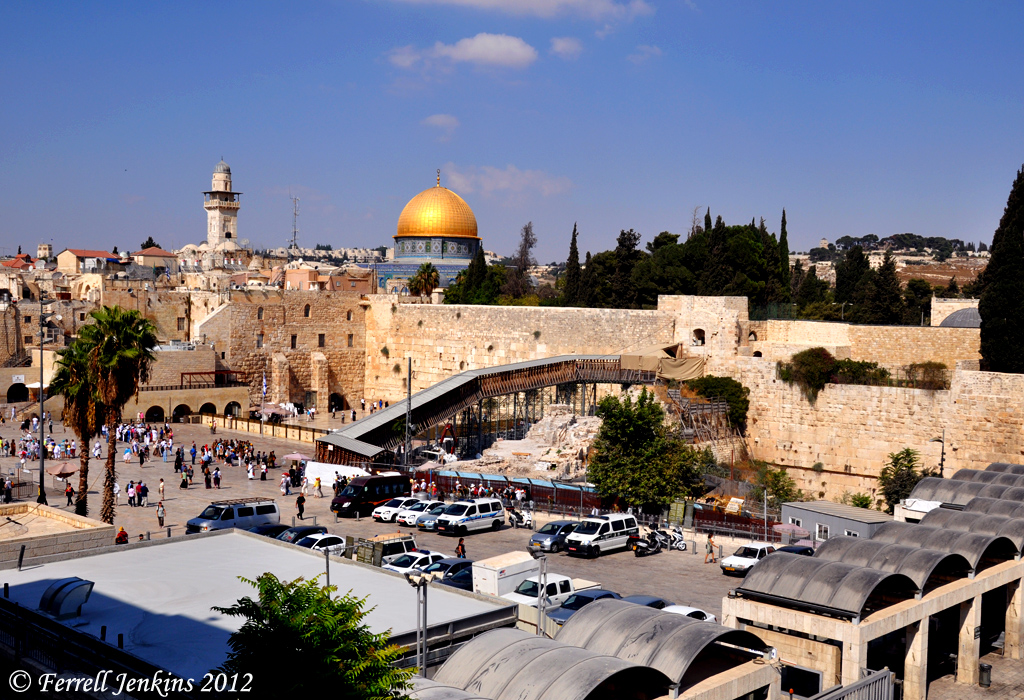
This photo of the Western Wall and Temple Mount platform was made from the southwest. You can see a portion of the Western Wall, the Mughrabi (temporary) Bridge, and the Dome of the Rock (where the biblical Temple once stood).

Temple Mount in Jerusalem from the SW. Photo by Ferrell Jenkins.

Temple Mount in Jerusalem from the SW. Photo by Ferrell Jenkins.

On the right side of the photo, in the distance, can be seen the hill between Mount Scopus and the Mount of Olives. I think this is where the Augusta Victoria Hospital is located.

It was a full day.

Visiting the Jordan River

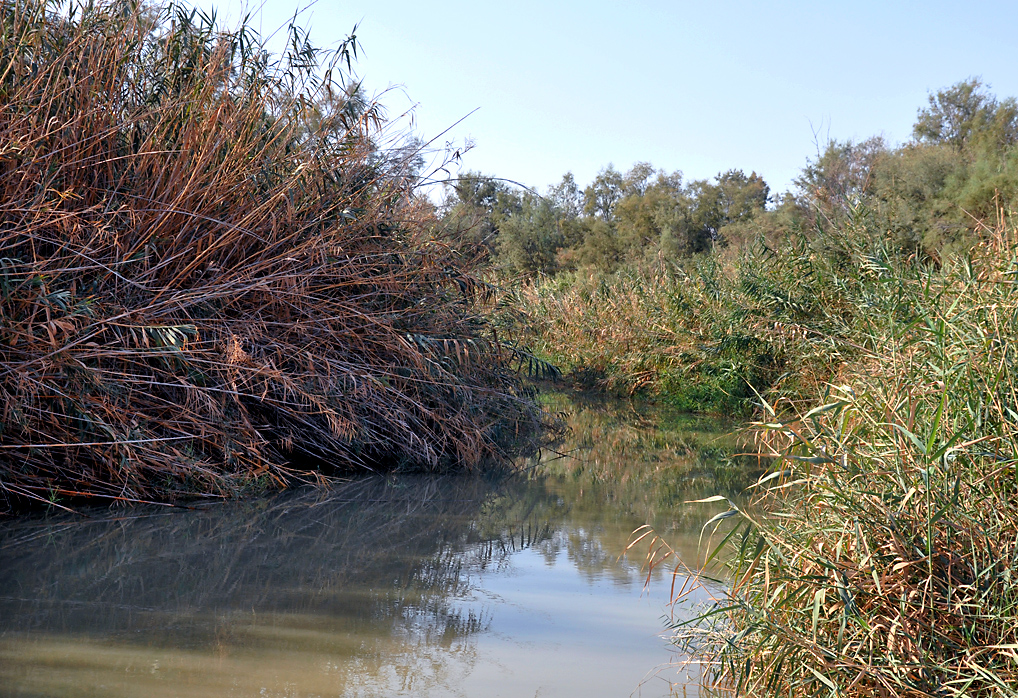
Israel has opened access to the Jordan River at the traditional site of the baptism of Jesus.

Bible students enjoy visiting this site for several reasons.

  • Ancient Israel crossed the Jordan to enter the promised land (Joshua 3).
  • Elijah and Elisha crossed the river (2 Kings 2).
  • John baptized in the Jordan (Matthew 3:6ff.; Mark 1:5-9; John 1:28; 10:40).
  • Jesus was baptized in the Jordan (Matthew 3:13).
  • Naaman dipped in the Jordan at a site further north (2 Kings 5).

We were able to visit the site this morning.

The Jordan River at the site of the baptism of Jesus. View south. Photo by Ferrell Jenkins.

Jordan River at the site of the baptism of Jesus. View south. Photo by Ferrell Jenkins.

We also visited Masada, Qumran, and Jericho.

Around the Sea of Galilee

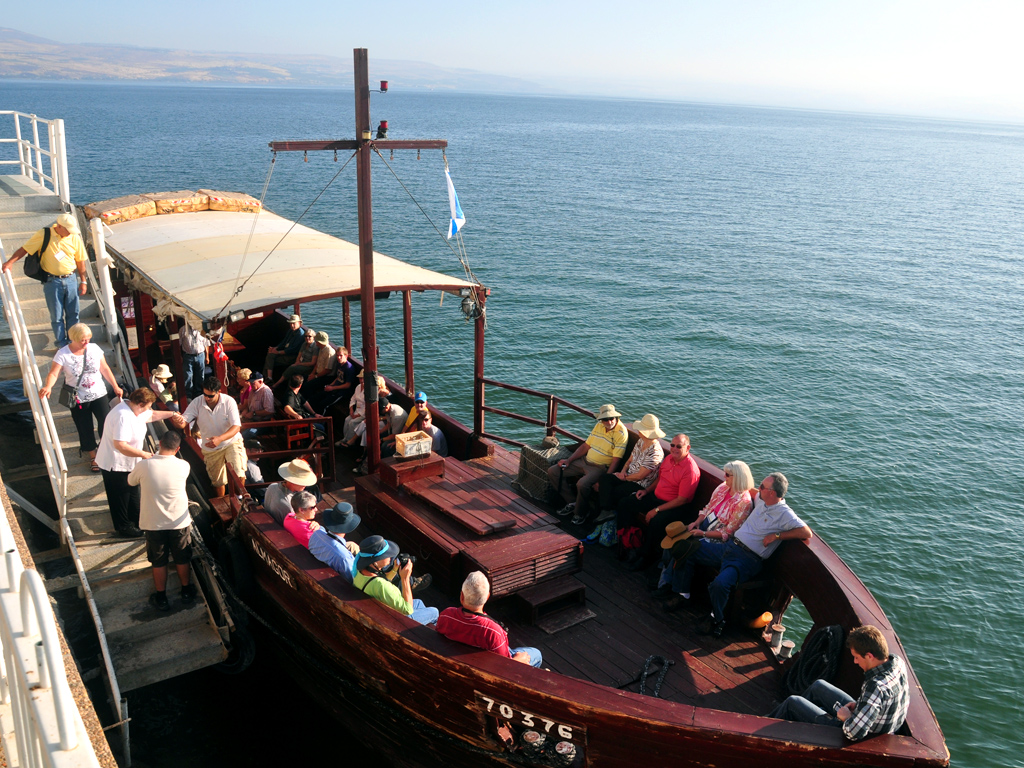
Our great little hotel in Tiberias, the Ron Beach, has its own boarding dock. I was delighted when I learned that the water level was high enough that this could be done. This morning we stepped out of our rooms and walked a few yards to boarded our boat for a ride on the Sea of Galilee.

We board our boat from the Ron Beach Hotel in Tiberias. Photo by Ferrell Jenkins.

We board our boat from the Ron Beach Hotel in Tiberias. Photo by Ferrell Jenkins.

After an orientation from the Sea, we visited major sites around the Sea of Galilee. These included the Roman Boat, Magdala (we actually entered the site, but were not allowed to make photos of the new excavations; it is not ready for tourist yet), Chorzain, Capernaum, the Mount of Beatitudes, the Cove of the Sower, Bethsaida/Geshur, Kursi, and a view of Hippos.

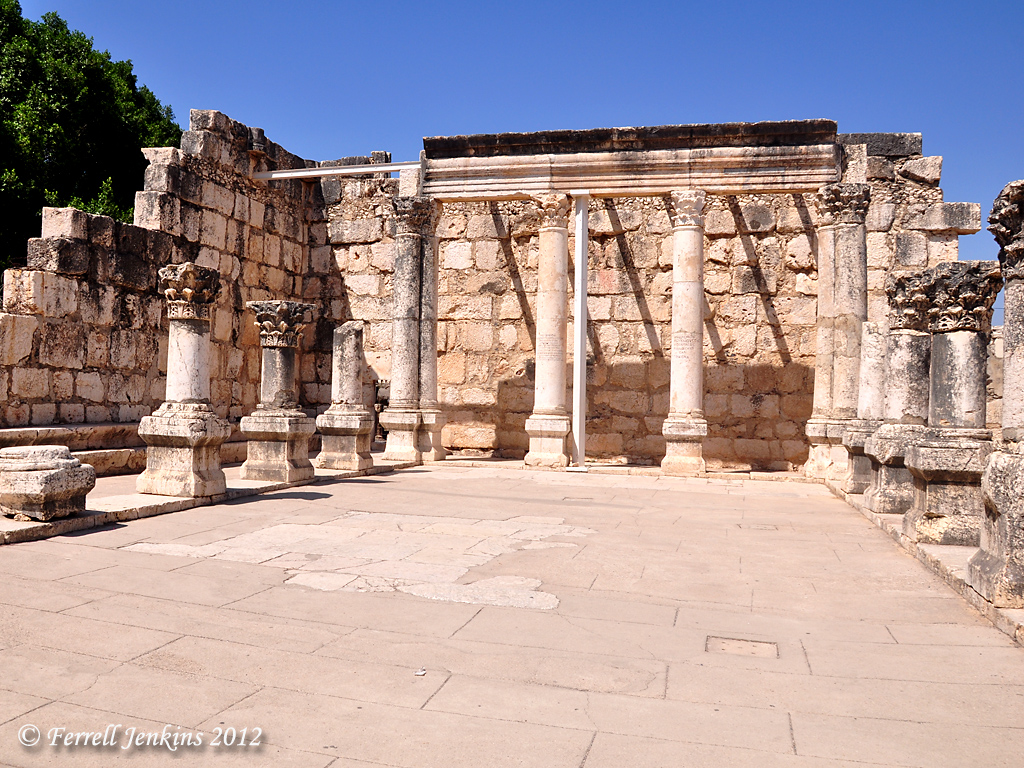
At Capernaum I waited with patience until I was able to get this photo of the interior of the 4th century (reconstructed) synagogue without a tourist in attendance. Not easy, I can tell you.

Interior of the Capernaum Synagogue. Photo by Ferrell Jenkins.

Interior of the Capernaum Synagogue. Photo by Ferrell Jenkins.

To my knowledge everyone in our group is well and enjoying this wonderful educational and spiritual experience.

First Temple Public Water Reservoir Exposed in Jerusalem

We have enjoyed a good day visiting in Israel, but I want to share word of this amazing discovery announced today by the Israel Antiquities Authority.

— • —

A Public Water Reservoir Dating to the First Temple Period has been Exposed for the First Time next to the Western Wall

According to Eli Shukron, excavation director on behalf of the Israel Antiquities Authority, “It is now absolutely clear that the Jerusalem’s water consumption during the First Temple period was not solely based on the output of the Gihon Spring, but that it also relied on public reservoirs”

The find will be presented to the public today (Thursday) in the “City of David Studies” conference that will be held in Jerusalem

Massive reservoir discovered near Western Wall in Jerusalem.. Photo by IAA.

Massive reservoir discovered near Western Wall in Jerusalem.. Photo by IAA.

A large rock-hewn water reservoir dating to the First Temple period was discovered in the archaeological excavations that are being conducted in the Jerusalem Archaeological Garden at the foot of Robinson’s Arch. The excavations at the site are being carried out by the Israel Antiquities Authority, underwritten by the ʽIr David Foundation and in cooperation with the Nature and Parks Authority.

The impressive reservoir will be presented today (Thursday) together with other finds from this past year at the 13th annual conference on the “City of David Studies of Ancient Jerusalem” to be held in Jerusalem.

The excavation, during the course of which the reservoir was discovered, is part of an archaeological project whereby the entire drainage channel of Jerusalem dating to the Second Temple period is being exposed. The channel runs north along the City of David spur, from the Siloam Pool to a point beneath Robinson’s Arch. The route of the channel was fixed in the center of the main valley that extends from north to south the length of the ancient city, parallel to the Temple Mount. In his description of Jerusalem in the Second Temple period, Josephus refers to the valley by its Greek name “Tyropoeon”, which scholars believe means “Valley of the Cheese-makers”. Another interpretation identifies the valley with the “Valley of the Decision”, mentioned in the Book of Joel.

It became apparent while excavating the channel that during the construction of this enormous engineering enterprise its builders had to remove earlier structures that were situated along the route of the channel and “pass through” existing rock-hewn installations that were located along it. An extraordinary installation that was exposed in recent weeks is a large water reservoir treated with several layers of plaster, which probably dates to the First Temple period.

The reservoir has an approximate capacity of 250 cubic meters [66,043 U.S. gallons] and is therefore one of the largest water reservoirs from the First Temple period to be discovered so far in Jerusalem, and this was presumably a reservoir that was used by the general public.

According to Eli Shukron, the excavation director on behalf of the Israel Antiquities Authority, “While excavating beneath the floor of the drainage channel a small breach in the bedrock was revealed that led us to the large water reservoir. To the best of our knowledge this is the first time that a water reservoir of this kind has been exposed in an archaeological excavation. The exposure of the current reservoir, as well as smaller cisterns that were revealed along the Tyropoeon Valley, unequivocally indicates that Jerusalem’s water consumption in the First Temple period was not solely based on the output of the Gihon Spring water works, but also on more available water resources such as the one we have just discovered.

According to Dr. Tvika Tsuk, chief archaeologist of the Nature and Parks Authority and an expert on ancient water systems, “The large water reservoir that was exposed, with two other cisterns nearby, is similar in its general shape and in the kind of plaster to the light yellow plaster that characterized the First Temple period and resembles the ancient water system that was previously exposed at Bet Shemesh. In addition, we can see the hand prints of the plasters left behind when they were adding the finishing touches to the plaster walls, just like in the water reservoirs of Tel Be’er Sheva, Tel Arad and Tel Bet Shemesh, which also date to the First Temple period”. Dr. Tsuk says, “Presumably the large water reservoir, which is situated near the Temple Mount, was used for the everyday activities of the Temple Mount itself and also by the pilgrims who went up to the Temple and required water for bathing and drinking”.

The exposure of the impressive water reservoir that lies below Robinson’s Arch joins a series of finds that were uncovered during recent excavations in this region of the city, indicating the existence of a densely built-up quarter that extended across the area west of the Temple Mount and predating the expansion of the Temple Mount. It seems that with the expansion of the Temple Mount compound to the west and the construction of the public buildings and the streets around the Temple Mount at the end of the Second Temple period, the buildings from the First Temple period and early Second Temple period were dismantled in this region and all that remains of them is a series of rock-cut installations, among them the hewn water reservoir.

According to Dr. Yuval Baruch, archaeologist in charge of the Jerusalem Region of the Israel Antiquities Authority, “Upon completion of the excavations along the route of the drainage channel, the IAA will examine possibilities of incorporating the impressive water reservoir in the planned visitors’ path”.

Click here to download high resolution photographs of the reservoir.

HT: Joseph Lauer


Felucas on the Nile

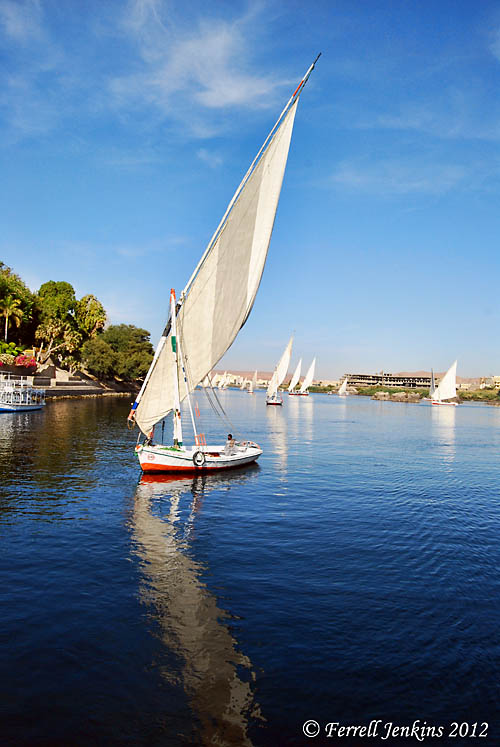
Felucas are common on the Nile in Egypt. The wooden sailing boat is moved by the wind. It seems to take two men to control the sail and the rudder. Many Nubians find work running these boats. See here. The photo below was made at Aswan, Egypt. Aswan is known as Syene in Ezekial 29:10 and 30:6.

Kitchener’s Island is visible on the left, and Elephantine Island is on the right.

A feluca on the Nile at Aswan. Photo by Ferrell Jenkins.

Felucas on the Nile at Aswan. Photo by Ferrell Jenkins.

Whether at Aswan or Cairo, an afternoon ride aboard a feluca is a pleasant and relaxing experience.

Acts 8 — An Ethiopian

So he [Philip] got up and went; and there was an Ethiopian eunuch, a court official of Candace, queen of the Ethiopians, who was in charge of all her treasure; and he had come to Jerusalem to worship, (Acts 8:27 NAU)

Where was Ethiopia in the first century? One might immediately think of the modern country of Ethiopia. And, I am certain that many modern Ethiopians might think so.

Nubia Today. Wikipedia Commons.

Nubia Today. Wikipedia Commons.

By checking numerous reliable sources, it becomes obvious that the terms Ethiopia in Acts 8 describes the ancient kingdom of Meroë. It was also known as Cush and Nubia in ancient times.

The ETHIOPIA referred to here is not the modern country of the same name but the ancient kingdom of Meroë, which lay along the upper Nile S of Aswan to Khartoum in the Sudan. (The International Standard Bible Encyclopedia, Rev. Vol. 2).

The map of the region of Nubia also shows the 6 cataracts of the Nile from Aswan in Egypt to Khartoum in Sudan.

One of the older sources says that the country we now call Ethiopia took rise about the middle of the first century A.D.

Another kingdom, that of Axum in the mountain region of Abyssinia proper, seems to have taken its rise about the middle of the 1st cent. A.D., but that does not come into view in our present inquiry. (Feltoe, (Hastings) Dictionary of the Apostolic Church).

R. H. Smith, in The Anchor Yale Bible Dictionary, says,

The place name “Ethiopia” (possibly meaning “land of the people of burnt faces,” i.e., dark skin; cf. Jer 13:23) appears, as such, only once in the Bible (Acts 8:27), but in the LXX it usually translates the Heb kūš (Cush), a name which appears several dozen times in the OT.

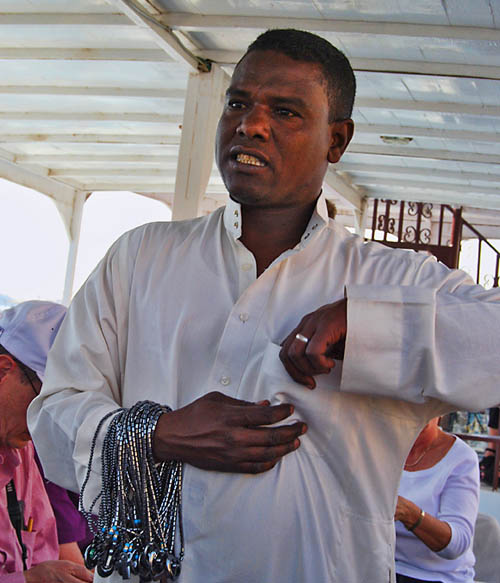
Nubian man at Philae Island near Aswan. Photo by Ferrell Jenkins.

Nubian man at Philae Island near Aswan. Photo by Ferrell Jenkins.

The building of the new Aswan dam by modern Egypt formed Lake Nasser, stretching south from Aswan for about 340 miles into northern Sudan. This made it necessary for the Nubians to be resettled around Aswan. Some of the famous monuments of Abu Simbel were covered by the lake. The Nubians are easily distinguished from the Egyptians because of their dark skin. They (and the Cushites) were distinct in the ancient Egyptian paintings and statuary.

Many of the Nubians have been employed in the tourism business. I wonder how they are surviving since the recent revolution.

Can the Ethiopian change his skin Or the leopard his spots? Then you also can do good Who are accustomed to doing evil. (Jeremiah 13:23 NAU)

The distance from Jerusalem to Ethiopia could be as much as 1500 miles. Quite a trip in a chariot.

Check the posts about Aswan here, and one about the Nubians here.

Good tips for any day

Over at the HolyLandPhotos’ Blog, Prof. Carl Rasmussen has begun a series of Travel Tips each Tuesday about places you should visit. So far all of them are in Israel.

  1. The newly opened baptism site at the Jordan River (here).
  2. Notre Dame restaurant [hotel, too] in Jerusalem. Many groups have their days full of activity with dinner provided at the hotel. The collection of artifacts and replicas, including the stone table from Magdala, make it worth a visit. I haven’t been there, but now it is on my bucket list. See here.
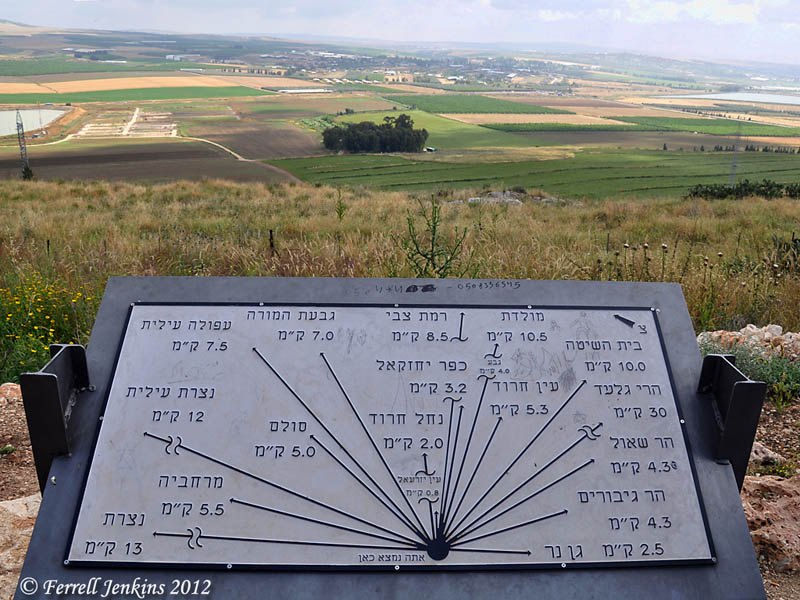
  3. Jezreel. Carl provides a list of important biblical events that transpired in the vicinity of Jezreel. See here.
The sign at the Jezreel pointing to historical sites in the area. Photo by Ferrell Jenkins.

The sign at Jezreel pointing to historical sites in the area. Photo by Ferrell Jenkins.

Free Book. Logos is offering The Epistle to the Hebrews by Brooke Foss Westcott as the free book for August. This book is from the 14-volume Classic Commentary on the Greek New Testament. Click here.

Todd Bolen’s Roundup. Todd Bolen’s Bible Places Blog is the best place on the Internet to keep up with a wide variety of archaeological work and other significant news from the Bible world. He usually has a Weekend Roundup, and sometimes a Midweek Roundup. The other days provide a more in depth look at Bible Places.

Shmuel Browns, a licensed Israel Tour Guide, is an accomplished photographer. Take a look here at his recent pictures from the desert, Mount Gerizim, Mar Saba Monastery in the wilderness of Judea, etc.

“Hyenas will cry in its towers”

Hyenas are mentioned only three times in the English Standard Version (Isaiah 13:22; 34:14; Jeremiah 50:39). Several English versions use hyenas only once.

The prophet Isaiah describes the overthrow of ancient Babylon. The town that once was the capital of the world would become a desolate place. The important buildings, once housing the likes of Nebuchadnezzar, would become a haunt for the wild animals.

Hyenas will cry in its towers, and jackals in the pleasant palaces; (Isaiah 13:22 ESV)

Hyena at Hai-Bar Nature Reserve in southern Israel. Photo by Ferrell Jenkins.

Hyena at Hai-Bar Nature Reserve in southern Israel. Photo by Ferrell Jenkins.

Here is a portion of A. E. Day’s description of the hyena.

The Palestinian hyena is the striped hyena (Hyaena striata) which ranges from India to North Africa. The striped, the spotted, and the brown hyenas constitute a distinct family of the order of Carnivora, having certain peculiarities of dentition and having four toes on each foot, instead of four behind and five in front, as in most of the order. The hyena is a nocturnal animal, rarely seen though fairly abundant, powerful but cowardly, a feeder on carrion and addicted to grave-robbing. (The International Standard Bible Encyclopedia, Revised, p. 787.

Makhtesh Ramon in the Wilderness of Zin

Mitzpe Ramon is situated on a cliff overlooking Makhtesh (Crater) Ramon. According to Alon, the crater is…

“about 30 km [18.64 miles] long, up to 8 km [5 miles] wide and some 400 m [1,312 ft.] deep. Its outer rim reaches about 1,000 m [3,280 ft.] above sea level. The crater floor has been hollowed down to its earliest geological strata” (Israel National Parks & Nature Reserves, 420).

Ibex enjoy the view at Mitzpe Ramon in the Wilderness of Zin. Photo by Ferrell Jenkins.

Ibex enjoy the view at Mitzpe Ramon in the Wilderness of Zin. Photo by Ferrell Jenkins.

Makhtesh Ramon is located within the region known as the wilderness (Hebrew midbar, desert) of Zin. The children of Israel lived in this region during the period we commonly call the wilderness wandering. From here the spies were sent to spy out the promised land.

So they went up and spied out the land from the wilderness of Zin to Rehob, near Lebo-hamath. (Numbers 13:21 ESV)

Acts 7 — Photo Illustrations

In the speech recorded in Acts 7, Stephen speaks of “the tabernacle of testimony in the wilderness” which God commanded Moses to make according to the pattern he had been given (7:44; cf. Exodus 25:9; Hebrews 8:5).

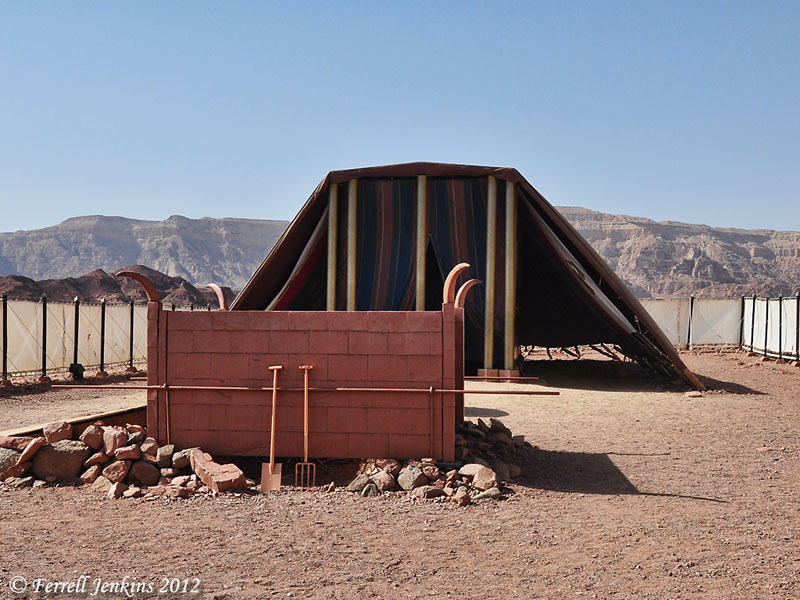
A full size model of the Israelite tabernacle has been constructed in Timna Park, 17 miles north of Eilat. The original tabernacle was built while the Israelites were at Mount Sinai (Exodus 25-40). The tabernacle was a movable tent of worship which was taken each place Israel wandered during the forty years in the wilderness.

The photo below shows the front of the Tabernacle with the altar of burnt offering in front of it.

Tabernacle in the Wilderness at Timna. Photo by Ferrell Jenkins.

Tabernacle in the Wilderness at Timna. Photo by Ferrell Jenkins.

When some men from the Synagogue of the Freedmen argued with Stephen, “they were unable to cope with the wisdom and the Spirit with which he was speaking” (Acts 6:10). They secured false witnesses to say that Stephen has spoken “blasphemous words against Moses and against God” (6:11). They also charged that he constantly speaks against “the holy place and the Law” (6:13-14).

The following brief summary by the late Princeton scholar, Charles R. Erdman, explains Stephen’s argument in a nutshell.

Stephen had been accused of blasphemy for declaring that God could be worshiped without the Temple and its rites; but, in referring to sacred history, he reminded his hearers in his first sentence that “the God of glory appeared unto … Abraham, when he was in Mesopotamia”—surely this was outside the Holy Land and the Temple. So he had revealed himself to Joseph in Egypt, and to Moses in the wilderness. Even when the Temple was finally built, Solomon, in his prayer of dedication, had reminded the people that the Most High could not be confined to the precincts of any building [1 Kings 8:27].

Step by step, the revelation of God had become more perfect, and it had reached its culmination in Christ, so Stephen seems to argue: first God revealed himself through a man, and then a family, and then a nation, and then a ceremonial, and finally in his Son. Toward the appearance of the Messiah all Jewish history had moved as to its goal; and now, through Christ, believers can worship God not only in the sacred mountain and the Temple, but wherever they turn to him “in spirit and truth.” God has a message for each of us even when surrounded by pagans and unbelievers, as Abraham in Mesopotamia; or when imprisoned and alone, as was Joseph in Egypt; or when driven into some wilderness by presumption and anger, as was Moses; or when worshiping by some ritual, as in the tabernacle; or when bowing beneath the beauties of some superb tabernacle, as did Solomon. However, all our experiences should be interpreted as designed to point us to Christ, and to lead us to find fellowship with God in him.