Category Archives: Old Testament

What do you know about Tisha B’Av?

Tuesday, August 1, 2017, many of the Jewish people recently will observe Tisha B’Av. This phrase, strange to Christians, means the Fast of the Ninth. The observance “is a day of mourning to commemorate the many tragedies that have befallen the Jewish people” (Judaism 101). According to this source, five terrible events took place on or near the ninth day of the month Av, the fifth month of the Jewish calendar.

The most significant of these events are the destruction of the Temple by the Babylonians in 586 B.C. (2 Kings 25:8-9; Jeremiah 52:12-13), and the destruction by the Romans in A.D. 70.

In the past half century a considerable amount of evidence has come to light concerning the destruction of Jerusalem by the Babylonians. The temple destroyed in 586 B.C. had been constructed by King Solomon in about 966 B.C. It was rebuilt by those who returned from the Babylonian Exile (530-516 B.C.).

In the previous post we published the Israel Antiquities Authority release about additional evidence of the Babylonian destruction of Jerusalem found in the City of David. Take a look at the additional photos there.
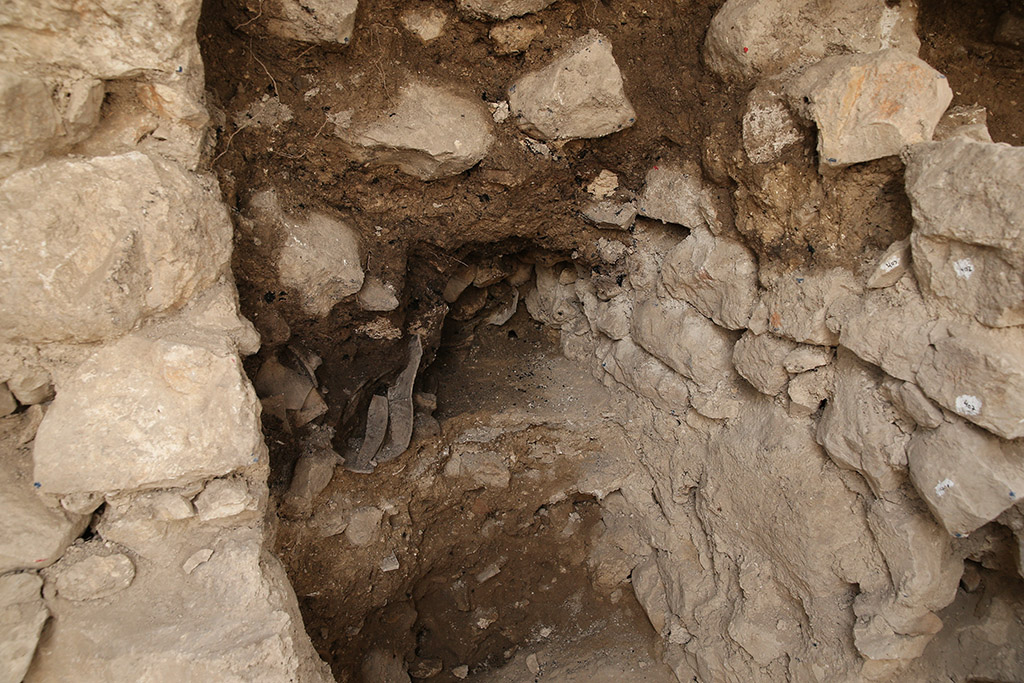
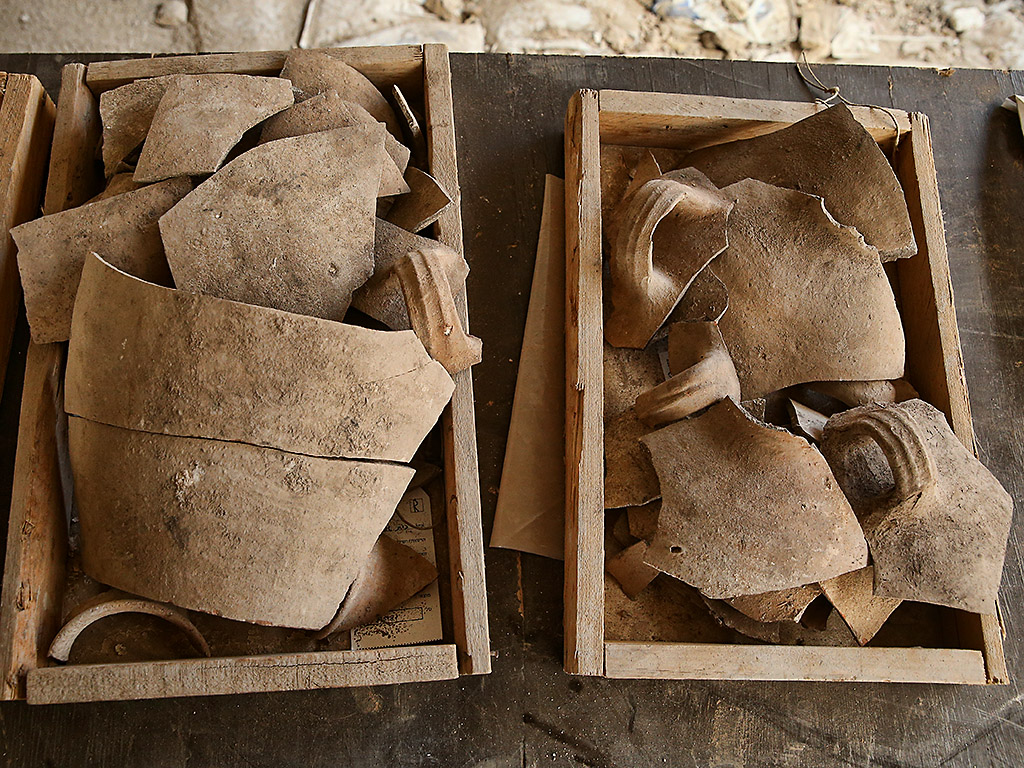
The structure in which shattered jugs were found, attesting to the destruction of Jerusalem by the Babylonians. Picture: Eliyahu Yanai, Courtesy of the City of David Archive.

The structure in which shattered jugs were found, attesting to the destruction of Jerusalem by the Babylonians. The darker area near the center of the photo shows the burn level when the city was destroyed. Picture: Eliyahu Yanai, Courtesy of the City of David Archive.

Herod the Great began about 19/20 B.C. to rebuild the temple. This work was still in progress during the ministry of Jesus.

Then the Jewish leaders said to him, “This temple has been under construction for forty-six years, and are you going to raise it up in three days?” (John 2:20 NET)

Christians take seriously the prophecy of Jesus.

Now as Jesus was going out of the temple courts and walking away, his disciples came to show him the temple buildings. And he said to them, “Do you see all these things? I tell you the truth, not one stone will be left on another. All will be torn down!” (Matthew 24:1-2 NET)

There is no archaeological evidence of the temple building itself. The site where the temple once stood is now covered with paving stones and the Dome of the Rock which was constructed by the followers of Mohamed in the 7th century A.D.
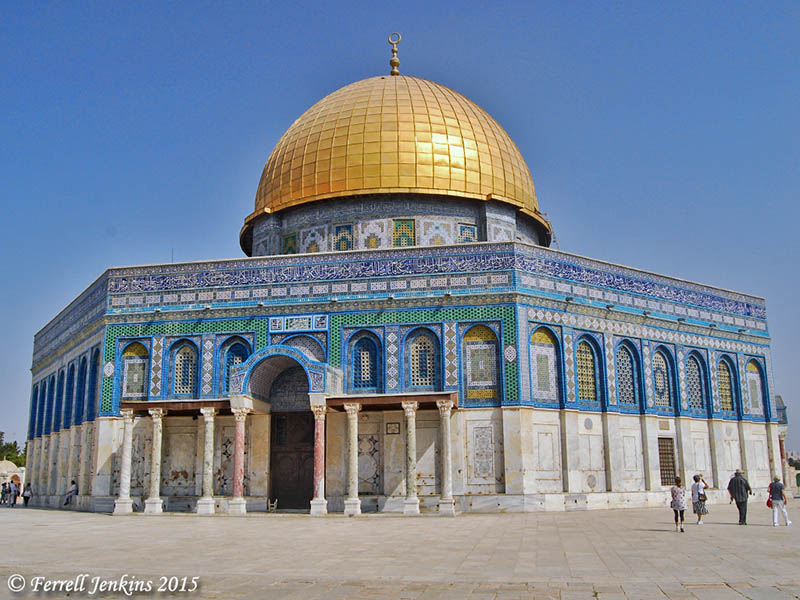
The Dome of the Rock stands where Solomon’s Temple was built. Photo by Ferrell Jenkins.

The Dome of the Rock stands where Solomon’s Temple was built. Photo by Ferrell Jenkins.

Vivid evidence of the Roman destruction of Jerusalem was discovered at the SW corner of the temple area in the Tyropean Valley. Some of the rubble can still be seen on the street which was probably built by Agrippa II in the 60s of the first century.
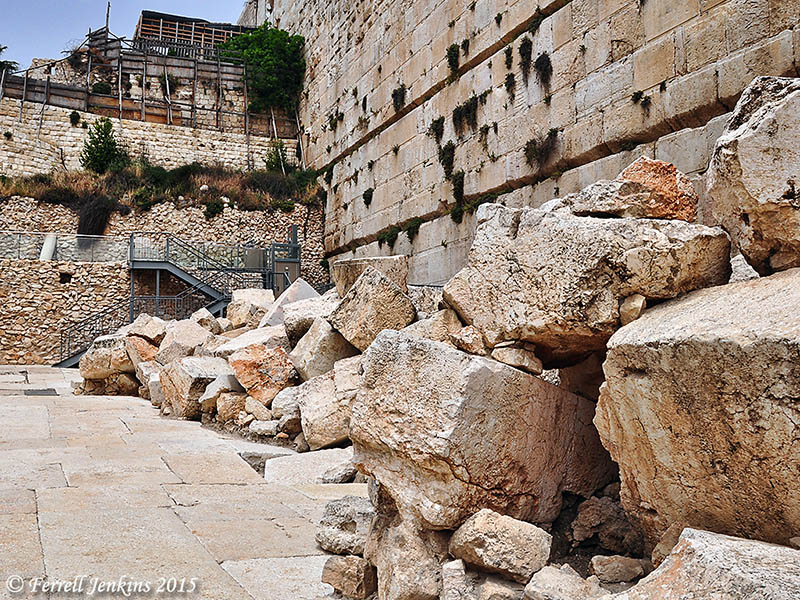
Stones that fell, or were pushed, from the Temple Mount to the street below in A.D. 70 at the time of the destruction by the Romans. Photo by Ferrell Jenkins.

Stones that fell, or were pushed, from the Temple Mount to the street below in A.D. 70 at the time of the destruction by the Romans. Photo by Ferrell Jenkins.

Wayne Stiles recently wrote an article here on this topic with several excellent photos from the Burnt House in Jerusalem, a house burned during the Roman destruction in A.D. 70.
More evidence of Babylonian destruction of Jerusalem

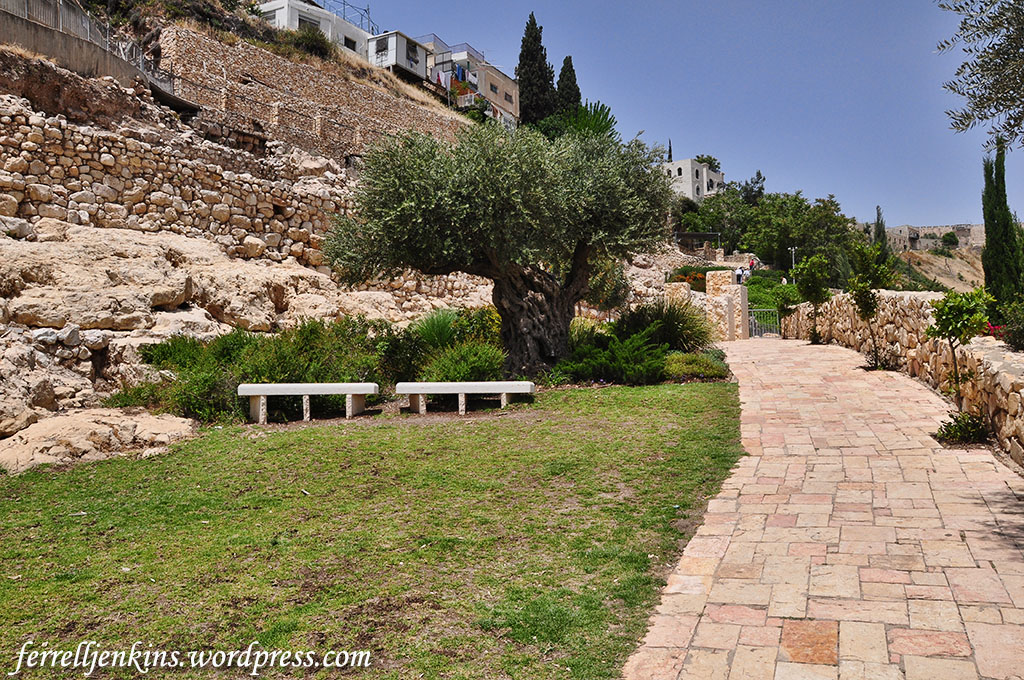
The Israel Antiquities Authority announced an important discovery in the Jerusalem Walls National Park today. Our photo below shows a portion of this park on the east slope of the city of David, overlooking the Kidron Valley. The view is north toward the southeastern corner of the Temple Mount.

Jerusalem Wall National Park on the east slope of the City of David. View North. Photo by Ferrell Jenkins.

Jerusalem Wall National Park on the east slope of the City of David. View North. Photo by Ferrell Jenkins.

I do not know the exact location of the new discovery, but this photo may give you some idea of the area.

Here is the IAA News Release.

— “ —

Evidence of the destruction of Jerusalem at the hands of the Babylonians has recently been unearthed in the City of David in excavations conducted by the Israel Antiquities Authority at the Jerusalem Walls National Park, funded by the City of David Foundation (Elad). In the excavations – concentrated on the eastern slope of the City of David, structures dating to more than 2,600 years ago have been unearthed after having been covered over by collapsed layers of stone. Nestled within the collapse, many findings have surfaced: charred wood, grape seeds, pottery, fish scales and bones, and unique, rare artifacts. These findings depict the affluence and character of Jerusalem, capital of the Judean Kingdom, and are mesmerizing proof of the city’s demise at the hands of the Babylonians.

Shattered jugs, attesting to the destruction. Photo: Eliyahu Yani, courtesy of the City of David Archive.

Shattered jugs, attesting to the destruction. Photo: Eliyahu Yani, courtesy of the City of David Archive.

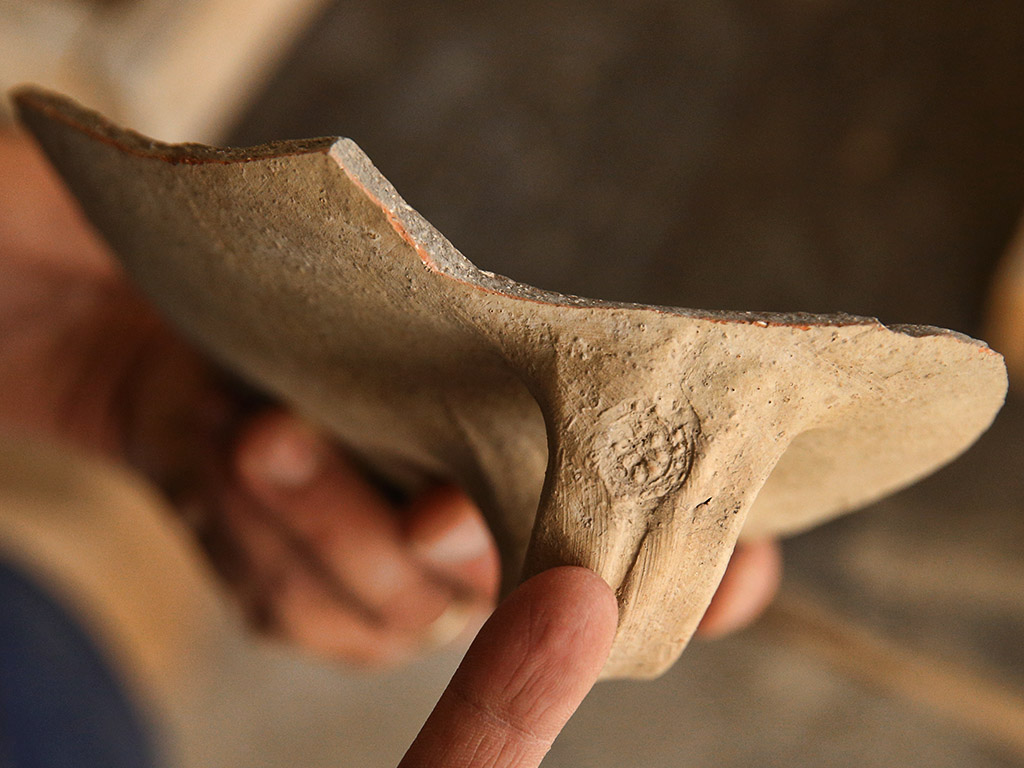
Among the excavation’s salient findings were dozens of storage jars which served to store both grain and liquids, several of which had stamped handles. Several of the seals discovered depict a rosette – a petalled rose. According to Ortal Chalaf and Dr. Joe Uziel, Israel Antiquities Authority excavation directors: “These seals are characteristic of the end of the First Temple Period and were used for the administrative system that developed towards the end of the Judean dynasty. Classifying objects facilitated controlling, overseeing, collecting, marketing and storing crop yields. The rosette, in essence, replaced the ‘For the King’ seal used in the earlier administrative system.”

Jug handles with the rosette seal used by the administrative system at the end of the Judean Kingdom. Picture: Eliyahu Yanai, Courtesy of the City of David Archive

Jug handles with the rosette seal used by the administrative system at the end of the Judean Kingdom. Picture: Eliyahu Yanai, Courtesy of the City of David Archive.

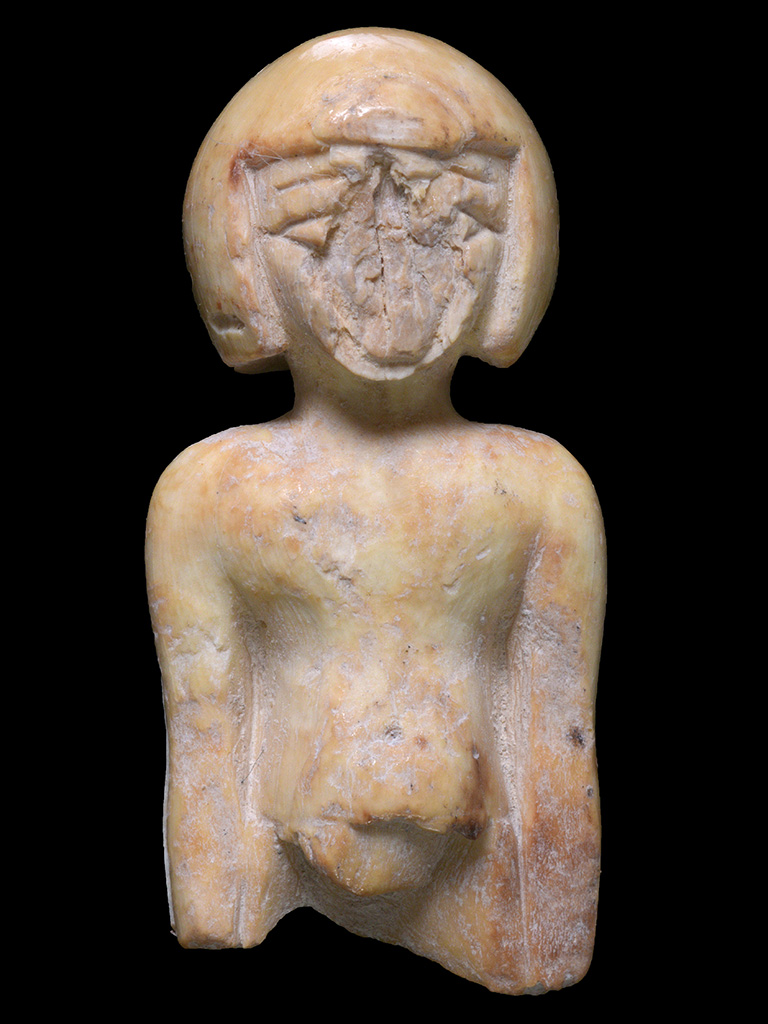
The wealth of the Judean kingdom’s capital is also manifest in the ornamental artifacts surfacing in situ. One distinct and rare finding is a small ivory statue of a woman. The figure is naked, and her haircut or wig is Egyptian in style. The quality of its carving is high, and it attests to the high caliber of the artifacts’ artistic level and the skill par excellence of the artists during this era.

Ivory statue in the image of a woman. Picture: Clara Amit, Israel Antiquities Authority

Ivory statue in the image of a woman. Picture: Clara Amit, Israel Antiquities Authority.

According to Ortal Chalaf and Dr. Joe Uziel, Israel Antiquities Authority excavation directors, “The excavation’s findings show that Jerusalem had extended beyond the line of  the city wall before its destruction. The row of structures exposed in the excavations is located outside beyond the city wall that would have constituted the eastern border of the city during this period. Throughout the Iron Age, Jerusalem underwent constant growth, expressed both in the construction of numerous city walls and the fact that the city later spread beyond them. Excavations carried out in the past in the area of the Jewish Quarter have shown how the growth of the population at the end of the 8th Century BCE led the annexation of the western area of Jerusalem. In the current excavation, we may suggest that following the westward expansion of the city, structures were built outside of the wall’s border on the east as well.”

— ” —

HT: Joseph I. Lauer

The shepherd and the sheepfold

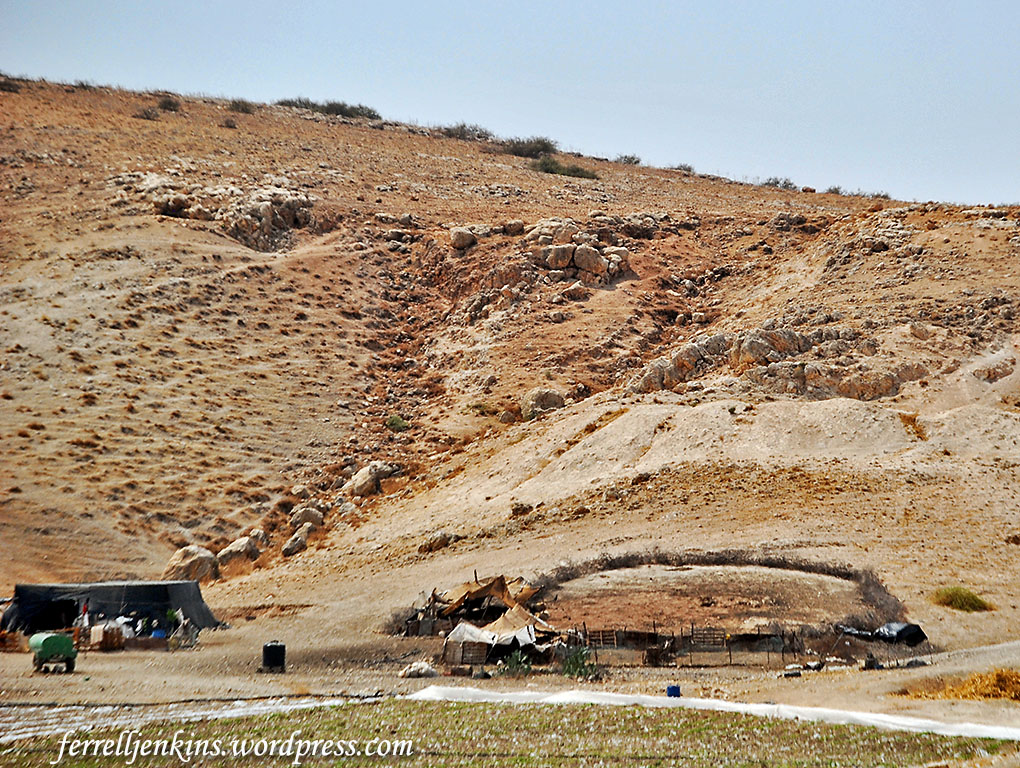
We still see scenes in the Bible world today of shepherds, sheep, and sheepfolds. The scene pictured below was made in the Jordan Valley in late August, a time that is extremely dry in the area.

Bedouin camp and sheepfold in the Jordan Valley in late August. Photo by Ferrell Jenkins.

Bedouin tent and sheepfold in the Jordan Valley. Photo by Ferrell Jenkins.

Scenes such as these remind us of the Biblical patriarchs who moved about from place to place with their flocks. Abraham and Lot provide an example.

And Lot, who went with Abram, also had flocks and herds and tents, (Genesis 13:5 ESV)

There are several biblical references to the sheepfold, or the fold of the sheep (Jeremiah 50:6; Micah 2:12; John 10:1, 16). Jesus used an illustration involving the sheepfold:

Truly, truly, I say to you, he who does not enter the sheepfold by the door but climbs in by another way, that man is a thief and a robber. But he who enters by the door is the shepherd of the sheep. (John 10:1-2 ESV)

Camel caravans carry merchandise and people

Traveling in the Sinai Peninsula is an interesting experience. I recall flying into the Sinai twice, and traveling through the Peninsula by bus or car twice. Thoughts immediately turn to the Israelites traversing this wilderness, stopping at Mount Sinai to receive “the Law of Moses, which the LORD God of Israel” gave to them (Ezra 7:6).

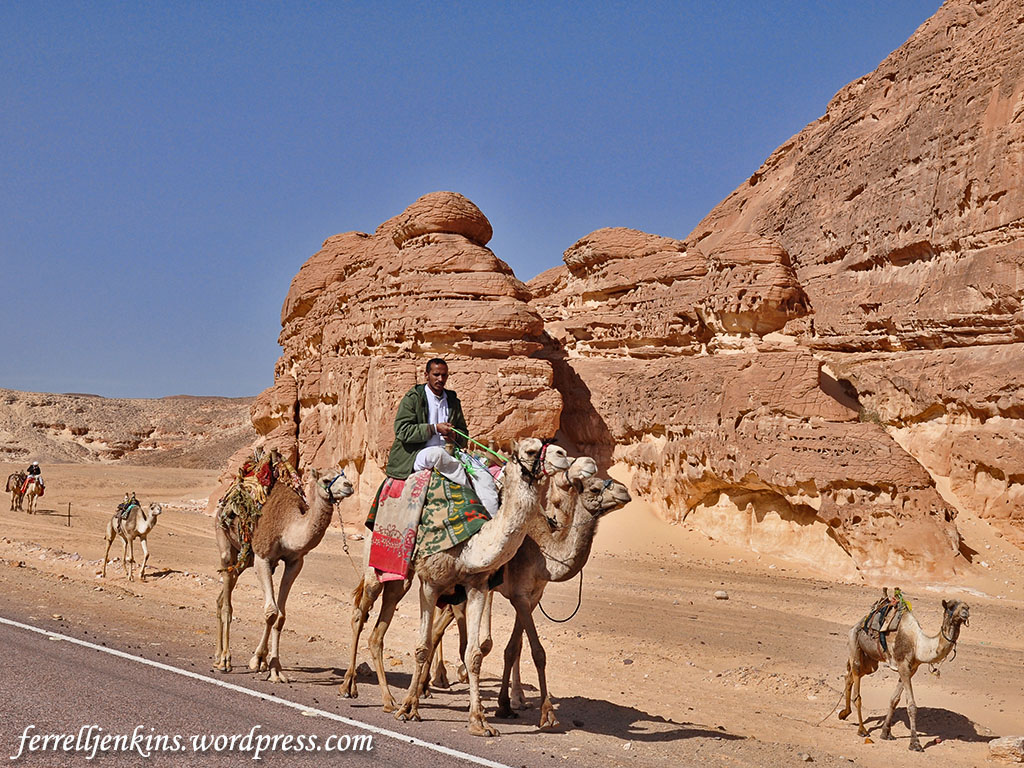
The caravan traveling here in the eastern Sinai is not carrying merchandise, but is on its way to the resort area of the Gulf of Eilat (or Aqaba). The camels seem to be ready with their saddles to entice the tourists to ride. The little camels are ready for the kids.

Camel caravan in the Eastern Sinai Peninsula. Photo by Ferrell Jenkins.

Camel caravan in the Eastern Sinai Peninsula. Photo by Ferrell Jenkins.

Several Biblical stories come to mind. Think of Rachel coming from Padan-Aram to southern Canaan to wed Isaac.

And Rebekah lifted up her eyes, and when she saw Isaac, she dismounted from the camel (Genesis 24:64 ESV)

Or of the sons of Jacob preparing to sell Joseph to a band of Ismaelites.

Then they sat down to eat. And looking up they saw a caravan of Ishmaelites coming from Gilead, with their camels bearing gum, balm, and myrrh, on their way to carry it down to Egypt. (Genesis 37:25 ESV)

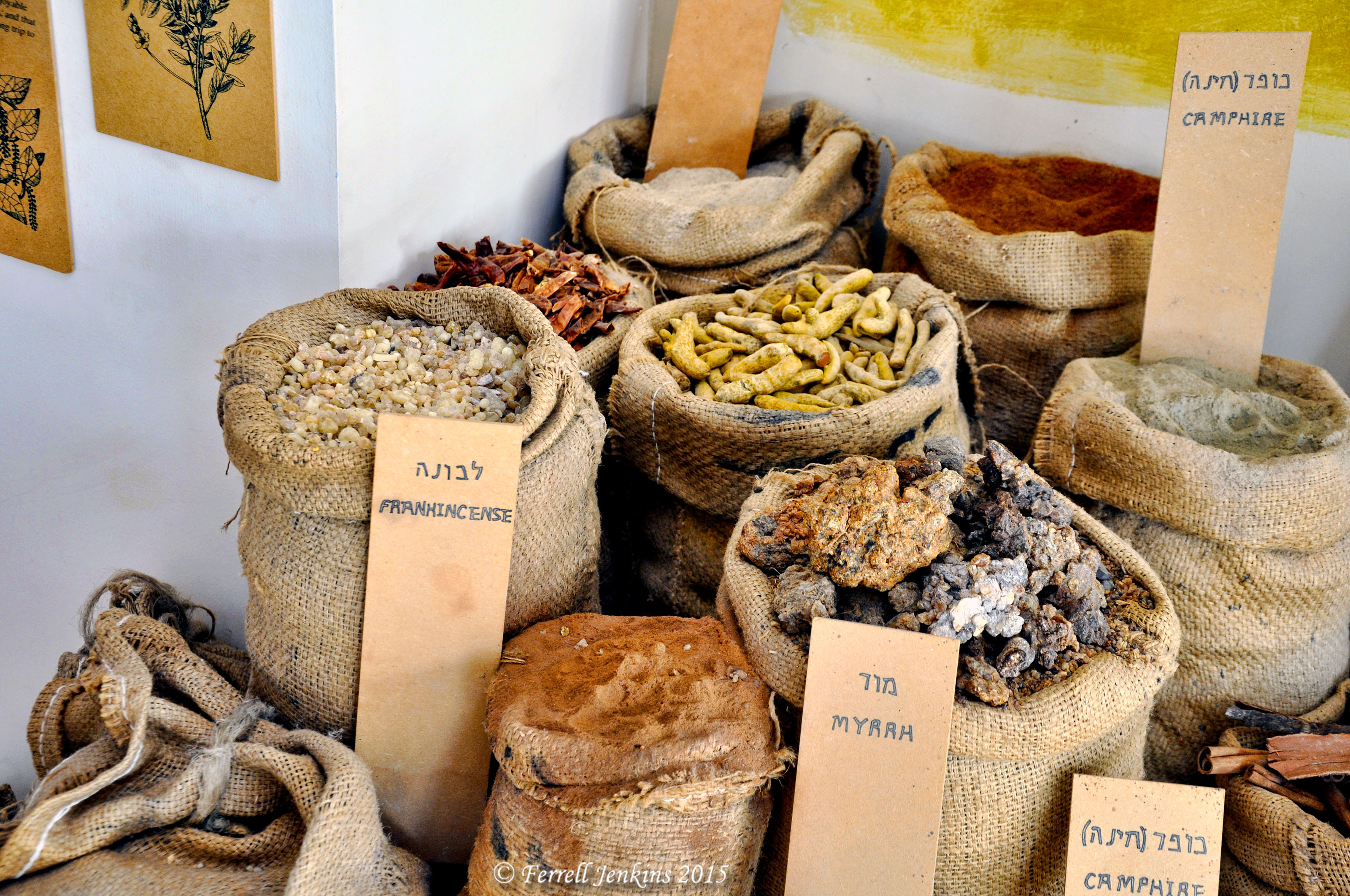
At Avedat in the Negev Highlands of Israel there is a display of the types of goods often transported across the Spice Route by the Nabateans.

Frankincense, Myrrh, and other spices were transported by camel caravans across the famous Spice Route. Photo by Ferrell Jenkins.

Frankincense, Myrrh, Pepper, and other spices were transported by camel caravans across the famous Spice Route. Photo by Ferrell Jenkins.

The stork in the Bible and the Bible Lands

Early in my travels to the Middle East I learned about the migration of the stork. They spend the winters in south-east Africa and then follow the great rift or depression through Israel, some going east to Asia and others going west to Europe. In the fall of the year they make their way back to Africa.

If you have traveled from Tiberias to Jericho by way of the Jordan valley you know that the valley is sometimes far below the highway. Once I saw a flock of storks traveling north through the valley. The stork, and other birds, spend some time in the Hulah valley north of the Sea of Galilee before continuing their trek.

Jeremiah seems to be describing the migratory habits of the stork.

Even the stork in the heavens knows her times, and the turtledove, swallow, and crane keep the time of their coming, but my people know not the rules of the LORD. (Jeremiah 8:7 ESV)

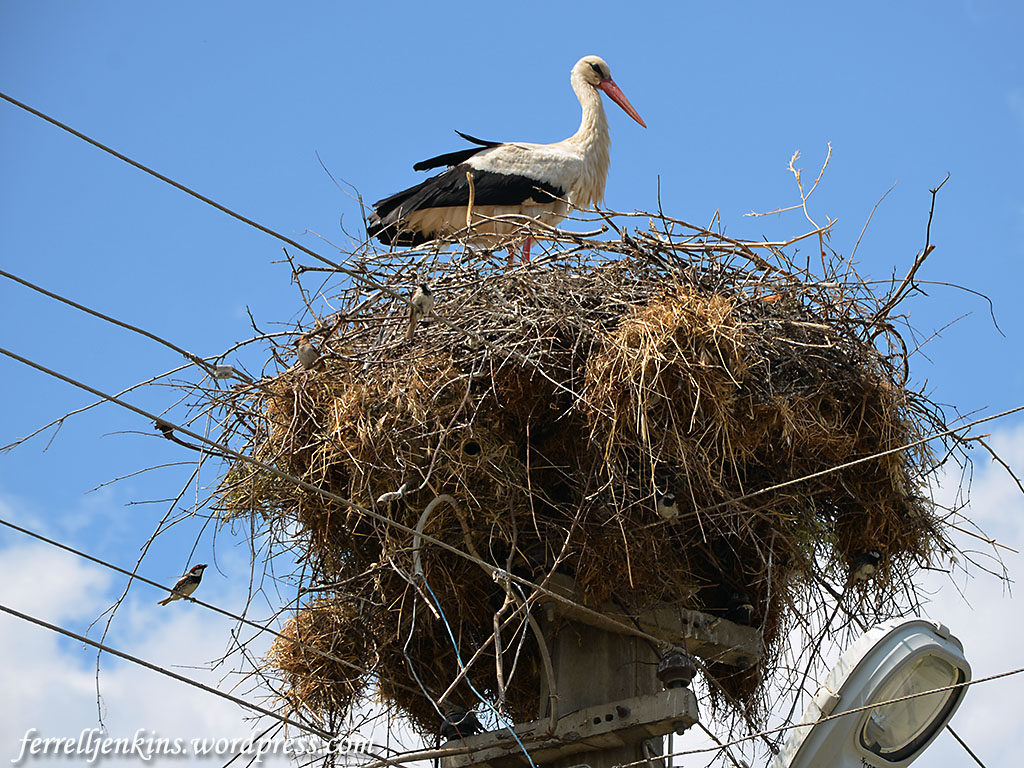
I have seen many storks in Turkey. They make their nests on chimneys (has to be summer!), on power poles, and on old columns. The Psalmist indicates that they also nest in the fir trees (Psalm 104:17). Our photo today was made near an old Roman road at Kovanlik, Turkey. It’s almost like they know to follow the roads through Asia to Europe.

A stork standing on her nest at Kovanlik, Turkey. Photo by Ferrell Jenkins.

A stork standing on her nest at Kovanlik, Turkey. Photo by Ferrell Jenkins.

According to the Mosaic law the stork was an unclean bird (Leviticus 11:19; Deuteronomy 14:18). The prophet Zechariah uses the movement of the storks with their strong wings as an illustration (which I dare not try to interpret).

Then I lifted my eyes and saw, and behold, two women coming forward! The wind was in their wings. They had wings like the wings of a stork, and they lifted up the basket between earth and heaven. (Zechariah 5:9 ESV)

The Keren Kayemeth Leisrael JNF website provides good information about storks, and other birds, in the Hulah valley here. Here is another nice site with information about storks and some good photos.

Where had Mary and Joseph stopped when they missed Jesus?

After his presentation in the Temple, there is no record of Jesus returning to Jerusalem until he is 12 years of age.

Now his parents went to Jerusalem every year at the Feast of the Passover.  And when he was twelve years old, they went up according to custom.  (Luke 2:41-42 ESV)

When the Feast of the Passover ended, his parents began the return to Nazareth. We can easily imagine that a large caravan of people were traveling together on this trip that would take several days. Jesus stayed behind in Jerusalem spending time among the teachers, “listening to them and asking them questions.” Because Mary and Joseph had relatives and acquaintances in the caravan they assumed that Jesus was among them until the end of the first day.

Keener provides some background on caravan travel.

Caravans, which afforded protection from robbers, were common on pilgrimages for the feasts in Jerusalem. Traveling with a caravan, in which neighbors from their town would watch the community children together, Mary and Joseph might assume that the near-adult Jesus was with companions, especially if by now they had younger children to attend to. If we assume a pace of twenty miles per day (though perhaps slower, depending on transportation and the children), Nazareth would be a little over three days’ journey along the shortest route. (Keener, C. S., The IVP Bible background commentary: New Testament)

Where did Mary and Joseph stop at the end of that first day of travel? We can not be certain of the route taken from Jerusalem to Nazareth. Travel from Galilee to Jerusalem was often through Perea on the eastern side of the Jordan Valley. We later find Jesus traveling north along the central mountain range through Samaria (John 4).

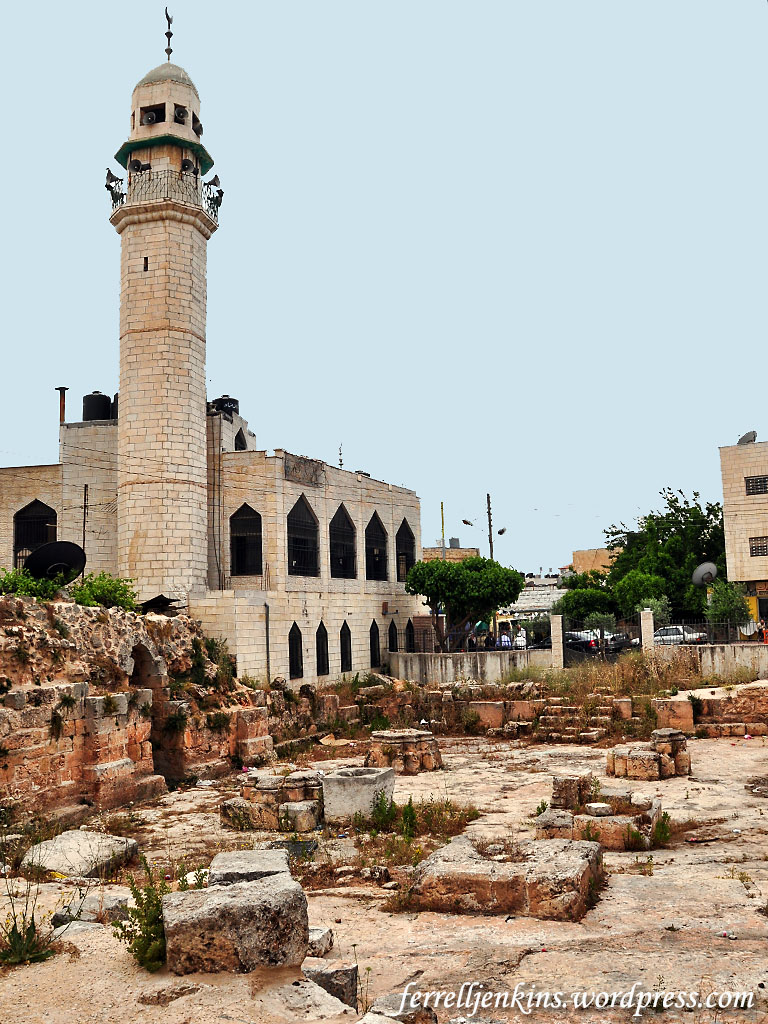
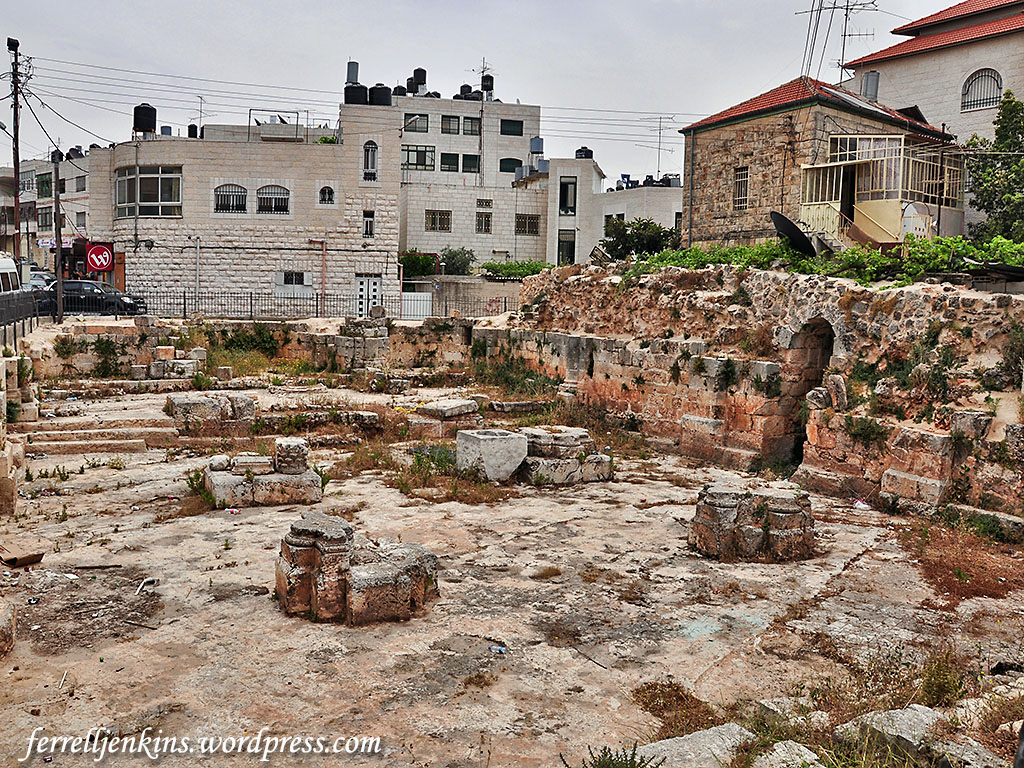
Ruins of medieval church beneath a Mosque in El Bireh. Photo by Ferrell Jenkins.

Ruins of medieval church beneath a Mosque in El Bireh. Photo by Ferrell Jenkins.

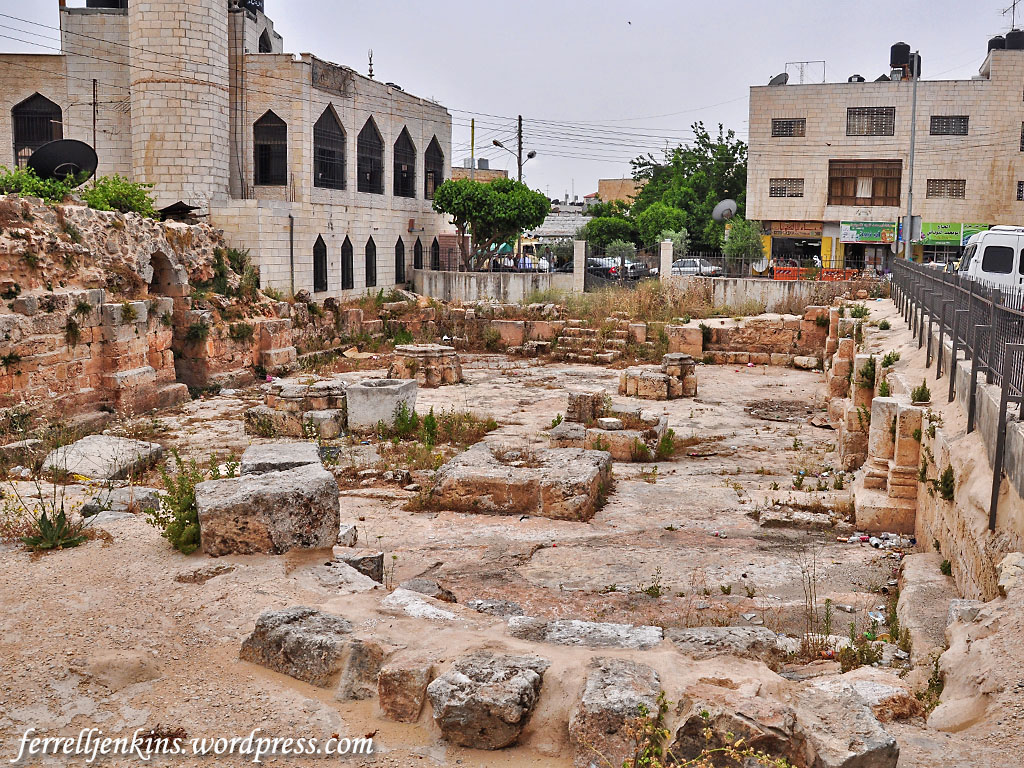
Tradition identifies the stop at el-Bireh (El Bira). Tradition has it that the first day’s stop after leaving Jerusalem was at a place now known as El Bira (or Bireh) east of Ramallah. El Bira is an Arab town. There is a spring and ruins of a medieval church. The Hachette World Guides: The Middle East (1966) says that the tradition associating this event with El Bireh dates to the 16th century. Eugene Hoade says it is probable that this church was built in 1146 “in memory of” the event mentioned in Luke 2. (Guide to the Holy Land). The apse of the church is visible in the photo below. The Hachette World Guide says the building was destroyed in 1915 and the stones were used for building bridges along the mountain route.

Ruins of medieval church beneath a Mosque in El Bireh. Photo by Ferrell Jenkins.

Ruins of medieval church beneath a Mosque in El Bireh. Photo by Ferrell Jenkins.

This site is only about 8 miles north of Jerusalem, but with a large caravan including women and children it is possible that a short distance was covered the first day. It was necessary to stop where water and various food supplies were available (John 4:6-8; Luke 9:51-53).

View of the ruins of the church at El Bireh. The apse is visible in the foreground. Photo by Ferrell Jenkins.

View of the ruins of the church at El Bireh. The apse is visible in the foreground. Photo by Ferrell Jenkins.

Is this Beeroth? Since the time of explorer Edward Robinson (1867), some scholars have identified El Bireh with the Old Testament Gibeonite city of Beeroth. The word Beeroth indicates the presence of a well. Biblical references include Joshua 9:17, 18:25, Ezra 2:25, and Nehemiah 7:29. Beeroth was considered part of the tribe of Benjamin (2 Samuel 4:2).

The late David Dorsey, after surveying the scholarship on the matter, says,

At present, therefore, the site of biblical Beeroth remains a matter of dispute. The most likely candidate would still seem to be the one originally proposed by Robinson, i.e., el-Bireh. (The Anchor Yale Bible Dictionary)

Where did Jeremiah go? Euphrates or En Prat?

The prophet Jeremiah is told to,

“Take the loincloth that you have bought, which is around your waist, and arise, go to the Euphrates and hide it there in a cleft of the rock.” (Jeremiah 13:4 ESV)

Various English translations use waistband, shorts, sash, girdle, and underwear to describe the piece of clothing that Jeremiah had bought. Whatever, the indication is that the garment was relatively new. Now he must take it to the Euphrates and hide it in a cleft of the rock.

Remember that Jeremiah was was from the little town of Anathoth, on the NE side of Jerusalem (Jeremiah 1:1). We still lack certainty regarding the specific location of the town, but the name lives on today in the Arab town of Anata.

Where was the Euphrates? At first we think of this as an easy question to answer. But on second thought there is another possibility. Jeremiah may have been told to go to a place identified as En Prat (or Ein Prat) in modern Israel. This place is identified with Parah in Joshua 18:23, and is called Perath in English transliteration of the Hebrew word. The Hebrew word en means spring. It is sometimes spelled ein, and in Arabic we find it as ain.

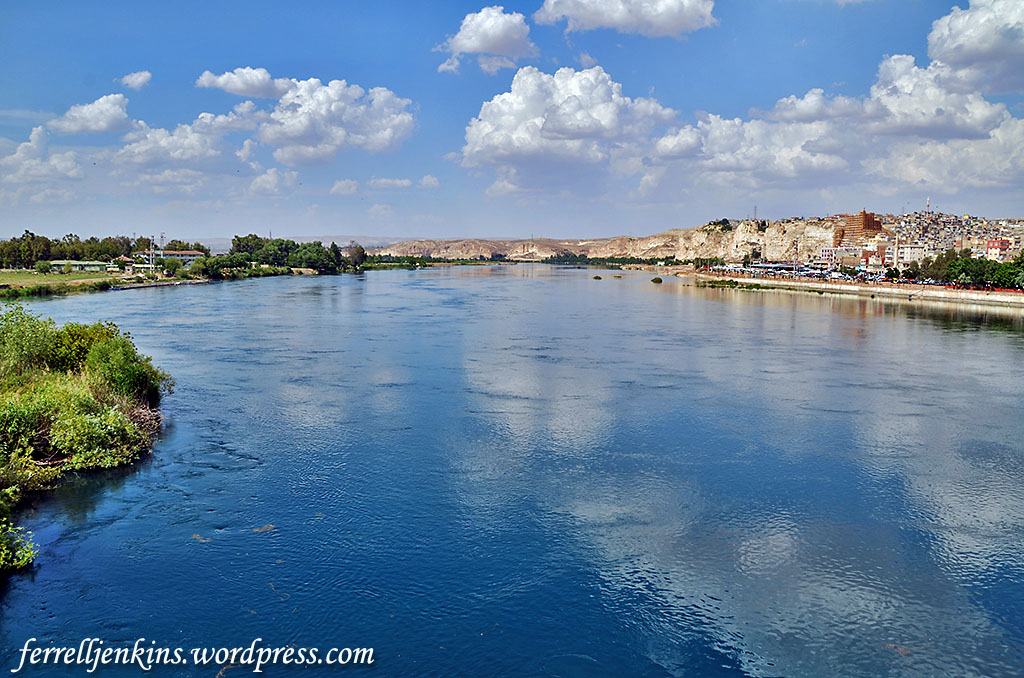
I have seen the Euphrates in several locations in Turkey, Syria, and Iraq. In Turkey the river is called the Firat Nehri.

The Firat Nehri (Euphrates River) in Birecik, Turkey. Photo by Ferrell Jenkins.

The Firat Nehri (Euphrates River) in Birecik, Turkey. Photo by Ferrell Jenkins.

The translator notes in the NET Bible provide a helpful comment:

There has been a great deal of debate about whether the place referred to here is a place (Parah [= Perath] mentioned in Josh 18:23, modern Khirbet Farah, near a spring ’ain Farah) about three and a half miles from Anathoth which was Jeremiah’s home town or the Euphrates River. Elsewhere the word “Perath” always refers to the Euphrates but it is either preceded by the word “river of” or there is contextual indication that the Euphrates is being referred to. Because a journey to the Euphrates and back would involve a journey of more than 700 miles (1,100 km) and take some months, scholars both ancient and modern have questioned whether “Perath” refers to the Euphrates here and if it does whether a real journey was involved. Most of the attempts to identify the place with the Euphrates involve misguided assumptions that this action was a symbolic message to Israel about exile or the corrupting influence of Assyria and Babylon. However, unlike the other symbolic acts in Jeremiah (and in Isaiah and Ezekiel) the symbolism is not part of a message to the people but to Jeremiah; the message is explained to him (vv. 9–11) not the people. In keeping with some of the wordplays that are somewhat common in Jeremiah it is likely that the reference here is to a place, Parah, which was near Jeremiah’s hometown, but whose name would naturally suggest to Jeremiah later in the LORD’s explanation in vv. 9–11 Assyria-Babylon as a place connected with Judah’s corruption (see the notes on vv. 9–10). For further discussion the reader should consult the commentaries, especially W. Holladay, Jeremiah (Hermeneia), 1:396 and W. McKane, Jeremiah (ICC), 1:285–92 who take opposite positions on this issue.

I have no fixed view on this subject, but the thought that Jeremiah went from Anathoth to Perath (= En Prat), a distance of 3 miles or so, is more sensible to me. Remember that Jeremiah had to make two trips to Perath, one to deposit his undergarment and another to retrieve it.

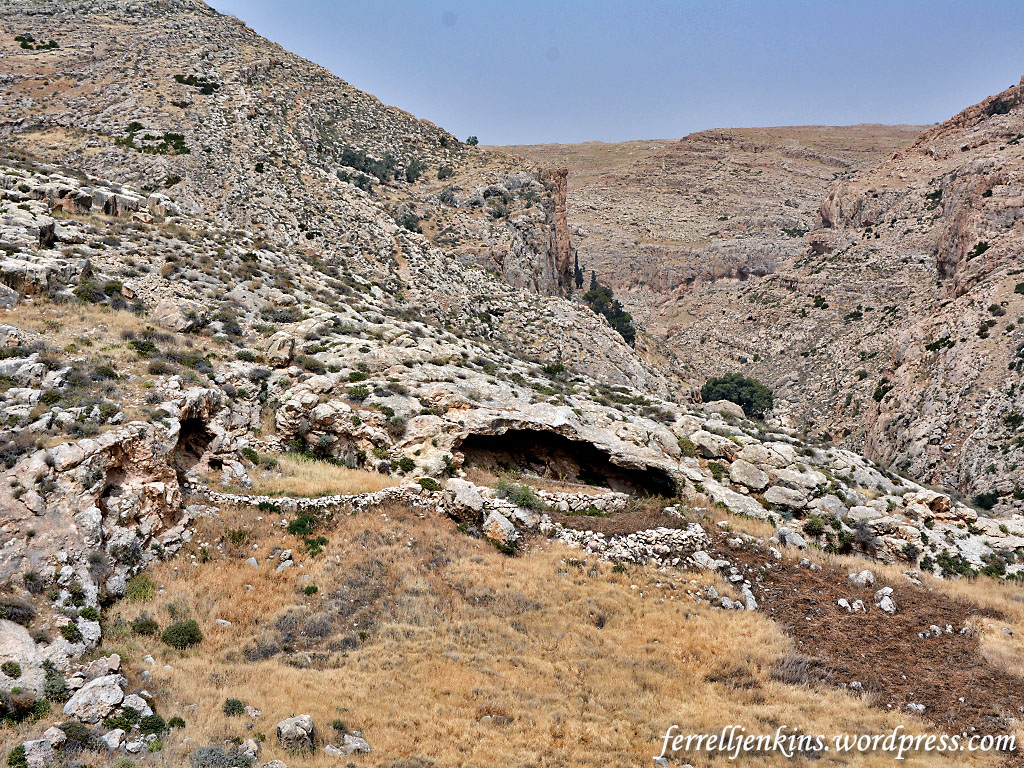
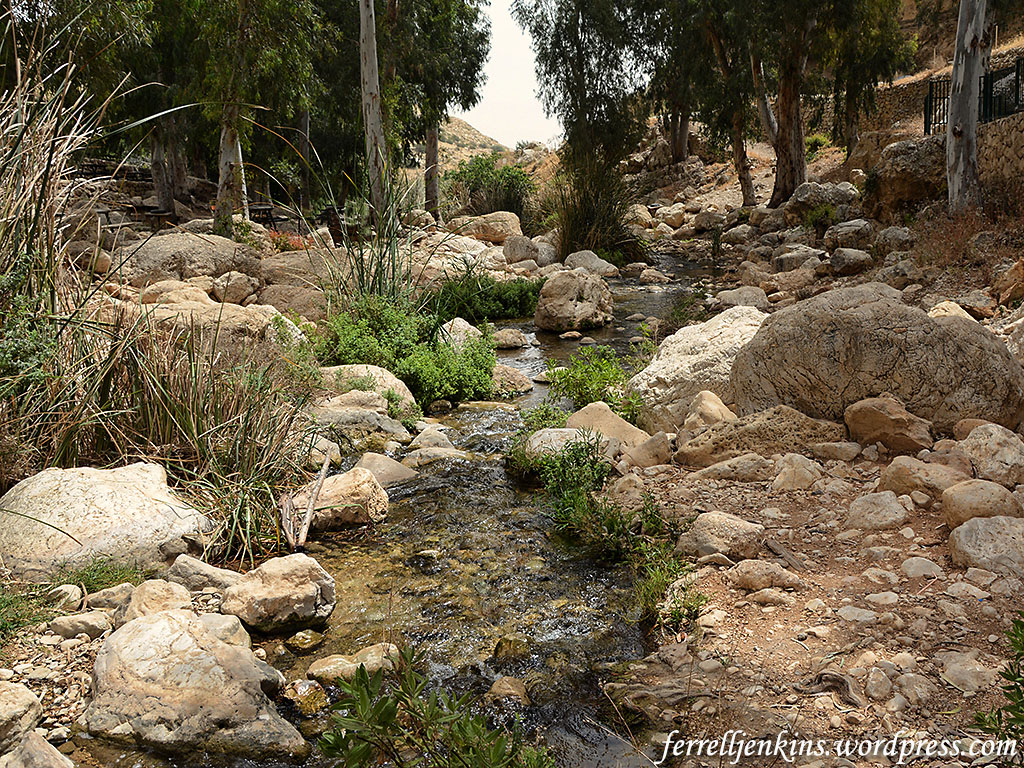
En Prat is located in the western edge of the wilderness of Judah at an elevation of 910 feet above sea level. You recall that Jerusalem is about 2400 feet above sea level. Here is a view as we approach En Prat. The elevation where I was standing is 1,060 feet above sea level.

In the wilderness on the way to En Prat. Photo by Ferrell Jenkins.

In the wilderness on the way to En Prat. In the photo you see caves, some of which were used as sheepfolds in the past. Photo by Ferrell Jenkins.

As Leon Mauldin and I reached En Prat this was the first photo of the area with a view to the west.

My first photograph of En Prat. Photo by Ferrell Jenkins.

My first photograph of En Prat. Photo by Ferrell Jenkins.

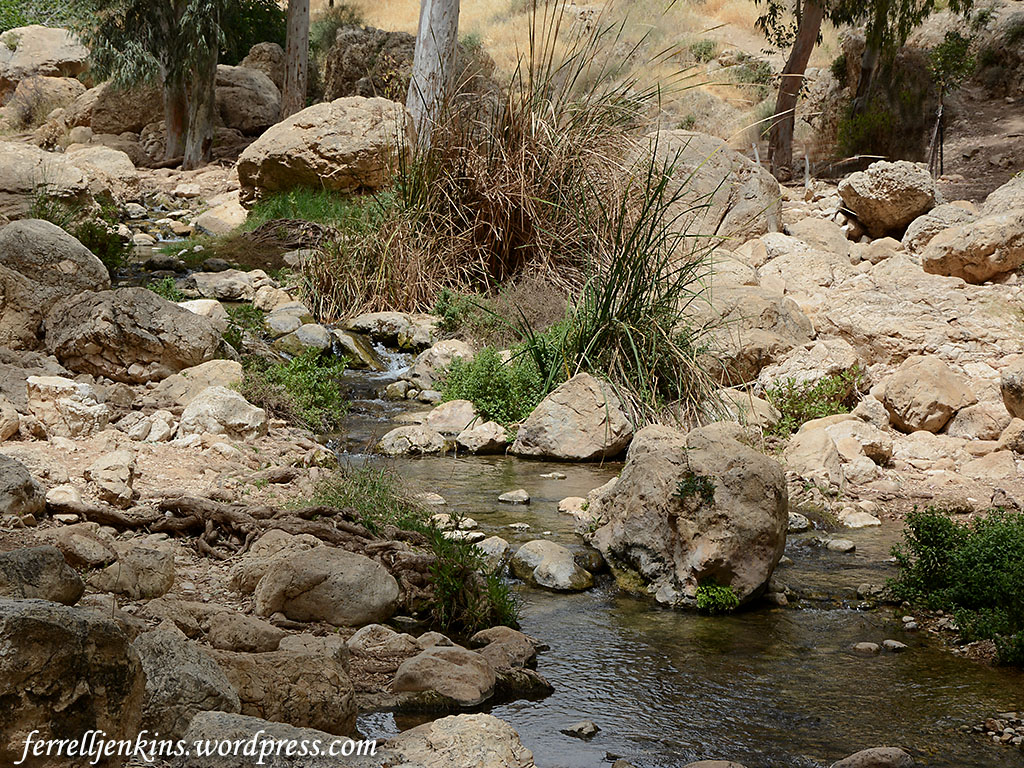
I thought about places Jeremiah might have hidden his under garment.

Many rocks around En Prat suitable for hiding a garment. Photo by Ferrell Jenkins.

Many rocks around En Prat suitable for hiding a garment. Photo by Ferrell Jenkins.

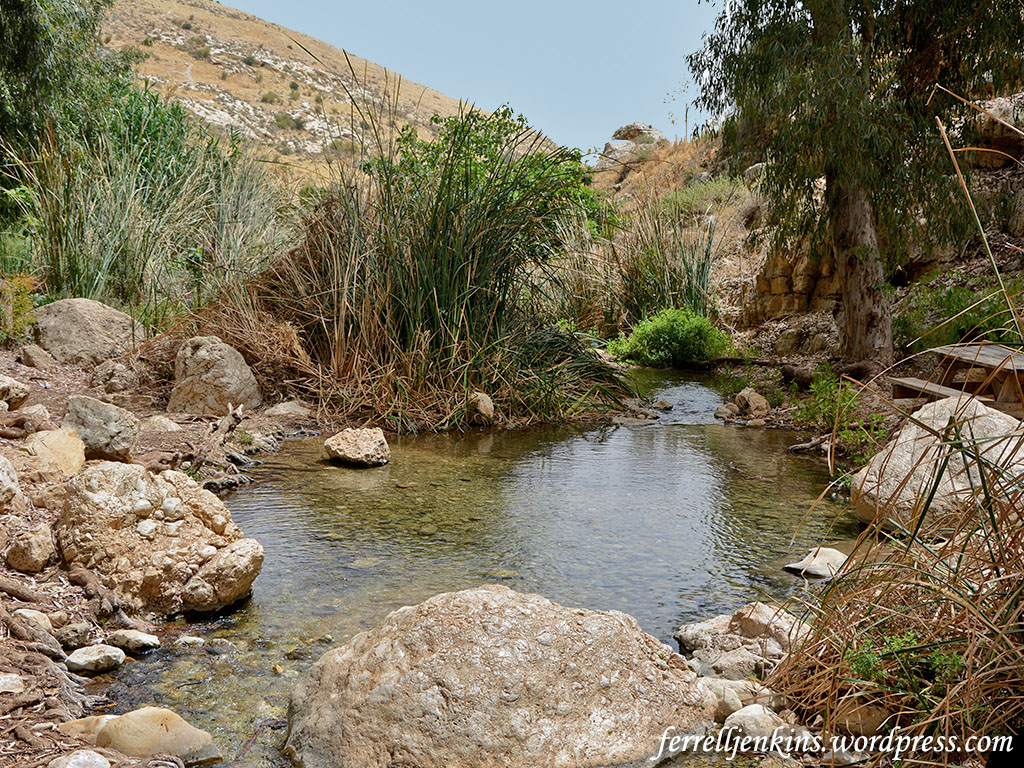
Here is a final photo with a view east. This stream, Nahal Prat, is also known as Wadi Kelt (or Qelt, or Qilt) and flows past Jericho to the Jordan Valley.

En Prat, view east toward the Jordan Valley. Photo by Ferrell Jenkins.

En Prat, view east toward the Jordan Valley. Photo by Ferrell Jenkins.

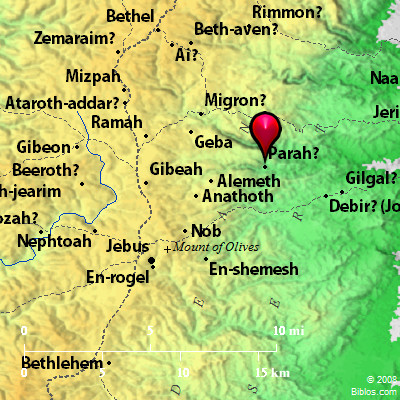
The small map below will show the relation between Jerusalem and Anathoth and En Prat (Perath, Parah).

This map identifies Perath as possibly the site mentioned in Joshua 18:23. Map courtesty of BibleHub.com.

This map identifies Parah as possibly the site mentioned in Joshua 18:23. Map courtesty of BibleHub.com.

The Pictorial Library of Bible Lands, sold by BiblePlaces.com, includes a fabulous selection of photos of En Prat and Wadi Qilt in Vol. 4 – Judah and the Dead Sea.

The Double and Triple Gates of the Temple Mount

In two previous posts I wrote about visiting the Dome of the Rock and the Al-Aksa Mosque. You must know that I learn more from this blog than anyone. That is one of the reason I enjoy preparing it.

In the last post I stated that “There is good reason to believe that both Jesus and the Apostles used this entry to the Temple (Matthew 21:12-13; Acts 3:1).” Mark Hoffman, a professor who writes the helpful Biblical Studies and Technological Tools blog, after leaving nice comment about my post, said,

One question: I was under the impression that the typical pilgrim in Jesus’ time would enter by the triple gates to the right (east) and exit by the double gates to which you draw attention. Do you know if this is correct?

I’m trying to locate the rabbinic reference, but I believe that people who entered by the double gates were mourning or grieving, and by walking up the steps through the double gates, others were made aware of their sorrow.

I began to dig into the sources at hand to see if I could find an answer. Perhaps I had rushed past this information before, but I don’t remember it.

This morning Joseph I. Lauer, who provides so much helpful information that I use on the blog, provided an answer.

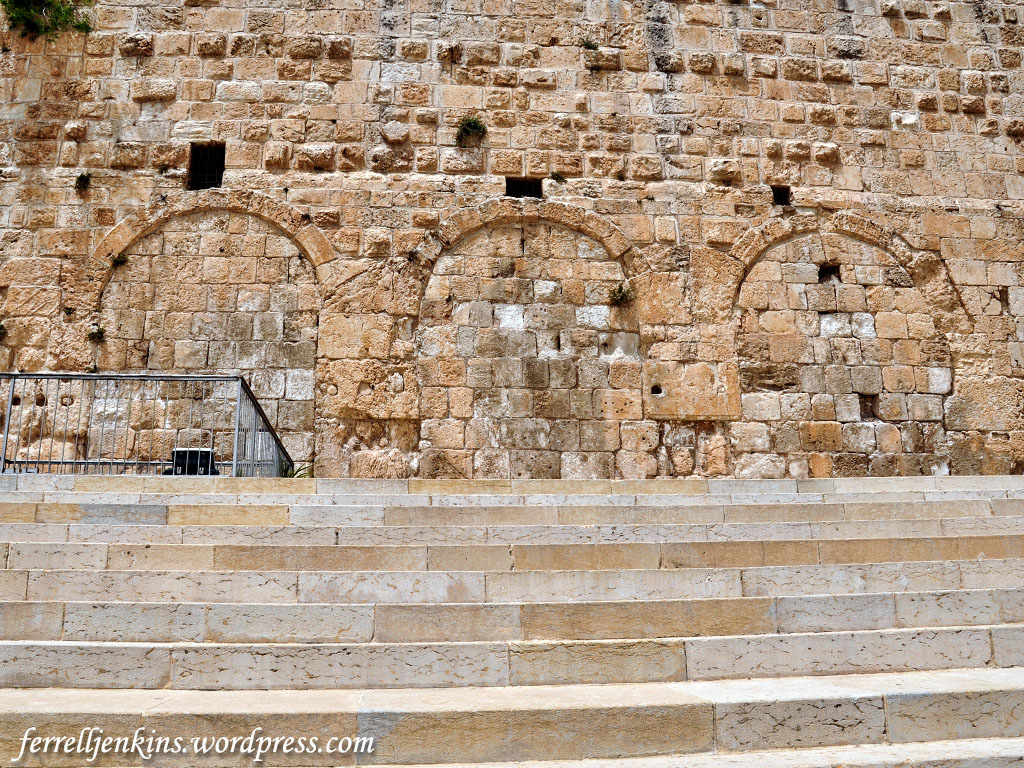
Mishnah Middot 1:3 states in part that “the two Huldah Gates in the south were used for entering and exiting.” Mishnah Middot 2:2 states in part that “All those entering the Temple Mount enter towards the right and circle and exit toward the left, except for one to whom something [adverse] occurred, for he would circle toward the left.” Circling toward the left would indicate to the others that he was a mourner or had been excommunicated.

Most of the Double Gate is covered by a later building, but a small portion of the eastern door jamb can be seen in the left of our photo. Herodian stone work has been found inside the gate. The lower part of a window in the Al Aksa Mosque is visible at the top of the photo. Photo by Ferrell Jenkins.

Most of the Double Gate is covered by a later building, but a small portion of the eastern door jamb can be seen in the left of our photo. Herodian stone work has been found inside the gate. The lower part of a window in the Al Aksa Mosque is visible at the top of the photo. Photo by Ferrell Jenkins.

By this time I had already located that reference and other interpretations of the Mishnah quotation. One source that was helpful was John McRay’s Archaeology and the New Testament.

In the Mishnah it is said that temple worshippers entered on the right and exited on the left. [Middoth 2:2] This statement may relate to the purification process involved. At Qumran, for example, small partitions in the stairways of the ritual baths kept those purified from being defiled by those who were yet unclean. A Talmudic passage refers to Gamaliel (the teacher of the apostle Paul, Acts 22:3) and the elders standing on top of the stairs at the Temple Mount. [Tosepthta Sanhedrin 2:2] Thus, entrance to the Temple Mount may have been through the Double Gates and exit through the Triple Gates. [Middoth 1:3, etc.] (McRay, John. Archaeology and the New Testament. Grand Rapids: Baker, 1991: 107)

Jack Finegan, in The Archaeology of the New Testament, suggests that the Double Gate, on the west, was used both for the “entry and exit of pilgrims,” and that the Triple Gate (on the east) “was used by the priests.”

On the south side of the Temple enclosure may be seen two gates, which are about seventy meters apart and now walled up. They are known as the Double Gate and the Triple Gate. They are usually identified with the gates in the middle on the south side mentioned by Josephus, and with the two Huldah Gates mentioned in Middoth, and they are sometimes called the Western and Eastern Huldah Gates, with the supposition that pilgrims entered the Temple area by the western gate and departed by the eastern gate. An alternate theory supposes that the Double Gate itself provided for entry and exit of pilgrims and was thus itself the two Huldah Gates while the Triple Gate was used by the priests. (Finegan, Jack. The Archaeology of the New Testament. Rev. ed. Princeton: Princeton UP. 1992. 206-207.)

The Triple Gate in the southern wall of the Temple Mount. The gates you see here are much later, but an original Herodian stone is located to the left of the gates. Photo by Ferrell Jenkins.

The Triple Gate in the southern wall of the Temple Mount. The gates you see here are much later, but an original Herodian stone is located to the left of the gates. Photo by Ferrell Jenkins.

I would also like to share one additional comment by Meir Ben-Dov. He begins by discussing why the entry to the Temple would be from the south.

Throughout the ages it was a standard practice to build temples in the highest spot in any given area, so that a visit to the holy site involved “ascent.” The slope to the south of the Temple Mount was the longest and steepest of all the gradients surrounding it; only there was it possible to manifest the idea that the approach to the Temple Mount would be both impressive and steep enough to create the feeling of ascent. This also explains the call in the Bible, “Arise ye, and let us go up to Zion” (Jeremiah 31:6), not in its modern “Zionist” sense but quite literally; for it was addressed to the inhabitants of Jerusalem, most of whom were then living in the City of David, south of and below the Ophel.

After that he proceeds to discuss the southern gates that are the subject of interest here.

The two gates in the southern wall are about 70 meters apart and served the pattern established for entry and exit: “Whoever it was that entered the Temple Mount came in on the right and went around and came out on the left, save any [who have suffered some tragedy], for he went round to the left. ‘What aileth thee that thou goest to the left?’ ‘Because I am a mourner.’ ‘May He that dwelleth in this House give thee comfort’” (Midot Tractate 2:2).

The picture that emerges from this description has the majority of the public entering the compound via the eastern Hulda Gate, walking around the Temple, and exiting through the western Hulda Gate} while a person in mourning that year would walk around the Temple in the opposite direction, entering through the western gate and leaving through the eastern one. This was a fitting custom, for if a visitor to the Temple met anyone walking in the opposite direction – even a perfect stranger he immediately understood that the man had suffered a tragedy, inquired about it, and comforted the mourner in his grief. In this way, a visit to the Temple was personalized and helped to cultivate a sense of national solidarity, which was not common to the temples of other peoples. (Ben-Dov, Meir. In the Shadow of the Temple. Trans. Ina Friedman. Jerusalem: Keter, 1982. 136.)

Thanks to the two gentlemen who stimulated this study. I now leave it to others who may have interest to do additional research and draw their own conclusions.

Visiting the Dome of the Rock

We begin today’s journey with an aerial view of the Temple Mount, the site believed to be the Mount Moriah of the Bible, the location of the Temple of Solomon and the location of the Temple built by Herod the Great. The area underwent a number of changes after the destruction of the temple by the Romans in A.D. 70

Since the late 7th century A.D. the site has been occupied by Moslem shrines, the Dome of the Rock and the Al Aksa Mosque.

Our aerial photo shows the enclosed Islamic sanctuary area that is commonly called the Haram es-Sherif. Benjamin Mazar says that this area is about 40 acres in size. He points out that Josephus and the Mishna give smaller dimensions, and says that they apparently refer to “the Soreg or sacred enclosure” (The Mountain of the Lord, 119-120). Other writers say the area is 36 acres in size. Certainly large enough for the crowds who came to Jerusalem for festivals such as the Passover and Pentecost.

Aerial view of the temple precinct from the time of Herod the Great. Today the area is occupied by Moslem shrines, Al Aksa Mosque and the Mosque of Omar (Dome of the Rock). Photo by Ferrell Jenkins.

Aerial view of the temple precinct from the time of Herod the Great. Today the area is occupied by Moslem shrines, Al Aksa Mosque and the Dome of the Rock. Photo by Ferrell Jenkins.

In this precinct the events of Acts 2, including the first preaching of the Gospel by the apostles of Christ, took place on the first Pentecost after the resurrection of Jesus.

In A Brief Guide to the Dome of the Rock and Al-Haram Al-Sharif, published by the Supreme Awqaf Council (1966), it is stated that the entire area, also known as the Noble Sanctuary, “is the religious center of the Muslims of the Middle East and second only to Mecca in the Muslim World” (p.1). The claim is made that,

The Prophet himself spoke of Al-Aqsa, the original name for the place and, according to tradition, made a miraculous journey to it.

My first visit inside the Dome of the Rock was in April, 1967. It has been a number of years since I have been inside the Dome of the Rock. The beautiful building covers the rock upon which Abraham offered Isaac (Genesis 22), the site of some parts of Solomon’s Temple (2 Chronicles 3:1), and the site of the Temple Jesus visited during his earthly ministry.

This rock was once the threshing floor of Araunah purchased by David as a site upon which he built an altar to the LORD (2 Samuel 24).

The beautiful building now standing in this place is commonly called the Dome of the Rock. Here is an exterior view.

Dome of the Rock exterior. Photo by Ferrell Jenkins.

Dome of the Rock exterior. Photo by Ferrell Jenkins.

When one steps into the building he first sees a circular wall about six feet tall in the center. Drawing close, he peeks over the wall and sees a huge rock, the top of Mount Moriah. This is the centerpiece of the building.

The rock around which the Dome of the Rock is built. Photo by Ferrell Jenkins.

The rock around which the Dome of the Rock is built. Lights and electrical cords are laid out on the Rock. Photo by Ferrell Jenkins.

Leen Ritmeyer, one of the best experts on the Temple, believes that the rock is where Solomon built the Holy of Holies. See his Jerusalem The Temple Mount (published by Carta, 2015), pages 130-135, for details.

Over the rock is a beautiful dome. The interior is pictured here.

The ceiling of the Dome of the Rock. Photo by Ferrell Jenkins.

The ceiling of the Dome of the Rock. Photo by Ferrell Jenkins.

Next, we go to the cave underneath the rock. Ritmeyer says,

Walking round to the south, you reach an opening to an underground cave known as al-Maghara. This was a small natural cave, enlarged by the Crusaders and used to commemorate the angel’s announcement to Zacharias that he would have a son (Luke 1.1 3) . A hole is cut in the rocky ceiling to let the smoke from candles and incense escape (p. 132).

This photo shows the cave and a remnant of the structure built by the Crusaders.

The underground natural cave enlarged by the Crusaders for the construction of a church or chapel to commemorate the announcement to Zacharias (Luke 1:13). Photo by Ferrell Jenkins.

The underground natural cave enlarged by the Crusaders for the construction of a church or chapel to commemorate the announcement to Zacharias (Luke 1:13). Photo by Ferrell Jenkins.

There is much modern history of interest, but I will leave that for your further, individual study.

In a future post we hope to share our visit to the Al Aska Mosque.

The Arch of Titus once had a golden menorah

Many who have visited the Roman Forum have seen the Arch of Titus at the southeast of the Forum. Mark Cartwright describes the Arch in the Ancient History Encycl0pedia here. There are many links within this quotation for those interested in following them.

The Arch of is a Roman Triumphal Arch which was erected by Domitian in c. 81 CE at the foot of the Palatine hill on the Via Sacra in the Forum Romanum, Rome. It commemorates the victories of his father Vespasian and brother Titus in the Jewish War in Judaea (70-71 CE) when the great city of Jerusalem was sacked and the vast riches of its temple plundered. The arch is also a political and religious statement expressing the divinity of the late emperor Titus.

The Arch of Titus in the Roman Forum commemorates the Roman victory of the Jews in A.D. 70. Photo by Ferrell Jenkins.

The Arch of Titus in the Roman Forum commemorates the Roman victory over the Jews in A.D. 70. Photo by Ferrell Jenkins.

The original inscription on the opposite side reads,

SENATUS
POPOLUS QUE ROMANUS
DIVO TITO DIVI VESPASIANI F
VISPASIANO AUGUSTO

The inscription attributes divinity to both Vespasian and his son Titus.

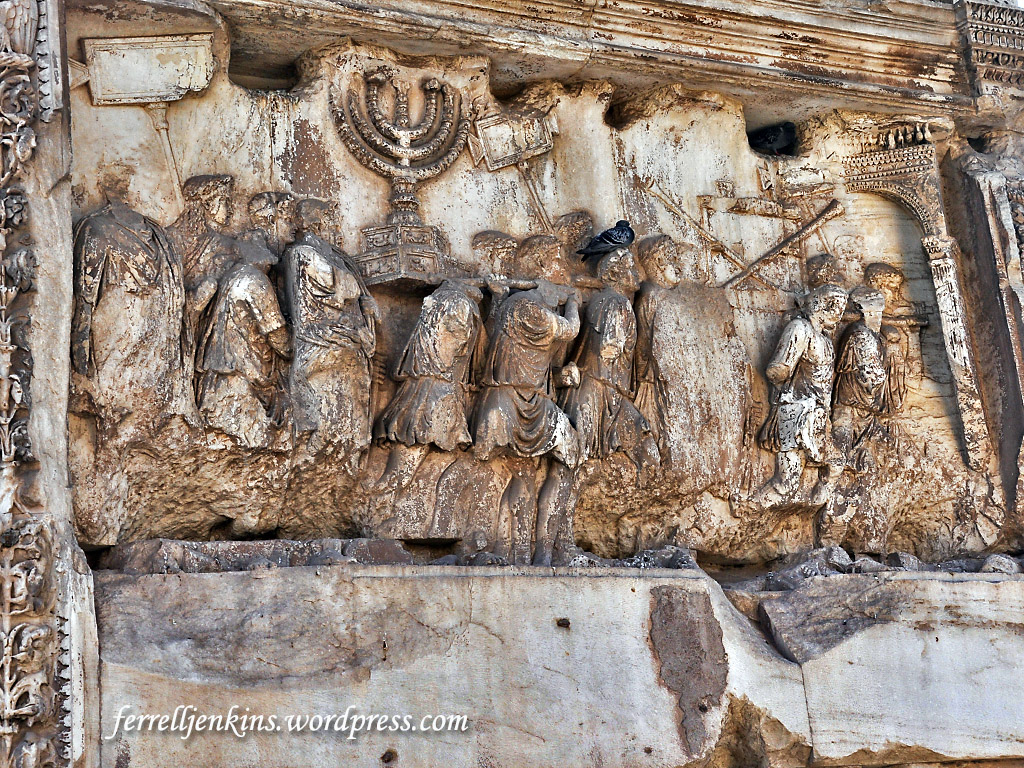
One of the large panels inside the arch shows Roman soldiers parading items taken from the Temple in Jerusalem in triumph through the streets of Rome. You will see the table of showbread, and the Menorah. One of the placards carried by the soldiers mentions the laws of the Jews.

Josephus, the first century Jewish historian, provides a first person account of the procession in Jewish Wars.

… and for the other spoils, they were carried in great plenty. But for those who were taken in the temple of Jerusalem, {c} they made the greatest figure of them all; that is, the golden table of the weight of many talents; the lampstand [Menorah] also, that was made of gold, though its construction was now changed from that which we made use of;
149 for its middle shaft was fixed upon a basis, and the small branches were produced out of it to a great length, having the likeness of a trident in their position, and had everyone a socket made of brass for a lamp at the tops of them. These lamps were in number seven, and represented the dignity of the number seven among the Jews;
150 and the last of all the spoils was carried the Law of the Jews.
151 After these spoils passed by a great many men, carrying the images of Victory, whose structure was entirely either of ivory or of gold.
152 After which Vespasian marched in the first place, and Titus followed him; Domitian also rode along with them, and made a glorious appearance, and rode on a horse that was worthy of admiration. (JW 7:148-152)

Arch of Titus relief showing Roman soldiers carrying the items taken from the Temple in Jerusalem in A.D. 70. Photo by Ferrell Jenkins.

Arch of Titus relief showing Roman soldiers carrying the items taken from the Temple in Jerusalem in A.D. 70. Photo by Ferrell Jenkins.

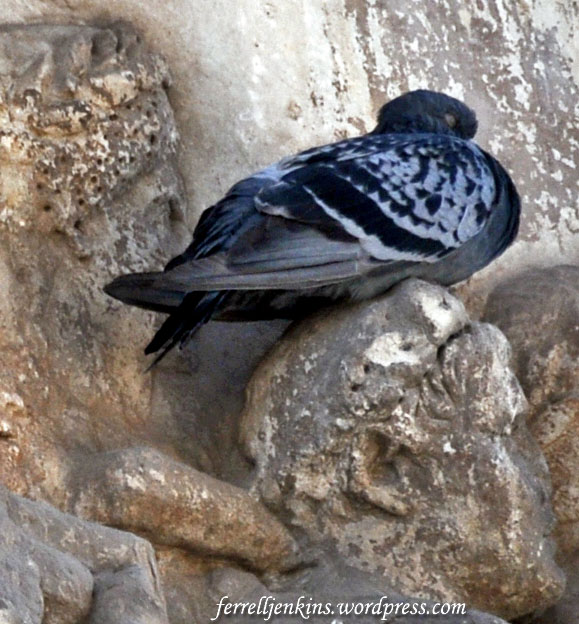
It appears that the first soldier carrying the Menorah on his shoulder is also carrying a pigeon, perhaps for an offering.  <grin>

Live pigeon on head of Roman soldier. Photo by Ferrell Jenkins.

Live pigeon on head of Roman soldier. Photo by Ferrell Jenkins.

For many years Dr. Steven Fine of Yeshiva University has been pursuing his interest in the Menorah. This, of course, led him to the Arch of Titus in Rome where the Menorah is depicted. The most recent results of his study,

includes the Digital Restoration Project, which in 2012 discovered the original yellow polychromy of the Arch menorah; numerous studies of the Arch and its menorah by Professor Fine, an upcoming exhibition and international conference on the Arch organized by Yeshiva University Museum (Summer, 2017), a free online Coursera course, The Arch of Titus: Rome and the Menorah, a 2016 summer seminar in Rome under the auspices of the Schottenstein Honors Program, and courses taught in Revel, Yeshiva College and Stern College.

Take a look at the Arch of Titus in color based on the 3D scan of the reliefs here. You will find a neat video showing the spoils panel in color, and a lecture by Dr. Fine presented at New York’s Metropolitan Museum of Art. There are also links to various articles about the project.

The emblem of the State of Israel is based on the Menorah depicted on the Arch of Titus.