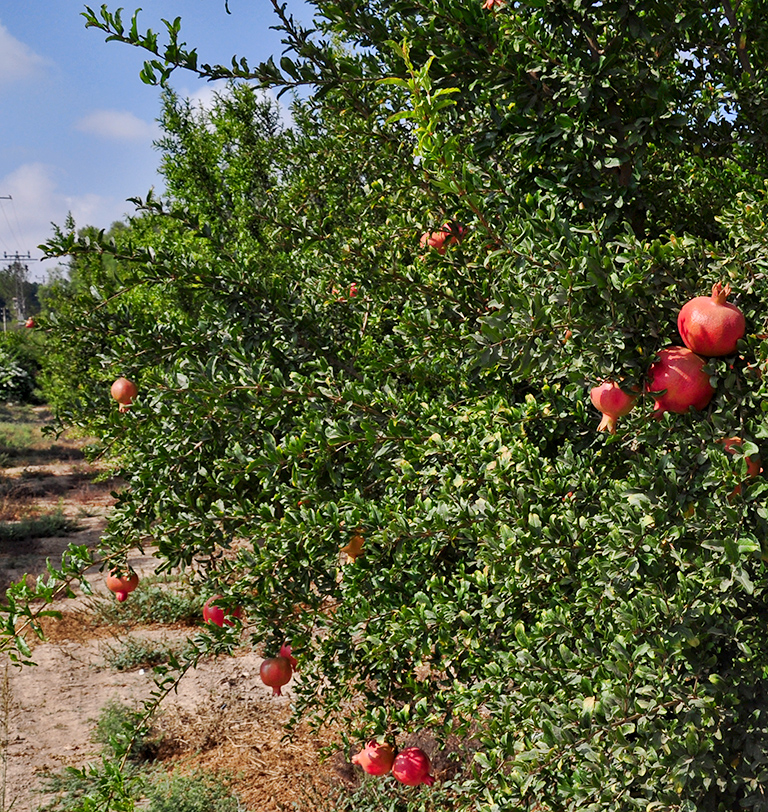
The Pomegranate was a popular fruit in Bible times. The ancient Israelites were promised “a land of wheat and barley, of vines and fig trees and pomegranates, a land of olive trees and honey” (Deuteronomy 8:8 ESV).
Our photo below shows the Pomegranate growing at Lachish in modern times.
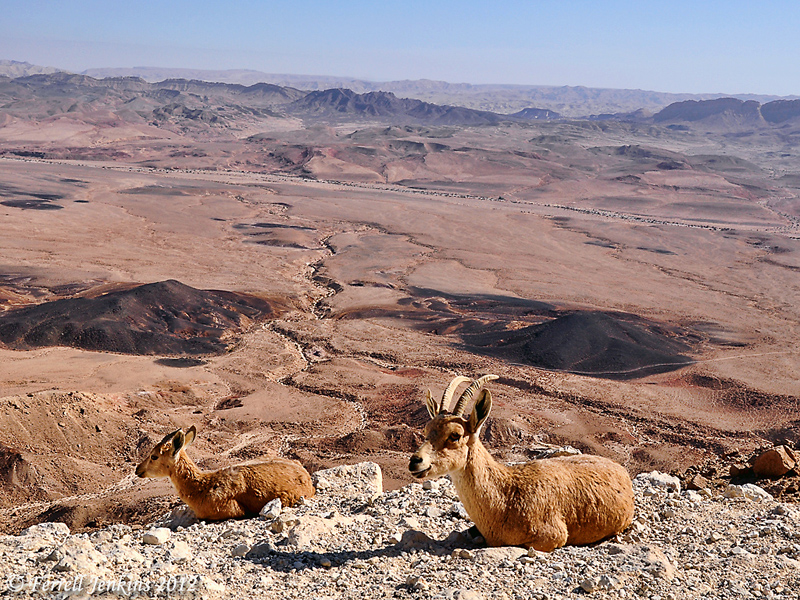
Ibex enjoy the view at Mitzpe Ramon, Israel, in the Wilderness of Zin. These two Ibex are lying on the edge of a steep cliff over a major highway below. Use the blog Search box to locate more photos of Ibex and additional information. Photo by Ferrell Jenkins.
Ibex enjoy the view at Mitzpe Ramon in the Wilderness of Zin. Photo by Ferrell Jenkins
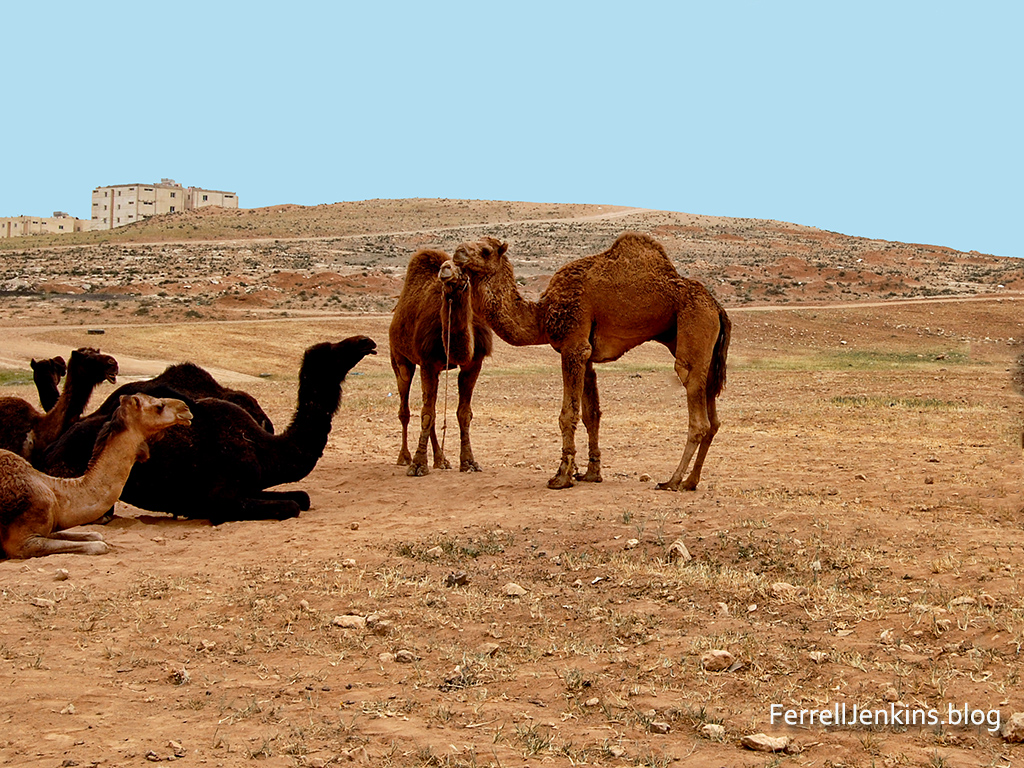
The site of Ramoth Gilead is located in northern Jordan near the Syrian border. The exact site is uncertain, but many scholars think Tall ar-Rumeith is to be identified with the biblical site. Ahab, king of ancient Israel, was concerned because the town of Ramoth Gilead which he claimed for the northern kingdom of Israel was controlled by Syria. Jehoshaphat, the king of Judah, agreed to go with Ahab to fight for Ramoth Gilead.
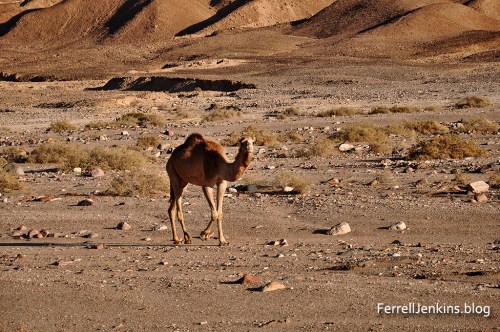
Camels in the foreground of the site possibly identified with Ramoth Gilead.
The prophets of the day seemed to be indebted to the kings and like good politicians assured them they would prosper in their effort to take the city. One prophet, a man named Micaiah came and told the king that he would not prosper. Micaiah said that he could only speak what the LORD told him.
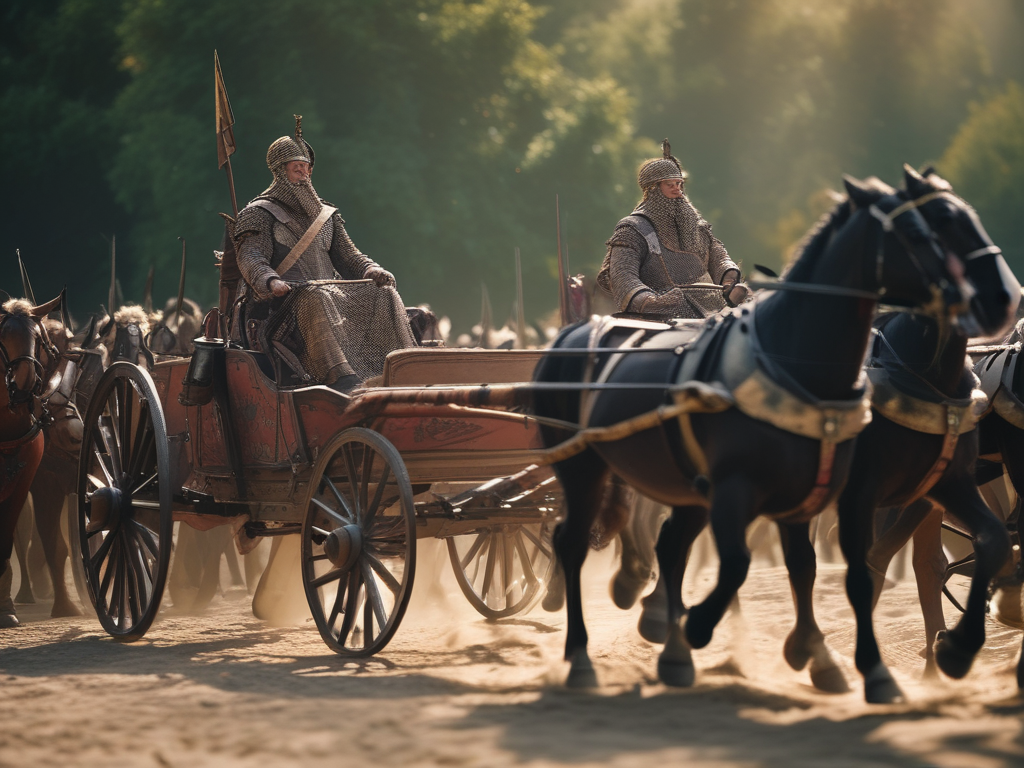
AI imagines that King Ahab looked something like this when he headed into battle.
When the kings arrived at Ramoth Gilead Ahab disguised himself and went into battle. He had convinced Jehoshaphat to put on his robes and go into battle. When the Syrian captains saw him, thinking he was Ahab, they went after him. When they saw it was not Ahab they turned back.
The Biblical record says that a “certain man drew his bow at random, and struck the King of Israel between the joins of his armor.” The soldiers of Israel propped up the king in his chariot and he died that evening. Ahab was taken back to Samaria for burial.
No amount of disguise can hide one from the LORD. This is another events that shows that the LORD rules in the kingdoms of men.
Read 1 Kings 22 for the full account of this event.
The arrogance of rulers frequently is given as a reason for God’s judgment upon the nations they rule. Notice first the example of ancient Egypt.
“Son of man, set your face against Pharaoh king of Egypt, and prophesy against him and against all Egypt; speak, and say, Thus says the Lord GOD: “Behold, I am against you, Pharaoh king of Egypt, the great dragon that lies in the midst of his streams, that says, ‘My Nile is my own; I made it for myself. (Ezekiel 29:2-3)
The Lord prophesied that (ancient) Egypt would become the lowest of the kingdoms (Ezekiel29:14-15). I have a lesson on the prophecies against Egypt in Introduction to Christian Evidences. All of my books are available from the Florida College Bookstore in Temple Terrace, FL (813-988-5131).
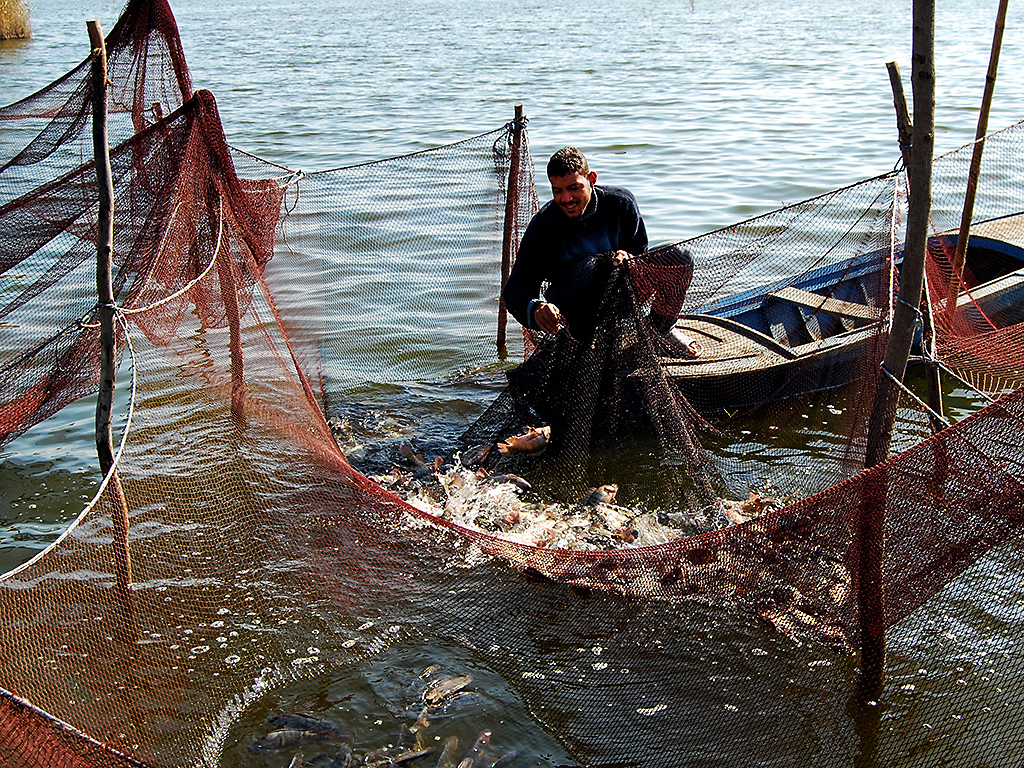
Fisherman in the Nile River south of Alexandria, Egypt. (C)FERRELL JENKINS 2008
The book of Habakkuk mentions a time when Edom (descendants of Esau). failed to come to the aid of Jacob (Israel) when they were under attack. Remember that Jacob and Esau were brothers.
When the prophet Habakkuk learned that the LORD was raising up the Chaldeans (the Babylonian Empire) against Edom, the prophet was puzzled that this could happen. In essence he said, “The Chaldeans are more wicked than the Edomites.” The LORD told Habakkuk that he would bring judgment upon the nations that failed to serve Him. That event was called the Day of the Lord (Habakkuk 1:15) or the Day of Jehovah. (ESV) or the Day of the LORD” (NAS, NKJ).
The Day of the Lord is described in highly figurative language in the Bible. It is a day when the mountains shake, when the rivers flood, the sun is darkened and the moon turns to blood. It is not the final judgment, but the judgment of nations. The prophet Obadiah spoke against Edom. Notice these words:
The vision of Obadiah. Thus says the Lord GOD concerning Edom: We have heard a report from the LORD, and a messenger has been sent among the nations: “Rise up! Let us rise against her for battle!” 2 Behold, I will make you small among the nations; you shall be utterly despised. 3 The pride of your heart has deceived you, you who live in the clefts of the rock, in your lofty dwelling, who say in your heart, “Who will bring me down to the ground?” 4 Though you soar aloft like the eagle, though your nest is set among the stars, from there I will bring you down, declares the LORD. (Obadiah1:1-4 ESV)
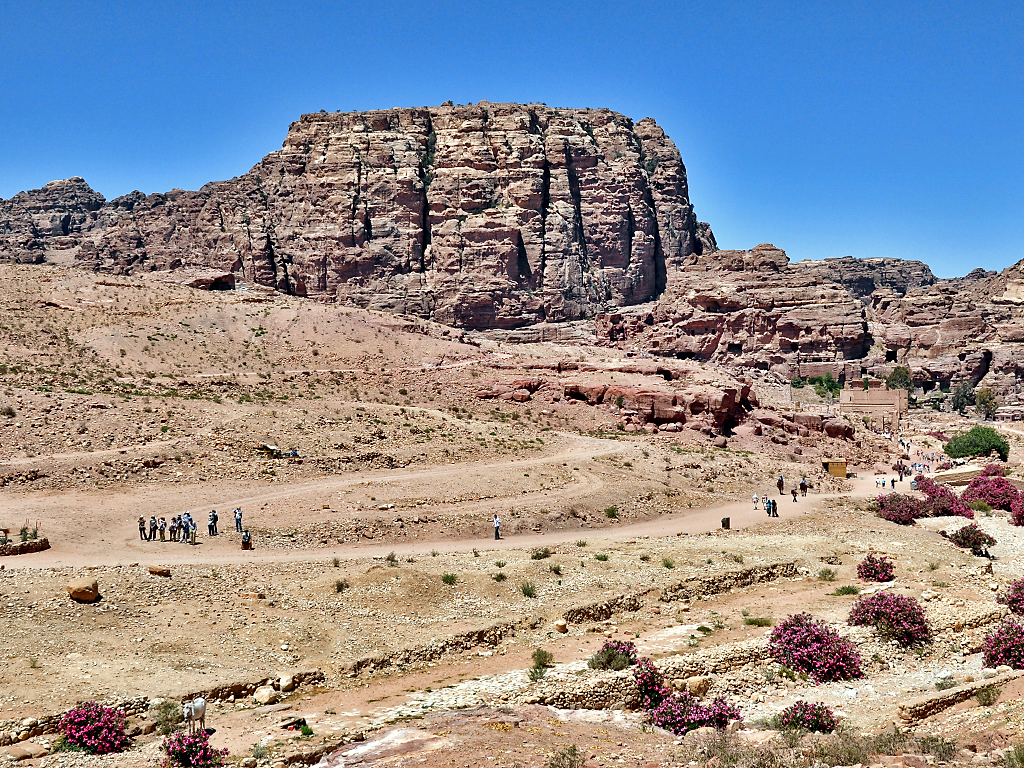
The site of Umm el Biyarah at Petra, Jordan. This was the fortress of the ancient Edomites Photo (c) Ferrell Jenkins.
Homer Hailey, my beloved college professor who first introduced me to the prophets, often said “God judges nations in time and individuals in eternity.”
The LORD used Assyria to punish the northern kingdom of Israel in 722 BC. Through the prophet Isaiah he said that he still held the Assyrians accountable (Isaiah 10:12).
The Assyrians were brought down by the Babylonians who also brought down the Egyptians (Ezekiel 29:17-30).
Am I able to say that a given conflict on this globe is the Day of the Lord? Since I do not have a “thus saith the Lord” in these cases I will not be dogmatic, but I think frequently about this clear biblical teaching.
In the gospels one may find several references or allusions to events of the wilderness wandering. This indicates the significance of the event and suggests that it should be studied carefully by Christians as well as Jews.
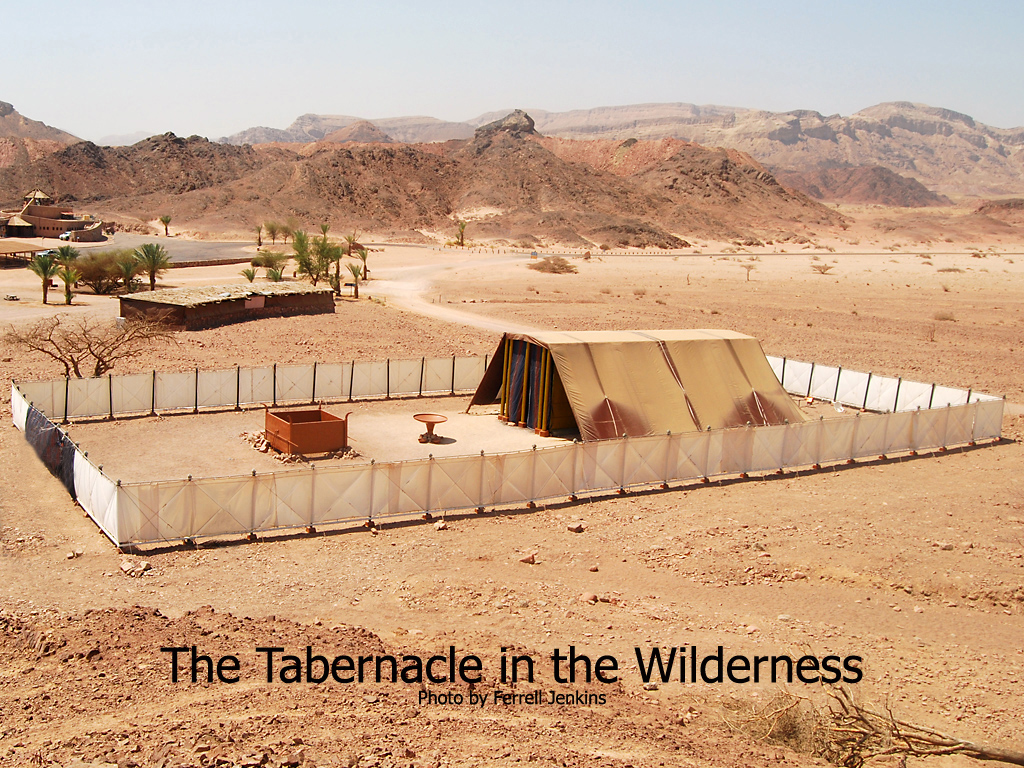
“The Word became flesh and dwelt [tented, tabernacled] among us…” (Jn. 1:14). The Lord made His presence known to the Israelites in the “tent of meeting” (the tabernacle; Ex. 29:45-46).
The Law was given through Moses [in the wilderness] (Jn. 1:17).
The serpent in the wilderness (Jn. 3:14ff.; cf. 8:28; 12:32).
The manna (Jn. 6:31ff.; notice the “grumbling” over the bread, vs. 41).
The water (Jn. 7:37-38).
Jesus was tempted in the wilderness by the devil. (Mt. 4:1-11).
Jesus fasted for 40 days and 40 nights (cf. Israel’s 40 years).
Jesus was tempted but did not succumb.
In response to the temptations of the devil Jesus quoted from the book of Deuteronomy (Mt. 4:4;
Dt. 8:3; Mt. 4:7; Dt. 6:16; Mt. 4:10; Dt. 6:13).
Stephen made several references to the events of the wilderness in his sermon (Acts
7:30-44).
Paul calls attention to the exodus and events of the wilderness wandering (Acts 13:18; Gal. 4:21-31). Notice his use of the phrase, “Remove the wicked man from among yourselves” (1 Cor. 5:13; cf. Dt. 13:5, the false prophet; 17:7, the one who served other gods; 17:12, one who acts presumptuously; 21:21, the rebellious son; 22:21, a girl not found a virgin).
Israel was baptized, ate spiritual food and drank spiritual drink, but practiced idolatry and immorality and fell (1 Cor. 10:1-13). Compare the situation at Corinth: Christians who had been baptized, ate and drank the Lord’s supper, were tempted by the idolatry (meat sacrificed to idols) and immorality of their city.
The Writer of Hebrews speaks of events of the wilderness wandering.
The events at Mount Sinai (Heb. 12:18-29). The word spoken through angels (2:2; cf. Gal. 3:19).
The unfaithfulness of Israel in the wilderness (Heb. 3–4).
In the book of Revelation.
“See…that you make all things according to the pattern which was shown you on the mountain” (Heb. 8:5; Ex. 25:40, the building of the tabernacle).
The woman who gave birth to the man child fled into the wilderness where she was nourished (Rev. 12:6). This symbol makes the wilderness a place of protection and nourishing. The figure seems to be based on the experience of the nation of Israel and of Elijah (1 Kings 19:1-18) as they were cared for by the Lord.
Some of the trumpets of chapters 8-10 are drawn from the plagues of Egypt. The one like a son of man came on a white cloud (cf. Isa. 19:1, judgment of Egypt) and judged the enemy (Rev. 14:14-20). The saints sing the song of Moses and the Lamb beside the sea (Rev. 15; cf. Ex. 14:31; 15:1-19).
At the top of our home page, we have a link to INDEXES (INDICES). There, occasionally I have included a collection of posts on a specific subject. If you have not used this feature of the blog, I suggest you take a look.
Specifically, I am calling attention to the INDEX: Route of the Exodus and the Location of Mount Sinai. Click on the link below to visit that page which includes many photos pertaining to the exodus and Mount Sinai.
Recently I observed on a social media site a discussion conducted by several young preachers. One was asking others what they thought about the location of Mount Sinai. A few days ago I received a note from an older former student about a column that some are calling Solomon’s Post or Pillar. I have learned enough about archaeology to know that an artifact must have a context. One random stone is not enough to build a legitimate conclusion. What archaeological excavation has determined the origin and provenance of the stone post? What ancient document has mentioned the post? What evidence do we have that it is in any way associated with Israelite King Solomon?
One respondent in the exchange on social media did call attention to the articles on my blog, but mostly they each were giving their opinion. The thing that really got my attention what that not one of them referenced a Bible dictionary or Bible encyclopedia. No one called attention to a Bible Atlas. When I was in college and several students gathered in a room to pool our ignorance we called it Shooting the Bull.
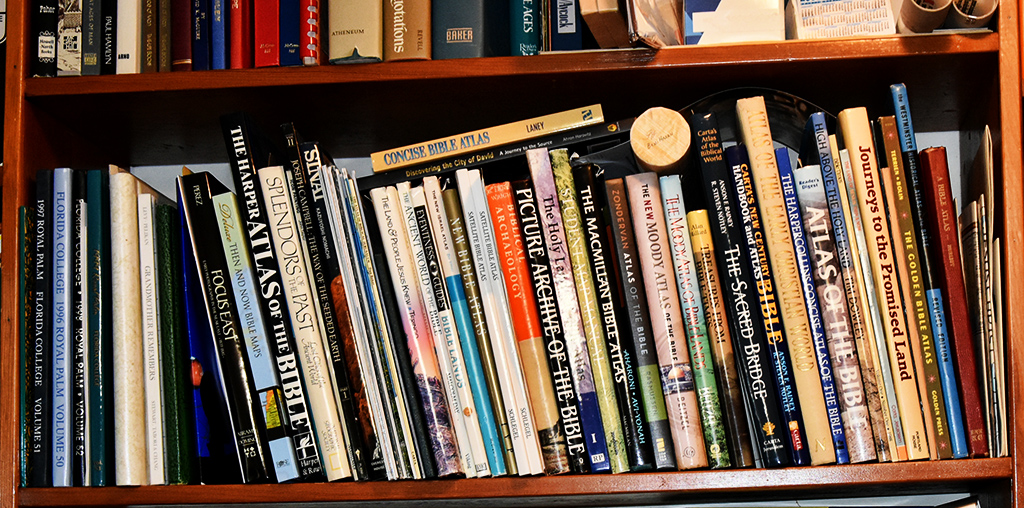
Most of my Bible Atlases.
Most of my Bible Atlases can be seen in this photo, but I have some others in digital format, and I do have several other smaller atlases on different shelves. Over half a century of travel to the Bible lands might explain why I have collected so many atlases as well as numerous road atlases and maps. Every preacher/teacher needs a few good Bible Atlases.
Gordon Franz at ETS annual conference.
Some scholars concentrate on certain areas of study and produce good material. Here I call attention to the work of Gordon Franz. He has written several essays under the category of Cracked Pot Archaeology at https://www.lifeandland.org/category/cracked-pot-archaeology/
His article on “Where is Mount Sinai in Arabia (Galatians 4:25)? Is especially helpful. Franz documents the view that the region commonly called Sinai was known as Arabia in Roman times:
Also check the article, MT. SINAI IS NOT AT JEBEL EL-LAWZ IN SAUDI ARABIA.
When you arrive at the Life and Land page search for Saudi Arabia. The site will return links for several articles.
Many of the articles written by Gordon Franz are available on the ABR (Associates for Biblical Research) web site. Go there and search for Mount Sinai. Use the link below to visit this site.
Franz exposes the claims of the late Ron Wyatt and Robert Cornuke pertaining to several biblical events.
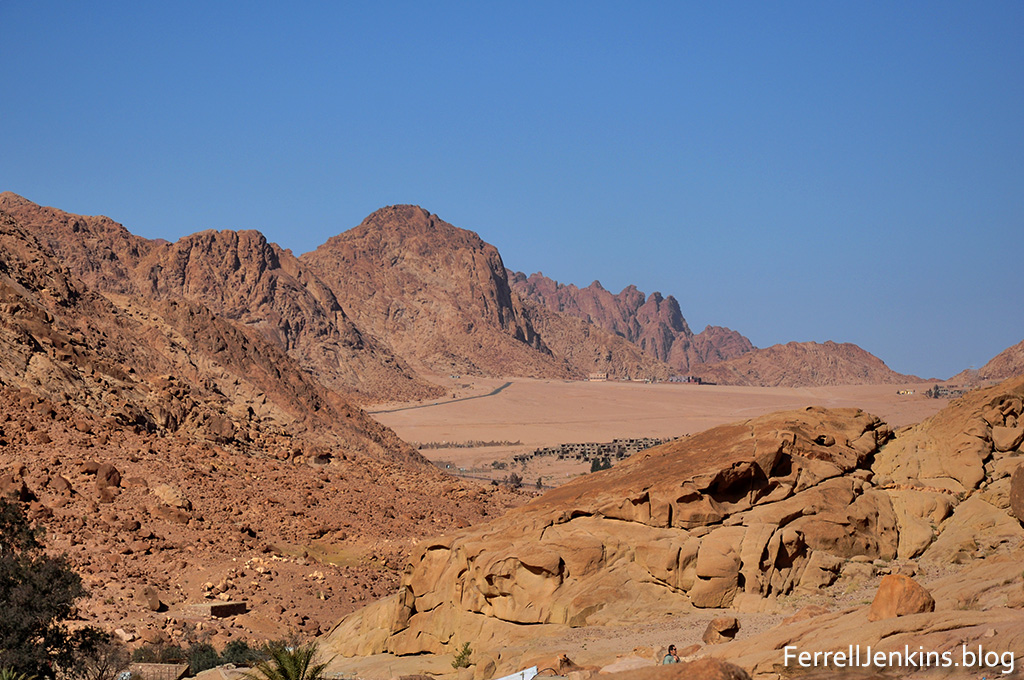
This is on the way to Mount Sinai which is still a distance to the east (left), Photo by Ferrell Jenkins
Carl Rasmussen says there are at “at least ten different proposals for the location of the Red Sea or Reed Sea including three lakes near the Mediterranean Sea, five lakes along the line of the present-day Suez Canal, as well as the Gulf of Suez and the Gulf of Elath. In addition, there are at least twelve different candidates for Mount Sinai: five in the southern part of the peninsula, four in the north, one in the center, one in Midian (Saudi Arabia), and another in Edom (southern Transjordan). (Zondervan Atlas of the Bible Revised Edition. 105).
The following map is part of a collection by David at BibleMapper now numbering 165. You may access this wonderful resource here.
BibleMapper shows no less than 10 candidates for the location of the Biblical Mount Sinai.
Anson F. Rainey was considered one of the top scholars on matters of Old Testament geography. I am pleased to have an autographed copy of The Sacred Bridge which was written by Anson Rainey (OT) and Steven Notley (NT).
Rainey’s comment on this matter is on page 120 of The Sacred Bridge. “Mount Sinai = Horeb = Mount Paran. The wilderness itinerary (Num 33:1–49) seems to point to a location for Mount Sinai in the southern Sinai Peninsula. Mount Sinai (סִינַי) is mentioned fifteen times in the books of Exodus, Leviticus, and Numbers as the place where the people of Israel received the revelation of the Torah. Poetic passages (e.g. Judg 5:5; Ps 68:9 [Eng. 8; note also v. 18 = Eng. 17]) depict it as the dwelling place of YHWH. Two call it Mount Paran (הַר פָּארָן; Deut 33:2; Hab 3:3). The steppe land (wilderness) of Paran (מִדְבַּר פָּארָן; e.g. Num 10:12; 12:16; 13:3) seems to be the generic name for the main Sinai expanses of which there are various subdivisions. Its name may be preserved in that of the oasis of Feirân known as Φαραν in Byzantine sources (Aharoni 1979:199). In Numbers 10:33 Sinai is called “the mountain of YHWH.” Seventeen times in the Hebrew Bible, especially throughout Deuteronomy and three passages in Exodus (3:1; 17:6; 33:6) and elsewhere (1 Kgs 8:9; 19:8; 2 Chr 5:10; Ps 106:9; Mal 3:22), the name Horeb (חֹרֵב) is used, evidently for the same place.” He also reminds us that several passages mention the mountain of God.
The Rest. This is suggested as the large expanse near Sinai where the Israelites camped before receiving the ten commandments.
In conclusion, I am writing this post in an effort to encourage all preachers and teachers to study more widely and deeper. I am aware that books are extremely expensive these days and many churches do not take into account this peculiar expense that ministers have. Perhaps this word to the sufficient is wise.
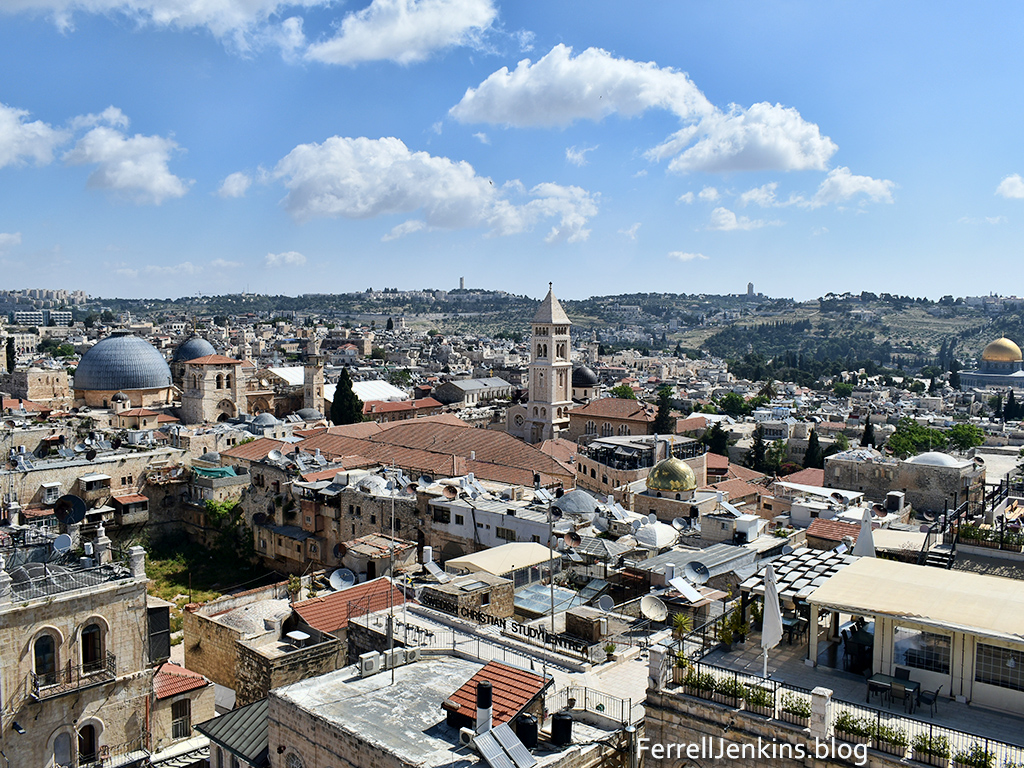
The climb to the roof of the Citadel, also known as the Tower of David, is worth the climb just to see the roof tops of various significance buildings. The Citadel is located at Jaffa [Joppa] Gate which serves as the main entry to the Old City of Jerusalem on the west side of the walled city.
Our photo looks northeast.
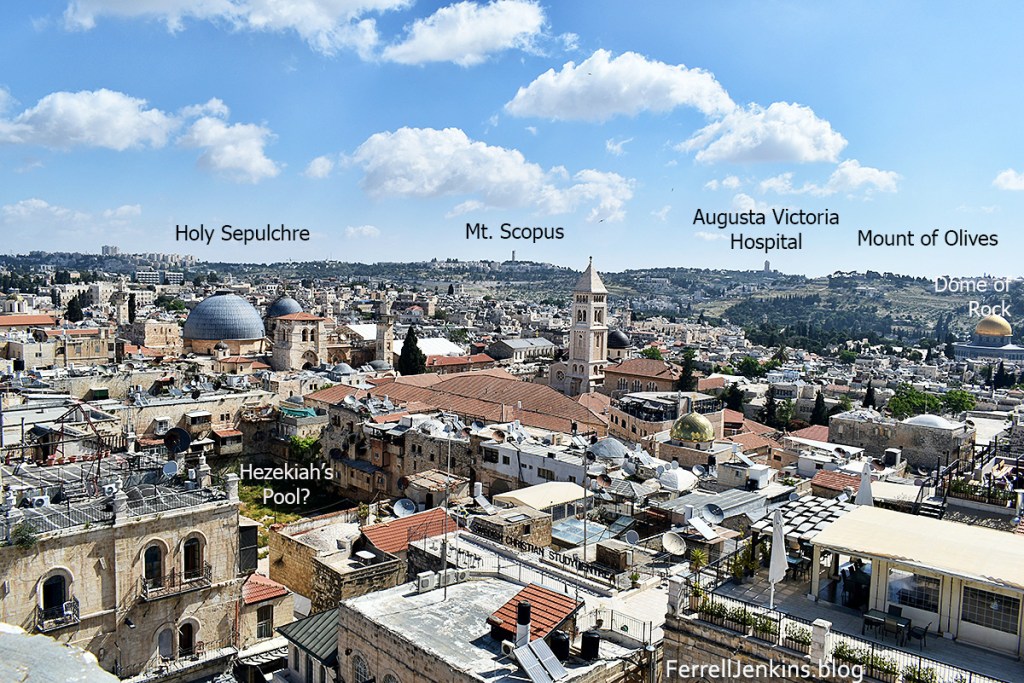
In a second photo I have placed identifying names on many of the highlights. Remember that you may download these photos for use in your Bible teaching. I had trouble uploading the second photo to WordPress, but you can see it in larger format by right clicking on it to open it.
Beginning left to right here is a list of some of the significant places shown on the photo.
Hezekiah’s Pool. Whether this pool had anything to do with King Hezekiah is unknown. Josephus identified it by the name Amygdalon, a place where the 10th Roman Legion was active in A.D. 70 (Wars, 5:468).
The Holy Sepulchre. This site has marked the location of Golgotha (the smaller dome) and of the burial of Jesus (the larger dome) since the early 4th century A.D.
The tower of the Lutheran Church of the Redeemer is the white tower with a pyramidal top. It is also possible to climb to the top of that tower.
At this point look to the North (left) on the horizon where you will see Mount Scopus, the place from which Alexander the Great scoped the city. Today this is the home of the Hebrew University. Continue along the mountain top right to the tower of the Victoria Augusta Hospital. Continue to the south (right) and you will see the Mosque of Omar, more commonly known as the Dome of the Rock. This site sits very near where Solomon’s Temple was built. The hill to the east of the Temple Mount is the Mount of Olives. If I had been using a slightly wider lens we would have a photo of the Tower of Ascension which is near Bethphage and Bethany.
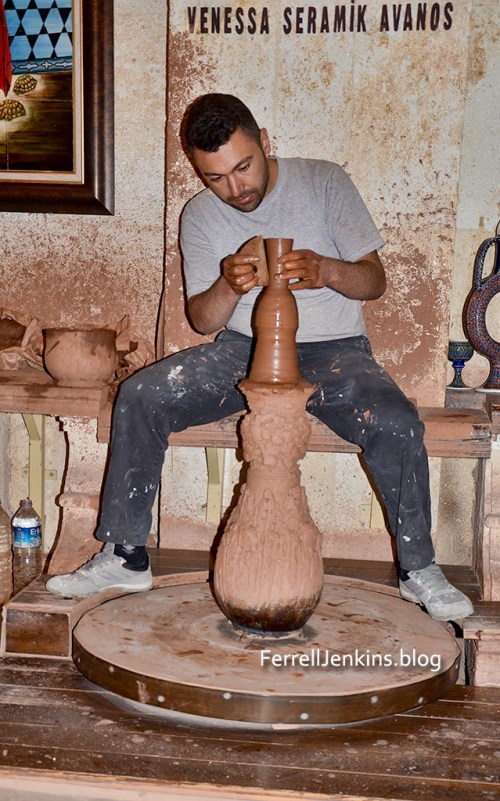
Throughout the modern lands that we often refer to as the Bible World groups are taken to a shop where they see a potter at work making pottery typical of ancient pottery. The resulting pottery is often decorated, etc. to make it sell for more than a simple pot. The town of Avonos, Turkey, is noted for it potters. In our photo you see the potter molding the clay into the vessel of his choice.
The prophet Isaiah reminds us all that the LORD God is the potter and we are the clay. He has given us free will and this means that we must choose to allow Him to make us as he wishes.
But now, O LORD, you are our Father; we are the clay, and you are our potter; we are all the work of your hand (Isaiah 64:8).
An experience with AI.
AI is all the rage in our society. Well, today WordPress allowed AI [Artificial Intelligence] to tell me how I should have written this blog. I thought of some of the things suggested in the AI comment, but had specifically chosen not to write that way. I am hoping that I will classify as not a complete dummy. But I thought you might enjoy reading the AI suggestions.
AI Assistant
The content explains the process of pottery making and relates it to the analogy of God being the potter and us being the clay. The use of the photo is a nice visual addition. However, the feedback could be improved by adding more depth and analysis to the topic. Here are some suggestions to enhance the content:
1. Provide more historical context: Explain the significance of pottery in ancient cultures and how it was an essential part of their daily lives.
2. Elaborate on the analogy: Explore the deeper meaning behind the analogy of God as the potter and us as the clay. Discuss how this relates to our relationship with God and the concept of surrendering to His will.
3. Include biblical references: In addition to Isaiah 64:8, reference other passages in the Bible that highlight God’s role as the potter and how it is relevant to our lives today.
4. Offer personal reflections: Share personal anecdotes or stories that illustrate the transformative power of God working in our lives and shaping us according to His purpose.
5. Connect with the reader: Provide practical insights on how readers can allow God to mold them and align their lives with His plans.
By expanding on these points, the content will become more engaging and insightful for the readers.
– – – – – – – – – – – – – – – – – – – – – –
Now, for those who read through the additional AI comments, you can let me know which you prefer today. Leave a brief comment to say if you liked FJ or AI.
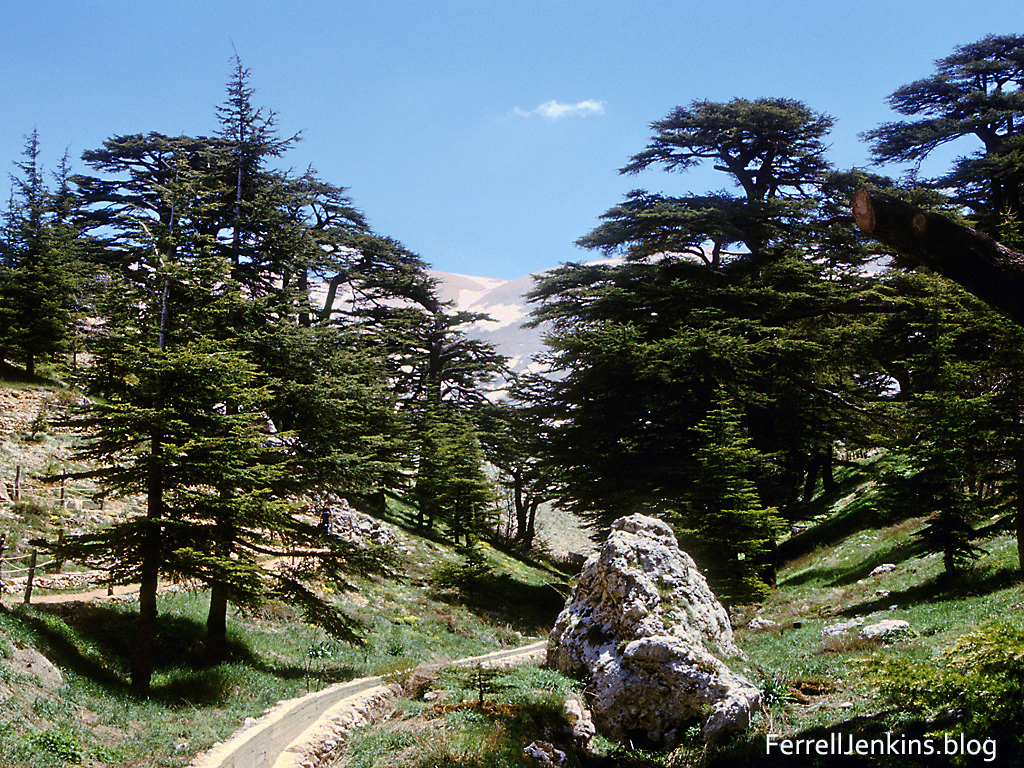
My first trip to Lebanon was in May, 1968. At that time I was able to visit several of the historic places that I had read about in the Bible and other sources. These included Tyre and Sidon, Byblos, and the Cedars of Lebanon.
The Cedars are about 75 miles north of Beirut on a mountainous road and not included on my second Bible Lands Tour. But we had a half day free to visit as we wished. My wife Elizabeth and I were joined by Louis and Margie Garret, co-workers at Florida College, and Joe Corley who had come all the way from Lethbridge, Alberta, Canada to join the tour. We had met Joe and his family earlier when I preached there a year or two earlier. We crowded into a taxi willing to take us to the Cedars.
A couple of days ago I located a slide I made on Agfachrome film during that visit. I hope you will enjoy it about half as much as I enjoyed seeing it again.
There are numerous biblical references to the cedars, but I wanted to mention just one reference today.
About 1040 BC King Solomon, the new king of Israel, requested cedars from King Hiram of Tyre in Lebanon for use in building the temple in Jerusalem. If you have visited Israel or read about the buildings you know that most of them are made of stone. Wood for various purposes had to be brought from other places.
Now therefore command that cedars of Lebanon be cut for me. And my servants will join your servants, and I will pay you for your servants such wages as you set, for you know that there is no one among us who knows how to cut timber like the Sidonians” (1 Kings 5:6 ESV).
Over the years we have posted several articles about the Cedars of Lebanon. To access these just put Cedars of Lebanon in the Search box. Think of the blog as a mini-dictionary where you can find information about various Bible places and customs.




 Ferrell's Travel Blog
You must be logged in to post a comment.