Category Archives: New Testament

Sinaitic Manuscript now online (with some problems)

The AP news release about the Sinaitic Manuscript can be read here [now broken]. The release correctly points out that the manuscript from the fourth century is the oldest complete New Testament. Of course, we have manuscripts of portions of the New Testament from the early second century.

The British Library says the full text of the Codex Sinaiticus will be available to Web users by next July, digitally reconnecting parts that are held in Britain, Russia, Germany and a monastery in Egypt’s Sinai Desert.

It is significant that all parties owning portions of the manuscript have agreed to work together to make the material available online. In the past I have made a few photos of the open pages of the manuscript in the British Museum. But with the glare of the glass it was always difficult to get a good photo. More recently the British Museum manuscript has been displayed in the new British Library, but in a dimly lit room.

Now you eventually will be able to read the manuscript online. The manuscript includes some portions of the Old Testament, too. To illustrate the high quality of the manuscript I am posting a photo of the first few lines of the Lamentation of Jeremiah over the destruction of Jerusalem by the Babylonians in 586 B.C. This is from a manuscript in Leipzig.
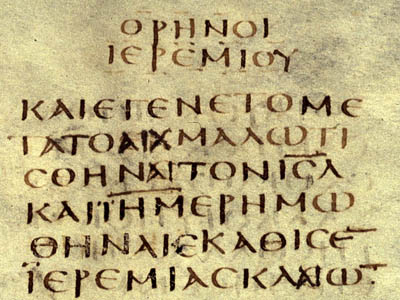
Notice that the words for Israel and Jerusalem are abbreviated. They are the words with the line over them. The name of Jeremiah is seen in the last line.

The first release of the Codex Sinaiticus Project went online a few minutes ago here. The only New Testament book in the present collection is Mark. At the moment the page is not behaving correctly, but I think that will be corrected in time. I am unable to see the image of the MS, but the transcription shows up fine. Take a look, and be patient. You will find some valuable information about the manuscript and the project.

I think I am getting a message saying the system is out of memory. Try later after the crowd leaves home!
Saint Catherine’s Monastery

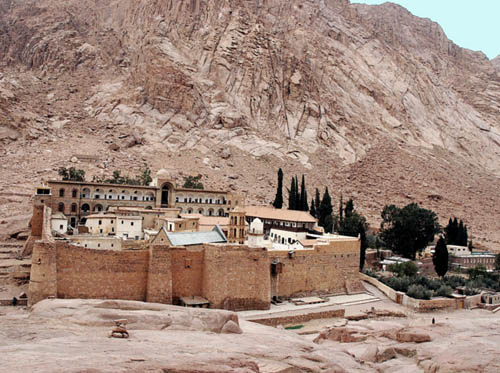
The Monastery of St. Catherine is located at an altitude of about 4925 feet in the Wadi el-Deir at the foot of Gebel Musa. Tradition identifies this as the site where Moses tended the flocks of Jethro and saw the burning bush (Exodus 3:1-4:17). The Monastery was built near the middle of the sixth century A.D. during the reign of the emperor Justinian. It is dedicated to Saint Catherine of Alexandria and is the oldest continuously inhabited convent in the Christian world. Through the centuries many monks have lived there; today it houses fewer than a dozen Greek Orthodox monks.

The monastery became a great center of over 3000 old manuscripts and over 2000 icons. Only the Vatican library has more manuscripts. The Sinaitic Manuscript (Aleph) of the Bible was discovered by Constantine Tischendorff in 1844. The Sinaitic is the oldest surviving complete manuscript of the New Testament (about 350 A.D.). In 1975 the monks at the monastery found a large number of previously unknown documents. (One interesting recent book dealing with the monastery and its manuscripts is Secrets of Mount Sinai by James Bentley.)The bedouin who work at the Monastery are called Jabaliye (Arabic for People of the Mountain).

“According to their tradition they are descendants of Christian slaves who were brought here by Emperor Justinian from Wallachia, today Rumania, as builders of the monastery and later its guards. In the course of time, when Sinai came under strict Moslem rule they were compelled to embrace Islam” (Vilnay, The Guide to Israel, 564).

There is a mosque within the monastery walls.

I have had an opportunity to visit the area of Gebel Musa a few fimes, and to visit the monastery a couple of times. Here is a photo of the monastery that I made on my last visit to the area in 2005.

Saint Catherine's Monastery

Absalom, John the Baptist, and Zechariah

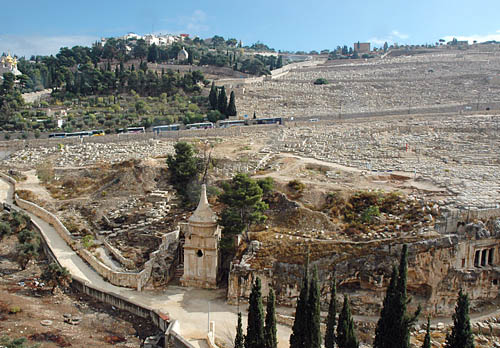
The Kidron Valley in Jerusalem has several ancient tombs in it. The Bible records that Absalom, son of King David, built a monument for himself in the King’s Valley.

Now Absalom in his lifetime had taken and set up for himself the pillar that is in the King’s Valley, for he said, “I have no son to keep my name in remembrance.” He called the pillar after his own name, and it is called Absalom’s monument to this day. (2 Samuel 18:18 ESV)

The so-called Absalmon's Monument in the Kidron Valley

In AD 1170 Benjamin of Tudela associated one of the monuments in the Kidron Valley with the monument of Absalom. The monument actually belongs to the early first century B.C. It is a funerary monument in front of an eight-chambered tomb.

Joe Zias, of Hebrew University, was able to locate an inscription on the right side of the monument in 2002. The inscription is written in Byzantine Greek of the fourth century AD and reads,

This is the tomb of Zacharias, martyr, very pious priest, father of John.

Could this be the priest Zacharias (also spelled Zechariah in English versions) who was the father of John the Baptist? I think the best we can do is agree with Murphy-O’Connor,

Such Byzantine identifications reflect the piety of the period and have no historical value.

John the Baptist at Machaerus

All four of the Gospels make some reference to the imprisonment of John the Baptist (Matthew 14:3,10; Mark 6:17; Luke 3:20; John 3:24). This must have been a significant and traumatic event for both the disciples of John and the disciples of Jesus.

Mark, the shortest gospel,  gives the most complete account of why Herod Antipas arrested and executed John. See Mark 6:17-32.

Josephus, the late first century Jewish historian, includes a long section about John in Antiquities 18:116-119. Perhaps another time we will take a closer look at all of it. For now, I am concerned with the place of execution.

Accordingly he was sent as prisoner, out of Herod’s suspicious temper, to Machaerus [or spell it Macherus], the citadel I before mentioned, and was there put to death. Now the Jews had an opinion that the destruction of this army was sent as a punishment upon Herod, and a mark of God’s displeasure to him. (Antiquities 18:119)

Josephus also records that Herod’s wife, the daughter of Aretas IV, king of Petra (the Nabateans), learned of his plan to divorce her and marry Herodias. Without telling Antipas that she knew, she asked for permission to be sent to Machaerus.I suspect that Herod was glad to get her out of town. She was no dummy. She had made arrangements for her father’s army to bring her safely [from Machaerus] to Arabia [perhaps Petra]. This event led to a war between the armies of Aretas and Herod Antipas. Herod’s army was destroyed. See Antiquities 18:109-115 for the full story.

Here is a brief summary about Machaerus.

  • Built by Alexander Jannaeus (102-75 B.C.).
  • Rebuilt by Herod the Great. This fortress is the eastern parallel to Masada.
  • Assigned to Herod Antipas at the death of Herod the Great (4 B.C.).
  • Destroyed by the Romans (A.D. 57).
  • Occupied by Jewish rebels (A.D. 66).
  • Captured by the Romans (A.D. 71).

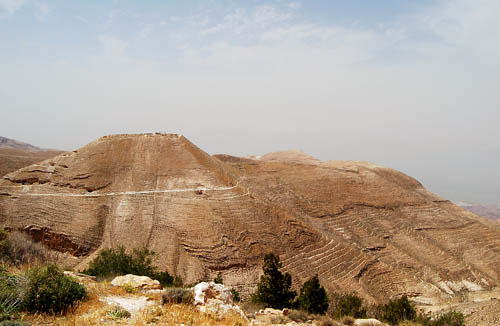
Machaerus has an impressive location overlooking the Dead Sea from the east. There was so much haze (eastern sand) in the air the day we visited last April that it was not possible to see the Dead Sea below. This photo gives some idea of the terrain. The citadel is located about 2300 feet above sea level. This would make it about 3600 feet above the Dead Sea. The hill to the east, where I stood, is about 60 feet higher than the citadel.

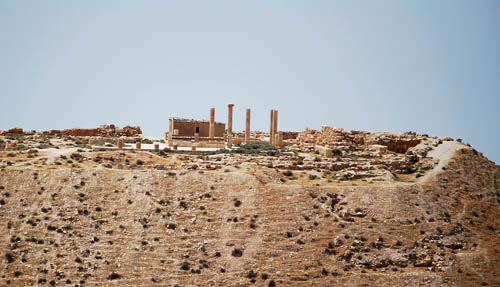
Here is a view of some of the reconstructed ruins at the top.

Where was John buried? Mark tells us that his disciples “came and took away his body and laid it in a tomb” (6:29). Did they bury him at Machaerus? At Samaria? Neither the Bible nor Josephus inform us.

If you could use some nice photos of Machaerus to illustrate Bible lessons, I suggest you check out those by David Padfield here.

John the Baptist and Samaria

I am in the process of preparing some material on John the Baptist in Biblical and Church History. There is a tradition that John was buried at Samaria. This is one of those late traditions that reflect the understanding of believers in the centuries following the time of John.

Jerome Murphy-O’Connor makes some comments on this in the fifth edition of The Holy Land. See our earlier reference to the book here.

Christian tradition very quickly (before 361) identified Samaria as the site of the infamous birthday party at which Herod Antipas had John the Baptist executed (Mark 6:17-29). With greater probability Josephus locates the murder at Machaerus in Jordan (Antiquities 18:119). This information, however, was not available to all Christians, and the much more accessible Samaria was associated with the name of Herod, who had held a wedding party there and much later executed two of his sons there. The fact that the two Herod’s were father and son would not have bothered the popular credulous mind. Two churches were built in John’s honour, one near Herod’s temple and the other in the modern village. (The Holy Land, 5th edition, 461)

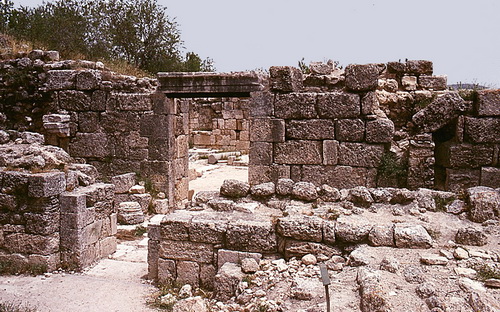
Samaria is in the West Bank of Israel, under the Palestinian Authority. It has been impossible to visit Samaria on a regular basis for many years. My last visit was in 2000, but I was trying to use the “latest” in digital technology. The photos are not very good. Another thing to remember about important sites like this is that they are not well maintained. Here is a photo of the Church of St. John that I have scanned from a 1984 slide.

At the Biblical Studies Info Page I keep a list of good sources for photos (check Scholarly, then Photos). None of these have a photo of this site. On May 19, 2005, some scholars associated with the Studium Biblicum Franciscanum in Jerusalem made a visit to Sebaste (Samaria). There are several good photos of approximately 800 x 600 pixels, with commentary. These are stashed away in the archives of the web site. Perhaps you can access them here. These photos include the Iron Age site belonging to the time of the Divided Kingdom, and the Herodian and Roman site from the time of the New Testament (Acts 8).

Here is a comment from the Franciscan site about the two churches at Sebaste identified with John.

The Alleged Discovery of the Baptist’s Head. It is not known what happened to the head consigned to Herodias; but as early as the fourth century, stories begin to appear about the finding of the supposed relic. One such inventio took place in Sebaste in the place regarded as the Baptist’s prison. A church associated with this discovery was erected near the acropolis, while the large church containing the tomb was below to the east, in the cemetery area.

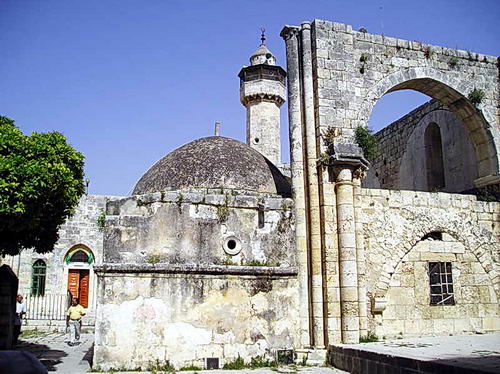
The cathedral from the mid-12th century, now a mosque, is said to enshrine the tomb of John the Baptist. The church is in the village of Sebaste. I am taking the liberty of showing you the photo of the exterior of the church from the SBF web site.

Pella of the Decapolis

The Jerusalem Post recently published an article about Pella under the title “Head for the hills.” The article is interesting, but is mostly speculation over whether Christians from Jerusalem found refuge in the Pella area at the time of the Roman destruction of Jerusalem (A.D. 70). It is not uncommon to find serious mistakes in articles of this type. They seem to be done hurriedly to meet a deadline. The article leaves the impression that Christ instructed the disciples “to reside for a while at Pella.” Here is the quotation:

“Christ having instructed them to leave Jerusalem and retire from it on account of the impending siege… to reside for a while at Pella.”

In fact, Eusebius says that the disciples were warned in advance, and that they fled to Pella. I have no stock in Eusebius, but see no reason to doubt what he says about this. Here is the statement from Eusebius:

The whole body, however, of the church at Jerusalem, having been commanded by a divine revelation, given to men of approved piety there before the war, removed from the city, and dwelt at a certain town beyond the Jordan, called Pella.

Anyway, if you would like to read the JP article, click here.

A few months back I prepared a short article for Biblical Insights about Pella, and thought I would share it with you here.

————

Pella was one of the cities of the Decapolis (Mt. 4:25; Mk. 5:20; 7:31). Pella is not mentioned in the Bible by name, but the location on the eastern side of the Jordan (Perea; “beyond the Jordan”) makes it likely that Jesus visited the area (Mt. 19:1; Mk. 10:1).

The term Decapolis was used to describe a group of ten cities established by the Greeks. Many of them claimed to have been founded by Alexander the Great. The number of cities may have been ten at some time, but the exact number varies from list to list. The cities include Abila [Lysanias was tetrarch of Abilene, Lk. 3:1], Gadara [Umm Qeis], Gerasa [Jerash], Hippos, Philadelphia [Amman], Scythopolis [Beth-shan], Pella, et al. These cities are located mostly south of the Sea of Galilee, and all except Scythopolis are east of the Jordan River. Damascus is included in some lists. In the first century A.D. they were part of the Roman province of Syria.

The cities of the Decapolis reflected the Hellenistic culture that had dominated the area since the days of Alexander. Jesus’ ministry took him “beyond the Jordan [east]” to “Galilee of the Gentiles” (Mt. 4:15; Isa. 9:1). It is here that we find a sizable number of swine (Mt. 8:28-34).

When Paul left Damascus to go away into Arabia, he would have traveled through the Decapolis area. And again on the return (Gal. 1:17).

Eusebius, the fourth century church historian of Caesarea Maritima, says that the church at Jerusalem, having been previously commanded by a divine revelation, left the city before the Romans destroyed it in A.D. 70. He says they fled to Pella (HE 3.5.5). This would have been in response to the teaching of Jesus recorded in Matthew 24, Mark 13, and Luke 21.

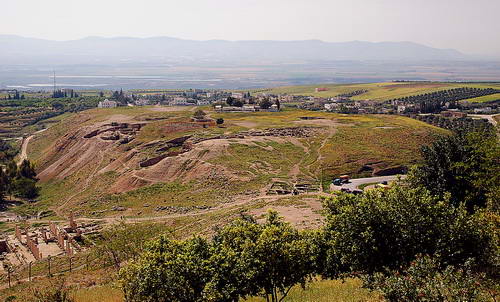
From a rest house above the mound one has a wonderful view of the tell and of the area to the west. From that point one can see (in the haze) Mount Gilboa, the Jezreel Valley (to the far right in our photo), and the city of Beth-shan across the Jordan Valley. The valley on the south side of Pella may have been the valley through which the Midianites fled from Gideon (Jud. 7). Surely the inhabitants of Jabesh-gilead would have come through this valley to take the body of Saul and his sons from the wall of Beth-Shan (1 Sam. 31:11-12).

Good illustrations for teaching

Every teacher of the Bible should be looking for good illustrations to help convey biblical truths. Ezekiel used a brick with a sketch of Jerusalem on it to teach about the destruction of the city (Ezekiel 4:1). Jeremiah broke a clay vessel to teach the same lesson (Jeremiah 19).

Jesus used sowers, birds, and flowers of the field to teach important lessons (Mt. 13:18; 6:26; 6:28).

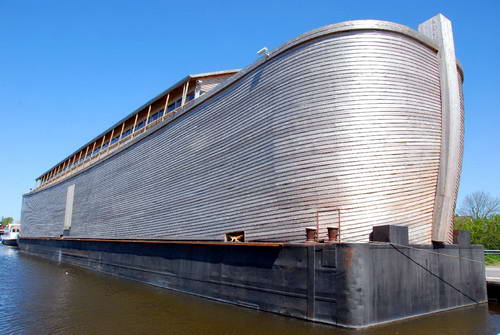
About a year ago we learned that a contractor in the Netherlands has built a replica of Noah’s ark. W. Frank Walton has called my attention to a series of photos by “Paul the Dane” showing both replica from both the outside and the inside. These photographer holds copyright to the photos, but his page says “permission from author required for commercial use.” I take this to mean that non-commercial use, such as Bible classes, is allowed. For information about Noah’s ark read Genesis 6-9.

Paul the Dane has these photos posted at Pbase. Click here for his page. He also has some nice photos of Damascus. He says this of the ark photos:

It was built approximately to scale, however is 1/2 the length and 1/3 the width of the Biblical dimensions. It was built to show the world how massive the Ark was and how so many animals could have been housed for a long time.

Here is one of the nice exterior views.

Frequently I go to Pbase to search for photos I might need of some historical site that I have not visited. Be sure you ask for permission if the photographer does not grant such.

A few years ago I wrote an article, “Using Photographs to Ilustrate Lessons” for Biblical Insights. Read it here. At the Biblical Studies Info page I have links to numerous sources of good photos of the Bible lands. Look here, then under Photos.

Update: J. P. van de Giessen has pointed me to his post about the ark here. He has some photos of the ark while under construction. Nothing quite like having a “reporter” on the spot! The official web page is here. It also includes photos of the construction.

The joy of traveling together

It is unfortunate that many younger couples are not able to travel to the lands of the Bible. This is especially true of young preachers who need the knowledge they could gain in their ministry. Some young folks could travel to these places if they wanted to. One fine lady who, along with her husband, had been on a tour to Israel and Greece, told me that she had rebuked (not her word) some of the young professionals she knew. She told them that they ought to give up a few ski trips and go to the Bible lands. A matter of priorities, isn’t it.

I find that many women want to travel, but their husbands refuse to do so. It often happens that the husband dies and the wife gets to travel. Too bad they could not have made these memories together. Elizabeth and I have enjoyed being blessed to travel to many parts of the world. We realize that most of those years are behind us and we have great memories to share. And we have made many wonderful friends in our travels.

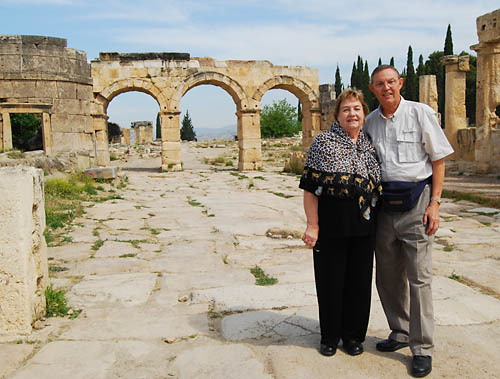
The photo below was made at Pamukkale, Turkey (ancient Hierapolis). We are standing on the colonnaded Roman road, and the monumental gateway behind us is the Arch of the Emperor Domitian (A.D. 81-96). It was constructed in A.D. 82-83.

Hierapolis was the home of Papias (c. A.D. 60 to c. A.D. 130). He was a disciples of the apostle John and a companion of Polycarp. There are some traditions associating Philip (apostle?, evangelist?) with the city.

The city of Hierapolis is one of the three cities of the Lycus River valley named in the New Testament.

For I testify for him that he has a deep concern for you and for those who are in Laodicea and Hierapolis. (Colossians 4:13).

Assos temple to be restored

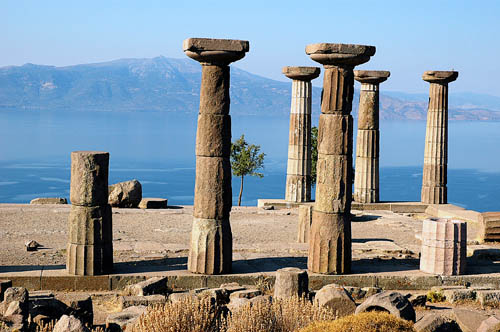
The current issue of Artifax reports that the temple of Athena at Assos in northwestern Turkey is to be restored. The temple was built originally about 540-530 BC. The project is expected to take about three years. Many pieces of the temple are scattered in museums (Istanbul Archaeological Museum, Louvre, Boston Museum of Fine Arts). The temple is built on a high cliff overlooking the sea. Here is the way the temple looks now.

The apostle Paul undoubtedly saw the temple of Apollo when he traveled the approximate 20 miles from Alexandria Troas to Assos by land. His companions had traveled by boat from Troas to Assos. The historical account reads this way:

But going ahead to the ship, we set sail for Assos, intending to take Paul aboard there, for so he had arranged, intending himself to go by land. And when he met us at Assos, we took him on board and went to Mitylene. (Acts 20:13-14 ESV)

The island across the strait is Lesbos. Further south is the town of Mitylene on Lesbos. Lesbos is now a Greek island in the Aegean.

U.S. Religious Landscape Survey

Anyone interested in reaching citizens of America with the gospel of Christ should be interested in the Pew Forum report on the Religious Landscape Study. You may read a summary of the key findings here. You may download the 18 page report and/or the full report of 268 in PDF.

According to the report, among Evangelical churches 57% believe many religions can lead to eternal life. Eighty seven percent of mainline Protestant churches believe that. Not far behind 89% of Buddhists. The same view is held by 56% of Muslims in America.

Imagine Jesus saying, “I am the way, and the truth, and the life; no one comes to the Father, but through Me” (John 14:6). “At least that’s what I think 57% of the time.”

One interesting aspect of the report is the percent who see a conflict between religion and modern society. The total of all Americans is 40%. And 42% of these say their values are threatened by Hollywood. You might find the views on abortion and homosexuality surprising, too.

The summary concludes with two paragraphs on the effect of secularization.

The U.S. has largely avoided the secularizing trends that have reshaped the religious scene in recent decades in European and other economically developed nations – but not entirely. The
Landscape Survey documents, for example, that the number of Americans who are not affiliated with a religion has grown significantly in recent decades, with the number of people who today say they are unaffiliated with a religious tradition (16% of U.S. adults) more than double the number who say they were not affiliated with a religion as children (7%).

It remains to be seen how this trend toward secularization will ultimately impact religion in the U.S. But what is clear is that religion remains a powerful force in the private and public lives of most Americans, a fact amply illustrated by the findings of the U.S. Religious Landscape Survey discussed in this report.

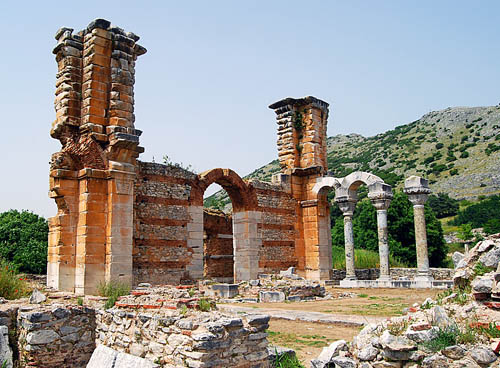
Will the buildings in which we meet one day stand in ruins (physically or spiritually) like this 550 A.D. building, called Basillica B, at Philippi? Read Acts 16 and Paul’s Epistle to the Philippians.

Go read, and learn.