Category Archives: New Testament

A New, Smaller Bible Atlas

Carta's New Century Handbook and Atlas of the Bible

Carta’s New Century Handbook and Atlas of the Bible
Abridgment of The Sacred Bridge

by Anson F. Rainey and R. Steven Notley
Carta, Jerusalem, 2007
280 pages + full color illustrations and maps, English. Cloth, 9 x 12 inches
ISBN: 9789652207036
List Price: $50.00. Your Price: $45.00

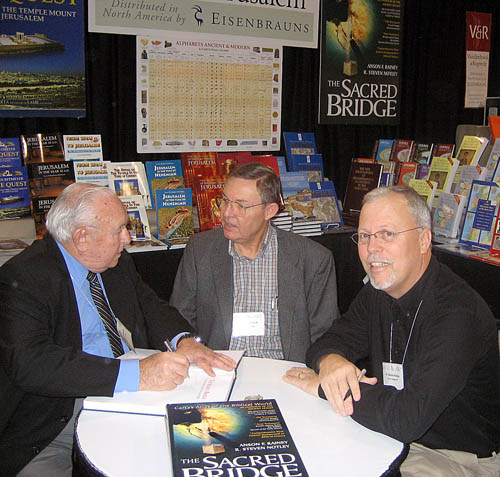
Several times we have mentioned the important of the Bible student having a good atlas. Check here. Two years ago Carta brought out The Sacred Bridge, by Rainey and Notley. The book is large, and the content is more than most students want or need. And the price was $100. In response to a request from many professors, the same authors have prepared Carta’s New Century Handbook and Atlas of the Bible. I have not seen this book, but I have been using the larger atlas, and I plan to get a copy of the abridged edition. Fortunately I was able to get The Sacred Bridge autographed by Rainey and Notley.

Eisenbrauns is the US distributor of Carta books and maps. A click on the title at the top will take you to their web page.

First century church (building) found?

Several blogs have noted the report of a claim out of Jordan than a first century church has been found. The Jordan Times report by Rula Samain follows:

AMMAN – Lying underneath Saint Georgeous Church in Rihab, Mafraq, is what archaeologists describe as the first Christian church in the world.

“We have uncovered what we believe to be the first church in the world, dating from 33 AD to 70 AD,” said Archaeologist Abdul Qader Hussan, head of the Rihab Centre for Archaeological Studies.

The discovery was “amazing”, Hussan told The Jordan Times.

“We have evidence to believe this church sheltered the early Christians: the 70 disciples of Jesus Christ,” the scholar said.

The early Christians, described in the mosaic inscription on St. Georgeous floor as “the 70 beloved by God and Divine”, are said to have fled from Jerusalem during the persecution of Christians, to the northern part of Jordan, particularly to Rihab, he added.

Citing historical sources, the expert said the 70 lived and practised their rituals in secrecy in this underground church.

We believe that they did not leave the cave and lived until the Christian religion was embraced by Roman rulers.

“It was then when St. Georgeous was built,” said Hussan.

Saint Georgeous is believed to be the oldest “proper” church in the world, built in 230 AD. This status is only challenged by a church unearthed in Aqaba in 1998, also dating back to 3rd century.

The findings in the graveyard near the cave offer valuable clues, according to Hussan.

“We found pottery items that date back from the 3rd to 7th century,” he added. The findings show that the first Christians and their offshoot continued living in the area till the late Roman rule.

“Going down a few steps into the cave, one would see a circle shape area, believed to be the apse, and several stone seats for the ecclesiastics,” he added.

Archimandrite Nektarious, Bishop Deputy of the Greek Orthodox Archdiocese, described the discovery of the cave as an “important milestone for Christians all around the world”.

“The only other cave in the world similar in shape and purpose is in Thessalonica, Greece,” the bishop said in an interview in Amman.

The cave also embraces the living place of the first Christians. “A wall with an entrance is the only partition separating the altar from the living area,” Hussan said.

There is also a deep tunnel, which is believed to have led the 70 Christians to their source of water, the archaeologist added.

Officials in Mafraq say they will capitalise on the discovery to further promote the area.

Governor Zeid Zreiqat, who noted Rihab is rich in unique archaeological sites, said that together with the new discovery, these sites can be invested to attract religious tourism.

“We are working on developing Rihab to become a major tourist attraction in the near future,” he told The Jordan Times.

So far, 30 churches have been discovered in Rihab,” Hussan said. It is also believed that Jesus Christ and the Virgin Mary have passed through this area, he added.

Are you excited about this discovery? Note that the report claims that the St. Geogeous Church “is believed to be the oldest proper church in the world, built in 230 AD.” The new discovery seems to have been a cave under the third century church. We must await further information on the inscription about the 70 disciples of Jesus.

There are several things in this report that arouse suspiction. Who were the 70 disciples? Were they the 70 of Luke 10:1-12? What rituals did they practice in secret? The church dates from 33 AD to 70 AD, yet they stayed in the cave until Christianity was embraced by the Roman government (early 4th century).

The pottery is said to date from the 3rd to the 7th century. Did the first century residents of the cave church leave no pottery? Do you really think a first century church had circular shaped seats for the clergy? (This is stated in the caption under a photo with the article.) We have no historical evidence for this clergy-laity distinction until well into the 2nd century.

We are told that the city of Mafraq will “capitalize on the discovery to further promote the area” and to help it become a major tourist attraction.

An MSNBC report cites Thomas Parker, of the University of North Carolina-Raleigh, as saying that this information should be greeted with a degree of caution. Read it here.

Philadelphia, the church with an open door

Philadelphia is located about 30 miles southeast of Sardis in the valley of the Cogamis, a tributary of the Hermus. The city is built on the slope of Mount Tmolus overlooking a fertile valley. Philadelphia was in the province of Lydia in Western Asia Minor.

Philadelphia stood at the place where the borders of Mysia, Lydia, and Phrygia met. “It was characteristically a border town” (Barclay). This position made it the gateway to the East. Ramsay says,

“the Imperial Post-Road of the first century, coming from Rome by Troas, Pergamum and Sardis, passed through Philadelphia and went on to the East; and thus Philadelphia was a stage on the main line of Imperial communication” (The Letters to the Seven Churches 395).

The site of ancient Philadelphia is now covered by the Turkish agricultural town of Alashehir which has a population of about 20,000. Alashehir (Red City) is named for the volcanic earth in the area (Blaiklock 122). The plain is filled with vineyards. If Philadelphia were not a Biblical city very few tourists would put forth the effort to visit it.

According to Hemer, the location had one great disadvantage.

“It lies perilously close to the region known as the Catacecaumene (“the burnt land”) of Lydia, a hilly tract to the northeast which contained volcanic cones which had been active in recent geological time. And the whole area lies in the Anatolian fault system. Philadelphia was peculiarly liable to earthquake” (Hemer, “Unto the Angels of the Churches,” Buried History 11 (1975), 166).

Trench says, “No city of Asia Minor suffered more, or so much, from violent and often recurring earthquakes.” In A.D. 17 there was a destructive earthquake in the region which affected 12 cities. Sardis suffered worst, but Philadelphia is also mentioned. The cities were exempted from direct taxation and Tiberius provided personal funds for relief (Tacitus. Annals. 2.47).

Ramsay, who spent much time in Asia, reports that “the first great shock of earthquake is not so trying to the mind as the subsequent shocks, even though less severe, when these recur at intervals during the subsequent weeks and months….” Colin J. Hemer visited Philadelphia in 1969 just a few days after an earthquake (172-73). The people would leave the city and go out into the open fields and live in tents. When all danger was passed, and they did the necessary rebuilding, they would go back into the city. Strabo reports this in A.D. 20 (Ramsay), and Hemer provides a photograph of people living in tents outside their houses in 1969.

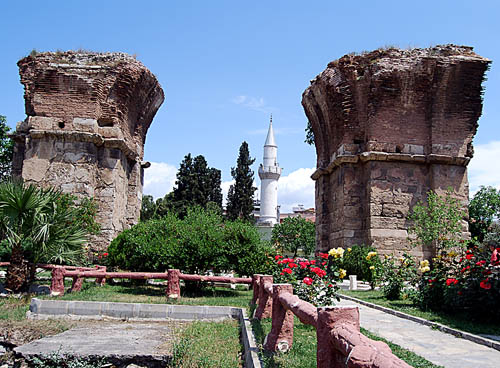
Our photo shows the ruins of the Byzantine church. Local tradition says this building served as a cathedral dedicated to St. John the Theologian. In Turkey the minaret is positioned to be in almost every tourist photo.

Toward the end of the first century the Lord sent a letter to the church at Philadelphia (Revelation 1:11; 3:7-13). The Lord commended the church with these words:

Behold, I have put before you an open door which no one can shut, because you have a little power, and have kept My word, and have not denied My name. Revelation 3:8

Another kind of Poppy

A few days ago I posted a photo of some poppies in Turkey and included the term anemone with it here. Reader J. P. Van de Griessen, of the Netherlands, informed us that he thinks that this is the “Papaver rhoeas or family of it.” I do not have much knowledge about plants, but I had noticed that the poppies in Turkey were a bit different from the ones I have seen in Israel and Jordan in the spring of the year. J. P. has a section of his blog dealing with flora. Even if you can not read the Dutch you might be able to make a suitable translation using the Google language tools.

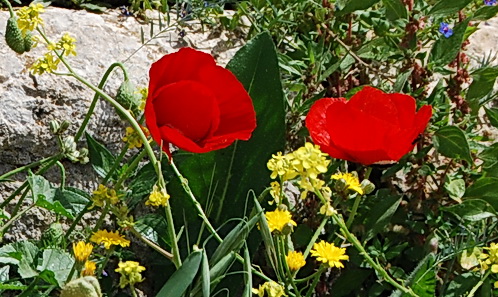
In the past three trips to Israel, with good digital equipment, I have not seen many poppies growing. In past visits, earlier in the year, we have seen entire fields colored with them. Here is a photo of some poppies among the ruins at Jerash in Jordan.

I understand this to be the anemone. Dr. David Darom, in Beautiful Plants of the Bible, calls it the common poppy (Papaver sp.). One Wikipedia article indicates that there are more than 150 varieties of the poppy. Darom links this plant with the “lilies of the field” mentioned by Jesus.

And why are you worried about clothing? Observe how the lilies of the field grow; they do not toil nor do they spin, yet I say to you that not even Solomon in all his glory clothed himself like one of these. “But if God so clothes the grass of the field, which is alive today and tomorrow is thrown into the furnace, will He not much more clothe you? You of little faith! (Matthew 6:28-30)

The UBS Fauna and Flora of the Bible comments on the New Testament word krinon:

It is used by Jesus in the Sermon on the Mount, when he says: ‘Even Solomon in all his glory was not arrayed like one of these.’ Most commentators now think of the Anemone coronaria, the anemone with beautiful bright colours which is to be found on the hills of Galilee, where it would undoubtedly have been seen by the people listening to Jesus. (page 135)

Thanks, J.P. Any other help will be appreciated.

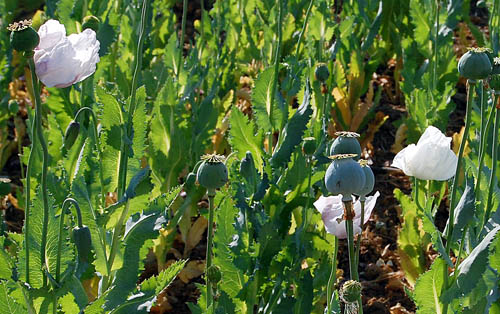
Speaking of poppies. In Turkey, another type of poppy is legally cultivated. On the outskirts of Yalvac (near Pisidian Antioch of Acts 14), I have seen cultivated fields of white poppies along the road. Under U. S. pressure, Turkey outlawed the growing of poppies in 1971. By 1974 they were allowing them to be grown under strict government control. Government factories convert the dried stems into poppy-straw concentrate (PSC) and then into morphine and codeine (See “The Poppy,” National Geographic, Feb., 1985, pp. 143-189). Here is a photo I made last year. I trust that I will not be charged with possession of a poppy photo!

From the mountains of Ararat to the island called Patmos

Or, from Genesis to Revelation. I did not make an intentional plan to do so, but within the past twelve months I have visited areas of the Bible world, from the mountains of Ararat to the island of Patmos. What a blessing to have the opportunity to spend about four weeks in Turkey, covering most of the sites mentioned in the Bible, about 10 days in Greece, more than a week in Israel, and a week in Jordan.

This means that I have been able to visit some of the most significant portions of the Bible world. Better than visiting the area alone, I have been able to share the area with other teachers (both men and women) who will be incorporating this information into their lessons for years to come.

When I first reflected on the past year and realized that I had been to Mount Ararat, in the mountains of Ararat, and on the Island of Patmos, I realized that this covers from Genesis 6 to the book of Revelation. Of course, this doesn’t mean that I have visited every place in between, but it does give a sense of comprehensive overview.

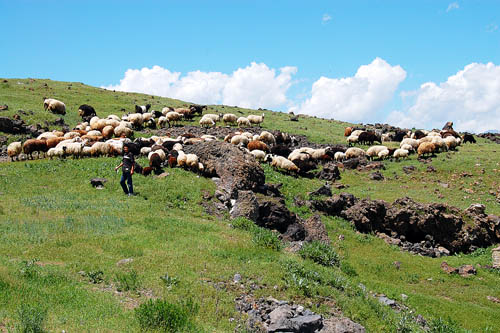
Here are a couple of photos I trust you will find helpful. The first is of a shepherd with his sheep in the mountains of Ararat. Remember that the book of Genesis records that Noah’s ark rested “upon the mountains of Ararat” (Genesis 8:4).

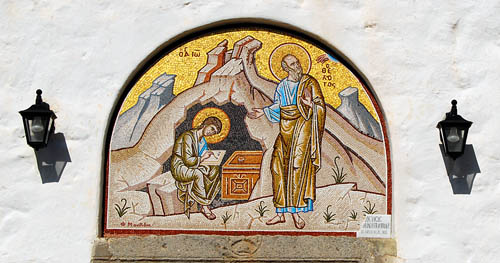
This photo was made at the entry to the cave of the Apocalypse on “the island called Patmos” (Revelation 1:9). John was exiled here during the reign of the Roman emperor Domitian. Whether the book of Revelation was written on Patmos, or after John’s release, we can not say with certainty. The mosaic over the entry to the cave shows John dictating the revelation given to him by the Lord.

It is my conviction that Bible land travel can enhance one’s Bible study and improve one’s understanding of the text. This, in turn, needs to be converted to action in obedience to the will of the Lord, and in service to Him.

Be sure to read…

I want to encourage you to go back to the post on “The historical credibility of the Gospel of John” and read the comment by my friend Bruce Hudson. Prof. F. F. Bruce was at the University of Manchester for many years. You might enjoy some comments I made about Prof. Bruce last Septermber when I was in Scotland. Click here.

The historical credibility of the Gospel of John

Over at Parchment and Pen, Dan Wallace has written on “The Gospel of John and Historical Realibility – Part 1. Already I am looking forward to Part 2+. Wallace says,

In 1844, the Tübinger Jahrbuch published an essay by F. C. Baur to the effect that John’s Gospel should be dated no earlier than AD 160, and probably closer to 170.

Everyone who has studied New Testament introduction knows that this view was dominant for nearly a century. Wallace tells what rocked Baur’s view:

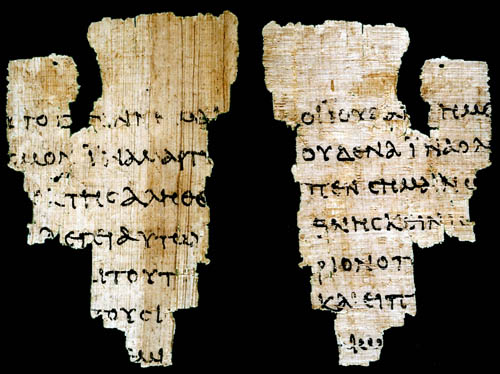
Ninety years after Baur first published his thesis on John, a young doctoral student studying at Manchester University came across a scrap of papyrus in the John Rylands Library. Colin H. Roberts was intrigued by the papyrus fragment, which had been excavated decades earlier from rubbish heaps in Egypt. It was only 2 & ½ inches by 3 & ½ inches, but its importance far outweighed its size. Roberts immediately recognized it as a fragment of John’s Gospel—chapter 18, verses 31 to 33 on one side, and chapter 18, verses 37 and 38 on the other, to be exact. He sent the photographs of the fragment to three of the leading papyrologists in Europe. Each one reported independently that this fragment should be dated, on paleographical grounds, between AD 100 and AD 150. A fourth scholar disagreed, arguing that the fragment should be dated in the 90s of the first century!

This tiny fragment of John’s Gospel rocked the scholarly near-consensus on the date of John, for it is impossible for a copy to be written before the original text is produced. It effectively sent two tons of German scholarship to the flames. As one wag put it, “This manuscript must have been written when the ink on the original text was barely dry.”

A number of years ago, while leading a tour of the British Isles, I called the Rylands Library at the University of Manchester to ask if I could see the Rylands Fragment. After being assured that I could, I took the train from York to Manchester. At the time, the little fragment was between two pieces of glass taped around the edge. There is only one piece of the fragment, but the image below (from a library slide) shows both sides.

We think the Gospel of John was written by John in Ephesus sometime during the 80s, but this manuscript is thought to have originated in Egypt between A.D. 100 and 150 (or earlier?). This is a small illustration of the rapid spread and copying of the Gospel.

The John Rylands Library has a page devoted to the fragment here.

Thessalonica in Macedonia

The Capsis hotel in Thessalonica was our home for two nights. Wednesday we used our time visiting the city. Thessalonica (called Thessaloniki now) is in biblical Macedonia. The area is still known as Macedonia, but is not to be confused by the modern country by that name. It is marked on maps of Greece as FYROM (former Yugoslav Republic of Macedonia). I know too little about the dispute to make any comments.

Paul came to Thessalonica on his second journey (A.D. 50-53; Acts 17). He wrote two letters to the church at Thessalonica while he was at Corinth. Aristarchus, a Macedonian of Thessalonica accompanied Paul on the voyage to Rome (Acts 27:2). When Demas forsook Paul he went to Thessalonica (2 Timothy 4:10).

I went to the Archaeological Museum of Thessalonica thinking I would jump in, make a few shots of some items I had need of and then move along. In fact, I found a new (since my last visit in 2001) museum with wonderful educational exhibits, nice displays, and great lighting.

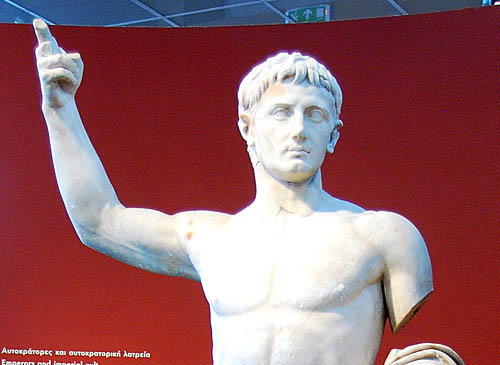
There is an impressive full-length statue of the Emperor Augustus (30 B.C. to A.D. 14). Augustus was emperor at the time of the birth of Jesus (Luke 2:1). Here is a photo of the top portion of the statue. This gives some indication of the wonderful lighting in the museum. This photo was made without flash.

On the display around the statue of the emperor there is a statement about the cult of the emperor. In our travels in Asia Minor (western Turkey) we saw many evidences that the admiration of the emperor grew into worship of the emperor as a divine being. This placed a real burden on the Christians of the time. It is this type of tribulation that the book of Revelation addresses.

The cult of the emperor was both an instrument of imperial policy progaganda and a means for the transmission of Roman culture. The image of the emperor gives a concrete form to the abstract idea of the Empire. Whether a full-lenth statue [as this one] of a bust, it makes his presence felt everywhere; in outoor and indoor spaces, in fora, in villas, and in libraries.

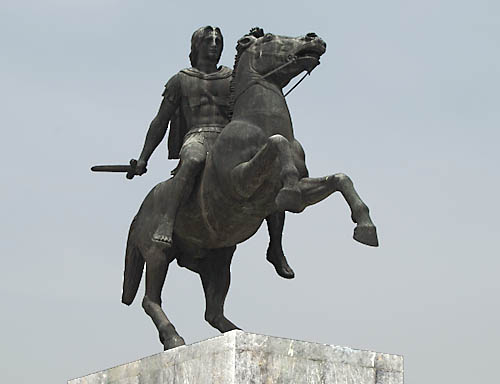
Elizabeth and I walked down by the harbor to see the colossal statue of Alexander the Great on his horse, ready to go into battle with sword drawn. We must put Alexander of Macedon among the most influential people of world history. His conquest of the areas we know as the Bible world continue to influence us till this day. He left his mark with the introduction of the oikumene concept of one world and the introduction of Greek culture and language. The Hebrew scriptures were translated into Greek in Alexandria beginning about 280 B.C. The New Testament was written in Greek. Even Paul, the Hebrew of Hebrews (Philippians 3:5), could speak Greek (Acts 21:37).

We visited the Arch of Galerius on the modern Via Egnatia, one of the main streets of Thessalonca. I made a few photos in the Roman agora before we rushed to get our bags packed to fly back to Athens.

By the time we arrived at our hotel, near the airport we had both decided that we were too tired to try to go to Delphi today. From our hotel room we are enjoying the beautiful view of a small town surrounded by mountains draped by blue sky with white clouds.

Paul’s journey in Macedonia

During his second journey, while at Troas, Paul saw a vision of a man of Macedonia. Luke gives the following record of the vision and of the subsequent action of the apostle.

A vision appeared to Paul in the night: a man of Macedonia was standing and appealing to him, and saying, “Come over to Macedonia and help us.” When he had seen the vision, immediately we sought to go into Macedonia, concluding that God had called us to preach the gospel to them. (Acts 16:9-10)

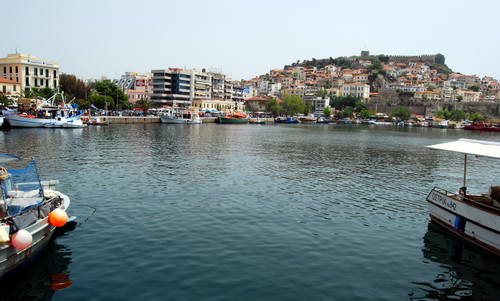
Paul and his companions, including Luke, landed at Neapolis (modern Kavalla). The text indicates that the real goal of their mission was to reach the Roman colony of Philippi. Someone has commented that it is often the case that preachers have a call from a man to come preach somewhere. When they arrive they find mostly women. Paul found Lydia of Thyatira. She was a seller of purple. Whether the cloth or the dye, we are not told. She was the first convert on European soil. We make much of the fact that this was the first preaching in Europe. At the time the most important thing is that it was the first preaching in the Roman province of Macedonia (now northern Greece). Here is a photo of the modern port at Kavalla.

Luke’s account of the first convert in the city is recorded in Acts 16.

And on the Sabbath day we went outside the gate to a riverside, where we were supposing that there would be a place of prayer; and we sat down and began speaking to the women who had assembled. A woman named Lydia, from the city of Thyatira, a seller of purple fabrics, a worshiper of God, was listening; and the Lord opened her heart to respond to the things spoken by Paul. And when she and her household had been baptized, she urged us, saying, “If you have judged me to be faithful to the Lord, come into my house and stay.” And she prevailed upon us. (Acts 16:13-15)

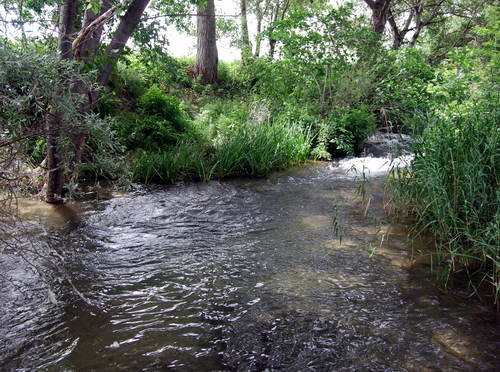
The river Ganga (some say Gangites) is a short distance north of the Agora of Philippi (IDB, III.787). This must be the river under consideration in the biblical account. Here is a photo of the river that I made yesterday.

We also visited Neapolis (modern Kavalla), Amphipolis and Appollonia.

Now when they had traveled through Amphipolis and Apollonia, they came to Thessalonica, where there was a synagogue of the Jews. (Acts 17:1)

Today we plan to visit some important sites in Thessalonica.

Group back in the USA

Early yesterday our group left for home. We have received several Emails from tour members saying that they have arrived home safely. For this we are thankful.

Elizabeth and I are spending a few days in northern Greece (biblical Macedonia). Yesterday we visited Berea (Acts 17) and Dion. Dion is in the shadow of Mount Olympus and is suggested by some as the place where the brethren from Berea took Paul down to the sea so he could continue on to Athens.

Today we plan to visit Neapolis, Philippi, et al. (Acts 16). We are staying in Thessalonica. Photos later.