Category Archives: New Testament

Up to Jerusalem again

The Bible speaks of going up to Jerusalem and down from Jerusalem. Certainly the main reason for this is the elevation of Jerusalem. It is located in the central mountain region of Judea at an elevation of about 2400 to 2500 feet above sea level.

We left Tiberias and the Sea of Galilee (Kinneret) this morning, spent some time in the Jezreel Valley, stopped by Caesarea Maritima, and then drove up to Jerusalem.

Here is a photo I made this morning at sunrise from my window on the shore of Galilee. I had in mind a photo that would be suitable for a presentation background. It reminded me of the fact that some of the disciples were fishermen, and were called by the Jesus to leave that work and accept His offer to become fishers for men.

Going on from there He saw two other brothers, James the son of Zebedee, and John his brother, in the boat with Zebedee their father, mending their nets; and He called them.  Immediately they left the boat and their father, and followed Him.  (Matthew 4:21-22)

A fisherman on the Sea of Galilee at sunrise. Photo by Ferrell Jenkins.

A fisherman on the Sea of Galilee at sunrise. Photo by Ferrell Jenkins.

Cove of the Sower, Akko, Upper Galilee

Today I put forth some extra effort to make a good photo at the spot on the north end of the Sea of Galilee called the Cove of the Sower. Some have suggested that this would have been the place where Jesus could speak to large numbers who assembled to hear Him.

Read the full account given by Mark in 4:1-20. Here is the way it begins:

He began to teach again by the sea. And such a very large crowd gathered to Him that He got into a boat in the sea and sat down; and the whole crowd was by the sea on the land.  And He was teaching them many things in parables, and was saying to them in His teaching,  “Listen to this! Behold, the sower went out to sow. (Mark 4:1-3)

Read the parallel accounts in Matthew 14:1-15 and Luke 8:4-10.

B. Cobbey Crisler conducted some experiments at places where the Bible records that large crowds gathered. The attempt was to see if the large number were able to hear a speaker without the aid of modern sound equipment. The places were Kadesh-barnea, Shiloh,  and The Cove of the Sower in Galilee. I suggest you read the entire article (“The Accoustics and Crowd Capacity of Natural Theaters in Palestine.” Biblical Archaeologist, 1976. Vol. 39. Num. 4.

The study indicated that the Cove of the Sower would allow between 5000 and 7000 people to hear.

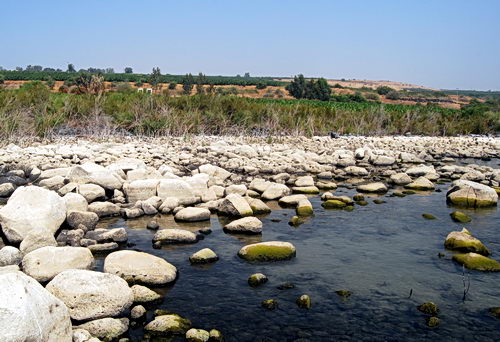
The water level of the Sea of Galilee is extremely low at this time due to lack of rain and snow in the past few years. In the photo posted below you will see many rocks in the foreground. Most years these rock would be covered with water. Due to the crops, and a highway, it is difficult to make out the amphitheater-like terrain. It would require several photos from different locations to show this, but it is there.

The "Cover of the Sower" in Galilee. Photo by Ferrell Jenkins.

The Cove of the Sower in Galilee. Photo by Ferrell Jenkins.

We made a wrong turn and realized we were near Dan. We had been there in April, but I decided to make new photos of the gates. This was a good move, because the light was perfect for the purpose.

We drove to Metulla, on the Lebanese border, to make a photo of Abel beth-maacah. Read 1 Kings 15:20; 2 Kings 15:29 and 2 Samuel 20:16. In this case the tel was dry, and brown, but the surrounding area was green with fruit trees. It made the tel stand out.

Our next stop was at Kedesh, one of the cities of refuge in Old Testament times (Joshua 21:32). We were at the same place yesterday, but did not have time to get good photos. I am now sure that I was successful today either.

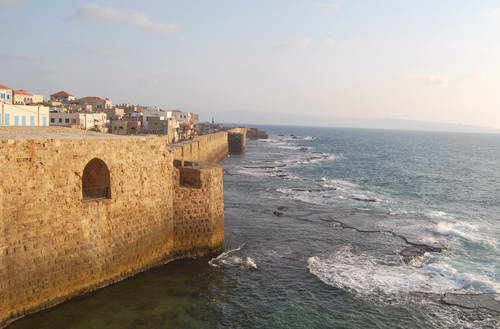
Our last stop before returning to Tiberias was to visit Acre (Acco, Akko). We passed the ancient tel on the way to see the Crusader ruins. The city is mentioned only once in the Old Testament (Judges 1:31), as a city that the tribe Asher was unable to retain as their possession.  Akko is known as early as 1800 B.C. from Egyptian execration texts. In the period between the testaments the city came under the control of the Ptolemies of Egypt. As a result, the city’s name was changed to Ptolemais. Paul visited brethren in the city for a day on the return from his third journey (Acts 21:7).

The Crusader fortress at Akko (Acre). Photo by Ferrell Jenkins.

The Crusader fortress at Akko (Acre). Photo by Ferrell Jenkins.

Elizabeth and I realized today that we have traveled not only from Dan to Beersheba, but from Eilat on the Rea Sea to the border of Lebanon.  We have traveled from the Jordan Valley to the Great Sea, the Mediterranean. We are very thankful for this opportunity.

In the Galilee

We spent the day visiting sites in the Galilee region of Israel. This morning we stopped by Magdala, but was not successful in getting photos. New excavations were conducted a few months ago, but the site is fenced and locked. In the afternoon I found a location on the road above that provided a fairly good overview of the site.

Magdala is not mentioned in the Bible, but is thought to be the home of Mary Magdalene. According to the gospel of John, Mary Magdalene was the first disciple to see the “open tomb” of Jesus.

Now on the first day of the week Mary Magdalene came early to the tomb, while it was still dark, and saw the stone already taken away from the tomb. (John 20:1).

As we continued North I noticed a good view of Mount Arbel and the Via Maris (the way to the Sea).

We tried to locate the cove of the sower, a sort of natural amphitheater that may be the site of Jesus sitting in a boat and speaking to a larger crowd of disciples on the shore (

And He got into one of the boats, which was Simon’s, and asked him to put out a little way from the land. And He sat down and began teaching the people from the boat. (Luke 5:3).

Our next stop was the Greek Orthodox church at Capernaum. From there we went to Gamla, an impressive fortress east of the Sea of Galilee. Jewish zealots were defeated by the Roman army about A.D. 66. Josephus describes the site in vivid terms:

for it was located upon a rough ridge of a high mountain, with a kind of neck in the middle: where it begins to ascend, it lengthens itself, and declines as much downward before as behind, insomuch that it is like a camel in figure, from where it is so named, although the people of the country do not pronounce it accurately. Both on the side and the face there are abrupt parts divided from the rest, and ending in vast deep valleys; yet are the parts behind, where they are joined to the mountain, something easier of ascent than the other; but then the people belonging to the place have cut an oblique ditch there, and made that hard to be ascended also. On its slope, which is straight, houses are built, and those very thick and close to one another. The city also hangs so strangely, that it looks as if it would fall down upon itself, so sharp is it at the top. (Wars of the Jews 4:5-7)

See for yourself in this photo I made today.
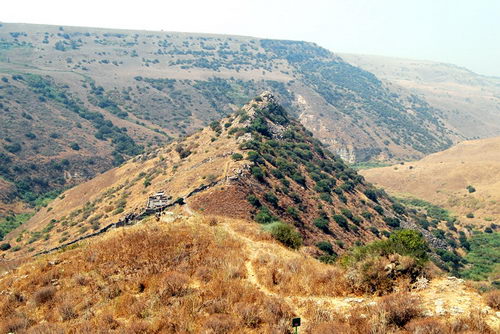
Gamla. Photo by Ferrell Jenkins.

Gamla. Photo by Ferrell Jenkins.

About Noon we stopped at Kursi, the site of a 6th century Byzantine monastery near the possible site of the miracle of the swine (Mark 5:11-13). See an article by Charles Page, excavator at Kursi, here.

We drove north in the Golan Heights and crossed from east of the Jordan River to the west side at a site called the bridge of Jacob’s daughters. We had some beautiful views of the Jordan River in this area north of the Sea of Galilee. It appears that some folks were having a lot of fun on the Jordan.
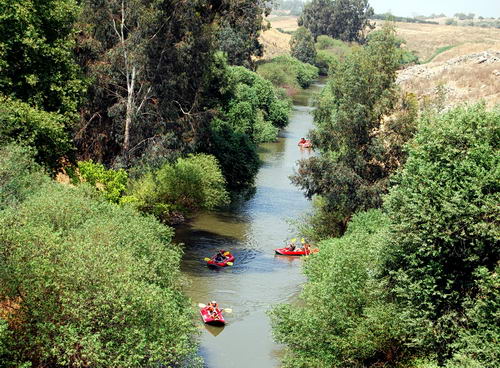
Jordan River at the Bridge of Jacob's Daughters. Photo by F. Jenkins.

Jordan River at the Bridge of Jacob

We made a stop at Hazor and I quickly made photos at each major area on the tel. We were here earlier this year, but I wanted to get a few additional photos.

Our last major stop was at Tel Kedesh in Upper Galilee, near the Lebanon border. This Kedesh was located in the territory of the Israelite tribe of Naphtali (Joshua 19:37). It is probably best known as one of the six cities of refuge assigned to the tribe of Levi (Joshua 20:7; 21:32).

By the time we pulled in to our hotel on the shore of Lake Kinneret, we were ready for a shower and a good dinner.

The Herodium, Tekoah, and Ashkelon

Today we visited the Herodium with our friend Elie who is known to many readers as the guide for several of our tours. Since this is the Sabbath in Jerusalem there was almost no traffic this morning. We left and went south past Bethlehem along the new road that connects various Israeli settlements. Elie met us at a designated place in Efrata and we went together from there to the Herodium.

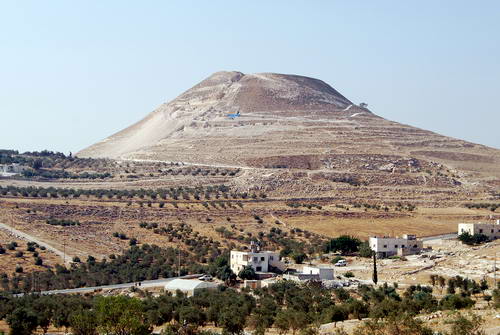
I don’t have a lot of time to give you all of the details of the Herodium, but here are a few facts to help. The artificial conical structure was built by Herod the Great at one of his fortresses. The fortress is located about 8 miles south of Jerusalem, 3 1/2 miles east of Bethlehem, on the western edge of the Wilderness of Judea. Herod was the king who tried to kill Jesus (Matthew 2). The photo below shows the north side of the Herodium. The tomb of Herod the Great was discovered about half way up the north side in 2007 by Prof. Ehud Netzer. You may see a blue tarp to the left of center. That marks the location of the tomb.

North side of the Herodium. Photo by Ferrell Jenkins.

North side of the Herodium. Photo by Ferrell Jenkins.

While in the vicinity we passed by Tekoah, the home of Amos the prophet (Amos 1:1), and the Valley of Decision in the wilderness of Tekoah (2 Chronicles 20. See especially verses 20 and 26). I also made some photos of vineyards and terraced farming.

Elie took us to a point from which one could understand the route of David from Bethlehem to the Valley of Elah. He had other oblications, so we left him and made our way to the coastal plain. Along the way we stopped for a photo of Tel Erfani. In earlier years several scholars identified it as Gath. A city, name Qiryat Gat, was built nearby and named for the ancient site. Many scholars now believe that Gath is to be identified with Tel es-Safi (see yesterday’s post).

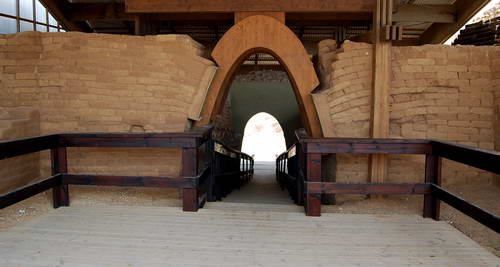
We continued to Ashkelon to see the newly reconstructed Canaanite gate. The sign at the site says,

This is the most ancient arched gate in the world. It consists of an arched corridor with arched openings on both ends. The gate was constructed in approximately 1850 BCE as part of th city’s fortification system, and is built mostly of mud brocks with some calcareous limestone. It is 15 meteres long, over 2 meters wide, and almost 4 meters high.

This photo shows the gate from the west (sea side).

The Canaanite Gate at Ashkelon. Photo by Ferrell Jenkins.

The Canaanite Gate at Ashkelon. Photo by Ferrell Jenkins.

According to 1 Samuel 6:17 there were five important Philistine cities: Ashdod, Gaza, Ashkelon, Gath, and Ekron. We were only a few miles north of Gaza. We tried diligently to locate Tel Ashdod, but were unable to do so.

Was John the Baptist a member of the Dead Sea Sect?

Identifying the Dead Sea Sect. We are speaking of the Jewish group responsible for preparing and hiding the scrolls that were discovered in and around Qumran on the shores of the Dead Sea beginning in 1947. The sect living here was likely the Essenes. I am aware of the numerous controversies about Qumran, but have not been impressed by the alternative views.

Was John the Baptist an Essene? It has been popular among some scholars to claim that John was an Essene. A suggestion is made that John’s parents died while he was yet a child. The Essenes were known to have cared for orphan children. So, they cared for John. Some comparisons may be drawn concerning John and the Essenes.

  1. John was in the deserts (Luke 1:80). The Essenes were in the desert.
  2. Both John and the Essenes used Isaiah 40:3 to describe themselves as the voice in the wilderness.
  3. The baptism (or washing) practiced by John and the Essenes required a change of heart.

There are significant differences between John and the Essenes.

  1. The Essenes hid themselves away from society in the wilderness. John was a very public figure.
  2. John had a much more strict diet (Luke 7:33) than did the Essenes.
  3. John preached Jesus as the Messiah. The Essenes did not recognize Jesus as Messiah, but they thought that the Teacher of Righteousness would arise from within their group.
  4. There was a strong organization among the Essenes that is missing among John’s disciples.

In the early days of my study about the Dead Sea Scrolls I found the book by F. F. Bruce, Second Thoughts on the Dead Sea Scrolls. I am pleased to inform you that you may download this book free of charge here.

Here is a photo of Cave 4 at Qumran. Many of the important scrolls were located here.

Cave 4 at Qumran. Photo by Ferrell Jenkins.

Cave 4 at Qumran. Photo by Ferrell Jenkins.

China Olympics opening is spectacular

I suspect that everyone reading this post saw either the opening ceremony of the Beijing 2008 Olympics or at least a few news clips about it. The Olympics originated with the Greeks centuries before Christ. The Isthmian games were conducted at Isthmia, a few miles from Corinth.

Paul used several illustrations relating to athletics in the epistles to the Corinthians.

Do you not know that those who run in a race all run, but only one receives the prize? Run in such a way that you may win. Everyone who competes in the games exercises self-control in all things. They then do it to receive a perishable wreath, but we an imperishable. Therefore I run in such a way, as not without aim; I box in such a way, as not beating the air;  but I discipline my body and make it my slave, so that, after I have preached to others, I myself will not be disqualified. (1 Corinthians 9:24-27 NASB)

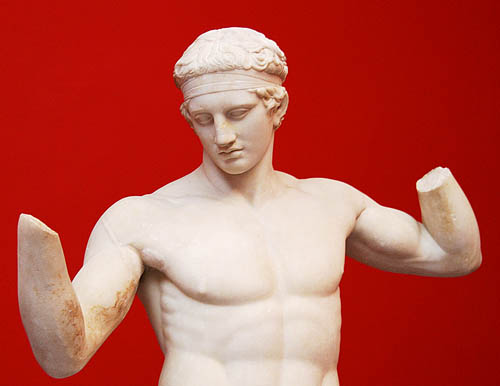
The Greeks had two words for crown. The diadema was the crown of the king. The stephanos was the crown of the victor in the races. This is the term used by Paul in the text above (the word wreath). Here is a photo of a nice sculpture displayed in the Athens National Archaeological Museum showing a young athlete wearing the stephanos. Incidentally, the stephanos was often made of olive branches, or other perishable items.

Young athlete wearing a crown (stephanos). Athens National Archaeological Museum. Photo by Ferrell Jenkins.

Young athlete wearing a crown (stephanos). Athens National Archaeological Museum. Photo by Ferrell Jenkins.

John also speaks of the stephanos. To the saints at Smyrna (modern Izmir in Turkey) he says,

Be faithful until death, and I will give you the crown of life. (Revelation 2:10).

Enjoy the Olympics, but think of the more important spiritual lessons.

The ESV Study Bible

Quite a bit of attention is being given to the forthcoming (October 15) English Standard Version Study Bible. Dr. Leen Ritmeyer has served as archaeological and architectural editor for the new study Bible. On his blog he calls attention to two interviews with Justin Taylor, Project Director and Managing Editor of the ESV Study Bible.

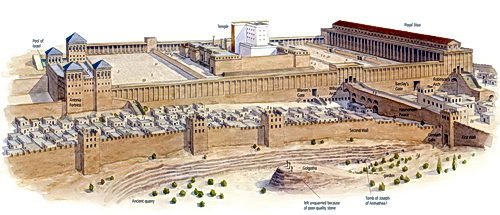
The first interview is “What Did Calvary Look Like?” Evidence for the Church of the Holy Sepulcher and the Garden Tomb is summarized. Golgotha on this drawing is now the site of the Church of the Holy Sepulcher.

Drawing showing Golgotha.

Drawing showing Golgotha.

The second interview is “What Did Jesus’ Tomb Look Like?”

If you teach the Bible you will want to download the large drawings associated with these interviews. Some sample pages in PDF (Introductions to Luke, Revelation, and Psalms) are available for download here.

Taylor explains the high quality of these drawings (“paintings”):

Using Dr. Ritmeyer’s extensive research and new drawings, we then turned to the illustration firm Maltings Partnership (in Derby, England) to produce the final, full-color paintings. We knew of Maltings’ superb work from their reconstruction drawings in the DK Travel Guides and the National Geographic Traveler guides. We could not be happier with the final results.

New study material online (including Español)

Over at BibleWorld I have posted the following items including Español el material de estudio de la Biblia.:

  • La Authoridad Biblica (under Foreign Language Materials). This book is for class or individual study.
  • Introduction to the Prophets. (This, and the other items below, are under Old Testament Studies.) Brief introductory outline showing the role of the prophets in Israel.
  • Analysis of the Book of Isaiah. This is the analysis by George L. Robinson.
  • Comparison of Kings of Israel, Judah, and Foreign Rulers. Helpful chart with dates for all rulers.

One you get to BibleWorld click on the Download Study Material in PDF link. Then scroll to the material you would like to take a look at and download if you wish.

Here is the link to BibleWorld.

Second Temple Model in new location

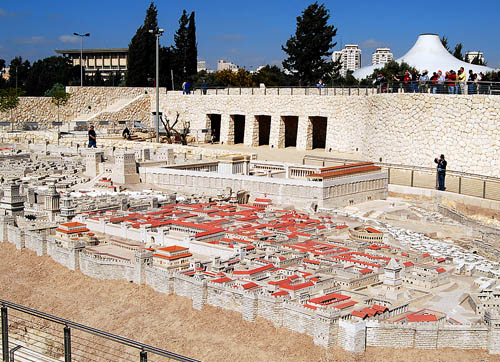
For years the model of Jerusalem from the time of the second temple was displayed on the grounds of the Holyland Hotel in Jerusalem. When the hotel needed the space to enlarge, the decision was made to relocate the model on the grounds of the Israel Museum. This was a wonderful decision. It is now possible to visit the model, the Shrine of the Book, and the archaeology museum with one stop. Also, the Bible Lands Museum is across the road.

Second Temple at the time of Herod and Christ? I know that Bible students wonder about this designation. In our Bible classes we often point out that the temple was first built by Solomon, king of Israel (970-931 B.C.). That temple was destroyed by the Babylonians in 586 B.C. The temple was rebuilt after the return from the Babylonian Exile in the days of the Persian King Darius (520-516 B.C.). If we consider Herod’s work a remodeling of the second temple, then I suppose we could think of it as the second temple. Herod’s work was so massive that we probably should think of it as the third temple. Herod began this work about 19/20 B.C. There is a reference to the long project in the gospel of John.

John 2:19-22  Jesus answered them, “Destroy this temple, and in three days I will raise it up.”  20 The Jews then said, “It took forty-six years to build this temple, and will You raise it up in three days?”  21 But He was speaking of the temple of His body.  22 So when He was raised from the dead, His disciples remembered that He said this; and they believed the Scripture and the word which Jesus had spoken. (John 2:19-22)

Here is a photo I made in April of the model which is based on available literary and archaeological evidence. In the background you see the Knesset of Israel and the Shrine of the Book where some of the Dead Sea Scrolls are displayed.

Second Temple Model of Jerusalem at its new location

A river in Pamphylia

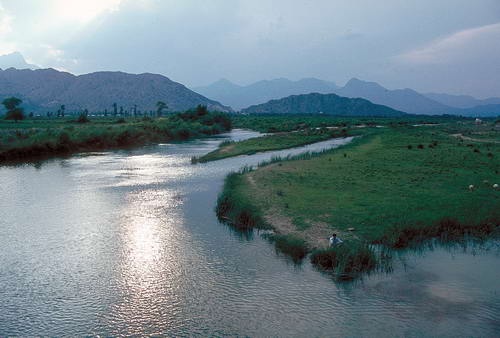
This week I am busy with a number of projects, but I wanted to share a beautiful photo that I made early one morning in the mid-80s. This is a river that flows from the Tarus Mountains into the Mediterranean at Antalya, Turkey. Antalya is know in the Bible as Attalia. Paul and Barnabas sailed from Attalia at the conclusion of the first preaching journey.

When they had spoken the word in Perga, they went down to Attalia. From there they sailed to Antioch, from which they had been commended to the grace of God for the work that they had accomplished. (Acts 14:25-26)

Attalia was in the Roman province of Pamphylia in the days of Paul.

A river in Pamphylia with the Tarus Mountains in the background.