Category Archives: New Testament

Jerome in Bethlehem

Recently I was reading a manuscript written by a friend on the general subject of how we got the Bible. Of course, he mentioned Jerome and his work of translating the ancient Hebrew and Greek manuscripts into what would be called the Latin Vulgate.

The earliest English versions of the Bible were translated from the Latin Vulgate. Even though the translations of today rely mostly on the Hebrew and Greek texts, we are still indebted to the work of Jerome.

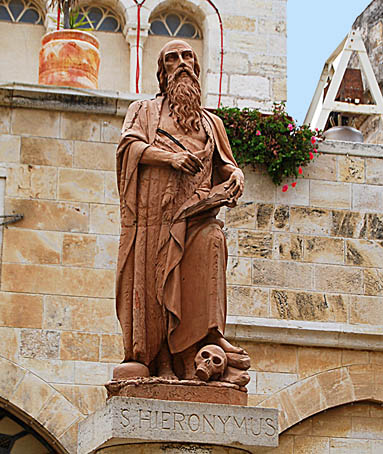
Jerome lived in Bethlehem from about 384 A.D. to 420 A.D. In the front of the Church of St. Catherine in Bethlehem there is a modern statue of Jerome showing him in the act of writing. Everyone always asks about the skull at the foot of the statue. Some have suggested that Jerome kept a skull on his desk to remind him of his mortality. That would do it for me!

Statue of Jerome in front of St. Catherine's Church. Photo by Ferrell Jenkins.

Statue of Jerome in front of the church of St. Catherine in Bethlehem. Photo by Ferrell Jenkins.

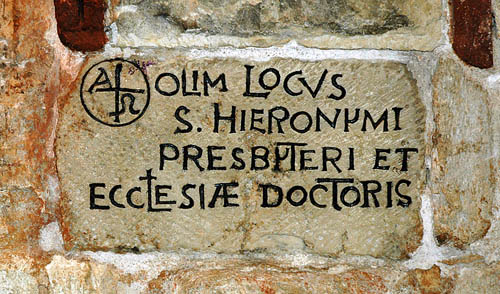
Underneath the Church of the Nativity there are a series of grottoes or caves. One of these is said to have been the place where Jerome did his work of translation and writing. This sign presently marks the place where he once lived.

The place where Jerome once lived. Photo by Ferrell Jenkins.

The place where Jerome once lived. Photo by Ferrell Jenkins.

Reliability of the New Testament Manuscripts

Earlier I mentioned hearing Dr. Daniel Wallace speak on New Testament Textual Criticism at the annual ETS meeting. Dan is NT editor of the NET Bible and a respected textual critic. He has a DVD video of this lecture and of another one (“Is What We Have Now What They Wrote Then?”) available for the small sum of $15.00 plus $3 S&H. This is good, up-to-date, material on this subject. I ordered my copies this morning. Here is the info about the DVDs:

“Is What We Have Now What They Wrote Then?”
A lecture at an apologetics conference in Providence, Rhode Island, 2008, about whether our printed New Testaments today accurately represent the original text.

“Challenges in New Testament Textual Criticism for the 21st Century”
A plenary lecture at the annual Evangelical Theological Society meeting in Providence, Rhode Island, 2008, on current issues in NT textual criticism.

Use this link to get to the order page: Wallace DVDs. To read a bit more about the DVDs and see comments by readers, click here.

Information about The Center for the Study of New Testament Manuscripts, which is headed by Wallace, is available here.

Healing of the blind man at Bethsaida

There are several accounts in the Gospels (Matthew, Mark, Luke, John) of Jesus giving sight to the blind.

  • Two blind men were healed (Matthew 9:27-31).
  • A blind, mute, demon-possessed man was healed by Jesus (Matthew 12:22).
  • Two blind men near Jericho were given sight (Matthew 20:29-34). It may be that the blind beggar named Bartimaeus was one of these (Mark 10:46-52).
  • A blind man was brought to Jesus at Bethsaida and healed (Mark 8:22-25).
  • The man who was blind from birth, and was told to go wash in the pool of Siloam in Jerusalem (John 9).

My eyes have experienced several problems over the past few years. I am fortunate to have received excellent care from a team of competent professionals. Earlier this week I had my first cataract surgery. I have been surprised that most of my friends who knew about the surgery asked “which eye?” I always said, “right,” but I wonder if their response would have been different if I had said “left.”

When you had your cataract surgery I thought it was minor and routine. When I had mine it was more serious! Actually it was not too difficult. I can tell that I see better in the right eye, but I must wait a couple of weeks to see what will be done about the lens I have been wearing before I will know how effective it has been. And then there is the left eye.

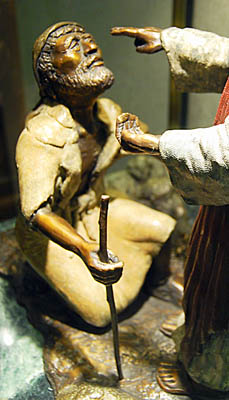
Well, all of this got me to thinking about the miracles of Jesus in the healing of the blind. One of the physicians at the clinic where I go has a nice piece of sculpture in his waiting area.

"Miracle of Sight" at Tampa Eye Clinic. Photo by Ferrell Jenkins.
Miracle of Sight.

I suspect that this sculpture is based on the account of the blind man in John 9. It could possibly be the account of the man at Bethsaida (Mark 8).

Bethsaida is now identified with et-Tell. In with Jesus through Galilee according to the fifth Gospel, the late Bargil Pixner points out that the man was healed in stages. He then says,

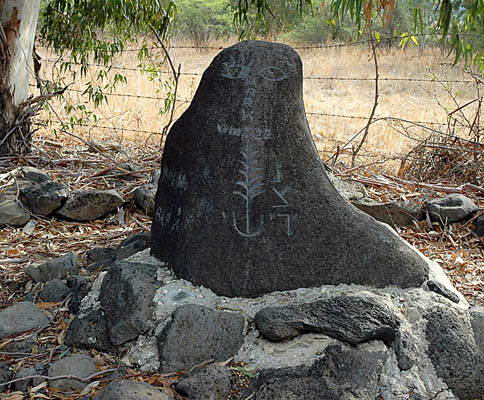
The place of the healing near Bethsaida is marked today by a memorial stone on which two eyes have been chiselled, one half-closed and the other open brightly. (page 95)

I had the opportunity to meet Pixner once at Tabgha and have him autograph a copy of his book. I asked him if he knew how long the marker had been at the site. He told me exactly and then added, “I put it there.” You might like to see that memorial stone.

Memorial stone placed at Bethsaida by Bargil Pixner. Photo by Ferrell Jenkins.

Traveling without a bag

Read the previous post, Treasures old and new, for an introduction to this one.

Recently I was reading a section in Light From the Ancient East by Adolf Deissman about the value of understanding the meaning of New Testament words through words in common use in New Testament times.

Deissman takes up the account of Jesus sending out the twelve and shows how one simple word is understood better through the use of documents from the same time period.

Jesus said to the disciples,

“Heal the sick, raise the dead, cleanse the lepers, cast out demons. Freely you received, freely give. “Do not acquire gold, or silver, or copper for your money belts, or a bag for your journey, or even two coats, or sandals, or a staff; for the worker is worthy of his support. (Matthew 10:8-10 NASB)

See also Mark 6:8 (the KJV uses scrip for the Greek pera) and Luke 9:3; 22:35-36.
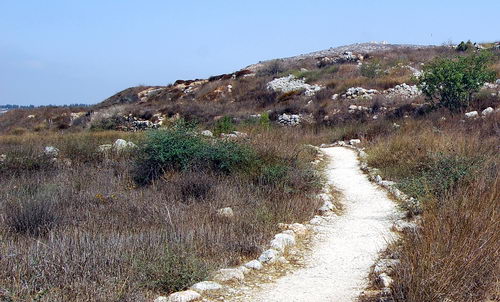
A path at Shiloh. Photo by Ferrell Jenkins.

A path at Shiloh. Photo by Ferrell Jenkins.

Below is the rather lengthy quotation from Deissman which I have in the Libronix format now. Because of the length of this paragraph I will not indent it as we normally do, and will divide it into three paragraphs for ease of reading.

——

One of the characteristic utterances of Jesus has here been handed down, not without variations, but still in such form that the original can be discerned beneath them: the apostles were told to take with them for their journey only the barest necessaries, among which was to be reckoned neither money nor bread. According to St. Matthew’s report they were further forbidden even to earn money on their way, as they might have done by working miracles of healing, etc. The meaning of the “wallet” (A.V. “scrip”) has seldom been questioned, because it seems so obvious: most commentators probably think of it as a travelling-bag, or, more precisely defined, as a bread-bag.

The word in the original Greek, πήρα, is capable of either meaning, according to circumstances. In the context “travelling-bag” would do very well; “bread-bag” not so well, being superfluous after the mention of “bread,” and tautology seems out of place in these brief, pointed commands given by Jesus. But there is a special meaning, suggested by one of the monuments, which suits the context at least as well as the more general sense of “bag” or “travelling-bag.” The monument in question was erected in the Roman Imperial period at Kefr-Hauar in Syria by a person who calls himself, in the Greek inscription, a “slave” of the Syrian goddess. “Sent by the lady,” as he says himself, this heathen apostle tells of the journeys on which he went begging for the “lady” and boasts triumphantly that “each journey brought in seventy bags.”

The word here employed is πήρα. Of course it has nothing to do with well-filled provision-bags for the journey: it clearly means the beggar’s collecting-bag. The same special meaning would make excellent sense in our text, particularly in St. Matthew’s version: there is to be no earning, and also no begging of money. With this possible explanation of the word πήρα the divine simplicity of Jesus stands out afresh against the background suggested by the heathen inscription. While Christianity was still young the beggar-priest was making his rounds in the land of Syria on behalf of the national goddess. The caravan conveying the pious robber’s booty to the shrine lengthens as he passes from village to village, and assuredly the lady will not forget her slave. In the same age and country One who had not where to lay His head sent forth His apostles, saying:—

“Freely ye received, freely give. Get you no gold, nor silver, nor brass in your purses: no wallet for your journey.”

——

I was looking at some material on the financial support of preachers. John encouraged his readers to receive those who come preaching the gospel. He says,

You will do well to send them on their journey in a manner worthy of God. For they have gone out for the sake of the name, accepting nothing from the Gentiles. (3 John 1:6-7)

The Linguistic and Exegetical Key to the Greek New Testament points out the difference between those who went out preaching the message of Christ and those who were out for the money. The preachers of Christ were to be supported by fellow Christians. This was “in marked contrast both to the wandering philosophers of the day and to the beggar priests of the Syrian goddess” [mentioned by Deissmann].

Treasures old and new

The use of current, reliable sources in our study and teaching is important. A study of the background and customs in Bible times is essential if we want to come to an understanding of the original meaning of the biblical text. One set of books that are helpful in this area is entitled New Testament Documents Illustrating Early Christianity. I think Eerdmans now handles the complete set of 9 volumes.

This is not to say, however, that older works are without value in our study. I have observed that some important material, after being noted by several scholars, will then be overlooked by later writers. Eventually few people have the original book and are unaware of the material.

One of the valuable older works is Light From the Ancient East by Adolf Deissman which was published originally in English in 1910. Deissman is the scholar who informed us that the Greek of the New Testament was the koine, common, vernacular Greek of everyday communication. Soon I plan to share a comment from Deissman about travel and preaching.

Listen to one of the parables of Jesus:

Then he said to them, “Therefore every expert in the law who has been trained for the kingdom of heaven is like the owner of a house who brings out of his treasure what is new and old.” (Matthew 13:52)

Final SBL report

Sunday afternoon I attended a session on Rome and Religion: A Cross-Disciplinary Dialogue. The featured speaker was Karl Galinsky, a distinguished professor of classics from the University of Texas. His topic was The Cult of the Roman Emperor: Uniter or Divider. Galinsky began by saying that he was pleased to see that New Testament scholars had finally discovered the “historic context of the New Testament.”

Galinsky emphasized that the Emperor cult existed. He said that we must not think of it as the prominent cult, but as being intertwined with the other cults known throughout the Roman Empire. Another speaker, Barbette Stanley Spaeth, cited evidence of the emperor cult in Corinth. I found the information significant in the study of the book of Revelation as well as the epistles of Paul.

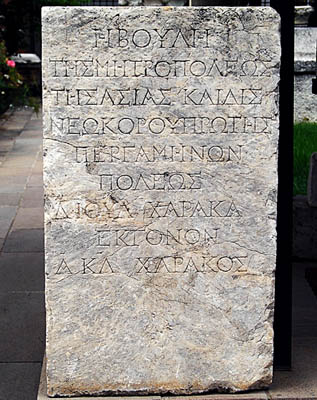
A Travel Note: The photo below shows an inscription which is now displayed in the garden of the archaeology museum in Bergama, Turkey (ancient Pergamum; Revelation 3:12-17). The inscription states that Pergamum was metropolis of Asia and twice NEOKOROS. This last word was the one commonly used when a city of Asia Minor was awarded the right to build a temple to the Emperor. This type of information must be taken into account when we consider the setting of the Book of Revelation.

Inscription at Pergamum claiming that the city was twice NEOKOROS. Photo by Ferrell Jenkins.

Inscription at Pergamum claiming that the city was twice NEOKOROS. Photo by Ferrell Jenkins.

Monday morning I attended another session on Biblical Lands and Peoples in Archaeology and Text. This one dealt with Samaria and the Samaritans. There were seven presenters. I especially enjoyed hearing Robert J. Bull of Drew University. Bull excavated a site called Tell er Ras on Mount Gerizim between 1964 and 1968 when it was under the control of the Hashemite Kingdom of Jordan. I enjoyed seeing his photos, drawings, and explanations. His work uncovered evidence of Hadrian’s temple in the early second century A.D. In more recent excavations Y. Magen claims to have discovered the Samaritan temple destroyed by John Hyrcanus. Magen was not present. Some of the speakers indicated that a final report has not been made by Magen and they did not comment on the matter.

This whole area is of great significance to students of the New Testament. The conversation between Jesus and the woman of Samarian dealt with this issue.

“Our fathers worshiped in this mountain, and you people say that in Jerusalem is the place where men ought to worship.” (John 4:20).

Learning more at the SBL meeting

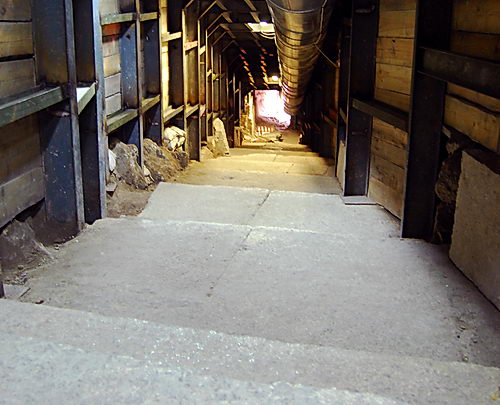
Sunday afternoon I attended two good sessions for a total of 10 papers or presentations. The first was on Biblical Lands and Peoples in Archaeology and Text. Ronny Reich of Haifa University spoke on the discovery of the road leading from the Pool of Siloam to the Temple Mount in Jerusalem. I saw a portion of this street and the tunnel underneath it earlier this year.

Street leading from Pool of Siloam up to the Temple Mount. Photo by Ferrell Jenkins.

Street leading from Pool of Siloam up to the Temple Mount. Photo by Ferrell Jenkins.

Doron Ben-Ami of the Israel Antiquities Authority spoke about the Givati Garage excavation south of Dung Gate. The structure found there is very large and is thought to have belonged to the family of Queen Helena of Adiabene. You can find more information and photos here.

One young scholar read a paper on Roman Jerusalem as a Setting of Earliest Christianity. He cited someone as saying that Acts might have been written in the middle of the second century. That theory is almost as old as the material he was dealing with. He thought that Luke’s account of the beginnings of Christianity was “magical.” Well, some presentations are well researched and profitable, and others are not.

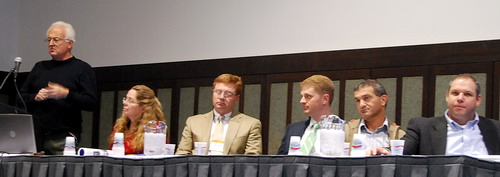
Bible Lands and Peoples in Archaeology and Text presenters. Reich is speaking. Photo by Ferrell Jenkins.

Bible Lands and Peoples in Archaeology and Text presenters.Photo by Ferrell Jenkins.

More later about the second section I attended.

The Importance of Water in the Bible World

Dr. Claude Mariottini, Professor of Old Testament at Northern Baptist Seminary, has shared two good articles on the importance of water in the development of civilization. These are worthwhile post, and I urge you to take time to read both of them.

The first article is here.

The second article is here.

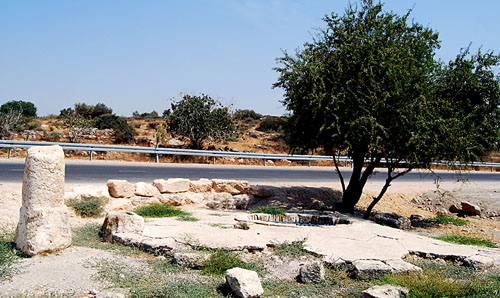
The photo below was made a Beit Guvrin (near Old Testament Mareshah). It shows a well for water, a tree for shade, and a milestone (which has been moved from the general area to this place.

A well, shade, and milstone at Beit Guvrin. Photo by Ferrell Jenkins.

A well, shade, and milstone at Beit Guvrin. Photo by Ferrell Jenkins.

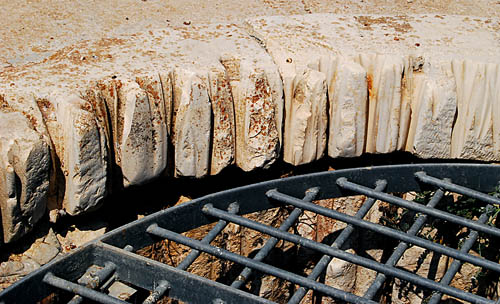
The next photo shows how ropes pulling water from the well cut grooves in the soft stone from which the curb was made.

Grooves cut in the well curb. Photo by Ferrell Jenkins.

Grooves cut in the well curb. Photo by Ferrell Jenkins.

There are many accounts in the Bible showing the importance of such a place as this. Note a few.

  • Hagar and Ishmael (Genesis 21:19).
  • David craved the water from the well at Bethlehem (2 Sam. 23:15-17).
  • The figurative use in Proverbs 5:15 and Song 4:15.
  • The Samaritan woman at Jacob’s well (John 4).

Gold earring from Roman-Byzantine period

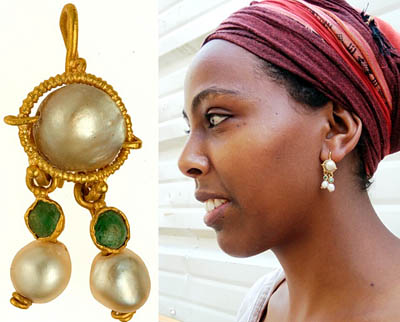
We noted earlier here about the discovery in Jerusalem of what is thought to be a palace belonging to the first century Queen of Adiabene. Archaeologists working for the Israel Antiquities Authority have found a single earring. The IAA press release describes the earring this way:

The earring, which is made of a coiled gold hoop, has a large inlaid pearl in its center. Connected to the hoop are two identical gold pendants, each of which is adorned with one emerald and pearl. The emerald is held by a kind of gold cap that connects it to the main hoop by means of a small hoop that is also fashioned from gold. Another pearl that is relatively smaller than the one inlaid in the upper hoop is attached to the other side of the emerald. The pearl is fastened to the emerald by means of a gold finding, which passes through a tiny hole that was drilled in it.

The earring was discovered in the ruins of a building dating from the Byzantine period (fourth-fifth centuries A.D.). The excavators say that this jewelry could have been produced sometime between the first century B.C. and the fourth century A.D.

The earring and a model displaying it. IAA Photos.

The earring and a model displaying it. IAA Photos.

I suspect we will see this design in stores soon.

Jesus spoke a parable that illustrates the value of a pearl.

“Again, the kingdom of heaven is like a merchant seeking fine pearls, and upon finding one pearl of great value, he went and sold all that he had and bought it. (Matthew 13:45-46 NASB)

Brawls at the Holy Sepulchre

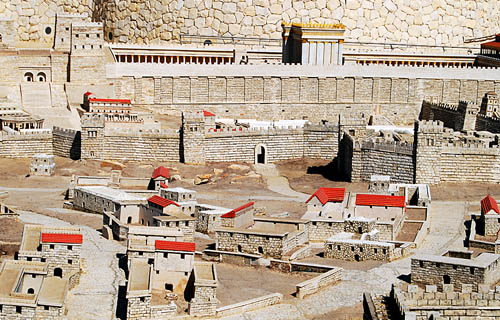
According to the biblical records, Jesus was crucified outside Jerusalem (John 19:20), probably not far from a gate (Hebrews 13:12), near a road (Mark 15:29; Matthew 27:39), and near a garden with a new tomb in it (John 19:41).

This photo of the Second Temple model, now located at the Israel Museum, shows the location of Calvary in the center of the image.

Second Temple model showing location of Calvary. Photo by F. Jenkins.

Second Temple model showing location of Calvary. Photo by F. Jenkins.

Nothing about the Church of the Holy Sepulchre reminds one of the actual setting where Christ was crucified and buried. One must remember, however, that Jerusalem has been continuously inhabited for many centuries. Strong evidence suggests that the site now occupied by the Church of the Holy Sepulchre was outside the wall of Jerusalem at the time of Christ.

Charlesworth points out that “there are no competing places for Calvary or Golgotha prior to the last century.” He has reference to Gordon’s Calvary and Garden Tomb which is located about a block north of Damascus Gate.

Some columns in the Church of the Holy Sepulchre date from the fourth century church built by Constantine. Through the centuries many additions and changes have been made. It reminds one of a building that needs to be remodeled.

Five religious groups compete for time and space in the Church today. From time to time we hear of a brawl breaking out among the competing groups for certain rights. This link leads to a video of the latest scuffle.

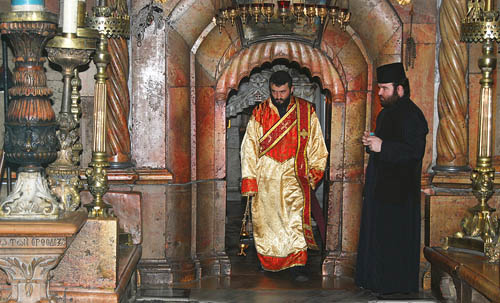
Elizabeth and I were in the Church one afternoon in September at the time of one of the services.

Entrance to the tomb of Jesus in the Church of the Holy Sepulchre. Photo by FJ.

Entrance to the tomb of Jesus in the Church of the Holy Sepulchre. Photo by FJ.

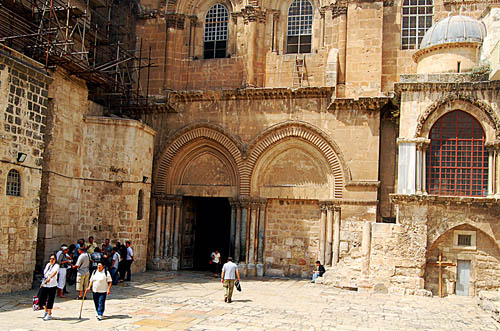
Numerous disputes have arisen through the centuries, and some have not yet been resolved. In photos of the entrance you will see a ladder on the ledge above the blocked door. It has been there since the middle of the 19th century because the sects cannot agree who should remove it.

Entrance to the Church of the Holy Sepulchre. Photo by Ferrell Jenkins.

Entrance to the Church of the Holy Sepulchre. Photo by Ferrell Jenkins.

These things are shameful. I have often remarked that many non-Christians of Palestine known nothing of New Testament Christianity except what they have learned from Church History (read: the Crusades) and the Shrines. If one wishes to learn about Christ and the Early Church let him/her read the New Testament.

We know what the Lord desires of those who believe in Him:

“I do not ask on behalf of these alone, but for those also who believe in Me through their word; that they may all be one; even as You, Father, are in Me and I in You, that they also may be in Us, so that the world may believe that You sent Me. (John 17:20-21 NAS)