Category Archives: New Testament

Alexandria Troas # 3

For # 1 scroll down to November 7, or click here. For # 2 scroll down to November 10, or click here.

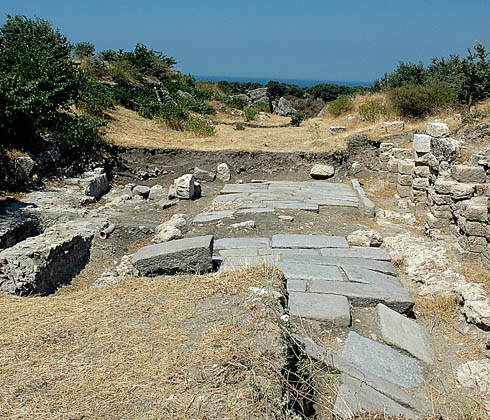
Recent excavations by the University of Münster have uncovered a portion of the Roman road at Troas. A member of the staff said, “We like to think that this is the road traveled by the apostle Paul when he entered the city.” Perhaps this photo helps illustrate the statement in Acts 16:8 which says “they came down to Troas.” The Aegean Sea is visible in the distance.

Recently excavated Roman road at Troas. Photo by Ferrell Jenkins 2006.

Recently excavated Roman road at Troas. Photo by Ferrell Jenkins 2006.

Alexandria Troas # 2

For # 1 scroll down to November 7, or click here.

Paul visited Troas on the return from his third journey. His companions, including the men who were taking the contribution to the poor among the saints at Jerusalem arranged time to be with the disciples on the first day of the week. When they met to break bread Paul spoke for a long time and raised Eutychus (Acts 20:4‑12). After the raising of Eutychus, Paul’s companions set sail for Assos, but Paul decided to travel about 20 miles south by land from Troas to Assos and meet the ship there (Acts 20:13‑14).

On another occasion, while awaiting the return of Titus from Corinth, Paul was very discouraged during his stay at Troas (2 Cor. 2:12ff.). He did not write a letter to the church at Troas, but in his last letter he requested Timothy to bring the cloak, the books, especially the parchments, which he had left at Troas with Carpus (2 Tim. 4:13).

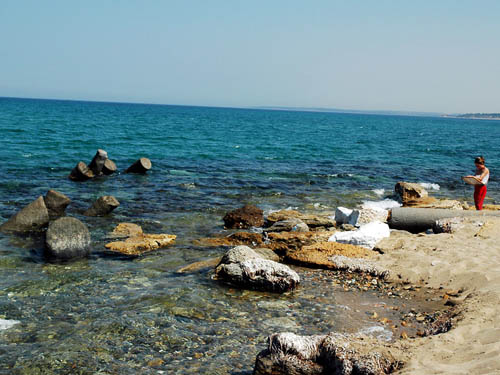
The inner harbor at Troas. Photo by Ferrell Jenkins.

The inner harbor at Troas. Photo by Ferrell Jenkins.

Earlier visits to Troas have allowed us to see only a few exposed ruins and a pathetic looking artificial harbor. The entry to the harbor is now clogged up; water flows into the harbor from the Aegean Sea, but none flows out. Over the past ten years archaeologists from the University of Münster and other institutions have been excavating in Troas. We will show some of the new discoveries in the next post.

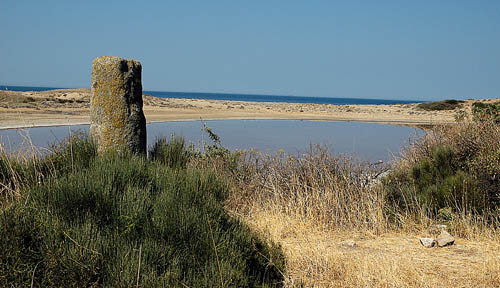
The outter harbor at Troas. Photo by Ferrell Jenkins.

The outter harbor at Troas. Photo by Ferrell Jenkins.

Alexandria Troas

The terms Troy, Troas, and Troad were derived from the name of the ancient people known as the Troes. The Troes lived in the Troad. This region became part of the Roman province of Asia, and was a substantial portion of the area known as Mysia which included the cities of Troas, Assos and Pergamum.

The term Troas or Troad was used to describe the region where Alexander first defeated the Persians in the Battle of Granicus. The city of Alexandria Troas, located about 10 miles from ancient Troy was first called Antigonia. Lysimachus changed the name to Alexandria in about 300 B.C., but there were many cities named for Alexander, so this one came to be called Alexandria Troas.

Colin Hemer points out that “Troas was a nodal point on what became a sophisticated system of international routes, organized functionally with regard to complex variables of speed and safety, of season and weather and conditions by land and sea.” Troas was, therefore, an ideal place from which the Gospel would spread into Europe.

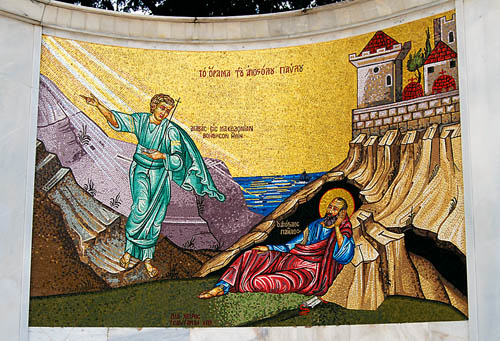
Troas was made a Roman colony by Augustus, and became one of the important cities of northwest Asia. A man of Macedonia appeared in a night vision to Paul at Troas and immediately his traveling party sailed for Macedonia (Acts 16:8‑11). Timothy, Silas, Luke, and perhaps others, were with Paul at Troas.

This photo from Berea illustrates the vision of the man of Macedonia calling on Paul to come over into Macedonia.

A man of Macedonia appears to Paul at Troas. Photo by Ferrell Jenkins.

A man of Macedonia appears to Paul at Troas. Photo by Ferrell Jenkins.

Ask in the next village

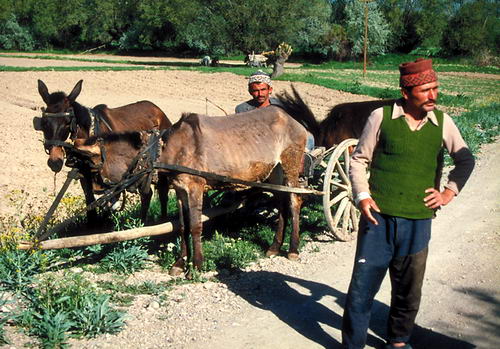
Once while visiting the site of Lystra our group enjoyed some time with local farmers who were working the fields below the tell (huyuk, in Turkey). I asked our guide to ask the men if they had heard of the apostle Paul. When he asked them, a puzzled look came over the face of the farmer who was doing most of the talking. He said, “No, but you might ask in the next village.”

The farmer said, "Ask in the next village." Photo by Ferrell Jenkins.

The farmer said, "Ask in the next village." Photo by Ferrell Jenkins.

Paul visited Lystra on his first journey (Acts 14). On the second journey he came through Lystra where Timothy lived. From that point on Timothy remained a faithful companion and co-worker with Paul in the spread of the gospel throughout the Roman Empire.

Paul came also to Derbe and to Lystra. And a disciple was there, named Timothy, the son of a Jewish woman who was a believer, but his father was a Greek,  2 and he was well spoken of by the brethren who were in Lystra and Iconium.  3 Paul wanted this man to go with him; and he took him and circumcised him because of the Jews who were in those parts, for they all knew that his father was a Greek.  (Acts 16:1-3 NASB)

Is the Apostle Paul known in your village? I mean, is the teaching of Christ and Him crucified known there? (1 Corinthians 2:2).

What shall we do now?

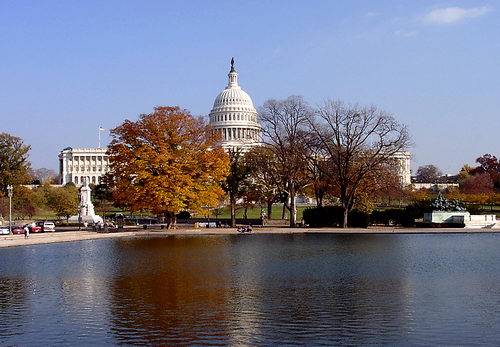
United States capitol in Washington, DC. Photo by Ferrell Jenkins.

United States capitol in Washington, DC. Photo by Ferrell Jenkins.

Paul’s Admonition to Christians
About Their Responsibility to Those in High Positions

1 Timothy 2:1-7

First of all, then, I urge that supplications, prayers, intercessions, and thanksgivings be made for all people, for kings and all who are in high positions, that we may lead a peaceful and quiet life, godly and dignified in every way.

This is good, and it is pleasing in the sight of God our Savior, who desires all people to be saved and to come to the knowledge of the truth.

For there is one God, and there is one mediator between God and men, the man Christ Jesus,  who gave himself as a ransom for all, which is the testimony given at the proper time.

For this I was appointed a preacher and an apostle (I am telling the truth, I am not lying), a teacher of the Gentiles in faith and truth. (ESV)

A look at two prodigal sons

Every Bible reader knows the story of the prodigal son. He became dissatisfied with things at home, asked his father for his part of the inheritance, and took off for a distant country. There he wasted his estate on wild living. See Luke 15 for details of the story.

I have often wondered if the young prodigal went away to the region of Decapolis. A city like Jerash doesn’t seem that far today, but we must remember that most people likely walked or used donkey transportation in those days. Jerash would provide a wonderful opportunity for a boy away from home for the first time to become involved in loose living. Most of the ruins at Jerash belong to the second century, but it is not difficult to imagine an impressive city there in the first century.
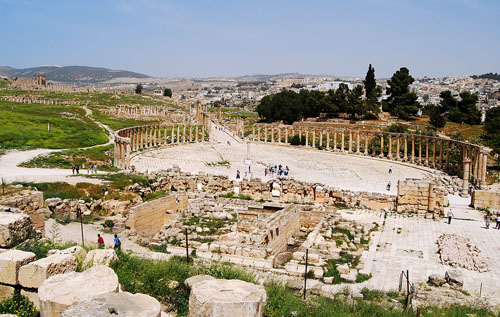
The forum at Jerash. Photo by Ferrell Jenkins.

The forum at Jerash. Photo by Ferrell Jenkins.

Another story worth considering has come to my attention. About 100 years ago Adolf Deissmann wrote Light From the Ancient East. He demonstrated how the Egyptian papyri illustrates New Testament teaching. In fact, he showed that the language of the New Testament was generally the koine (common) Greek of the day.

The papyrus about which Deissmann writes comes from the second century A.D. It tells of a young man named Antonius Longue from the village of Caranis in the Fayum of Egypt. He quarreled with his mother, left home, engaged in loose living, and running up debts.

Eventually Antonius learns that his mother has come to town to search for him. He writes her to plead for reconciliation. One must still question his character, for he hints that his mother might pay his debts. In his letter written to his mother he says,

I beseech thee, mother, be reconciled to me! I know that I have sinned.

Deissmann comments on the value of an account like this in the study of the New Testament.

There can be no doubt that this letter is one of the most interesting human documents that have come to light among the papyri. This priceless fragment, rent like the soul of its writer, comes to us as a remarkably good illustration of the parable of the Prodigal Son (Luke 15:11 ff.).

He also points out that the term reconciled is the same one used in the New Testament in texts like Matthew 5:23-24.

If therefore you are presenting your offering at the altar, and there remember that your brother has something against you, leave your offering there before the altar, and go your way; first be reconciled to your brother, and then come and present your offering. (NASB)

The Bosporus

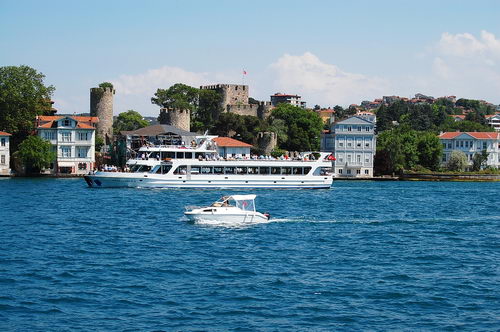
I think on all of my tours to Istanbul we have included and enjoyed a boat ride along the Bosporus (Bosphorus), vital waterway linking the Black Sea to the Mediterranean Sea. The Asian side was known as Bythinia in Roman times. Peter addressed his epistles to the saints in various parts of modern Turkey (1 Peter 1:1).

Today there is an interesting article in The New York Times about a boat ride on the Bosporus. I suggest you check this quickly if you are interested. I don’t know how long these links remain active. Click here.

Here is one of the many beautiful photos I have made during a boat ride on the Bosporus.

A view along the Bosphorus. Photo by Ferrell Jenkins.

A view along the Bosphorus. Photo by Ferrell Jenkins.

Mohammed Ali Mosque in Cairo

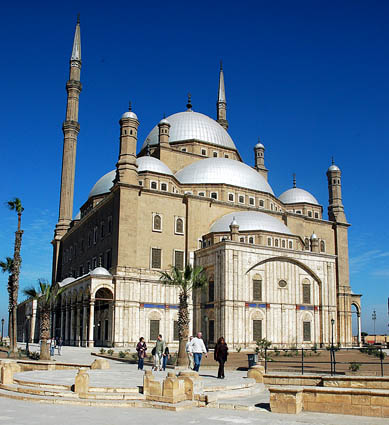
Mohammed (or Mohammad) Ali Alabaster Mosque in Cairo. No, not the boxer. He took the same name. Mohammed Ali was an Albanian who played a prominent role in the history of Egypt during the 19th century. He brought numerous reforms to Egypt and his influence continued until the middle of the 20th century.

Mohammed Ali Alabaster Mosque in Cairo. Photo by Ferrell Jenkins.

Mohammed Ali Alabaster Mosque in Cairo. Photo by Ferrell Jenkins.

My first visit here was in 1967. I vividly recall sitting on the floor of the mosque with the others of my group listening to our guide, Ahmad, explain about the history of the mosque and answering any questions we had about the Muslim religion. Someone asked him if one was free to be a Christian in Egypt. He said, “Yes, if you are born a Christian you are free to be a Christian.” He went on to say that one would not make a change of religion unless there was some bad motive involved.

In many countries the preaching of the gospel of Christ is not freely allowed. The very nature of the gospel assumes that one must make a change in order to be acceptable to God. Jesus makes this clear in his discussion with the Jewish leader Nicodemus. A spiritual birth is necessary for one to become a Christian.

Jesus answered, “I tell you the solemn truth, unless a person is born of water and spirit, he cannot enter the kingdom of God. (John 3:5 NET)

The church as a solid bulwark

The apostle Paul wrote these words to the saints at Colossae:

For though I am absent in body, yet I am with you in spirit, rejoicing to see your good order and the firmness of your faith in Christ. (Colossians 2:5 ESV)

J. B. Lightfoot suggested that the term stereoma [firmness] was a military metaphor. He says that Paul’s companionship with soldiers of the praetorian guard (Philippians 1:13) might have suggested the image.

I always enjoy William Barclay’s comments on words. He makes the following comments on order and firmness.

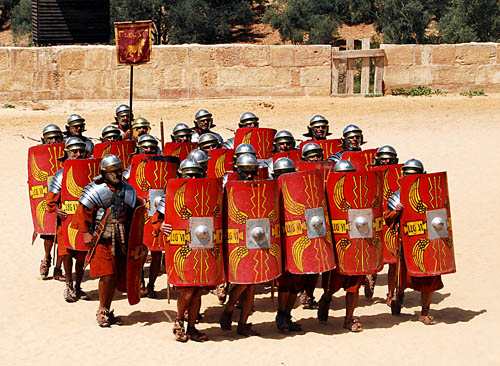
These two words present a vivid picture, for they are both military words. The word translated order is taxis, which means a rank or an ordered arrangement. The Church should be like an ordered army, with every man in his appointed place, ready and willing to obey the word of command. The word translated firmness is stereoma, which means a solid bulwark, an immovable phalanx. It describes an army set out in an unbreakable square, solidly immovable against the shock of the enemy’s charge. Within the Church there should be disciplined order and strong steadiness, like the order and steadiness of a trained and disciplined body of troops.

These soldiers from the Roman Army and Chariot Experience at Jerash, Jordan, demonstrate what is meant by the term firmness (stereoma).

Soldiers in formation as a solid bulwark. Photo by Ferrell Jenkins.

Soldiers in formation as a solid bulwark. Photo by Ferrell Jenkins.

Zaccheus climbed up into a sycamore tree

The sycamore (Ficus sycomorus) is a type of tree growing only in the Jordan Valley and near the Mediterranean coast. The sycamore is pictured as growing in abundance in the shephelah (lowland, 1 Kings 10:27). This is in contrast to cedars which Solomon planted in Jerusalem.

The sycamore is not the same as the tree by that name that grows in North America. The sycamore tree belongs to the nettle family, like the mulberry and fig trees. The fruit looks like a fig, but the taste is unpleasant. It is eaten by the poor. See Fauna and Flora of the Bible, 179-81.

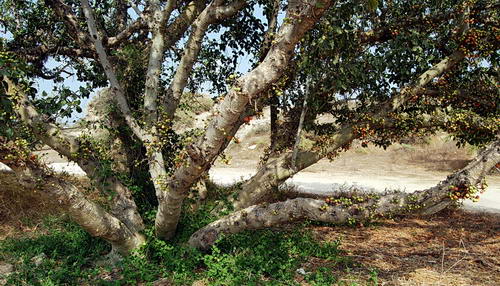
Zaccheus climbed up into a sycamore tree at Jericho (Luke 19:4). Here is a sycamore tree at Ashkelon that reminded me of Zacchaeus. The limbs are low. Even a child could climb into the tree to get a better view.

Sycamore tree at Ashkelon. Photo by Ferrell Jenkins.

Sycamore tree at Ashkelon. Photo by Ferrell Jenkins.

Amos the prophet, who lived at Tekoah on the edge of the Judean wilderness, spoke of working with the sycamore fruit.

Amos replied to Amaziah, “I was not a prophet by profession. No, I was a herdsman who also took care of sycamore fig trees. (Amos 7:14, NET Bible).

This photo shows the sycamore figs on the tree.

Sycamore figs. Photo by Ferrell Jenkins.

Sycamore figs. Photo by Ferrell Jenkins.