Category Archives: New Testament

The shepherd and his sheep

Scenes typical of biblical times are common Jordan, Turkey, and portions of the West Bank of Palestine today. There are some differences, of course.

We were traveling between Diyarbakir and Sanliurfa, Turkey, in early June. Several farmers were harvesting their grain using modern combines.
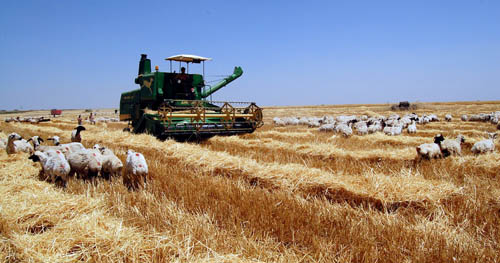
Harvesting grain in Eastern Turkey. Photo by Ferrell Jenkins.

Harvesting grain in Eastern Turkey. Photo by Ferrell Jenkins.

As quickly as the combine passed by, the shepherds brought in the sheep to feed.

The sheep/shepherd analogy was used by Jesus to describe His relationship to His disciples.

I am the good shepherd. The good shepherd lays down his life for the sheep. (John 10:11 ESV)

When Paul spoke to the elders of the Ephesian church he instructed them “to shepherd the church of God” (Acts 20:28 NAS). I note that the ESV uses the term care instead of shepherd to translate the Greek poimaino. That certainly conveys the right idea.
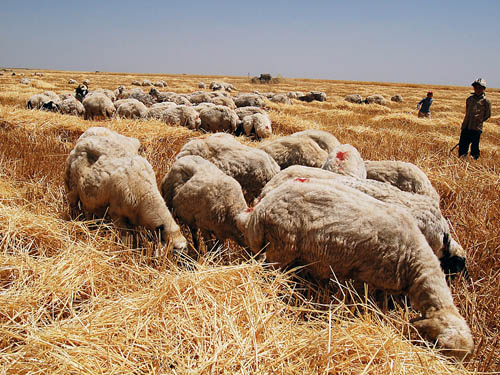
Shepherds care for their sheep in Eastern Turkey. Photo by Ferrell Jenkins.

Shepherds care for their sheep in Eastern Turkey. Photo by Ferrell Jenkins.

Peter instructed elders to “shepherd the flock of God among you” (1 Peter 5:2). The NET Bible says, “Give a shepherd’s care to God’s flock among you.” Lest these men who have been appointed to this work be elevated in their own importance, Peter added,

And do not lord it over those entrusted to you, but be examples to the flock. (1 Peter 5:3 NET)

not domineering over those in your charge, but being examples to the flock. (1 Peter 5:3 ESV)

J. B. Phillips, in his translation of this text, used a vivid phrase to illustrate the overreaching of some elders:

You should aim not at being “little tin gods” but as examples of Christian living in the eyes of the flock committed to your charge. And then, when the chief shepherd reveals himself, you will receive that crown of glory which cannot fade.
The number of New Testament textual variants

This note is not about travel, but it is about an extremely important subject. Sometime during 2008 Daniel Wallace wrote a series of articles on the subject of Textual Variants. Due to a crash these articles were lost. Recently the one on “The Number of Textual Variants: An Evangelical Miscalculation” was recovered and posted at Parchment and Pen. Go directly to the post here.

At the bottom of his post you will see links to several Related Posts.

Earlier I posted a note about two recent lectures by Dr. Daniel Wallace here.

A visit to the Siegfried H. Horn Museum

Andrews University in Berrien Springs, Michigan, has long been associated with archaeological work, especially in Jordan. This work is carried out under the name of the Institute of Archaeology.

The interesting history of the Siegfried H. Horn Museum may be read here. The name of Siegfried H. Horn is well known to anyone who had read about biblical archaeology in modern times.

Last week I was at Valparaiso, Indiana, presenting a series of lessons on Bible History and Archaeology. I had long wanted to visit the Horn Archaeological Museum. When we learned that we were slightly more than an hour away, Mark Russell, Steve Wolfgang and I made the trip one morning. The Museum is hopeful of moving into a new facility as soon as the project can be funded. At this time the small museum is open only on Saturday afternoon, but they will open by appointment, as they did for us.

The Siegfried H. Horn Archaeological Museum houses over 8,500 artifacts, but only a small portion of those are on display. There are replicas of a few famous artifacts such as the Black Obelisk of Shalmannessar II and the Moabite Stone

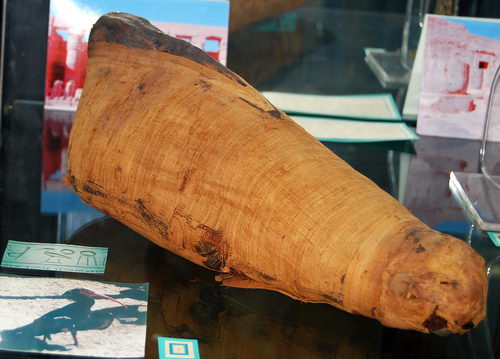
There are significant original pieces from most areas of the Bible world with Mesopotamia and Transjordan being featured. There is a mummified Ibis from Egypt. The Egyptian god Thoth was portrayed with the head of an Ibis. I never see representations of these gods without thinking of Paul’s description of the Roman world prior to the coming of Christ.

Claiming to be wise, they became fools, and exchanged the glory of the immortal God for images resembling mortal man and birds and animals and creeping things. (Romans 1:22-23 ESV)

Mummfied Ibis from Egypt. Photo by Ferrell Jenkins.

Mummified Ibis from Egypt. Photo by Ferrell Jenkins.

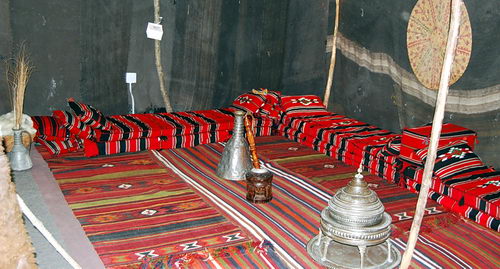
In the main exhibit hall there is a life-size Bedouin tent. This makes a good background for explaining patriarchal life.

Authentic Bedouin Tent at Horn Museum. Photo by Ferrell Jenkins.

Authentic Bedouin Tent at Horn Museum. Photo by Ferrell Jenkins.

By faith Abraham obeyed when he was called to go out to a place that he was to receive as an inheritance. And he went out, not knowing where he was going. By faith he went to live in the land of promise, as in a foreign land, living in tents with Isaac and Jacob, heirs with him of the same promise. For he was looking forward to the city that has foundations, whose designer and builder is God. (Hebrews 11:8-10 ESV)

Two other things should be mentioned. There are some wonderful models. One that impressed me was of the Roman rolling-stone tomb at Heshbon. The murals covering biblical and modern church history are impressive.

I recommend that anyone traveling in the vicinity of Berrien Springs, or those living within driving distance, take advantage of this opportunity to visit. Bible class teachers would do well to become familiar with this Museum and arrange for their students to see it.

Our thanks to Jody Washburn, an Administrative Assistant at the Institute of Archaeology, for her help in making our visit pleasant.

Longest underground Roman aqueduct

A recent article in Spiegel Online reports on the discovery of “The Ancient World’s Longest Underground Aqueduct.”

Roman engineers chipped an aqueduct through more than 100 kilometers of stone to connect water to cities in the ancient province of Syria. The monumental effort took more than a century, says the German researcher who discovered it.

When the Romans weren’t busy conquering their enemies, they loved to waste massive quantities of water, which gurgled and bubbled throughout their cities. The engineers of the empire invented standardized lead pipes, aqueducts as high as fortresses, and water mains with 15 bars (217 pounds per square inch) of pressure.

In the capital alone there were thousands of fountains, drinking troughs and thermal baths. Rich senators refreshed themselves in private pools and decorated their gardens with cooling grottos. The result was a record daily consumption of over 500 liters of water per capita (Germans today use around 125 liters).

However, when the Roman legions marched into the barren region of Palestine, shortly before the birth of Christ, they had to forgo the usual splashing about, at least temporarily. It was simply too dry.

The article by Matthias Schulz says,

This colossal waterworks project supplied the great cities of the ‘Decapolis’ – a league originally consisting of 10 ancient communities — with spring water. The aqueduct ended in Gadara, a city with a population of approximately 50,000. According to the Bible, this is where Jesus exorcized demons and chased them into a herd of pigs.

The full story may be read here. There are some nice photos and diagrams.

The identification of the “country of the Gadarenes” (Matthew 8:28-34), and the “country of the Gerasenes” (Mark 5:1; Luke 8:26-39), and the exact place where the swine rushed down the steep cliff into the Sea, is a difficult one.  And I don’t have the time to work on it today.

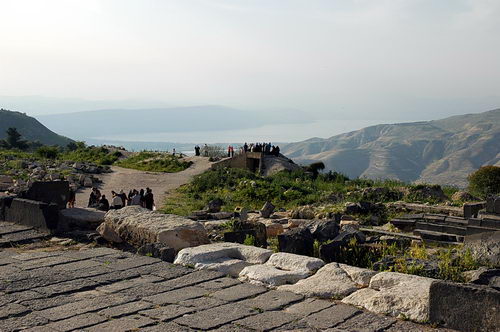
View of Sea of Galilee from Umm Queis. Photo by Ferrell Jenkins.

View of Sea of Galilee from Umm Queis. Photo by Ferrell Jenkins.

We know that Gadara had a port on the Sea of Galilee, and that Roman coins of the city portrayed ships.

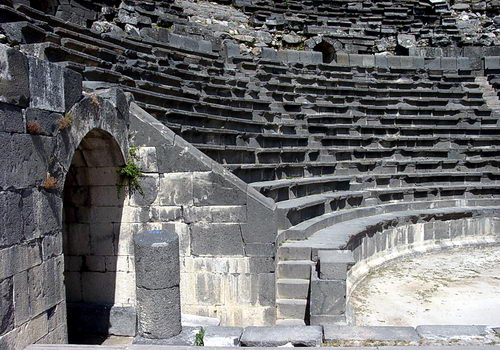
Here is a photo of the Roman theater of Umm Queis. The earliest buildings of this city are made of basalt, the volcanic rock common in the area.

The basalt theater at Umm Queis. Photo by Ferrell Jenkins.

The basalt theater at Umm Queis. Photo by Ferrell Jenkins.

HT: Joe Lauer

Another Byzantine church uncovered

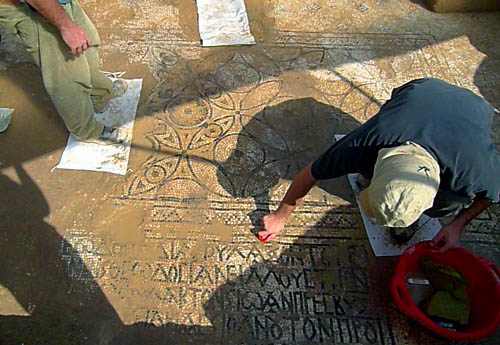
The Israel Antiquities Authority announced today the discovery of a church building dating to the Byzantine period. This one is located near Moshav Nes-Harim, about 3.11 miles east of Beth Shemesh. The full press release may be read here. The Byzantine period in Israel may be dated from about A.D. 325 to the early part of the 7th century.

Christianity grew out of the soil of Judaism. In the early part of the first century Jesus said, “for salvation is from the Jews” (John 4:22).

Max Miller says,

The population of the Holy Land became almost entirely Christian, except for Jewish enclaves primarily in Galilee. moreover, Christian pilgrims flocked to the Holy Land from all over the Roman-Byzantium world and Christian churches were built over virtually every spot which could be imagined to have any connection with a biblical event. (Introducing the Holy Land, 130-131).

He continues to say,

By 640 most of Egypt, the Holy Land and Syria were under Islamic control.

Mosaic dedicatory inscription in Greek. Photo by Daniel Ein Mor, IAA.

Mosaic dedicatory inscription in Greek. Photo by Daniel Ein Mor, IAA.

Evidence for the existence of Jewish and Christian buildings and settlements continues to become known rapidly. It has become common among some Muslim sources to deny the existence of Jews in the land of Palestine before the 20th century. The evidence of archaeology says otherwise. The Old Testament scriptures say otherwise. The New Testament, and the existence of the church in those early centuries, say otherwise.

The sad thing is that buildings are found, not churches composed of Christians. The church had so departed from the New Testament order that it was not able to effectively survive the pressures of  the Muslim invasion. The church of our day appears very weak as it faces the cultural pressures of the postmodern world.

HT: Joseph I. Lauer

ESV Study Bible online free (for a while)

Recently I received a copy of the ESV Study Bible from the publisher, Crossway Books and Bibles, for review. Hopefully I will be able to get to this in the next week or two.

Meanwhile, you have the opportunity to use the ESV Study Bible online free of charge until March 31, 2009. The Bible has been available online and in several computer Bible programs for some time. The Study Bible has many additional features such as explanatory notes, charts, maps, diagrams, etc. This will give you a few weeks to read some passages you may be studying and check the additional resources.

Check the ESV Bible Blog for complete information.

ESV Study Bible

ESV Study Bible

Or, you may go to this link, create a login and password and begin using all features of the ESV Study Bible.

The cost of discipleship: “foxes have holes”

Jesus used simple illustrations to reach the heart. When someone said, “I will follow You wherever You go,” He responded this way:

As they were going along the road, someone said to Him, “I will follow You wherever You go.” And Jesus said to him, “The foxes have holes and the birds of the air have nests, but the Son of Man has nowhere to lay His head.” (Luke 9:57-58 NASu; see Matthew 8:19-20)

Foxes have holes. Photo at Hai Bar Nature Reserve by Ferrell Jenkins.

Foxes have holes. Photo at Hai Bar Nature Reserve by Ferrell Jenkins.

William Barclay, in The Daily Study Bible, comments on this account at Matthew 8:19-20.

It is as if Jesus said to this man: “Before you follow me—think what you are doing. Before you follow me—count the cost.

Jesus did not want followers who were swept away by a moment of emotion, which quickly blazed and just as quickly died. He did not want men who were carried away by a tide of mere feeling, which quickly flowed and just as quickly ebbed. He wanted men who knew what they were doing. He talked about taking up a cross (Matthew 10:38). He talked about setting himself above the dearest relationships in life (Luke 14:26); he talked about giving away everything to the poor (Matthew 19:21). He was always saying to men: “Yes, I know that your heart is running out to me, but—do you love me enough for that?”

Jesus still demands full allegiance.

Epaphras worked hard for the Laodiceans

Laodicea is mentioned only in Paul’s epistle to the Colossians (2:1; 4:13-16) and in the Revelation of John (1:11; 3:14). Paul says that Epaphras worked diligently for the saints in Colossae, Laodicea, and Hierapolis.

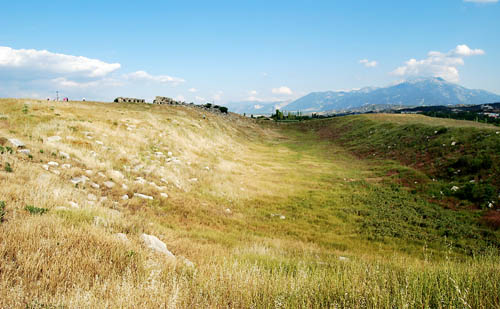
Here is a photo of the ruins of the stadium at Laodicea. Mount Cadmus can be seen in the distance to the east. Colossae was located at the foot of Mount Cadmus. Hierapolis was located to the north of Laodicea.

The stadium at Laodicea. Photo by Ferrell Jenkins.

The stadium at Laodicea. Photo by Ferrell Jenkins.

The stadium was an enclosed structure used for gladiatorial games. An inscription tells that a wealthy family dedicated it to Vespasian and Titus. One still can make our the unexcavated ruins of the 1000 feet long stadium.

IBR discussions on Jesus now online

Members of the Institute for Biblical Research who specialize in historical Jesus research have been meeting for the past 10 years to discuss essays written by group members. You may recognize the names of Darrell Bock, Craig Evans, Grant Osborne, Michael Wilkins, et al. During June, 2008, several members of the group met in Jerusalem. While there they were filmed at various sites discussing the relevant issues.

These scholars did not start with the assumption that the Bible is the world of God. Rather, they asked, is the Bible consistent with other documents of the first century? How would one go about to establish the historicity of Alexander the Great, Julius Caesar, or Jesus?

The Day of Discovery TV program filmed these scholars on site in Israel discussing the various issues involved. Jesus: Man, Messiah, or More? is the theme of the presentations. The first was filmed in the Synagogue in Capernaum; the second from Caesarea Philippi. From now through early April there will be a total of eight presentations. These will certainly be a fresh breath of air compared to the usual Easter fare on cable and network TV.

Enter the discussion here.

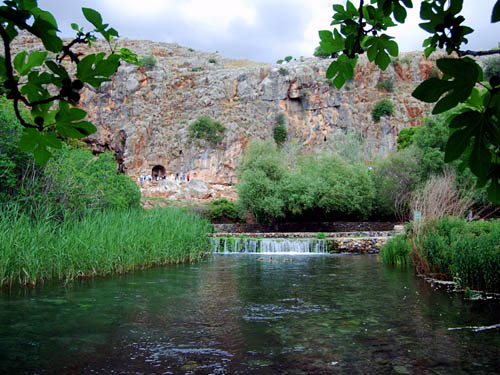
This photo shows the Banias River, one of the major sources of the Jordan River, at the site of Caesarea Philippi. It was in this region that Jesus was confessed to be the Son of the Living God by the apostle Peter (Matthew 16:13-20).

The Banias River at Caesarea Philippi. Photo by Ferrell Jenkins.

The Banias River at Caesarea Philippi. Photo by Ferrell Jenkins.

HT: Primetime Jesus

Jesus visited the town of Nain

The town of Nain is mentioned only once in the New Testament.

Soon afterward Jesus went to a town called Nain, and his disciples and a large crowd went with him. (Luke 7:11 NET)

In the full account, Luke (7:11-17) reports that as Jesus approached the town gate a funeral procession was in progress. When Jesus saw the widow He had compassion and told her to stop weeping. Luke, the physician (Colossians 4:14), reports that Jesus touched the bier and said, “Young man, I say to you, get up!” Then, as a simple matter of fact, Luke says,

So the dead man sat up and began to speak, and Jesus gave him back to his mother. (verse 15)

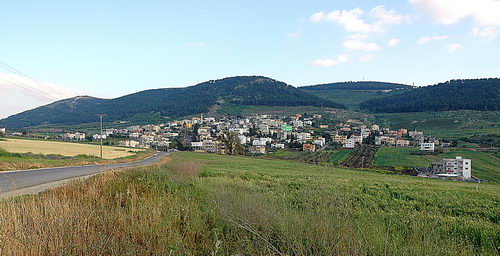
Nain is identified with the Arab village of Nein on the north slope of the Hill of Moreh. Nein is said to mean pleasant.

The town of Nein on the north slope of the Hill of Moreh. Photo by Ferrell Jenkins.

The town of Nein on the north slope of the Hill of Moreh. Photo by Ferrell Jenkins.

Ralph Earle describes the pleasant location of Nain.

The town of Jesus’ day may have stood higher on the hill than the present village. It probably was named for the pleasant view that the site affords across the plain of Esdraelon. To the west one can see Mt. Carmel, and to the north the hills behind Nazareth stand out, about 91/2 km (6 mi) away. To the northeast one can look past nearby Tabor (3 km [2 mi] away) to snowcapped Mt. Hermon in the distance. Southward lies Mt. Gilboa. (The International Standard Bible Encyclopedia, Revised, 3:480)