Category Archives: New Testament

The tomb of Jesus

The New Testament describes the tomb and burial of Jesus:

When it was evening, there came a rich man from Arimathea, named Joseph, who also was a disciple of Jesus. He went to Pilate and asked for the body of Jesus. Then Pilate ordered it to be given to him. And Joseph took the body and wrapped it in a clean linen shroud and laid it in his own new tomb, which he had cut in the rock. And he rolled a great stone to the entrance of the tomb and went away. Mary Magdalene and the other Mary were there, sitting opposite the tomb. (Matthew 27:57-61 ESV)

The Church of the Holy Sepulchre likely contains the empty tomb of Jesus. Since 1810 the tomb has been covered by a monument that hides the original appearance of the tomb. In fact, even in the 4th century Constantine changed the natural appearance of the area by cutting away some of the natural stone.

The tomb is similar to other tombs from the first century. This one is small, but that would be consistent with the fact that it was the personal tomb of Joseph of Arimathea. The museum of the Studium Biblicum Franciscanum in the Old City has a model of the tomb showing a side view. From right to left one enters the tomb when the rolling stone is moved away. The first room serves as a vestibule. The second room contains a bench or shelf cut into the rock. This was called the arcosolium. The wrapped body would be placed on this bench.

Model of the tomb in the Church of the Holy Sepulchre. Photo by F. Jenkins.

Model of the tomb in the Church of the Holy Sepulchre. Photo by F. Jenkins.

Believers appreciate the loving care Joseph gave the body of Jesus.

The house of Caiaphas

Jesus observed the Passover of the Jews somewhere in the upper city of Jerusalem, the present Mount Zion. Scholarly consensus locates the house of Caiaphas at a site near the Cenacle on Mount Zion. Another site, further down the slope toward the Pool of Siloam, is held by some as the house of Caiphas. It is  called St. Peter in Gallicantu (cock-crow). According to this tradition, it is the place where Jesus was taken after His arrest (Matthew 26:57). If correct, this would be the site of Peter’s denial of the Lord.

The late W. Harold Mare says,

Whatever interpretation is accepted, one is impressed with the ancient stone stairs that run from the vicinity of the Cenacle down past the Church of St. Peter in Gallicantu to the Pool of Siloam, stairs that are thought to be from the Jewish period. It could be that these were the very stairs used by Jesus as he went down from the Last Supper to the Kidron Valley and on to Gethsemane (John 18:1). (The Archaeology of the Jerusalem Area. Baker, 1987)

My understanding is that Jesus would have observed the Passover and instituted the Lord’s Supper in the Upper City. He then went with His disciples to Gethsemane. From there He was taken to the House of Caiaphas. Jesus may have taken these steps in both directions. Here is a photo of those stone stairs that I made in 1979.

First century steps leading to the Upper City. Photo by Ferrell Jenkins.

First century steps leading to the Upper City. Photo by Ferrell Jenkins.

The Jesus Tomb Unmasked

unmasked_thumbExpedition Bible has produced a high-quality DVD entitled The Jesus Tomb Unmasked. This is an expose of the Discovery Channel “documentary” about the Talpiot Tomb. You remember the claim that this was the tomb of Jesus and his wife Mary. The Jesus Tomb Unmasked may be ordered as a DVD, or watched online free. Information here.

The film features several of the scholars who were quoted in the Discovery Channel film. In this film they say their comments were taken out of context in The Lost Tomb of Jesus.

HT: Todd Bolen, BiblePlaces Blog.

A place called Gethsemane

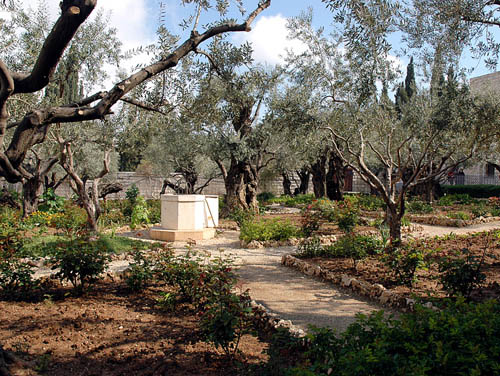
Gethsemane is a place well known in the minds of Christians, for according to the Gospels it was there that Jesus prayed alone to the Father before his arrest and trial. The word Gethsemane means oil-press. It is the name of an olive orchard on the Mount of Olives. Not many olive trees remain on the mountain originally named for them. This photo was made in the modern Garden at the Church of All Nations.

Garden of Gethsemane on the Mount of Olives. Photo by Ferrell Jenkins.

Garden of Gethsemane on the Mount of Olives. Photo by Ferrell Jenkins.

Take time to meditate on the events of that night.

Then Jesus came with them to a place called Gethsemane, and said to His disciples, “Sit here while I go over there and pray.” And He took with Him Peter and the two sons of Zebedee, and began to be grieved and distressed. Then He said to them, “My soul is deeply grieved, to the point of death; remain here and keep watch with Me.” And He went a little beyond them, and fell on His face and prayed, saying, “My Father, if it is possible, let this cup pass from Me; yet not as I will, but as You will.”

And He came to the disciples and found them sleeping, and said to Peter, “So, you men could not keep watch with Me for one hour? “Keep watching and praying that you may not enter into temptation; the spirit is willing, but the flesh is weak.” He went away again a second time and prayed, saying, “My Father, if this cannot pass away unless I drink it, Your will be done.” Again He came and found them sleeping, for their eyes were heavy. And He left them again, and went away and prayed a third time, saying the same thing once more.

Then He came to the disciples and said to them, “Are you still sleeping and resting? Behold, the hour is at hand and the Son of Man is being betrayed into the hands of sinners.  “Get up, let us be going; behold, the one who betrays Me is at hand!” (Matthew 26:36-46 NASu)

The Way of the Cross – Via Dolorosa

Numerous events from the last day prior to the crucifixion of Jesus are recorded in the New Testament (Matthew 26-27; Mark 14-15; Luke 22-23; John 18-19). As early as Byzantine times Christians began to follow the final steps of Jesus on specified days. Over the centuries many changes were made in the route and the stops. The traditional Via Dolorosa, as known today, was fixed in the 18th century.

Jerome Murphy-O’Connor says,

The Via Dolorosa is defined by faith, not by history. (The Holy Land, 5th edition, 37)

He continues,

The present Way of the Cross has little chance of corresponding to hsitorical reality… (38)

According to tradition, the third station of the cross is where Jesus falls the first time under His cross. It sounds reasonable, but the Gospels make no specific mention of this.

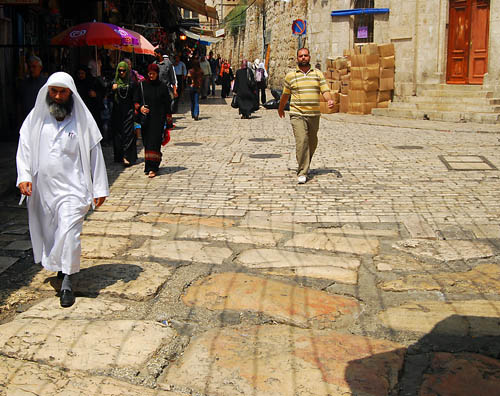
Roman period street near 3rd station of the cross. Photo by F. Jenkins.

Roman period street near 3rd station of the cross. Photo by F. Jenkins.

This photo shows the street in front of the third station. The plaque in Hebrew, Arabic and English provides the following information about the street.

Paving stones, apparently from the Second Temple Period (ca. 100 B.C.C. – 100 C.E.). The street was found in its entirety 3 meters below the existing level and was partially restored by the Municipality of Jerusalem … 1980-1981.

This means that the street Jesus might have walked is at least 10 feet below the present street level.

Hellenistic pier found at Akko – Ptolemais

A harbor from the Hellenistic period was found at Akko on the Mediterranean coast. Here is a brief description of the discovery provided by the Israel Antiquities Authority.

The part of the floor that has been revealed so far extends for a distance of 15 meters and is 4 meters wide (the full dimensions of the floor have not yet been exposed). The floor was built of rectangular, smoothly dressed kurkar stones that were placed atop a foundation course of roughly hewn kurkar stones arranged next to each other as “headers”. In probes that were conducted beneath the floor, numerous fragments of ceramic jars of Aegean provenance (from Rhodes, Kos and elsewhere) were found that were used to transport wine, as well as tableware and cooking vessels. Among the other artifacts recovered were a Greek style bronze arrowhead and bronze coins that are covered with marine encrustations. A preliminary identification of the finds shows that the floor was constructed in the Hellenistic period (end of the third century until the middle of the second century BCE) as part of a national project.

Akko Crusader wall. Excavated area of Hellenstic Harbor. Photo: Kobi Sharvit, IAA.

Akko Crusader wall. Excavated area of Hellenistic pier. Photo: Kobi Sharvit, IAA.

The photo below shows some of the kurkar stone pavement discovered one meter under the present water level.

The floor from the Hellenistic period. Photo: Kobi Sharvit, IAA.

The floor from the Hellenistic period. Photo: Kobi Sharvit, IAA.

Akko (Acre or Accho) is mentioned in Judges 1:31 as a city of the tribe of Asher. During the late 3rd or early 2nd century B.C. Akko was given the name Ptolemais by Ptolemy I or II of Egypt. Ptolemais is the name we read in the New Testament. Paul and his companions stopped at Ptolemais for one day on the return from his third journey in the Greco-Roman world.

When we had finished the voyage from Tyre, we arrived at Ptolemais, and we greeted the brothers and stayed with them for one day. (Acts 21:7 ESV)

Several things are learned from this text (and context). The previous stop was a few miles north at Tyre where they had stayed for seven days (Acts 21:4-6). After Ptolemais they arrived at Caesarea.

Paul’s companions included all of those “messengers” of the churches who were taking the contributions of the churches of Macedonia and Achaia to the poor among the saints at Jerusalem (Romans 15:25-27; 2 Corinthians 8-9). A list of names is given in Acts 20:4.

A view of the Mediterranean from the Crusader ramparts at Akko. Photo by Ferrell Jenkins.

A view of the Mediterranean from the Crusader ramparts. Photo by Ferrell Jenkins.

The monastery of the Gerasene swine

Stephen G. Rosenberg, senior fellow of the W. F. Albright Institute of Archeological Research in Jerusalem, has an article about the monastery of the Gerasene swine in The Jerusalem Post here. Take a look.

This site, located on a hill above the eastern shore of the Sea of Galilee, marks the traditional site of the miracle of the swine running down the steep cliff into the sea.

When He came to the other side into the country of the Gadarenes, two men who were demon-possessed met Him as they were coming out of the tombs. They were so extremely violent that no one could pass by that way. And they cried out, saying, “What business do we have with each other, Son of God? Have You come here to torment us before the time?” Now there was a herd of many swine feeding at a distance from them. The demons began to entreat Him, saying, “If You are going to cast us out, send us into the herd of swine.” And He said to them, “Go!” And they came out and went into the swine, and the whole herd rushed down the steep bank into the sea and perished in the waters. The herdsmen ran away, and went to the city and reported everything, including what had happened to the demoniacs. And behold, the whole city came out to meet Jesus; and when they saw Him, they implored Him to leave their region. (Matthew 8:28-34 NAS)

The article by Rosenberg points out that this would have been the land of Geshur in Old Testament times. David was married to Maacah, “the daughter of Talmai, king of Geshur” (2 Samuel 3:3). Maacah was the mother of Absalom. The Bible points out that Absalom spent three years in exile after killing Amnon.

Rosenberg says,

Geshur is well-known from the Bible. King David married Maacah, the princess of Geshur, in the early years of his reign. That will have been for political reasons, to ensure a security pact with Geshur, which could shield David from the power of Aram (Syria) to the north, but this lady must have been powerfully beautiful as well. Her two children by David, Tamar and Absalom, are both described as being unusually good-looking. Tamar was “beautiful” and as for Absalom, “there was none in Israel to be so much praised for his beauty.”

Remember that the excavators of et-Tell like to identify it as Old Testament Geshur and New Testament Bethsaida. The sites are not far apart and both belonged in the general region of Geshur.

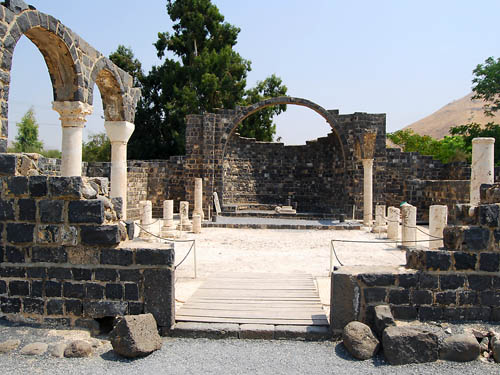
This photo of the basilica, made of black basalt with white limestone columns, was made last August. This site provides a wonderful view west across the Sea of Galilee.

The basilica at Kursi. Photo by Ferrell Jenkins.

The basilica at Kursi. Photo by Ferrell Jenkins.

Murphy-O’Connor says this has been a place of pilgrimage since the fifth century A.D. He suggests the name of the place, Kursi, “is possibly a dialectical deformation” of Chorazin. (The Holy Land).

HT: Joseph I. Lauer

The Wilderness of Judea

John the Baptist preached in the wilderness of Judea (Matthew 3:3), and Jesus was tempted in the wilderness (Matthew 4:1). Jesus spoke to the crowds about John this way:

What did you go out into the wilderness to see? A reed shaken by the wind? (Luke 7:24 ESV)

The wilderness (Greek eremos) of Judea is described this way in Bauer (BDAG):

Of the Judean wilderness, the stony, barren eastern declivity of the Judean mountains toward the Dead Sea and lower Jordan Valley.

The Hebrew word for this wilderness is midbar. Charles F. Pfeiffer said the wilderness of Judea,

is the region of rugged gorges and bad lands in the eastern part of Judah where the land slopes off toward the Jordan Valley. In ancient times this area was infested with wild animals. Except for a brief time during the spring rains the wilderness is arid. (Baker’s Bible Atlas, 201)

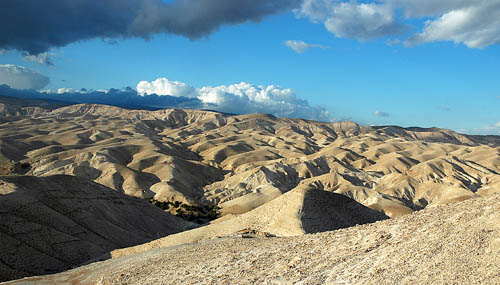
Many people who read the Bible in English, without checking into the matter, think of the wilderness as being a place filled with wild growth and underbrush. Jesus’ question to the crowds indicates that no reeds are to be found in the wilderness. In this case a picture really is worth a thousand words. This shows one of the many changing views one might see in the wilderness. This one was made in the month of November and shows a view west toward Jerusalem.

The wilderness of Judea. Looking west up toward Jerusalem. Photo by Ferrell Jenkins.

The wilderness of Judea. Looking west toward Jerusalem. Photo by Ferrell Jenkins.

The wilderness of Judea stretches west from the Jordan Valley up to the Mount of Olives. Of course, it extends much farther south along the Dead Sea.

Update: 04/01/09

Green pastures and quiet waters

Psalm 23 is one of the best known and most loved chapters of the Bible. In it David describes his relationship to the LORD under the analogy of a sheep and his shepherd.

The LORD is my shepherd, I shall not be in want. He makes me lie down in green pastures, he leads me beside quiet waters, he restores my soul. He guides me in paths of righteousness for his name’s sake. Even though I walk through the valley of the shadow of death, I will fear no evil, for you are with me; your rod and your staff, they comfort me. (Psalm 23:1-4 NIV)

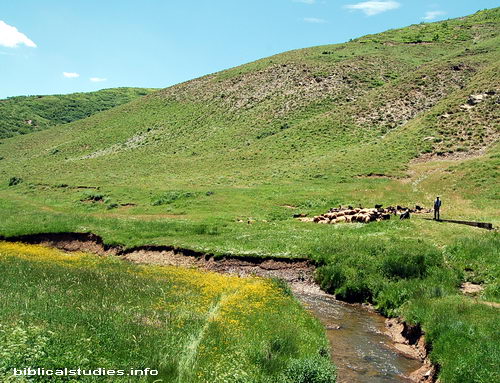
This Psalm  describes one of the common scenes in certain parts of the Middle East. Our photo was made in the mountains of ancient Urartu (Ararat) in eastern Turkey. Notice especially the green pastures and the quiet waters.

A shepherd provides green pastures and quiet water for his sheep. Photo by Ferrell Jenkins.

A shepherd provides green pastures and quiet water for his sheep. Photo by Ferrell Jenkins.

Jesus called Himself the “good shepherd” (John 10:11, 14). Jesus wants the same of elders or overseers in the local church, and He reminds them that it is God’s flock and that He is the Chief Shepherd (1 Peter 5:4).

To the elders among you, I appeal as a fellow elder, a witness of Christ’s sufferings and one who also will share in the glory to be revealed:  Be shepherds of God’s flock that is under your care, serving as overseers– not because you must, but because you are willing, as God wants you to be; not greedy for money, but eager to serve;  not lording it over those entrusted to you, but being examples to the flock. (1 Peter 5:1-3 NIV)

Good shepherds serve God’s flock willingly to provide food, care, and protection for the sheep. The concept of “lording it over” the flock or “domineering” is foreign to the spirit of a good shepherd. Overseers lead the flock by their example of godliness.

The Watchman

The watchman (or watchmen) is mentioned at least 35 times in the Old Testament. His role was one of great significance in keeping a city safe from attackers.

The prophet Ezekiel was appointed as a watchman over the house of Israel.

Son of man, I have appointed you a watchman for the house of Israel. Whenever you hear a word from my mouth, you must give them a warning from me. (Ezekiel 3:17 NET)

Further explanation is given in chapter 33.

But suppose the watchman sees the sword coming and does not blow the trumpet to warn the people. Then the sword comes and takes one of their lives. He is swept away for his iniquity, but I will hold the watchman accountable for that person’s death. (Ezekiel 33:6 NET)

The Psalmist reminds us that the LORD must be the true guard of a city.

If the LORD does not build a house, then those who build it work in vain. If the LORD does not guard a city, then the watchman stands guard in vain. (Psalm 127:1 NET)

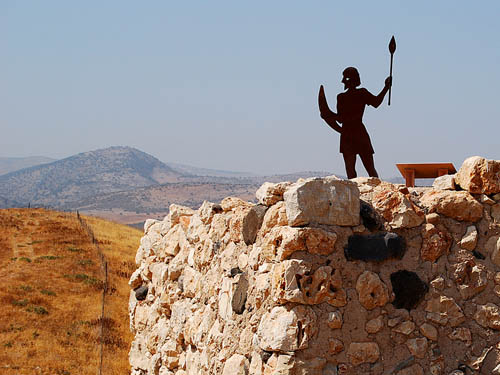
This photo was made a the site of Hazor where a warrior stands in the position of a watchman over the city. The watchtower allows him to look in all directions, but especially to the north. The prophets of Israel warned of the approaching enemy from the north. See Jeremiah 1:14 and Isaiah 14:31.

The Watchman at Hazor. Photo by Ferrell Jenkins.

The Watchman at Hazor. Photo by Ferrell Jenkins.

The closest thing to the concept of the watchman in the New Testament is found in the description of the “leaders” among Christians mentioned in Hebrews 13:17.

Obey your leaders and submit to them, for they keep watch over your souls and will give an account for their work. Let them do this with joy and not with complaints, for this would be no advantage for you. (NET)

William Hendriksen points out that the identity of the leaders is not specified.

Those leaders who had spoken the Word of God in earlier days were no longer present. They must be remembered for their conduct and faith, says the author of Hebrews 13:7. Successive leaders have taken their place. The writer is not interested in the status of these leaders—he gives no hint whether they were elders, overseers, preachers, or teachers. Rather, he asks the reader to obey them. (New Testament Commentary: Exposition of Hebrews, 426)