Category Archives: New Testament

The museum at Hierapolis

There is a small, but nice, museum at Pamukkale (ancient Hierapolis, Colosians 4:13). It is housed in a second century Roman bath house. The exhibits indicate a large Roman presence in the area during the second and third century A.D.

The museum has the nicest statue of the “god” Hades that I have seen.
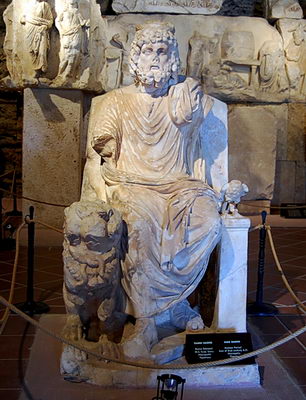
The god Hades in the Pamukkale Museum. Photo by Ferrell Jenkins.

The god Hades in the Pamukkale Museum. Photo by Ferrell Jenkins.

Hades was known in Greek mythology as the lord of death and the god of the underworld or nether world. The term hades is used in the New Testament of the abode of the souls of the wicked prior to the judgment. Note the comments by William Hendriksen.

As to the word “hell,” which here in the original is Gehenna (and so also in [Matthew] 5:22, 29, 30; 18:9; 23;15, 33; Mark 9:43-47; Luke 12:5; James 3:6), it generally refers to the abode of the wicked, body and soul, after the judgment day. When the same abode is called Hades the references is to the time before the judgment day, though Hades also has other meanings in Scripture. (New Testament Commentary: Exposition of the Gospel According to Matthew 472).

The Book of Revelation makes it clear that Jesus has control over both Death and Hades.

When I saw Him, I fell at His feet like a dead man. And He placed His right hand on me, saying, “Do not be afraid; I am the first and the last,  and the living One; and I was dead, and behold, I am alive forevermore, and I have the keys of death and of Hades. (Revelation 1:17-18 NAU; see also 6:8; 20:13, 14)
Hierapolis, Philip and Papias

Early tradition associates Philip with the city, but scholars differ over whether it was Philip the apostle (Matthew 10:3) or Philip the evangelist (Acts 21:8).

This was the home of Papias (about A.D. 60 to 130) who was a disciple of the apostle John and a companion of Polycarp. Fragments of his writings about the apostles survive in Irenaeus and Eusebius of Caesarea. Eusebius (about A.D. 265 − about A.D. 339), tells us that Papias wrote as follows:

“Matthew also issued a written Gospel among the Hebrews in their own dialect, while Peter and Paul were preaching at Rome, and laying the foundations of the Church. After their departure, Mark, the disciple and interpreter of Peter, did also hand down to us in writing what had been preached by Peter. Luke also, the companion of Paul, recorded in a book the Gospel preached by him.” He adds that John, the disciple who leaned on Jesus’ breast, published a Gospel from Ephesus (Against Heresies III.1.1).

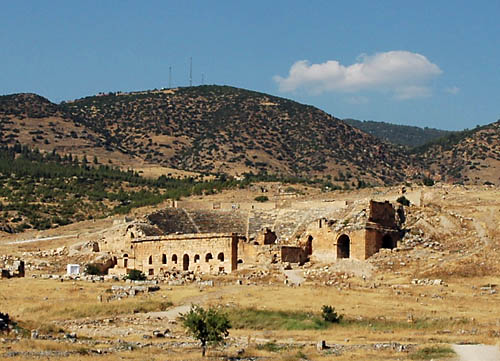
Some things of interest to see at Hierapolis include the hot springs and limestone formations, the monumental Arch of Domitian and Roman Street. This entire region suffered from the policies of the Emperor Domitian. The photo below shows the theater set against the surrounding hills.

Roman theater at Hierapolis. Photo by Ferrell Jenkins.

Roman theater at Hierapolis. Photo by Ferrell Jenkins.

The theater was built in the 2nd century A.D., renovated in the 3rd century, and again in the 4th century.

During the 4th-century renovations, the orchestra area of the theater was altered to allow it to be filled with water for staging mock naval battles and other water presentations. (Fant and Reddish, A Guide to Biblical Sites in Greece and Turkey, 213)

The hot springs at Hierapolis

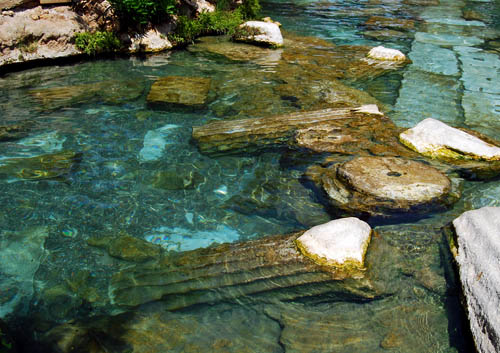
The hot springs at Hierapolis caused the city to be known for its textile industry. There were guilds of wool workers, carpet weavers, and purple dyers. The hot medicinal springs (95°) attracted visitors. The city prospered under the Romans, but often suffered from earthquakes.

Ruins of the Roman city of Hierapolis in the hot springs. Photo by Ferrell Jenkins.

Ruins of the Roman city of Hierapolis in the hot springs. Photo by Ferrell Jenkins.

Recall that Hierapolis is one of three cities of the Lycus River valley named in the New Testament.

For I can testify that [Epaphras] has worked hard for you and for those in Laodicea and Hierapolis. (Colossians 4:13 NET)

Hierapolis and the Lycus River Valley

Hierapolis is mentioned only once in the New Testament. Paul commends Epaphras, who seems to be from Colossae, for his burdensome labor for the churches of the Lycus River Valley. He says,

For I bear him witness that he has worked hard for you and for those in Laodicea and in Hierapolis. (Col. 4:13 ESV)

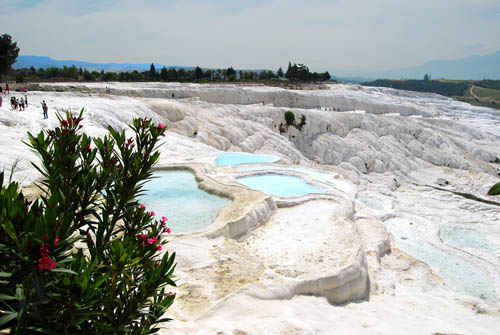
The name Hierapolis means “holy city.” The modern Turkish name is Pamukkale, meaning “cotton castle” or “cotton fortress.” The city is famous for the hot springs and the limestone formations that cascade down the hillside below the city.

Limestone formations at Hierapolis. Photo by Ferrell Jenkins.

Limestone formations at Hierapolis. Photo by Ferrell Jenkins.

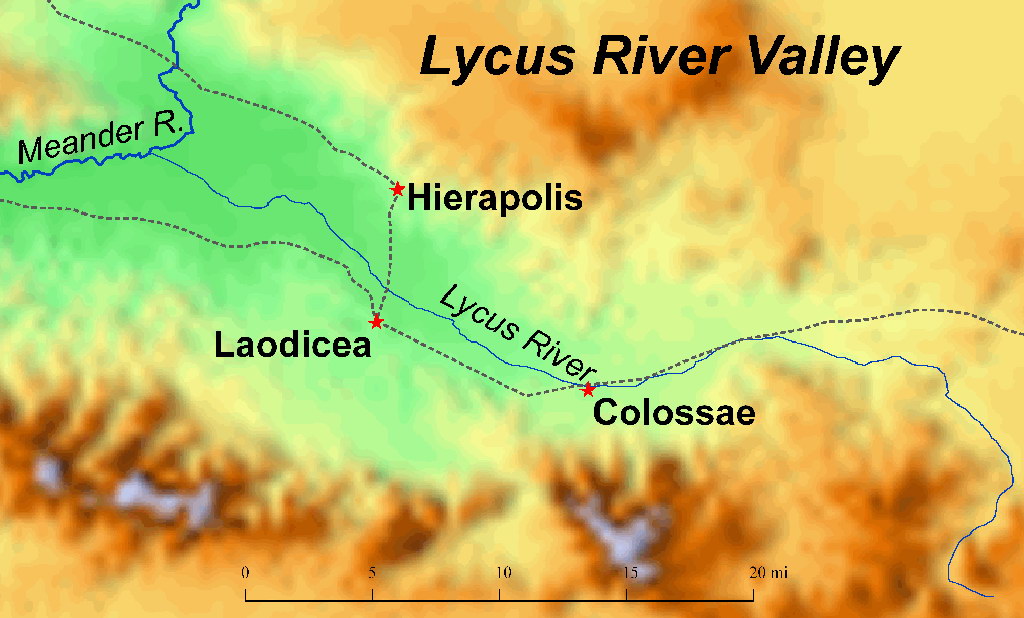
The Lycus valley is in extreme southwestern Phrygia, Asia Minor. Hierapolis is situated on a plateau about 600 feet above the valley floor. Hierapolis, Colossae, and Laodicea form a triangle in the valley. From Hierapolis to Laodicea is about 6 miles south. The sites can be seen across the valley. From Laodicea to Colossae is about 10 miles to the southwest. From Colossae it is about 12 miles to Hierapolis.

The Lycus River Valley.

The Lycus River Valley.

Click on the map for a copy large enough to use in a PowerPoint presentation. Detailed maps of the area around Hierapolis, Laodicea, and Colossae are not usually found in maps found in Bibles, or even atlases. I used Bible Mapper to make this map showing the three cities of the valley. The Lycus river begins south east of Colossae, flows through the valley to join the Meander River. The Meander flows west to the Aegean Sea at Miletus. The dotted lines show the major roads traversing the valley.

Cinema fire reveals Roman wall in Izmir (Smyrna)

A report from Izmir says that a cinema (movie theater) burned down in Izmir, Turkey, revealing portions of an 11 meter Roman wall and arch.

Archaeologist Akın Ersoy, the leader of a local excavation team, said this new discovery proved the importance of the agora, a meeting place in ancient times. Stating that Izmir had become synonymous with agoras, Ersoy said: “(The excavation) of the agora is the best heritage to leave behind for future generations. With the support of Izmir Metropolitan Municipality, the environment of the Izmir agora, one of the biggest and oldest agoras in the world, has been opened up and can now be seen by people from the Çankaya neighborhood. We have not started work on the wreckage of the cinema building yet but we believe this ancient site is two times bigger than the local agora site.”

The full account is carried in Hurriyet Daily News.

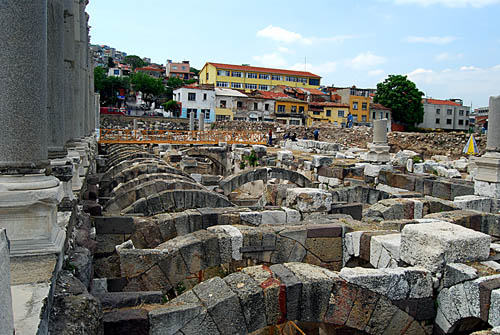
Always a good reason to return to a site. Here is a photo of the lower level of the agora in Izmir. Notice the older buildings along the edge of the agora. If the city of Izmir would clear and excavate this entire area the city would have a real reason for many tourists to visit the city.

Looking over the lower level of the Izmir Agora. Photo by Ferrell Jenkins.

Looking over the lower level of the Izmir Agora. Photo by Ferrell Jenkins.

The Turkish city of Izmir is known as Smyrna in Revelation 1:11, 2:8.

HT: RogueClassicism.

Do the work of an evangelist

This morning I am scheduled to speak at the Florida College annual lectures on the subject “Do the Work of an Evangelist.” I thought I would share a tiny section of the material I have prepared in a part of the lecture dealing with the importance of preparation (next two paragraphs).

The evangelist must be an approved workman who can handle accurately the word of truth (2 Tim. 2:15). A. T. Robertson wrote a small book nearly 90 years ago entitled Types of Preachers in the New Testament. He began with a chapter on “Apollos the Minister with Insufficient Preparation.” Apollos was eloquent (learned, cultured) and “mighty in the Scriptures” (Acts 18:24). We understand that his knowledge was incomplete, but that he was willing to learn. Robertson’s comment is apropos for today.

There is hope for the man who is ready to learn. One is never too old to learn. The minister who is always learning will always have a hearing. There is no deadline for him. That comes the minute one stops learning. Apollos is a rebuke to the preacher who is content to preach his old sermons through the years without reading the new books or mastering the old ones. Here is a profound student of the Scriptures, a master in Old Testament interpretation, who is glad to sit at the feet of Priscilla and Aquila and learn more of Jesus. That is the place for all of us, at the feet of anyone who can teach us more about Jesus. We cannot know too much about Him. We cannot be too accurate in our knowledge of Him. (24)

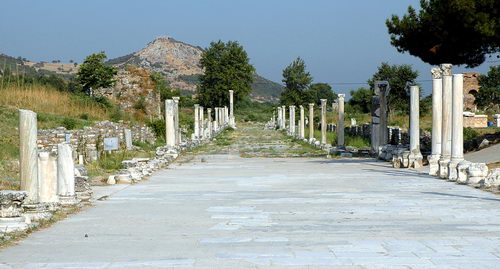
Paul, Timothy, Apollos, Priscilla and Aquila were all associated with the work of the gospel at Ephesus (Acts 18:24-19:1; 1 Timothy 1:3). The photo below shows the ruins of the Arcadian Way. This street led from the theater to the harbor. The harbor is now dry, but must have been used by all of these characters in their contact with the city of Ephesus.

The Arcadian Way at Ephesus. Photo by Ferrell Jenkins.

The Arcadian Way at Ephesus. Photo by Ferrell Jenkins.

The Vulture

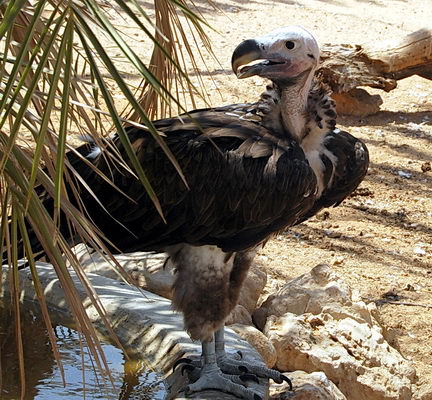
Vultures were among the unclean animals for the Israelites (Leviticus 11:13, 18; Deuteronomy 14:12, 17). This means that Israelites were not permitted to eat vultures. In some of the references both eagles and vultures are mentioned.

Vulture at the Hai-Bar Reserve in Israel. Photo by Ferrell Jenkins.

Vulture at the Hai-Bar Reserve in Israel. Photo by Ferrell Jenkins.

In the Greek New Testament the word aetos is translated both eagle (Revelation 8:13; 12:14) and vulture (Matthew 24:28; Luke 17:37).

One of the most memorable comments about the vulture was made by Jesus in His discussion of the destruction of Jerusalem. He described the condition of the Jewish state at the time when the Roman armies invaded the country.

Wherever the corpse is, there the vultures will gather. (Matthew 24:28 ESV)

Not a pretty picture. And a clear warning for all.

A meditation for Sunday

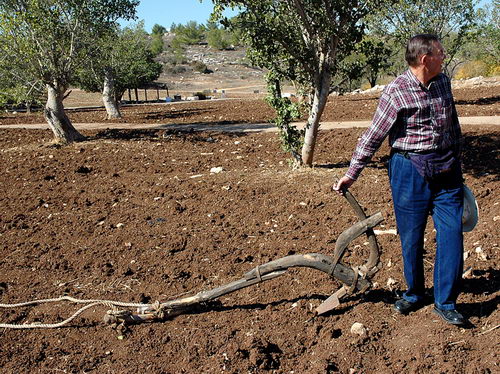
As they were going along the road, someone said to him, “I will follow you wherever you go.” And Jesus said to him, “Foxes have holes, and birds of the air have nests, but the Son of Man has nowhere to lay his head.” To another he said, “Follow me.” But he said, “Lord, let me first go and bury my father.” And Jesus said to him, “Leave the dead to bury their own dead. But as for you, go and proclaim the kingdom of God.” Yet another said, “I will follow you, Lord, but let me first say farewell to those at my home.” Jesus said to him, “No one who puts his hand to the plow and looks back is fit for the kingdom of God.” (Luke 9:57-62)

Illustrating a parable at Neot Kedumim in Israel. Photo by Leon Mauldin.

Illustrating a parable at Neot Kedumim in Israel. Photo by Leon Mauldin.

Antonia Fortress discussion

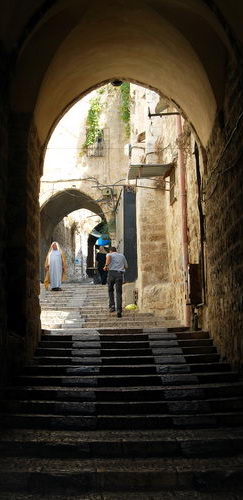
A street in the Moslem Quarter of Jerusalem. Photo by F. Jenkins.

A street in the Moslem Quarter of Jerusalem. Photo by F. Jenkins.

Todd Bolen calls attention to an article by Ehud Netzer in the curent Biblical Archaeology Review on the location of the Antonia Fortress. Read the post here.

Leen Ritmeyer posted a response to Netzer and included some of his great diagrams here.

With Todd’s photo and Leen’s diagrams you will have some great material to help you understand the location of the Antonia.

The Antonia may not be the place where Jesus appeared before Pontius Pilate, as we once thought, but it is the place where Paul stayed under the custody of the Romans before his transfer to Caesarea Maritima.

English versions refer to the building as the barracks (Acts 21:37). Paul’s speech on the stairs was from the steps leading from the temple precinct to the Antonia.

Our photo above was made in the Moslem Quarter of Jerusalem near the site of the Antonia.  I think the street is Bab Hutta. These little side streets are always so intriguing.

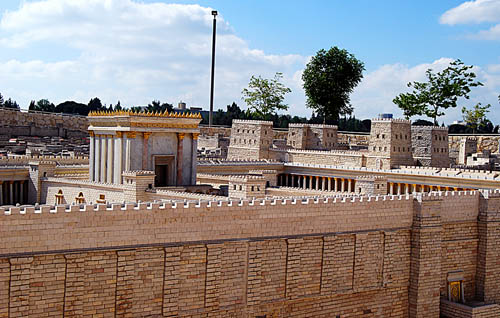
The photo below shows the Temple Mount in the Second Temple model at the Israel Museum. The Antonia is the large building on the right, the northwest corner of the Temple Mount.

The Temple Mount and the Antonia Fortress. Photo by F. Jenkins.

The Temple Mount and the Antonia Fortress. Photo by F. Jenkins.

Roman period figurine discovered in Jerusalem

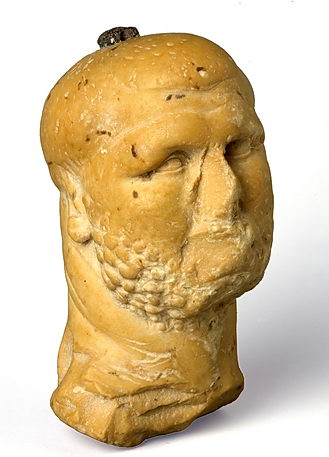
The Israel Antiquities Authority announced a few days ago the discovery of a figurine in the image of a bearded man, probably a boxer. The artifact was uncovered in the Givati car park excavation south of the Dung Gate, and is dated to the second or third century A.D.

Clara Amit, IAA.

Head of Roman Boxer found at Jerusalem. Photo: Clara Amit, IAA.

Notice a few comments from the press release.

The stylistic motifs that are manifested in the image, such as its short hair style, the prominent lobes and curves of the ears, as well as the almond-shaped eyes suggest that the object most likely portrays an athlete, probably a boxer. Boxing was one of the most popular fields of heavy athletics in Roman culture and more than once Roman authors mention the demand by the Roman public in general, and the elite in particular, for boxing matches. Besides the prestige and the substantial amounts of money the victors of boxing competitions won, they were also afforded the support of the emperor himself, as in the famous case of Melancomas who was Titus’ favorite boxer.

According to the researchers the two tiny holes that were drilled in its nape and which contained the remains of metal that was inserted in them indicate that this is a suspended weight that was used with hanging scales that are characteristic of the Roman period. Miniature bronze images of athletes, philosophers, satyrs etc were among the most popular of the suspended weights that were used in the regions that were under the control of the  Roman Empire – from Pompeii to Sepphoris.

I have seen busts of boxers or wrestlers with “cauliflower ears” in museums.  One such bust is in the museum at Thessalonica.

In a different setting, writing to the church in Greco-Roman Corinth, Paul says,

Therefore I run in such a way, as not without aim; I box in such a way, as not beating the air;  but I discipline my body and make it my slave, so that, after I have preached to others, I myself will not be disqualified. (1 Corinthians 9:26-27).

Read the complete report here.