Category Archives: New Testament

Sir William M. Ramsay – New Testament Scholar

As a student Ramsay had been influenced by Baur and the Tubingen School and doubted the historical trustworthiness of the New Testament. His studies in Asia Minor caused him to study the book of Acts, which he accepted as a document of the second half of the second century. He tells in The Bearing of Recent Discovery on the Trustworthiness of the New Testament how he came to change his mind about this. In a study of Acts 14, Ramsay saw that Luke listed Lystra and Derbe as cities of Lycaonia, but did not include Iconium (Acts 14:6). He thought this had been deliberately invented by Luke because he was under a false impression. Check maps you have in your Bible and various Bible Atlases. You will probably see that some of them still have this incorrect. The SN (Study Note) in the NET Bible contains this note:

Iconium was a city in Lycaonia about 90 mi (145 km) east southeast of Pisidian Antioch. It was the easternmost city of Phrygia.

This comment relies on the older classical location of Iconium, but it was not this way during the Roman Imperial period.

In The Bearing of Recent Discovery…, Ramsay says that the purpose of his book, St. Paul the Traveler and the Roman Citizen, is to show:

“that Luke is a historian of the first rank; not merely are his statements of fact trustworthy; he is possessed of the true historical sense; he fixes his mind on the idea and plan that rules in the evolution of history, and proportions the scale of his treatment to the importance of each incident. He seizes the important and critical events and shows their true nature at greater length, while he touches lightly or omits entirely as much that was valueless for his purpose. In short, this author should be placed along with the very greatest of historians” (222).

The people of Lystra spoke the Lycaonian language (14:11). They called Barnabas, Zeus, and Paul, Hermes (14:12). Inscriptions have been found that identify these particular gods with Lycaonia.

F. F. Bruce mentions his debt to the writings of Sir William Ramsay, and frequently calls attention to Ramsay’s works. Colin Hemer’s works on Acts and Revelation build on the work of Ramsay.

Dr. Mark W. Wilson, of Seven Churches Network has edited and updated at least four of Ramsay’s works: The Letters to the Seven Churches (Hendrickson), St. Paul the Traveler and Roman Citizen (Kregel), and Historical Commentary on First Corinthians (Kregel). This makes these older works much more valuable.

Our photo below shows a portion of a Roman road a few miles north of Tarsus, home of Saul of Tarsus. I think this is the route that would have been taken by Paul and Silas to connect them to the Cilician Gates and the Anatolian plateau. See Acts 15:41 – Acts 16:2.
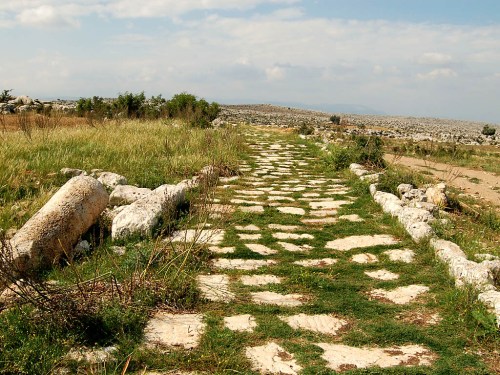
Roman Road north of Tarsus. Note the fallen milestone. Photo by Ferrell Jenkins.
Roman Road north of Tarsus. Note the fallen milestone. Photo by Ferrell Jenkins.
Sir William M. Ramsay

William M. Ramsay (1851-1939), a native of Scotland, studied classics at the University of Aberdeen. In 1880 he won a traveling studentship to study in Asia Minor. For several decades he was able “to study the geography and archaeology of Roman proconsular Asia, Phyrgia, Lycaonia, Cappadocia, and Galatia” (Gasque, Sir William M. Ramsay Archaeologist and New Testament Scholar, 15; I am indebted to this work for much information about Ramsay). He was knighted in 1906.

Gasque’s book has recently been made available here by Rob Bradshaw of Biblical Studies.org.uk in either PDF or Scribd. Grab it while it is available. Rob is providing a wonderful service in making works like this available.

Some of Ramsay’s more significant writings include The Historical Geography of Asia Minor, The Cities and Bishoprics of Phrygia, St. Paul the Traveller and the Roman Citizen, The Bearing of Recent Discovery on the Trustworthiness of the New Testament, The Letters to the Seven Churches, and A Historical Commentary on St. Paul’s Epistles to the Galatians. He wrote many articles for the 9th edition of Encyclopedia Britannica and for the five-volume Dictionary of the Bible by Hastings, including “Roads and Travel in the New Testament.”

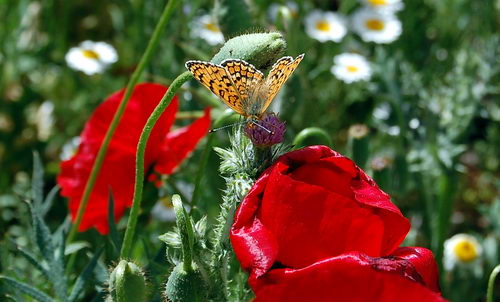
This photo of a butterfly among wild flowers was made west of Konya, Turkey. Konya was biblical Iconium (Acts 13:51 – Acts 14).

Spring wild flowers growing west of Konya, Turkey. Photo by Ferrell Jenkins.

Spring wild flowers growing west of Konya, Turkey. Photo by Ferrell Jenkins.

In the next post we will explain more about the significance of Ramsay to New Testament studies.

Jacob’s Well — from Jacob to Jesus

Jesus came to Sychar, a city of Samaria, near the piece of land Jacob had owned (John 4:5; Genesis 33:19). The territory was apportioned to the descendants of Joseph, and Joseph was buried there at Shechem (Joshua 24:32). It was a place of great historic importance.

We are not able to speak with certainty regarding the location of Sychar. Some scholars associate the site with Shechem; others think it should be identified with the village of Askar which is located a short distance north. The traditional Jacob’s Well is located at Shechem in the valley between Mount Gerizim and Mount Ebal. The modern town of Nablus now fills this valley.

André Parrot says,

“Of all the ‘holy places’ of Palestine, none has more reason to be considered authentic than Jacob’s well. Indeed, there is no reason why its authenticity should be questioned” (Land of Christ 65).

Parrot describes the water as “cool and pleasant-tasting…drawn from a depth of 128 feet.” I have drunk the water several times, but in the past couple of decades my guides have advised against it due to pollution in the area.

The Samaritan woman said, “the well is deep” (John 4:11). Parrot reports the well is 128 feet deep. Murphy-O’Connor says it is 22.5 meters deep (about 74 feet). McGarvey cites several measurements mentioned in 19th century writers and reminds us that the well became filled with stones cast in by travelers trying to hear how long it would take a stone to hit the bottom (Lands of the Bible 283). He reports that the well was often dry.

There are numerous springs in the area of Shechem. Jacob, as a late-comer to the region, might have found it necessary to dig a well to assure water for his family and cattle.

A church was erected over the well about A.D. 380. The Crusaders built another church on the site in the 12th century. The property came under the control of the Greek Orthodox church in 1860. By the end of the 19th century the Greeks began a new church, but construction was halted during World War I. The last time I was at Jacob’s well (2000) construction had resumed and Murphy-O’Connor reports completion in 2007.

It has been difficult for groups to visit Jacob’s Well in recent years due to the situation in Nablus.

Jacob's Well. Most likely the well where Jesus met the woman of Samaria (John 4). Photo by Ferrell Jenkins.

Jacob's Well. Most likely the well where Jesus met the woman of Samaria (John 4). Photo by Ferrell Jenkins.

With this information, I leave it to you to study the great lessons of John 4. They are deep, too.

He had to pass through Samaria

The Gospel of John informs us that Jesus had to pass through Samaria (4:4). The most direct travel route between Judea and Galilee was through Samaria. Josephus says, “it was the custom of the Galileans, when they came to the holy city at the festivals, to take their journeys through the country of the Samaritans….” (Ant. XX.118). He also informs us that the trip took three days (Life of Flavius Josephus 1.269). This route ran along the central mountain range, sometimes called the water-parting route.

Carson says geography determined that Jesus had to go through Samaria, but some scholars believe the term had indicates necessity. The following conversation with the woman of Samaria and the visit with the people of Sychar may explain why He had to go through Samaria.

We know that Jesus and His disciples encountered problems when traveling through Samaria (Luke 9:51-56). When Jesus sent out the twelve He told them not to enter any city of the Samaritans (Matthew 10:5).

The Jews, on their way from Galilee to Judea, could travel through Transjordan (Perea). It seems that Jesus took this route when He traveled through Jericho up to Jerusalem (Luke 19).

This photo was made in 1981 from the hill of Samaria with a view of the surrounding “mountains of Samaria” (Amos 3:9). One can easily imagine Jesus and His disciples traveling paths such as this.

samaria_path_mountains_1981-t

One sows and another reaps

Jesus took advantage of the opportunity to teach the woman of Samaria at the well where they met (John 4). She went into the city and told the men about Jesus (John 4:28-29). When the disciples of Jesus returned from the city where they had gone to buy food they encouraged Jesus to eat. He said, “I have food to eat that you do not know about.” The disciples misunderstood this, thinking He had reference to material food. This conversation led Jesus to say,

Do you not say, ‘There are yet four months, then comes the harvest’? Look, I tell you, lift up your eyes, and see that the fields are white for harvest. Already the one who reaps is receiving wages and gathering fruit for eternal life, so that sower and reaper may rejoice together. For here the saying holds true, ‘One sows and another reaps.’ I sent you to reap that for which you did not labor. Others have labored, and you have entered into their labor.” (John 4:35-38 ESV)

The disciples apparently did not know that Jesus had been teaching the woman, and that she had gone into the city to tell others about Him. Jesus is reminding the disciples of a common thing in the agricultural practices of that time. One sows and another reaps. It may have been sowing time, but some were ready to be reaped. The fields were ready to be harvested.

The words of the prophet Amos provide insight into this episode. He said,

“Behold, days are coming,” declares the LORD, “When the plowman will overtake the reaper And the treader of grapes him who sows seed; When the mountains will drip sweet wine And all the hills will be dissolved. (Amos 9:13 ESV)

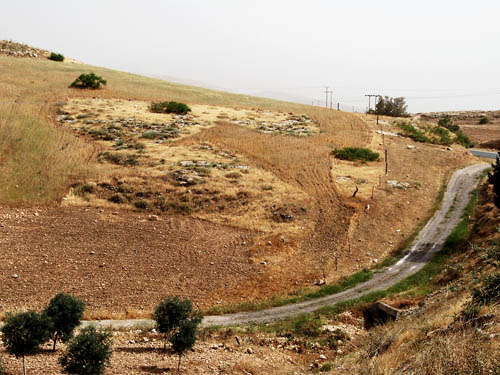
In modern times, with the use of some mechanical farm equipment, it is becoming difficult to find scenes exactly like the practices of the time of Jesus. But we still see things that remind us of these teachings. The photo below shows a field in Jordan just above the Jordan valley floor near Deir Allah. On a clear day one could see the valley.

The field has been plowed while grain grows nearby. Photo by F. Jenkins.

The field has been plowed while grain grows nearby. Photo by F. Jenkins.

Notice the rocks in the field. The plowman has worked around them. In the days of broadcast sowing, like in the parable of the sower (Luke 8), this scene has all of the elements. Good soil, rocky soil, road, and certainly thorns.

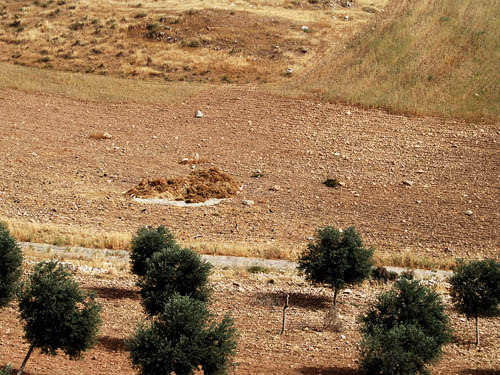
Extend our view to the left in the photo above. You will see, in the photo below, sheaves in the field that has been plowed. Indeed, the plowman overtakes the reaper.

Harvested grain in a field already plowed for sowing. Photo by Ferrell Jenkins.

Harvested grain in a field already plowed for sowing. Photo by Ferrell Jenkins.

It is true today in the preaching of the gospel. One plows and another reaps. Paul says, “I planted, Apollos watered, but God was causing the growth” (1 Corinthians 3:6).

If we had more sowing, there would be more reaping.

The carpenter in New Testament times

Jesus is called a carpenter in Mark 6:3. In Matthew’s account He is called the carpenter’s son. The study note in the NET Bible suggests that this was probably a derogatory term. Those who used the term thought of Him as “a common laborer like themselves.”

Lane says the term carpenter (Greek tekton) “commonly designates a worker in any hard material: wood, metal or stone, and so comes to mean a builder.”

Louw-Nida says,

There is every reason to believe that in biblical times one who was regarded as a tekton would be skilled in the use of wood and stone and possibly even metal.

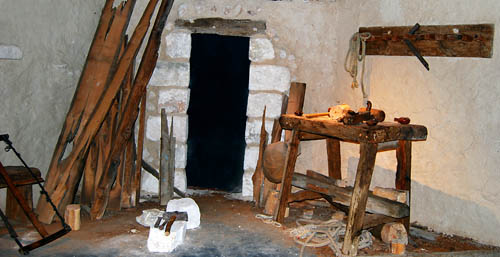
A carpenter’s shop is exhibited at Nazareth Village. It is correct in showing tools for stone cutting as well as wood working.

Carpenter shop at The Nazareth Village. Photo by Ferrell Jenkins.

Carpenter shop at Nazareth Village. Photo by Ferrell Jenkins.

A place called Fair Havens

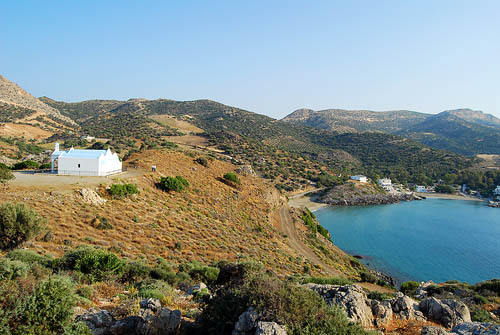
Last year I wrote here about a visit to Fair Havens on the island of Crete. I have been thinking about the rugged beauty of that place and decided to share a different photo with you. This one emphasizes the mountains surrounding the harbor of Fair Havens. The white Greek Orthodox chapel adds to the beauty of the area today.

Mountains surrounding Fair Havens in Crete. Photo by Ferrell Jenkins.

Mountains surrounding Fair Havens in Crete. Photo by Ferrell Jenkins.

Crete is associated with Paul’s voyage to Rome. The biblical account is found in Acts 27:7-15. Note verses 7 and 8.

When we had sailed slowly for a good many days, and with difficulty had arrived off Cnidus, since the wind did not permit us to go farther, we sailed under the shelter of Crete, off Salmone; and with difficulty sailing past it we came to a place called Fair Havens, near which was the city of Lasea.

The ship sailed under the shelter of Crete and came to Kali Limenes (Fair Havens) near the city of Lasea. Because Fair Havens was not a suitable harbor for wintering, the pilot and captain of the ship decided to sail on in hopes of reaching “Phoenix, a harbor of Crete, facing southwest and northwest,” and spend the winter there. Because of a severe wind, called Euraquilo, which came down from the land, they were driven by the wind and eventually wrecked on the island of Malta.

They were fishermen

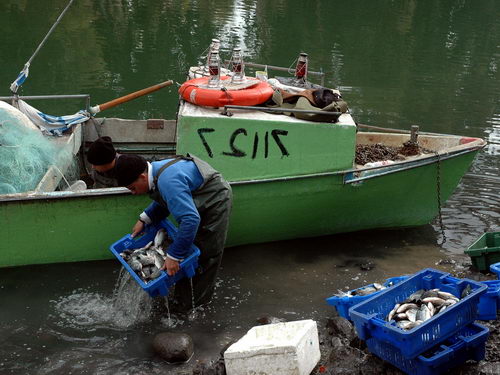
The first disciples called by Jesus were fishermen. In the previous post we indicated the significance of fishing on the Sea of Galilee. The best time to see fishermen on the Sea is early in the morning. The photo below was made early one morning where the Jordan River exits from the Sea of Galilee. These fishermen have been fishing with nets and have brought in a nice catch.

Fishermen on the Sea of Galilee bringing in the catch. Photo by Ferrell Jenkins.

Fishermen on the Sea of Galilee bringing in the catch. Photo by Ferrell Jenkins.

This reminds us of the call Jesus gave to the disciples one day in ancient Galilee.

Now as Jesus was walking by the Sea of Galilee, He saw two brothers, Simon who was called Peter, and Andrew his brother, casting a net into the sea; for they were fishermen. And He said to them, “Follow Me, and I will make you fishers of men. Immediately they left their nets and followed Him.” (Matthew 4:18-20 NAS)

Taxes the easy way

Working on tax return preparation for the past two days got me to thinking about this episode from the ministry of Jesus:

24 When they came to Capernaum, the collectors of the two-drachma tax went up to Peter and said, “Does your teacher not pay the tax?” 25 He said, “Yes.” And when he came into the house, Jesus spoke to him first, saying, “What do you think, Simon? From whom do kings of the earth take toll or tax? From their sons or from others?” 26 And when he said, “From others,” Jesus said to him, “Then the sons are free. 27 However, not to give offense to them, go to the sea and cast a hook and take the first fish that comes up, and when you open its mouth you will find a shekel. Take that and give it to them for me and for yourself.” (Matthew 17:24-27 ESV).

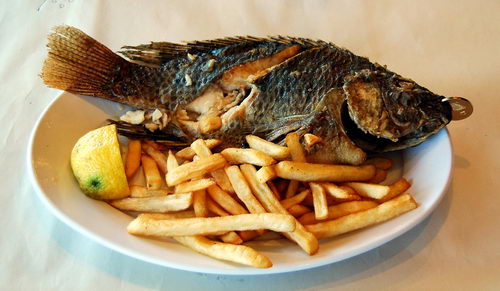
Fishing is still important on the Sea of Galilee. Our groups usually have at least one meal of the famous St. Peter’s Fish when we are in the Galilee.

A fish from the Sea of Galilee with a coin in its mouth. Photo by F.Jenkins.

A fish from the Sea of Galilee with a coin in its mouth. Photo by Ferrell Jenkins.

Mendel Nun spent more than 50 years fishing the Sea of Galilee. He became an expert in the history of fishing on the Sea.  His article, “Cast Your Net Upon the Waters: Fish and fishermen in Jesus’ Time” (Biblical Archaeology Review, 19:06), includes information on this episode. Because this is a lengthy quotation I will leave it full width for easier reading.

– – – – – –

The musht is the only large fish in the lake that moves in shoals, which of course is a key to the identification of the fish in the story in Luke, although not the only one.

The flat shape of the musht makes it especially suitable for frying. The skeleton consists of an easily detachable backbone and relatively few small bones, and thus it is easy to eat. It has long been known as St. Peter’s fish. Recently, it has even been exported under this name. But, alas, the name is a misnomer.

Presumably the fish got its name because of an incident recorded in the Gospel of Matthew (Matthew 17:24–27). In this episode, the tax collectors come to Capernaum to collect the half-shekel Temple tax that each Jew was required to pay annually. Jesus tells Peter, “Go to the sea and cast a hook, and take the first fish that comes up, and when you open its mouth you will find a shekel; take that and give it to them for me and yourself.”

The musht was probably given the name St. Peter’s fish because of this miracle. However, this cannot have been the fish Peter caught with a hook and line. The reason is simple: Musht feeds on plankton and is not attracted by other food. It is therefore caught with nets, and not with hook and line. The fishermen on the lake have, since time immemorial, used a hook baited with sardine to fish for barbels, which are predators and bottom feeders. Peter almost surely caught a barbel. There can be only one explanation for the confusing change of name. It was good for tourism! The Sea of Galilee has always attracted pilgrims; musht (today raised mostly in ponds) is part of the unique local cuisine. It is delicious, especially when freshly fried. In ancient times, just as today, the fishing boats delivered their catch to the eating places on shore. Indeed, the proverbial metaphor for speed in the Talmud is “as from the sea into the frying pan.” This expression was part of daily speech in Tiberias and clearly refers to musht and not barbels; the latter are best when boiled.

The first Christians were local people and were therefore familiar with the various fish. They of course knew that the fish Peter caught could only have been a barbel and not a musht. However, as pilgrims began to come from distant regions, it no doubt seemed good for business to give the name “St. Peter’s fish” to the musht being served by the early lakeside eating houses. The most popular and easily prepared fish acquired the most marketable name! But even if Peter did not catch a musht, he deserves to have his name associated with the best fish in the lake.

The empty tomb

The women who came to the tomb of Jesus on the first day of the week found the stone rolled away from the tomb. When they entered the tomb the body was not there (Luke 24:1-3).

The two men (Matthew says angel) said,

He is not here, but has risen. Remember how he told you, while he was still in Galilee, that the Son of Man must be delivered into the hands of sinful men and be crucified and on the third day rise.” (Luke 24:6-7 ESV)

Several tombs of the type in which Jesus was buried have survived the centuries. This one was discovered during road construction a few years ago near Mount Carmel.

A Roman Period tomb with a rolling stone. Photo by Ferrell Jenkins.
A Roman Period tomb with a rolling stone. Photo by Ferrell Jenkins.
The women told the apostles what happened when they went to the tomb.

1 Now on the first day of the week Mary Magdalene came to the tomb early, while it was still dark, and saw that the stone had been taken away from the tomb. 2 So she ran and went to Simon Peter and the other disciple, the one whom Jesus loved, and said to them, “They have taken the Lord out of the tomb, and we do not know where they have laid him.” (John 20:1-2 ESV)

The Gospel of John records the reaction of Peter and the other disciple [John]:

3 So Peter went out with the other disciple, and they were going toward the tomb. 4 Both of them were running together, but the other disciple outran Peter and reached the tomb first. 5 And stooping to look in, he saw the linen cloths lying there, but he did not go in. 6 Then Simon Peter came, following him, and went into the tomb. He saw the linen cloths lying there, 7 and the face cloth, which had been on Jesus’ head, not lying with the linen cloths but folded up in a place by itself. 8 Then the other disciple, who had reached the tomb first, also went in, and he saw and believed; 9 for as yet they did not understand the Scripture, that he must rise from the dead. 10 Then the disciples went back to their homes. (John 20:1-10 ESV)

I asked Frank and Norm, two living disciples, to stoop and look into an empty tomb much the way Peter and John did on that first day of the week.

Two disciples look into an empty tomb. Photo by F. Jenkins.

Two disciples look into an empty tomb. Photo by F. Jenkins.