Category Archives: New Testament

The Roman Army & Chariot Experience in Jerash

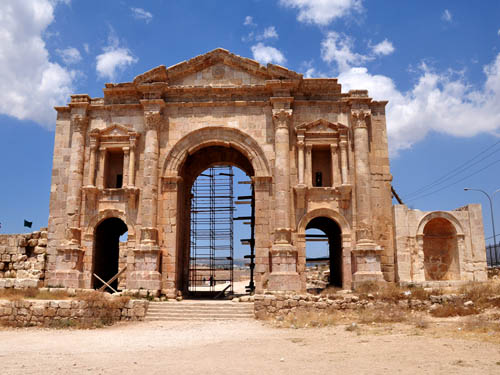
Jerash was one of the cities of the Decapolis in New Testament times. The impressive Roman ruins include a monumental arch, a hippodrome, s theater, a well-preserved cardo, and numerous byzantine churches. The Roman Emperor Hadrian visited Jerash about 130 A.D.

Hadrian's Monumental Arch at Jerash. Photo by Ferrell Jenkins.

Hadrian's Monumental Arch at Jerash. Photo by Ferrell Jenkins.

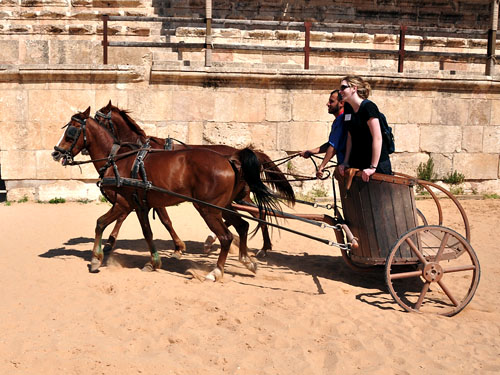
We crossed from Israel into Jordan at the Sheik Hussein bridge a few miles south of Bethshean. Our plan was to be at the 11 a.m. RACE (Roman Army Chariot Experience) at Jerash. Because it took a little longer at the bridge, we had to attend the 2 p.m. show. The show was good, but the sun was already to the back of the performers. This caused the photos to be less than ideal. After the show I made a few photos in the Hippodrome with the sun over my shoulder. One of the young ladies in our group decided she would like to ride in the chariot. See for yourself.

Erin gets a chariot ride at Jerash. Photo by Ferrell Jenkins.

Erin takes a chariot ride at Jerash. Photo by Ferrell Jenkins.

When Jesus traveled through the Decapolis He possibly visited the area around Jerash (Mark 7:31).

A great day in Galilee

After breakfast our group walked to the dock in Tiberias and boarded a boat for a ride on the Sea of Galilee. At first it appeared that it might be a bit hazy on the sea. However, as we moved along the sky cleared and it turned out to be a wonderful day for photographs and teaching about the sites associated with the ministry of Jesus.

A few of the tour members have been to Israel before, but for most of them it is the first trip. It doesn’t matter how many times one comes here he/she always learns something new.

I had arranged earlier with our tour guide and tour company to have a demonstration of cast net fishing on the sea and to sail past the Cove of the Sower, the name given to the site where Jesus taught from a boat to people sitting on the shore.

Again he began to teach by the lake. Such a large crowd gathered around him that he got into a boat on the lake and sat there while the whole crowd was on the shore by the lake. (Mark 4:1 NET)

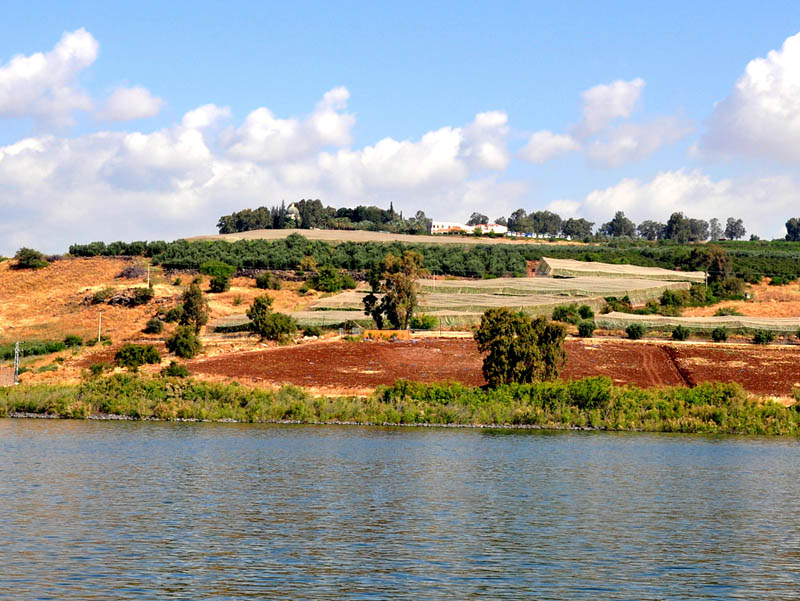
The view of the traditional Mount of Beatitudes (Matthew 6-7) was tremendous. The appearance of the hill has changed over the years. Trees have grown up around the church. A larger building, painted a light color, has made the site less aesthetically appealing. The hillside is filled with agricultural projects. Did Jesus really speak the Sermon on the Mount here? If it wasn’t here, it could not have been far away. The precise spot matters little.

The Mount of Beatitudes. Photo by Ferrell Jenkins.

The Mount of Beatitudes. Photo by Ferrell Jenkins.

Click on the photo for a larger image.

We turned west and sailed to Nof Ginosar in the land of Gennesaret (the English equivalent).

After they had crossed over, they came to land at Gennesaret and anchored there. (Mark 6:53 NET)

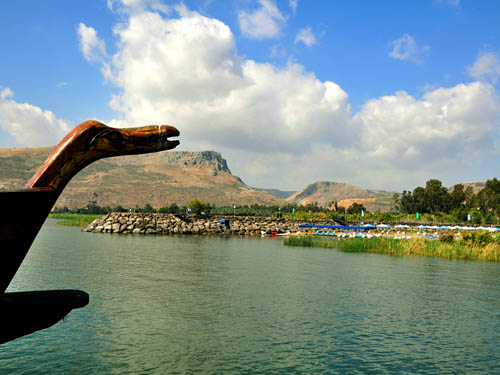
As we approached the shore I noticed one of the ships with an interesting figurehead of a bird, and captured this photo of the Via Maris, the road that leads from Migdal (Magdala) eastward.

The Via Maris from the Sea of Galilee at Nof Ginosar. Photo by Ferrell Jenkins.

The Via Maris from the Sea of Galilee at Nof Ginosar. Photo by Ferrell Jenkins.

The Sea of Galilee is extremely low. The area where you see the blue shade and cabanas now serves as a beach. A few years ago it was covered with water.

We did a lot more today, but that’s it for tonight. Everyone in the group appears to be in good health and enjoying the experience.

Samaritan Passover is today

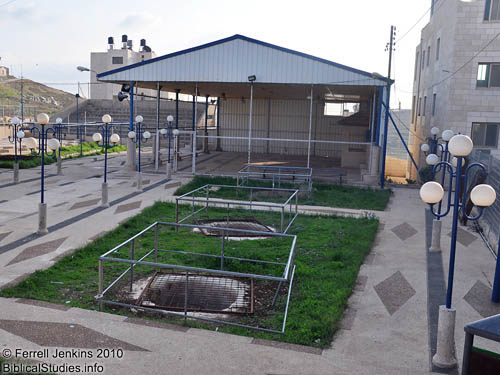
The Samaritans celebrate passover today, April 28, 2010. Lambs will be sacrificed and roasted in the pits seen here on Mount Gerizim.

Pits used by Samaritans on Mt. Gerizim at Passover. Photo by Ferrell Jenkins.

Pits used by Samaritans on Mt. Gerizim at Passover. Photo by Ferrell Jenkins.

See old photos at Life in the Holy Land here. Todd Bolen has some nice photos and explanations at Bible Places here, and another article here. A website provided by the Samaritans is available here.

Passover is a celebration that originated as the Israelites prepared to depart from Egypt.

And when your children say to you, ‘What do you mean by this service?’ you shall say, ‘It is the sacrifice of the LORD’s Passover, for he passed over the houses of the people of Israel in Egypt, when he struck the Egyptians but spared our houses.’” And the people bowed their heads and worshiped. (Exodus 12:26-27 ESV)

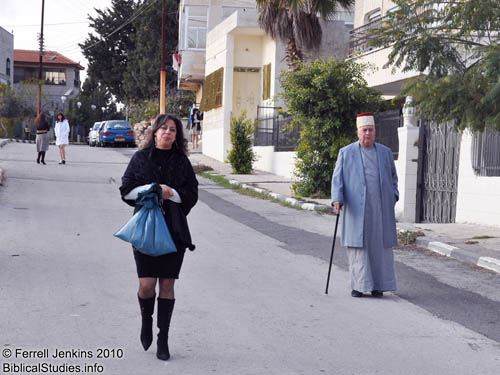
The Samaritans are a curiosity in the modern world. The men and boys wear a dress-like robe, while many of the women dress in modern fashions. We have written more about the Samaritans here.

Samaritan man and woman on Mount Gerizim. Photo by Ferrell  Jenkins.

Samaritan man and woman on Mount Gerizim. Photo by Ferrell Jenkins.

Jesus paused in the valley below Mount Gerizim at Jacob’s well. He discussed the issue of worship in “this mountain” with the woman of Samaria (John 4:1-42).

Our fathers worshiped on this mountain, but you say that in Jerusalem is the place where people ought to worship.” Jesus said to her, “Woman, believe me, the hour is coming when neither on this mountain nor in Jerusalem will you worship the Father. You worship what you do not know; we worship what we know, for salvation is from the Jews. But the hour is coming, and is now here, when the true worshipers will worship the Father in spirit and truth, for the Father is seeking such people to worship him.  God is spirit, and those who worship him must worship in spirit and truth.” (John 4:20-24 ESV)

Jodanian students work at Umm Qais

Jordanian students from the International Academy Amman spent a week excavating at Umm Qais. The full article may be read in The Jordan Times here.
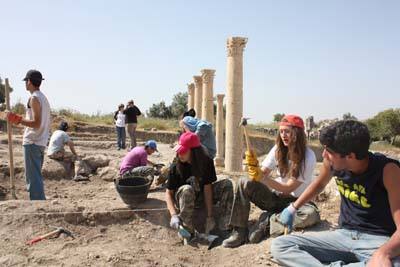
Students from the International Academy in Amman work at Um Qais. Photo by Taylor Luck, Jordan Times.

Students from the International Academy in Amman work at Um Qais. Photo by Taylor Luck, Jordan Times.

Umm Qais (a common spelling) is the site of Gadara, one of the cities of the Decapolis. Mendel Nun discovered 16 ancient ports around the Sea of Galilee, including one for the city of Gadara. He describes Gadara:

Gadara, the most magnificent of the Hellenistic towns that circled the Sea of Galilee, was located on the heights of Gilead above the Yarmuk River. The marine suburb and the city’s harbor were located on the southeastern shore of the lake, at Tel Samra (now Ha-on Holiday Village). In form, Gadara’s harbor resembles that of Sussita—a closed basin with an opening to the south—but it is much larger and more luxurious. The central breakwater is 800 feet long and its base 15 feet wide. The promenade was 650 feet long, built with finely chiseled stones, only one of which remains. The 150-foot-wide basin covered an area of 3 acres.

This harbor is superior to the one at Sussita not only because of its size but also because of its facilities. At the center of the promenade are the remains of a tower. Ruins of a large structure—probably the building of the harbor administration—are scattered on the ground near the harbor gate.

Gadara’s maritime character is attested by its coins, which depicted ships of war for some 250 years. The city’s harbor at Tel Samra was almost certainly not only an anchorage for ships. Second-century coins from Gadara commemorate the Naumachia—naval battle games performed for the inhabitants of Gadara. Until recently, researchers assumed that these games took place on the Yarmuk River, which flows into the Jordan just south of the Sea of Galilee; but this does not seem likely, and no remains of a facility of this kind have been found at this site. The large harbor basin at Tel Samra, however, with its 1,600-foot-long combined promenade and breakwater, would surely have been more suitable to accommodate the throngs of spectators as they arrived. In addition, Gadara’s harbor must have been used by thousands of visitors to the famous baths at Hamat Gader, located 5 miles southeast of the sea. The ancient Roman road connecting Beth Shean and Sussita passed near Tel Samra, and the road to Hamat Gader branched off this road. (Mendel Nun. “Ports of Galilee.” Biblical Archaeology Review 25:04; July/Aug 1999)

From Umm Qais (Gadara) one has a great view of the Sea of Galilee and the Yarmuk River valley. We are told that Jesus visited the region of Decapolis.

Then he returned from the region of Tyre and went through Sidon to the Sea of Galilee, in the region of the Decapolis. (Mark 7:31 ESV)

The Gospel of Matthew informs us about the healing by Jesus of two demon-possessed men in the country of the Gadarenes (Matthew 8:28). Mark puts this event in the country of the Gerasenes (Mark 5:1-20). Luke adds that they “sailed to the country of the Gerasenes, which is opposite Galilee” (Luke 8:26).

The photo below was made in the late afternoon when citizens of the local Jordanian village came out to enjoy the view. The view across the Sea is not clear, but you can see the entire western coast line. In the right foreground you can see a bunker used by the Jordanians in recent wars in the region. The hill directly across from the bunker is the beginning of the Golan Heights. Prior to 1967 this was in Syria. The Yarmuk River flows into the Jordan River south of the Sea of Galilee. All of the significant rivers of Jordan that flow into the Jordan River have dams on them, thus decreasing the amount of water flowing into the Jordan.
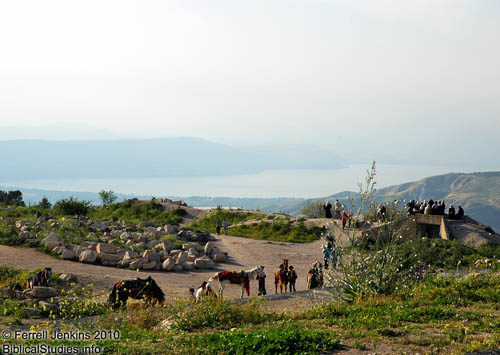
Late afternoon view of the Sea of Galilee from Umm Qais. Photo by Ferrell Jenkins.

The next photo was made in 2002. It shows a portion of the nymphaeum (attractive water fountain) and the Yarmuk Valley.
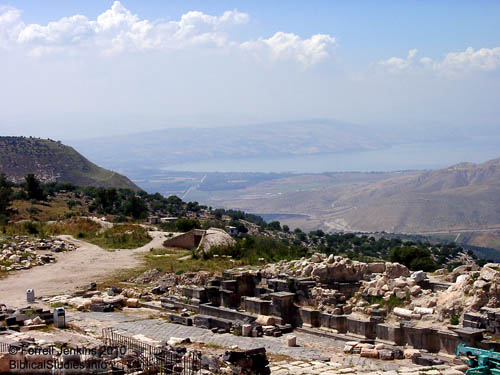
The Sea of Galilee from Umm Qais (Gadara). Photo by Ferrell Jenkins.

The Sea of Galilee from Umm Qais (Gadara). Photo by Ferrell Jenkins.

Todd Bolen posted a beautiful, clear photo that also shows the Yarmuk River valley and the nymphaeum here. Note that the nymphaeum had undergone some reconstruction when his photo was made.

HT: Joseph Lauer

Hoard of coins from time of Ptolemy III discovered

The Egyptian Supreme Council of Antiquities announced Thursday the discovery of a hoard of 383 bronze coins dating to the time of King Ptolemy III (ruled 246–222 B.C.). The well-preserved coins, found in the Fayoum about 50 miles southwest of Cairo, depict the Egyptian god Amun-Zeus on one side and the words Ptolemy and king in Greek on the other.

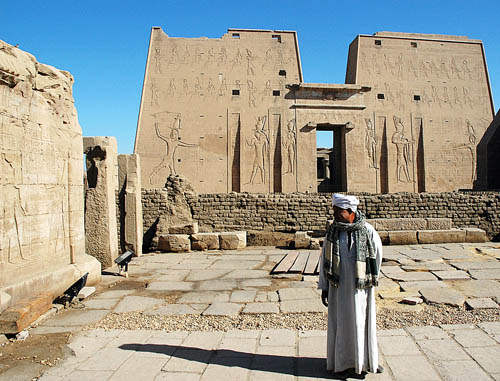
The Edfu Temple begun by Ptolemy III. Photo by Ferrell Jenkins.

The Edfu Temple begun by Ptolemy III. Photo by Ferrell Jenkins.

The famous Alexandria Library was established in the 4th century B.C. by Ptolemy Soter I, or a few years later by his son. The Hebrew scriptures were translated into Greek under the Ptolemaic rulers, beginning about 280 B.C. This Greek version was in common use in the first century. More than half of the quotations from the Old Testament in the New Testament come from the Septuagint (Greek) version. For example, this is the version the man of Ethiopia was reading about the suffering servant:

So Philip ran to him and heard him reading Isaiah the prophet and asked, “Do you understand what you are reading?” (Acts 8:30 ESV)

Philip the evangelist began at that Scripture and preached Jesus to him.

HT: Joseph I. Lauer; various media reports.

Update: Todd Bolen has posted a beautiful photo here of Lake Qarun near the site of the discovery.

Palestine nineteen centuries ago

Alfred Edersheim wrote his Sketches of Jewish Social Life in 1876. He tells us how the land of Palestine looked after three and a half centuries of Ottoman Rule. If you have read after some of the older scholars you know they were fond of long paragraphs. A far cry from the single sentence paragraphs we see in newspapers today. It says a lot about the readers, I suppose. Anyway, I have divided the single paragraph into four for ease of reading.

Eighteen and a half centuries ago, and the land which now lies desolate—its bare, grey hills looking into ill-tilled or neglected valleys, its timber cut down, its olive- and vine-clad terraces crumbled into dust, its villages stricken with poverty and squalor, its thoroughfares insecure and deserted, its native population well-nigh gone, and with them its industry, wealth, and strength—presented a scene of beauty, richness, and busy life almost unsurpassed in the then known world.

Then, he tells us how the land was described eighteen centuries prior to his day:

The Rabbis never weary of its praises, whether their theme be the physical or the moral pre-eminence of Palestine. It happened, so writes one of the oldest Hebrew commentaries, that Rabbi Jonathan was sitting under a fig-tree, surrounded by his students. Of a sudden he noticed how the ripe fruit overhead, bursting for richness, dropped its luscious juice on the ground, while at a little distance the distended udder of a she-goat was no longer able to hold the milk. “Behold,” exclaimed the Rabbi, as the two streams mingled, “the literal fulfillment of the promise: ‘a land flowing with milk and honey.’“ “The land of Israel is not lacking in any product whatever,” argued Rabbi Meir, “as it is written (Deuteronomy 8:9): ‘Thou shalt not lack anything in it.’“ Nor were such statements unwarranted; for Palestine combined every variety of climate, from the snows of Hermon and the cool of Lebanon to the genial warmth of the Lake of Galilee and the tropical heat of the Jordan valley. Accordingly not only the fruit trees, the grain, and garden produce known in our colder latitudes were found in the land, along with those of sunnier climes, but also the rare spices and perfumes of the hottest zones.

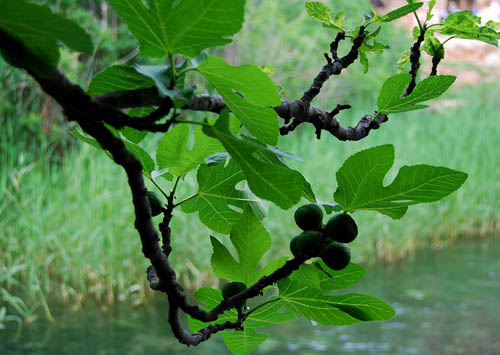
Fig growing at Caesarea Philippi. Photo by Ferrell Jenkins.

Fig growing at the Banias River, Caesarea Philippi. Photo by Ferrell Jenkins.

Similarly, it is said, every kind of fish teemed in its waters, while birds of most gorgeous plumage filled the air with their song. Within such small compass the country must have been unequaled for charm and variety. On the eastern side of Jordan stretched wide plains, upland valleys, park-like forests, and almost boundless corn and pasture lands; on the western side were terraced hills, covered with olives and vines, delicious glens, in which sweet springs murmured, and fairy-like beauty and busy life, as around the Lake of Galilee.

In the distance stretched the wide sea, dotted with spreading sails; here was luxurious richness, as in the ancient possessions of Issachar, Manasseh, and Ephraim; and there, beyond these plains and valleys, the highland scenery of Judah, shelving down through the pasture tracts of the Negev, or South country, into the great and terrible wilderness. And over all, so long as God’s blessing lasted, were peace and plenty. Far as the eye could reach, browsed “the cattle on a thousand hills”; the pastures were “clothed with flocks, the valleys also covered over with corn”; and the land, “greatly enriched with the river of God,” seemed to “shout for joy,” and “also to sing.” Such a possession, heaven-given at the first and heaven-guarded throughout, might well kindle the deepest enthusiasm.

Jaffa Gate unveiling tomorrow

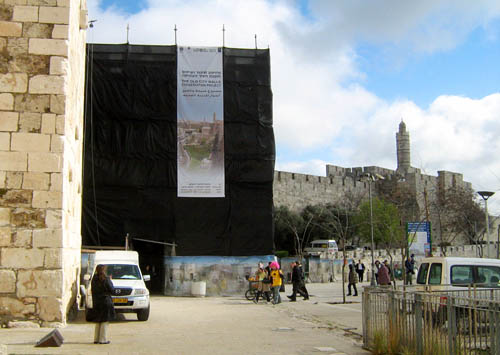
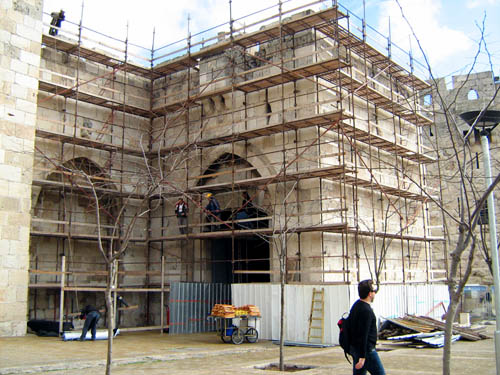
The newly rehabilitated Jaffa Gate will be unveiled tomorrow, April 21, after several months of conservation work. Jaffa Gate is the only one of the seven gates of the Old City on the western side of Jerusalem.

Jaffa Gate awaiting unveiling. Photo: IAA.

Jaffa Gate awaits unveiling after several months of rehabilitation. Photo: IAA.

The Israel Antiquities Authority press release briefly describes the history of the gate:

Jaffa Gate was first inaugurated in 1538. It constituted part of the city walls and in fact it was only toward the end of the nineteenth century did it become a center of bustling and prosperous activity. The period culminated in the year 1898, when it was decided to breach a wide entrance in the city wall of Jerusalem (as we know it today) and thereby allow the German Kaiser, Wilhelm II and his wife, Augusta Victoria, to enter the city in their carriage. Thus, for the first time in the history of modern Jerusalem, carts could enter the Old City.

In the War of Independence the gate was the focal point of some very harsh battles. During the war Jaffa Gate was completely blocked by an armored vehicle that had been damaged in the fighting and was wedged in the opening. In the cease-fire agreements between Israel and Jordan Jaffa Gate stood at the opening to the no man’s land that stretched from Jaffa Gate to Zahal Square and the Mamilla neighborhood and separated it from Jordanian controlled Jerusalem in the east. Consequently, the blocked armored vehicle was not removed, and the gate remained closed the entire period that the city was divided. The remains of the bullets that pierced the stones of the gate are clearly visible on the upper parts of the structure.

You may read the press release in its entirety here.

Jaffa Gate during rehabilitation. Photo: IAA.

Jaffa Gate during rehabilitation. Photo: Israel Antiquities Authority.

English Bible students will recognize the word Jaffa as Joppa. This is the gate through which one would leave Jerusalem to go to Joppa on the Mediterranean coast. Cedar timber from Lebanon was brought from Joppa to Jerusalem for the building of Solomon’s temple.

And we will cut whatever timber you need from Lebanon and bring it to you in rafts by sea to Joppa, so that you may take it up to Jerusalem. (2 Chronicles 2:16 ESV)

HT: Joseph I. Lauer

Temples made by man

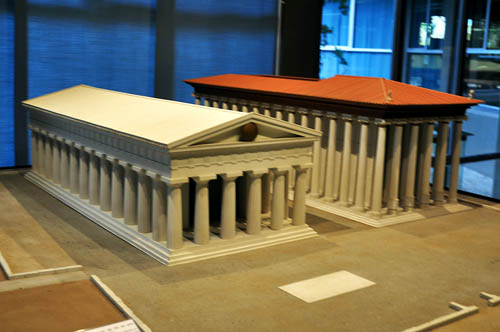
Any Greek or Roman city we visit is surely to have ruins of a theater and a temple. Both Greek and Roman theaters remain at Syracuse (Acts 28:12).The Paoli Orsi Regional Archaeological Museum displays a model of the Temple of Athena (left; 480 B.C.) and the Temple of Artemis (right; 520 B.C.).

Temple models at Syracuse, Sicily, archaeological museum.

Model of Temple Athena and Temple of Artemis. Syracuse. Photo by Ferrell Jenkins.

The Apostle Paul had to contend with this in every Roman city he visited. At Athens he said,

The God who made the world and everything in it, being Lord of heaven and earth, does not live in temples made by man, nor is he served by human hands, as though he needed anything, since he himself gives to all mankind life and breath and everything. (Acts 17:24-25 ESV)

He reminded the Corinthians, who lived in a city filled with temples,

For although there may be so-called gods in heaven or on earth–as indeed there are many “gods” and many “lords”– yet for us there is one God, the Father, from whom are all things and for whom we exist, and one Lord, Jesus Christ, through whom are all things and through whom we exist. (1 Corinthians 8:5-6 ESV)

Solomon’s temple in Jerusalem, as well as the later temples built by Zerubbabel and Herod, were made with hands. Paul certainly knows this. But he also knows what Solomon said about the same subject:

“But will God indeed dwell on the earth? Behold, heaven and the highest heaven cannot contain you; how much less this house that I have built! (1 Kings 8:27 ESV)

Read the full account of the building and dedication of the temple in 1 Kings 6-8. The temple was a place of worship, but it was not to be the object of worship.

Jesus taught His disciples to pray like this: “Our Father in heaven, hallowed be your name” (Matthew 6:9).

Paul stayed three days in Syracuse

After three months on the Island of Malta, Paul’s voyage to Rome resumed when an Alexandrian ship that had wintered there set sail. The next stop was Syracuse in Sicily (Acts 28:11-12).

K. L. McKay describes Syracuse:

A city with a large harbour on the E coast of Sicily. Founded in 734 bc by Corinthian colonists, it had by the end of the 5th century bc become the most important city, politically and commercially, in Sicily, especially under the tyrants Gelon and Dionysius I. (New Bible Dictionary, 1143).

The stop at Syracuse is nearly overlooked by Luke, with only these words:

We put in at Syracuse and stayed there three days. (Acts 28:12 NET)

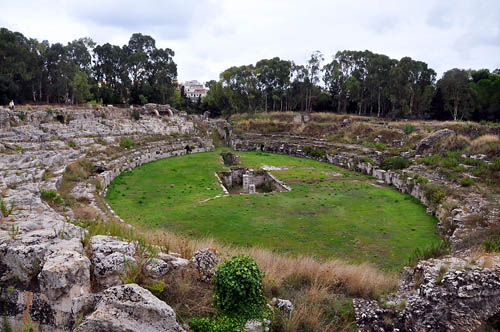
It is doubtful that Paul, as a prisoner, had much liberty to visit the sites of the city as he did at Athens (Acts 17:23). There are a few Roman and Greek ruins to be seen today. Our photo today is of the Greek theater built in the fourth century B.C.

Syracuse Greek Theater. Photo by Ferrell Jenkins.

Ruins of the Greek Theater in Syracuse. Photo by Ferrell Jenkins.

The Good Shepherd

When the Pharisees and scribes complained that Jesus received sinners and ate with them, He told them a parable that we call the parable of the lost sheep (Luke 15:1-7).

“What man among you, if he has a hundred sheep and has lost one of them, does not leave the ninety-nine in the open pasture and go after the one which is lost until he finds it? “When he has found it, he lays it on his shoulders, rejoicing. “And when he comes home, he calls together his friends and his neighbors, saying to them, ‘Rejoice with me, for I have found my sheep which was lost!’  “I tell you that in the same way, there will be more joy in heaven over one sinner who repents than over ninety-nine righteous persons who need no repentance. (Luke 15:4-7 NAU)

“When he has found it, he lays it on his shoulder, rejoicing.” This describes the work of good shepherds and a practice that was well known to those who heard Jesus. On another occasion Jesus called Himself the good shepherd (John 10:11, 14).

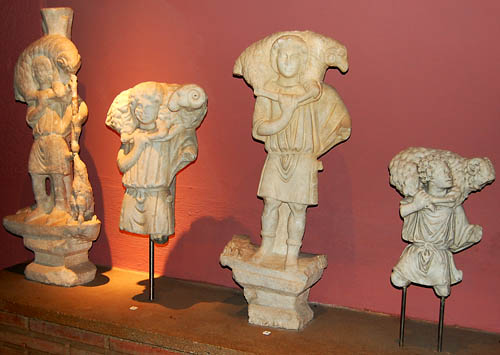
The motif of the good shepherd with the sheep on his shoulder became common in later Christian iconography. Similar drawings are known from the catacombs in Rome. The four statuettes shown below date from the 4th century A.D., and are displayed in the Istanbul Archaeological Museum.

Good shepherd statues. Istanbul Archaeological Museum. Photo by Ferrell Jenkins.

Good shepherd statues. Istanbul Archaeological Museum. Photo by Ferrell Jenkins.

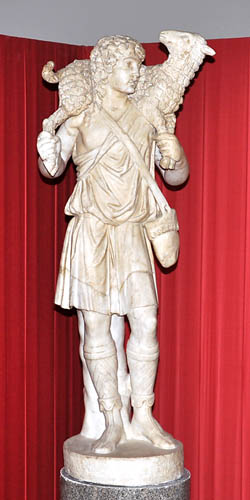
Last September I saw a special exhibit of early Christian artifacts in the Vatican Museum. The photo below shows a wonderful early 4th century statuette of the Good Shepherd.

The Good Shepherd in the Vatican Museum. Photo by Ferrell Jenkins.

The Good Shepherd in the Vatican Museum. Photo by Ferrell Jenkins.