Category Archives: New Testament

Passing through the grainfields

All three of the Synoptic Gospels record the incident of Jesus and His disciples passing through the grainfields on a Sabbath.

On a Sabbath, while he was going through the grainfields, his disciples plucked and ate some heads of grain, rubbing them in their hands. But some of the Pharisees said, “Why are you doing what is not lawful to do on the Sabbath?” (Luke 6:1-2 ESV)

I thought I would put together some photos to help you visualize what happened here. First, we have a photo of a wheat field below Mount Tabor. The photo is made looking north west from near the site of ancient En-dor. The area is famous as the home of the medium visited by King Saul (1 Samuel 28:7).

Wheat field below Mount Tabor. Photo by Ferrell Jenkins.

Wheat field with view NW to Mount Tabor. Photo by Ferrell Jenkins.

Now, imagine the disciples taking grain in their hands.

Picking heads of grain. Photo by Ferrell Jenkins.

Picking heads of grain. Photo by Ferrell Jenkins.

And then rubbing the heads to separate the grain from the chaff.

Rubbing grain to separate the head from the chaff. Photo by Ferrell Jenkins.

Rubbing grain to separate the head from the chaff. Photo by Ferrell Jenkins.

The last two photos were made in the vicinity of Mount Nemrut in eastern Turkey. Larger images, suitable for use in teaching, are available by clicking on the photos.

Archaeology Illustrated by Balage Balogh

His work has been featured on the Discovery Channel and in many scholarly books. A native Hungarian, Balage now creates images of ancient Israel, Egypt, Babylon, Greece, Rome, and other civilizations. He tell the story in these words:

I began working with archaeologists, scholars and experts in the field in the Department of Archaeology at the Hebrew University of Jerusalem, the Albright Institute, the Israel Museum, and universities throughout the United States.  My archaeological illustrations were published in National Geographic Hebrew edition,  A Guide to Jerusalem, The World of the New Testament, The World of the Old Testament, Excavating Jesus, and The Jesus Dynasty among others and many of my illustrations were part of exhibits at the Israel Museum, the Welcome Center in the City of David, Jerusalem, and permanently displayed in the Archaeology Department at the Hebrew University of Jerusalem.

Balage Balogh contacted me with the request that I offer some of his art free of charge on my web sites in exchange for a permanent link. Since I have more readers of the blog than of the web sites I decided to begin here. As time permits I will post a few more of his illustrations here and at the Biblical Studies Info Page and Bible World.

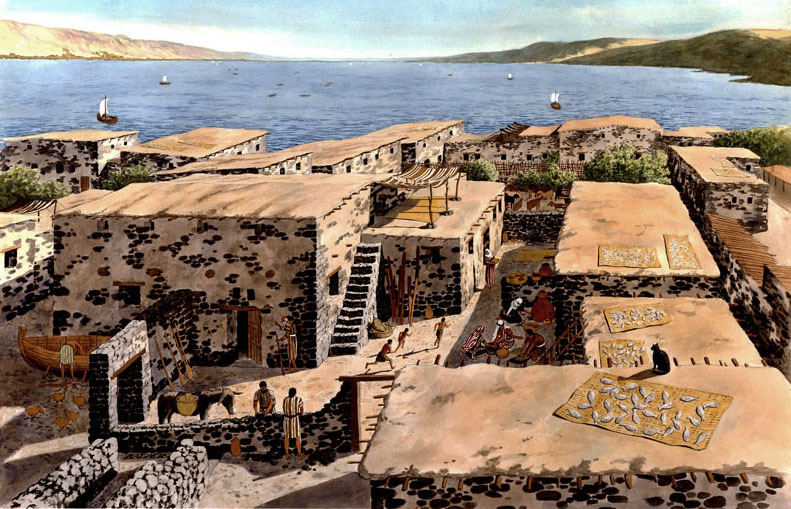
Here is a wonderful drawing of Capernaum at the time of Jesus. One need only know something about the archaeological discoveries of the first century to see the accuracy of this drawing. Notice the basalt stone and the way the roofs are constructed. A larger image is available by clicking on the drawing.

Capernaum at the time of Jesus. Art by Balage Balogh.

Capernaum at the time of Jesus. Art by Balage Balogh.

Take a look at Archaeology Illustrated. Balogh’s work may be purchased for use in presentations or publications. This illustration is © Balage Balogh 2010.

Kinneret Regional Project uncovers synagogue

Several weeks ago I added a link to the Kinneret Regional Project on the Bible Places page of the Biblical Studies Info Page. My intention was to write about the project and show a photo of Tel Kinneret (Kinrot; Arabic Tell el-‘Oreme) on the northwestern shore of the Sea of Galilee.

Now word comes of the discovery of a fourth century synagogue at Horvat Kur, about a mile northwest of Tel Kinneret. The press release here says that the discovery “adds new evidence [along with the synagogues at Capernaum, Chorazin, Kh. Hammam, and Magdala] for a very tight net of synagogues in a relatively small area on the Northwestern shores of the Lake of Galilee.”

Todd Bolen created a map using Google Earth to identify Horvat Kur, Tel Chinnereth (Kinneret), Tabgha, Mount of Beatitudes, Cove of the Sower, and Capernaum. This great resource for studying the ministry of Christ may be accessed at the Bible Places Blog.

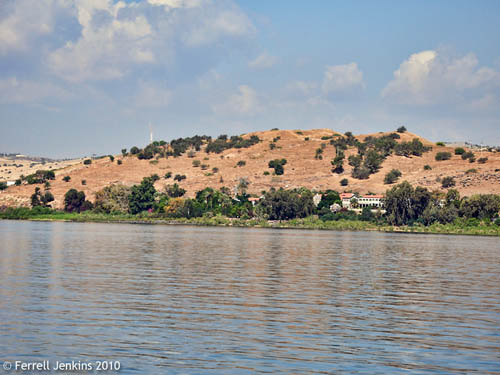
Earlier I mentioned that the day in early May when my group took a boat ride on the Sea of Galilee was a great one for making photos. I caught this wonderful view of Tel Kinneret from the boat. The buildings on the shore below the tel belong to Pilgerhaus Tabgha, a guesthouse operated by the German Association of the Holy Land.

Tel Kinerot from the Sea of Galilee. Photo by Ferrell Jenkins.

Tel Kinneret from the Sea of Galilee. Photo by Ferrell Jenkins.

From the Kinneret Regional Project site you may download several good resources. The 2004 report by Pakkala, et al., begins with this description of Tel Kinneret.

The site boasts remains from the Chalcolithic to the Ottoman period. In its heyday in the Early Iron Age, i.e. the 11th/early 10th century BCE, Kinneret developed into a regional center, controlling the surrounding region and becoming one of the most important urban sites of the country.

The body of water that we commonly call the Sea of Galilee is known as the Sea of Chinnereth in the Old Testament (Numbers 34:11; Joshua 13:27). Chinnereth is listed as one of the fortified cities of the tribe of Naphtali in Joshua 19:35.

I think most tourists to Galilee overlook Tel Kinneret. They are excited about having seen the Roman boat at Nof Ginosaur, and the guide is beginning to tell them about Taghba, Capernaum, or the Mount of Beatitudes. Or it may be because the site is obscured from the highway by the electric power station below it.

HT: Joseph I. Lauer

Reaching 400,000

Moments ago someone recorded hit number 400,000 for this blog. Your words of appreciation are greatly appreciated. In the past few weeks, while traveling on the West Coast, numerous people told me they found the posts helpful. The comments left on the blog, and the Emails received are also appreciated.

400,000 hits at ferrelljenkins.wordpress.com.

Ferrell's Travel Blog recorded his number 400,000 this evening.

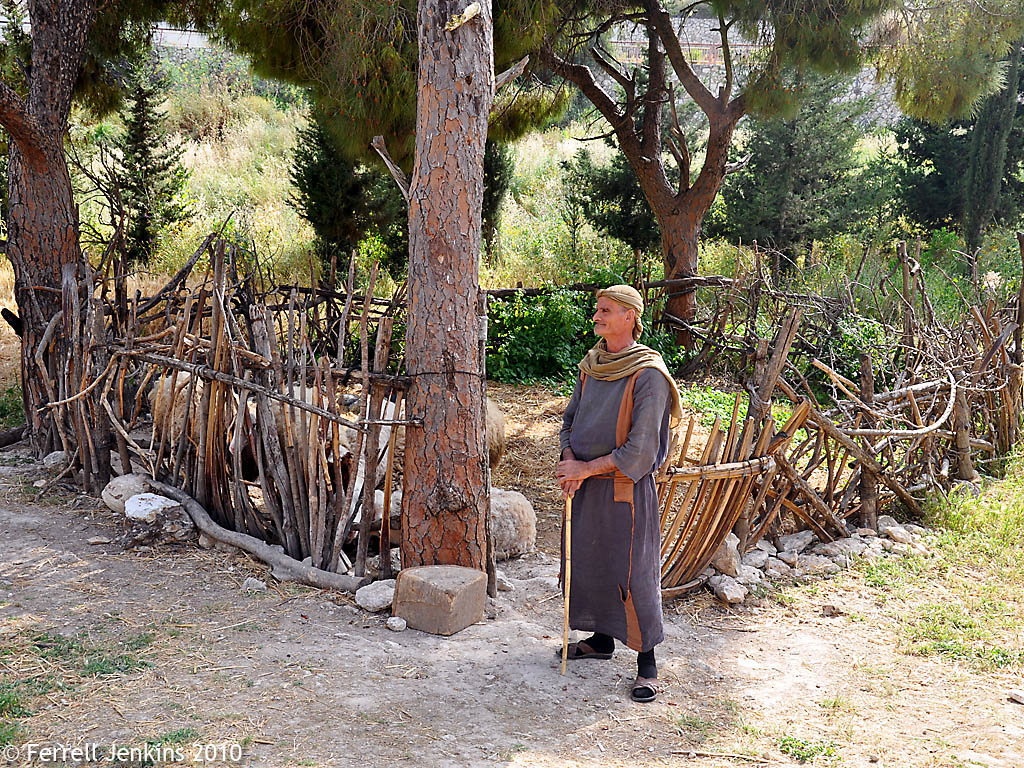
As a marker of this milestone I am posting a photo I think many of you will be able to use in the Bible classes you teach. Click on the photo for a larger image suitable for use in PowerPoint.

Shepherd and sheepfold at Nazareth Village. Photo by Ferrell Jenkins.

Shepherd and sheepfold at Nazareth Village. Photo by Ferrell Jenkins.

This photo might be used in teaching any of the texts mentioning the sheepfold (Genesis 49:14; Numbers 32:16; Judges 5:16; 1 Samuel 24:3; 2 Chronicles 32:28; Psalm 28:13; Psalm 78:70).

It provides a good illustration of the teaching of Jesus in John 10.

“Truly, truly, I say to you, he who does not enter by the door into the fold of the sheep, but climbs up some other way, he is a thief and a robber.  “But he who enters by the door is a shepherd of the sheep. “To him the doorkeeper opens, and the sheep hear his voice, and he calls his own sheep by name and leads them out. (John 10:1-3 NAU)

Second century A.D. gold coin found at Bethsaida

“Rare coin bears good tidings for UNO’s Israeli excavations” is the headline for an article by John Keenan in the Omaha World-Herald.

Dr. Rami Arav, of the University of Nebraska Omaha, is the director of the excavation at et-Tell in Galilee. I’m sure it wasn’t necessary for the reporter to say that Arav was excited when Alexis Whitley, one of the volunteers at the dig, found a gold coin dating to the mid-second century A.D.
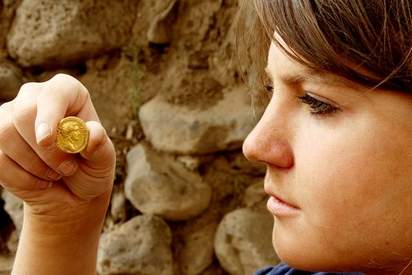
Alexis Whitley - a volunteer from West Virginia University.

Alexis Whitley - a volunteer from West Virginia University.

The coin, which weighs 7 grams, is 97.6 percent gold, Arav said.

The find was unexpected because Bethsaida primarily was home to humble fishermen, he said. Arav said somebody must have been doing good business a little more than 100 years after the birth of Christ.

The gold coin, about three-quarters of an inch in diameter, carries the image of Antoninus Pius, the 15th Roman emperor, who reigned between A.D. 138 and 161.

“Before newspapers, coins fulfilled the job of disseminating information. In our case, Antoninus wanted to announce that the Senate designated him to the position of a consul for the second time. This position was among the highest at Rome.”

Arav thinks this is the first Antoninus Pius gold coin excavated in Israel. I like the fact that he gave credit to the young volunteer who discovered the coin.
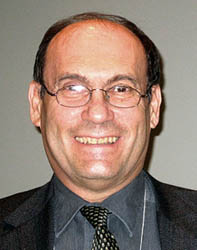
Prof. Rami Arav. Photo by Ferrell Jenkins.

Rami Arav. Photo: F. Jenkins.

“This type of a coin was never sold in the market because it is so rare,” he said. “It may go for as much as people will be able to pay for it.”

For now, the coin — along with the rest of the Bethsaida finds, considered to be the heritage of the State of Israel — will go to the Israel Antiquities Authority. Its ultimate destination probably will be the Israel Museum in Jerusalem, Arav said.

“Bethsaida has already enriched the Israel Museum with a few other outstanding and rare finds.”

The article in its entirety may be read here.

Bethsaida is mentioned in the New Testament as the place where Jesus healed a blind man (Mark 8:22-25). Not everyone agrees with Dr. Arav’s identification of et-Tell as Bethsaida, where he has been working for nearly a quarter of a century. See a previous post about Bethsaida here.

A report of the Bethsaida 2010 excavation is posted here. Photos of coins, including the gold coin, and items associated with fishing are posted under Special Pics. Shai Schwartz has posted 234 photos from the recent excavation in his Picasa album here.

HT: Joseph Lauer, Paleojudaica, Bible Places Blog.

Dead Sea Scrolls: the French connection

Bloomberg reports on the exhibition of the Dead Sea Scrolls at the National Library (Bibliothèque nationale de France) in Paris with a discussion of the French connection and the problems posed by the scrolls. Jorg von Uthmann says,

The discovery of the Dead Sea Scrolls in 1947 was, along with the opening of Tutankhamun’s tomb in 1922, the greatest archaeological sensation of the 20th century. An exhibition at Paris’s National Library puts the scrolls in their historical and theological context and questions the mainstream hypothesis about their origin.

It’s the first show of this kind in France. That’s all the more amazing as French scholars were deeply involved in the deciphering of the scrolls and the tens of thousands of fragments on papyrus or parchment.

Most of the work was done at the Ecole Biblique et Archeologique in Jerusalem under the direction of the Dominican archaeologist Father Roland de Vaux.

To fund excavations at Khirbet Qumran on the western shore of the Dead Sea, De Vaux sold, in 1953, 377 fragments to the French government. Presented in airtight cases, they occupy the center of the theatrically staged show.

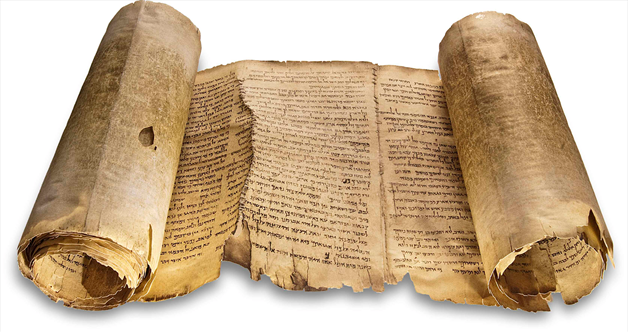
The complete article may be read here. The link to the National Library in Paris is here. The Bloomberg article includes three nice photos, including this one of a facsimile of the Isaiah scroll.

Facsimile of the Dead Sea Isaiah. National Libary via Bloomberg.com.

Facsimile of the Dead Sea Isaiah. National Library via Bloomberg.com.

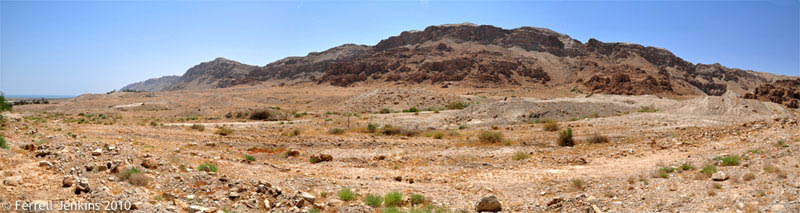
About two weeks ago I was at Qumran and tried my eye and hand at making a panorama of the area immediately to the west of Qumran. In this photo, made of three images, you can see the Dead Sea on the left. The Qumran settlement is on the plateau to the right of the sea. As you enter, or leave, the Qumran parking lot you will see a sign pointing to Kalya.  These photo were made from that road. Click the image for a slightly larger photo.

Qumran Panorama by Ferrell Jenkins.

Qumran Panorama. Photo by Ferrell Jenkins.

About two months ago Todd Bolen identified the caves associated with the Scrolls. For high resolution photos of this same area see here.

HT: Joseph I. Lauer

Remembering the Dead

Memorial Day, originally called Decoration Day, is a day of remembrance for those who have died in our nation’s service. There are many stories as to its actual beginnings, with over two dozen cities and towns laying claim to being the birthplace of Memorial Day. (Memorial Day History)

When I was a kid, growing up in the American South, the day we now call Memorial Day was called Decoration Day. Families went to the local cemeteries to clean up the grave sites of relatives and leave fresh flowers. If it was known that there were no family members left in the community, those graves also were cleaned. I don’t recall when I first began to hear, or think, that the day was intended to honor those fallen in war.

Like many holidays, the original purpose has changed. Memorial Day, Independence Day, Labor Day, Christmas, Easter, and other holidays, have become times for picnics, trips, vacations, and assorted non-related practices. Every holiday has become a time for stores to have sales.

I like the idea of Memorial Day. I am pleased to join in the remembrance of troops fallen in battle, and all of the dead who have played a significant role in my life.

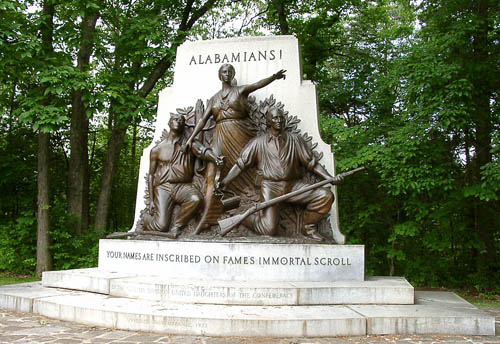
Honoring the Fallen from Alabama at Gettysburg. Photo by Ferrell Jenkins.

Honoring the Fallen from Alabama at Gettysburg. Photo by Ferrell Jenkins.

Our header today is a photo I made at Normandy a few years ago.

For Christians, every Lord’s Day is a special day of remembrance. We gather to remember the death of the Lord Jesus for our sins.

23 For I received from the Lord that which I also delivered to you, that the Lord Jesus in the night in which He was betrayed took bread;
24 and when He had given thanks, He broke it and said, “This is My body, which is for you; do this in remembrance of Me.”
25 In the same way He took the cup also after supper, saying, “This cup is the new covenant in My blood; do this, as often as you drink it, in remembrance of Me.”
26 For as often as you eat this bread and drink the cup, you proclaim the Lord’s death until He comes. (1 Corinthians 11:23-26 NAU)

Fires damages Gamla Nature Reserve

The nature reserve at Gamla has been severely damaged, according to a Haaretz report here.

Israel’s nature and parks authority believed the blaze was started by a military tank, whose metal tracks gave off sparks when moving over rocks.

Gamla is an impressive fortress east of the Sea of Galilee. It is not mentioned in the New Testament, but Jewish zealots were defeated here by the Roman army about A.D. 66. Josephus describes the site in vivid terms:

for it was located upon a rough ridge of a high mountain, with a kind of neck in the middle: where it begins to ascend, it lengthens itself, and declines as much downward before as behind, insomuch that it is like a camel in figure, from where it is so named, although the people of the country do not pronounce it accurately. Both on the side and the face there are abrupt parts divided from the rest, and ending in vast deep valleys; yet are the parts behind, where they are joined to the mountain, something easier of ascent than the other; but then the people belonging to the place have cut an oblique ditch there, and made that hard to be ascended also. On its slope, which is straight, houses are built, and those very thick and close to one another. The city also hangs so strangely, that it looks as if it would fall down upon itself, so sharp is it at the top. (Wars of the Jews 4:5-7)

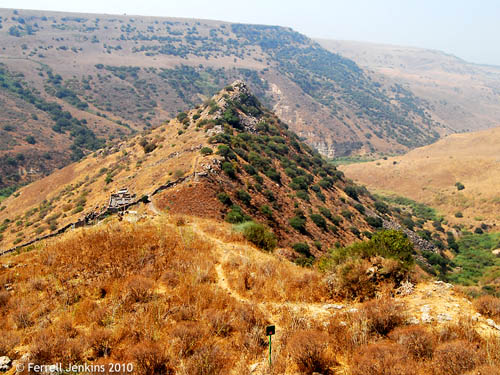
A view of the site while reading the description by Josephus will probably be helpful.

Gamla. Photo by Ferrell Jenkins.

Gamla. Photo by Ferrell Jenkins.

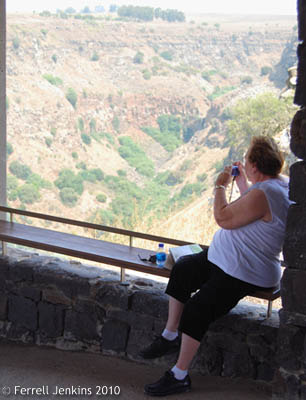
The photo below shows a canyon near the ancient site. From this concrete lookout tourists look for soaring eagles which are common in the reserve.

Viewing Gamla in 2008. Photo by Ferrell Jenkins.

Looking for Eagles in 2008.

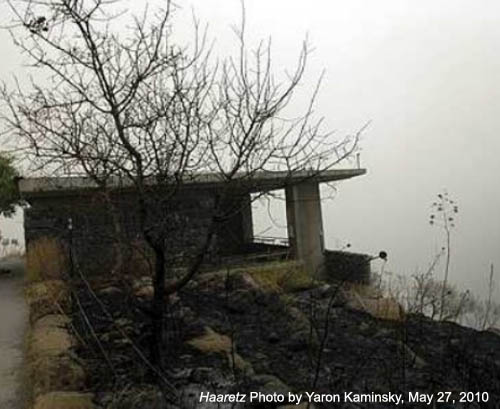
The photo below from Haaretz shows the same concrete observation building after the fire. Be sure to check the article to see more photos of the damage caused by the fire.

Gamla Nature Reserve Fire. Haaretz. May 27, 2010. Yaron Kaminsky.

Gamla Nature Reserve Fire. Photo: Haaretz, Yaron Kaminsky.

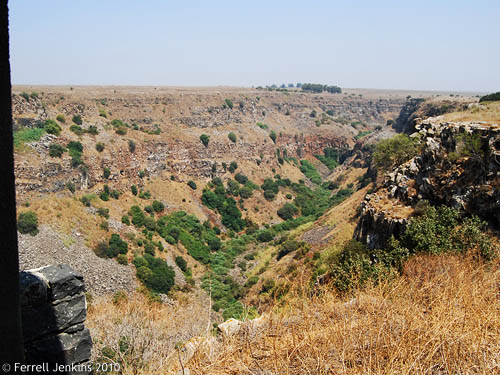
This photo will give you a good view of the area as we saw it from the lookout near the end of August, 2008.

Gamla Nature Reserve. Photo by Ferrell Jenkins, Aug. 30, 2008.

Gamla Nature Reserve. Photo by Ferrell Jenkins, Aug. 30, 2008.

HT: Bible Places Blog.

Israel Museum set to open in two months

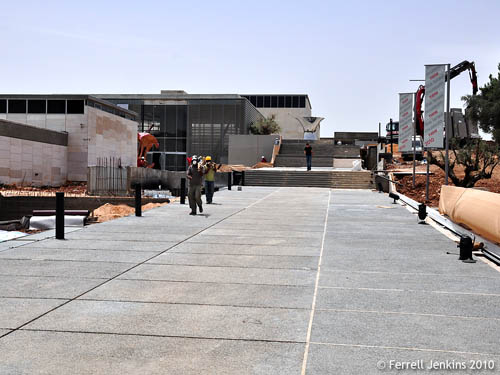
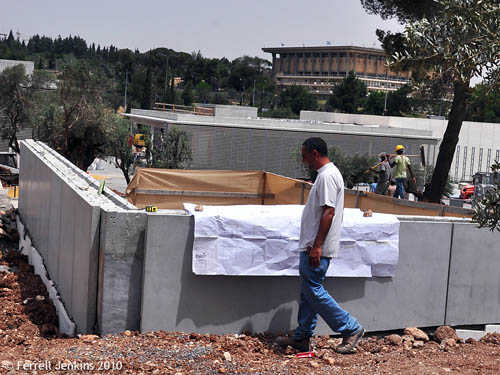
The Bible Places Blog reports here that the Israel Museum, after a lengthy and expensive renovation, is scheduled to reopen July 26. Twice, during the recent trip to Israel, I visited the grounds of the Israel Museum. The last visit to the Second Temple Model was ten days ago. At that time I made a few photos of the work going on outside the museum.

Construction at the Israel Museum - May 17, 2010. Photo by Ferrell Jenkins.

Construction at the Israel Museum - May 17, 2010. Photo by Ferrell Jenkins.

From the outside the Museum looks much the same as before, especially the long, uphill walk to get to the entrance.

Reading the Blueprint at the Israel Museum - May 17, 2010. Photo by Ferrell Jenkins.

Reading the Blueprint at the Israel Museum - May 17, 2010. Photo by Ferrell Jenkins.

The already impressive location of the Museum campus with the Shrine of the Book, the Second Temple Model and the nearby Israeli Knesset building is sure to be even more impressive.

I look forward to my next visit to Jerusalem when I may again see the wonderful exhibits inside the Museum. The great museums of the world with biblical collections, the British Museum, the Louvre, the Metropolitan in New York, the Istanbul Archaeological Museum, the Oriental Institute of the University of Chicago, the University of Pennsylvania, the National Museum in Athens, and the Pergamum Museum in Berlin, allow photographs of their exhibits. It would be great to see the Israel Museum follow the practice of these outstanding museums. Then, only the museums in Amman, Cairo, and Damascus would be out of step.

HT: Bible Places Blog

Roman altar excavated at Ashkelon

It happens with regularity in Israel. Someone is building. The builder encounter ancient ruins. The Israel Antiquities Authority is called. (I wonder how many times they are not called.) Construction is halted while an emergency excavation is conducted. Amazing discoveries are often uncovered.

This time it happened at Ashkelon during construction of an Emergency Room at the Barzilai Hospital. Here is the account provided by the IAA.

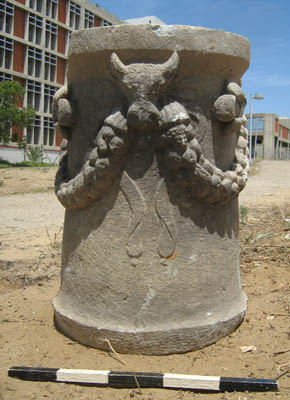
The development work for the construction of a fortified emergency room at Barzilai Hospital, which is being conducted by a contractor carefully supervised by the Israel Antiquities Authority, has unearthed a new and impressive find: a magnificent pagan altar dating to the Roman period (first-second centuries CE) made of granite and adorned with bulls’ heads and a laurel wreaths. The altar stood in the middle of the ancient burial field.

According to Dr. Yigal Israel, Ashkelon District Archaeologist of the Israel Antiquities Authority, “The discovery further corroborates the assertion that we are dealing with a pagan cemetery. It is an impressive find that has survived 2,000 years. The altar is c. 60 centimeters [24 inches] tall and it is decorated with bulls’ heads, from which dangle laurels wreaths. There is a strap in the middle of each floral wreath and bull’s head. The laurel wreaths are decorated with grape clusters and leaves. This kind of altar is known as an “incense altar”. Such altars usually stood in Roman temples and visitors to the temple used to burn incense in them, particularly myrrh and frankincense, while praying to their idols. We can still see the burnt marks on the altar that remain from the fire. The altar was probably donated by one of the families who brought it to the cemetery from the city of Ashkelon”.

Roman altar discovered at Ashkelon. Photo: IAA.

Roman altar discovered at Ashkelon. Photo: IAA.

More information is available from the IAA here.

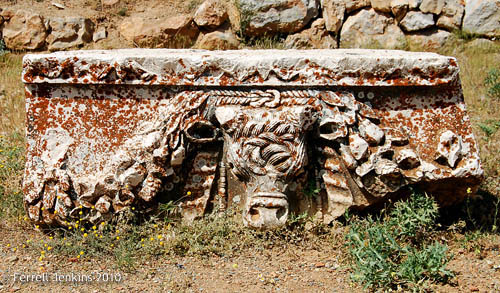
The motif on this altar is common in the Greco-Roman world. The photo below shows a similar bull’s head on what appears to be part of an architectural frieze in the Augustan Imperial Sanctuary at Pisidian Antioch.

From Augustan Imperial Sanctuary at Pisidian Antioch. Photo by Ferrell Jenkins.

From Augustan Imperial Sanctuary at Pisidian Antioch. Photo by Ferrell Jenkins.

The Archaeological Museum in Thessalonica exhibits an altar from the Roman Imperial age (35 B.C.) that, according to the inscription on it, was reused as a pedestal in the temple of Isis in the 2nd century A.D.

Roman Imperial Altar. Thessalonica, Greece, Museum. Photo by Ferrell Jenkins.

Roman Imperial Altar. Thessalonica Museum. Photo: Ferrell Jenkins.

These stones showing garlanded animals remind me of what happened to Paul and Barnabas at Lystra in Lycaonia.

And the priest of Zeus, whose temple was at the entrance to the city, brought oxen and garlands to the gates and wanted to offer sacrifice with the crowds. (Acts 14:13 ESV)

HT: Joseph Lauer and numerous blogs. Note especially the comments on the current religious/political comments by Jim West and Aren Maeir about the Ashkelon altar at Zwinglius Redivivus.