Category Archives: New Testament

Vessels of honor and dishonor

In explaining to Timothy the importance of right living, Paul says,

Now in a great house there are not only vessels of gold and silver but also of wood and clay, some for honorable use, some for dishonorable. Therefore, if anyone cleanses himself from what is dishonorable, he will be a vessel for honorable use, set apart as holy, useful to the master of the house, ready for every good work. (2 Timothy 2:20-21 ESV)

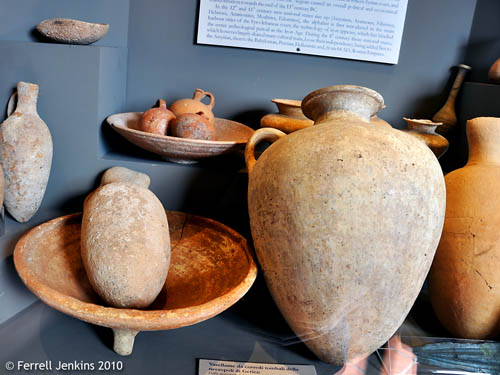
The term vessel (Greek, skeuos) is used of literal vessels made of clay, gold, silver, or wood. It is also used by analogy of individuals as a vessel. I have chosen two photos to illustrate vessels of different value. The first shows vessels from Middle Bronze II Jericho made of clay. Vessels of this type were used throughout Bible times.

Middle Bronze II pottery from Jericho. Vatican Museum. Photo by Ferrell Jenkins.

Middle Bronze II pottery from Jericho. Vatican Museum. Photo by Ferrell Jenkins.

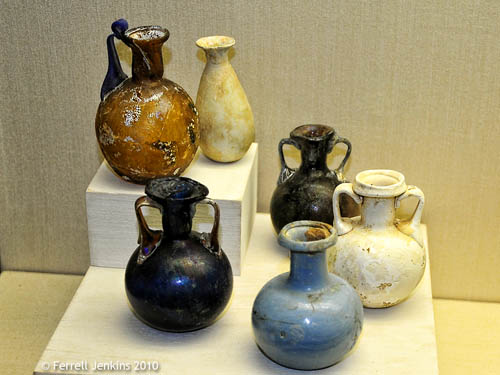
The next photo shows several pieces of “mold-blown perfume vessels decorated with stylized motifs” on display at the Eretz Israel Museum, Tel Aviv, Israel. These vessels are obviously more delicate and require more care than the ordinary clay vessels. For our time we might compare Melmac (if you are too young  to know, look it up!) and fine china.

Mold-blown perfume vessels. Erezt Israel Museum. Photo by Ferrell Jenkins.

Mold-blown perfume vessels. Erezt Israel Museum. Photo by Ferrell Jenkins.

Paul says to Timothy, and to us, “be a vessel for honorable use, set apart as holy, useful to the master of the house.”

Peter uses a similar analogy in speaking of the husband’s responsibility to his wife.

Likewise, husbands, live with your wives in an understanding way, showing honor to the woman as the weaker vessel, since they are heirs with you of the grace of life, so that your prayers may not be hindered. (1 Peter 3:7 ESV)

Another jumping off place — the pinnacle of the temple

A couple of days ago we wrote about the pinnacle of the temple (Mark 11:11; Luke 4:9). We followed the common suggestion that the reference was to the southeast corner of the temple mount precinct.

We mentioned that the late Benjamin Mazar, The Mountain of the Lord (page 149), shows a photo of the southeast corner of the wall with the comment that this “is known as the ‘pinnacle of the Temple’ (Mark 11:11; Luke 4:9).”

Leen Ritmeyer left us a comment to say that “Mazar actually had a different idea,” and called attention to his own post at ritmeyer.com.

Dr. Ritmeyer, author of The Quest: Revealing the Temple Mount in Jerusalem, provided some insight into the subject that is helpful and appreciated. He says,

Although this statement does appear in the book, I remember discussing this problem with him and he said that he actually saw the  southwest corner of the Temple Mount as a more likely candidate for the pinnacle of the Temple. One needs to determine what was the most important element in the temptation of Jesus to throw himself down from the pinnacle. Was it the height of the corner above what lay below or did the temptation lie in impressing as many people as possible with that jump?

As the southwest corner was a busy junction between the major north-south street running through Jerusalem and the Plaza in front of the Southern Wall of the Temple Mount, there would have been many more people to impress here than on the much quieter southeast corner.

It is in a setting such as this that we can visualise the dramatic scene that would have taken place had not Jesus challenged the temptation with the power of God’s Word.

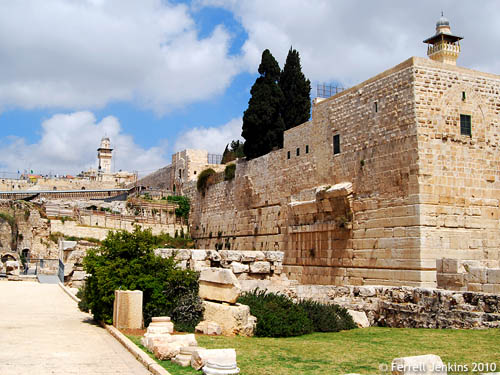
The Temple Mount Southwest Corner. Photo by Ferrell Jenkins.
The Southwest Corner of the Temple Mount. Photo by Ferrell Jenkins.

The western side of the Temple Mount enclosure ran along the Tyrophean Valley from north to south. A few years ago archaeologists found the first century street level at the southwest corner. The stones you see protruding from the wall are known as “Robinson’s Arch”, named for 19th century explorer Edward Robinson. When I first visited Jerusalem in 1967 it was commonly thought that the arch was the beginning of a bridge across the Tyrophean Valley, similar to Wilson’s Arch which is north of the Western Wall plaza. Now we know that the arch was the beginning of a winding staircase that allowed access to the Royal Stoa on the temple platform. (You will see a nice drawing of this staircase in Ritmeyer’s post.)

In my original post I said, “In a post to follow I will mention another view.” The other view I had in mind was the southwest corner.

Richard M. Mackowski, Jerusalem City of Jesus, says this corner “may be identified with the biblical Pinnacle of the Temple” (page 122). This is the comment I intended to use in today’s post. I am delighted that Dr. Ritmeyer calls attention to the discussion he had with Benjamin Mazar. We expect scholars to change their minds as they gain new information. It is also possible that an editor added the note in the book.

My bottom line is that we do not know for certain where the pinnacle of the temple is located. Either of these views suggest a good possibility.

The pinnacle of the temple

A friend asks about the pinnacle of the temple.

Can you tell me where to find a diagram that shows the “pinnacle of the temple?” It looks as if the consensus is that it was Solomon’s porch. Anyone jumping off would land in the Kidron Valley.

In my reading the most common view is that the southeast corner of the Temple Mount is the place mentioned in Mark and Luke as  the pinnacle of the temple.

William Barclay says,

In the third temptation Jesus in imagination saw himself on the pinnacle of the Temple where Solomon’s Porch and the Royal Porch met. (The Gospel of Luke, in The Daily Study Bible Series, 44)

Benjamin Mazar, The Mountain of the Lord, shows a photo of the southeast corner of the wall with the comment that this “is known as the ‘pinnacle of the Temple’ (Mark 11:11; Luke 4:9),” page 149.

William Hendriksen says,

The present temptation, then, takes place in Jerusalem, to which the devil has led Jesus. Satan has set the Savior on the very pinnacle (literally wing) of the outer wall of the entire temple complex. The exact spot is not given. It may have been the roof-edge of Herod’s royal portico, overhanging the Kedron Valley, and looking down some four hundred fifty feet, a “dizzy height,” as Josephus points out (Antiq. XV.412). This spot was located southeast of the temple court, perhaps at or near the place from which, according to tradition, James, the Lord’s brother, was hurled down. See the very interesting account in Eusebius, EcclHist;, II.xxiii. ( New Testament Commentary : Exposition of the Gospel According to Luke, 237)

Here is the comment by Josephus,

… and this cloister deserves to be mentioned better than any other under the sun; for while the valley was very deep, and its bottom could not be seen, if you looked from above into the depth, this further vastly high elevation of the cloister stood upon that height, insomuch, that if anyone looked down from the top of the battlements, or down both those heights, he would be giddy, while his sight could not reach to such an immense depth. (Ant. 15:412)

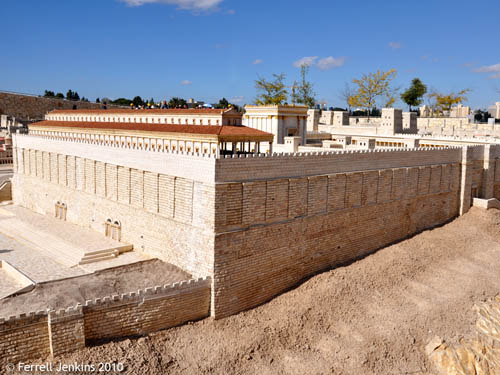
The photo below shows the southeast corner of the temple enclosure built by Herod the Great in the Second Temple model now displayed on the grounds of the Israel Museum.

Second Temple Model, Jerusalem. Photo by Ferrell Jenkins.

Second Temple Model view from the southeast. Photo by Ferrell Jenkins.

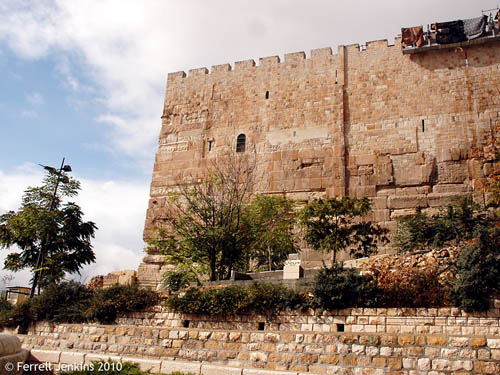
In the photo below we see the southeast corner from the east. The stone work includes a conglomerate ranging from later Moslem (at the top) to Herodian (at the bottom). At the present time one certainly would not fall into the Kidron Valley if he jumped from the top of the wall. I do not know what it might have been in the time of Jesus. I think a jump from the present wall to the land below would be deadly enough.

Southeast corner of Temple Mount enclosure. Photo by Ferrell Jenkins.

Southeast corner of Temple Mount enclosure. Photo by Ferrell Jenkins.

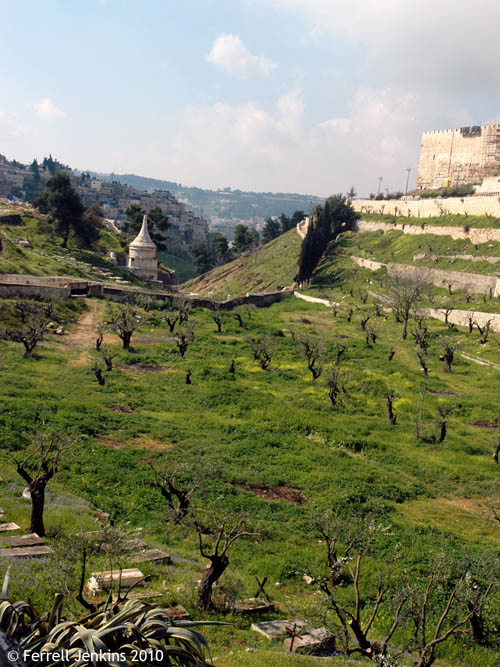
Here is a view of the Kidron Valley looking south. The “pinnacle of the temple” is visible in the upper right of the photo. The valley drops off rapidly near the point where you see the tomb on the left (Absalom’s Pillar).

Kidron Valley looking South. Photo by Ferrell Jenkins.

Kidron Valley looking South. Note wall in upper right. Photo by Ferrell Jenkins.

In a post to follow I will mention another view.

My friend asked where to find a diagram of the pinnacle of the temple. One might check the Image Library at Ritmeyer Archaeological Design here.

The photos above might be all one needs to illustrate the point. I have posted these in sizes large enough for use in teaching presentations.

Elaborate hairstyles in New Testament times

The apostle Peter wrote much, by comparison to the size of his first epistle, about the Christian and submission. I wish to call attention to something he said about the relation of wives to their husbands. Notice the reading in four English versions.

Your beauty should not consist of outward things like elaborate hairstyles and the wearing of gold ornaments or fine clothes; (1 Peter 3:3 CSB)

Do not let your adorning be external–the braiding of hair and the putting on of gold jewelry, or the clothing you wear– (1 Peter 3:3 ESV)

Let your beauty not be external– the braiding of hair and wearing of gold jewelry or fine clothes– (1 Peter 3:3 NET)

Your beauty should not come from outward adornment, such as braided hair and the wearing of gold jewelry and fine clothes. (1 Peter 3:3 NIV)

Years ago I was impressed with the comments by William Barclay about the elaborate dressing habits of the upper class women of the Greco-Roman world.

In the world of the Greeks and the Romans it is interesting to collect the references to personal adornments. There were as many ways of dressing the hair as there were bees in Hybca. Hair was waved and dyed, sometimes black, more often auburn. Wigs were worn, especially blonde wigs, which are found even in the Christian catacombs; and hair to manufacture them was imported from Germany, and even from as far away as India. Hairbands, pins and combs were made of ivory, and boxwood, and tortoiseshell; and sometimes of gold, studded with gems. (Barclay, Daily Study Bible Series: The Letters of James and Peter)

He gives other illustrations of the expensive clothing and jewelry of some of the women of the Imperial household. He says,

Christianity came into a world of luxury and decadence combined.

In face of all this Peter pleads for the graces which adorn the heart, which are precious in the sight of God. These were the jewels which adorned the holy women of old. Isaiah had called Sara the mother of God’s faithful people (Isaiah 51:2); and if Christian wives are adorned with the same graces of modesty, humility and chastity, they too will be her daughters and will be within the family of the faithful people of God.

Kistemaker calls attention to a comment by J.N.D. Kelly,

The elaboration in hair-styles, make-up, dress and personal jewelery in the [first] and [second] cent[urie]s is eloquently attested by the literature and art of the period.

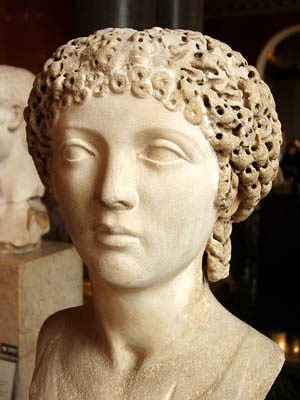
With that in mind I decided to show a few examples of statuary of some of the women of the royal households. The first is a woman from the time of Nero (A.D. 54-68). Peter’s letters were written during that period.

Woman from the time of Nero. The Louvre. Photo by Ferrell Jenkins.

Woman from the time of Nero. The Louvre. Photo by Ferrell Jenkins.

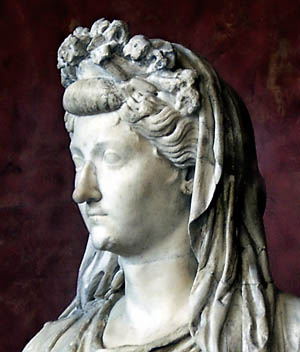
The next example is of Livia, the wife of Augustus and the mother of Tiberius.

Livia, wife of Augustus, mother of Tiberius. The Louvre. Photo by Ferrell Jenkins.

Livia, wife of Augustus, mother of Tiberius. The Louvre. Photo by Ferrell Jenkins.

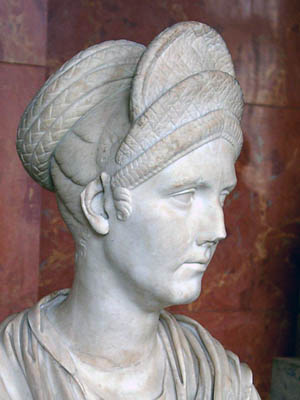
And finally, here is a bust of a neice of Trajan (A.D. 98-117).

Trajan's neice. The Louvre. Photo by Ferrell Jenkins.

Trajan's neice. The Louvre. Photo by Ferrell Jenkins.

Can you imagine the women of that time watching the TV award shows or reading the latest glamor magazines and not wanting to have their hair fixed the same way?

There is a lesson here for everyone, both female and male, who seeks to imitate Christ.

More about the first preaching on Pentecost

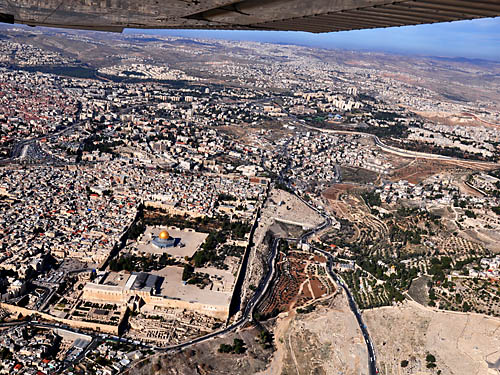
In this aerial view of Jerusalem you can see the Temple Mount enclosure and most of the Old City of Jerusalem. The Kidron Valley and the western slope of the Mount of Olives is visible on the right of the photo.

Aerial view of Jerusalem looking NE. Photo by Ferrell Jenkins.

Aerial view of Jerusalem looking NE. Photo by Ferrell Jenkins.

The photo below is a cropped portion of the image with emphasis on the Temple Mount.

The Temple Mount enclosure from the south. Photo by Ferrell Jenkins.

A closer view of the Temple Mount enclosure from the south. Photo by Ferrell Jenkins.

Herod the Great began to rebuild the existing postexilic temple on a grander scale about 20 B.C. Work had been going on for 46 years in the early days of the ministry of Jesus.

Then the Jewish leaders said to him, “This temple has been under construction for forty-six years, and are you going to raise it up in three days?” (John 2:20 NET)

Where did Peter preach on Pentecost?

A questions comes from a young friend who has traveled to Israel with me, and who is preparing a sermon related to Peter’s sermon on Pentecost (Acts 2). He asks,

Where do you think that Peter spoke from on Pentecost? I ask because I plan on using pictures and visuals in PowerPoint and I want to make sure I’m showing pictures of the right places. From my research, it seems most likely that Peter would have either spoken from the southern steps leading up to the Temple Mount (the double gate) or from the actual Temple Mount. I plan to show just how large the area was, and why there would have been so many people at the Temple that day and at that time (9:00 am).

I have gathered a few comments that express some of my thoughts on this matter.

Some scholars begin with the “one place” where the disciples were gathered (Acts 2:1). It is said to be a “house” (Greek, oikos, Acts 2:2). Kistemaker indicates the place was a house and not in the precincts of the temple. He says we can not be certain, but assumes it was a place near the temple.

Where were the believers? Luke tersely writes that they were “in one place.” If we think of the upper room (1:13), we question whether this room could accommodate a group of 120. Luke, however, indicates that they were sitting in a house (v. 2) and not in the precincts of the temple.3 We admit that we are unable to achieve certainty, but we presume that the meeting place was near the temple, where the apostles stayed continually praising God (compare Luke 24:53). — New Testament Commentary: Exposition of the Acts of the Aposltes, 76.

Longnecker discusses references where the term house is used of the temple. He says,

… in the temple precincts they would have had the best opportunity of addressing a large crowd.

His conclusion is,

Therefore it is likely that Luke meant us to picture that same upper room as the setting for the miracle of the Spirit’s coming and the place from where the disciples first went out to proclaim the gospel.

The view that the preaching of Acts 2 took places in the house (upper room) does not provide suitable explanation for the larger group suggested in the text. About three thousand persons accepted the gospel and were baptized on that day (Acts 2:41). There were obviously many who did not obey.

Acts 2 begins in a house, but closes in the temple (Acts 2:46). Marshall expresses my thoughts.

We must assume that at some point the disciples moved outside from the upper room and came in contact with the crowds assembled in Jerusalem for the feast; dwelling need not necessarily imply permanent residence, although many Jews did return to Jerusalem from the Dispersion to end their days there. (Acts: An Introduction and Commentary, Tyndale New Testament Commentaries)

We should note that the term for temple in Acts 2 is hieros. This is the term used of the “temple courts” (NET) or the “temple complex” (CSB).
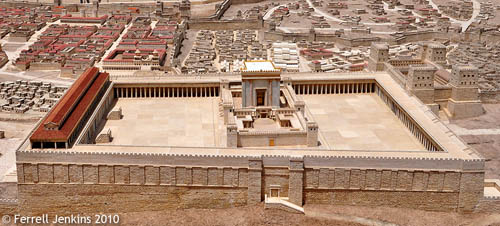
Second Temple model at the Israel Museum. Photo by Ferrell Jenkins.

Second Temple model at the Israel Museum. Photo by Ferrell Jenkins.

The temple precinct or complex is large. I was in Jerusalem one year at the close of the Moslem Ramadan when it was reported that more than 100,000 persons were present in the area. This would have provided adequate space for the activities of Acts 2.

The LORD prophesied through Isaiah about the events of the Pentecost of Acts 2.

And many peoples will come and say, “Come, let us go up to the mountain of the LORD, To the house of the God of Jacob; That He may teach us concerning His ways And that we may walk in His paths.” For the law will go forth from Zion And the word of the LORD from Jerusalem. (Isaiah 2:3 NAU)

It is true that the term Zion was sometimes applied to the entire city of Jerusalem, but it frequently seems to have a more specific reference to the temple area.

The disciples continued to go up to the temple at the hour of prayer (Acts 3:1). Their number soon grew to five thousand men and they met in Solomon’s Portico, thought to be on the east side of the temple platform (Acts 4:4; 5:12).

Where did Peter preach? I can’t be absolutely certain, but I opt for the temple complex. A copy of the photo suitable for presentations is available by clicking on the image.

Post A.D. 70 Roman bathhouse found in Jerusalem

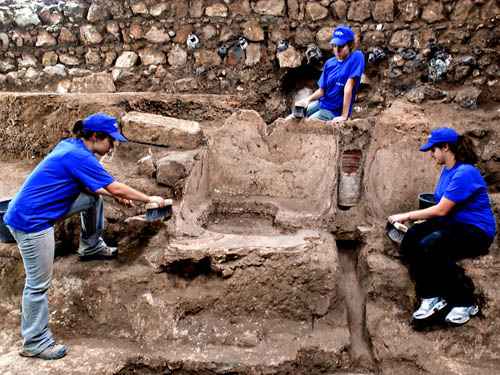
The Israel Antiquities Authority released a report today about the discover of a Roman period (Post A.D. 70) bath was found in the Jewish Quarter of the Old City of Jerusalem.

Three excavators working on the Roman bathhouse.

The Roman bathhouse. Photo: Assaf Peretz, courtesy of the Israel Antiquities Authority.

A 1,800 year old bathing pool that was probably part of a bathhouse used by the Tenth Legion – the Roman soldiers who destroyed the Temple – was exposed in excavations the Israel Antiquities Authority is conducting prior to the construction of a men’s ritual bath (miqve) by the Jerusalem Municipality and the Moriah Company.

The discovery sheds light on the scope of Aelia Capitolina, the city that was founded on the Second Temple period ruins of Jerusalem and that defined the character of ancient Jerusalem as we know it today….

According to Dr. Ofer Sion, excavation director on behalf of the Israel Antiquities Authority, “We were surprised to discover an ancient bathhouse structure right below the spot where a miqve is to be built. During the excavation we uncovered a number of plastered bathtubs in the side of the pool. Incorporated in the side of the pool is a pipe used to fill it with water and on the floor of the pool is a white industrial mosaic pavement. The bathhouse tiles, which are stamped with the symbols of the Tenth Legion “Fretensis” – LEG X FR, were found in situ and it seems that they were used to cover a rock-hewn water channel located at the bottom of the pool. The hundreds of terra cotta roof tiles that were found on the floors of the pool indicate it was a covered structure. The mark of the soldiers of the Tenth Legion, in the form of the stamped impressions on the roof tiles and the in situ mud bricks, bears witness to the fact that they were the builders of the structure. It seems that the bathhouse was used by these soldiers who were garrisoned there after suppressing the Bar Kokhba uprising in 135 CE, when the pagan city Aelia Capitolina was established. We know that the Tenth Legion’s camp was situated within the limits of what is today the Old City, probably in the region of the Armenian Quarter. This assumption is reinforced by the discovery of the bathhouse in the nearby Jewish Quarter which shows that the multitude of soldiers was spread out and that they were also active outside the camp, in other parts of the Old City”.

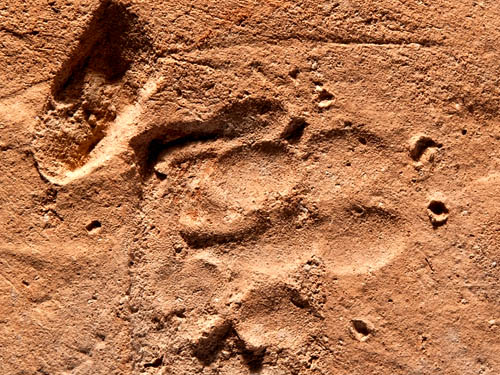
Dr. Sion adds, “Another interesting discovery that caused excitement during the excavation is the paw print of a dog that probably belonged to one of the soldiers. The paw print was impressed on the symbol of the legion on one of the roof tiles and it could have happened accidentally or have been intended as a joke”.

Read the full report here.

Dog paw found in excavation of Roman bathhouse in Jerusalem.

Dog paw found in the Roman bathhouse in the Jewish Quarter of Jerusalem.Photo: Assaf Peretz, courtesy of the Israel Antiquities Authority.

I could not help but think of  the situation poor Lazarus found himself in at the gate of the rich man:

He longed to be filled with what fell from the rich man’s table, but instead the dogs would come and lick his sores. (Luke 16:21 CSB)

HT: Bible Places Blog

Half a millionaire!

Compared with many websites and blogs, reaching the 500,000 hits level, as we did a few minutes ago, is not much. However, for a blog by an obscure writer dealing with the narrow topic of the Bible lands this might be impressive.

During our first month online (May, 2007) we averaged about 81 hits a day. The blog was intended to provide an opportunity for friends of those traveling with me on a tour of Anatolian Turkey and the area of Paul’s first journey to keep in touch. I think there was no thought of continuing the blog on a regular basis.

When we discovered that there was continuing interest in the photographs and bits of information we provided, we continued to write. The growth of readership was gradual. This month we are averaging about 885 hits a day. At the annual professional meetings of the NEAS, ETS, and SBL several people who saw my name badge mentioned reading the blog.

We always have in mind those who preach and teach the Bible as we prepare our material.

Thank you for your interest in this material and for your kind words of encouragement from time to time. I must confess that some days I give thought to discontinuing the blog. Except for the evidence that some of the readers are finding this material helpful I probably would.

I am grateful to others who have called attention to my blog through their links and honorable mentions. Every time Todd Bolen mentions my posts at Bible Places Blog I note an uptick in hits. I continue to be thankful for WordPress and the platform provided to anyone who wishes to post their thoughts/materials on the Internet.

Just had a thought. What if I had a dollar for each hit? It was just a thought.

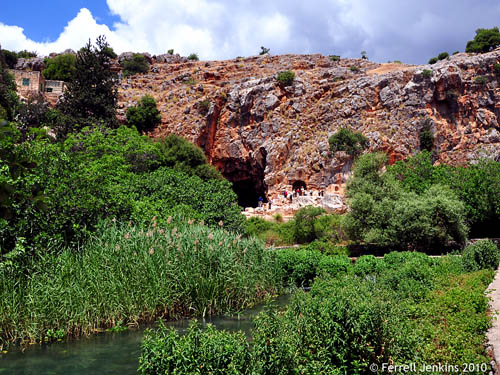
For this special occasion I wanted to share a nice photo of the site of Paneas /Banias/Caesarea Philippi. This photo shows the site of the Pan shrine at the foot of the vast rock which is part of the the foothills of Mount Hermon. A spring flows from beneath the rock to form the Banias River which in turn joins other branches to form the Jordan River. Click on the photo to get an image suitable for use in sermon and class presentation.

The site of Paneas was Caesarea Philippi in the time of Jesus. Photo by Ferrell Jenkins.

The site of Paneas was Caesarea Philippi in the time of Jesus. Photo by Ferrell Jenkins.

Here is the Bible text that goes with the photo.

13 Now when Jesus came into the district of Caesarea Philippi, He was asking His disciples, “Who do people say that the Son of Man is?”
14 And they said, “Some say John the Baptist; and others, Elijah; but still others, Jeremiah, or one of the prophets.”
15 He said to them, “But who do you say that I am?”
16 Simon Peter answered, “You are the Christ, the Son of the living God.”
17 And Jesus said to him, “Blessed are you, Simon Barjona, because flesh and blood did not reveal this to you, but My Father who is in heaven.
18 “I also say to you that you are Peter, and upon this rock I will build My church; and the gates of Hades will not overpower it.
19 “I will give you the keys of the kingdom of heaven; and whatever you bind on earth shall have been bound in heaven, and whatever you loose on earth shall have been loosed in heaven.” (Matthew 16:13-19 NAU)

Attending the Near East Archaeological Society

For the past few days I have been attending the annual meeting of the Near East Archaeological Society and the Evangelical Theological Society. NEAS is a small organization which meets in association with the ETS each year. This gives one the opportunity to attend meetings of either society. ETS has grown tremendously over the years that I have attended — first about 1976, I think. This year more than 2600 persons registered for the meeting. Even though I no longer teach, I like to attend these meetings in order to keep abreast of recent scholarship in areas in which I have special interest.

Among the lectures I heard at NEAS are the following:

Douglas Petrovich (University of Toronto) presented an impressive lecture on “More signs of societal upheaval in Egypt during the days of Joseph.”

Randall Price (Liberty University) was scheduled to make a presentation on Messiah in the Temple: A New 3-D Digital Computer Model of the Second Temple based on historical and archaeological data,” but his co-presenter was not able to make the trip from Germany. Dr. Price gave a presentation in refutation of the recent claims of a Chinese group who claimed they had found Noah’s ark on Mount Ararat.

Mark Wilson (Asia Minor Research Center) and Nadin Burkhardt (University of Frankfurt) spoke about the new excavation of the Priene synagogue (in Western Turkey).

Steven Ortiz (Southwestern Baptist Seminary) spoke about the most recent excavations at Gezer. Dr. Ortiz is one of the directors of the dig where much evidence from the 9th and 10th century B.C. is coming to light.

Eric Mitchell (Southwestern Seminary) told about the landscape archaeology associated with the current excavations at Gezer.

Bryant G. Wood (Associates for Biblical Research) presented the finds from the 2009 and 2010 seasons at Khirbet el-Maqatir. Wood thinks that this site is an excellent candidate to be identified with biblical Ai, rather than the generally accepted site at Et-Tell. Wood is director of this dig in the Palestinian West Bank.

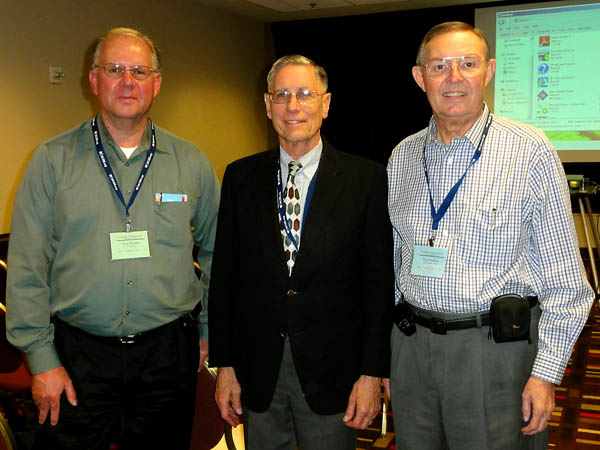
I asked Michael Luddeni, photographer for Bible and Spade and several excavation projects, to make a photo of Leon Mauldin and me with Dr. Bryant Wood.

Leon Mauldin, Dr. Bryant Wood, Ferrell Jenkins at NEAS annual meeting.

Leon Mauldin, Dr. Bryant Wood, Ferrell Jenkins at NEAS annual meeting.

Steven Collins (Trinity Southwestern University) made an excellent presentation on the rise and ruin of a bronze age city-state at Tall el-Hammam, Jordan. Collins is director of this dig.

James H. Charlesworth (Princeton Theological Seminary) was an invited speaker who gave a lecture on two Herodian pools north and south of the Jerusalem temple as they relate to the Gospel of John (chs. 5 and 9). These, of course, were the pools of Bethesda and Siloam. He argued that both pools were mikvaoths (ritual pools) at the time.

There were other good lectures at NEAS. Some of these scholars make similar presentation at the ASOR or SBL meetings.

Among the lectures I heard at ETS, I found these two to be extremely good:

British scholar N. T. Wright (St. Andrews University) spoke on “Justification yesterday, today and tomorrow.”

Eugene H. Merrill (Dallas Theological Seminary) gave the presidential address at the banquet on “Old Testament Scholarship and the man on the street: whence and whither?”

When I was still teaching I attended lectures dealing primarily with the subjects I was actively teaching. Now I attend anything that strikes my fancy. Because I frequently travel to the Middle East I enjoy keeping up with the archaeological excavations in those areas.

Ritmeyer’s Image Library now online

Dr. Leen Ritmeyer is well know for his archaeological drawings of the biblical era buildings, especially the temple. He now has much of his material online for immediate download. The Image Library is described this way:

The Image Library of Ritmeyer Archaeological Design contains authoritative reconstruction drawings and models which you will not find on any other website. The photos of ancient sites in the lands of the Bible have also been taken through the informed lens of an archaeological architect. A treasure-trove for teachers, pastors, lecturers and picture editors, it is the result of years of experience digging and researching in Israel and traveling in the surrounding countries.

The Image Library is arranged in different categories and is fully searchable. The different categories are designed to help you find the picture you are looking for easily. All preview illustrations are watermarked, but these won’t appear on the downloads.

For ease of use, each image comes with a descriptive note and, where applicable, full Scripture references. With the explosion of information coming from excavations, we hope that this will become an ever-expanding resource vital for all who wish to incorporate both beauty and authenticity into their portrayal of the Bible background.

Go here for additional information, and to browse the collection. The architectural drawings are $5 each, and the photographs are $3 each.

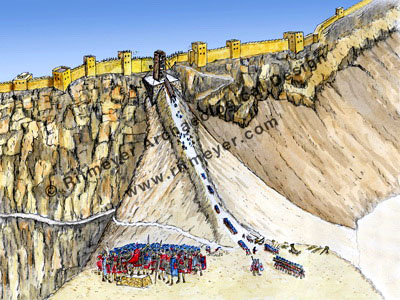
Here is a small sample of one of the drawings. This one shows the siege ramp built by the Romans at Masada in A.D. 72.

Roman siege ramp at Masada. Ritmeyer Image Library.

Roman siege ramp at Masada. Ritmeyer Image Library.

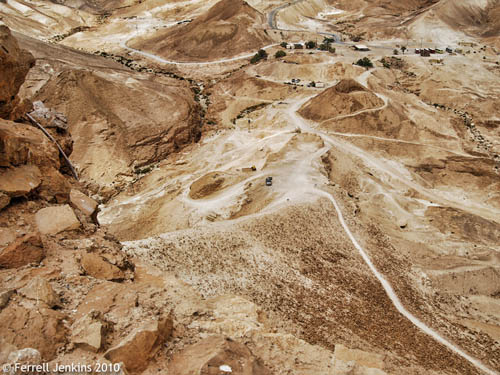
Here is one of my photos showing the siege ramp from above. The wall of Masada is visible in the left of the image.

The siege ramp at Masada. Photo by Ferrell Jenkins.
The Roman siege ramp at Masada from above. Photo by Ferrell Jenkins.

Certainly there is no excuse for presenting a dull, image deprived Bible class lesson or sermon.