Category Archives: New Testament

“You offspring of vipers…”

When the Pharisees and Sadducees came to John the Baptist for baptism, John said,

”You offspring of vipers! Who warned you to flee from the coming wrath? (Matthew 3:7 NET; cf. Luke 3:7)

Jesus used the same language of the Scribes and Pharisees.

You snakes, you offspring of vipers! How will you escape being condemned to hell? (Matthew 23:33 NET; cf. 12:34)

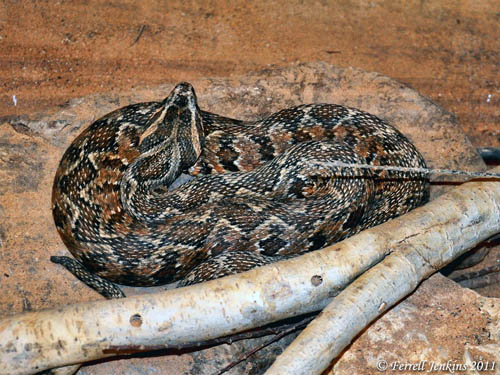
The photo below shows the Palestinian Viper (behind tough plastic!) at the the Hai Bar Animal and Nature Reserve, north of Eilat, Israel.

Palestinian Viper at the HaiBar Reserve near Eilat, Israel. Photo by Ferrell Jenkins.

Palestinian Viper at the HaiBar Reserve near Eilat, Israel. Photo by Ferrell Jenkins.

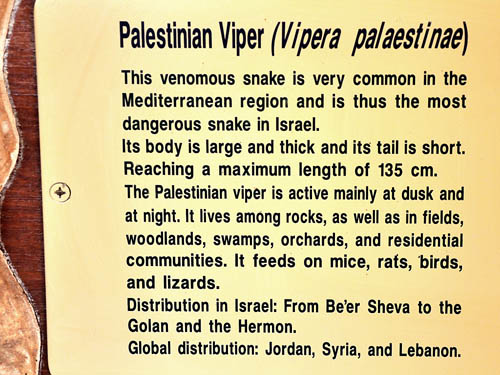
The sign at the Reserve gives some explanation about this poisonous viper.

Description of the Palestinian Viper at HaiBar Reserve.

A visit to Hai Bar is a wonderful experience. The kids will love it, too.

Lead books or lead balloons?

In the past 24 hours I have received a couple of Emails about the “new” “ancient” lead codices. The best photos I have seen are in the Mail Online here. The account from Yahoo News is here. Put a few words in Yahoo or Google and you will have numerous links.

First Impressions. My first impression, based on the limited information, is that this may be another of those spectacular claims with no substance. I was busy with appointments earlier today and was delighted when I had time to check the blogs to see that Todd Bolen had written a good summary of information at the Bible Places Blog here. There is no reason for me to try to rehash this material. I urge you to take a look at Todd’s summary. He says, “Personally I am inclined to believe that this find is genuine.” My first inclination leans the other way. I know it is not much of a argument, but this report lacks the “ring of truth.” I remember that F. F. Bruce said that second thoughts are best. With more information my thoughts may change. Let’s be patient.

The Sealed Book in Revelation. There is no reason at this point to  link these lead books with the sealed book of Revelation 5-7. Revelation is an apocalyptic book of symbols. Other ancient sealed books have been found in modern times. Examples: some of the Elephantine papyri, a papyrus document from Wadi Daliyeh near Jericho had seven seals still in place (Jenkins, Studies in the Book of Revelation, 18).

Jim Davila has posted numerous notes about the lead codices at Paleojudaica over the past few weeks. Follow all of Todd Bolen’s links and you will know about as much as can be known for the moment.

Libya and the Bible — more than you think

UNESCO: respect historical sites in Libya

According to an article in M & C here, UNESCO has called for Libyan and allied forces to protect six specified historical sites in Libya.

Libya’s sites on the World Heritage List include the archaeological site of Cyrene, which was established as a Roman province in 74 BC; and the site of Leptis Magna, which was founded in the first millennium BC.

Cyrene is located near Al Bayda in eastern Libya.

The Biblical Connection

When Jesus was being led to the place of crucifixion, Simon of Cyrene was compelled to bear his cross. He was the father of Alexander and Rufus, to people apparently known to Mark’s audience (Mark 15:21).

As they were going out, they found a man from Cyrene named Simon, whom they forced to carry his cross. (Matthew 27:32 NET)

The fifth station of the cross along the traditional Via Dolorosa in Jerusalem marks the spot where Simon took up the cross. Photos of the Catholic chapel at the spot may be viewed at Holy Land Photos here. Just search for Cyrene. Or check the photos at Bible Walks here.

  • Jews from the district of Libya around Cyrene were present in Jerusalem on Pentecost (Acts 2:10).
  • Some men from Cyprus and Cyrene were responsible for the first preaching to Gentiles at Syrian Antioch (Acts 11:20).
  • Lucius of Cyrene was one of the prophets or teachers at Antioch (Acts 13:1).

Galen Frysinger has a collection of older photos of Cyrene on his website here.

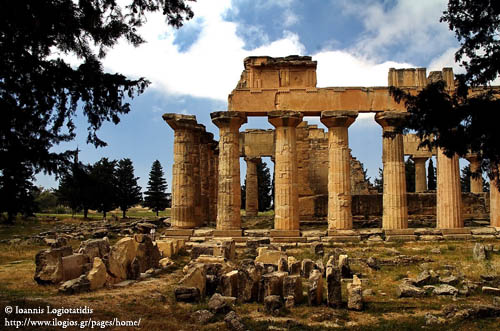
Ioannis Logiotatidis has some of the best photos I have found for Cyrene. He has kindly granted permission for me to share a couple of these with our readers. Both of are the Temple of Zeus. This temple was built originally in the 5th century B.C., but has been destroyed and rebuilt several times over the centuries.
Temple of Zeus at Cyrene, Libya. Photo by Ioannis Logiotatidis.

Temple of Zeus at Cyrene, Libya. Photo by Ioannis Logiotatidis.

Check out more of Ioannis’ newer artistic photographs at his web site here.
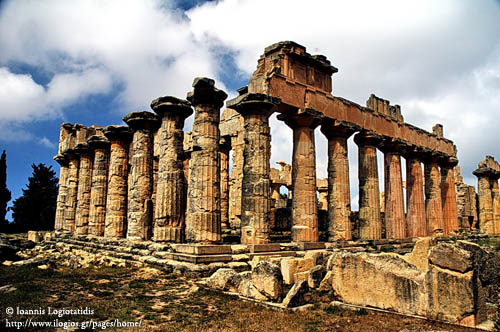
Temple of Zeus at Cyrene, Libya. Photo by Ioannis Logiotatidis.

Temple of Zeus at Cyrene, Libya. Photo by Ioannis Logiotatidis.

You may notice a strong resemblance between this temple and the Temple of Apollo at Corinth.

The Alexander (son of Simon) Ossuary

Sukenik and Avigad discovered an ossuary in 1941 bearing the inscription “Alexander (son) of Simon.”

Tom Powers, a guide in Israel, has written two articles about the ossuary for BAR. You may access them here. He concludes in the second article that this ossuary could be the ossuary of both Alexander and Simon.

Another article about ossuaries and Jesus contains photographs and a brief mention of the Alexander-Simon ossuary. Click here.

Paul’s Shipwreck on the Voyage to Rome

Libya is not mentioned, but the Syrtis is mentioned in the account of Paul’s voyage to Rome.

Running under the lee of a small island called Cauda, we managed with difficulty to secure the ship’s boat. After hoisting it up, they used supports to undergird the ship. Then, fearing that they would run aground on the Syrtis, they lowered the gear, and thus they were driven along. (Acts 27:16-17 ESV)

You will notice that the Syrtis Major and the Syrtis Minor are located on the Mediterranean coast of Libya. This was a dangerous place for a ship in a storm.

Gordon Franz recently posted an article asking “Why were the sailors afraid of the Syrtis Sands?” here.

In the map below you will note the location of Cyrene. Simon had a long trip to Jerusalem. Notice also the location of the Syrtis Major in relation to the suggested route of Paul’s ship. Click on the map for a clearer image. (I am still struggling to learn the Bible Mapper program and how to export maps.)
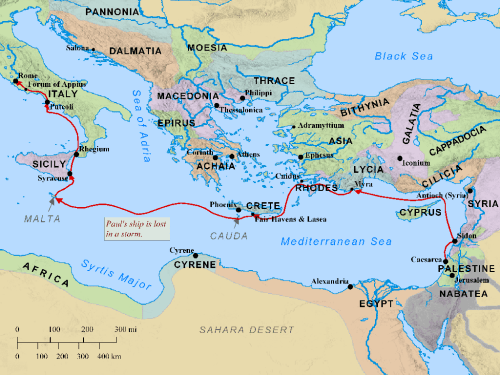
Paul's Voyage to Rome. Map by BibleMapper.

Paul's Voyage to Rome. Map by BibleMapper.
A grave matter

Ancient burial places create serious problems for archaeologists. Ultra-Orthodox Jews often create a scene at digs when they know or suspect that there may be Jewish tombs in the area.

The cemeteries of the Holy Land have become a ground for religious and political skirmishes. Leen Ritmeyer reported on fake Arab tombs near the Temple Mount here.

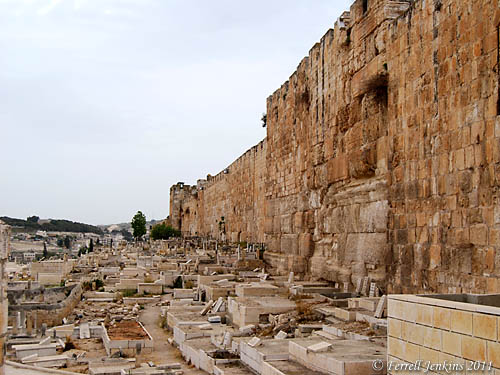
Muslim tombs have been on the eastern wall of the Old City for a long time. This photo was made looking south from outside the Lion’s Gate (or St. Stephens’ Gate). Perhaps every reader knows that this is across the Kidron Valley from the Mount of Olives which we mentioned in the previous post.

Muslim Cemetery along the East Wall of the Old City near Lion's Gate. Photo by Ferrell Jenkins.

Muslim Cemetery along the Eastern Wall of the Old City of Jerusalem near Lion's Gate. Photo by Ferrell Jenkins.

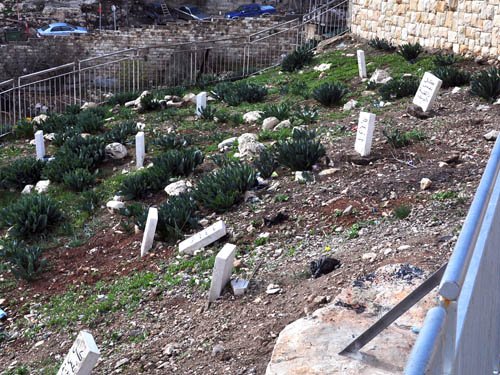
In early February I noticed a large number of new tombstones with Arabic inscriptions in a small plot above the Pool of Siloam. Suspicious, to say the least.

New Tombstones above the Pool of Siloam. Photo by Ferrell Jenkins.

New Tombstones above the Pool of Siloam. Photo by Ferrell Jenkins.

Later, if not sooner, all of these matters will become obvious.

“Do not marvel at this; for an hour is coming, in which all who are in the tombs will hear His voice, and will come forth; those who did the good deeds to a resurrection of life, those who committed the evil deeds to a resurrection of judgment. (John 5:28-29 NAU)

Banias — easternmost source of the River Jordan

The Nahr (River) Banias is the easternmost source of the River Jordan. The source of the Banias is located at a site we know as Caesarea Philippi in the New Testament. It is well known to those who study the ministry of Jesus (Matthew 16:13-19).

Banias is located on the eastern side of the Beka or Hula Valley.  The valley is called the Beka in Lebanon, and a little further south the Hula Valley. The elevation is about 1150 feet above sea level in the foothills of Mount Hermon.

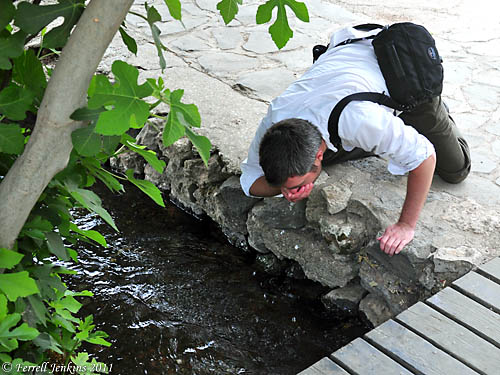
The photo below shows the place where the water emerges from the earth. Perhaps you are reminded of the text from the prophet Jeremiah:

for my people have committed two evils: they have forsaken me, the fountain of living waters, and hewed out cisterns for themselves, broken cisterns that can hold no water. (Jeremiah 2:13 ESV)

Getting a drink at the source. River Banias, Caesarea Philippi.

Getting a drink at the source. River Banias, Caesarea Philippi. Photo by Ferrell Jenkins.

Other posts about this site are listed below. Check them all.

Three other rivers we have recently mention, Flea River, the Senir, and the Dan, join with the Banias to form the River Jordan.

Speaking in North Georgia

The Mountain View Church of Christ, Cumming, Georgia, has invited me to speak on Bible History and Archaeology at the North Georgia Bible Forum in Cumming, Georgia, March 20-25. Stop by if you happen to be in the area. Full details are available here.

Races called off at Caesarea Maritima hippodrome

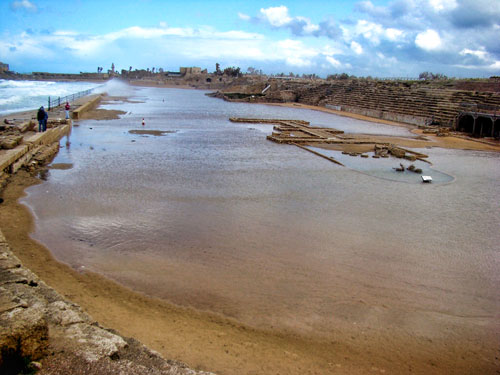
Friend Leon Mauldin is traveling in Israel for a few days. He reports “a mixture of wind, rain, and sunshine” today. He shared a nice photo of the hippodrome at Caesarea Maritima flooded. Note the heavy clouds and the water crashing in from the sea.

Caesarea Maritima Hippodrome standing in water. Photo by Leon Mauldin.

Caesarea Maritima Hippodrome standing in water. Photo by Leon Mauldin.

Our thanks to Leon for sharing this photo with out readers. You may follow the progress of his tour at Leon’s Message Board here.

We know that Israel needs the rain after several years of drought conditions. The archaeological park was closed due to storm damage in mid-December, 2010. See here.

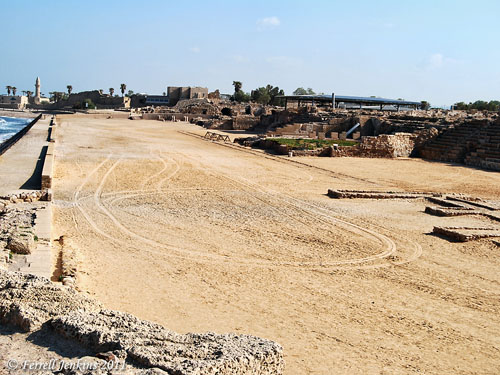
Here is a photo of the same area made during a dry period.

Caesarea Maritima Hippodrome. Photo by Ferrell Jenkins.

Caesarea Maritima Hippodrome Dry. Photo by Ferrell Jenkins.

Herod the Great built a hippodrome along the coast at Caesarea Maritima in 10 B.C. to celebrate the opening of the city. Read more here.

Peter preached to Cornelius at Caesarea (Acts 10,11).

Paul was imprisoned in the city for two years before departing for Rome (Acts 24:27; 27:1).

Camels in biblical times

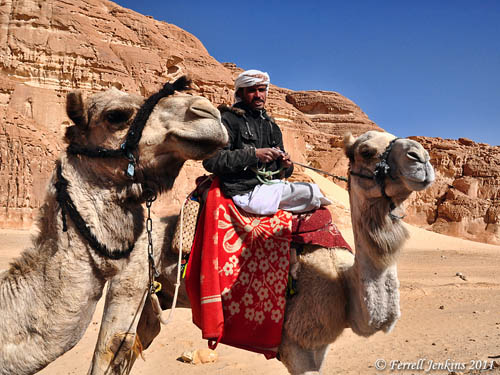
Camels are mentioned in the Bible from the days of Abraham (Genesis 12:16) to New Testament times (Mark 1:6). Recently while traveling in the eastern Sinai peninsula near the Gulf of Aqaba (Eilat) we saw a large number of camels with their riders.

Camels in the Eastern Sinai Peninsula. Photo by Ferrell Jenkins.

Camels in the Eastern Sinai Peninsula. Photo by Ferrell Jenkins.

When the Queen of Sheba visited Jerusalem to quiz Solomon she brought with her a large retinue, with camels carrying valuable gifts for Solomon.

Now when the queen of Sheba heard of the fame of Solomon, she came to Jerusalem to test Solomon with difficult questions. She had a very large retinue, with camels carrying spices and a large amount of gold and precious stones; and when she came to Solomon, she spoke with him about all that was on her heart. Solomon answered all her questions; nothing was hidden from Solomon which he did not explain to her. (2 Chronicles 9:1-2 NAU)

Mahanaim — where Jacob wrestled with an angel

The name Mahanaim is found 13 times in the Old Testament. The site is where Jacob and Laban met and made a covenant. Mahanaim seems to mean “two camps” (Genesis 32:2). This is where Jacob’s name was changed to Israel after he wrestled with a man (angel, Hosea 12:4). When morning came Israel crossed over Penuel (Genesis 32:31).

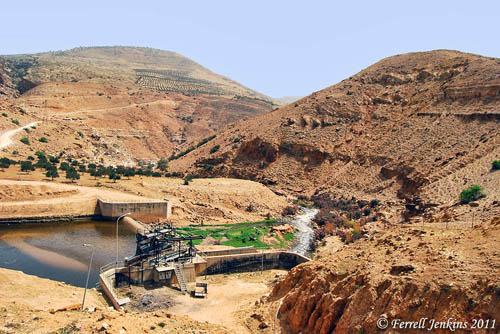
Two large tells face each other and the Jabbok River flows in an S-curve between them. The tells are now named Tall adh-Dhahab East and Tall adh-Dhahab West. These tells are located a few miles east of the Plains of the Jordan and Tell Deir Allah (likely the site of biblical Succoth). Some scholars identify Dhahab West as Mahanaim and Dhahab East as Penuel. Other scholars reverse the identifications.

When Transjordan was divided among the tribes, Mahanaim was located in the territory of Gad on the boundary with East Manasseh (Joshua 13:26, 30). It was one of the cities allotted to the Levites (Joshua 21:38; 1 Chronicles 6:80).

After the death of Saul, Abner made Ishbosheth, the son of Saul, king over all Israel from Mahanaim (2 Samuel 2:8, 12, 29).

When David fled from his rebellious son Absalom he fled across the Jordan to Mahanaim (2 Samuel 17:24, 27; cf. 2 Kings 2:8). Absalom met his death in a nearby forest.

A Gileadite by the name of Barzillai took care of King David while he stayed at Mahanaim (2 Samuel 19:32). The city became one of Solomon’s administrative centers (1 Kings 4:14).

Song 6:13 describes gazing upon the Shulammite girl to be like looking on “the dance of the two camps” or “dance of two companies” (CSB, JPS, NAU, NKJ). Other translations use the expression “the dance of Mahanaim” (ASV, NIV, NJPS, TNIV) or “dance of the Mahanaim” (NET).

Recent excavations at Dhahab West, conducted by a German team, have revealed what they believe to be part of a monumental building of Herod the Great. They think this was the Hellenistic and Roman site described by Josephus as Amathus.

Tall adh-Dhahab East (left) and Tall adh-Dhahab West (right). Photo by Ferrell Jenkins.

Tall adh-Dhahab East (left) and Tall adh-Dhahab West (right). These are thought to be the sites of Mahanaim and Penuel. Photo by Ferrell Jenkins.

Our photo shows both tells. (Tall adh-Dhahab East is on the left. Tall adh-Dhahab West is on the right.) There is a pumping station on the Jabbok to provide agricultural irrigation. The Jabbok continues in the valley separating the two hills and tells.

Click on the photo for an image suitable for use in teaching presentations.

Bauckham on the Gospels as Histories

Last Wednesday I went to the Reformed Theological Seminary near Orlando to hear a lecture by Prof. Richard Bauckham. Bauckham was the speaker for the annual Kistemaker Academic Lecture Series. His general topic was The Gospels as Histories: What sort of history are they? I suspect that he was reading chapters that will eventually be published in a new book.

I found Bauckham, Professor Emeritus at St. Andrews University, difficult to understand during the lecture because of the his accent, but I was able to keep up with the general thread of his argument.

If you would like a little taste of Bauckham’s argument about Jesus and the Eyewitnesses I suggest you watch this short video by StJohnsNottingham (other interesting videos also available).

I was delighted to pick up a copy of Jesus and the Eyewitnesses: The Gospels as Eyewitness Testimony at the bookstore and have it autographed by Prof. Bauckham.

Richard Bauckham signs a book. Photo by Ferrell Jenkins.

Richard Bauckham autographs a book. Photo by Ferrell Jenkins.

Order Jesus and the Eyewitnesses from Amazon.
Jesus and the Eyewitnesses: The Gospels As Eyewitness Testimony

Bauckham’s material speaks clearly to the common misconception that the “Church” compiled the Gospels decades, even centuries, after Jesus lived.