Category Archives: New Testament

Mary and Joseph went a day’s journey. Where did they stop?

After his presentation in the Temple, there is no record of Jesus returning to Jerusalem until he is 12 years of age.

Now his parents went to Jerusalem every year at the Feast of the Passover.  And when he was twelve years old, they went up according to custom.  (Luke 2:41-42 ESV)

When the Feast of the Passover ended, his parents began the return to Nazareth. We can easily imagine that a large caravan of people were traveling together on this trip that would take several days. Jesus stayed behind in Jerusalem spending time among the teachers, “listening to them and asking them questions.” Because Mary and Joseph had relatives and acquaintances in the caravan they assumed that Jesus was among them until the end of the first day.

Keener provides some background on caravan travel.

Caravans, which afforded protection from robbers, were common on pilgrimages for the feasts in Jerusalem. Traveling with a caravan, in which neighbors from their town would watch the community children together, Mary and Joseph might assume that the near-adult Jesus was with companions, especially if by now they had younger children to attend to. If we assume a pace of twenty miles per day (though perhaps slower, depending on transportation and the children), Nazareth would be a little over three days’ journey along the shortest route. (Keener, C. S., The IVP Bible background commentary : New Testament)

Where did Mary and Joseph stop at the end of that first day of travel? We can not be certain of the route taken from Jerusalem to Nazareth. Travel from Galilee to Jerusalem was often through Perea on the eastern side of the Jordan Valley. We later find Jesus traveling north along the central mountain range through Samaria (John 4).
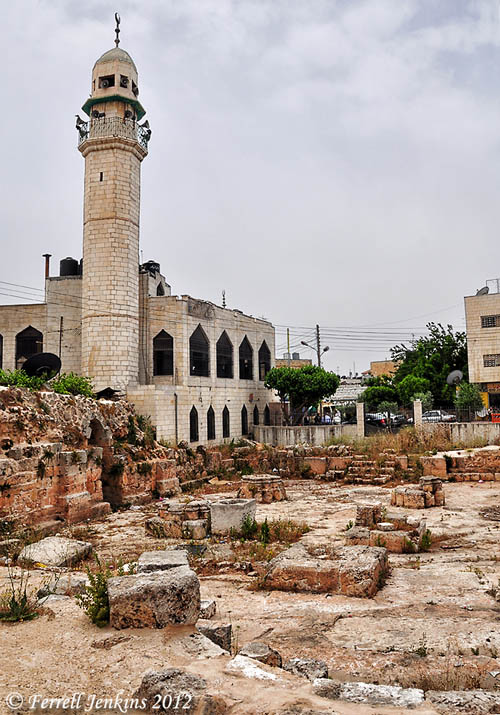
Ruins of medieval church beneath a Mosque in El Bireh. Photo by Ferrell Jenkins.

Ruins of medieval church beneath a Mosque in El Bireh. Photo by Ferrell Jenkins.

Tradition identifies the stop at El Bira. Tradition has it that the first day’s stop after leaving Jerusalem was at a place now known as El Bira (or Bireh) east of Ramallah. El Bira is an Arab town. There is a spring and ruins of a medieval church. The Hachette World Guides: The Middle East (1966) says that the tradition associating this event with El Bireh dates to the 16th century. Eugene Hoade says it is probable that this church was built in 1146 “in memory of” the event mentioned in Luke 2 (Guide to the Holy Land). The apse of the church is visible in the photo below. The Hachette World Guide says the building was destroyed in 1915 and the stones were used for building bridges along the mountain route.

This site is only about 8 miles north of Jerusalem, but with a large caravan including women and children it is possible that a short distance was covered the first day. It was necessary to stop where water and various food supplies were available (John 4:6-8; Luke 9:51-53).
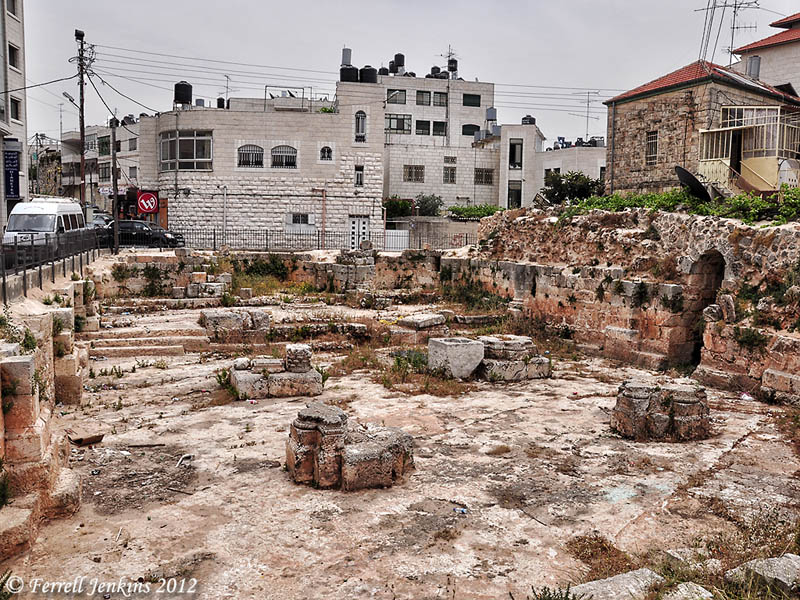
Ruins of the medieval church in El Bireh. Photo by Ferrell Jenkins.

Ruins of the medieval church in El Bireh. Photo by Ferrell Jenkins.

Is this Beeroth? Since the time of explorer Edward Robinson (1867), some scholars have identified El Bireh with the Old Testament Gibeonite city of Beeroth. The word Beeroth indicates the presence of a well. Biblical references include Joshua 9:17, 18:25, Ezra 2:25, and Nehemiah 7:29. Beeroth was considered part of the tribe of Benjamin (2 Samuel 4:2).

David Dorsey, after surveying the scholarship on the matter, says,

At present, therefore, the site of biblical Beeroth remains a matter of dispute. The most likely candidate would still seem to be the one originally proposed by Robinson, i.e., el-Bireh. (The Anchor Yale Bible Dictionary)
John wore a garment of camel’s hair

Now John wore a garment of camel’s hair and a leather belt around his waist, and his food was locusts and wild honey.  (Matthew 3:4 ESV)

Emmerson comments on the type of garment worn by John:

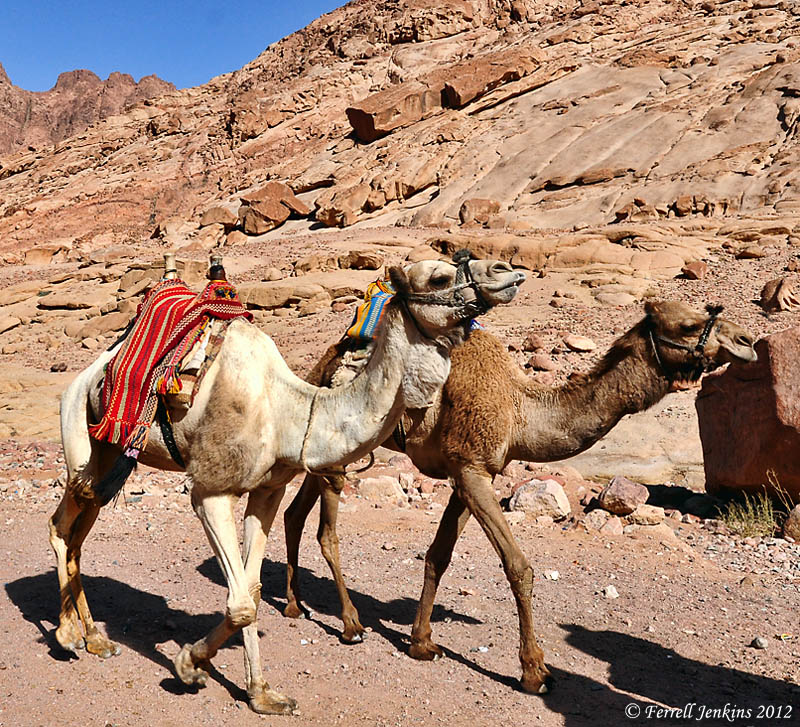
Hair from the back and hump of the camel was woven into a harsh material, and a softer cloth was produced from the finer hair taken from underneath the animal. The natural variations in the color of the hair could be woven into a pattern. (The International Standard Bible Encyclopedia Revised, 1:584).

Camels in the Sinai Peninsula. Photo by Ferrell Jenkins.

Camels in the Sinai Peninsula. Photo by Ferrell Jenkins.

John did not wear the soft clothing typical of those who dwell in royal palaces.

What then did you go out to see? A man dressed in soft clothing? Behold, those who are dressed in splendid clothing and live in luxury are in kings’ courts. (Luke 7:25 ESV)

Bible students immediately remember similarities between John and the prophet Elijah (2 Kings 1:8; cf. Luke 1:7).

John baptized in the river Jordan

John the Baptist proclaimed the coming Messiah in the Wilderness of Judea. The Gospel accounts point out that many people from Jerusalem and all Judea and the region about the Jordan came to be baptized. These were Jews who were being called to repent and confess their sins.

Then Jerusalem and all Judea and all the region about the Jordan were going out to him,  and they were baptized by him in the river Jordan, confessing their sins. (Matthew 3:5-6 ESV)

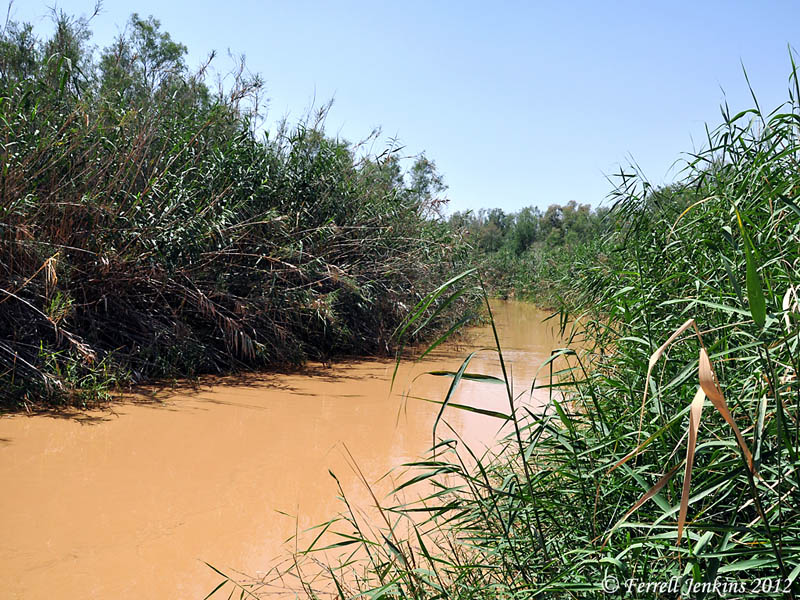
The photo shows a view of the River Jordan at the traditional site where John was baptizing. This photo was made in the spring of the year when the river shows the flow of mud as a result of the spring rains.

Jordan River (view south) at traditional site where John baptized. Photo: Ferrell Jenkins.

Jordan River (view south) where John baptized. Photo by Ferrell Jenkins.

Jesus was baptized by John, not because he was a sinner, but because it was part of God’s plan for him “to fulfill all righteousness.”

Then Jesus came from Galilee to the Jordan to John, to be baptized by him. John would have prevented him, saying, “I need to be baptized by you, and do you come to me?” But Jesus answered him, “Let it be so now, for thus it is fitting for us to fulfill all righteousness.” Then he consented. And when Jesus was baptized, immediately he went up from the water, and behold, the heavens were opened to him, and he saw the Spirit of God descending like a dove and coming to rest on him; and behold, a voice from heaven said, “This is my beloved Son, with whom I am well pleased.” (Matthew 3:13-17 ESV)

John was a voice in the wilderness

There may be some question about the location of the wilderness mentioned in Luke 3:2. The term wilderness (eremos) is described by BDAG as “an uninhabited region or locality, desert, grassland, wilderness (in contrast to cultivated and inhabited country).” The same term is translated deserts in Luke 1:80, where it seems to refer to an isolated area of Judah.

When John begins his ministry, it is clear that he was working in the wilderness between Jerusalem and the Jordan River/Dead Sea.

And he went into all the region around the Jordan, proclaiming a baptism of repentance for the forgiveness of sins.  As it is written in the book of the words of Isaiah the prophet, “The voice of one crying in the wilderness: ‘Prepare the way of the Lord, make his paths straight. (Luke 3:3-4 ESV)

Matthew’s account names the area of John’s preaching as “the wilderness of Judea” (Matthew 3:1).

This stretch of wilderness is well known as a region of rugged and desolate badlands. Our first photo shows a portion of the wilderness in bright sunlight on the way from Jerusalem to Jericho. The view is toward the west. Peter Walker describes the Judean Desert:

It is a place of austere beauty and an almost deafening silence; a place where human beings are acutely conscious of their frailty and utter dependence on water for brute survival. And yet in biblical times it was also a place where people went to find solitude and space, to hear the voice of God addressing them above the cacophony of other competing demands and voices. John the Baptist had begun his ministry here, ‘a voice of one calling in the desert’ (Isaiah 40:3).… (In the Steps of Jesus, Zondervan: 52)

Wilderness of Judea on way from Jerusalem to Jericho. Photo by Ferrell Jenkins.

Wilderness of Judea on way from Jerusalem to Jericho. Photo by Ferrell Jenkins.

One of the fascinating things about the wilderness is the constant change of the view, especially as clouds move over it from West to East

Wilderness of Judea. View toward east with rain clouds on mountain range. Photo by Ferrell Jenkins.

Wilderness of Judea. View west with clouds on the mountain range. Photo: F. Jenkins.

The road from Jerusalem to Jericho and the Jordan River was used even by pilgrims coming from Galilee for the various feast days in Jerusalem. Luke’s parable of the good Samaritan speaks of a man “going down from Jerusalem to Jericho” (Luke 10:30). Luke also records that Jesus traveled this way in the opposite direction (Luke 19). John records that Jesus traveled this way from Bethany beyond the Jordan to the Bethany near Jerusalem (John 11).

John was a man of history

In recent posts we have called attention to Luke’s account of the events surrounding the birth of John the Baptist. Some readers may treat Zacharias, Elizabeth, John, and even Jesus, as fictional. Luke deals with the characters and events as historical.

Notice especially how Luke deals with the beginning of the ministry of John.

Now in the fifteenth year of the reign of Tiberius Caesar, when Pontius Pilate was governor of Judea, and Herod was tetrarch of Galilee, and his brother Philip was tetrarch of the region of Ituraea and Trachonitis, and Lysanias was tetrarch of Abilene,  in the high priesthood of Annas and Caiaphas, the word of God came to John, the son of Zacharias, in the wilderness.  (Luke 3:1-2 NAU)

Luke treats John as a man of history by placing him at a specific place (“the district around the Jordan” – v. 3), and a specific time, in the reign of specific political and religious leaders.

  • In the 15th year of reign of Tiberius Caesar
  • Pontius Pilate was governor of Judea
  • Herod [Antipas] was tetrarch of Galilee
  • Herod Philip was tetrarch of the region of Ituraea and Trachonitis
  • Lysanias was tetrarch of Abilene
  • High priesthood of Annas & Caiaphas

In the absence of a calendar such as the one we use, one could hardly be more precise. All of these are historical characters. They are known in other written records, by coins bearing their image, by inscriptions, by statues, and one is know by his ossuary (burial bone box).

There is too much here for us to deal with each of these characters at this time. Let’s look at Pontius Pilate. Pilate is known in written records aside from the New Testament (more than 50 times), and Josephus (more than 20 times). Tacitus, the Roman historian, says that “…Christ, was put to death by the procurator Pontius Pilate…” (Annals XV.44.2).

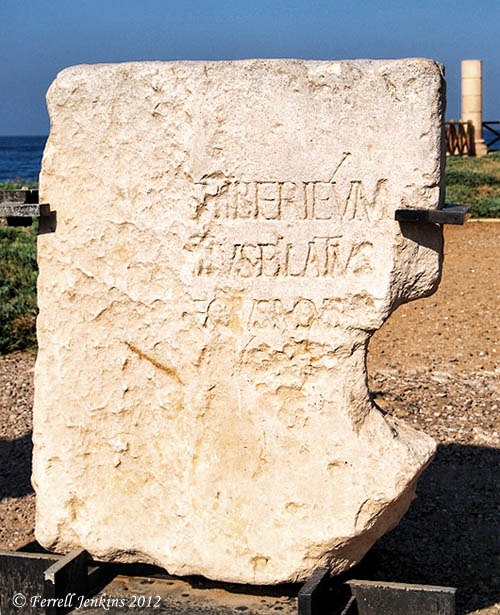
Use our search box to locate other posts we have written about Pilate. Begin with this one. The photo below shows the replica of the inscription bearing Pilate’s name that was found at Caesarea Maritima in 1961. The original is in the Israel Museum, Jerusalem.

Replical of inscription bearing the name of Pontius Pilate.Photo by Ferrell Jenkins.

Replica of inscription bearing the name of Pontius Pilate.Photo by Ferrell Jenkins.

For accounts in which Pilate played an important role, read Matthew 27, Mark 15, Luke 23, and John 18.

Zacharias asked for a writing tablet

When John was born, the neighbors and relatives thought they would call the child “Zacharias, after his father.” His mother, Elizabeth, said that he should be called John. The guests made signs to the mute Zacharias to have him say what he wanted the child called. Luke says,

He asked for a writing tablet and wrote, “His name is John.” And they were all amazed.  (Luke 1:63 NET)

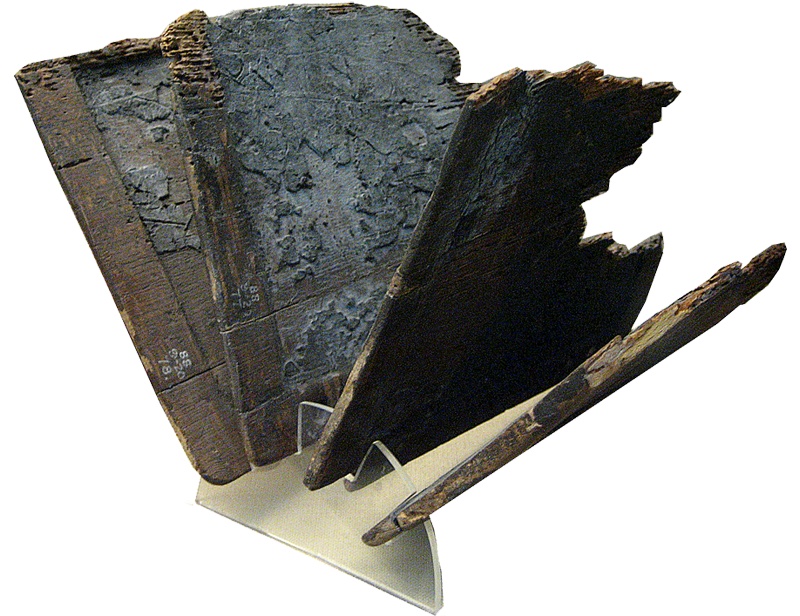
The Greek word Luke used for tablet is pinakidion. It is used only here in the New Testament. BDAG Lexicon says the term is used of a “little (wooden) tablet esp. of a writing-tablet for notes.”  Louw-Nida says the word describes “a small writing tablet (normally made of wood).” The Study Note in the NET Bible points out that “The writing tablet requested by Zechariah [Zacharias] would have been a wax tablet.”

Four leaves of a wooden writing tablet. Roman period from Hawara, Egypt. British Museum.

Wooden writing tablet (Roman period from Egypt). British Museum. Photo by F. Jenkins.

Ralph Earle comments on the tablet:

It was a wax-coated, small, wooden “writing tablet” (NIV)—something quite different from a “writing table” (KJV). — Word Meanings in the New Testament.

A little insight into the culture of the time makes the Bible come alive.

Origen, c. 185–c. 254, comments on this verse in his Commentary on Matthew Bk. XIII.

Earliest evidence of a New Testament verse in stone

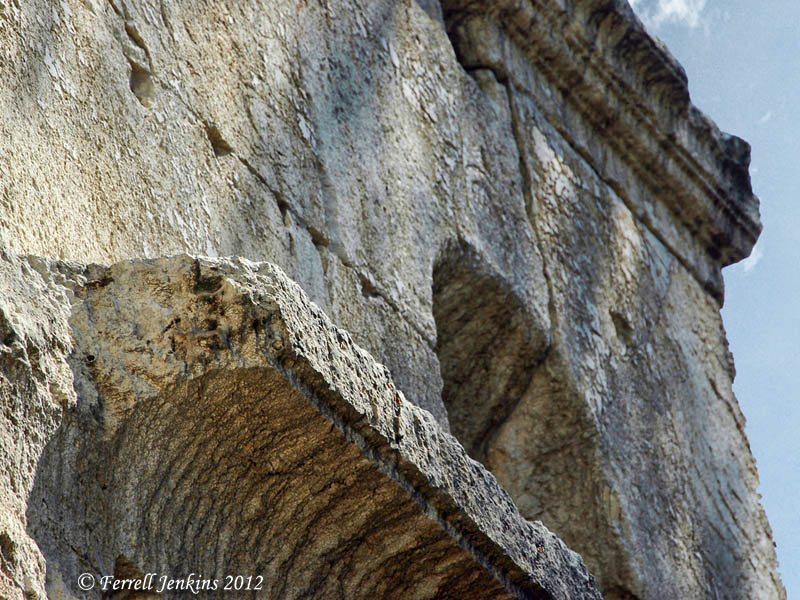
In two previous posts we have mentioned the so-called Tomb of Absalom in the Kidron Valley here and here. We noted that the horizontal inscription on the south side of the monument reads,

This is the tomb of Zacharias, martyr, very pious priest, father of John.

We know from Luke 1 that Zacharias was a priest and the father of John (the Baptist). Whether the monument was actually used as the tomb of Zacharias is a matter of conjecture, but the inscription does show what the common belief in the 4th century A.D. about Zacharias and John.

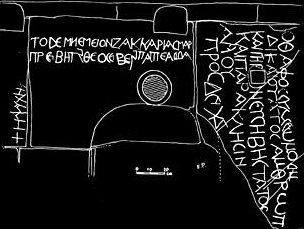
We noted that there are two inscriptions on the Absalom monument. The horizontal inscription is the one mentioned above. The vertical inscription is the one we wish to mention in this post. (In fact, there is a third inscription consisting of a cross and the words “The nephesh.”)

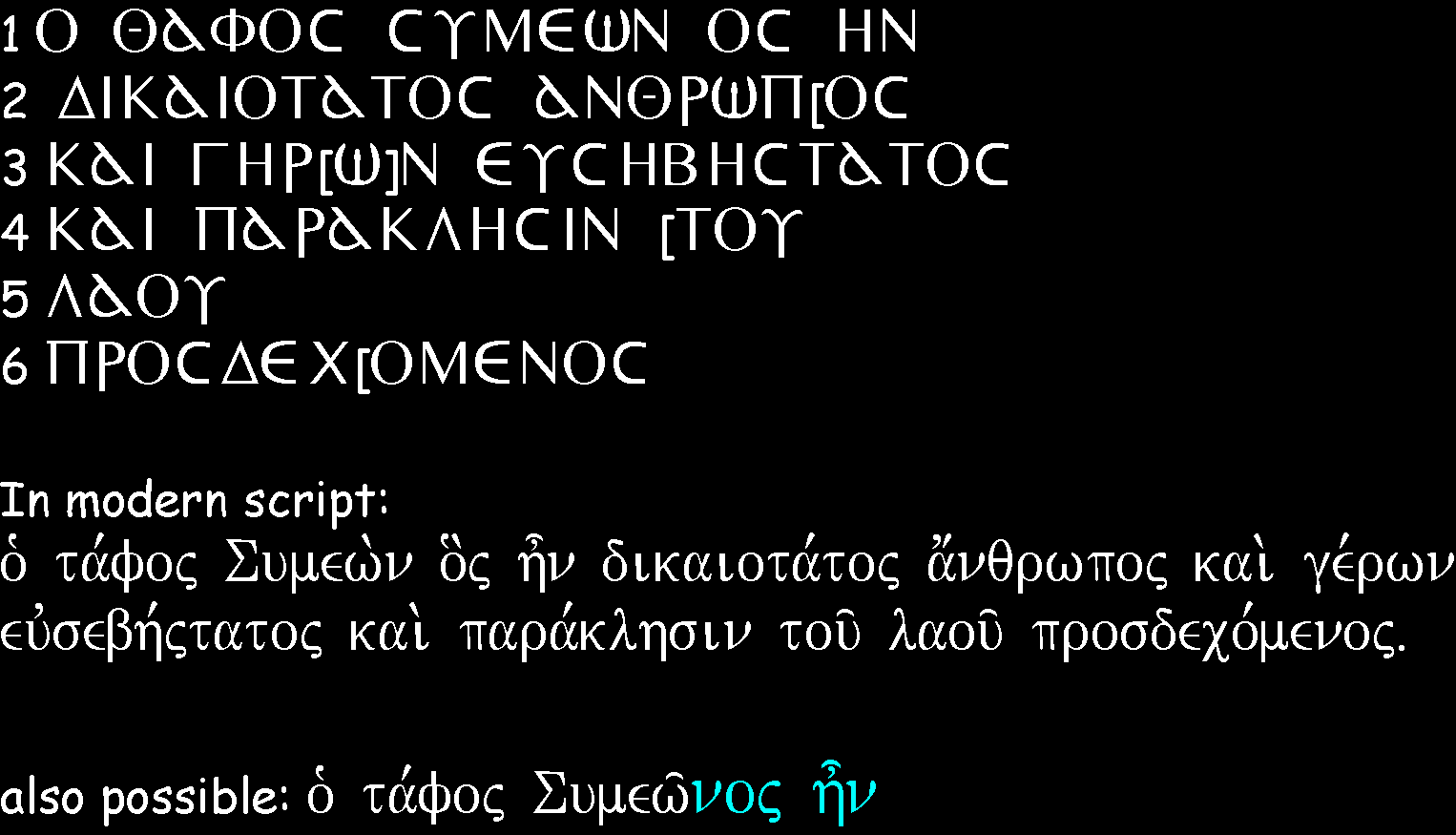
The long vertical inscription consists of the five lines in Greek. Puech translates them as follows,

The tomb of Simeon who was
a very just man
and a very devout el(der)
and (who was) waiting for
the consolation of
the people.

After considerable study, the scholars thought it was clear “that the scribe had engraved the main part of a verse from a gospel, Luke 2:25.” The drawing below shows the six lines of the inscription and the same in modern Greek. Click on the image for a larger, clearer one.

Inscription on south side of Absalom Monument.

Inscription on south side of Absalom Monument.

Luke 2:25 is part of the account of the presentation of Jesus in the Temple by Mary. Verse 25 reads,

And there was a man in Jerusalem whose name was Simeon; and this man was righteous and devout, looking for the consolation of Israel; and the Holy Spirit was upon him. (Luke:25 NAU)

The word Israel is changed in the inscription to read people.

Puech and Zias comment about the use of Luke 2:25 in the stone inscription.

So, the inscriptions on the tomb bear witness to the written traditions from the Byzantine period as well as those of the early church fathers. Moreover, the inscription from the Gospel of Luke is identical to that found in the Codex Sinaiticus, dated to the second quarter of the fourth century, prior to a correction according to the text of the Codex Vaticanus (εὐσεβὴς prima manu instead of εὐλαβὴς) around the middle of the sixth century, thus showing that the local Palestinian text was widely accepted as authoritative by the early church of Palestine….

Thus this inscription is the earliest evidence for a New Testament verse engraved in stone, and it fits Palestinian tradition (Puech and Zias 2004: 572).

Most of my information comes from Near Eastern Archaeology, Dec. 2005.

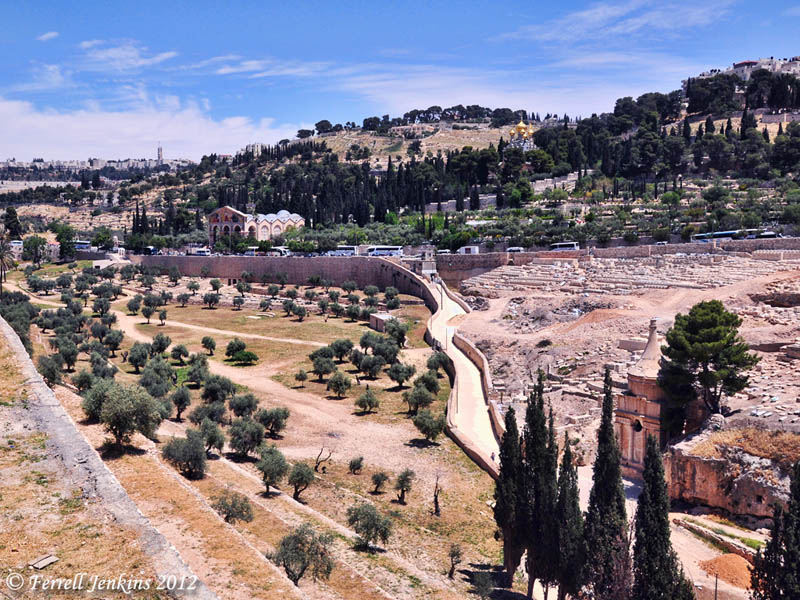
The photo below shows the Kidron Valley. The Mount of Olives is visible in the upper right of the photo. The tomb of Absalom is visible in the lower right. The view is to the northeast. The low hill with buildings in the distant left is Mount Scopus.

View of Kidron Valley from SE corner of Temple Mount. Photo by Ferrell Jenkins.

View of Kidron Valley from SE corner of Temple Mount. Photo by Ferrell Jenkins.

One never knows where the next significant discovery will be made.

Another free Ebook — this one on James

Another of Gundry’s individual commentaries from his Commentary on the New Testament is free today for the Kindle and other compatible digital devices. Today only, I think.

This week it is the book of James. Follow this link to Amazon. Don’t imagine that you are getting a $49.99 book free. That is the price of the Commentary on the New Testament. James is only about 17 2-column pages of that book.

I think this may be the last of the free books from Baker Academic at this time. Several publishers seem to be following this model in order to get readers attracted to their publications — always in hope that you will buy other volumes.

Let the Lower Lights be Burning

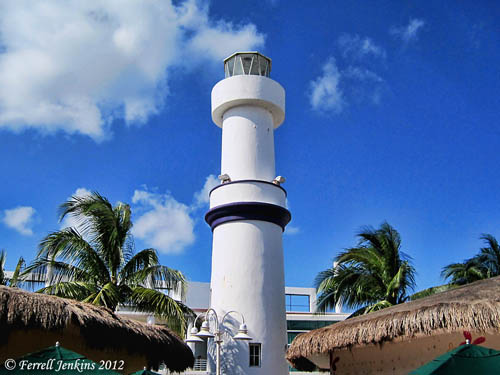
Lighthouse at Cozumel, Mexico. Photo by Ferrell Jenkins.

Lighthouse at Cozumel, Mexico. Photo by Ferrell Jenkins.

One of the great gospel songs that I remember from my childhood is Let the Lower Lights Be Burning (or Brightly Beams our Father’s Mercy). I understood the song even before I saw a lighthouse.

The song was written by a talented young musician names Philip P. Bliss in 1871. Osbeck tells the story of the writing of the hymn. Bliss was traveling with Dwight L. Moody and was impressed by an illustration about a violent storm on Lake Erie that was often used by Moody.

On a dark, stormy night, when the waves rolled like mountains and not a star was to be seen, a boat, rocking and plunging, neared the Cleveland harbor. “Are you sure this is Cleveland?” asked the Captain, seeing only light from the lighthouse.
“Quite sure, sir,” replied the pilot.
“Where are the lower lights?”
“Gone out, sir!”
“Can you make the harbor?”
“We must, or perish, sir.”

With a strong hand and a brave heart, the old pilot turned the wheel, But alas, in the darkness he missed the channel, and, with a crash upon the rocks, the boat was slivered and many a life lost in a watery grave.

“Brethren,” concluded Mr. Moody, “the Master will take care of the great lighthouse. Let us keep the lower lights burning.”

Osbeck, K. W. (1985). 101 more hymn stories (175). Grand Rapids, Mich.: Kregel Publications.

Here are the words of the hymn.

Brightly beams our Father’s mercy from His lighthouse evermore,
But to us He gives the keeping of the lights along the shore.
Let the lower lights be burning! Send a gleam across the wave!
For to us He gives the keeping of the lights along the shore.
[or Some poor struggling, sinking sailor you may rescue, you may save.]

Dark the night of sin has settled, loud the angry billows roar;
Eager eyes are watching, longing, for the lights, along the shore.
Let the lower lights be burning! Send a gleam across the wave!
Eager eyes are watching, longing, for the lights, along the shore.

Trim your feeble lamp, my brother, some poor sailor tempest tossed,
Trying now to make the harbor, in the darkness may be lost.
Let the lower lights be burning! Send a gleam across the wave!
Trying now to make the harbor, some poor sailor may be lost.

I located the lyrics to this old hymn at hymnlyrics.org.

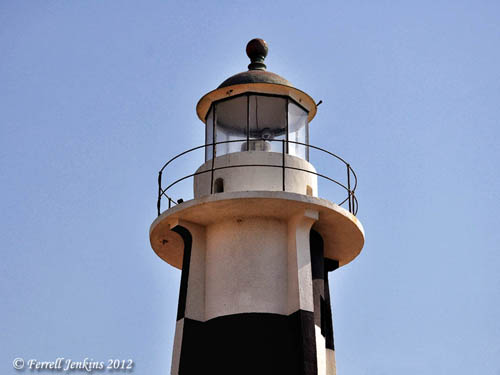
The next photo is of the lighthouse at the Crusader city of Akko on the Mediterranean. Akko (Acre) was known as Ptolemais in New Testament times. The Apostle Paul stopped at the city on the return from his third preaching journey (Acts 21:7).

The Akko Crusader lighthouse. Photo by Ferrell Jenkins.

The Akko Crusader City lighthouse. Photo by Ferrell Jenkins.

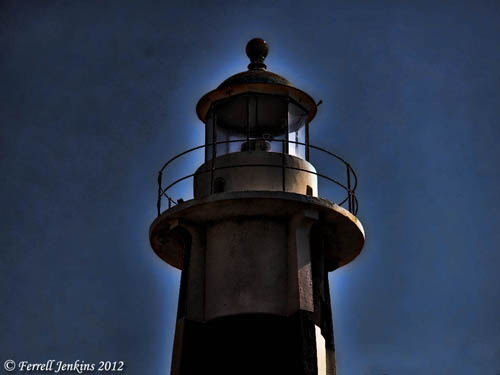
Utilizing the power of some of the photo tools I use, I thought about what this lighthouse might look like if the lights did not burn at night. Add a heavy fog and it would be impossible for the captain (pilot) of the ship to see it, let alone the “lights along the shore.”

Akko Crusader lighthouse as it might appear at night. Photo by Ferrell Jenkins.

Akko Crusader City lighthouse as it might appear at night. Photo by Ferrell Jenkins.

Two great New Testament texts come to mind:

“Let your light shine before men in such a way that they may see your good works, and glorify your Father who is in heaven. (Jesus; Matthew 5:16 NAU)

… so that you will prove yourselves to be blameless and innocent, children of God above reproach in the midst of a crooked and perverse generation, among whom you appear as lights in the world, (Apostle Paul; Philippians 2:15 NAU)

Thinking that some readers might like to use this illustration in a lesson, I have provided hi-res images. Just click on the images above.

Absalom’s Pillar and the Tomb of Zacharias, father of John

Yesterday we wrote about the mistaken identification of a first century B.C. tomb in the Kidron Valley as the monument Absalom built for himself (2 Samuel 18:18).

About 12 years ago an art history student at Hebrew University turned in a paper to Joe Zias which included an old photo of an inscription on the south side of the Pillar of Absalom. The inscription is difficult to see because the monument is cut from the natural rock. After many late afternoon visits to the site in 2002, waiting for the sun to be in the right spot to highlight the inscription, Zias finally saw it. Afterwards, efforts were made to photograph it.

South side of the Pillar of Absalom. Photo by Ferrell Jenkins.

South side of the Pillar of Absalom. Photo by Ferrell Jenkins.

Zacharias and Simeon inscriptions on the Absalom Pillar.

Zacharias & Simeon inscriptions on the Absalom Pillar.

There are two inscriptions on the south side of the monument. This little drawing, made available  shortly after the announcement, shows a horizontal inscription and a vertical one. The horizontal inscription is the one pertaining to Zacharias and John. In my photo you only see a small portion of the area where the Zacharias inscription is located.

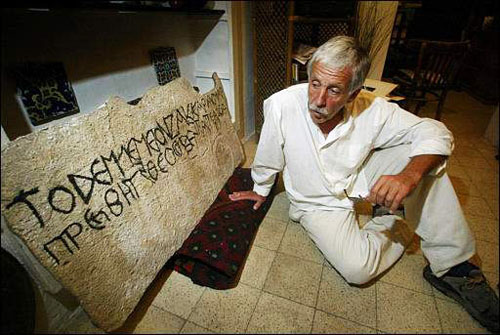
Due to a number of circumstances it was thought best to make a cast of the inscription so it could be studied in the lab. Numerous scholars from various fields of study were called in to assist and give advice. This photo shows Joe Zias, a physical anthropologist, with the cast.

Joe Zias with cast of Zacharias inscription from Absalom Monument.

Joe Zias with cast of Zacharias inscription from Absalom Monument.

The inscription is written in Byzantine Greek of the fourth century A.D. Zias teamed up with Fr. Émile Puech, a professor at the École Biblique in Jerusalem, to read the inscriptions. The horizontal inscription reads,

This is the tomb of Zacharias, martyr, very pious priest, father of John.

Luke records the naming of John by Zacharias this way:

And it happened that on the eighth day they came to circumcise the child, and they were going to call him Zacharias, after his father. 60 But his mother answered and said, “No indeed; but he shall be called John.” 61 And they said to her, “There is no one among your relatives who is called by that name.” 62 And they made signs to his father, as to what he wanted him called.  63 And he asked for a tablet and wrote as follows, “His name is John.” And they were all astonished.  64 And at once his mouth was opened and his tongue loosed, and he began to speak in praise of God.  (Luke 1:59-64 NAU)

I had the opportunity to hear Joe Zias and Émile Puech make their presentation about this discovery at the annual meeting of the Society of Biblical Literature in 2003. The discovery was published in Revue Biblique, July 2003.

Could this be the priest Zacharias (also spelled Zechariah in some English versions) the father of John the Baptist? We may think that it does, but it might be best to agree with Jerome Murphy-O’Connor who says that this inscription only reflects a tradition from the 4th century A.D.

Such Byzantine identifications reflect the piety of the period and have no historical value.

Another scholarly article appeared in Near Eastern Archaeology, Dec. 2005. It includes photos showing how these scholars were able to make the cast. One of the best popular articles I saved was published in The Christian Science Monitor. I see that it is no longer available online. If you have additional interest you might take a look at the Associated Press article here.

The vertical inscription may be even more significant. Perhaps I can get to that in a future post.