Category Archives: New Testament

They removed the roof and let down the bed

During the ministry of Jesus at Capernaum four men brought a paralyzed man to see Jesus, likely seeking healing, but there were so many people in the house that it was not possible to get in to see Jesus.

And when they could not get near him because of the crowd, they removed the roof above him, and when they had made an opening, they let down the bed on which the paralytic lay. (Mark 2:4 ESV)
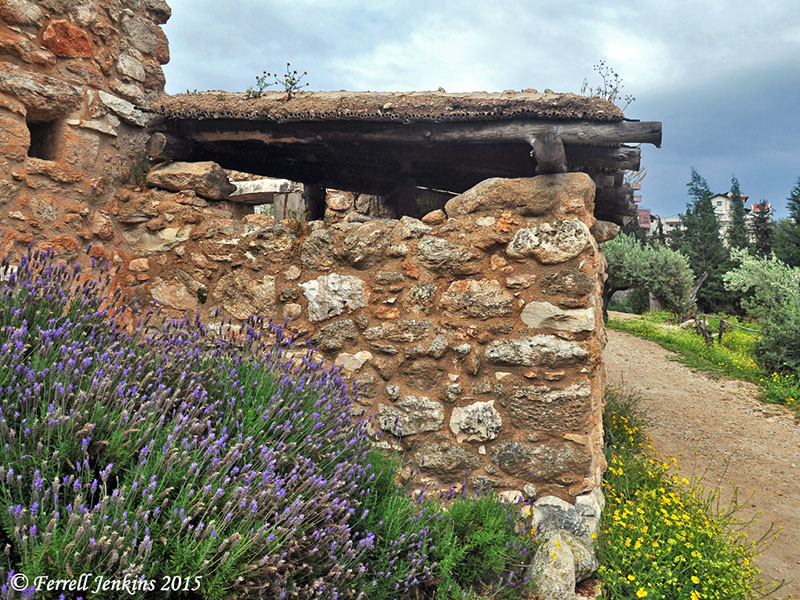
Reconstructed house at Nazareth Village showing roof construction. Photo by Ferrell Jenkins.

Reconstructed house at Nazareth Village showing roof construction. Notice the few weeds growing on the roof. Photo by Ferrell Jenkins.

Craig S. Keener describes the way the roofs of these houses were constructed.

The roof was approached by an outside staircase, so they could reach it unimpeded. The roof of single-story homes was sturdy enough for walking but was normally made of branches and rushes laid over the roof’s beams and covered with dried mud; thus one could dig through it. (The IVP Bible Background Commentary: New Testament)

M. J. Selman says,

Roofs were constructed from beams covered with branches and a thick layer of mud plaster, though the rafters were sometimes supported by a row of pillars along the middle of the room. Cylindrical stone rollers about 60 cm. [23.6 inches] long were used to keep the roofs flat and waterproof, though roofs needed to be re-plastered annually prior to the rainy season to seal cracks which had developed during the summer heat. (New Bible Dictionary, 3rd ed.)

The picture below shows a reconstructed house at Nazareth Village with a roof like the one mentioned above. Notice the beams made from small trees, the mud on the top, and some grass and weeds growing in it.
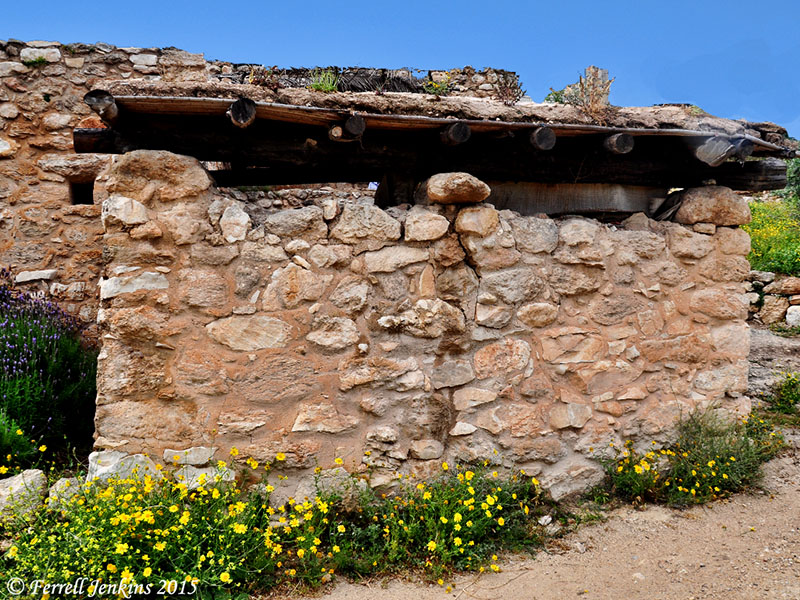
Reconstructed house at Nazareth Village showing roof construction. Photo by Ferrell Jenkins.

Reconstructed house at Nazareth Village showing roof construction. Photo by Ferrell Jenkins.

The next photo shows a portion of a roof made from wood and mud. You will also notice a roof roller on the roof. After the winter rains it was necessary to pack the roof with a roof roller. Roof rollers are commonly discovered during archaeological excavations.
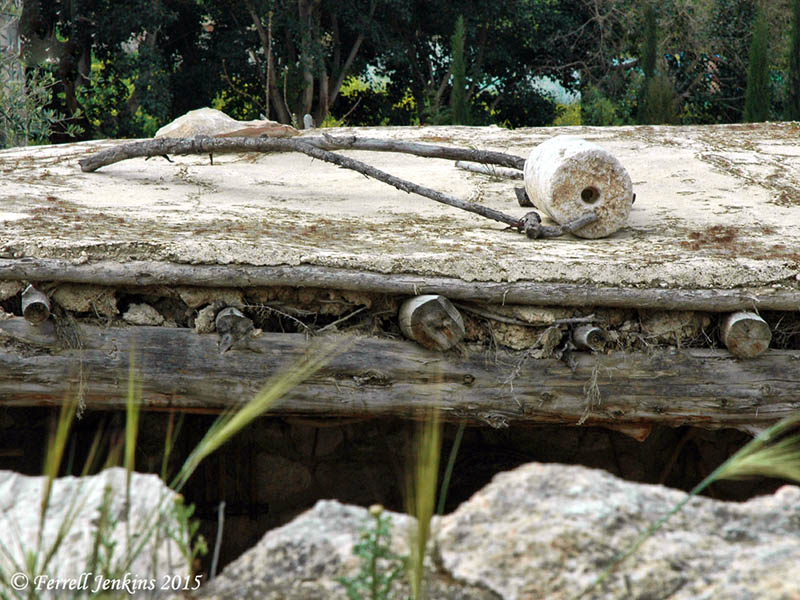
Typical roof from NT times with roof roller. Nazareth Village. Photo by Ferrell Jenkins.

Typical roof from NT times with roof roller. Nazareth Village. Photo by Ferrell Jenkins.

The account of Luke, a gentile physician, adds an interesting point that creates a small problem in interpretation.

But since they found no way to carry him in because of the crowd, they went up on the roof and let him down on the stretcher through the roof tiles right in front of Jesus. (Luke 5:19 NET)

Did you notice the reference to roof tiles? One of the Translator’s Notes in the NET Bible discusses this problem.

There is a translational problem at this point in the text. The term Luke uses is keramos. It can in certain contexts mean “clay,” but usually this is in reference to pottery (see BDAG 540 s.v. 1). The most natural definition in this instance is “roof tile” (used in the translation above). However, tiles were generally not found in Galilee. Recent archaeological research has suggested that this house, which would have probably been typical for the area, could not have supported “a second story, nor could the original roof have been masonry; no doubt it was made from beams and branches of trees covered with a mixture of earth and straw” (J. F. Strange and H. Shanks, “Has the House Where Jesus Stayed in Capernaum Been Found?” BAR 8, no. 6 [Nov/Dec 1982]: 34). Luke may simply have spoken of building materials that would be familiar to his readers.

There are other possible interpretations, but I hope this information with the photos will help you better understand the biblical text.

Pay your taxes and do not fear the authorities

While reading Romans 13 I came to Paul’s admonition to the saints at Rome, “Would you have no fear of the one who is in authority? Then do what is good.” My mind immediately turned to the mosaic which was discovered during the excavation of the Byzantine public area at Caesarea Maritima.

The context in Paul’s Epistle to the Romans reads this way.

For rulers are not a terror to good conduct, but to bad. Would you have no fear of the one who is in authority? Then do what is good, and you will receive his approval, for he is God’s servant for your good. But if you do wrong, be afraid, for he does not bear the sword in vain. For he is the servant of God, an avenger who carries out God’s wrath on the wrongdoer. (Romans 13:3-4 ESV)

The sign at the site describes the building where the mosaic was found as a Tax Archive. The original is said to be on display at the Kibbutz Sdot Yam Museum. The edifice is identified as “Byzantine government offices where clerks recorded tax revenues.”

Mosaic Treasury at Caesarea Maritima. Photo by Ferrell Jenkins.

Mosaic Treasury at Caesarea Maritima. Photo by Ferrell Jenkins.

I suppose they did not understand that this is politically incorrect!

“If Christ be not raised…”

Several tombs of the type in which Jesus was buried have survived the centuries. This one was discovered during road construction a few years ago near the Jezreel Valley, not very far from Megiddo.

Roman period tomb with a rolling stone near the Jezreel Valley. Photo by Ferrell Jenkins.

Roman period tomb with a rolling stone near Jezreel Valley. Photo by Ferrell Jenkins.

So far as I know no New Testament writer ever used the expression “empty tomb” but the phrase accurately reflects what they taught.

The resurrection of Christ is mentioned more than 100 times in the New Testament. Take a look at just a few statements. With the exception of the Gospel of John and the book of Revelation, we have good evidence that each of these books was written prior to A.D. 70. John wrote both the Gospel and Revelation before the end of the first century.

Matthew

“He is not here, for He has risen, just as He said. Come, see the place where He was lying. Go quickly and tell His disciples that He has risen from the dead; and behold, He is going ahead of you into Galilee, there you will see Him; behold, I have told you.” (Matthew 28:6-7 NAU)

Mark

Looking up, they saw that the stone had been rolled away, although it was extremely large. Entering the tomb, they saw a young man sitting at the right, wearing a white robe; and they were amazed. And he said to them, “Do not be amazed; you are looking for Jesus the Nazarene, who has been crucified. He has risen; He is not here; behold, here is the place where they laid Him. (Mark 16:4-6 NAU)

Luke

And they found the stone rolled away from the tomb, but when they entered, they did not find the body of the Lord Jesus. (Luke 24:2-3 NAU)

“He is not here, but He has risen. Remember how He spoke to you while He was still in Galilee, saying that the Son of Man must be delivered into the hands of sinful men, and be crucified, and the third day rise again.” (Luke 24:6-7 NAU)

John

Now on the first day of the week Mary Magdalene came early to the tomb, while it was still dark, and saw the stone already taken away from the tomb. So she ran and came to Simon Peter and to the other disciple whom Jesus loved, and said to them, “They have taken away the Lord out of the tomb, and we do not know where they have laid Him.” So Peter and the other disciple went forth, and they were going to the tomb. The two were running together; and the other disciple ran ahead faster than Peter and came to the tomb first; and stooping and looking in, he saw the linen wrappings lying there; but he did not go in. And so Simon Peter also came, following him, and entered the tomb; and he saw the linen wrappings lying there, and the face-cloth which had been on His head, not lying with the linen wrappings, but rolled up in a place by itself. So the other disciple who had first come to the tomb then also entered, and he saw and believed. For as yet they did not understand the Scripture, that He must rise again from the dead. (John 20:1-9)

Peter

“But God raised Him up again, putting an end to the agony of death, since it was impossible for Him to be held in its power. (Acts 2:24 NAU)

“God raised Him up on the third day and granted that He become visible, not to all the people, but to witnesses who were chosen beforehand by God, that is, to us who ate and drank with Him after He arose from the dead. (Acts 10:40-41 NAU)

… who through Him are believers in God, who raised Him from the dead and gave Him glory, so that your faith and hope are in God. (1 Peter 1:21 NAU)

Paul

“But God raised Him from the dead; (Acts 13:30 NAU)

For I delivered to you as of first importance what I also received, that Christ died for our sins according to the Scriptures, and that He was buried, and that He was raised on the third day according to the Scriptures, (1 Corinthians 15:3-4 NAU)

John in Revelation

John to the seven churches that are in Asia: Grace to you and peace, from Him who is and who was and who is to come, and from the seven Spirits who are before His throne, and from Jesus Christ, the faithful witness, the firstborn of the dead, and the ruler of the kings of the earth. To Him who loves us and released us from our sins by His blood– and He has made us to be a kingdom, priests to His God and Father– to Him be the glory and the dominion forever and ever. Amen. (Revelation 1:4-6 NAU)

Conclusion

Several of these references indicate that they believed that the Old Testament Scriptures had predicted the resurrection.

Occasionally there are critics of the Bible who seek contradictions within the Bible, but there is clearly one message on the resurrection of Christ. Confidence in the resurrection of Christ provides a foundation on which to build our faith and provides the hope of our own resurrection from the dead.

Jesus’ calendar during Passover week

If we consider the Gospel of John a sort of “Day Planner” for Jesus, we have nearly complete activity recorded for two weeks of the earthly ministry of Jesus. The first is in John 1:19—2:11 where activity for six of the seven days is recorded. I think the omitted day is the sabbath.

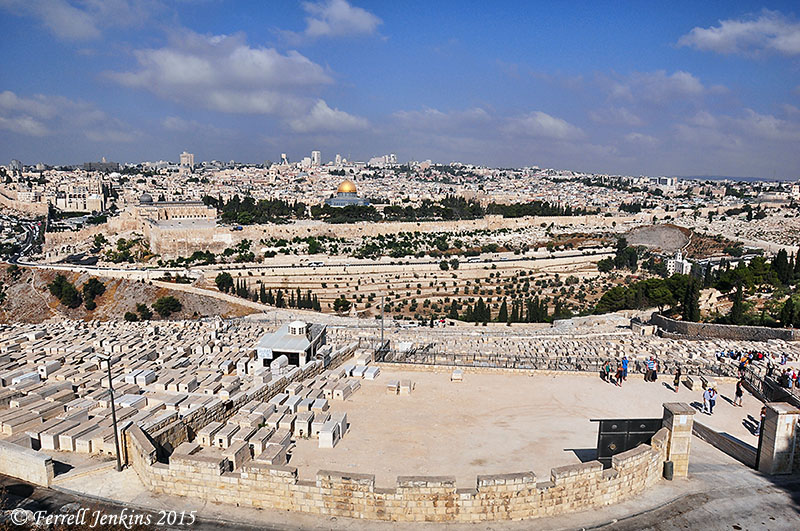
View of Jerusalem from the Mount of Olives. Photo by Ferrell Jenkins.

View of Jerusalem from the Mount of Olives. Imagine the city as it would have appeared to Jesus when he reached the top of the Mount of Olives. Photo by Ferrell Jenkins.

The next nearly complete week is the last week, leading up to the resurrection. John gives more attention to the last week than any other Gospel. Even here we have activities for only six of eight days. This section begins in John 12:1 and continues into John 20. Here is the way I have reconstructed it. Where John does not record the activity I have omitted the scripture reference.

  • Sunday — The King enters Jerusalem — 12:12-19
  • Monday — Cleansing the Temple —
  • Tuesday — Visit of the Greeks — 12:20-36
  • Tuesday — Jewish rejection — 12:37-50
  • Wednesday — No events recorded in the Gospels
  • Thursday Evening — Passover Meal, including Washing Disciples Feet (only in John) — 13:1-38
  • Thur. Eve — Farewell discourses — 14—16
  • Thur. Eve — Prayer — 17
  • Thur. Eve — Annas (only in John) — 18:12-14
  • Thur. Eve — Caiaphas — 18:24-28
  • Friday — Pilate — 18:28—19:16
  • Friday — Crucifixion — 19:16-42
  • Sabbath —
  • First Day — Resurrection — 20

It should be noted that the appearance before Annas and Caiaphas were the Jewish (Religious) trials. The appearance before Pilate [and Herod Antipas] were the Roman (Civil) trials.

John does not record the pronouncement of woes on the religious leaders, the institution of the Lord’s Supper, and the account of the agony in the Garden of Gethsemane.

With this sparse attention given to two weeks, no wonder John says,

Now there are also many other things that Jesus did. Were every one of them to be written, I suppose that the world itself could not contain the books that would be written. (John 21:25 ESV)

Updated from April 21, 2011

Jerusalem from above

Today I am sharing an aerial photo of Jerusalem that shows the entirety of the Old City. The 16th century Ottoman walls can be seen along the south and west of the city.

Jerusalem from the air. View north and east. Photo by Ferrell Jenkins.

Jerusalem from the air. View north and east. Photo by Ferrell Jenkins.

The view is toward the north and east. You can see that the Judean wilderness is near the city of Jerusalem. Notice that the city is reflected on the wing of the plane. If you look carefully you can see the reflection of the Dome of the Rock and a portion of the Temple Mount. Click on the photo for a larger image. The image is large enough to use in presentations for teaching for those who are willing to spend some time studying the location of various Bible events.

Another look at Hippos (Sussita)

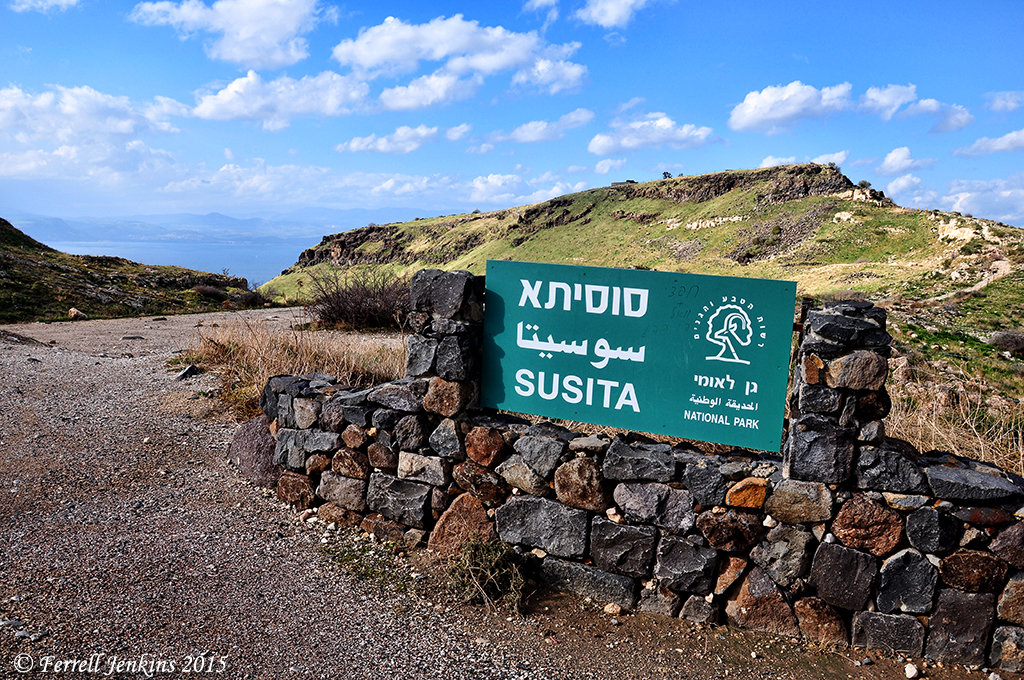
I think many Bible Land travelers pass En Gev on the eastern shore of the Sea of Galilee and never realize that the site of Hippos is visible about one and a half miles to the east. Perhaps that is because of the almost magnetic attraction of the Sea of Galilee.

View of Hippos/Sussita (Susita) with the Sea of Galilee. Photo by Ferrell Jenkins.

View of Hippos/Sussita (Susita) with the Sea of Galilee. Photo by Ferrell Jenkins.

Vassilios Tzaferis wrote about Hippos in Biblical Archaeology Review:

If you look at the site of Sussita/Hippos from an adjacent mountain, or, better yet, from the air, and follow the adjoining ridge, or saddle, to the east, the site looks like the head of a horse and the saddle, or ridge, looks like the long, outstretched neck of a horse. It is this configuration that gave the site its name for nearly a thousand years. The ancient Greeks, who apparently were the first to settle the site, must have been aware of this resemblance because they named the place Hippos (horse). When the Jews conquered the city, they translated the name to Sussita, “mare” in Aramaic. When the Arabs conquered it, they called it Qal’at el Husn, the “fortress of the horse.”

The summit of the mountain is a plateau of about 37 acres on which lie scattered the ruins of what was once a beautiful town overlooking the lake.

Our story begins—perhaps it will begin much earlier after the site is thoroughly excavated—about a century after Alexander the Great conquered and Hellenized much of the then-known world. After Alexander’s death in 331 B.C., his empire split in two—the Ptolemies in Egypt and the Seleucids in Syria shared this world. Over the centuries Palestine passed from one side to the other, occasionally winning its own independence. The first evidence we now have of organized habitation at Hippos indicates that it was founded by the Seleucids in the middle of the third century B.C., very probably as a frontier fortress against the threat of the Ptolemaic kingdom to the south. The settlement was located on a most strategic point, on the western approach to Gaulanitis (today’s Golan Heights). The site’s natural fortification and defense allowed it to serve equally as a fortress stronghold and as an effective frontier post, controlling any movement to the east, both in time of war and peace. In about 200 B.C., the boundaries of the Seleucid kingdom were pushed down to southern Palestine, so Hippos lost much of its strategic significance but it retained its importance as an urban cultural center, with a social and political organization in accord with the principles of a Greek polis.

When the town was formally recognized as an official constitutional polis, it was renamed Antiocha, in honor of the head of the Seleucid kingdom, Antiochus the Great (III), although the old name Hippos was also officially used.

Hippos had a port on the Sea of Galilee “to serve the commercial and navigational needs” of the city.

The progress of the city as a Hellenistic center was interrupted for a period of about 20 years during the first half of the first century B.C. Sometime between 83 and 80 B.C., the Judean king Alexander Jannaeus, who then ruled an independent fiefdom, conquered Hippos. According to the first-century A.D. historian Flavius Josephus (Antiquities of the Jews 14.75), Jannaeus forced Hippos’ heathen inhabitants to be circumcised and to accept Judaism. In 64 B.C., however, the Roman army entered the scene. The Roman general Pompey took the city from the Jews; it was then included in the League of the Ten Cities, the Decapolis, created by Pompey in the northern Jordan Valley and adjacent Transjordan. Each city in the Decapolis had jurisdiction over an extensive area. As a member of the Decapolis, Hippos enjoyed internal autonomy and could even mint its own coins. The population of Hippos welcomed Pompey with open arms.

About 35 years later, Hippos again became part of a Jewish realm. In 30 B.C. the Roman emperor Augustus gave Hippos to Herod the Great, who ruled it until his death 26 years later, in 4 B.C. After Herod’s death, Hippos was assigned by the Romans to the province of Syria.

During the First Jewish Revolt against Rome (66–70 A.D.), the Jews attacked Hippos and its Greek inhabitants, who retaliated by killing or imprisoning the Jews residing there. (Biblical Archaeology Review 16:05, Sep/Oct 1990).

Riesner says that Hippos “must be” the city of the Decapolis presupposed in Mark 5:1-20 (the account of casting demons into swine; Dictionary of Jesus and the Gospels 40). It might be. Hippos is the closest of the cities of the Decapolis to the area of Jesus’ ministry which was centered in Capernaum. It would make sense that Gentiles in this area might be growing pigs.

And he [the healed demon-possessed man]went away and began to proclaim in the Decapolis how much Jesus had done for him, and everyone marveled. (Mark 5:20 ESV)

And great crowds followed him [Jesus] from Galilee and the Decapolis, and from Jerusalem and Judea, and from beyond the Jordan. (Matthew 4:25 ESV)

Could Hippos Be the City Set on a Hill? Chris McKinney wrote an article for Seeking a Homeland in May, 2010 suggesting consideration of Hippos (Hippus) for the “city set on a hill” mentioned by Jesus in Matthew 5:14b). He uses Google Earth to show the location of various sites around the Sea of Galilee. There is also a nice photo allowing you to see how the site looks like the head of a horse. Read his article here. Certainly plausible.

Parts of this post are reposted from March 26, 2010. See here.

Pan mask uncovered at Decapolis city of Hippos-Sussita

Earlier today a press release was issued by The University of Haifa regarding a recent discovery at Hippos-Sussita, a town of the Decapolis located about 2 km. east of the Sea of Galilee. (For those who have been in the area, the mound is visible to the east of En Gev.)

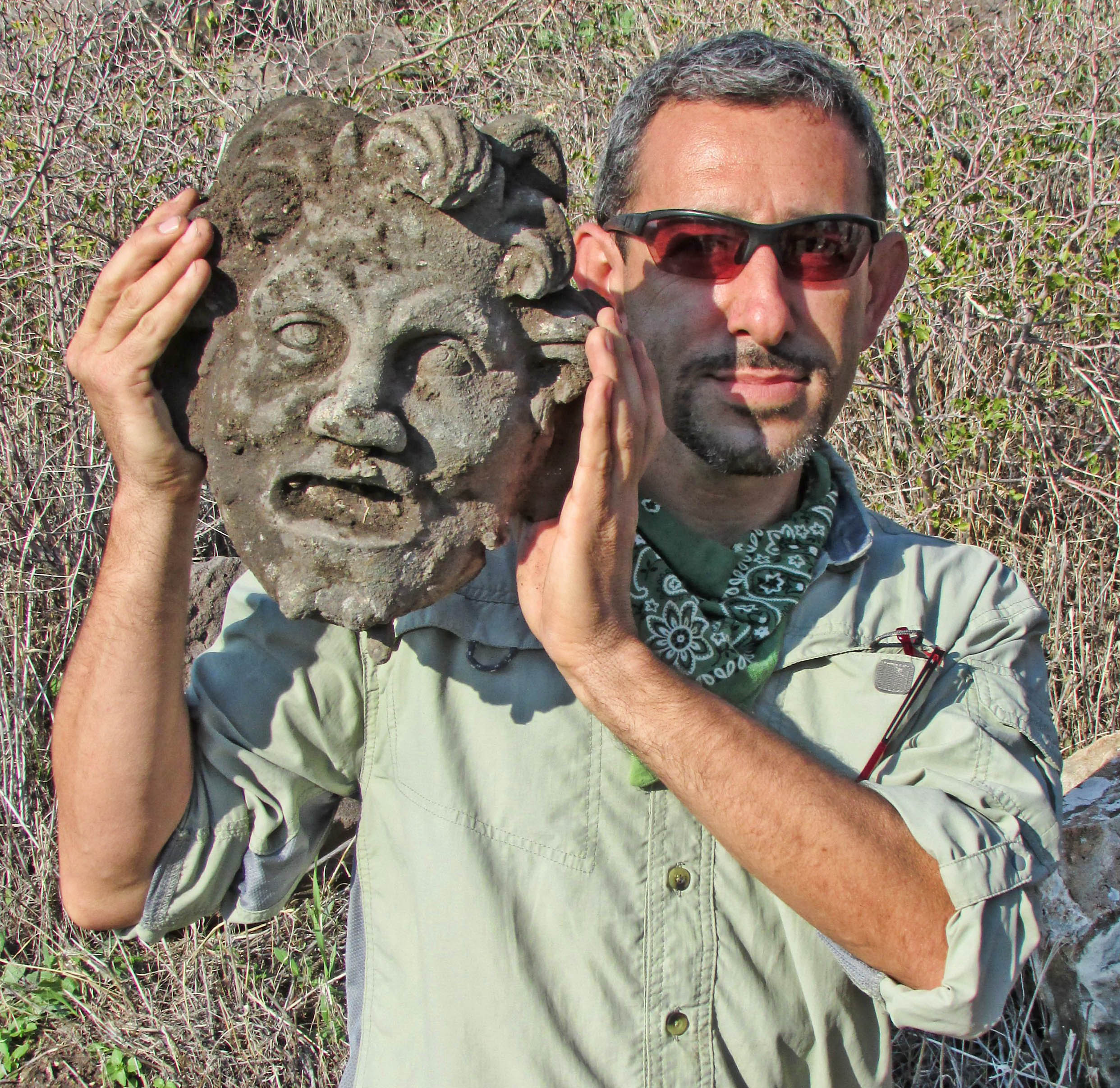
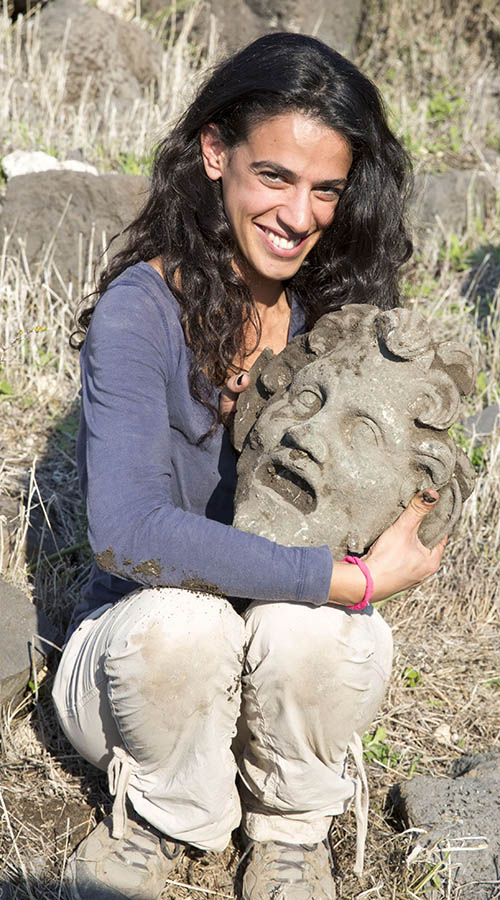
A large bronze mask of the god Pan, the only of its kind, was uncovered at the University of Haifa’s excavation at Hippos-Sussita National Park. According to Dr. Michael Eisenberg, bronze masks of this size are extremely rare and usually do not depict Pan or any of the other Greek or Roman mythological images. “Most of the known bronze masks from the Hellenistic and Roman periods are miniature”.

Dr. Michael Eisenberg, University of Haifa, holding the Pan mask discovered at Hippos-Sussita.

Dr. Michael Eisenberg, University of Haifa, holding the Pan mask discovered at Hippos-Sussita.

It seems that in recent years, the mysteries of Hippos-Sussita have been revealing their secrets in an extraordinary way: first, a sculpture of Hercules was exposed by the winter rains of 2011, then, two years later, a basalt tombstone with a sculpture of the deceased’s bust was uncovered. Now there is a new surprise: the only finding of a bronze mask of unnatural size, in the form of the god Pan/Faunus.

Excavations at Hippos-Sussita are usually conducted in the summer. However, a series of intriguing structures on the ridge of the city, where the ancient road passed, led to a one-day dig in the winter. The dig focused on a basalt structure which the researchers assumed was a type of armoured hangar for the city’s projectile machines. The finding of a ballista ball made of limestone, a different material from the basalt that was customarily used at Hippos-Sussita to make balista balls, made them realize that it was an enemy’s projectile.

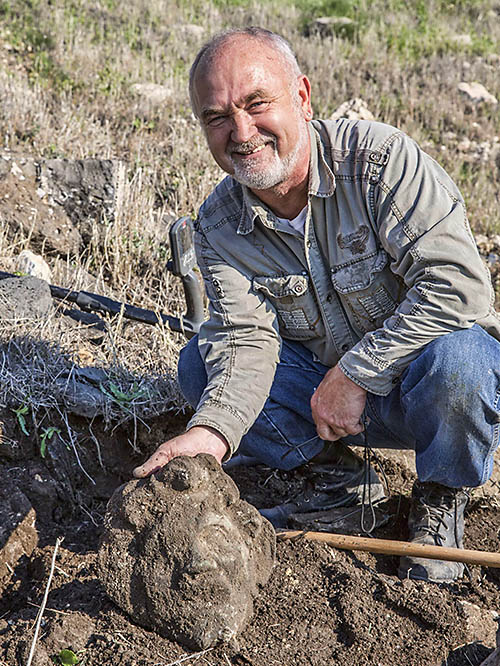
In light of this interesting find the researchers decided to search the structure for coins to help them date the the balls. It didn’t take long for the metal detector, operated by the capable hands of Dr. Alexander Iermolin, head of the conservation laboratory at the Institute of Archaeology at the University, to start beeping frantically. The archaeologists were not yet aware of what was in store for them: “After a few minutes we pulled out a big brown lump and realized it was a mask. We cleaned it, and started to make out the details: The first hints that helped us recognize it were the small horns on top of its head, slightly hidden by a forelock,” said Dr. Eisenberg.

Dr. Alexander Iermolin immediately after uncovering the Pan mask at Hippos-Sussita.

Dr. Alexander Iermolin immediately after uncovering the Pan mask at Hippos-Sussita.

Horns like the ones on the mask are usually associated with Pan, the half-man half-goat god of the shepherds, music and pleasure. A more thorough cleaning in the lab, revealed  strands of a goat beard, long pointed ears, and other characteristics that led Dr. Eisenberg to identify the mask as depicting a Pan/Faunus/Satyr. “The first thought that crossed my mind was, ‘Why here, beyond the city limits?’ After all, the mask is so heavy it could not have just rolled away. The mask was found nearby the remains of a basalt structure with thick walls and very solid masonry work, which suggested a large structure from the Roman period. A Pan altar on the main road to the city, beyond its limits, is quite likely. After all, Pan was worshiped not only in the city temples but also in caves and in nature. The ancient city of Paneas, north of Hippos-Sussita, had one of the most famous worshiping compounds to the god Pan inside a cave. Because they included drinking, sacrificing and ecstatic worship that sometimes included nudity and sex, rituals for rustic gods were often held outside of the city”, Dr. Eisenberg explained.

Archaeological team member cradles the mask of Pan.

Archaeological team member cradles the mask of Pan.

Now the archeologists have begun to uncover the basalt structure, in the hopes of finding more clues to its purpose. They assume that it was used for defensive purposes “Perhaps in a later period, during the Pax Romana, when the city fortifications were not required, the building turned into a place of worship to the god of shepherds, and maybe what we have here is a magnificent fountain-head or burial offerings of a nearby mausoleum,” Dr. Eisenberg suggests.

As mentioned, the researchers are unfamiliar with any similar bronze mask from the Roman or Hellenistic era of Pan or a Satyr. “Most of the masks are usually similar in size to theater masks, are made of stone or terracotta and are of ritual, apotropaic, decorative or symbolic significance. I contacted the curators of some of the world’s greatest museums, and even they said that they were not familiar with the type of bronze mask that we found at Hippos. Hippos-Sussita cannot compete in wealth with the ancient cultural centers of the Roman Empire and as such, a finding of this kind here, of all places, is amazing,” concluded Dr. Eisenberg.

The press release may be read in its entirety here.

Jesus visited the region of Decapolis during His public ministry (Mark 5:20; 7:31; Matthew 4:25).

We commonly think of Pan in association with the site of Panias (Banias=Caesrea Philippi), an area visited by Jesus (Matthew 16:13-20). See more info about the site here.

HT: Joseph I. Lauer

Thinking better of Mary Magdalene

A group of Christian women recently convened at the ancient site of Magdala on the western shore of the Sea of Galilee “to honor International Women’s Day and discuss women’s empowerment.”

Advocates spoke of the issue of legal prostitution in Israel and the struggles of the over 15,000 Israeli women who are drawn into the industry, often against their will. (The Jerusalem Post Newsletter, March 11, 2015).

The meeting at Magdala seemed to discuss some important issues, but the characterization of Mary Magdalene is inaccurate to say the least.

Each speaker related the issues of feminism and women empowerment to the lessons of Mary Magdalene, speaking about how the healing process for women who have suffered such abuse. Consecrated woman, Jennifer Ristine, spoke of how Mary Magdalene inspires hope and healing for victims of abuse.

“Through the transforming experience of love, Mary Magdalene’s dignity was affirmed and she becomes a leader among leaders, inspiring hope and  reconciliation,” Ristine said. “Do we have anything in common with this woman? When a woman is deeply convinced of the truth that she is unconditionally loved, she is set free to be what she is called to be for others. She becomes a catalyst for reconciliation.”

An entire “cult” has risen around Mary Magdalene over the years to the point that some have suggested that Mary Magdalene was the wife of Jesus, and that she “carried the royal bloodline of Jesus Christ” (The DaVinci Code, p. 244, 249).

Some writers assume that Mary Magdalene is to be identified with the sinful woman of Luke 7:36-50. The comments by William Hendriksen are helpful in correcting this misunderstanding.

First among the women here mentioned is Mary called Magdalene; that is, Mary of Magdala (meaning The Tower) located on the western shore of the Sea of Galilee and south of Capernaum. She figures very prominently in all the four Passion accounts. She was one of the women who later: (a) watched the crucifixion (Matt. 27:55, 56; Mark 15:40; John 19:25); (b) saw where Christ’s body was laid (Matt. 27:61; Mark 15:47; Luke 23:55); and (c) very early Sunday morning started out from their homes in order to anoint the body of the Lord (Matt. 28:1; Mark 16:1; Luke 24:10). Besides, she was going to be the first person to whom the Risen Christ would appear (John 20:1–18; see also Mark’s disputed ending, 16:9).

The item about the seven demons that had been expelled from Mary Magdalene has led to the wholly unjustifiable conclusion that she was at one time a very bad woman, a terribly immoral person. But there is not even an inkling of proof for the supposition that demon-possession and immorality go hand in hand. Weird and pitiable mental and/or physical behavior are, indeed, often associated with demon-possession (Luke 4:33, 34; 8:27–29; 9:37–43, and parallels), not immorality. (Hendriksen, Baker New Testament Commentary: Luke, comments on Luke 8:2-3)

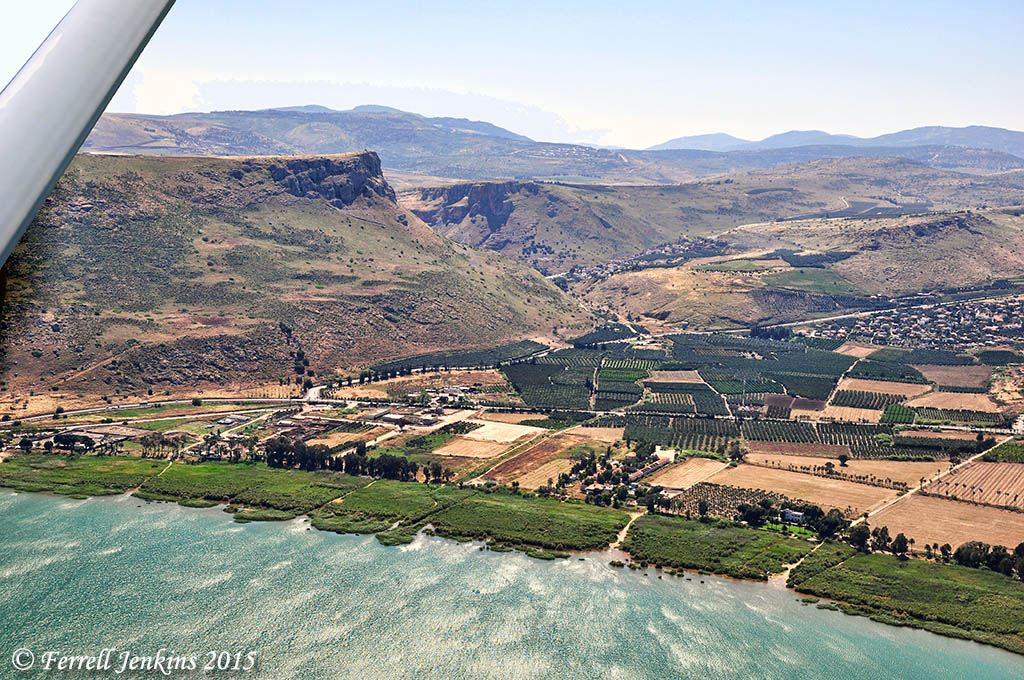
Our aerial photo was made in 2011. The area of ancient Magdala is seen on the left 40% of the photo along the shore of the Sea of Galilee. On the right side you will see the Plain of Genessaret. Mount Arbel and the Via Maris are seen in the background. The mountains of Upper Galilee are visible in the distance. Click on the photo for an image suitable for use in presentations.

Aerial view of Magdala and the Plain of Genessaret. Photo by Ferrell Jenkins.

Aerial view of Magdala and the Plain of Genessaret. Photo by Ferrell Jenkins.

It is wonderful that any variety of sin can be forgiven, but let’s not turn Mary Magdalene into something she was not. The words of Paul, the apostle of Christ Jesus, are encouraging.

Or do you not know that the unrighteous will not inherit the kingdom of God? Do not be deceived: neither the sexually immoral, nor idolaters, nor adulterers, nor men who practice homosexuality, nor thieves, nor the greedy, nor drunkards, nor revilers, nor swindlers will inherit the kingdom of God. And such were some of you. But you were washed, you were sanctified, you were justified in the name of the Lord Jesus Christ and by the Spirit of our God. (1 Cor. 6:9-11 ESV)

Pilate erected a Tiberium in Caesarea Maritima

An inscription bearing the name of Pontius Pilate was found at Caesarea Maritima June 15, 1961 during the excavation of the Roman theater. The stone on which the inscription is found had been reused in the theater. The photo below shows a replica of the inscription displayed in the building described by Murphy-O’Connor as the Palace of the Procurators. The original inscription is in the Israel Museum.

Pilate inscription displayed in the Palace area at Caesarea Maritima. Photo by Ferrell Jenkins.

Pilate inscription displayed in the Palace area at Caesarea. Photo by Ferrell Jenkins.

It is the inscription that has bearing on our current study relating to the Imperial Cult in Roman Palestine. Murphy-O’Connor gives the following translation:

Pontius Pilate, Prefect of Judaea, made and dedicated the Tibereieum to the Divine Emperor. (The Holy Land, Fifth Ed., p. 243)

The top line has the word for Tiberium. The second line has [Pon]tius Pilatus, and the third line seems to be the title of Pilate. Only one letter remains on the fourth line.

Joan Taylor, whose 2006 New Testament Studies article we have mentioned before, reads the inscription as follows:

  1. [_ _ _] S TIBERIÉUM
  2. [_ _ PO]NTIUS PILATUS
  3. [PRAEF]ECTUS IUDA[EA]E
  4. [_ _ _ _ _] É[_ _ _ _ _ _ _]

She translates the inscription as,

  1. [. . .] Tiberieum
  2. [.Po]ntius Pilate
  3. [Pref]ect of Judaea
  4. [. . .] e [. . .]

If you use Logos, you will be able to locate a suggested reconstruction of Pontius Pilate’s Inscription in the Faithlife StudyBible Infographics.

Taylor’s interpretation of the inscription is significant.

The word ‘Tiberieum’ is found nowhere else in the corpus of Latin inscriptions or literature and, given the relatively small size of the inscription and its terse quality, this Tiberieum should probably be understood as something of modest proportions. Possibly this small structure was attached to the theatre of Caesarea, located in the southern part of the city, which would explain its existence as a step in the remodelled theatre later on. (566)

Taylor describes the Tiberieum.

A dedicated structure in honour of the emperor Tiberius, a res sacra, would easily be called in Latin a ‘Tiberieum’. The most natural thing in terms of the Latin word would be to consider this to be not some secular lighthouse for the help of sailors or any other profane building, but an edifice or annex associated with the Roman imperial cult. (567)

Taylor’s excellent article covers Pilates coins, the shields he erected in Jerusalem, and the tiberium he built at Caesarea. This allows her to conclude that Pilate “does seem to have been purposively determined to maintain, if not advance, the Roman imperial cult in Judaea.” (582)

Once more, for those who wish to follow up on this subject, here is the bibliographic reference to Taylor’s article.

Taylor, Joan E. “Pontius Pilate and the Imperial Cult in Roman Judaea.” New Testament Studies 52. 2006: 555-582.

Other helpful materials include:

Bond, Helen K. “The Coins of Pontius Pilate: Part of An Attempt to Provoke the People or to Integrate Them into the Empire? Journal for the Study of Judaism XXVII 3. 1996: 241-262.

Carl Rasmussen has written about this topic on his Holy Land Photos’ Blog here. In a post here, Rasmussen emphasizes that Herod’s Imperial Cult Temples were “all less than 40 miles from Nazareth/Capernaum,” and that the temples “had been in existence for over 40 years!”

We may add that Pilate’s activities were closer to the time of the ministry of Jesus and the beginning of the church.

Note to Those Who Heard My Florida College Presentation. While I was working on this series of articles I noticed that I had misspelled the name of the Roman Emperor Tiberius throughout the presentation. I used the spelling of the town Tiberias. I am sure that all of my former students will agree that there should be no counting off for misspelled words. 🙂

I am also aware of the different spelling of the structure credited to Pilate. Tiberieum is the more typical British-type spelling; Tiberium is often used by American writers.

Emperor Worship in Asia Minor. I have been asked if I will discuss Emperor Worship as it relates to the book of Revelation. At this time the answer is no. Perhaps later on. I always presented material on this when I taught Revelation, and I have included a chapter on the subject in Studies in the Book of Revelation which is available at the Florida College Bookstore.

Pilate promoted the Imperial Cult by setting up shields in Jerusalem

In addition to the use of coins, Pilate used other means to promote the Imperial (Emperor) Cult in Roman Palestine.

In the previous post we called attention to the article by Prof. Joan E. Taylor who said that the coinage of Pilate and the Pilate inscription from Caesarea,

“indicate a prefect determined to promote a form of Roman religion in Judaea.”

The residence of the governor of Judea was at Caesarea Maritima, but he came to Jerusalem for special events. Pilate would likely stay at Herod’s place. This is where he would have set up shields in honor of the Emperor Tiberius. Both Josephus (JW 2:169ff.) and Philo of Alexandria (Legatio ad Gaium) record this episode.

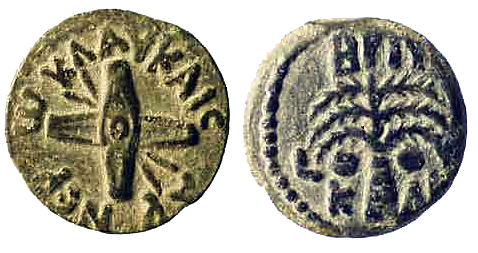
What were these shields? This coin that was minted later by Felix, prefect of Judea about AD 52-59 (Acts 23-24) might give us an idea. The obverse of the coin shows two oblong shields and two spears.

Coin of the Prefect Felix showing shields and spears.

Coin of the Prefect Felix showing two oblong shields and two crossed spears.

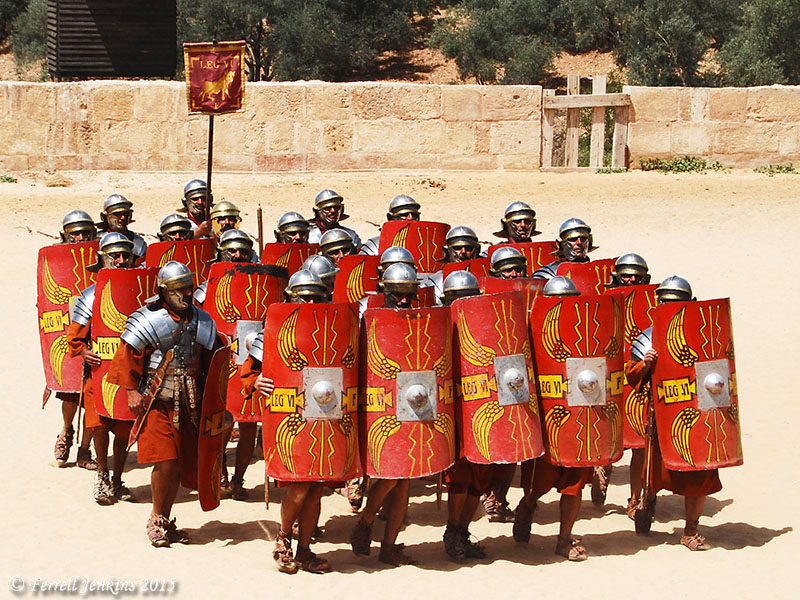
The actors involved in the RACE show at Jerash, Jordan, show us what the shields of the 6th Roman Legion might have looked like.

Enactment of soldiers of the 6th Roman Legion. Photo by Ferrell Jenkins.

Enactment of soldiers of the 6th Roman Legion. Photo by Ferrell Jenkins.

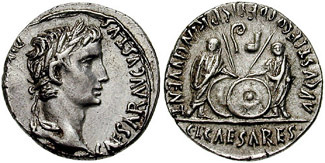
A denarius bearing the image of Augustus was struck in Lyon between 2 BC and AD 4. The reverse shows Gaius and Lucius standing, facing, holding shields and spears. In this case the shields are round, and are shown in association with the lituus and simpulum, symbols of the Imperial Cult. (I think you can easily find larger images of this coin on the Internet.)

Coin of Augustus showing shields, lituus, and simpulum.

Coin of Augustus showing shields, lituus, and simpulum.

Our point in all of this is to show that when Pilate erected the shields in Jerusalem it was in fact a symbol of the Imperial cult.

Next we plan to discuss the tiberium built by Pilate at Caesarea.