Category Archives: Israel

Sharks at Sharm el-Sheikh in the Sinai

Even our local TV news is reporting on the shark attacks at Sharm el-Sheikh in Egypt. Sharm el-Sheikh is located  on the tip of the Sinai Peninsula. The Huffington Post includes numerous links for those who have an interest in this subject here.

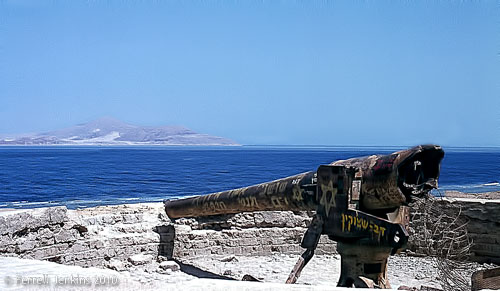
I have been in the Sinai peninsula several time, but have visited Sharm el-Sheikh only once in 1973. At that time the Sinai was under Israeli control. The site played an important role in the June War of 1967. The United Arab Republic closed the Straits of Tiran to Israeli shipping and blockaded all ships headed for Eilat. This narrow waterway and one of the Egyptian guns is seen in the old photo I made. Today Israel and Egypt share diplomatic relations and the Sinai is under Egyptian control. Sharm el-Sheikh is one of Egypt’s most popular resorts.

Egyptian gun taken by Israel at the Straits of Tiran in 1967. Photo by Ferrell Jenkins.

Egyptian gun taken by Israel at the Straits of Tiran in 1967. Photo by Ferrell Jenkins.

The Sinai is significant in biblical history because the traditional location of Mount Sinai is located there, equated with Jebel Musa.

The glory of the LORD settled on Mount Sinai, and the cloud covered it for six days. On the seventh day He called to Moses from the cloud. (Exodus 24:16 CSB)

Scholars are not in agreement on the location of Mount Sinai. In the beautiful revised edition of the Zondervan Atlas of the Bible, geographer Carl G. Rasmussen says,

… there are at least twelve different candidates for Mount Sinai: five in the southern part of the peninsula, four in the north, one in the center, one in Midian (Saudia Arabia), and another in Edom (southern Transjordan). — page 103

The pinnacle of the temple

A friend asks about the pinnacle of the temple.

Can you tell me where to find a diagram that shows the “pinnacle of the temple?” It looks as if the consensus is that it was Solomon’s porch. Anyone jumping off would land in the Kidron Valley.

In my reading the most common view is that the southeast corner of the Temple Mount is the place mentioned in Mark and Luke as  the pinnacle of the temple.

William Barclay says,

In the third temptation Jesus in imagination saw himself on the pinnacle of the Temple where Solomon’s Porch and the Royal Porch met. (The Gospel of Luke, in The Daily Study Bible Series, 44)

Benjamin Mazar, The Mountain of the Lord, shows a photo of the southeast corner of the wall with the comment that this “is known as the ‘pinnacle of the Temple’ (Mark 11:11; Luke 4:9),” page 149.

William Hendriksen says,

The present temptation, then, takes place in Jerusalem, to which the devil has led Jesus. Satan has set the Savior on the very pinnacle (literally wing) of the outer wall of the entire temple complex. The exact spot is not given. It may have been the roof-edge of Herod’s royal portico, overhanging the Kedron Valley, and looking down some four hundred fifty feet, a “dizzy height,” as Josephus points out (Antiq. XV.412). This spot was located southeast of the temple court, perhaps at or near the place from which, according to tradition, James, the Lord’s brother, was hurled down. See the very interesting account in Eusebius, EcclHist;, II.xxiii. ( New Testament Commentary : Exposition of the Gospel According to Luke, 237)

Here is the comment by Josephus,

… and this cloister deserves to be mentioned better than any other under the sun; for while the valley was very deep, and its bottom could not be seen, if you looked from above into the depth, this further vastly high elevation of the cloister stood upon that height, insomuch, that if anyone looked down from the top of the battlements, or down both those heights, he would be giddy, while his sight could not reach to such an immense depth. (Ant. 15:412)

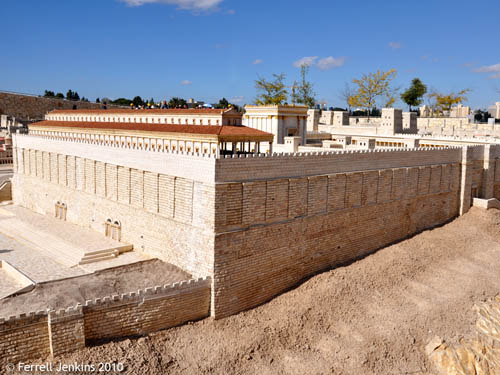
The photo below shows the southeast corner of the temple enclosure built by Herod the Great in the Second Temple model now displayed on the grounds of the Israel Museum.

Second Temple Model, Jerusalem. Photo by Ferrell Jenkins.

Second Temple Model view from the southeast. Photo by Ferrell Jenkins.

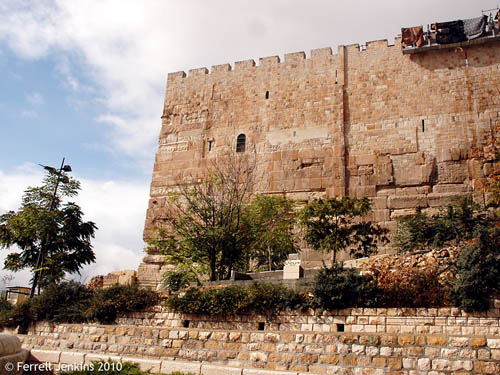
In the photo below we see the southeast corner from the east. The stone work includes a conglomerate ranging from later Moslem (at the top) to Herodian (at the bottom). At the present time one certainly would not fall into the Kidron Valley if he jumped from the top of the wall. I do not know what it might have been in the time of Jesus. I think a jump from the present wall to the land below would be deadly enough.

Southeast corner of Temple Mount enclosure. Photo by Ferrell Jenkins.

Southeast corner of Temple Mount enclosure. Photo by Ferrell Jenkins.

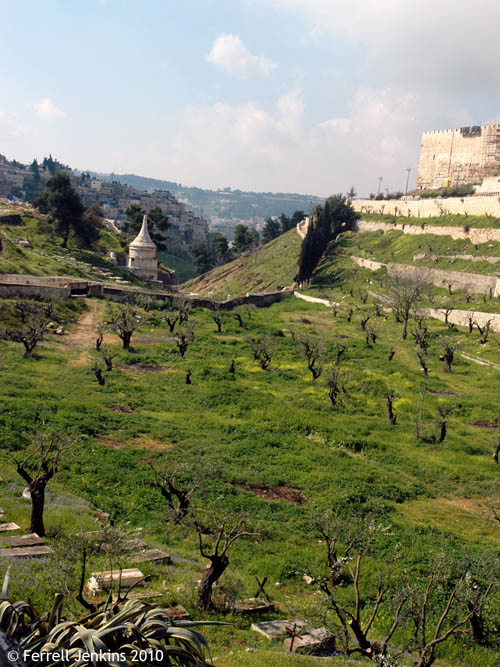
Here is a view of the Kidron Valley looking south. The “pinnacle of the temple” is visible in the upper right of the photo. The valley drops off rapidly near the point where you see the tomb on the left (Absalom’s Pillar).

Kidron Valley looking South. Photo by Ferrell Jenkins.

Kidron Valley looking South. Note wall in upper right. Photo by Ferrell Jenkins.

In a post to follow I will mention another view.

My friend asked where to find a diagram of the pinnacle of the temple. One might check the Image Library at Ritmeyer Archaeological Design here.

The photos above might be all one needs to illustrate the point. I have posted these in sizes large enough for use in teaching presentations.

Fire rages in Carmel mountains

Haaretz reports here on a fire in the Carmel mountains.

Forty people were killed on Thursday as a huge brush fire continued to rage across the Carmel Mountains in northern Israel, killing and injuring dozens, among them prison guards and firemen.

Some 13,000 people were evacuated from their homes in the north and Israel called for international aid as the fire blazed out of control, fanned by easterly winds following a month of near record temperatures for the time of year.

This story developed throughout the day Thursday and it would be best to use Google to search for updates.

Mount Carmel is a range which runs southeast from the Mediterranean Sea for about 14½ miles. It is probably best known in the Bible as the place of the contest between the prophet Elijah and the prophets of Baal (1 Kings 18:17-40). The traditional site for this event is shown at Muhraka on the eastern end of the range.

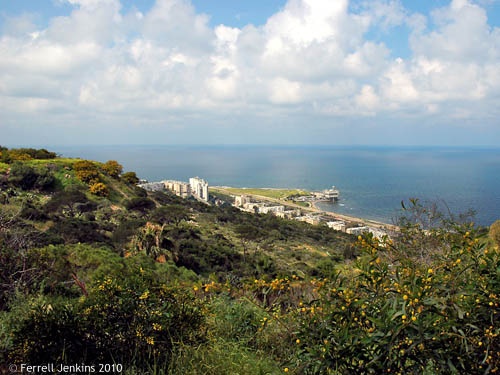
The photo below was made from an observation point on the western end of the Carmel range. Some of the buildings of greater Haifa can be seen along the Mediterranean. The photo shows some of the typical scrub brush seen many places on the mountain.

The Mediterranean Sea from Mount Carmel near Haifa. Photo by Ferrell Jenkins.

The Mediterranean Sea from Mount Carmel near Haifa. Photo by Ferrell Jenkins.

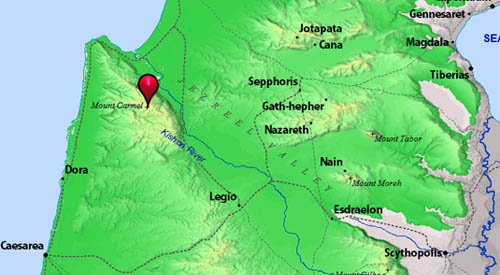
This map from BibleAtlas.org shows Mount Carmel in relation to sites in the Jezreel Valley and lower Galilee.

Map from BibleAtlas.org to show location of Mount Carmel.

Map from BibleAtlas.org showing the location of Mount Carmel.

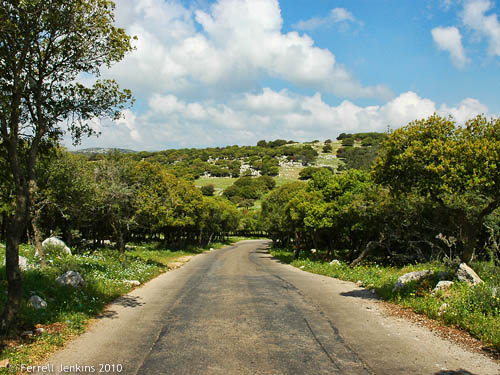
The next photo was made near Murakah on the southeastern end of the Carmel range.

Mount Carmel near Murakah. Photo by Ferrell Jenkins.

Mount Carmel near Murakah. Photo by Ferrell Jenkins.

Update: Todd Bolen, at the BiblePlaces Blog, calls attention to 35 powerful photos of the fire on Mount Carmel. Check boston.com.

Uriah’s trip from Jerusalem to Rabbah

Last evening I was looking at the biblical account of David’s battles against the Ammonites (2 Samuel 10-11).

In the spring of the year, at the time when kings normally conduct wars, David sent out Joab with his officers and the entire Israelite army. They defeated the Ammonites and besieged Rabbah. But David stayed behind in Jerusalem. (2 Samuel 11:1 NET)

You probably know the rest of the story. David is attracted to Bathsheba, commits adultery, learns Bathsheba is pregnant, calls Uriah home in hope that he will spend the night with Bathsheba. Uriah acted in the true warrior way by not enjoying the benefits of the marriage bed while his companions were camping in the open field. David sent Uriah back to the battle with a letter to Joab to put Uriah in the forefront of the battle.

Have you thought about the journey made by Uriah and the other Israelite soldiers as they traveled from Jerusalem to Rabbah and back? You know where Jerusalem is located. It is situated on the eastern side of the water parting ridge of Israel at an elevation of about 2400 feet above sea level. Numerous times we have discussed the journey from Jerusalem to the Jordan Valley. See here and here.

The distance from Jerusalem to the Dead Sea is not more than 20 miles. The elevation drops from about 2600 feet at the Mount of Olives to (currently) about 1384 feet below sea level at the surface of the Dead Sea. The point of crossing at the Jordan River would be a little higher. From there one must go up into the Transjordan Tableland to reach Rabbah. The general elevation of the Transjordan Tableland is about 3000 feet above sea level. Amman is about 2500 feet above sea level. That makes this a difficult route of travel.

Rabbah (Rabbath), the capital of ancient Ammon, is the site we now know as Amman, capital of Jordan. During the Hellenistic period the city was renamed Philadelphia.

The total distance from Jerusalem to Rabbah is about 40 miles as the crow flies. Men rarely travel like crows. The distance by road is longer and more difficult.

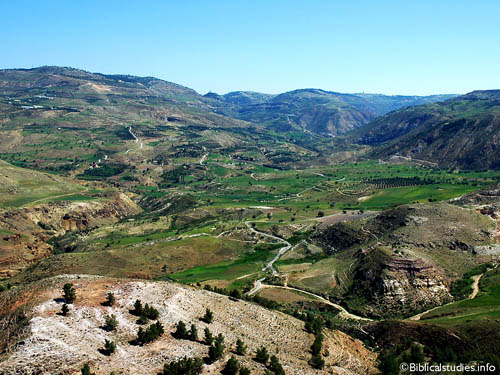
The photo I wish to share today was made in early April. It was made along a road a little east of the Jordan Valley and the Plains of Moab. From here you can see the terrain David’s men, including Joab and Uriah, had to travel on their way from Jerusalem to Rabbah. Modern Amman is located in the mountains we see on the horizon.

View looking east toward Amman. Photo by Ferrell Jenkins.

View looking east toward Amman. Photo by Ferrell Jenkins.

Learning routes of travel is one of the most important values in visiting the Bible lands. I hope this photo will help you with your study of the biblical account.

More about the first preaching on Pentecost

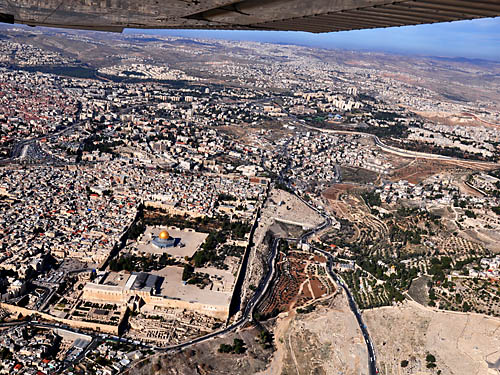
In this aerial view of Jerusalem you can see the Temple Mount enclosure and most of the Old City of Jerusalem. The Kidron Valley and the western slope of the Mount of Olives is visible on the right of the photo.

Aerial view of Jerusalem looking NE. Photo by Ferrell Jenkins.

Aerial view of Jerusalem looking NE. Photo by Ferrell Jenkins.

The photo below is a cropped portion of the image with emphasis on the Temple Mount.

The Temple Mount enclosure from the south. Photo by Ferrell Jenkins.

A closer view of the Temple Mount enclosure from the south. Photo by Ferrell Jenkins.

Herod the Great began to rebuild the existing postexilic temple on a grander scale about 20 B.C. Work had been going on for 46 years in the early days of the ministry of Jesus.

Then the Jewish leaders said to him, “This temple has been under construction for forty-six years, and are you going to raise it up in three days?” (John 2:20 NET)

Where did Peter preach on Pentecost?

A questions comes from a young friend who has traveled to Israel with me, and who is preparing a sermon related to Peter’s sermon on Pentecost (Acts 2). He asks,

Where do you think that Peter spoke from on Pentecost? I ask because I plan on using pictures and visuals in PowerPoint and I want to make sure I’m showing pictures of the right places. From my research, it seems most likely that Peter would have either spoken from the southern steps leading up to the Temple Mount (the double gate) or from the actual Temple Mount. I plan to show just how large the area was, and why there would have been so many people at the Temple that day and at that time (9:00 am).

I have gathered a few comments that express some of my thoughts on this matter.

Some scholars begin with the “one place” where the disciples were gathered (Acts 2:1). It is said to be a “house” (Greek, oikos, Acts 2:2). Kistemaker indicates the place was a house and not in the precincts of the temple. He says we can not be certain, but assumes it was a place near the temple.

Where were the believers? Luke tersely writes that they were “in one place.” If we think of the upper room (1:13), we question whether this room could accommodate a group of 120. Luke, however, indicates that they were sitting in a house (v. 2) and not in the precincts of the temple.3 We admit that we are unable to achieve certainty, but we presume that the meeting place was near the temple, where the apostles stayed continually praising God (compare Luke 24:53). — New Testament Commentary: Exposition of the Acts of the Aposltes, 76.

Longnecker discusses references where the term house is used of the temple. He says,

… in the temple precincts they would have had the best opportunity of addressing a large crowd.

His conclusion is,

Therefore it is likely that Luke meant us to picture that same upper room as the setting for the miracle of the Spirit’s coming and the place from where the disciples first went out to proclaim the gospel.

The view that the preaching of Acts 2 took places in the house (upper room) does not provide suitable explanation for the larger group suggested in the text. About three thousand persons accepted the gospel and were baptized on that day (Acts 2:41). There were obviously many who did not obey.

Acts 2 begins in a house, but closes in the temple (Acts 2:46). Marshall expresses my thoughts.

We must assume that at some point the disciples moved outside from the upper room and came in contact with the crowds assembled in Jerusalem for the feast; dwelling need not necessarily imply permanent residence, although many Jews did return to Jerusalem from the Dispersion to end their days there. (Acts: An Introduction and Commentary, Tyndale New Testament Commentaries)

We should note that the term for temple in Acts 2 is hieros. This is the term used of the “temple courts” (NET) or the “temple complex” (CSB).
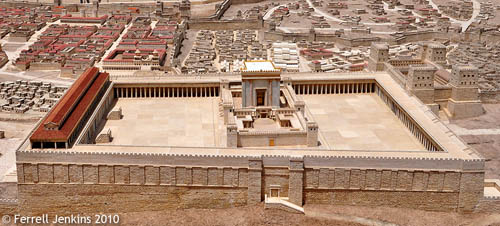
Second Temple model at the Israel Museum. Photo by Ferrell Jenkins.

Second Temple model at the Israel Museum. Photo by Ferrell Jenkins.

The temple precinct or complex is large. I was in Jerusalem one year at the close of the Moslem Ramadan when it was reported that more than 100,000 persons were present in the area. This would have provided adequate space for the activities of Acts 2.

The LORD prophesied through Isaiah about the events of the Pentecost of Acts 2.

And many peoples will come and say, “Come, let us go up to the mountain of the LORD, To the house of the God of Jacob; That He may teach us concerning His ways And that we may walk in His paths.” For the law will go forth from Zion And the word of the LORD from Jerusalem. (Isaiah 2:3 NAU)

It is true that the term Zion was sometimes applied to the entire city of Jerusalem, but it frequently seems to have a more specific reference to the temple area.

The disciples continued to go up to the temple at the hour of prayer (Acts 3:1). Their number soon grew to five thousand men and they met in Solomon’s Portico, thought to be on the east side of the temple platform (Acts 4:4; 5:12).

Where did Peter preach? I can’t be absolutely certain, but I opt for the temple complex. A copy of the photo suitable for presentations is available by clicking on the image.

Post A.D. 70 Roman bathhouse found in Jerusalem

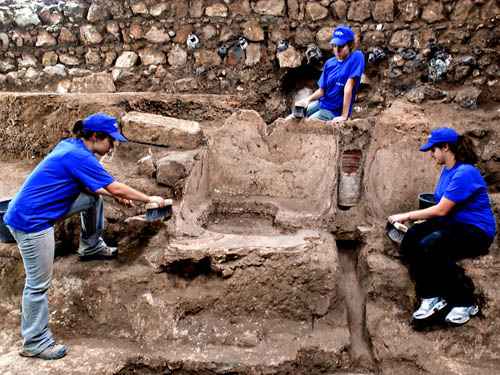
The Israel Antiquities Authority released a report today about the discover of a Roman period (Post A.D. 70) bath was found in the Jewish Quarter of the Old City of Jerusalem.

Three excavators working on the Roman bathhouse.

The Roman bathhouse. Photo: Assaf Peretz, courtesy of the Israel Antiquities Authority.

A 1,800 year old bathing pool that was probably part of a bathhouse used by the Tenth Legion – the Roman soldiers who destroyed the Temple – was exposed in excavations the Israel Antiquities Authority is conducting prior to the construction of a men’s ritual bath (miqve) by the Jerusalem Municipality and the Moriah Company.

The discovery sheds light on the scope of Aelia Capitolina, the city that was founded on the Second Temple period ruins of Jerusalem and that defined the character of ancient Jerusalem as we know it today….

According to Dr. Ofer Sion, excavation director on behalf of the Israel Antiquities Authority, “We were surprised to discover an ancient bathhouse structure right below the spot where a miqve is to be built. During the excavation we uncovered a number of plastered bathtubs in the side of the pool. Incorporated in the side of the pool is a pipe used to fill it with water and on the floor of the pool is a white industrial mosaic pavement. The bathhouse tiles, which are stamped with the symbols of the Tenth Legion “Fretensis” – LEG X FR, were found in situ and it seems that they were used to cover a rock-hewn water channel located at the bottom of the pool. The hundreds of terra cotta roof tiles that were found on the floors of the pool indicate it was a covered structure. The mark of the soldiers of the Tenth Legion, in the form of the stamped impressions on the roof tiles and the in situ mud bricks, bears witness to the fact that they were the builders of the structure. It seems that the bathhouse was used by these soldiers who were garrisoned there after suppressing the Bar Kokhba uprising in 135 CE, when the pagan city Aelia Capitolina was established. We know that the Tenth Legion’s camp was situated within the limits of what is today the Old City, probably in the region of the Armenian Quarter. This assumption is reinforced by the discovery of the bathhouse in the nearby Jewish Quarter which shows that the multitude of soldiers was spread out and that they were also active outside the camp, in other parts of the Old City”.

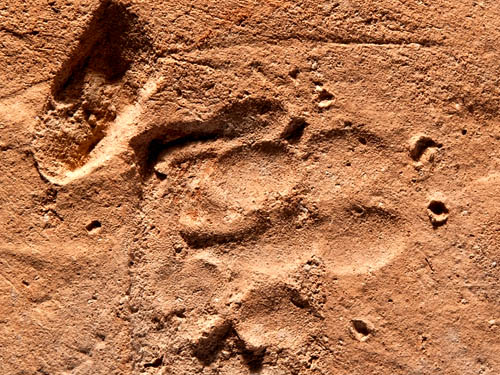
Dr. Sion adds, “Another interesting discovery that caused excitement during the excavation is the paw print of a dog that probably belonged to one of the soldiers. The paw print was impressed on the symbol of the legion on one of the roof tiles and it could have happened accidentally or have been intended as a joke”.

Read the full report here.

Dog paw found in excavation of Roman bathhouse in Jerusalem.

Dog paw found in the Roman bathhouse in the Jewish Quarter of Jerusalem.Photo: Assaf Peretz, courtesy of the Israel Antiquities Authority.

I could not help but think of  the situation poor Lazarus found himself in at the gate of the rich man:

He longed to be filled with what fell from the rich man’s table, but instead the dogs would come and lick his sores. (Luke 16:21 CSB)

HT: Bible Places Blog

Astronaut photo of Egypt, Israel and Jordan at night

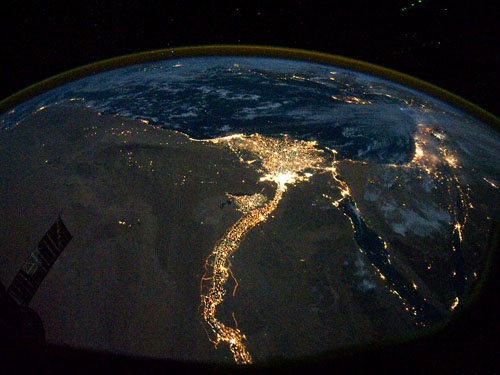
The satellite photo below is one of the fabulous photos made by NASA astronauts from space. The emphasis in this photo is the Nile Delta at night. You are able to see the portion of Egypt where most of the people live. The Sinai, Israel and Jordan are also visible. To the north, the island of Cyprus and the south shore of Turkey can be seen.

NASA Astronaut Photography of the Egypt and Israel by night.Astronaut photo of Egypt, Israel and Jordan at night.

NASA provides a helpful explanation of the photo.

One of the fascinating aspects of viewing Earth at night is how well the lights show the distribution of people. In this view of Egypt, we see a population almost completely concentrated along the Nile Valley, just a small percentage of the country’s land area.

The Nile River and its delta look like a brilliant, long-stemmed flower in this astronaut photograph of the southeastern Mediterranean Sea, as seen from the International Space Station. The Cairo metropolitan area forms a particularly bright base of the flower. The smaller cities and towns within the Nile Delta tend to be hard to see amidst the dense agricultural vegetation during the day. However, these settled areas and the connecting roads between them become clearly visible at night. Likewise, urbanized regions and infrastructure along the Nile River becomes apparent (see also The Great Bend of Nile, Day & Night.)

Another brightly lit region is visible along the eastern coastline of the Mediterranean—the Tel-Aviv metropolitan area in Israel (image right). To the east of Tel-Aviv lies Amman, Jordan. The two major water bodies that define the western and eastern coastlines of the Sinai Peninsula—the Gulf of Suez and the Gulf of Aqaba—are outlined by lights along their coastlines (image lower right). The city lights of Paphos, Limassol, Larnaca, and Nicosia are visible on the island of Cyprus (image top).

Scattered blue-grey clouds cover the Mediterranean Sea and the Sinai, while much of northeastern Africa is cloud-free. A thin yellow-brown band tracing the Earth’s curvature at image top is airglow, a faint band of light emission that results from the interaction of atmospheric atoms and molecules with solar radiation at approximately 100 kilometers (60 miles) altitude.

The image is used courtesy of the Image Science & Analysis Laboratory, NASA Johnson Space Center. You may access various images at their website here. An annotated photo is available there.

HT: Aantekeningen bij de Bijbel

Attending the Near East Archaeological Society

For the past few days I have been attending the annual meeting of the Near East Archaeological Society and the Evangelical Theological Society. NEAS is a small organization which meets in association with the ETS each year. This gives one the opportunity to attend meetings of either society. ETS has grown tremendously over the years that I have attended — first about 1976, I think. This year more than 2600 persons registered for the meeting. Even though I no longer teach, I like to attend these meetings in order to keep abreast of recent scholarship in areas in which I have special interest.

Among the lectures I heard at NEAS are the following:

Douglas Petrovich (University of Toronto) presented an impressive lecture on “More signs of societal upheaval in Egypt during the days of Joseph.”

Randall Price (Liberty University) was scheduled to make a presentation on Messiah in the Temple: A New 3-D Digital Computer Model of the Second Temple based on historical and archaeological data,” but his co-presenter was not able to make the trip from Germany. Dr. Price gave a presentation in refutation of the recent claims of a Chinese group who claimed they had found Noah’s ark on Mount Ararat.

Mark Wilson (Asia Minor Research Center) and Nadin Burkhardt (University of Frankfurt) spoke about the new excavation of the Priene synagogue (in Western Turkey).

Steven Ortiz (Southwestern Baptist Seminary) spoke about the most recent excavations at Gezer. Dr. Ortiz is one of the directors of the dig where much evidence from the 9th and 10th century B.C. is coming to light.

Eric Mitchell (Southwestern Seminary) told about the landscape archaeology associated with the current excavations at Gezer.

Bryant G. Wood (Associates for Biblical Research) presented the finds from the 2009 and 2010 seasons at Khirbet el-Maqatir. Wood thinks that this site is an excellent candidate to be identified with biblical Ai, rather than the generally accepted site at Et-Tell. Wood is director of this dig in the Palestinian West Bank.

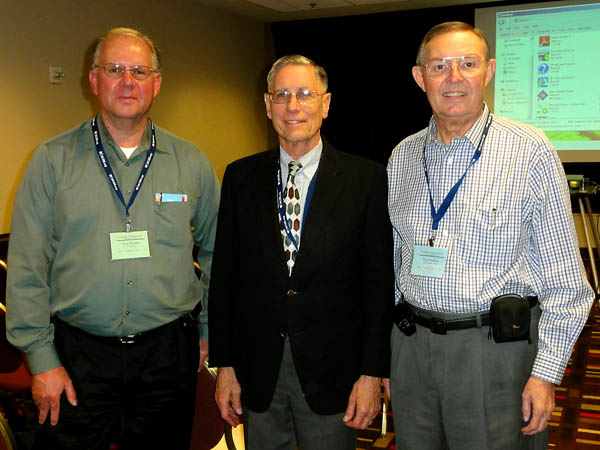
I asked Michael Luddeni, photographer for Bible and Spade and several excavation projects, to make a photo of Leon Mauldin and me with Dr. Bryant Wood.

Leon Mauldin, Dr. Bryant Wood, Ferrell Jenkins at NEAS annual meeting.

Leon Mauldin, Dr. Bryant Wood, Ferrell Jenkins at NEAS annual meeting.

Steven Collins (Trinity Southwestern University) made an excellent presentation on the rise and ruin of a bronze age city-state at Tall el-Hammam, Jordan. Collins is director of this dig.

James H. Charlesworth (Princeton Theological Seminary) was an invited speaker who gave a lecture on two Herodian pools north and south of the Jerusalem temple as they relate to the Gospel of John (chs. 5 and 9). These, of course, were the pools of Bethesda and Siloam. He argued that both pools were mikvaoths (ritual pools) at the time.

There were other good lectures at NEAS. Some of these scholars make similar presentation at the ASOR or SBL meetings.

Among the lectures I heard at ETS, I found these two to be extremely good:

British scholar N. T. Wright (St. Andrews University) spoke on “Justification yesterday, today and tomorrow.”

Eugene H. Merrill (Dallas Theological Seminary) gave the presidential address at the banquet on “Old Testament Scholarship and the man on the street: whence and whither?”

When I was still teaching I attended lectures dealing primarily with the subjects I was actively teaching. Now I attend anything that strikes my fancy. Because I frequently travel to the Middle East I enjoy keeping up with the archaeological excavations in those areas.

Ritmeyer’s Image Library now online

Dr. Leen Ritmeyer is well know for his archaeological drawings of the biblical era buildings, especially the temple. He now has much of his material online for immediate download. The Image Library is described this way:

The Image Library of Ritmeyer Archaeological Design contains authoritative reconstruction drawings and models which you will not find on any other website. The photos of ancient sites in the lands of the Bible have also been taken through the informed lens of an archaeological architect. A treasure-trove for teachers, pastors, lecturers and picture editors, it is the result of years of experience digging and researching in Israel and traveling in the surrounding countries.

The Image Library is arranged in different categories and is fully searchable. The different categories are designed to help you find the picture you are looking for easily. All preview illustrations are watermarked, but these won’t appear on the downloads.

For ease of use, each image comes with a descriptive note and, where applicable, full Scripture references. With the explosion of information coming from excavations, we hope that this will become an ever-expanding resource vital for all who wish to incorporate both beauty and authenticity into their portrayal of the Bible background.

Go here for additional information, and to browse the collection. The architectural drawings are $5 each, and the photographs are $3 each.

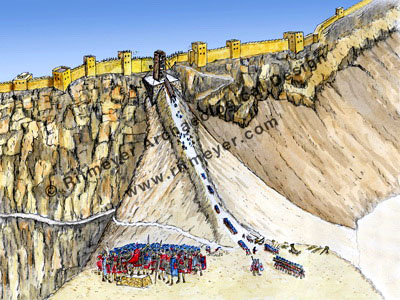
Here is a small sample of one of the drawings. This one shows the siege ramp built by the Romans at Masada in A.D. 72.

Roman siege ramp at Masada. Ritmeyer Image Library.

Roman siege ramp at Masada. Ritmeyer Image Library.

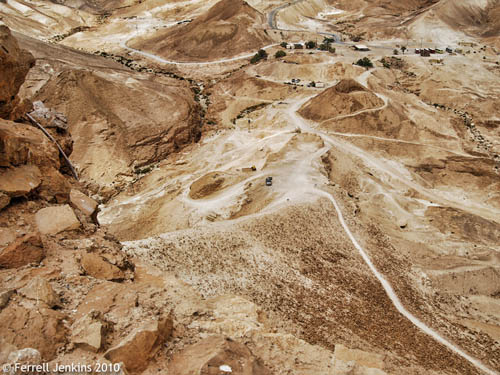
Here is one of my photos showing the siege ramp from above. The wall of Masada is visible in the left of the image.

The siege ramp at Masada. Photo by Ferrell Jenkins.
The Roman siege ramp at Masada from above. Photo by Ferrell Jenkins.

Certainly there is no excuse for presenting a dull, image deprived Bible class lesson or sermon.