Category Archives: Israel

Herod the Small

It is true that we refer to him as Herod the Great because of the power he exerted, his long reign, the sons he appointed as rulers, and the massive buildings and fortresses he constructed.

In character he was small or little.Notice the account of the birth of Jesus in Matthew 2, and Herod’s reaction to the news of the wise men from the east.

 1 Now after Jesus was born in Bethlehem of Judea in the days of Herod the king, behold, wise men from the east came to Jerusalem,  2 saying, “Where is he who has been born king of the Jews? For we saw his star when it rose and have come to worship him.”  3 When Herod the king heard this, he was troubled, and all Jerusalem with him;  4 and assembling all the chief priests and scribes of the people, he inquired of them where the Christ was to be born.  5 They told him, “In Bethlehem of Judea, for so it is written by the prophet:  6 “‘And you, O Bethlehem, in the land of Judah, are by no means least among the rulers of Judah; for from you shall come a ruler who will shepherd my people Israel.'” 7 Then Herod summoned the wise men secretly and ascertained from them what time the star had appeared.  8 And he sent them to Bethlehem, saying, “Go and search diligently for the child, and when you have found him, bring me word, that I too may come and worship him.” (Matthew 2:1-8 ESV)

When Herod learned that he had been tricked he was outraged, and made plans to kill not only Jesus but all of the male children in the Bethlehem region that were under two years of age.

Then Herod, when he saw that he had been tricked by the wise men, became furious, and he sent and killed all the male children in Bethlehem and in all that region who were two years old or under, according to the time that he had ascertained from the wise men. (Matthew 2:16 ESV)

I have found it ironic that one of the most important of Herod’s building programs was the fortress known as the Herodium built within sight of Bethlehem. Nonetheless, this king feared an infant. Little men always fear those who threaten their power.

Here is a photo of the Herodium with some of the ruins of the lower Herodium in the foreground.
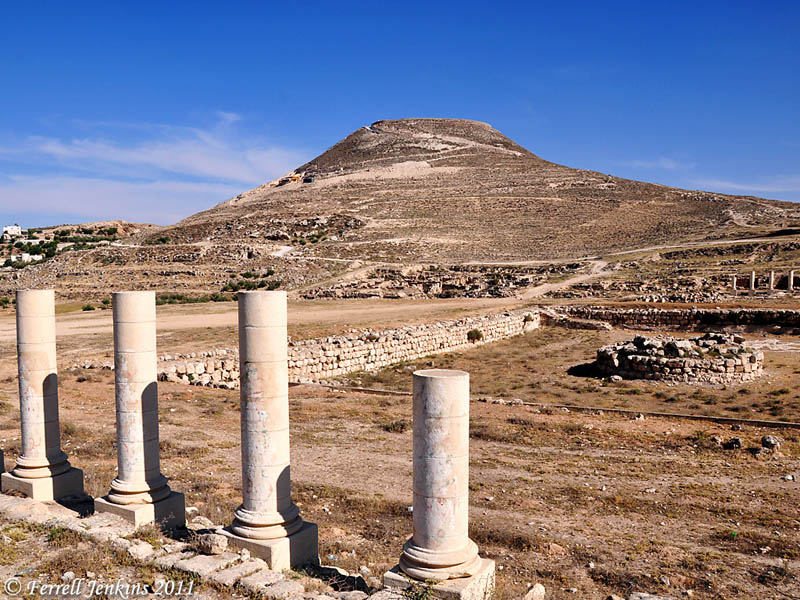
The Herodium with ruins of Herodia in the foreground. Photo by Ferrell Jenkins.

The Herodium with ruins of lower Herodium in the foreground. Photo by Ferrell Jenkins.

The artificial conical structure was built by Herod as one of his fortresses. This fortress is located about 8 miles south of Jerusalem, 3 1/2 miles east of Bethlehem, on the western edge of the Wilderness of Judea.

The tomb of Herod the Great was discovered about half way up the north side in 2007 by the late Prof. Ehud Netzer. You may use the search box to locate other articles about the Herodium, including some aerial photos.

A few years ago I called attention to a psychological study of Herod. I see the review of the scholarly book is still available at Haaretz here. If you have thought or read that he was cruel, just wait till you read this.

Previous posts relating to the birth of Jesus and Christmas

Thanks for the good response to our posts on frankincense and myrrh. Over the past 4+ years I have written several posts about Christmas, the birth of Jesus, and Bethlehem, in hope that they would be beneficial to Bible students and teachers.

Here are links to some of the more significant articles, usually with photos.

If you have more interest in learning about the origin of the celebration of the birth of Christ, take a look here. A more detailed study of the historical aspects of the celebration is available in PDF here.

For the next couple of days I plan to spent some (read, total) time with my grandson. I trust you will enjoy quality time with your family and friends.

I see that Leon Mauldin has a post about the manger at Leon’s Message Board here, and another about the traditional site of Jesus’ birth in Bethlehem here.

Todd Bolen has a list of his Christmas-Related Posts at Bible Places Blog here.

Some things you may not hear about Myrrh in a sermon

Myrrh is described in Fauna and Flora of the Bible, a publication of the United Bible Societies, as follows:

Myrrh is a dark-red gum with a strong aroma and a bitter taste. It exudes from a bush or tree belonging to a family of the burseraceæ which grows in Arabia, Abyssinia and on the Somali coast of East Africa. It is not native to Palestine. This tree or bush has a great number of knotted branches. The gum exudes from the branch as a thick light-coloured paste which, when exposed to the atomsphere, soon hardens and takes on a brownish colour. The finest myrrh was the resin secreted of itself (rather than by artificial incision) through the bark… (147)

When the secretion is collected directly from the bark it can be used as an ingredient in ointments.

When Ismaelites (Midianites) came from Gilead into the Dothan valley on their way to Egypt, Joseph’s brothers sold him to them (Genesis 37:27, 36). The Bible describes the caravan and the goods the Midianites were transporting.

a caravan of Ishmaelites was coming from Gilead, with their camels bearing aromatic gum and balm and myrrh, on their way to bring them down to Egypt. (Genesis 37:25 NAU)

In previous posts we have written about the Incense Route which was used by the Nabateans. This event was much earlier, and we see the caravan coming from the east (Gilead). The famous King’s highway ran through Gilead.

Myrrh is listed as a product of the land of Canaan when Jacob prepares his gift basket to be taken to Joseph (Genesis 43:11). This differs from what we normally read about myrrh. I do not know the solution to the problem at the moment. Perhaps it had been purchased from traveling merchants and was included with local products in the gift basket.

Myrrh could be in a liquid form. The ointment used in the anointing of priests had myrrh in it (Exodus 30:23). Oil of myrrh was in the cosmetics used by Esther (Esther 2:12). See also Song of Solomon 5:5.

The young man is advised to avoid the prostitute. He is told that she will entice him by saying,

I have sprinkled my bed
With myrrh, aloes and cinnamon. (Proverbs 7:17 NAU)

The young lady in the Song of Solomon thinks of her lover as a pouch or sachet of myrrh that lies all night between her breasts (1:13). She thinks of his lips as dripping with liquid myrrh (5:13).

The young man dreams of the time when he can approach her, and perhaps thinks of her breasts as the mountain of myrrh and the hill of frankincense.

Until the day breathes and the shadows flee, I will go away to the mountain of myrrh and the hill of frankincense. (Song of Solomon 4:6 ESV)

Myrrh displayed at Avdat, a stop on the Incense Route. Photo by Ferrell Jenkins.

Myrrh displayed at Avdat, a stop on the Incense Route. Photo by Ferrell Jenkins.

The wine offered to Jesus on the cross was mixed with myrrh (Mark 15:23).

Nicodemus brought about 75 pounds (= 100 Roman pounds) of myrrh and aloe for the burial of Jesus (John 19:39). We may conclude from this that Nicodemus, like Joseph of Arimathea (Matthew 27:57 NAU), was a wealthy man.

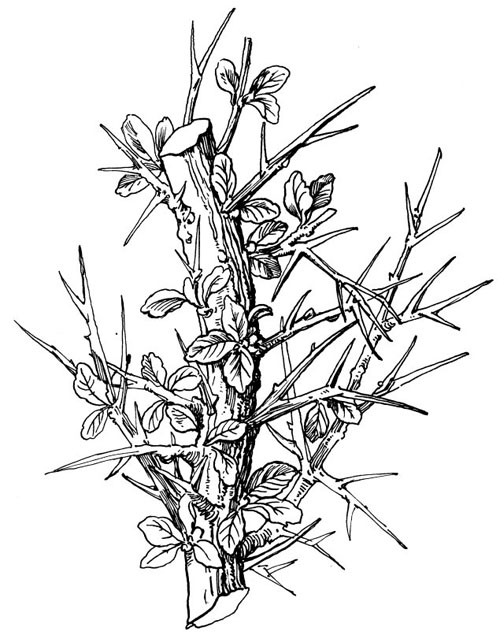
Myrrh branch. From 1000 Bible Images (Logos digital edition).

Myrrh branch. From 1000 Bible Images (Logos digital edition).

The wise men brought rare and expensive gifts to Jesus (Matthew 2:11). I trust that this brief discussion over the past three days has enhanced your understanding and appreciation of those gifts. What have we to give Him?

J. P. Van de Giessen has an article on Myrrh here, and a photo of the tree here.

Frankincense comes from a tree

In the previous post we looked at a few Biblical references that mention both frankincense and myrrh. We called attention to the Incense Route which ran from Arabia through Petra (now in Jordan) and Avdat in the Negev. In New Testament times this route was controlled by the Nabateans.

Frankincense is described in the Fauna and Flora of the Bible:

Frankincense is a balsamic gum exuding from the wood of different species of shrubs and trees belonging to the genus Boswellia. The bark is incised, and the finest quality of resin is obtained if this is done not too early in the year. The different species of Boswellia are native to India, the Somali coast and Arabia; the Midianites imported frankincense from Ephah and Sheba, Is 60:6; Jer. 6:20. Whether the Boswellia was grown in Palestine is rather doubtful. (121-122)

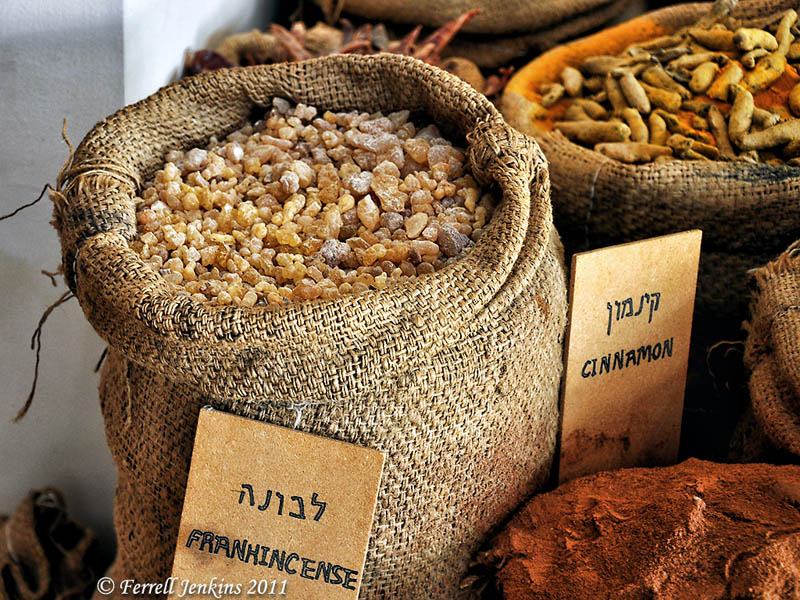
Frankincense is displayed at Avdat, stop number 62 on the famous Incense Route. Click on the photo for a larger image.

Frankincense at Avdat on the Incense Route. Photo by Ferrell Jenkins.

Frankincense at Avdat on the Incense Route. Photo by Ferrell Jenkins.

The Bible indicates several uses for frankincense.

  • Used in the incense associated with the anointing of the priests (Exodus 30:32).
  • Placed on a grain offering (Leviticus 2:1-2).
  • Placed on the bread for the tabernacle (Leviticus 24:7).

Levites were appointed to take care of the frankincense used in the temple (1 Chronicles 9:29). Eliashib the priest hid Tobiah in a large room where frankincense and other sacrificial items were stored (Nehemiah 13:5, 9).

Gold is mentioned with frankincense in Isaiah 60:6 and Matthew 2:11. Both are mentioned among the goods the merchants could no longer sell because of the fall of Babylon (Revelation 118:11-13).

The illustration showing the frankincense tree comes from 1000 Bible Images (Logos digital edition).

Frankincense Tree. 1000 Bible Images.

Frankincense Tree. 1000 Bible Images.

Our current header photo was made at Avdat, and indicates the importance of the city as an important stop on the Incense Route.

Frankincense and Myrrh

Frankincense and myrrh are mentioned together in the Song of Solomon and in the account of the visit of the magi from the east to see Jesus. Several significant things can be learned from these Biblical verses.

Look first at Song of Solomon 3:6.

“What is this coming up from the wilderness Like columns of smoke, Perfumed with myrrh and frankincense, With all scented powders of the merchant? (Song of Solomon 3:6 NAU)

  • Myrrh and frankincense are associated with the wilderness (desert; Hebrew, midbar).
  • Perhaps incense used in sacrifice or offering, “like columns of smoke.”
  • Associated with perfume and scented or fragrant powders.
  • Something traveling merchants would bring from the wilderness.

Song of Solomon 4:13-14 provides more insights.

“Your shoots are an orchard of pomegranates With choice fruits, henna with nard plants,  Nard and saffron, calamus and cinnamon, With all the trees of frankincense, Myrrh and aloes, along with all the finest spices. (Song of Solomon 4:13-14 NAU)

  • Associated with trees, and classified with spices.

The reference in the New Testament is in the account of the birth of Jesus (Matthew 2:1-11).

  • Frankincense and myrrh are in the category with gold, and offered as gifts to one who is considered a king and is being worshiped.
  • The magi have come from east of Jerusalem and Bethlehem.
  • Gold, frankincense, and myrrh are considered treasures.

All of these tips harmonize with what is known about frankincense and myrrh. The plants or trees from which these come are known to grow in the desert regions. They are not native to Biblical Israel. Traveling merchants from Arabia traveled long distances across the desert, making stops at Petra, Avdat, and other places on their way to Gaza and other Mediterranean ports where the products could be shipped throughout the Mediterranean world.

The photo below was made at Avdat, a Nabatean site in the Negev. The city was especially significant in the first century B.C. and the first century A.D. Avdat was stop number 62 on the famous Incense Route. It is now part of Israel’s National Park system, and a World Heritage Site. A display at the ticket office and shop explains about the Incense Route and shows some of the goods that were transported across the desert. This photo shows little packets of frankincense and myrrh that may be bought as souvenirs of your visit. Gold is still costly, but the market for frankincense and myrrh has fallen drastically since Bible times. The price in New Israeli Shekels is less than $4.

Frankincense and myrrh on the Incense Route at Avdat. Photo by Ferrell Jenkins.

Frankincense and myrrh on the Incense Route at Avdat. Photo by Ferrell Jenkins.

More to follow, hopefully.

Dead Sea Scrolls exhibition in Times Square, New York

Are you traveling to New York in the next few months? The Dead Sea Scrolls: Life and Faith in Biblical Times exhibition at the Discovery Times Square building in New York City is worth a visit.

Gordon Franz, a Bible teacher and archaeologist, has written about the exhibition on his Life and Land blog here. Gordon is known to the regular readers of this blog. We have called attention to several of his articles, especially those about “cracked pot archaeology.”

In addition to giving the details about the exhibition and how to get a $5 discount on your ticket, Franz tells you how to access his 39-page guide which he has written specifically from a Christian perspective. Actually, it should be helpful for any serious student of the Bible.

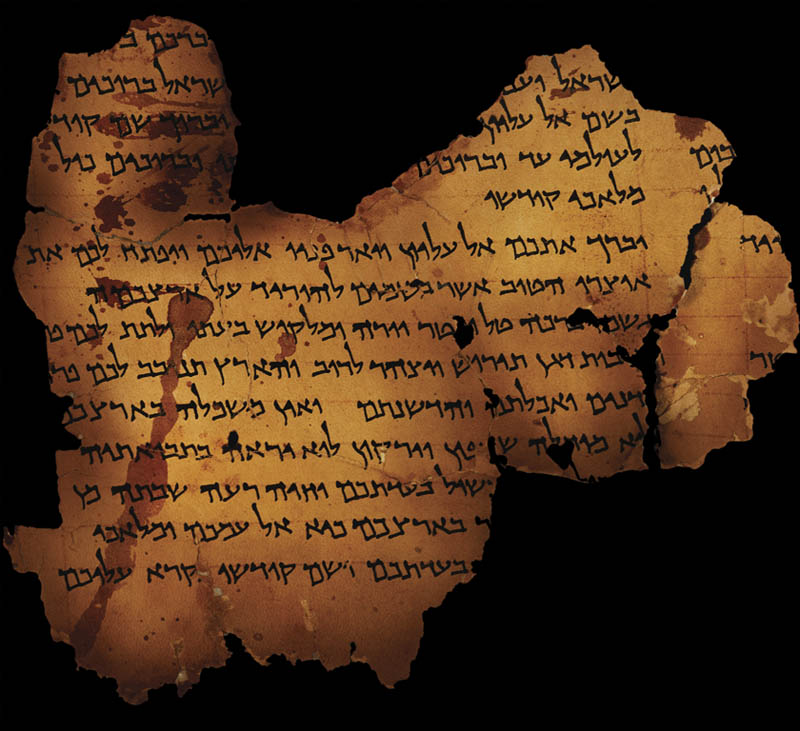
War Scroll displayed at the Discovery Times Square in New York City.

War Scroll displayed at the Discovery Times Square in New York City.

This exhibition is much more than a few fragments of the Dead Sea Scrolls. Artifacts, ossuaries, pottery, lamps, seals, and a stone from the wall build around the Temple Mount are included among the 500 items on display. The exhibition is on loan from the Israel Antiquities Authority. The exhibition runs until April 15, 2012. After that it moves to Philadelphia’s Franklin Institute for a few months beginning in May.

Dead Sea Scrolls - Life and Faith in Biblical Times display

Dead Sea Scrolls - Life and Faith in Biblical Times display.

If you have the opportunity to visit this exhibition, you should read Gordon’s guide written from a Christian perspective. His guide will be helpful to anyone interested in Bible life and times, even if you don’t get to visit the exhibition. The link to the guide is located at his Life and Land website here.

Thanks to Gordon Franz for giving me a heads-up on his guide.

Herod the Great didn’t do it all

Archaeologists in Jerusalem announced yesterday a new discovery that changes popular thinking about the building of the walls around the Temple Mount. It is not much of a surprise. We already knew that the Roman Street found at the SW corner of the wall dates to the period just before the destruction of Jerusalem by the Romans in A.D. 70. The last paragraph of the press release mentions that what was found was in harmony with the account of Josephus.

I have understood John 2:20 to be saying that work on the temple precinct was continuing as late as A.D. 26/27. That is a major reason this is not a surprise.

Then the Jewish leaders said to him, “This temple has been under construction for forty-six years, and are you going to raise it up in three days?” (John 2:20 NET)

Here is a portion of the press release issued by the Israel Antiquities Authority. I am leaving it full width for easier reading.

— • —

Professor Ronny Reich of the University of Haifa and Eli Shukron of the Israel Antiquities Authority: A ritual bath exposed beneath the Western Wall of the Temple Mount shows that the construction of that wall was not completed during King Herod’s lifetime.

Who built the Temple Mount walls? Every tour guide and every student grounded in the history of Jerusalem will immediately reply that it was Herod. However, in the archaeological excavations alongside the ancient drainage channel of Jerusalem a very old ritual bath (miqwe [mikve]) was recently discovered that challenges the conventional archaeological perception which regards Herod as being solely responsible for its construction.…

In an excavation beneath the paved street near Robinson’s Arch, sections of the Western Wall’s foundation were revealed that is set on the bedrock — which is also the western foundation of Robinson’s Arch — an enormous arch that bore a staircase that led from Jerusalem’s main street to the entrance of the Temple Mount compound.

According to Professor Reich, “It became apparent during the course of the work that there are rock-hewn remains of different installations on the natural bedrock, including cisterns, ritual baths and cellars. These belonged to the dwellings of a residential neighborhood that existed there before King Herod decided to enlarge the Temple Mount compound. The Jewish historian Josephus, a contemporary of that period, writes that Herod embarked on the project of enlarging the compound in the eighteenth year of his reign (that is in 22 BCE) and described it as “the largest project the world has ever heard of.”

When it was decided to expand the compound, the area was confiscated and the walls of the buildings were demolished down to the bedrock. The rock-cut installations were filled with earth and stones so as to be able to build on them. When the locations of the Temple Mount corners were determined and work was begun setting the first course of stone in place, it became apparent that one of the ritual baths was situated directly in line with the Western Wall. The builders filled in the bath with earth, placed three large flat stones on the soil and built the first course of the wall on top of this blockage.

While sifting the soil removed from inside the sealed ritual bath, three clay oil lamps were discovered of a type that was common in the first century CE. In addition, the sifting also yielded seventeen bronze coins that can be identified. Dr. Donald Ariel, curator of the numismatic collection of the Israel Antiquities Authority, determined that the latest coins (4 in all) were struck by the Roman procurator of Judea, Valerius Gratus, in the year 17/18 CE. This means that Robinson’s Arch, and possibly a longer part of the Western Wall, were constructed after this year – that is to say: at least twenty years after Herod’s death (which is commonly thought to have occurred in the year 4 BCE).

This bit of archaeological information illustrates the fact that the construction of the Temple Mount walls and Robinson’s Arch was an enormous project that lasted decades and was not completed during Herod’s lifetime.

This dramatic find confirms Josephus’ descriptions which state that it was only during the reign of King Agrippa II (Herod’s great-grandson) that the work was finished, and upon its completion there were eight to ten thousand unemployed in Jerusalem.

— • —

If you wish to see the complete press release click here.

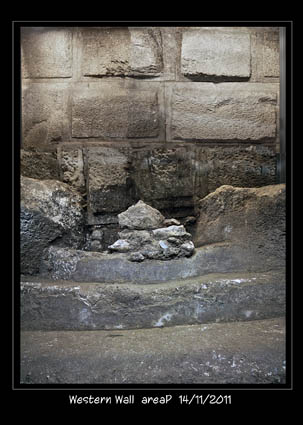
Below are a few of the photos provided by the IAA. The first shows the lowest course of the wall resting on bedrock.

The first course of the wall resting on the bedrock. Photograph: Vladimir Naykhin.

The first course of the wall resting on the bedrock. Photograph: Vladimir Naykhin.

The next photo shows one of the coins dating to the time of Roman Procurator Valerius Gratus in the year A.D. 17/18. He was procurator A.D. 15-26, and followed by the better known Pontius Pilate (A.D. 26-36).

A coin of the Roman procurator Valerius Gratus, which helped in dating the construction of Robinson’s Arch.

A coin of the Roman procurator Valerius Gratus, which helped in dating the construction of Robinson’s Arch. Courtesy IAA.

The third photo shows some of the workers excavating the area.

Archaeologists working at bedrock below Robinson's Arch. Photo: IAA.

Archaeologists working at bedrock below Robinson's Arch. Photo: IAA.

After writing my post, I see that Todd Bolen accuses the IAA of being “desperate for headlines.” See his comments here.

HT: Joseph I. Lauer

New insights into the clothing of the Qumran inhabitants

The recent edition of Dead Sea Discoveries has an article by Orit Shamir and Naama Sukenik on “Qumran Textiles and the Garments of Qumran’s Inhabitants.” The article costs $35 from Brill. To order click here. Here is the abstract.

Among the Qumran textiles that were kept at the Rockefeller Museum was a group of textiles that were unusual for Qumran. Most of them were made of wool, and some were dyed or decorated. Their marking QCC—Qumran Christmas Cave indicates their origin. In 2007 the cave was investigated by Porat, Eshel, and Frumkin. The cave is located in the bottom section of Kidron valley and doesn’t belong to Qumran caves. It can now be determined that all of the textiles from Qumran are made solely of linen. They were free of any colored decoration, except for scroll wrappers that decorated in blue. This, and the simplicity and whiteness of the textiles from Qumran, is compatible with the literary sources. It appears that the people of Qumran wished to differentiate themselves from the rest of the population also on the basis of their style of garments.

A popular article based on the technical paper appears in LiveScience here. Some speculation about the writers of the scrolls is based on the cloths found with the scrolls. Look also for an Image Album of 8 captioned photos including the textiles from Qumran and the Christmas Cave.

Most of the cloth wrappings found at Qumran were white and made of linen. The wrappings found at Christmas Cave were colorful and made of wool. The Mosaic law was clear about the clothing to be worn by the Israelites.

Do not wear clothes made of both wool and linen. (Deuteronomy 22:11 CSB)

Jodi Magness cites the War Scroll to illustrate that the “Qumran sectarian clothing must be made entirely of linen” (Stone and Dung, Oil and Spit, 116).

Most Bible students probably think of the Kidron valley running north to south between Jerusalem and the Mount of Olives. That is correct, except that the brook joins with the Hinnom valley and continues east to the Dead Sea.

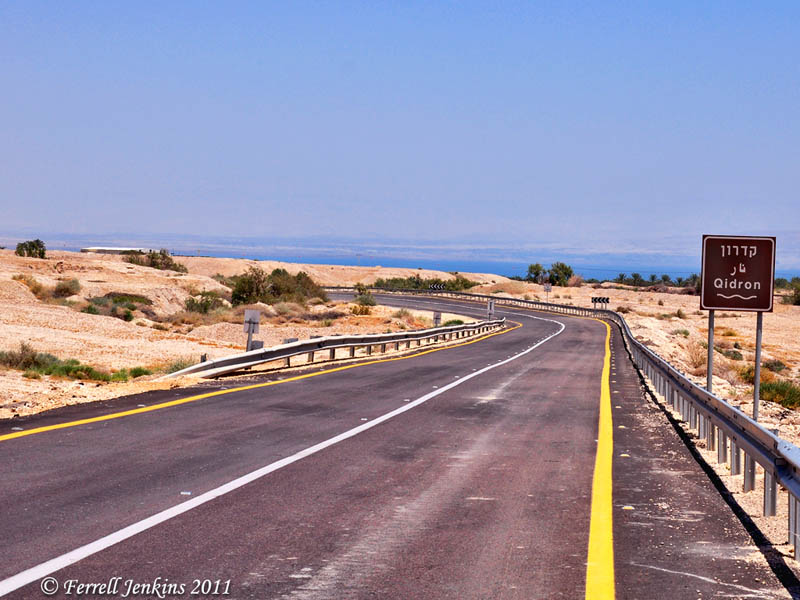
The photo below was made about 4.25 miles south of Qumran along the Dead Sea Road (Hwy. 90) as it crosses the brook Kidron (Qidron). The Christmas Cave mentioned in the article is to the west (left) of the highway as the brook comes down from Jerusalem. (Click on the photo for a larger image.)

Location of the Brook Kidron on Dead Sea Road (view north). Photo by Ferrell Jenkins.

Crossing Brook Kidron on Dead Sea Road (view northeast). Photo by Ferrell Jenkins.

When David fled from Jerusalem at the time of Absalom’s rebellion, he crossed the Kidron “toward the way of the wilderness.”

Everyone in the countryside was weeping loudly while all the people were marching past. As the king was crossing the Kidron Valley, all the people were marching past on the road that leads to the desert. (2 Samuel 15:23 CSB)

HT: Joseph I. Lauer

Approaching Gennesaret

The Sea of Galilee is called the “lake of Gennesaret” (Luke 5:1), and the “Sea of Tiberias” (John 6:1; 21:1). This indicates that both Tiberias, where Herod Antipas had built his capital in the mid-20s of the first century, and Gennesaret were significant places. When one traveled from Nazareth, Cana, or others places west of the Sea of Galilee, he would pass by Mount Arbel into the plain or land of Gennesaret.

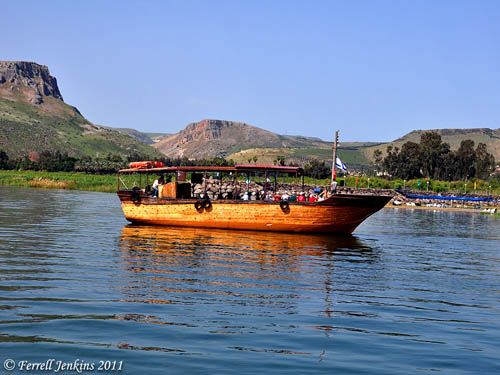
This photo, taken on an unusually clear day, shows a small ship about to anchor at Nof Ginosaur (= Gennesaret). To the west we see Mount Arbel and the pass below allowing travel and commerce between lower Galilee and the towns around the Sea of Galilee.

Boat approaches the land of Genessaret. Photo by Ferrell Jenkins.

Boat approaching the land of Gennesaret. Photo by Ferrell Jenkins.

The photo nicely illustrates the text of Mark 6.

When they had crossed over they came to land at Gennesaret, and moored to the shore. When they got out of the boat, immediately the people recognized Him, and ran about that whole country and began to carry here and there on their pallets those who were sick, to the place they heard He was. Wherever He entered villages, or cities, or countryside, they were laying the sick in the market places, and imploring Him that they might just touch the fringe of His cloak; and as many as touched it were being cured. (Mark 6:53-56 NAU. cf. Matthew 14:34-36)

The first disciples of Jesus were called by the lake of Gennesaret (Luke 5:1).

The Patriarchs lived in the Negev

English Bibles translate the Hebrew word negev in a variety of ways.

  • South — KJV; NKJV
  • “the South [country]” is the Translator’s Note in the NET Bible. A study note says, “Negev is the name for the southern desert region in the land of Canaan.”
  • Negeb — ESV
  • Negev — most modern English versions.
  • eremos — the word for desert or wilderness is used in the LXX. This word does not describe the Negev precisely enough.

I am away from home and most of my resources, but I recall hearing the late Anson Rainey describe the Negev like the figure 8. Turn the 8 horizontal with Beersheba in the center. The area is one that is often subject to drought and famine.

The Patriarchs, Abraham, Isaac, and Jacob spent much time in the Negev (Genesis 12:9; 13:1,3; 20:1; 24:62).

The Israelite spies were sent by Moses from the Sinai to investigate Canaan. The text makes it clear that they had to go through the Negev to get to the hill country and Hebron. Hebron is only about 25 miles north of Beersheba. Once we head south from Hebron we begin to notice a change from the hill country to a more dry clime.

When Moses sent them to investigate the land of Canaan, he told them, “Go up through the Negev, and then go up into the hill country (Numbers 13:17 NET)

When they went up through the Negev, they came to Hebron… (Numbers 13:22 NET)

The Canaanite king of Arad lived in the Negev (Numbers 21:1). Arad is located east of Beersheba as the land slopes down to the Dead Sea.

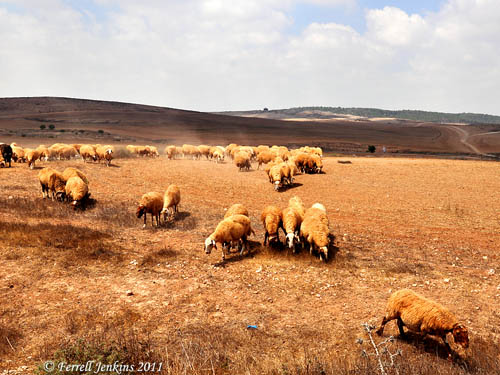
Our photo today was made a few miles north of Beersheba. I think it illustrates the typical dryness of the region.

Sheep in the Negev. Photo by Ferrell Jenkins.

Sheep in the Negev. Photo by Ferrell Jenkins.