Category Archives: Israel

Mosaic of Samson and the foxes discovered in Galilee synagogue

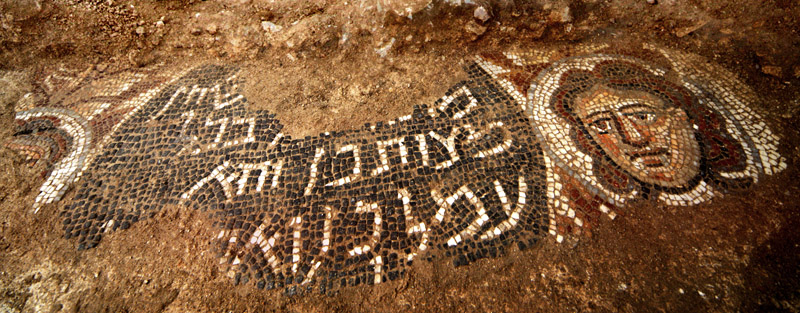
Excavations at Huqoq in Galilee have uncovered a mosaic floor depicting exploits of Samson. The photo below shows a female face and a partial Hebrew inscription referring to “rewards for those who perform good deeds .” No photo of the Samson portion of the mosaic has been provided.
Huqoq Galilee Synagogue Mosaic showing Samson. Photo by Jim Haberman.

Huquq Synagogue Mosaic with female face and inscription. Photo by Jim Haberman.

At the moment the most best information I have is from the Israel Antiquities Authority. Everything set off below, and the photo above, is from that source.

—•—

A monumental synagogue building dating to the Late Roman period (ca. 4th-5th centuries C.E.) has been discovered in archaeological excavations at Huqoq in Israel’s Galilee.

The excavations are being conducted by Jodi Magness of the University of North Carolina at Chapel Hill and David Amit and Shua Kisilevitz of the Israel Antiquities Authority, under the sponsorship of UNC, Brigham Young University in Utah, Trinity University in Texas, the University of Oklahoma and the University of Toronto in Canada. Students and staff from UNC and the consortium schools are participating in the dig

Huqoq is an ancient Jewish village located approximately two to three miles west of Capernaum and Migdal (Magdala). This second season of excavations has revealed portions of a stunning mosaic floor decorating the interior of the synagogue building. The mosaic, which is made of tiny colored stone cubes of the highest quality, includes a scene depicting Samson placing torches between the tails of foxes (as related in the book of Judges 15). In another part of the mosaic, two human (apparently female) faces flank a circular medallion with a Hebrew inscription that refers to rewards for those who perform good deeds.

“This discovery is significant because only a small number of ancient (Late Roman) synagogue buildings are decorated with mosaics showing biblical scenes, and only two others have scenes with Samson (one is at another site just a couple of miles from Huqoq),” said Magness, the Kenan Distinguished Professor in the department of religious studies in UNC’s College of Arts and Sciences. “Our mosaics are also important because of their high artistic quality and the tiny size of the mosaic cubes. This, together with the monumental size of the stones used to construct the synagogue’s walls, suggest a high level of prosperity in this village, as the building clearly was very costly.”

—•—

The web site of Dr. Magness may be accessed here.

Several centuries before the synagogue at Huqoq was built, Jesus visited synagogues in Galilee.

Jesus went throughout all of Galilee, teaching in their synagogues, preaching the gospel of the kingdom, and healing all kinds of disease and sickness among the people. (Matthew 4:23 NET)

HT: Joseph Lauer
Header: The view from Adullam

The header we have chosen to use today shows a view of the Judean shephelah south from Adullam. The photo is a panorama of three images.

The cave of Adullam is associated with David. When he left Gath he went to Adullam before sending his parents to Moab for safety.

So David left there and escaped to the cave of Adullam. When his brothers and the rest of his father’s family learned about it, they went down there to him. (1 Samuel 22:1 NET)

In fact, David spent much time at Adullam. I suggest you read the entire account in 2 Samuel 23:13ff.

For more information on Adullam, and a photo of the cave associated with David, click here.

Leeches in Sea of Galilee; Palestinian Village; Jericho

Sea of Galilee invaded by leeches. For the second time in 7 years the lake has an explosion of leeches. The article in Haaretz says,

Standing in the water for as little as two minutes will cause your legs to be covered in hundreds of leeches. These particular types are not blood-suckers, making them relatively easy to remove once one is out of the water

Causes for the large number of leeches include “human activity, including pollution, poisoning and overpumping.”

Read the full article here.

The Sea of Galilee was central to much of the ministry of Jesus.

While walking by the Sea of Galilee, he saw two brothers, Simon (who is called Peter) and Andrew his brother, casting a net into the sea, for they were fishermen. (Matthew 4:18 ESV)

Palestinian Village uses Roman irrigation system to continue terraced farming near Bethlehem. Read the story, with beautiful photo, in The New York Times here.

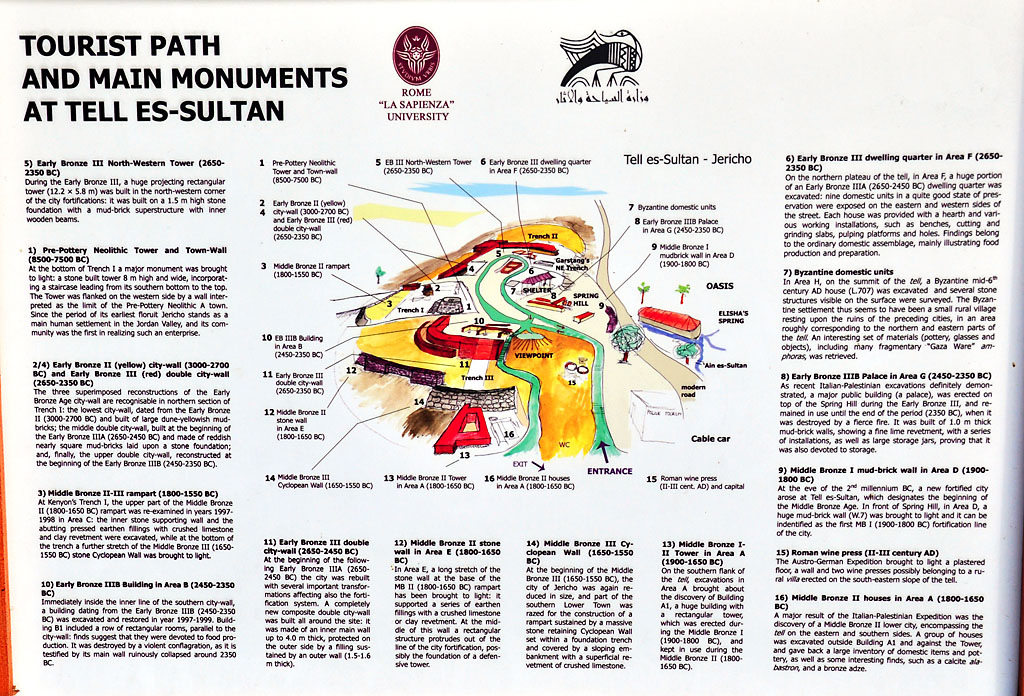
Tell es-Sultan/Jericho. Sepienza University in Rome, in cooperation with the Palestinian General Directorate of Antiquities, has published a Palestine Archaeological Databank and Information System. Check here for maps and other information. Our readers will likely be interested in the excavation reports on Tell es-Sultan/Jericho here. Click on the Results 2012 photo for the most recent work by the Italian-Palestinian Expedition at Jericho. Every visitor to the site will welcome is the new paths, identifying signs, and general clean-up of the site.

I was especially pleased to see the Digital Visit plan of the site. Click on it was a colorful, readable plan of the site like the central portion of the one shown below. Prof. Lorenzo Nigro is the director of the excavation.

Tourist Path and Main Monuments at Tell es-Sultan/Jericho. Photo by Ferrell Jenkins.

Tourist Path and Main Monuments at Tell es-Sultan/Jericho. Photo by Ferrell Jenkins.

Jericho is important in Old Testament history (Joshua 6).

HT: Bible Places Blog; Jack Sasson; Barry Britnell; “La Sapienza” Expedition to Palestine.

BiblePlaces giveaway of the PLBL Israel Collection

Between now and Friday at 10 am Pacific time you have an opportunity to enter a significant giveaway worth $149. Todd Bolen announces how you can win one of two copies of the 5 volumes of Israel photos in the Pictorial Library of Bible Lands.

For full details click here. If you don’t win one of the sets you can always purchase it.

For my opinion about the full 18 volume Pictorial Library of Bible Lands see the review here.

— • —

Peter’s Epistles and Pontus. I have been busy with other matters and unable to write more about the Black Sea coast. Hopefully tomorrow.

Major revision of the Pictorial Library of the Bible Lands

Todd Bolen announces the release of a total revision of the Pictorial Library of Bible Lands. This revised and expanded edition is the culmination of 9 years of work. The previous version contained 6000 photographs in 10 volumes. According to the announcement,

This new edition consists of 18 volumes with nearly 18,000 photographs, adding hundreds of new sites and re-visiting the old favorites.

Here are just a few features of the new edition of the Pictorial Library of Bible Lands.

  • Eight new volumes: (Lebanon, Eastern and Central Turkey, The Greek Islands, and more. New subjects include Cultural Images, Signs, and Trees, Plants, and Flowers.
  • New Photos: For example, more than 1000 new photos have been added to the Jerusalem volume.
  • New Photographers. In addition to the photos by Todd Bolen, the work of more than 40 photographers are included in this new set.
  • New Maps. New, original maps have been created to identify the sites.
  • New Indexes. Every photograph is indexed in a list of more than 400 pages.
  • You get the hi-res photos and the photos already in PowerPoint. You can use the presentation as it is or include individual slides in your own lesson.
  • And more…
Pictorial Library Complete Collection. BiblePlaces.Com.

Front cover of the new Pictorial Library Complete Collection.

For those who already own the previous collection, Bible Places is offering the new 18-volume set for the upgrade price of $179. The entire set for new purchasers is $389.

Would you prefer to make your own photos? Try buying a good digital SLR camera starting at about $1500, flying to Israel (not to mention Lebanon, Egypt, Turkey, Greece, the Greek Islands, Italy, et al.), renting a car for a few weeks, buying the gas. Oh, and don’t forget to hire a private plane for a few hours so you can get some good aerial photos. That might cost at least $389. 🙂 And what if the lighting conditions were not right for a good photos the day you were at a site? What if you don’t have time to get your photos organized and write a description of each one? Need I go on to make a point? Did I mention that living and teaching in Israel for a decade helps?

Every church should have a set of this material for the teachers to use in their teaching. Over the years I have found that some short-sighted groups (churches) will not make such an expenditure. The other choice is to buy the set for yourself.

I hear several lessons a week, and every one of them could be improved by the use of photos from this wonderful collection.

Learn more about the new Pictorial Library of Bible Lands in the following places:

Charles Savelle has a good interview with Todd Bolen at the BibleX blog here.

I have profited much from the work of Todd Bolen and am delighted to count him as a friend and to recommend this collection of photographs to every teacher of the Bible.

Follow the BiblePlaces.com Blog here.

Additional Gezer boundary stone discovered

Eric Mitchell and Jason Zan report the discovery of a “previously undiscovered bilingual inscription” at Gezer, and the rediscovery of  an inscription lost for more than a century.

An archaeological survey led by Southwestern Baptist Theological Seminary of Fort Worth, Texas, discovered a previously undiscovered bilingual inscription this week at the ancient site of Tel Gezer, Israel. Gezer, a biblical city, was situated on the border between the Philistine and Israelite territories guarding the route to Jerusalem. The city was given as a dowry to the daughter of Pharaoh, who married king Solomon. Gezer is well known in the later Maccabean period for its boundary stones with inscriptions in both Hebrew and Greek. In addition to the new inscription, the Southwestern Seminary survey team rediscovered a previously known inscription that had been lost to the archaeological community for more than a century.

The boundary inscriptions demonstrate the period of conflict between the Seleucids and Maccabees. They show that the city had agricultural land around it and that the Jewish occupants were concerned over keeping their fields according to Jewish law. These discoveries are significant since the boundary stones have been frequently sought, but with long time frames between new discoveries. According to the scholarship of Ronnie Reich, of the University of Haifa, there are 12 known and published Gezer boundary stones dating to the Maccabean period. These bilingual inscriptions in outcrops of limestone bedrock ring the ancient city of Gezer on the South, East and Northeast. Many of these are two line inscriptions reading “Region of Gezer” on one line in Hebrew and “Belonging to Alkios” on the second line in Greek.

The article may be read in its entirety here.

According to the article, there are now 13 known boundary inscriptions from Gezer.

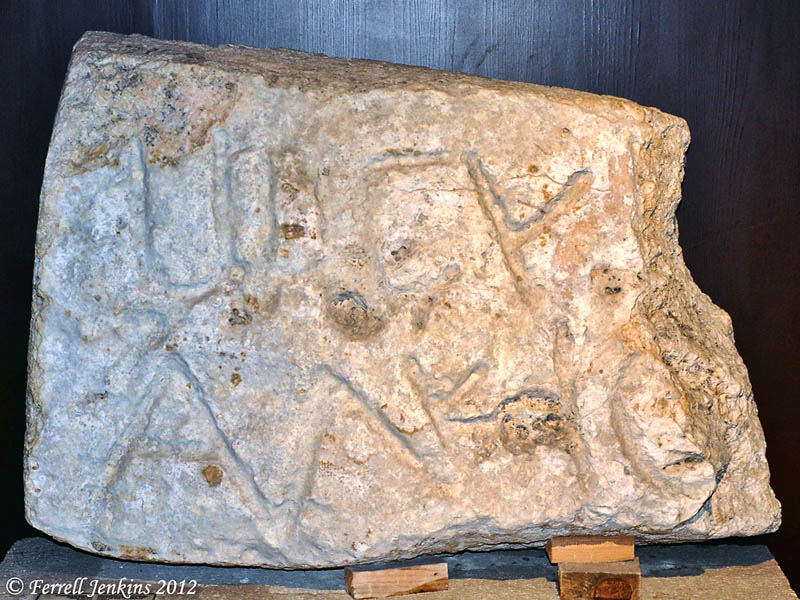
On my recent tour in the Steps of Paul and John, we visited the Istanbul Archaeological Museum where one of these boundary stones is displayed. It is turned so that the Greek letters “Alkio” are visible on the bottom. We would expect the missing letter to be the “s” or “u“. The line at the top, but upside down, is the Aramaic word for boundary or region, and the first letter of Gezer (GZR). Todd Bolen includes a photo here of one of the inscriptions still in place at Gezer.

Gezer Boundary Stone. Istanbul Archaeology Museum. Photo by Ferrell Jenkins.

Gezer Boundary Stone. Istanbul Archaeology Museum. Photo by Ferrell Jenkins.

Biblical references to Gezer include the following:

  • The king of Gezer fought against Joshua and the Israelites during the conquest (Joshua 10:33; 12:12).
  • Gezer was allotted to Ephraim (Joshua 16:3).
  • Gezer became a city of the Levites (Joshua 21:21). It was designated as a city of refuge (1 Chronicles 6:67).
  • Israel failed to drive out the Canaanites who lived in Gezer (Joshua 16:10; Judges 1:29).
  • By the time of David the Philistine seem to be living at Gezer (2 Samuel 5:25; 1 Chronicles 14:16; 20:4).
  • Pharaoh, king of Egypt, captured Gezer, burned it, and gave it as a dowry to his daughter, Solomon’s wife (1 Kings 9:16).
  • Solomon (re)built the cities of Hazor, Megiddo, and Gezer (1 Kings 9:15-17).

The following aerial photograph of Gezer was made in December, 2009.

Gezer Aerial View. Photo by Ferrell Jenkins.

HT: Bible Places Blog.

1400 year old olive press excavated

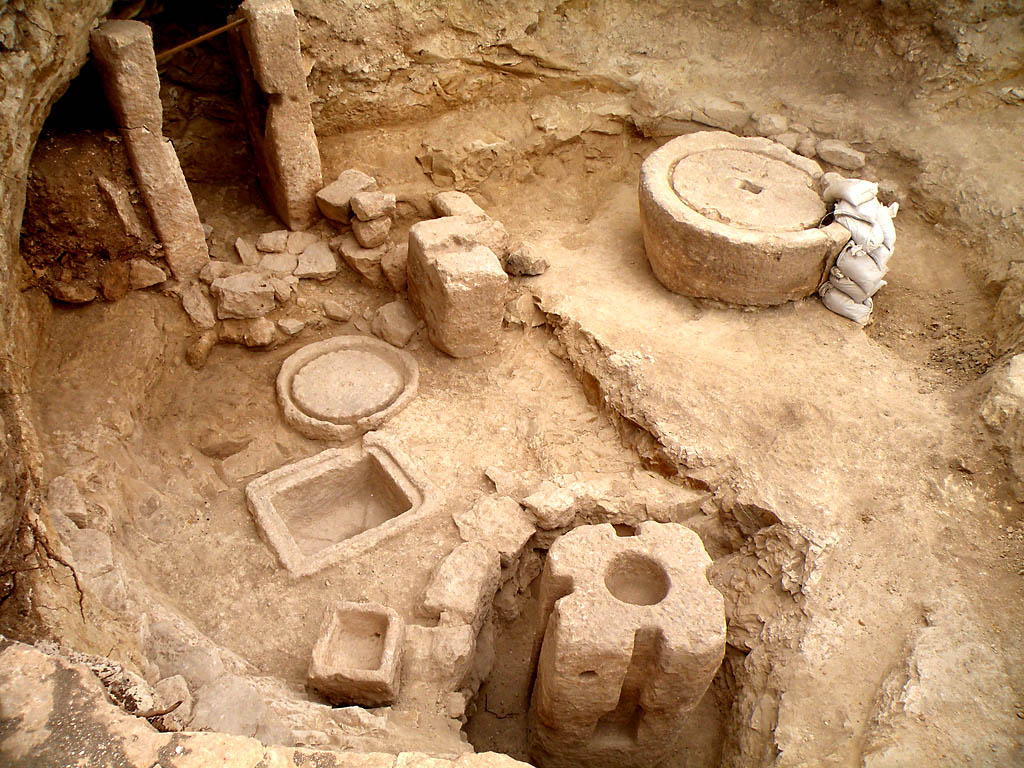
The Israel Antiquities Authority announces the discovery of a 1400 year old olive press at Modi’in. According to a brief article in Arutz Sheva,

A statement by the IAA called the press the grandest and most complete one found so far.

Archaeologist Hagit Torgë, who is directing the dig, said the press, which was used to produce industrial quantities of oil for food and light, about 1,400 years ago, “was preserved surprisingly intact with all its components.”

1400 year old olive press at Modi'in. Credit: Hagit Torgë, Israel Antiquities Authority.

Olive press at Modi’in. Credit: Hagit Torgë, Israel Antiquities Authority.

Click on the photo for a hi-res image.

Olives are mentioned in the Bible from Genesis (8:11) to Revelation (18:13), and are still important in many parts of the world.

HT: Joseph Lauer

Grinding grain in Bible times

The grinding of grain was an important part of the life of people in Bible times. After the grain was gathered from the fields it had to be threshed. This was done by running a threshing sledge over the stalks of grain on the threshing floor (2 Samuel 24:22). The stalks, now cut into small pieces, was then winnowed with “shovel and fork” to separate the chaff from the good grain (Isaiah 41:16; Ruth 3:2; Luke 3:17; Psalm 1:4). Next came the sifting of the grain to further removed small pieces of debris. Jesus makes reference to this practice when he predicts Peter’s denial:

“Simon, Simon, pay attention! Satan has demanded to have you all, to sift you like wheat, (Luke 22:31 NET)

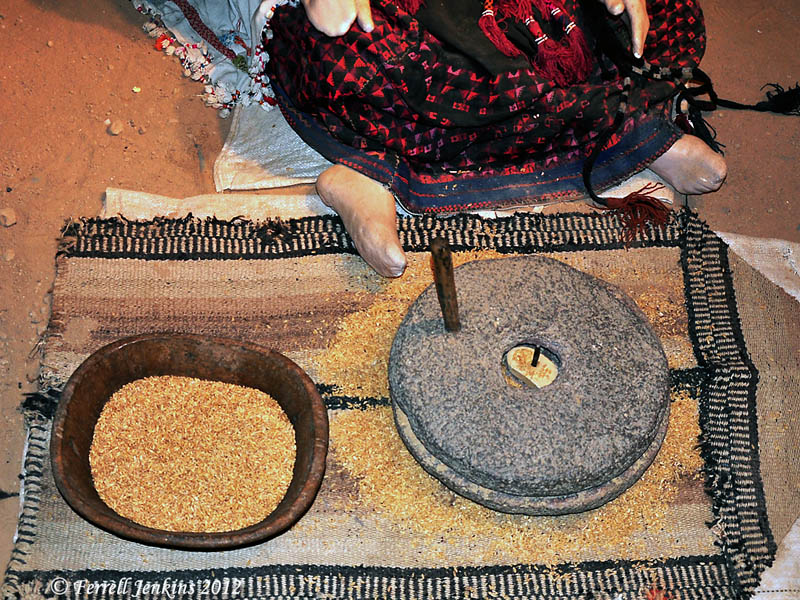
After that, there was still hard work to be done. The grain had to be ground between two millstones. The photo, below taken at The Museum for Bedouin Culture at Kibbutz Lahav in the Negev, shows the process.

Grinding grain. Exhibit at Museum of Bedouin Culture at Kibbutz Lahav. Photo by Ferrell Jenkins.

Grinding grain. Exhibit at The Museum of Bedouin Culture at Kibbutz Lahav in the Negev. Photo by Ferrell Jenkins.

There will be two women grinding grain together; one will be taken and the other left. (Luke 17:35 NET)

There was still the necessary kneading before the bread could be baked and eaten.

I am worn out. I think I will run down to the store and get a loaf of bread.

More camel humor

In The Humor of Christ (1964), the late Evangelical philosopher Elton Trueblood discusses “The Preposterous” in the teaching of Christ. He says we should,

recognize that Christ used deliberately preposterous statements to get His point across.

Trueblood comments on the rich man and the needle’s eye (see yesterday’s post).

Taken literally, of course, the necessary conclusion is that no one who is not in absolute poverty can enter the Kingdom, because most people have some riches, and it is impossible for a body as large as that of a camel, hump and all, to go through an aperture as small as the eye of a needle. For humorous purposes this is evidently the same camel swallowed by the Pharisee when he carefully rejected the gnat. That the listeners failed to see the epigram about the needle’s eye as a violent metaphor is shown by their question, “Then who can be saved?” (Mark 10:26). (47)

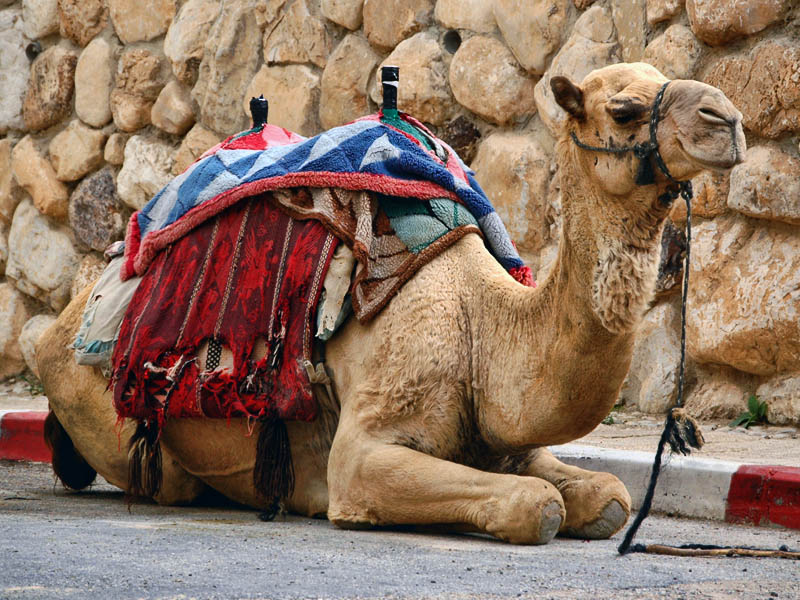
Camel at Qumran near the Dead Sea. Photo by Ferrell Jenkins.

Camel at Qumran near the Dead Sea. Photo by Ferrell Jenkins.

Had you thought about the humor of this statement?

You blind guides, straining out a gnat and swallowing a camel! (Matthew 23:24 ESV)

There are the self righteous leaders straining their wine through a cloth. They eliminate every gnat, but then swallow the whole camel — head first, then front legs, then hump (and even second hump). After that, I suppose the rest would be easy.

Of camels and needles

Jesus warned His disciples about the danger of riches. On one occasion He said,

In fact, it is easier for a camel to go through the eye of a needle than for a rich person to enter the kingdom of God.”  Those who heard this said, “Then who can be saved?”  He replied, “What is impossible for mere humans is possible for God.”  (Luke 18:25-27 NET; cf. Matthew 19:24-26; Mark 10:25-27)

I suppose in the time of Jesus almost everyone had seen a camel and understand what Jesus was talking about. And most of them also had seen a needle.

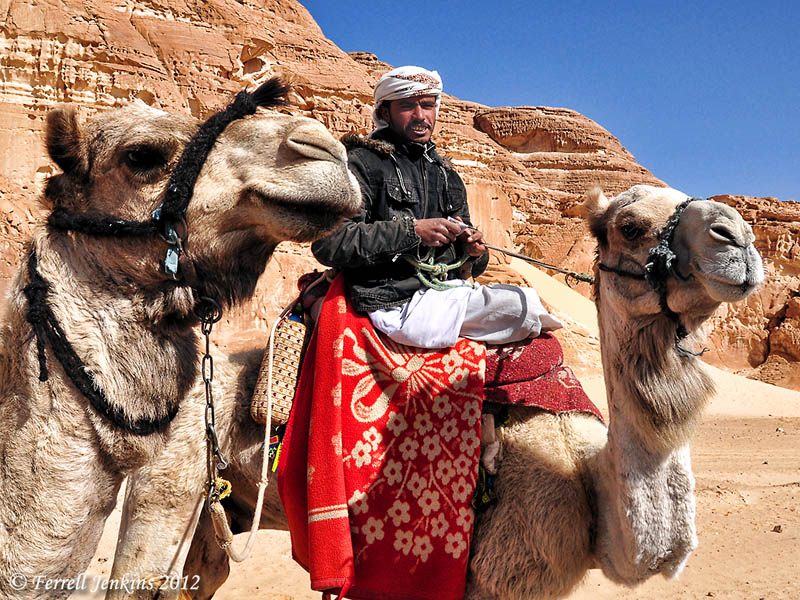
Camels and rider in the Sinai Peninsula. Photo by Ferrell Jenkins.

Camels and rider in the Sinai Peninsula. Photo by Ferrell Jenkins.

The bronze needle below is displayed in the British Museum. The camel above is greatly reduced, and the needle below is greatly enlarged.

Bronze needle from the Roman period. British Museum. Photo by Ferrell Jenkins.

Bronze needle from the Roman period. British Museum. Photo by Ferrell Jenkins.

What did Jesus mean? There is a popular theory that there was a gate in Jerusalem with a smaller gate called the eye of the needle. It is said that the camel could go through the small gate when the burden was unloaded.

Sounds good doesn’t it? But it destroys the teaching of Jesus. Jesus spoke of something that was impossible for mere humans, but possible for God.

Many of the medieval gates we know of in ancient cities had a small gate within the larger gate. There was no need to open a huge gate just for any individual to pass.

Authors of Hard Sayings of the Bible, after mentioning this legend, say,

But this charming explanation is of relatively recent date; there is no evidence that such a subsidiary entrance was called the eye of a needle in biblical times. (438)

They also warn of the temptation to tone down the teaching of Jesus.

There is probably no saying of Jesus which is harder in the Western mind today than the saying about the camel and the needle’s eye, none which carries with it such a strong temptation to tone it down. (439).

The IVP Bible Background Commentary: New Testament comments on the eye of the needle at Mark 10:25.

This image reflects a Jewish figure of speech for doing something impossible (a large animal going through a needle’s eye). The saying, a hyperbole, refers to a literal needle. (Those who think Jesus refers here to a gate in Jerusalem called the “eye of a needle” are mistaken, because that gate was built in medieval times.) A wealthy person could relinquish wealth only by God’s grace (10:26–27).