Category Archives: Israel

Visualizing Isaiah 9: the Philistines on the west

Isaiah 9 contains several geographical references. I decided to concentrate on the reference to the Philistines in verse 12. Notice that the text mentions the Syrians (Arameans) on the east, literally northeast of Israel and Judah, and the Philistines on the west (literally the southwest).

“The Syrians on the east and the Philistines on the west devour Israel with open mouth. For all this his anger has not turned away, and his hand is stretched out still.” (Isaiah 9:12 ESV)

Both powers were perennial enemies of Israel. Both would take part in attacks on Israel. The Philistines also are mentioned in 2:6 and 11:14.

It is commonly understoos that the Philistines of the Old Testament were the Sea People. The five major cities of the Philistines were Ashdod, Gaza, Ashkelon, Gath, and Ekron (1 Samuel 6:17).

A row of signs at the entry to Tel Ashkelon picture some of the peoples who lived there. This sign represents the Philistines. Photo by Ferrell Jenkins.

A row of signs at the entry to Tel Ashkelon picture some of the people who lived there. This sign represents the Philistines. Photo by Ferrell Jenkins.

The temple of Medinet Habu is located near the Colossi of Memnon at Thebes (Luxor), Egypt. The temple was built during the reign of Rameses III (reigned 1186–1155 B.C.). The structures at the site were built by the Pharaoh to serve as an administrative complex and funerary temple. The most interesting aspects of the temple to me are the reliefs of the Sea Peoples that the king claims to have subjugated. Notice that some of these men are bound.
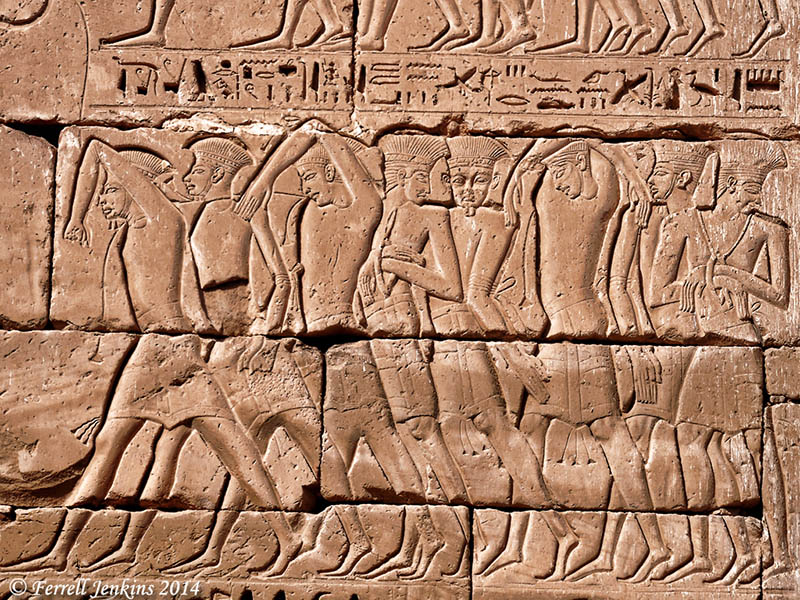
This is a portion of a wall at Medinet Habu showing the subjugation of the Sea People by Ramses III. Photo by Ferrell Jenkins.

A portion of a wall at Medinet Habu shows the subjugation of the Sea People by Ramses III. Notice the distinctive feathered hats and animal skin skirts. Photo by Ferrell Jenkins.

These peoples might seem more powerful than Israel at the moment, but the LORD will punish them. Both Damascus and the Philistines fell to the Assyrians within a few years.

The LORD continued to remind Israel and Judah that He was willing to save them from the coming oppression:

For all this his anger has not turned away, and his hand is stretched out still. (Isaiah 9:21 ESV)
Visualizing Isaiah 8: the gentle flowing waters of Shiloah

Isaiah 8 teaches that the rejection of the LORD by His people would bring about severe punishment. To illustrate this, the LORD says His people “refused the waters of Shiloah that flow gently,” and that He would bring up against them “the waters of the River” [Euphrates], that is, the Assyrians. This would not be gentle flowing, but would flood even to the neck. It would be impossible to stay afloat when that happens.

The LORD spoke to me again: “Because this people has refused the waters of Shiloah that flow gently, and rejoice over Rezin and the son of Remaliah, therefore, behold, the Lord is bringing up against them the waters of the River, mighty and many, the king of Assyria and all his glory. And it will rise over all its channels and go over all its banks, and it will sweep on into Judah, it will overflow and pass on, reaching even to the neck, and its outspread wings will fill the breadth of your land, O Immanuel.” (Isaiah 8:5-8 ESV)

From the earliest days of the city, the water source for Jerusalem was the Gihon Spring. The well-known Hezekiah’s tunnel and the new pool that he built on the west side of the city of David would not be constructed for about 25 to 35 years (2 Kings 20:20; 2 Chronicles 32:30).

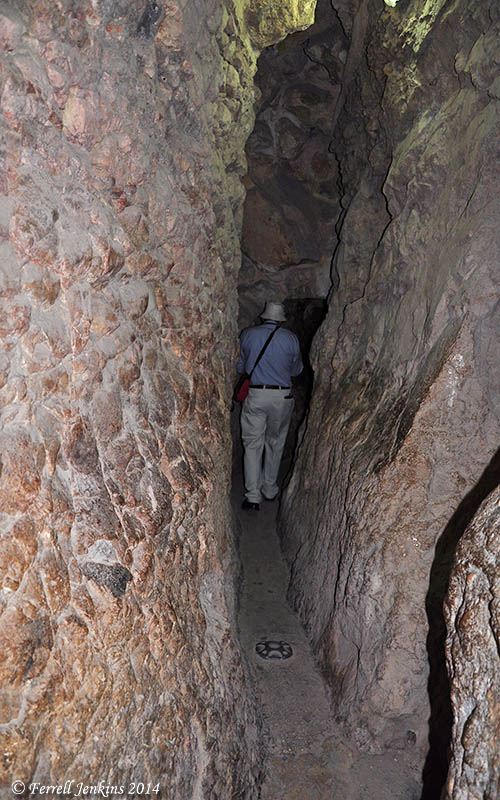
The Canaanites had cut a small tunnel through the rock to allow water to flow from the Gihon Spring into the valley on the east side of what would later be called the city of David.

The comment in The IVP Bible Background Commentary: Old Testament provides a good explanation of the tunnel and pool under consideration.

Hezekiah’s tunnel had not yet been constructed at this time. Water was conducted from the Gihon Spring (in the Kidron Valley on the east side of the city) toward the south through an aqueduct that brought the water to a reservoir at the southwestern tip of the city. This aqueduct is known as the Siloam Channel and in biblical times went by the name Shiloah.

Since 1997 it has been possible for visitors to the source of the Gihon Pool to walk through the dry Canaanite tunnel and exit in the valley which is part of the Silwan village. (That exit is now within an enclosed park area known as the City of David (Jerusalem Walls) National Park.) Our photo below show a portion of that tunnel.

The Canaanite Tunnel through which the gentle "waters of Shiloah" once flowed. Photo by Ferrell Jenkins.

The Canaanite Tunnel through which the gentle “waters of Shiloah” once flowed. Photo by Ferrell Jenkins.

Visualizing Isaiah 7: the house of David

The historical setting for Isaiah 7 concerns the efforts of Syria (Aram) and Israel (Ephraim, the northern kingdom) to form an alliance to attack king Ahaz of Judah (cf. 2 Kings 15:37). Some refer to this as the Syro-Ephraimite coalition against Judah.

The southern kingdom over which Ahaz ruled is referred to as the “house of David” twice in this chapter (7:2,13), and again in Isaiah 22:22.

In the days of Ahaz the son of Jotham, son of Uzziah, king of Judah, Rezin the king of Syria and Pekah the son of Remaliah the king of Israel came up to Jerusalem to wage war against it, but could not yet mount an attack against it. When the house of David was told, “Syria is in league with Ephraim,” the heart of Ahaz and the heart of his people shook as the trees of the forest shake before the wind. (Isaiah 7:1-2 ESV)

This chapter clearly mentions three distinct nations or governments – Syria, Israel, and Judah (the house of David). According to the Bible, the throne of David was established forever (2 Samuel 7:11-15). Christians understand that Jesus Christ is the final fulfillment of that promise (Luke 1:31-32; Acts 2:25-36).

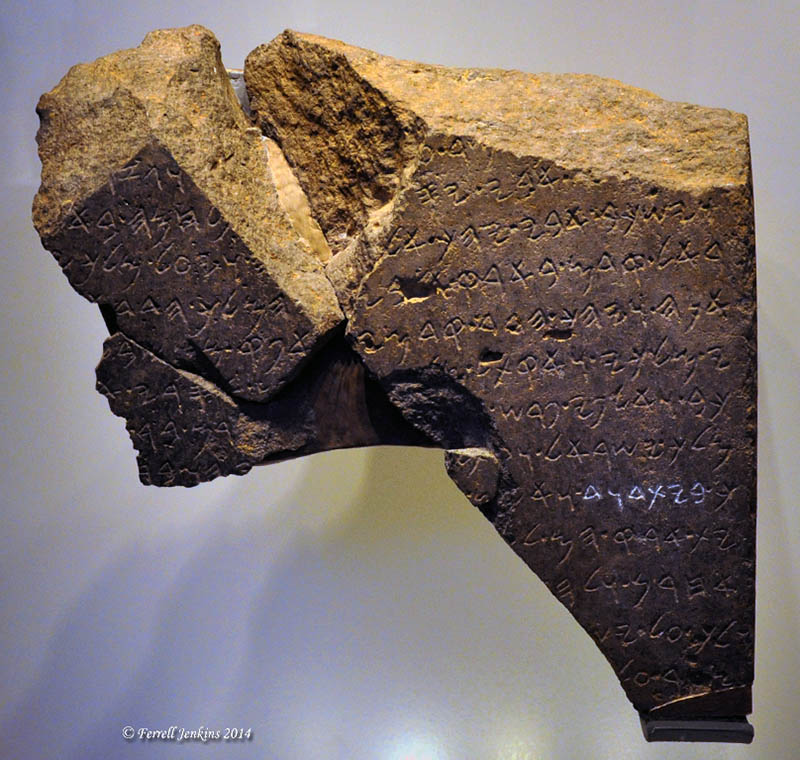
Three fragments of an Aramic inscription were found at Tel Dan in 1993/1994 mentioning the king of Israel, the “house of David” and the Aramean (Syrian) god of storms and warfare, Hadad. You may recall that some of the Syrian kings were named after Hadad (e.g., Ben-Hadad, 1 Kings 15:18). This document probably refers to a different historical setting, but the kingdoms are the same: Israel, Syria, and Judah (house of David). Because all of the kings of Judah from David to the carrying away into Babylon are of the family of David, It is appropriate to refer to the house of David as the Davidic dynasty.

The Tel Dan inscription is displayed in the Israel Museum in Jerusalem.

The Tel Dan inscription displayed in the Israel Museum. Photo by Ferrell Jenkins.

The Tel Dan inscription displayed in the Israel Museum. The term “houseofdavid”, written right to left, is highlighted in white. Photo by Ferrell Jenkins.

Visualizing Isaiah 6: King Uzziah

Isaiah 6 begins with this historical note:

In the year that King Uzziah died I saw the Lord sitting upon a throne, high and lifted up; and the train of his robe filled the temple. (Isaiah 6:1 ESV)

There are images from the ancient near east to help illustrate the vision in Isaiah 6, but I have chosen something pertaining to King Uzziah. Uzziah, also known as Azariah (2 Kings 14:21), reigned over Judah from about 792 to 740 B.C. From 792-767 his reign overlapped that of Amaziah.

Epitaph of King Uzziah of Judah. Israel Museum. Photo by Ferrell Jenkins.

Epitaph of King Uzziah of Judah. Israel Museum. Photo by Ferrell Jenkins.

This Aramaic inscription, now displayed in the Israel Museum, claims to mark the tomb of King Uzziah. It reads “Hither were brought the bones of Uzziah, king of Judah. Do not open!”

The Chronicles of the Land: Archaeology in The Israel Museum Jerusalem includes this comment about Uzziah.

When he died, he could not be buried in the royal tombs because he was a leper. Some seven hundred years after his death, in the Second Temple Period, Jerusalem expanded, and Uzziah’s tomb had to be moved outside the new city limits. An epitaph was erected to mark the king’s new burial place. (69)

See also 2 Chronicles 26:23.

Visualizing Isaiah 4: the Branch of the LORD

The book of the prophet Isaiah promises the return of a remnant from captivity, but is also filled with Messianic expectation. After describing the terrible consequences of the conquest by foreign powers, Isaiah promises,

In that day the branch of the LORD shall be beautiful and glorious, and the fruit of the land shall be the pride and honor of the survivors of Israel. (Isaiah 4:2 ESV)

It should be pointed out that many of the popular English versions capitalize the word Branch (see NAU, NKJ, CSB, NIV, NRSV). The NET Bible understands the expression to refer to “crops given by the LORD.”

Edward J. Young says,

In the present passage the Sprout is that shoot which comes from the tree of David which has been cut down, and which springs to life from its fallen trunk and brings the tree to more glorious and wondrous heights than before. (The Book of Isaiah)

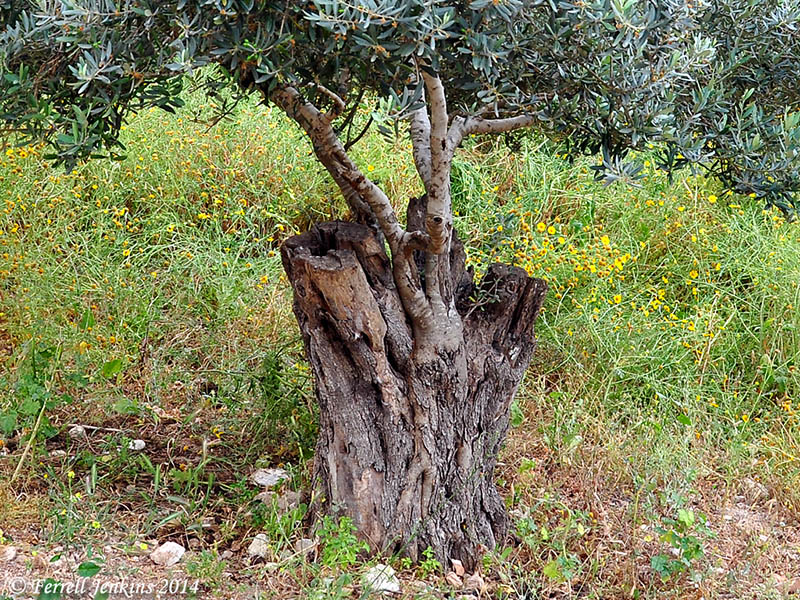
Our photo is intended to illustrate this truth. The tree of David was cut down; only a stump was left. But a shoot, Sprout, or Branch (the Messiah) sprang from it. Certainly a Divine act.

A Sprout comes forth from an olive stump at Nazareth Village. Photo by Ferrell Jenkins.

A Sprout comes forth from an olive stump at Nazareth Village. Photo by Ferrell Jenkins.

I understand this verse to be parallel to the following texts.

In that day the root of Jesse, who shall stand as a signal for the peoples– of him shall the nations inquire, and his resting place shall be glorious. (Isaiah 11:10 ESV; cf. Romans 15:12; Revelation 5:5; 22:16)

“Behold, the days are coming, declares the Lord, when I will raise up for David a righteous Branch, and he shall reign as king and deal wisely, and shall execute justice and righteousness in the land.” (Jeremiah 23:5)

See also Jeremiah 33:15 and Zechariah 3:8.

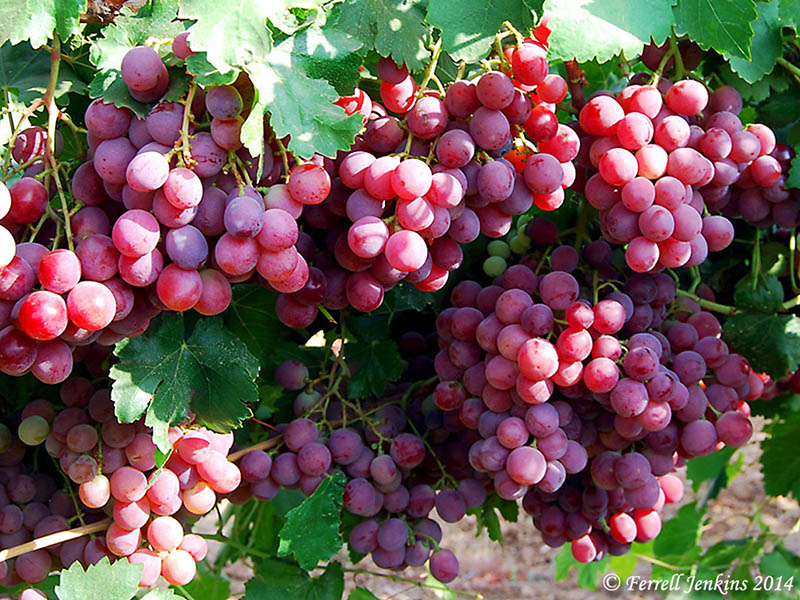
If you would like to think of an abundance of fruit, whether literal or figurative, I think this photo might help.

Abundant fruit in the vineyards of Lachish. Photo by Ferrell Jenkins.

Abundant fruit in the vineyards of Lachish. Photo by Ferrell Jenkins.

Visualizing Isaiah 3: a skirt of sackcloth

Isaiah describes the luxurious life of the women of Jerusalem in vivid terms. The prophet was definitely not politically correct.

16 The LORD said: Because the daughters of Zion are haughty and walk with outstretched necks, glancing wantonly with their eyes, mincing along as they go, tinkling with their feet,
17 therefore the Lord will strike with a scab the heads of the daughters of Zion, and the LORD will lay bare their secret parts.
18 In that day the Lord will take away the finery of the anklets, the headbands, and the crescents;
19 the pendants, the bracelets, and the scarves;
20 the headdresses, the armlets, the sashes, the perfume boxes, and the amulets;
21 the signet rings and nose rings;
22 the festal robes, the mantles, the cloaks, and the handbags;
23 the mirrors, the linen garments, the turbans, and the veils.
24 Instead of perfume there will be rottenness; and instead of a belt, a rope; and instead of well-set hair, baldness; and instead of a rich robe, a skirt of sackcloth; and branding instead of beauty. (Isaiah 3:16-24 ESV)

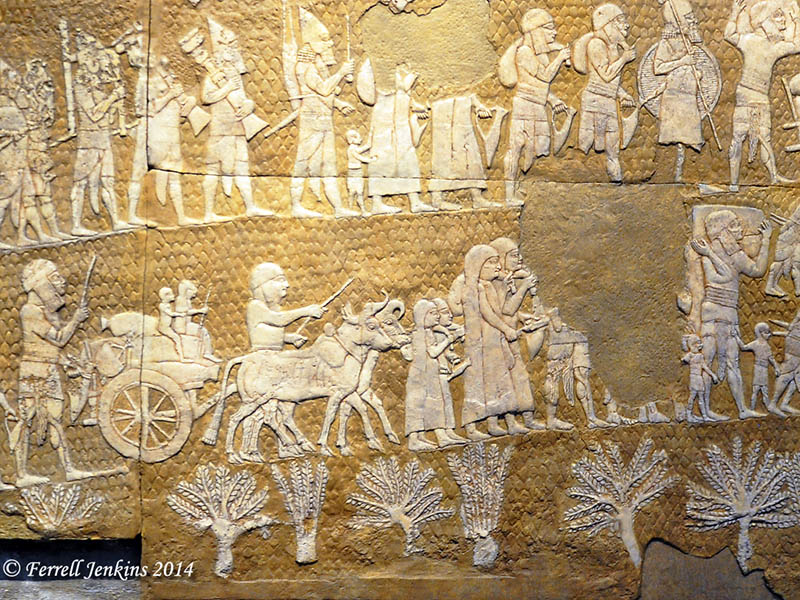
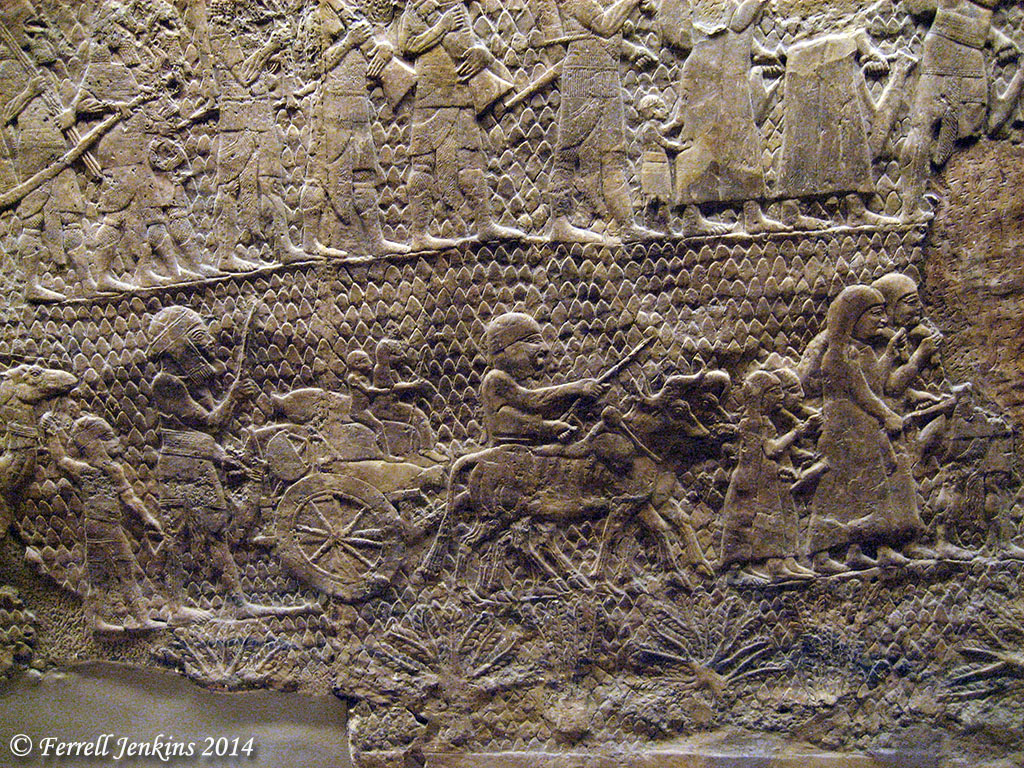
When the Assyrians captured Lachish and other cities of Judea they took some of the people captive. Something similar must have happened when the Babylonians took captive many of the citizens of Jerusalem in 586 B.C.

Our photo shows a portion of the relief Sennacherib left on his palace wall after the capture of Lachish. You may recognize that this is not the original now displayed in the British Museum. This replica is in the Israel Museum. Notice especially the women in the center of the bottom panel.

Sennacherib's relief showing the women of Lachish going into captivity. Replica in Israel Museum. Photo by Ferrell Jenkins.

Sennacherib’s relief showing the women of Lachish going into captivity. Replica in Israel Museum. Photo by Ferrell Jenkins.

Here is the original of the same scene as it is displayed in the British Museum. Click the photo for a larger image.

Sennacherib's Relief in British Museum. Photo by Ferrell Jenkins.

Sennacherib’s Relief in the British Museum. Photo by Ferrell Jenkins.

The women of the Shephelah were country women and the attire they are wearing may have been normal. The stylish women of Jerusalem would become like the plain women of the country and don a skirt of sackcloth.

David Ussishkin, excavator of Lachish, describes the scene:

The deportees are distinguishable by their appearance and dress. The women—adults and girls alike—wear a long, simple garment. A long shawl covers their head, shoulders and back, reaching to the bottom of the dress. The heads of both the adult men and boys are wound with scarves whose fringed ends hang down, covering the ears and reaching the level of their shoulders. A thick horizontal line below the belt probably marks the bottom of a sleeveless shirt. The garment has a fringed (?) tassel hanging between the legs, apparently attached to the bottom of the shirt. The men have short beards. Both men and women are barefooted. (The Conquest of Lachish by Sennacherib, 109).

Boating on the Dead Sea

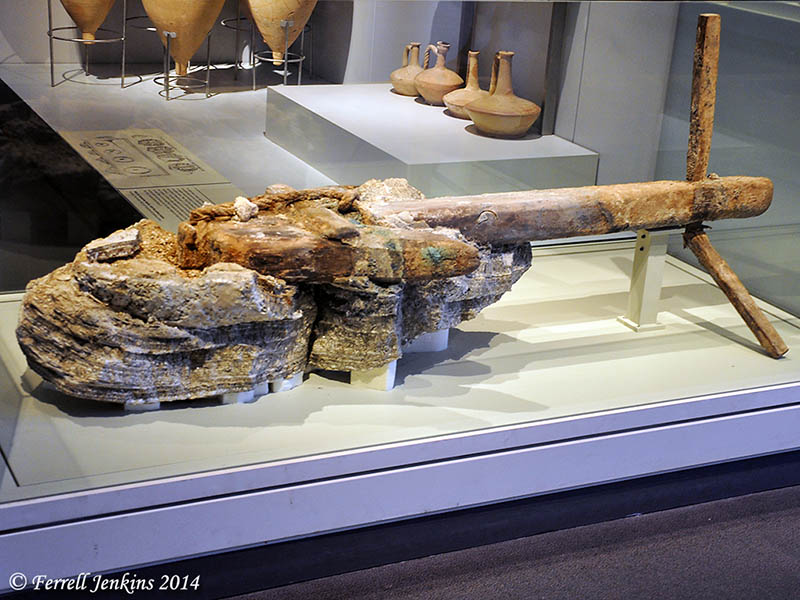
In 2005 a two-armed anchor was discovered on the shore of the Dead Sea, north of En Gedi. The materials associated with this anchor includes jujube wood, palm fiber, lead, iron, and bronze.

Two-armed anchor from the Dead Sea. Photo by Ferrell Jenkins.

Two-armed anchor from the Dead Sea. Photo by Ferrell Jenkins.

The sign associated with this exhibit in the Israel Museum reads as follows:

In ancient times, the Dead Sea was an active sea route, used  for the transportation of passengers as well as the agricultural  products and natural resources for which the area was famous.  This rare anchor, found on the Dead Sea shore, was made with the best of Hellenistic-Roman technology. Its size and style suggest that it belonged to a luxurious ship, one that may have  been part of the royal fleets of King Alexander Jannaeus or  Herod the Great, each of whom built palaces and fortresses near this Shore.

The anchor was found north of En Gedi and belongs to the period between the 2nd century B.C. and the 1st century A.D. The materials included in the anchor include jujube wood, palm fiber, lead, iron, and bronze.

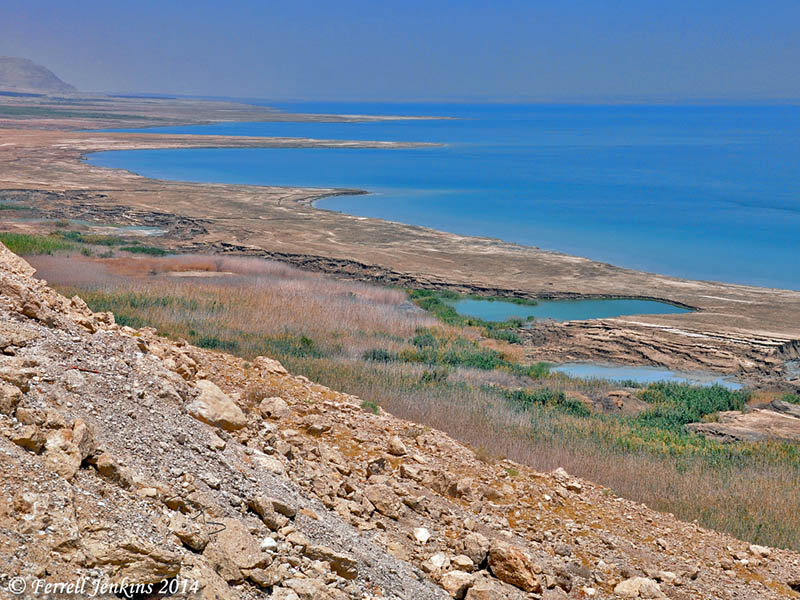
I understand that this anchor, and another one about 500 years older, was located because of the receding of the waters of the Dead Sea. Our photo shows a view of the western shore of the Dead Sea north of En Gedi. In the recent past the water covered the land we see here.

Western shore of the Dead Sea north of En Gedi. Photo by Ferrell Jenkins.

Western shore of the Dead Sea north of En Gedi. Photo by Ferrell Jenkins.

The Dead Sea is known as the Salt Sea in Genesis 14:3.

Visualizing Isaiah: Trusting in horses and chariots

The prophet Isaiah describes what had happened to the people of Judah and Jerusalem.

Their land is filled with silver and gold, and there is no end to their treasures; their land is filled with horses, and there is no end to their chariots. (Isaiah 2:7 ESV)

The nation had come to depend on instruments of war rather than the LORD God.

Before the entry into the promised land, the LORD said that His people would desire a king. He laid down restrictions for that king. One of the stipulations is stated this way:

Only he must not acquire many horses for himself or cause the people to return to Egypt in order to acquire many horses, since the LORD has said to you, ‘You shall never return that way again.’ (Deuteronomy 17:16 ESV)

Solomon is especially noted for his trade in horses and chariots from Egypt (1 Kings 10:28-29).

Ahab, king of the northern kingdom of Israel, had a powerful army. The Assyrian king Shalmanesser III met Ahab and 11 other kings in the Battle of Qarqar in 853 B.C. The stone monolith from Kurkh records that Ahab provided 2,000 chariots and 10,000 foot soldiers to the confederacy.

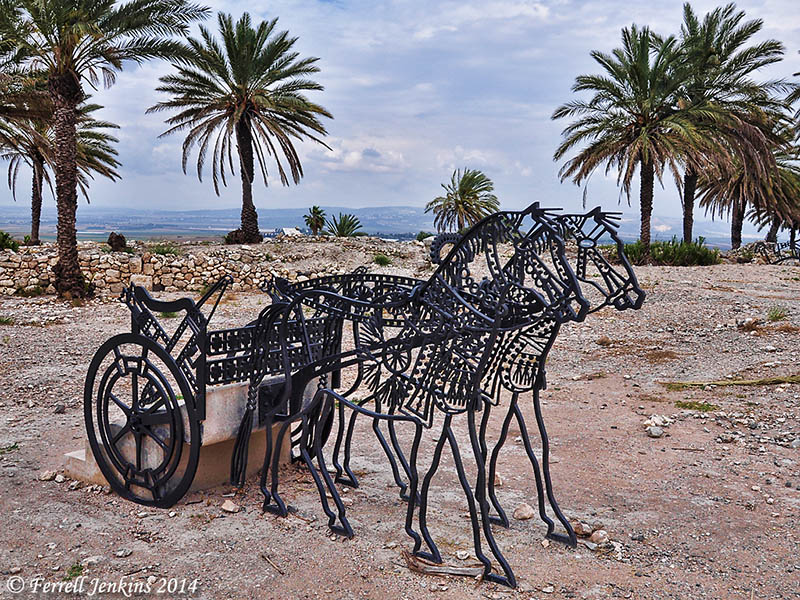
Stables have been uncovered during excavations at Megiddo. The town is so clearly associated with horses and chariots that a metal sculpture has been erected at the site.

Metal sculpture of horses and chariot at Megiddo. Photo by Ferrell Jenkins.

Metal sculpture of horses and chariot at Megiddo. Photo by Ferrell Jenkins.

Because Megiddo was located on the main trunk road between Egypt and the empires of the north (Hittites and Syria) and those of the east (Assyria, Babylon, and Persia), we should not find this surprising.

Solomon is said to have built the house of the LORD, his own house, the Millo and the Wall of Jerusalem, and the cities of Hazor, Megiddo, and Gezer (1 Kings 9:15). The same context makes reference to chariot cities built by Solomon:

and all the store cities that Solomon had, and the cities for his chariots, and the cities for his horsemen, and whatever Solomon desired to build in Jerusalem, in Lebanon, and in all the land of his dominion. (1 Kings 9:19 ESV

Isaiah was spot-on.

The Pools of Solomon

It is a fact that numerous structures in Israel are incorrectly identified. Earlier travelers may have asked where this or that biblical event took place. There was always someone willing to show them what they wanted to see. Some items that come to mind include the Tower of David and Solomon’s Stables in Jerusalem, Ahab’s Palace at Jezreel, and Solomon’s Pools southwest of Bethlehem.

In the earliest days of my tours we were able to visit Solomon’s Pools as we traveled between Bethlehem and Hebron. In more recent years the Pools have been in the Palestinian Authority’s West Bank. This means going to Bethlehem and then making arrangement to visit the pools.

Solomon, who ruled about 970–931 B.C., is said to have developed vineyards, gardens, and pools.

I made great works. I built houses and planted vineyards for myself. I made myself gardens and parks, and planted in them all kinds of fruit trees. I made myself pools from which to water the forest of growing trees. (Ecclesiastes 2:4-6 ESV)

These pools do not belong to the time of Solomon. It may be legendary, but Josephus says that Solomon used to ride upon a chariot to a place called Etham (Etam). This area is described as “very pleasant in its fine gardens, and abounding in rivulets of water; he used to go there in the morning sitting high in his chariot” (Antiquities 8:186).

One of the earliest projects conducted by Amihai Mazar, in 1968, was a survey of the 70 kilometers of aqueducts. He wanted to see how accurate Conrad Schick has been in his 19th century surveys.

Several springs feed into the “pools of Solomon” from the south through two aqueducts. From the western pool a high level aqueduct carried water to the Upper City of Jerusalem. From the easternmost pool a low level aqueduct carried water to the Temple Mount.

One of the earliest projects conducted by Amihai Mazar, now Professor Emeritus at Hebrew University, in 1968 was a survey of 70 kilometers of aqueducts. He wanted to see how accurate Conrad Schick had been in his surveys in the 19th century. He says the pools,

must date to the Hasmonean period, perhaps to Alexander Jannaeus [126 B.C.–76 B.C.]. We don’t have any written sources, and there is no objective archaeological data for dating them. But we base our assumption on the fact that in the Mishnah the aqueducts are referred to and are very important for ritual purposes on the Temple Mount. (BAR, 10:3, May/June 1984).

Mazar’s study of “The Aqueducts of Jerusalem” is published in Jerusalem Revealed: Archaeology in the Holy City 1968–1974. 79-84.

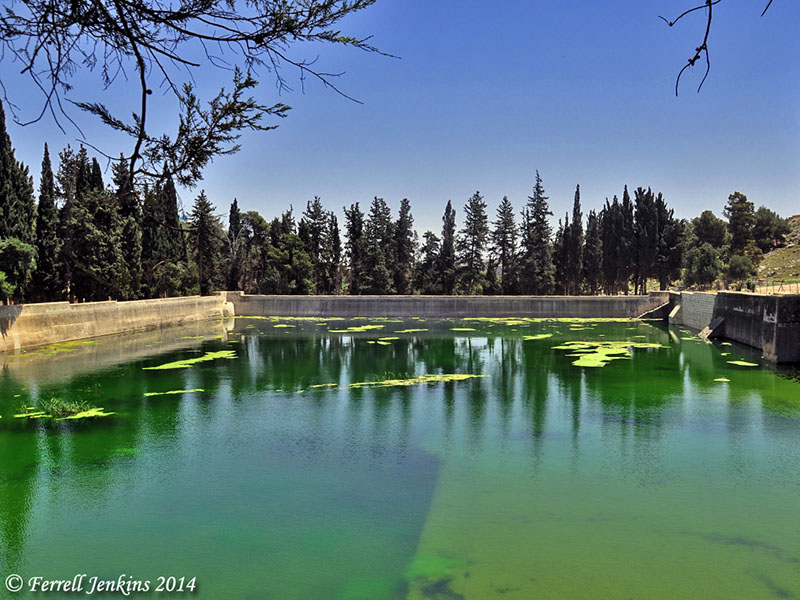
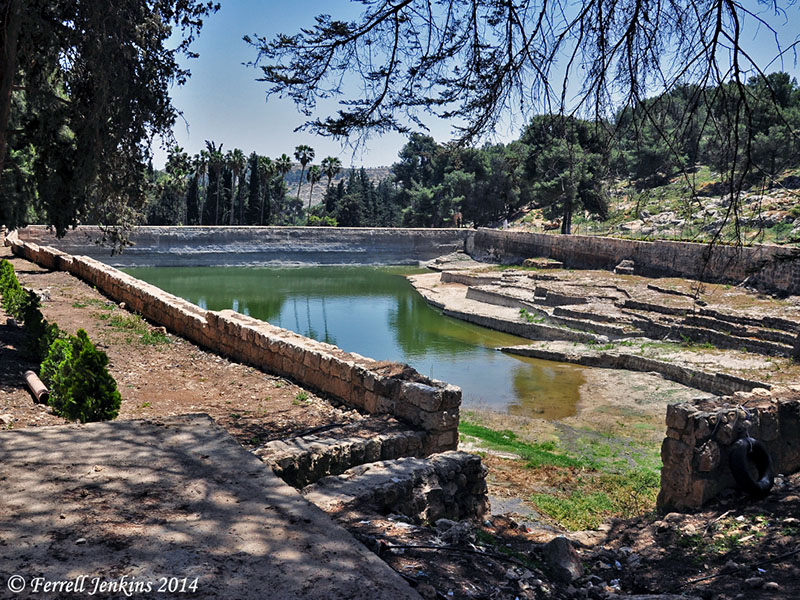
Our first photo shows the highest of the pools which I am calling the western pool.

The western most pool. View east. Photo by Ferrell Jenkins.

The western pool. View east. Photo by Ferrell Jenkins.

The middle pool is shown here with a view to the northwest. You can see the higher hills in the break between the trees.

The middle pool. View west. Photo by Ferrell Jenkins.

The middle pool. View northwest. Photo by Ferrell Jenkins.

The third pool (eastern) is shown below with a view toward the west.

The eastern pool. View west. Photo by Ferrell Jenkins.

The eastern pool. View west. Photo by Ferrell Jenkins.

A recent study of “Jerusalem’s Ancient Aqueduct System” by Tom Powers is available for download at his website here. This article can be helpful for those who wish to know more about the subject.

Jerome Murphy-O’Connor has a few pages devoted to Solomon’s Pools, including the aqueduct system, in The Holy Land (483-486).

Within the past few weeks there has been some information, and some unfounded speculation, about a water system found at ‘Ain Joweizeh. Todd Bolen describes the location of the site:

The site is located 5.5 miles (9 km) southwest of the Old City of  Jerusalem, 3.5 miles (5.5 km) northwest of Bethlehem, and just down the slope to the west of Har Gilo.

Bolen has a good summary of what we know about this water system (“Royal Water System Excavated in Judean Hills”) in a recent post here.

BAR’s Bible History Daily includes photos of the Proto-Aeolic Capital associated with the recently discovered tunnel here.

Ancient sunken treasure returned to Israel Antiquities Authority

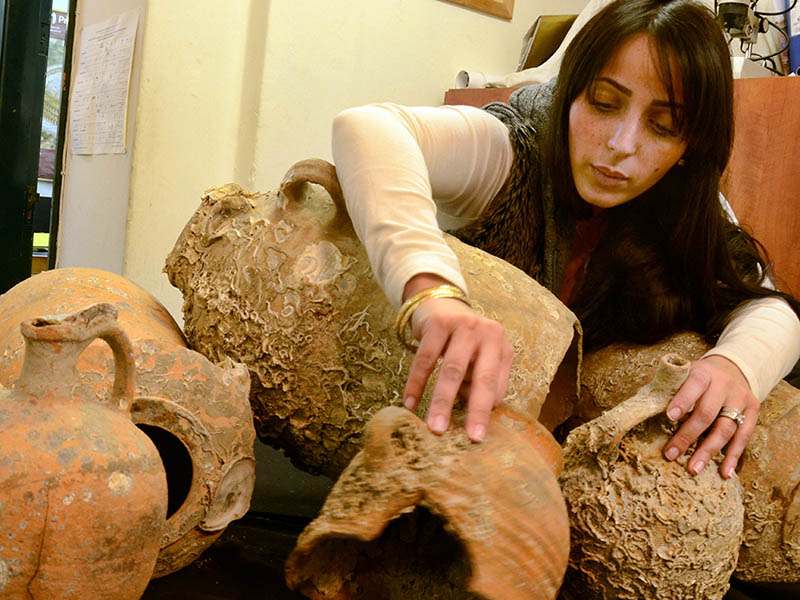
It really happened. A lady in Poriya Illit, a village a short distance from the western shore of the southern tip of the Sea of Galilee, called the Israel Antiquities Authority. She told them that a now-deceased family member had “fished” some treasures from the Mediterranean. It was packed in her basement, but she wanted it to be in a museum so her grandchildren would be able to see it in due time. The information below comes from an article by Roz Wolberger in The Jerusalem Post Online Edition here.

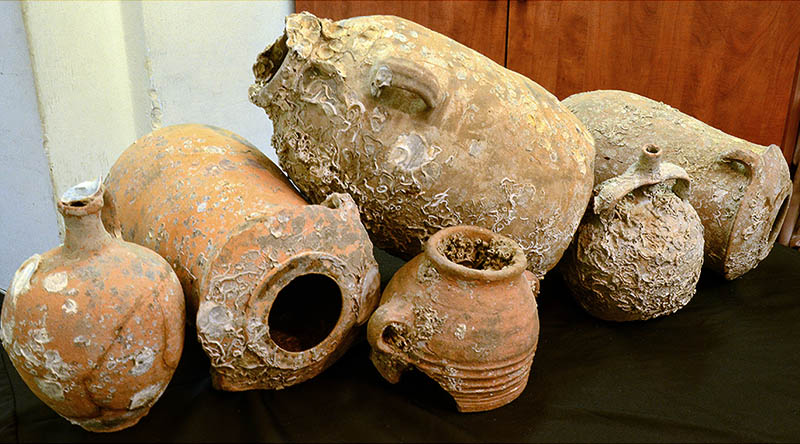
Soon after the phone call, two archaeologists from the IAA arrived at Lester’s Galilee home and were amazed to see the extent of the treasure: wrapped in cloth and stacked in boxes were a large number of whole pottery vessels, clearly very ancient and rare. The surface of the vases were encrusted with sea shells and other ocean sediments, including the occasional fossil. Most of the pieces were fully intact, and the rest were in large fragments, neatly wrapped in fabric.

The cache of artifacts came from a wide variety of periods.

An especially beautiful vase with a tall frame and high handles was immediately recognized as being from the time of the Biblical period, about 3000 years ago. Another remarkable piece was reported to be from the Roman period, some 2000 years ago, and yet another round urn was dated to the Byzantine period, about 1500 years ago

Sunken treasure from the Mediterranean. Photo: Israel Antiquities Authority

Sunken treasure from the Mediterranean. Photo: Israel Antiquities Authority

I think the vase with “a tall frame and high handles” is the second from the right in both photos. My guess is that the lady in the photo above is with the IAA.

Sunken treasure from the Mediterranean. Photo: Israel Antiquities Authority

Sunken treasure from the Mediterranean. Photo: Israel Antiquities Authority

HT: Joseph Lauer