Category Archives: Israel

Jesus went among the villages teaching

Jesus left the shores of the Sea of Galilee and Capernaum to return to Nazareth to teach the people there.

 And when Jesus had finished these parables, he went away from there, and coming to his hometown he taught them in their synagogue, so that they were astonished, and said, “Where did this man get this wisdom and these mighty works?  (Matthew 13:53-54 ESV)

When he left Nazareth He “went about among the villages teaching” (Mark 6:6).

When I see the scene depicted at Nazareth Village of the stone house, the olive trees, and the dusty path, I recall the visits Jesus and His disciples made throughout Galilee.
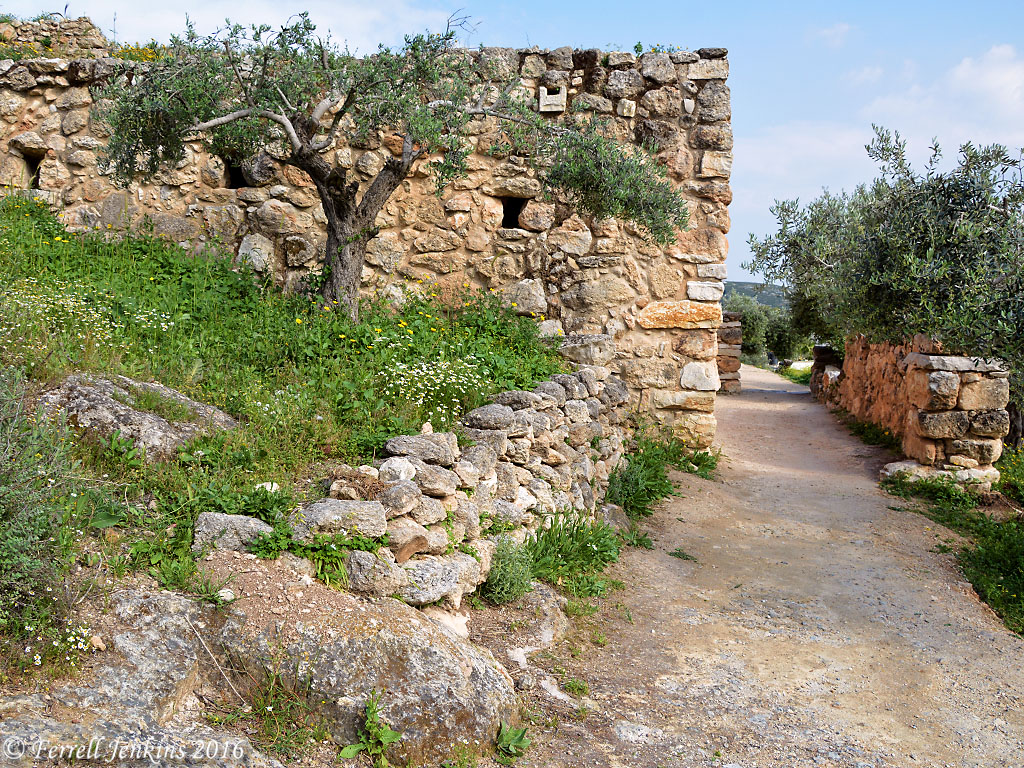
A dirt path and one of the houses at Nazareth Village. Photo by Ferrell Jenkins.

A dirt path and one of the houses at Nazareth Village. Photo by Ferrell Jenkins.

Lois Tverberg, in her excellent book Walking in the Dust of Rabbi Jesus, has written a helpful work about Jesus and His teaching drawing on the Jewish concept of the rabbi and his disciples.

The way Jesus taught his first disciples was not unique but part of a wider tradition in Judaism that began a few centuries before his time. Jesus didn’t hand his disciples a textbook or give them a course syllabus. He asked each one of them to follow him— literally, to “walk after” him. He invited them to trek the byways at his side, living life beside him to learn from him as they journeyed. His disciples would engage in life’s activities along with him, observing his responses and imitating how he lived by God’s Word.

Out of this unusual teaching method arose a well-known saying: you should learn from a rabbi by “covering yourself in his dust.” You should follow so closely behind him as he traveled from town to town teaching that billows of sandy granules would cling to your clothes. As you walked after your rabbi, your heart would change. This will be our task in this book, to stroll through Jesus’ ancient world at his side, listening to his words with the ears of a disciple. (Walking in the Dust of the Rabbi Jesus, Zondervan, p. 28)

There must have been a buzz of excitement when Jesus and His disciples walked the dusty paths of Nazareth, and indeed, of all Galilee.

When Jesus came to Nazareth He entered the synagogue on the Sabbath day and participated in the study.
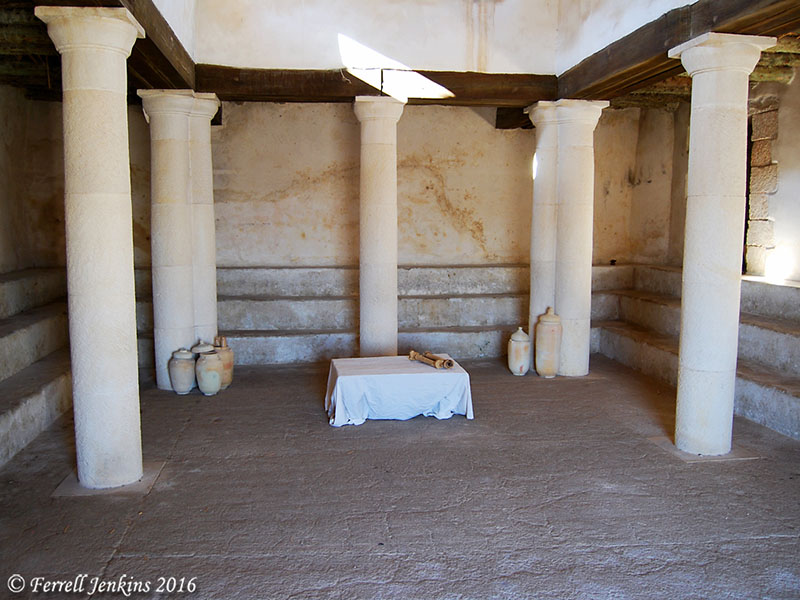
Synagogue reconstruction at Nazareth Village. Photo by Ferrell Jenkins.

Synagogue reconstruction at Nazareth Village. Photo by Ferrell Jenkins.

Lee Levine of Hebrew University summarizes the archaeological evidence for known first century synagogues.

Solid archaeological evidence for the first-century synagogue is attested at eight sites in Judea: Masada, Herodium, Jerusalem (the Theodotos inscription from the City of David), Qiryat Sefer, and Modi’in (both in western Judea), with a possible additional site at Horvat ‘Etri, south of Bet Shemesh. In the Galilee, it is found at Gamla, Migdal, and quite probably Khirbet Qana, with considerably less certain remains from Capernaum, Chorazin, and at a second site in Migdal. (Lee I. Levine, “The Synagogues of Galilee” in Fiensy and Strange, Galilee in the late second temple and mishnaic periods, Vol. I. Minneapolis: Fortress Press, 2014. 129-150.)

The New Testament writers mention other synagogues such as the one at Nazareth.

It is unfortunate that the residents of Nazareth did not want to get dusty. Are you dusty from following Jesus?
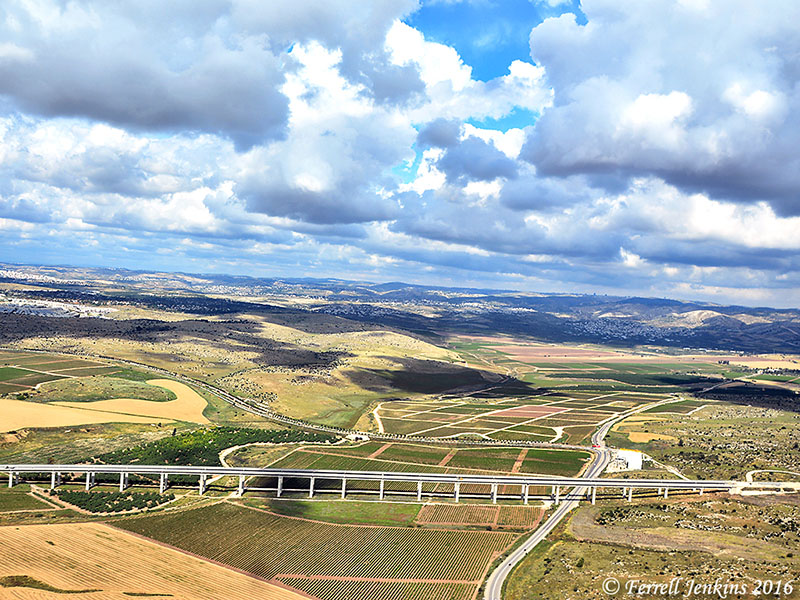
The Valley of Aijalon (Ayalon) and Joshua’s Long Day

The events of Joshua 9 and 10 are likely well-known to all readers of this page. After the Israelites entered Canaan and captured Jericho and Ai, the inhabitants of Gibeon acted craftily to deceive the Israelites into making an alliance with them. Even though Israel had been deceived they kept their end of the bargain when the Gibeonites were threatened. Adoni-zedek, king of Jerusalem, headed up a group of Amorite kings to fight against Gibeon.

The LORD helped Israel by sending large hailstones upon the enemy. Joshua spoke to the LORD in the presence of Israel: “O sun, stand still at Gibeon, And O moon in the valley of Aijalon” (Joshua 10:12). Gibeon sits on the central mountain range about 6 miles north, and slightly west, of Jerusalem. As one makes the descent from Gibeon westward toward the coastal plain he goes through the valley of Aijalon.

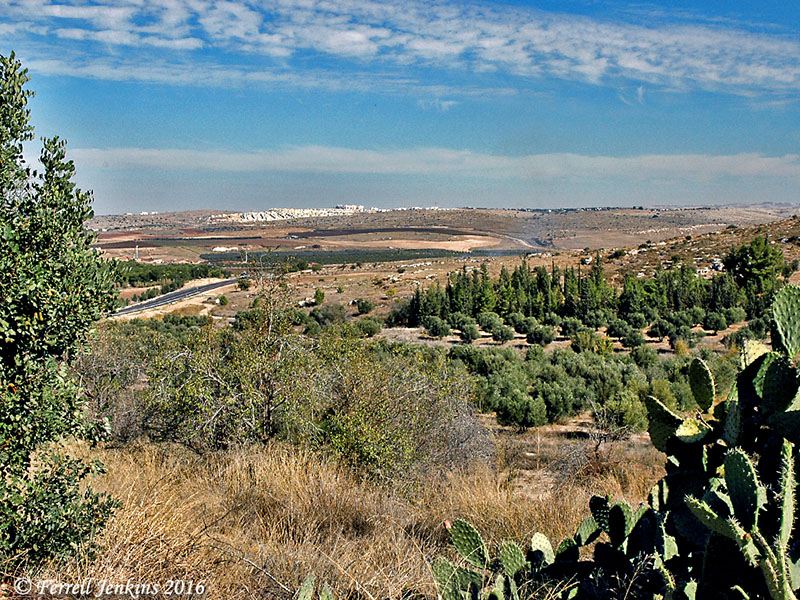
When we travel on the modern highway from Jerusalem down to the Ben Gurion Airport we cross over the valley of Aijalon. Our photo of the valley is made below traditional Emmaus (Nicopolis) looking northwest. The terrain shows the Shephelah, or as many English versions indicate, the lowland. To the right is the way up to Gibeon. To the left one continues past the towns of Aijalon and Gezer down to the coastal plain.

Aijalon Valley from the Latrun Interchange on Highway 1. Photo by Ferrell Jenkins.

Aijalon Valley from the Latrun Interchange on Highway 1. 2005 Photo by Ferrell Jenkins.

In April I flew over the Aijalon Valley in approximately the same area. This perspective provides a better view of the valley. We were avoiding the afternoon storm clouds on our way from Jerusalem to the Sde Dov Airport at Tel Aviv.

Aerial view of Aijalon (Ayalon) Valley. The view is to the north. The bridge is for the yet-to-open Tel Aviv-Jerusalem railway. Photo by Ferrell Jenkins.

Aerial view of Aijalon (Ayalon) Valley. The view is to the north. The bridge is for the yet-to-open Tel Aviv-Jerusalem railway. Photo by Ferrell Jenkins

Three east-west valleys divide the Shephelah and provide access between the plain and the mountains. To the north is the valley of Aijalon. Further south is the valley of Sorek, and then the valley of Elah. Significant battles took place in the valley of Aijalon and the valley of Elah.

The town of Aijalon which overlooks the valley was allotted to the tribe of Dan (Joshua 19:42), but Dan moved to the northern part of the country and Aijalon was considered one of the cities of Judah and Benjamin (2 Chronicles 11:5-12). In the days of King Ahaz the city had fallen under Philistine control (2 Chronicles 28:16-20).

Have scientists discovered Joshua’s long day?

In 1969 an article began to be circulated in church bulletins, and later by Email, claiming that scientists had found evidence of the missing day of Joshua 10. Harry Rimmer had reported a similar story in The Harmony of Science and Scripture in 1936. There is no truth to this claim. I have an article written in response to it available at BibleWorld.com. An article by Dr. Bryant Wood is available at the ABR web site here.

This article is a revised reprint from 2009

Birket Ram on the road to Trachonitis

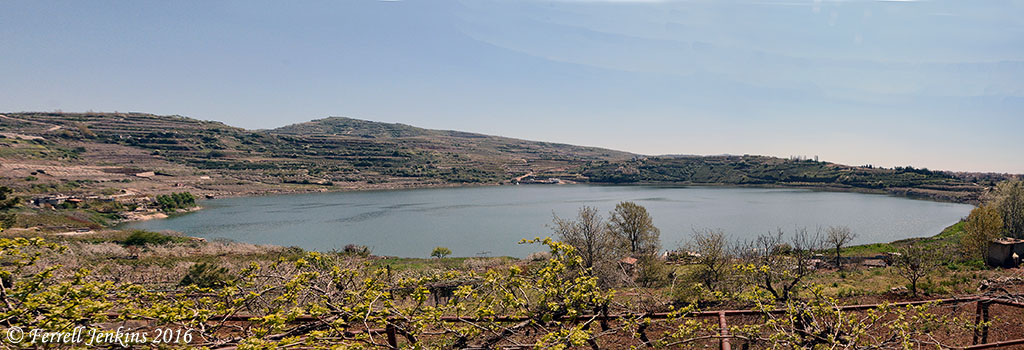
Birket Ram is located north of Mas’ada in the Golan Heights (now Northeastern Israel; formerly Syria). Using two 18mm images I was able to make this panorama. Click on the photo for a larger image.

Panorama of Birket Ram. Photo by Ferrell Jenkins.

Panorama (view south) of Birket Ram. Photo by Ferrell Jenkins.

Birket Ram is not mentioned in the Bible, but there is some related historical information.

Azaria Alon devotes only a single paragraph to Birket Ram, or Ram Pool.

Birket Ram is a natural water formation which measures 600 x 900 meters [1,968 x 2,952 ft.], reaches a depth of 6 to 10 meters [20 to 30 ft.], and holds about 3 million cubic meters of water. The pool has the appearance of a crater and is at an elevation of 940 meters [3,083 ft.]. It contains sweet water fed by underground springs and rain. Geologists believe that the pool was formed by volcanic activity in which the peak of the mountain blew off leaving a crater. (Israel National Parks & Nature Reserves, 2008. p. 39).

Josephus states that Panium [Paneas or Banias = Caesarea Philippi] is thought to be the source of the Jordan River. He claims, however, the source is Phiale (Birket Ram).

509 Now Panium is thought to be the source of the Jordan, but in reality it is carried there after a hidden manner from the place called Phiale:
510 this place lies as you go up to Trachonitis, and is fifteen miles from Caesarea, and is not far out of the road on the right hand;
511 and indeed it has its name of Phiale [vial or bowl] very justly, from the roundness of its circumference, as being round like a wheel: its water continues always up to its edges, without either sinking or running over;
512 and as this origin of Jordan was formerly not known, it was discovered when Philip was tetrarch of Trachonitis [Luke 3:1];
513 for he had chaff thrown into Phiale, and it was found at Panium, where the ancients thought the source of the river was, where it had been therefore carried [by the waters]. (Jewish Wars 3:509-513)

In 1865 Edward Robinson questioned the claim of Josephus saying,

This story helps to confirm the identity of Phiala with Birket er-Râm; but the supply of such a fountain as that of Bâniâs would exhaust this lake in a single day. (Physical Geography of the Holy Land)

Contrary to Alon’s claim that the water of Birket Ram is sweet, Robinson and other older sources say that the water is stagnant and slimy. I got no closer than the photo shows and can not testify about the quality of the water.

Timnah – where Samson met his first love

Perhaps the most memorable event of Timnah recorded in the Bible is that of the affair between Samson and a Philistine woman.

Samson went down to Timnah, where a Philistine girl caught his eye. (Judges 14:1 NET)

Delilah, the most famous of Samson’s three wives, is said to have lived in the Sorek Valley, but Timnah is not specifically named (Judges 16:4).

The LORD had commanded Israel not to become involved in mixed marriages with the people of the land (Exodus 34:16; Deuteronomy 7:3). But Samson had the misfortune of living too close to the border of Israel’s enemies, the Philistines. And he lacked the determination to abide by the commands of the LORD.

There were other significant events associated with Timnah. Here is a brief list.

  • Judah went up to Timnah to his sheep shearers, at which time he mistook Tamar, his own widowed daughter-in-law, for a prostitute. She conceived and bore twin sons (Genesis 38:12-30).
  • Timnah is mentioned as being a town of the tribe of Judah (Joshua 15:10, 57).
  • A little later the territory had transferred to the tribe of Dan (Joshua 19:40-46).
  • By the time of King Ahaz (735-715 B.C., McKinny), Timnah was in the hands of the Philistines (2 Chronicles 28:18).

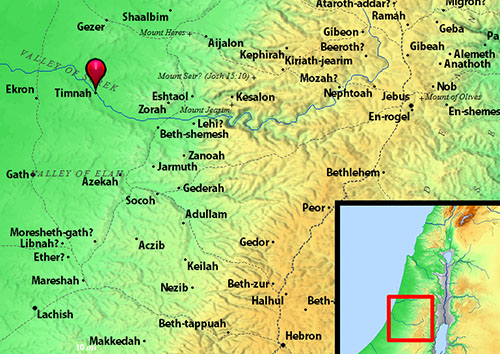
Timnah is identified with Tel Batash in the Sorek Valley, about 4 miles northwest of Beth-Shemesh. Ekron (Tel Miqne) is about 3½ miles west of Timnah. The Sorek River flows past both cities on its way to the Mediterranean.

Tel Batash was excavated by New Orleans Baptist Theological Seminary for three seasons (1977-79). Between 1981-89, the site was excavated under the direction of George L. Kelm of Southwestern Baptist Theological Seminary and Amihai Mazar of Hebrew University. The site was occupied from the Middle Bronze IIB (18th or 17th centuries B.C.), through the Late Bronze Age and the Iron Age. In Iron Age I, Timnah was a Philistine city.

Kelm and Mazar wrote Timnah A Biblical City in the Sorek Valley (Eisenbrauns 1995) to provide a report of their excavations.

Map showing Timnah. Credit: BibleHub.com.

Map showing Timnah. Credit: BibleHub.com.

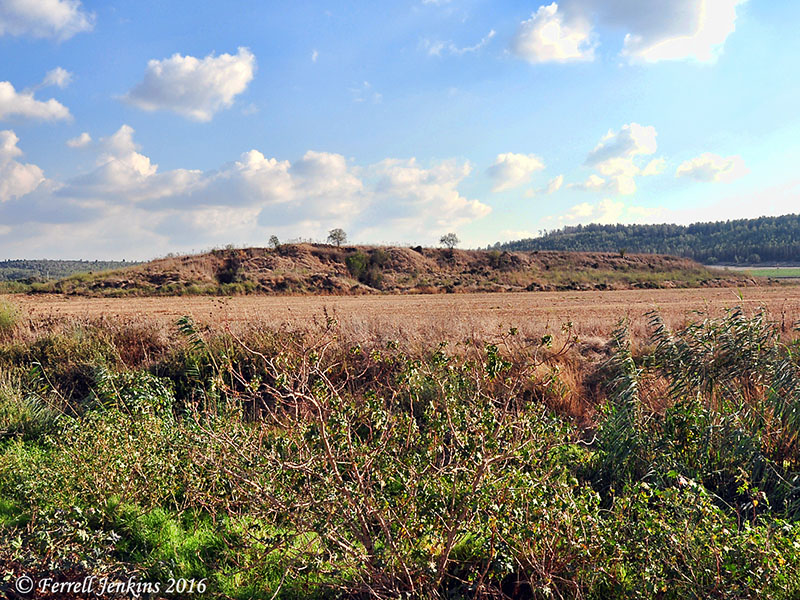
Timnah is off the beaten track and very few people visit it. Easy routes to the site have been blocked by the farmers in the Valley. Leon Mauldin and I searched for, and eventually located, Timnah in the rich alluvial Sorek Valley in 2011. Unlike Lachish, Mareshah, Gath, or Azekah the tel is unimpressive.

Timnah, beyond the brook Sorek, in August, 2011. Photo by Ferrell Jenkins.

Timnah, on the southern bank of the Sorek, in August, 2011. Photo by Ferrell Jenkins.

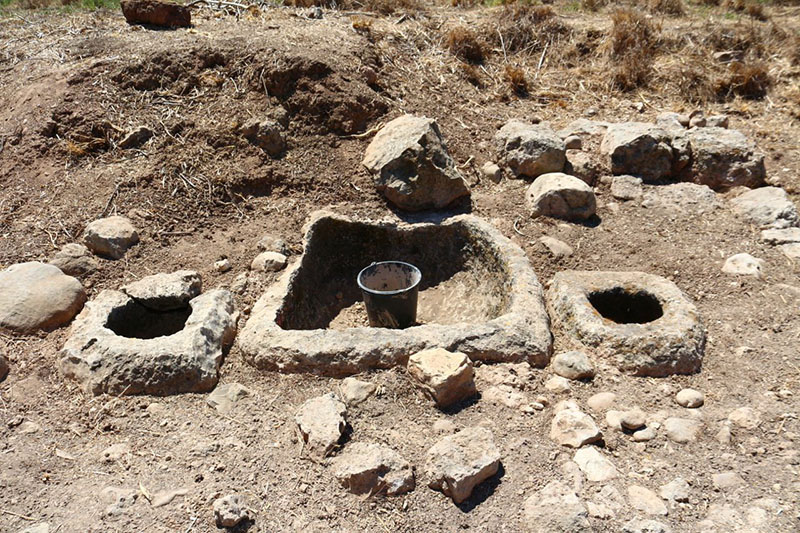
In 2013 our friends Trent and Rebekah Dutton were trying to locate Timnah when they saw two shade tents and the Israel Antiquities Authority flag on a small rise in the fields. The IAA was doing some work at the site and explained to them the restoration work they were doing. Here is a photo the Dutton’s shared of the reconstructed Oil Press from the 7th century B.C. See Kelm and Mazar, pp. 150-152, for the way this looked at the time of the dig. An architect’s (Leen Ritmeyer) drawing of the installation is found on page 87. Some finds are intentionally covered by the excavators at the end of a season or the completion of a dig. This appears to be one such example.

The Oil Press installation at Timnah. Photo by Trent & Rebekah Dutton.

The Oil Press installation at Timnah. Photo by Trent & Rebekah Dutton.

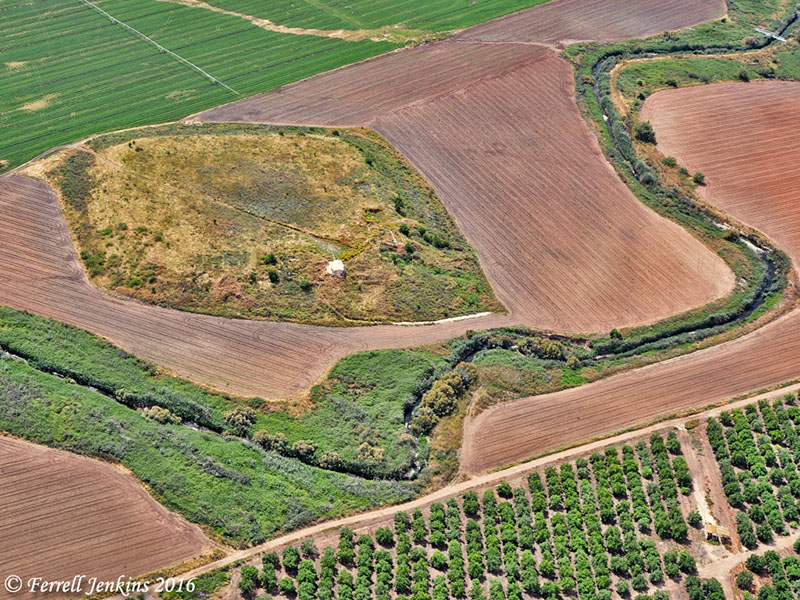
Earlier this month Leon and I had the opportunity to fly over the Sorek Valley. I don’t think our pilot had ever seen the site before, but our previous experience on the ground, Google earth, and the excavation report allowed us to locate it from the air.

Aerial view of Timnah. Photo by Ferrell Jenkins.

Aerial view of Timnah and the Sorek (April, 2016). Photo by Ferrell Jenkins.

I think the little white building covers the Oil Press installation. After a quarter of a century the excavated areas are now covered with natural growth.

It is a long story, but this is where Samson met his first Philistine wife, and maybe another. There is always a danger when one lives too close to the border.

If you do not already have Brad Gray’s Make Your Mark: Getting Right What Samson Got Wrong, now might be time to take a look at our earlier review.

My late friend and colleague, James Hodges, served as an Area Supervisor at Timnah in 1977.

A glimpse of the River Jordan

The Jordan River is shy, rarely revealing very much of itself. As we travel in the Jordan Valley from the Sea of Galilee to the Dead Sea we only see the river on a few occasions. Even then we only see short distances.

The photo below is one I made yesterday about 12 km. south of the Sea of Galilee. You can see the dirt road on the Israeli side of the border and the River in Jordan.

The Jordan River flowing into Jordan for a short distance. Photo by Ferrell Jenkins.

The Jordan River flowing into Jordan for a short distance. Photo by Ferrell Jenkins.

Bible students enjoy visiting the Jordan River for several reasons.

  • The ancient Israelites crossed the Jordan to enter the land that had been promised to the seed of Abraham (Joshua 3).
  • Elijah and Elisha crossed the river (2 Kings 2).
  • John baptized in the Jordan (Matthew 3:6ff.; Mark 1:5-9; John 1:28; 10:40).
  • Jesus was baptized in the Jordan (Matthew 3:13).
  • Naaman, the Aramean [Syrian] military commander, dipped in the Jordan at a site further south (2 Kings 5).

I have been unable to post very much while traveling in Israel, but the mother of my favorite grandson said I should be posting more. She knows how to get things done.

A level of interest never imagined for the blog

Sometime earlier today while our group was driving through the Shephelah (low land, or hill country) of Israel the stats for this blogged rolled over past two million (2,000,000). When I first started the blog, just to inform folks back home that those traveling with me were doing well, I was pleased with 70 or 80 hits a day. I don’t know how reliable these statistics are, but they sound nice.

Thanks for readers who check in from time to time and find something useful here.

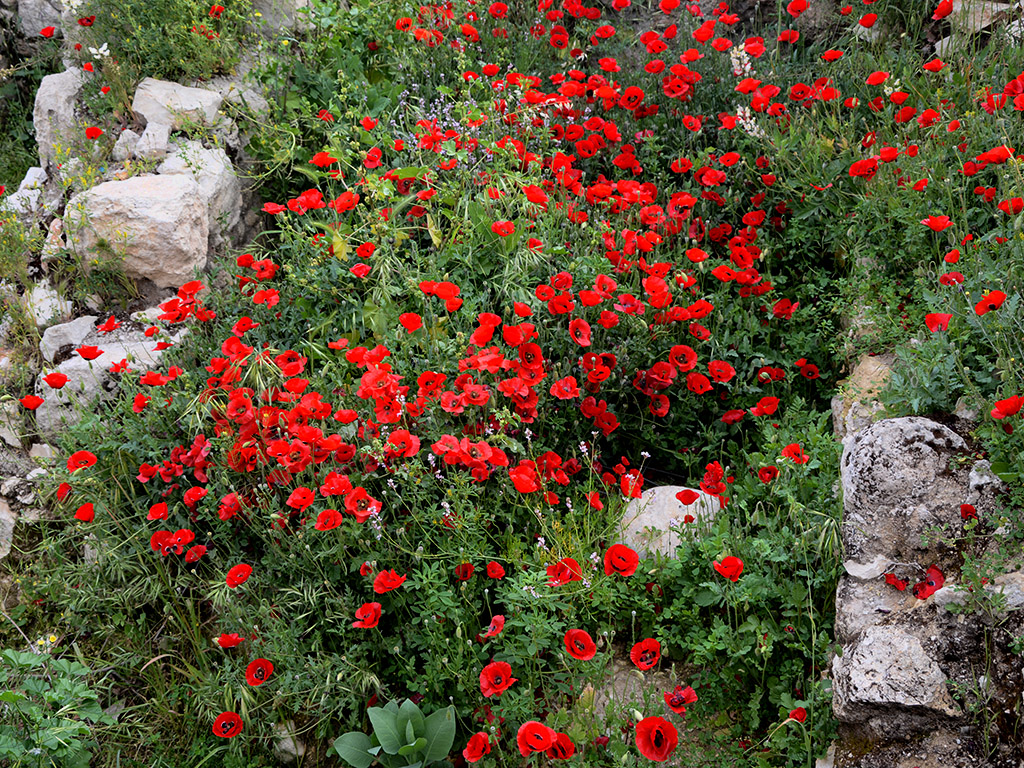
As a small token of my thanks I am sharing a photo I made yesterday morning among the ruins in the Old City of Jerusalem near Dung Gate.

Flowers growing among the ruins in the Old City of Jerusalem near Dung Gate. Photo by Ferrell Jenkins.

Flowers growing among the ruins in the Old City of Jerusalem near Dung Gate. Photo by Ferrell Jenkins.

Many readers will think of the statement of Jesus:

Consider the lilies, how they grow: they neither toil nor spin, yet I tell you, even Solomon in all his glory was not arrayed like one of these. (Luke 12:27 ESV)

The NET Bible uses the term flowers instead of lilies. A Translator’s Note says,

Traditionally, “lilies.” According to L&N [Louw-Nida] 3.32, “Though traditionally kri,non has been regarded as a type of lily, scholars have suggested several other possible types of flowers, including an anemone, a poppy, a gladiolus, and a rather inconspicuous type of daisy.” In view of the uncertainty, the more generic “flowers” has been used in the translation.

I observe that Bauer (Arndt-Gingrich-Danker) comments:

in this connection the principal opinions include the autumn crocus, Turk’s cap lily, anemone, or gladiolus, but the data do not permit certainty. Perh. Jesus had no definite flower in mind, but was thinking of all the wonderful blooms that adorn the fields of Galilee.

Enjoy the beauty and think of God’s care for you. A larger image is available by clicking on the photo.

Photo of 50th Anniversary tour group

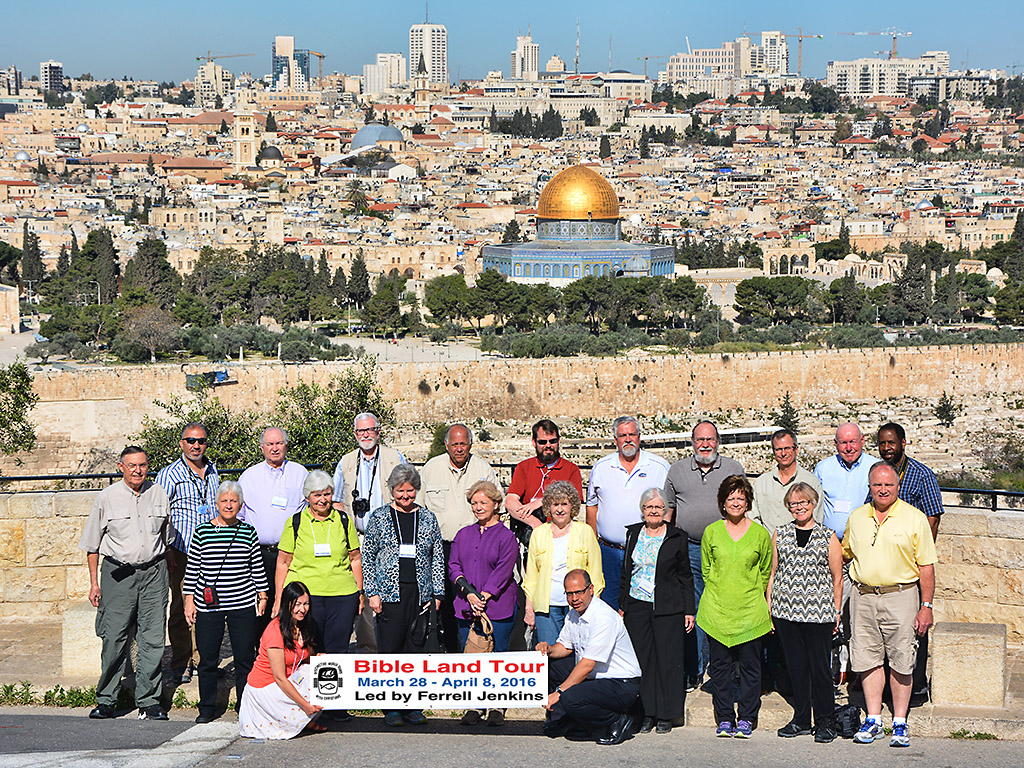
Our journey is Israel is now beginning the second half. We enjoyed a beautiful day in Jerusalem visiting sites related to the Bible. This is an especially significant tour for me. It is my 50th Anniversary tour. The first one  that included Israel was in 1967. Overall it is the 84th tour that I have directed.

Our group this year comes from Florida, Alabama, Georgia, Indiana, Missouri, Texas, Oklahoma and Guatemala. I think eleven of us have traveled together before.

50th Anniversary Tour Group led by Ferrell Jenkins.

50th Anniversary Tour Group led by Ferrell Jenkins.

Nothing compares to studying the Bible in the land where it was written and where the events described in it took place. I am thankful to have shared this experience with so many over this half century.

Only one example of Roman crucifixion discovered

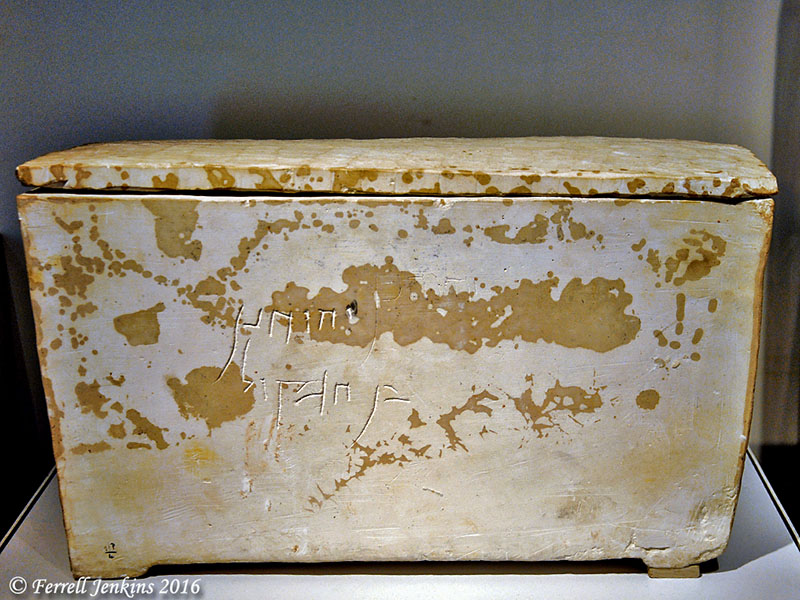
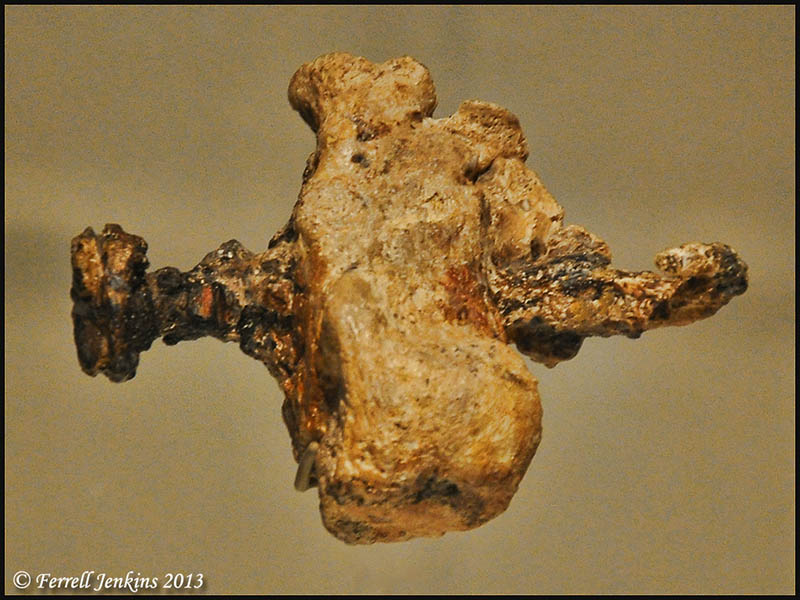
The Romans were adept at crucifixion, according to many historical sources. The first archaeological evidence of crucifixion was uncovered in 1968 when, during a controlled archaeological dig under the direction of the late Vasillios Tzaferis, an ossuary (bone box, or receptacle) was found north of Jerusalem containing the bones of a man who had been crucified. His name was “Yehohanan, the son of Hagakol.” He is thought to have been between 24 and 28 years of age, and was about 5 feet 6 inches in height.

Ossuary of Yehohanan, son of Hagkol. Dates to first century A.D., and is made of soft limestone. Israel Museum. Photo by Ferrell Jenkins.

Ossuary of Yehohanan, son of Hagkol. Dates to first century A.D., and is made of soft limestone. Israel Museum. Photo by Ferrell Jenkins.

Both the ossuary and a replica of the heel bone are displayed in the Israel Museum. When Yehohanan was removed from the cross the nail pulled away from the wood. He was buried with the nail in his heel.

Ankle bone of a man crucified outside Jerusalem in Roman times. Photo by Ferrell Jenkins.

Ankle bone replica of  Yehohanan, son of Hagkol, who was crucified outside Jerusalem in Roman times. Display in Israel Museum. Photo by Ferrell Jenkins.

On Pentecost, Peter proclaimed the truth about Jesus. He said,

This man was handed over to you by God’s deliberate plan and foreknowledge; and you, with the help of wicked men, put him to death by nailing him to the cross. (Acts 2:23 NIV)

No ossuary or bones belonging to Jesus have been found. I am aware of the speculation that a tomb in the Talpiot neighborhood of Jerusalem contained the family of Jesus, and possibly even the ossuary of Jesus. One summary of this speculation was published by Bible Places Blog here.

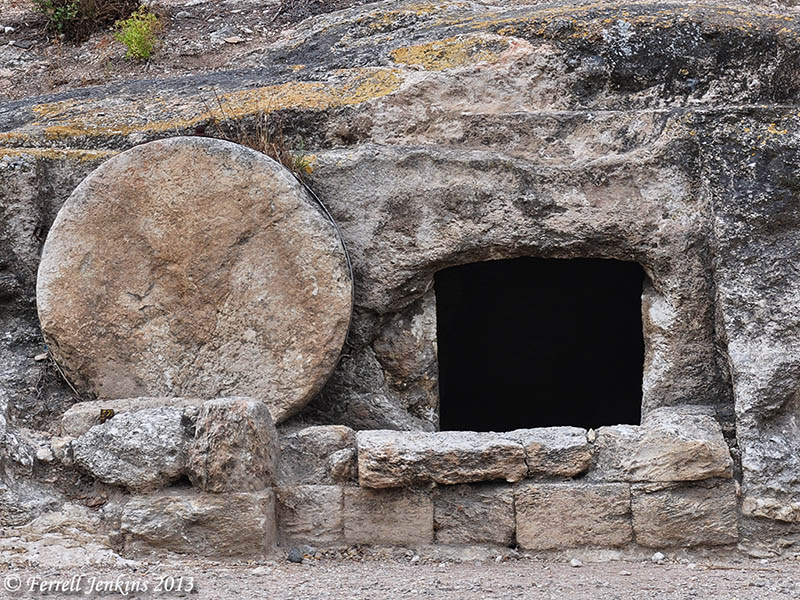
The angel at the empty tomb of Jesus announced to the women who had gone to complete the burial,

He is not here, for he has been raised, just as he said. Come and see the place where he was lying. (Matthew 28:6 NET)

Rock tomb with rolling stone near Jezreel Valley. Photo by Ferrell Jenkins.

Roman period rock tomb with rolling stone near Jezreel Valley. Photo by Ferrell Jenkins.

SourceFlix has posted a nice brief video of Passion Week Archaeology here.

Post updated from March, 2013.

The week leading to the crucifixion & resurrection

If we consider the Gospel of John a sort of “Day Planner” for Jesus, we have nearly complete activity recorded for two weeks of the earthly ministry of Jesus. The first is in John 1:19—2:11 where activity for six of the seven days is recorded. I think the omitted day is the Sabbath.

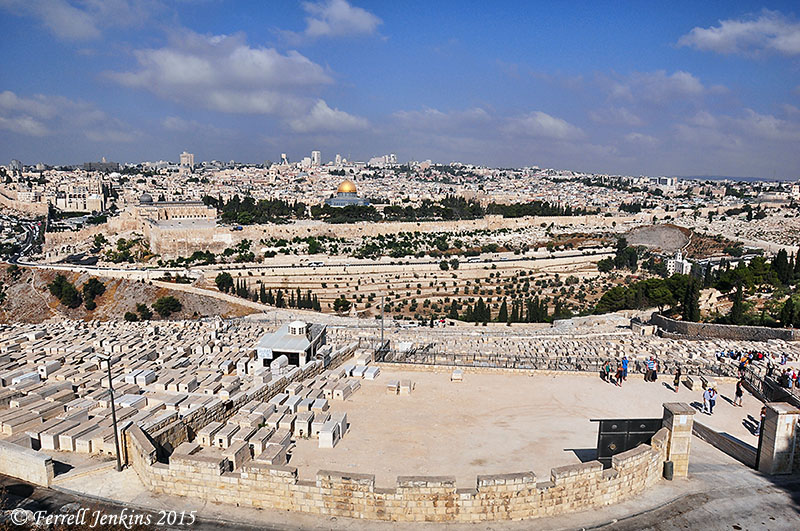
View of Jerusalem from the Mount of Olives. Photo by Ferrell Jenkins.

View of Jerusalem from the Mount of Olives. Imagine the city as it would have appeared to Jesus when he reached the top of the Mount of Olives. Photo by Ferrell Jenkins.

The next nearly complete week is the last week, leading up to the resurrection. John gives more attention to the last week than any other Gospel. Even here we have activities for only six of eight days. This section begins in John 12:1 and continues into John 20. Here is the way I have reconstructed it. Where John does not record the activity I have omitted the scripture reference.

  • Sunday — The King enters Jerusalem — 12:12-19
  • Monday — Cleansing the Temple —
  • Tuesday — Visit of the Greeks — 12:20-36
  • Tuesday — Jewish rejection — 12:37-50
  • Wednesday — No events recorded in the Gospels
  • Thursday Evening — Passover Meal, including Washing Disciples Feet (only in John) — 13:1-38
  • Thur. Eve — Farewell discourses — 14—16
  • Thur. Eve — Prayer — 17
  • Thur. Eve — Annas (only in John) — 18:12-14
  • Thur. Eve — Caiaphas — 18:24-28
  • Friday — Pilate — 18:28—19:16
  • Friday — Crucifixion — 19:16-42
  • Sabbath —
  • First Day — Resurrection — 20

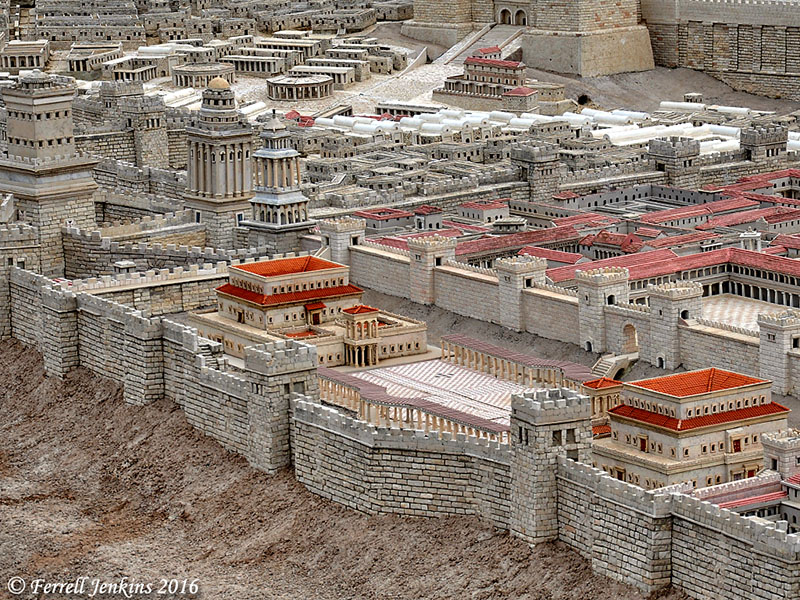
It should be noted that the appearance before Annas and Caiaphas were the Jewish (Religious) trials. The appearance before Pilate [and Herod Antipas] were the Roman (Civil) trials.

The Second Temple Model at the Israel Museum shows the location of the Palace of Herod Antipas and the Pretorium of Pontius Pilate. Photo by Ferrell Jenkins.

The Second Temple Model at the Israel Museum shows the location of the Palace of Herod Antipas and the Praetorium of Pontius Pilate. Photo by Ferrell Jenkins.

John does not record the pronouncement of woes on the religious leaders, the institution of the Lord’s Supper, and the account of the agony in the Garden of Gethsemane.

With this sparse attention given to two weeks, no wonder John says,

Now there are also many other things that Jesus did. Were every one of them to be written, I suppose that the world itself could not contain the books that would be written. (John 21:25 ESV)

———————————————————————–

Updated from earlier posts

Roman road from Elah valley to Bethlehem

Portions of roads from the Roman period are found throughout Israel, and we have posted about several of them.

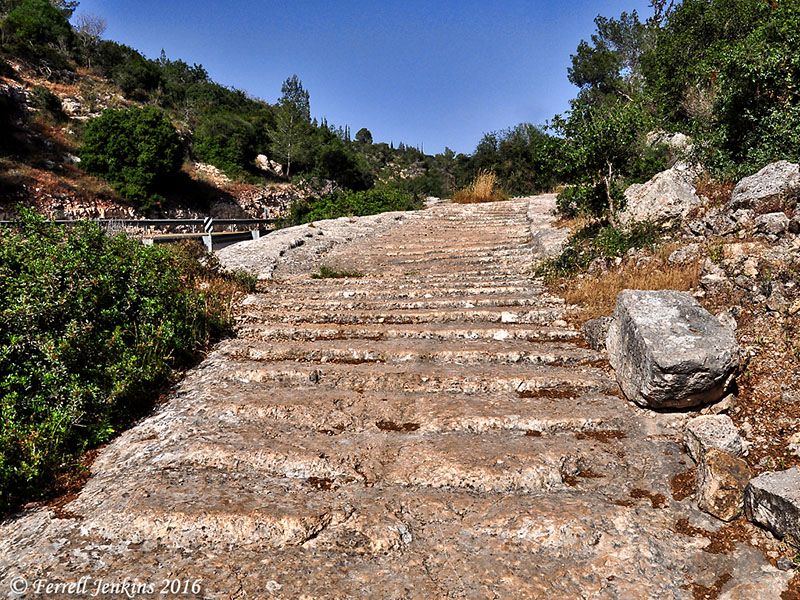
One interesting Roman road is the stepped road leading from the Valley of Elah up to Bethlehem. This photo was made 4.2 km west of Mata on Highway 375. I am not sure of the date of this unusual stretch of Roman Road, but I think most of the Roman roads date to the late first century or the second century A.D.

These steps would have made the trip up into, and down from, the mountains of Judea easier for both man and beast. This is likely the same route, centuries before the Romans controlled the area, taken by David as he went from Bethlehem to take some special provisions to his brothers on the firing line in the Valley of Elah (1 Samuel 17:15-22). Note especially verse 15:

… but David went back and forth from Saul to feed his father’s sheep at Bethlehem. (1 Samuel 17:15 ESV)

Roman Road 4.2 km W of Mata on Hwy 375. S of Hwy. Photo by Ferrell Jenkins.

Roman Road 4.2 km W of Mata on Hwy 375. S of Hwy. Photo by Ferrell Jenkins.

When David was in the cave at Adullam he wished for a drink of water from “the well of Bethlehem that is by the gate.”  The Biblical text records that three of his mighty men, without the knowledge of David, made their way to Bethlehem to bring him some of that water (2 Samuel 23:15-17). David refused to drink the water and poured it out to the LORD. I think the three mighty men would have used this same route.