Category Archives: Israel

Caesarea Maritima

Caesarea Maritima was a first century Roman capital and seaport. The gospel was first preached to the Gentiles here when Peter came from Joppa to Caesarea to tell Cornelius words by which he could be saved (Acts 10, 11).

Herod the Great built a city on the site of Strato’s Tower and named it Caesarea in honor of Caesar Augustus. It became a center of Roman provincial government in Judea. The city had a harbor and was located on the main caravan route between Tyre and Egypt. This city is called Caesarea Maritima (on the sea) to distinguish it from Caesarea Philippi.

The theater, now restored, was built originally by Herod the Great. Others added to and modified the theater in later centuries. The seating capacity is about 4000. Between the theater and the Mediterranean Sea is an open area in which numerous building fragments are displayed in a park-like environment. In the foreground we see the base of a column.

The restored theater at Caesarea Maritima. Photo by Ferrell Jenkins.

The restored theater at Caesarea Maritima. Photo by Ferrell Jenkins.

An inscription with the name of Pontius Pilate, the Roman procurator, was found during the reconstruction of the theater June 15, 1961.

The Apostle Paul used the harbor at Caesarea several times. He was imprisoned here for two years before departing for Rome (Acts 24:27; 27:1).

Underground quarry discovered in Jordan Valley

Israeli papers are reporting the discovery of an underground quarry in the Jordan Valley. Prof. Adam Zertal and a team of archaeologists from the University of Haifa are working on the hypothesis that this is the site of biblical Gilgal.
The biblical account in Joshua reads,
Now the people came up from the Jordan on the tenth of the first month and camped at Gilgal on the eastern edge of Jericho. Those twelve stones which they had taken from the Jordan, Joshua set up at Gilgal. (Joshua 4:19-20 NAU)
The report in Ha’aretz gives more information about the discovery.

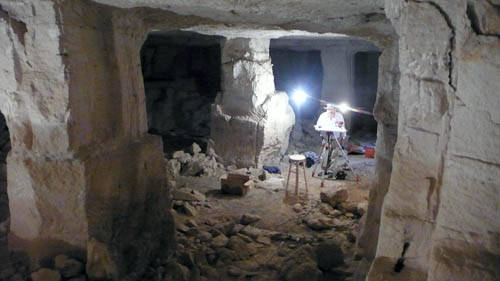
A spectacular underground quarry has recently been discovered in the Jordan Valley north of Jericho, which archaeologists believe may have marked a biblical site sacred to ancient Christians.

The large cave was discovered by Prof. Adam Zertal and a team from the University of Haifa which has been conducting a survey of the region since 1978. “When we reached the entrance to the cave, two Bedouin approached us and warned us not to go in, because it was cursed and inhabited by wolves and hyenas,” Zertal said yesterday from the site.

They entered anyway, discovering a ceiling supported by 22 gigantic columns on which various symbols were carved, including 31 crosses, a possible wheel of the Zodiac and a Roman legionary symbol. The columns also had niches for the placement of oil lamps and holes that apparently served as hitching posts.

Jordan Valley cave. Photo courtesy of University of Haifa.

Jordan Valley cave. Photo courtesy of University of Haifa.

The Ha’aretz article continues,

Zertal says their working theory is that the site is Galgala, biblical Gilgal, mentioned on the sixth-century Madaba mosaic map. The cave, buried 10 meters underground, is about 100 meters long, 40 meters wide and 4 meters high, is the largest artificial cave so far discovered in Israel.

Potsherds found in the cave and the carvings on the columns led Zertal to date the first quarrying of the cave to around the beginning of the Common Era. It was used mainly as a quarry for 400 to 500 years, “but other finds give the impression it was used for other purposes, perhaps a monastery or even a hiding place,” Zertal said.

Zertal said scholars wondered why people would dig a quarry underground considering the effort needed just to pull the stones out of the ground.

A possible answer may be in the famous Madaba Map of ancient Palestine, found in Jordan. In it, a place named Galgala is marked and an accompanying Greek word meaning “12 stones.” The map also depicts a church near the site. Archaeologists say they have found two ancient churches near the cave.

According to Zertal, scholars had always assumed that “12 stones” referred to the biblical story of the 12 stones the Israelites set up at Gilgal after they crossed the Jordan. However, the discovery of the quarried cave may mean the reference was to a quarry established where the Byzantines identified Gilgal. Zertal explains that in antiquity sanctuaries were built out of stones from sacred places.

If the Byzantines identified the site as biblical Gilgal, it would have been considered sacred and quarrying would have remained underground to preserve it.

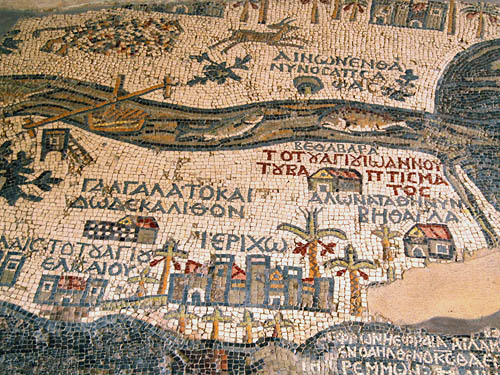
Here is a photo of a portion of the Madaba Map that I made last year.

Madaba Map showing Gilgal, Jericho, Jordan River. Photo by Ferrell Jenkins.

Madaba Map showing Gilgal, Jericho, Jordan River. Photo by Ferrell Jenkins.

This portion of the map shows the northern end of the Dead Sea and the Jordan River. You will notice fish turning around when they reach the Dead Sea. I think everyone can make out the city of palm trees, IERIXW (Jericho, Deuteronomy 34:3). To the north of Jericho, and a little east toward the river, is the site of Gilgal.

The inscription reads “Galgala, also the twelve stones.” Below the inscription is a small church with its entrance hidden by a long structure with 12 white spots on it (two rows of six). The Madaba map is dated to about A.D. 560 to 565. You may read more about the Madaba Mosaic Map here.

HT: Joseph I. Lauer

UPDATE: A short video showing the cave and featuring Dr. Zertal is available from BBC here.

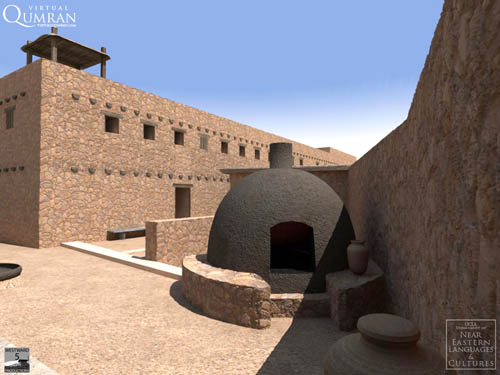
Virtual Qumran Reconstruction

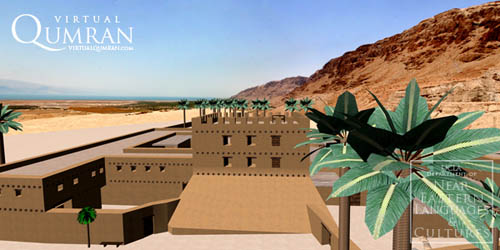
Dr. Robert R. Cargill announced here that images and a movie of Virtual Qumran are available for free download. To view the images go directly to www.VirtualQumran.com. These images will be helpful in any teaching about Qumran and the Dead Sea Scrolls. Cargill is Chief Architect and Designer of the Qumran Visualization Project.

Virtual Qumran. North East View. UCLA Qumran Visualization Project.

Virtual Qumran. North East View. UCLA Qumran Visualization Project.

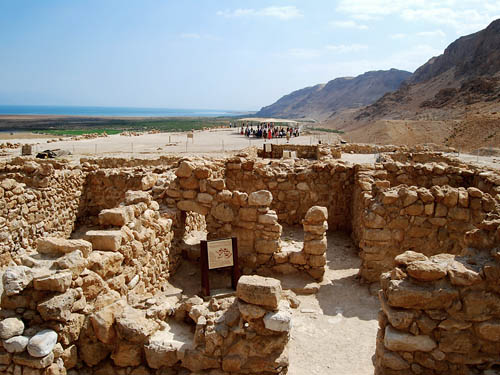
Here is a photo I made at the reconstructed ruins of Qumran.

View of proposed study room at Qumran. View NE. Photo by Ferrell Jenkins.

View of proposed study room at Qumran. View NE. Photo by Ferrell Jenkins.

The sign in the room reads,

The members of the Qumran Sect occupied themselves with studying the books of the Bible. Hundreds of pottery lamps were discovered in this room, validating the supposition that it was used for study during the night.

I am not sure this is a valid conclusion.

Qumran Potters Quarter. UCLA Qumran Visualization Project.

Qumran Potters Quarter. UCLA Qumran Visualization Project.

Check our earlier discussion of the Dead Sea Sect here.

Almonds – a symbol of watchfulness and old age

Almonds were also among the best products of the land sent by Jacob to the man in Egypt (Genesis 43:11). The Hebrew word for almond (seqedim) comes from the root sqd which means “to watch, wake.” King and Stager tell us that the name was given because,

its splendid white blossoms appear as early as the end of January, a true harbinger of spring. Jeremiah plays on sqd: “The word of Yahweh came to me [Jeremiah], saying, ‘Jeremiah, what do you see?’ And I said, ‘I see a branch of an almond tree (saqed).’ Then Yahweh said to me, ‘You have seen well, for I am watching (soqed) over my word to perform it” (Jer. 1:11-12). (Life in Biblical Israel, 105)

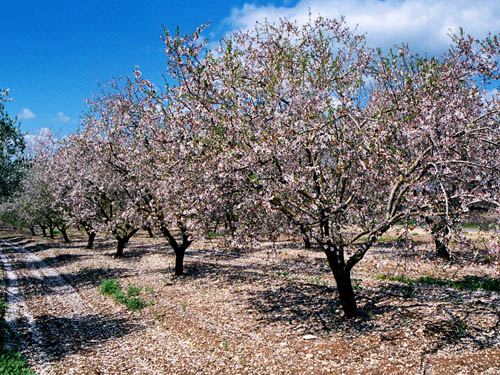
The photo below was made in early March near the north border of the Palestinian West Bank near Jenin. Notice that the falling blossoms turn the ground gray.

Almond trees blooming in the West Bank. Photo by Ferrell Jenkins.

Almond trees blooming in the West Bank near Jenin. Photo by Ferrell Jenkins.

Other biblical references to the almond include the following:

  • The cups of the lampstand for the tabernacle were shaped like almond blossoms (Exodus 25:33).
  • Aaron’s rod sprouted and brought forth buds, produced blossoms, and bore ripe almonds (yummy; Numbers 17:8).
  • Used figuratively of the person growing older (“the almond tree blossoms,” Ecclesiastes 12:5). Matthew Henry says, “The old man’s hair has grown white, so that his head looks like an almond-tree in the blossom. The almond-tree blossoms before any other tree, and therefore fitly shows what haste old age makes in seizing upon men; it prevents their expectations and comes faster upon them than they thought of. Gray hairs are here and there upon them, and they perceive it not.”
Almond blossoms in the West Bank. Photo by Ferrell Jenkins.

Almond blossoms in the West Bank. Photo by Ferrell Jenkins.

Pistachio nuts among best products of the land

During the days of a severe famine in the land of Canaan, Israel (Jacob) agreed to allow his youngest son Benjamin to go to Egypt at the request of the man who was in charge of dispensing food. That man was Joseph, the son of Israel. Jacob agreed to allow Benjamin to go with his older brothers. He also told the boys to take some of “the best products of the land” including pistachio nuts.

Then their father Israel said to them, “If it must be so, then do this: take some of the best products of the land in your bags, and carry down to the man as a present, a little balm and a little honey, aromatic gum and myrrh, pistachio nuts and almonds. (Genesis 43:11 NAU)

I began thinking about this post while studying John 12.

Mary then took a pound of very costly perfume of pure nard, and anointed the feet of Jesus and wiped His feet with her hair; and the house was filled with the fragrance of the perfume. (John 12:3 NAU)

There are several significant words in this text: perfume (muron), pure (pistikos), and nard (vardos). The Greek word for pure (pistikos)  is difficult to define. Bauer-Danker says it is “variously interpreted, but evidently suggesting exceptional quality.” A comment by William Barclay caught my attention.

Oddly enough, no one really knows what that word means. There are four possibilities. It may come from the adjective pistos which means faithful or reliable, and so may mean genuine. It may come from the verb pinein which means to drink, and so may mean liquid. It may be a kind of trade name, and may have to be translated simply pistic nard. It may come from a word meaning the pistachio nut, and be a special kind of essence extracted from it. In any event it was a specially valuable kind of perfume.

Then I noticed the comments by Keil and Delitzsch on pictachio nuts (sic) in Genesis 43:11.

which are not mentioned anywhere else, are, according to the Samar. vers., the fruit of the pistacia vera, a tree resembling the terebinth, – long angular nuts of the size of hazel-nuts, with an oily kernel of a pleasant flavour; it does not thrive in Palestine now [1875], but the nuts are imported from Aleppo.

Well, that led me to think of photos I made in a pistachio orchard near Carchemish on the Euphrates (Jeremiah 46:2). This is about 65 miles from Aleppo.
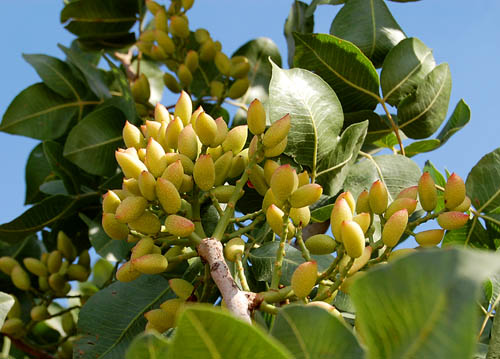
Pistachio's growing near Carchemish on the Euphrates. Photo by Ferrell Jenkins.

Pistachio's growing near Carchemish on the Euphrates. Photo by Ferrell Jenkins.

I think this is the only place I have seen pistachio’s growing on a tree. The practical comment by Matthew Henry is worth meditating on for a while.

Note, (1.) Providence dispenses its gifts variously. Some countries produce one commodity, others another, that commerce may be preserved. (2.) Honey and spice will never make up the want of bread-corn. The famine was sore in Canaan, and yet they had balm and myrrh, etc. We may live well enough upon plain food without dainties; but we cannot live upon dainties without plain food. Let us thank God that that which is most needful and useful is generally most cheap and common.

That sort of outlines the rambling of the mind back of this post. It is amazing what one may learn once he begins to track down leads. I still don’t know if pure (pistikos) has anything to do with pistachio nuts! Meditate.

The Samaritans

Samaritan Priest with Samaritan Pentateuch Scroll. Photo by Ferrell Jenkins.

Samaritan Priest with Samaritan Pentateuch Scroll. Photo by Ferrell Jenkins.

“Samaritans use modern means to keep ancient faith” is the title of an informative article about the modern Samaritans on Mount Gerizim at Reuters. A slide show of 10 good photos is included. I especially liked the one showing the priest in the museum with a painting of Jesus and the Samaritan woman at the well.

We recently wrote about the meeting of Jesus with the woman of Samaria at Jacob’s Well here. We wrote about Jesus passing through Samaria here.

Todd Bolen’s article on the Samaritan Passover may be read here.

Years back I made black and white photos for use in publications. This one shows a Samaritan priest displaying a copy of the Samaritan Pentateuch. He said it was the oldest book in the world. Textual scholars think it is no older than the 12th century A.D.

A Reuter’s Blog here gives some additional information about how the reporters got to Mount Gerizim. Check the video at the bottom of the page.

HT: Joseph Lauer; Paleojudaica.

“Our IAA which art in Israel”

Tourist confesses to taking a stone from an Israel Antiquities Excavation 12 years ago.

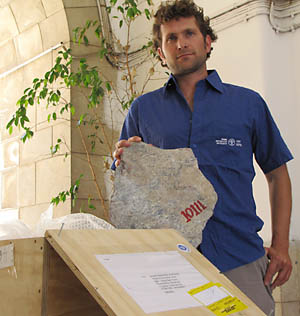
Twelve years after a stone disappeared from an Israel Antiquities Authority Excavation south of the Temple Mount, a tourist from New York confessed: “I Took It. My Conscience Bothers Me and I Am Asking for Forgiveness” The stone, which weighs 21 kilo, was returned to Jerusalem this week.

Here is part of the account released by the IAA in Jerusalem.

In 1997, a twenty one kilogram fragment of a marble column disappeared from one of the excavations the Israel Antiquities Authority was conducting south of the Temple Mount.

Several weeks ago, the IAA received an unexpected e-mail from a clergyman in the state of New York: “I am requesting forgiveness for a member of my congregation”, he writes. “The fellow confessed to me that twelve years ago he took a stone from Jerusalem and his conscience has bothered him ever since. I wish to return the stone to Israel and hope that you will forgive the man for his transgression”.
A letter from the fellow was attached to the heavy stone fragment, which arrived in Jerusalem in a wooden crate that was specially constructed for the flight back to Israel. “I came to Israel on an organized trip. As a student of archaeology, I was very excited when we visited an excavation south of the Temple Mount. I asked how I can purchase a stone from the excavation because I wanted a souvenir with which to pray for Jerusalem and was told it was not possible. On the last day of the trip our Israeli tour guide approached me and took the stone fragment from inside his coat. ‘Take it’, he said. ‘It’s a present from me’. I asked him how he obtained the stone and he replied, ‘It’s okay; don’t worry’. I was very happy and took the stone with me on my flight back to New York. Only later did I realize that he probably took the stone from the excavation without permission. For the past twelve years since then, rather than remind me of the prayer for Jerusalem, I am reminded of the mistake I made when I removed the stone from its proper place in Israel. I am asking for your forgiveness”.

Shay Bar Tura displays the package and the returned stone. Photo by IAA.

Shay Bar Tura displays the package and the returned stone. Photo by IAA.

Shay Bar Tura, Deputy Director of the Unit for the Prevention of Antiquities Robbery in the IAA, stated,

It should be emphasized that any activity conducted at an antiquity site requires permission from the IAA. Taking archaeological artifacts from antiquities sites constitutes a severe criminal offense which is punishable by law with imprisonment”.

Who was the tour guide?

HT: Joe Lauer

Paul in Ephesus

Paul taught in the school of Tyrannus during his stay in Ephesus. We need not think that Paul was assigned as an Associate Professor, or Lecturer. He may have simply used a rented facility or hall for his teaching.

But when some were becoming hardened and disobedient, speaking evil of the Way before the people, he withdrew from them and took away the disciples, reasoning daily in the school of Tyrannus. (Acts 19:9)

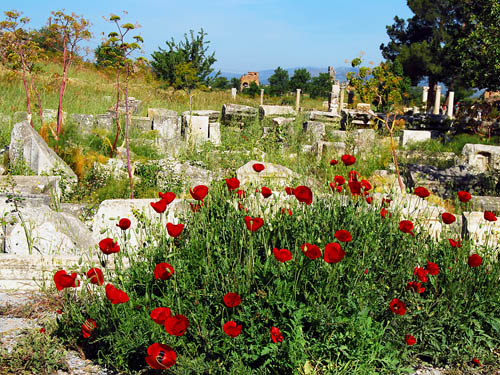
When we visit Ephesus today we see nothing but ruins and a few partially reconstructed buildings. We wonder about all of the things that happened to Paul, Apollos, Aquila, Priscilla, and Timothy in these places. Meditate on these things as you enjoy today’s photo.

Flowers blooming among the ruins at Ephesus. Photo by Ferrell Jenkins.

Flowers blooming among the ruins at Ephesus. Photo by Ferrell Jenkins.

Discovery of the Roman Pool of Siloam

In early June, 2004, an announcement was made by Ronny Reich and Eli Shukron of the discovery of a pool dating to the Second Temple period (Herod’s temple). Continuing excavations have revealed three sets of stairs leading down into the pool. Most of the pool has not yet been uncovered. In November, 2005, I spoke with Professor Reich at the pool and he explained several things about the discovery.

A feature article was published in Biblical Archaeology Review, Sept.-Oct., 2005. Todd Bolen of BiblePlaces.com, who assisted in the excavations at the site, included some comments on his BiblePlaces Blog here in August, 2005. Many reports that appear in the news media are incomplete and sometimes misleading.

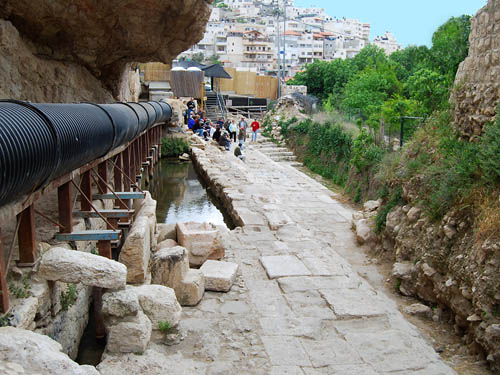
Pool of Siloam. View toward East. Byzantine pool is to our back. Photo by F.Jenkins.

Pool of Siloam. View toward East. Byzantine pool is to our back. Photo by F. Jenkins.

See Todd’s photos and comments about The Pool of Siloam Revealed at BiblePlaces.com.

Our photo shows the northern steps and the eastern corner of the pool. You can detect the present road level at the top of the wooden steps. In the distance, across the Kidron Valley, you can see a hill south of the Mount of Olives, sometimes called the Hill of Evil Counsel. Beyond that lies the Judean Wilderness.

The Pool of Siloam

More than 700 years before Christ, the Judean King Hezekiah dug a tunnel to bring the water of the Gihon spring to a new pool which he constructed on the west side of the city of David (2 Kings 20:20; 2 Chron 32:30; Sirach 48:17). This pool would later be known as the pool of Siloam.

One of the great signs of Jesus, recorded in the Gospel of John, is the healing of a man born blind (John 9). Jesus spat on the ground and made clay of the spittle. He then applied the mud to the blind man’s eyes and told him, “Go, wash in the pool of Siloam.” We understand that mud made from saliva and water from Siloam will not normally cause a blind person to see. This sign demonstrates the power of Jesus over blindness and demonstrates the validity of His claim to be “the Light of the world” (9:5). The blind man’s faith to obey Jesus clearly played a role in his healing.

For many years we have been aware of the Pool of Siloam at the southern end of Hezekiah’s tunnel. A church dedicated to “Our Savior, the Illuminator” was built here in the fifth century by the Byzantine Empress Eudokia, but was destroyed in A.D. 614 and never rebuilt. Some columns from the building can still be seen. See Hoade, Guide to the Holy Land, and Murphy-O’Connor, The Holy Land, for details.

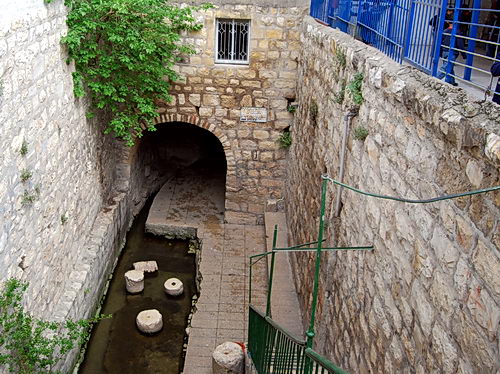
This photo shows the Byzantine pool at the southern end of Hezekiah’s tunnel. Note the present ground level along the blue fence.

Ruins of the Byzantine church at end of Hezekiah's Tunnel. Photo by F. Jenkins.

Ruins of the Byzantine church at end of Hezekiah's Tunnel. Photo by F. Jenkins.

In a post to follow we will discuss the newly discovered Pool of Siloam from the Roman period.