Category Archives: Greece

The looting of Sardis

Finally, Greece and Turkey can agree on something. They wish they had back the archaeological treasures that have been taken to other countries in the past. Greece wants back the Elgin marbles taken from Athens to the British Museum. Turkey wants back the treasures taken from Sardis in September 1922, the days of unrest during the fall of the Ottoman Empire. According to the article by John Leonard in Athens News, the port city of Smyrna (modern Izmir) was burning when John Horton sent crates of antiquities to the United States.

Numerous Turkish artifacts, including some real big ones (in size and importance), are displayed in the British Museum, and in the Pergamum Museum in Berlin.

It is a fascinating story with two sides. Read Leonard’s article here.

The photo below is one I made at Sardis earlier this month. The view is West over the ruins of the Temple of Artemis. One of the Ionic capitals is in the Metropolitan Museum in New York. The temple dates back to at least the 6th century B.C., but was destroyed in 499 B.C., and then underwent three rebuilding phases. The columns seen here date to the third rebuilding phase (ca. A.D. 150). Ruins of a restored Byzantine church from the fourth century A.D. may be seen in the left corner of the photo.
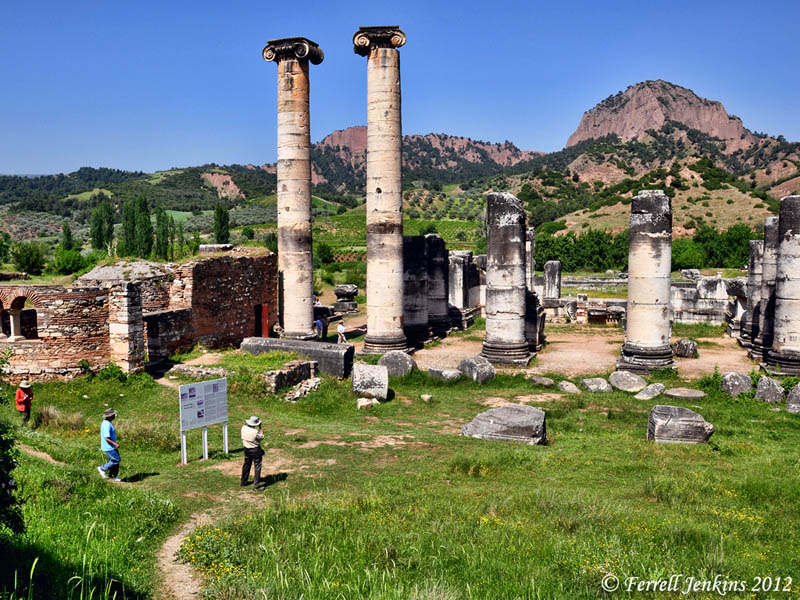
Sardis. Temple of Artemis. View West. Photo by Ferrell Jenkins.

Sardis. View west over the Temple of Artemis. Photo by Ferrell Jenkins.

Sardis is mentioned in the Bible only in Revelation (Apocalypse) 1:11 and 3:1-6.

saying, “Write what you see in a book and send it to the seven churches, to Ephesus and to Smyrna and to Pergamum and to Thyatira and to Sardis and to Philadelphia and to Laodicea.”  (Revelation 1:11 ESV)

Another post about efforts to retrieve artifacts from foreign museums may be read here.

HT: Jack Sasson
Paul worked 18 months at Corinth

Paul first visited Corinth during his second preaching journey (A.D. 50-53; Acts 15:36-18:22). After facing opposition of his fellow Jews in Thessalonica and Berea, the brethren at Berea conducted him to the sea and to Athens, the intellectual capital of the Greco-Roman world.

Paul was alone in Athens, but he had sent for Timothy and Silas to come to him immediately from Berea. After what might be considered limited success at Athens, Paul continued to Corinth in the Peloponnesus. Paul stayed at Corinth for 18 months according to Luke’s account in Acts 18.

During that time he was brought before Gallio. The site of this encounter was likely before the bema, the judgement-seat, in the agora. The photo reflects one of the important things we saw today at Corinth. The foundation of the bema is seen in the left of the photo. The Acrocorinth, the high point of the city, is in the distance.

Corinth. The Bema in the Agora. Acrocorinth in distance. Photo by Ferrell Jenkins.

The Bema in the Agora of Corinth. Photo by Ferrell Jenkins.

Numerous changes are taking place all over Europe at popular tourist destinations. I first noticed it a few years ago when the bus driver had to park a distance from the center of activity in Salzburg, Austria. Everyone had to walk a considerable distance to reach the place where the walking normally began. Then I saw it in Florence and Rome. Now it is true in Athens and Corinth. Buses are required to drive a long distance out of the way to reach the parking at Corinth.

At the site we now see rope barriers preventing one from walking close to the columns of the Temple of Apollo, or approaching the Fountain of Peirene, or the Bema. I understand that these restricting are imposed by the European Union on their member states.

Visiting anywhere in the world takes longer than it did a few decades ago due to the tremendous increase in traffic.

Paul preached in Athens

Our cruise ship, the Louis Cristal, arrived in Athens early this morning. After breakfast we disembarked and met our local tour operator and guide. Andi has guided my groups several times over the years, and I am pleased to have her with us. She divides her time each year between the USA and Greece.

We drove by the usual historical places in Athens, and stopped at the old Olympic stadium before going to the Acropolis.

Syntagma (Constitution) Square was clean and orderly; not at all the way it has been portrayed on American TV lately. I am not saying that the things shown on TV never happened, but that when the same video clips are shown over and over for many days it leaves the wrong impression.

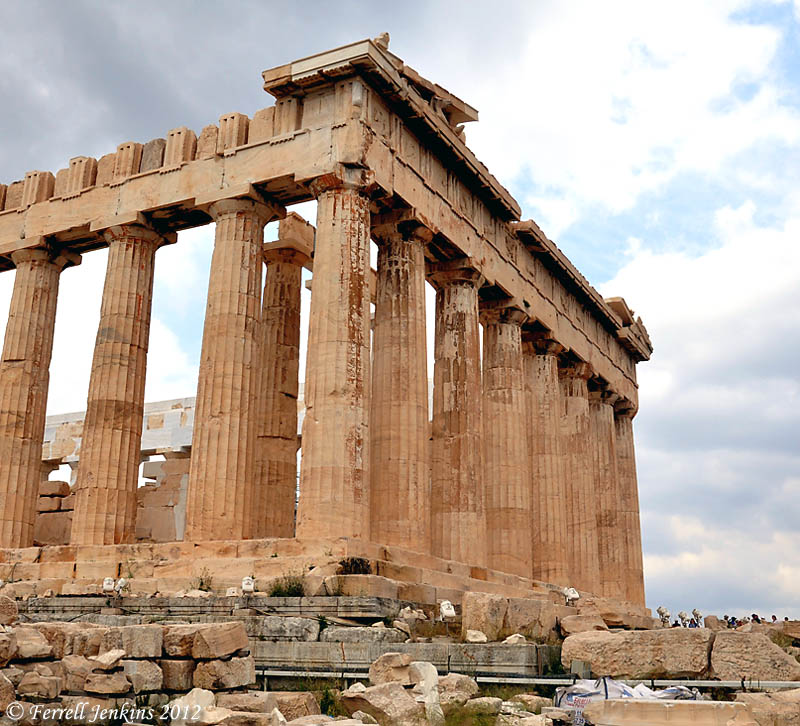
I had hoped that the scaffolding and cranes used in the restoration of the Parthenon would be gone. Such was not the case. The only place I could get a photo without showing these things was from the back.

The back of the Parthenon in May, 2012. Photo by Ferrell Jenkins.

The back of the Parthenon in May, 2012. Photo by Ferrell Jenkins.

The Parthenon, where the virgin goddess Athena was worshiped, was built between 447 and 438 B.C. It is still quite a building.

We also visited the Areopagos (Mar’s Hill), possibly the place where Paul delivered his speech on the Unknown God (Acts 17).

While the group went with the guide looking at some highlights in the Athens National Museum, I made some photos of the nice collection of Roman Emperors.

Below is a photo of the portrait head of the Emperor Claudius (A.D. 41-54) in Pentelic marble.The museum sign says,

The head is crowned with the corona civica (a wreath of oak leaves and acorns) tied with a ribbon.

The Roman Emperor Claudius in the Athens National Museum. Photo by Ferrell Jenkins.

The Roman Emperor Claudius in the Athens National Museum. Photo by Ferrell Jenkins.

Paul’s visit to Athens and Corinth was during the reign of Claudius. In fact, the emperor is mentioned in Acts 18:2.

And he found a Jew named Aquila, a native of Pontus, recently come from Italy with his wife Priscilla, because Claudius had commanded all the Jews to leave Rome. And he went to see them,

The great famine mentioned in Acts 11:28 also took place during the reign of Claudius.

We have plans to visit Corinth tomorrow.

Steps of Paul and John in Turkey and Greece

We’re off to visit Turkey and Greece for the next few days. Visiting all of the sites where Paul and John traveled would be impossible in a few weeks. Our tour in Turkey, which we have conducted several times since 1968, is limited to the area of the Seven Churches of Revelation (1:4, 11), and a few cities associated with Paul’s ministry (Ephesus, Acts 19; Colossae and Hierapolis, Colossians 4:13; Miletus, Acts 20). The entry point into the country is Istanbul, the former Constantinople, a city that was significant in the early post-apostolic history of the church.


In the Aegean Sea we visit Patmos (Revelation 1:9), Rhodes (Acts 21:1), and Crete (Acts 27; Titus 1:5).

Our stops in Greece are limited to Athens, Corinth and Cenchreae (Acts 17-18).

We don’t promise to be as thorough as we might while in the comfort of the study at home, but we will try to post a few photos of interest as we move along.

We arrived in Istanbul this morning, collected the luggage, cleared customs and had our luggage loaded on the bus by noon. After a stop for lunch near the Hagai Sophia and the Blue Mosque, we continued with some general sightseeing of the city and a boat ride on the Bosporus. I think everyone is looking forward to a good night of sleep and a full day of sightseeing in the city tomorrow.

Santorini sunset

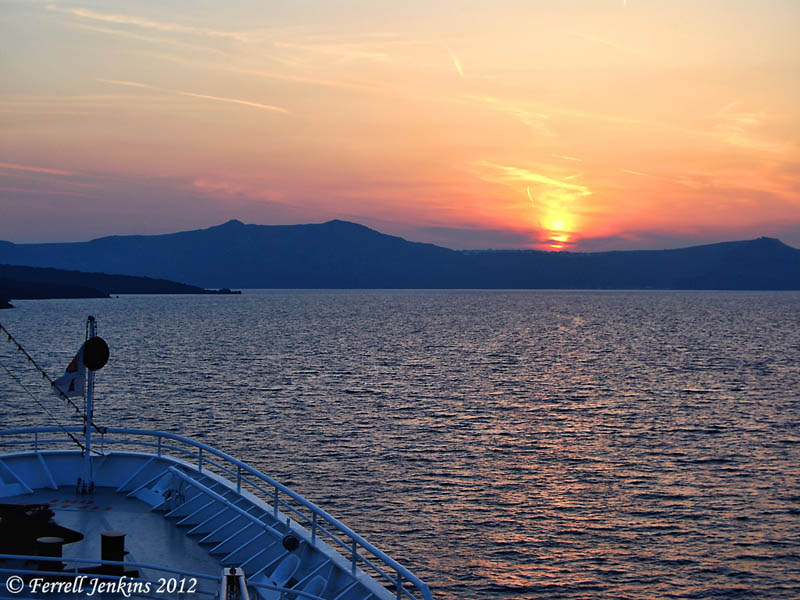
Perhaps like many of you, I have been occupied with working on taxes the past few days. Not much time to write something substantial. I decided to share one of the sunset photos I made of the island of Santorini silhouetted against the sunset.

Santorini at sunset. Photo by Ferrell Jenkins.

Santorini at sunset. Photo by Ferrell Jenkins.

The sun plays a prominent role in the visions of John from the island of Patmos, also in the Aegean. Note just this one reference to the woman who gives birth to the “male child.”

And a great sign appeared in heaven: a woman clothed with the sun, with the moon under her feet, and on her head a crown of twelve stars. She was pregnant and was crying out in birth pains and the agony of giving birth. (Revelation 12:1-2 ESV)

Akrotiri archaeological site reopens after seven years

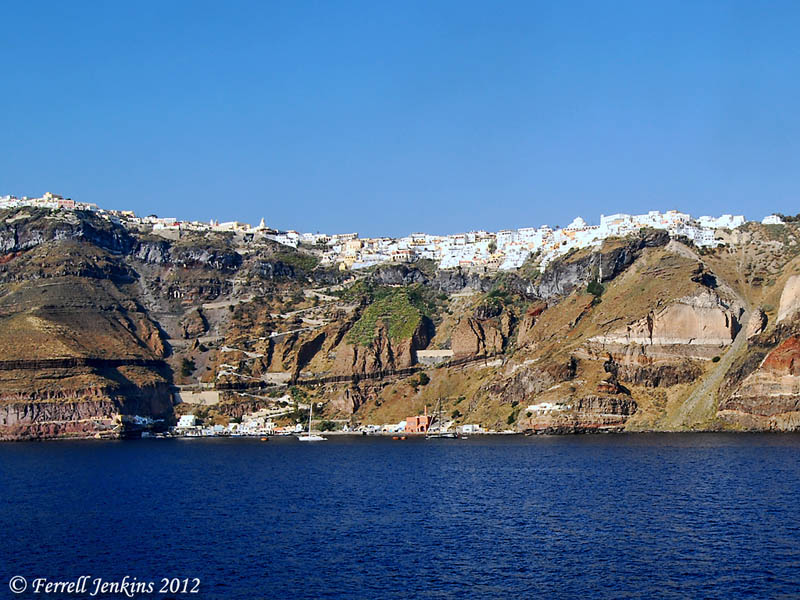
The volcanic island of Santorini, also known as Thira, is a popular stop on Aegean cruises. Eruptions are known to have occurred about 1600 B.C., 1475 B.C., and in the twelfth century B.C. The cruise ships float around in the crater and the passengers are taken by tinder to a place where they have a choice of cable car or donkey to reach the rim.

A view from inside the crater at Santorini. Photo by Ferrell Jenkins.

A view from inside the crater at Santorini. The town of Fira sits perched upon the rim of the volcanic crater. Photo by Ferrell Jenkins.

I have been to Santorini several times on my Steps of Paul and John tours. It is a “necessary” stop on the cruise that allows visits to the biblical sites of Patmos, Rhodes, and Crete. Prior to 2005 a visit to the archaeological site of Akrotiri was worthwhile. A brief description of Akrotiri is given at Wikitravel here.

Akrotiri, in the south, a roughly 3,500 year old Minoan town preserved in volcanic ash like Pompeii, is one of Santorini’s “must-sees”. The excavation site is covered by a roofing system, which makes it something that you can comfortably visit no matter what time of year. The ruins, are extremely well preserved. Streets, buildings, stairs and even second floors of buildings are still visible. Visitors can stand in the ruins and look at Minoan pottery and frescoes, and with a little imagination, feel what it would have been like to live in ancient Greece. Due to an accident in September 2005, the excavation site is still closed to the public.

Word comes from the China Post that the archaeological site reopened last Friday. I look forward to visiting it again next month. I am sure I recall making slides there, but have been unable to locate any in my files.

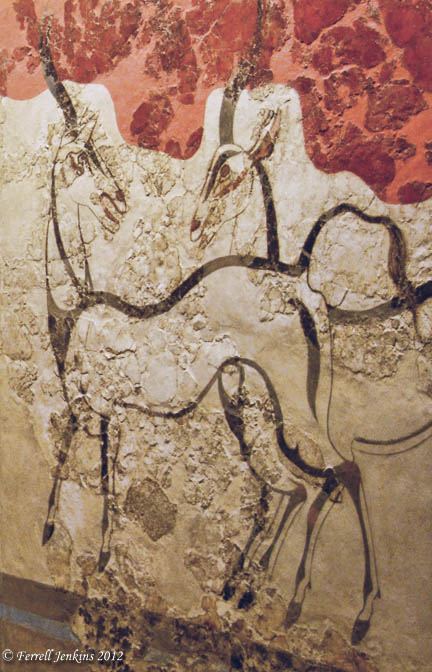
The Athens National Museum has a wonderful exhibit of fresco’s and other artifacts from Akrotiri on the second floor of the museum. The photo here is of the Antelopes fresco.

The Antelopes fresco from Akrotiri. Athens National Museum. Photo by Ferrell Jenkins.

The Antelopes fresco from Akrotiri displayed in the Athens National Museum. Photo by Ferrell Jenkins.

Professor Hans Goedicke proposed that the Exodus and the drowning of the Egyptian army was an historical event in 1477 B.C. According to the theory, a tsunami produced by volcanic eruption in the Mediterranean was responsible for the flooding that drowned the Egyptian Army. See Shanks, “The Exodus and the Crossing of the Red Sea, According to Hans Goedicki.” BAR 07:05 (Sept/Oct 1981). The dating does not fit what I understand to be the date of the Exodus, but I am unable to comment further on the theory at this time.

HT: Jack Sasson

Paul spent a night at Cos (Kos)

Paul and his companions, including the physician Luke, made their way from Miletus to Cos (Kos).

And when we had parted from them and set sail, we came by a straight course to Cos, and the next day to Rhodes, and from there to Patara. (Acts 21:1 ESV)

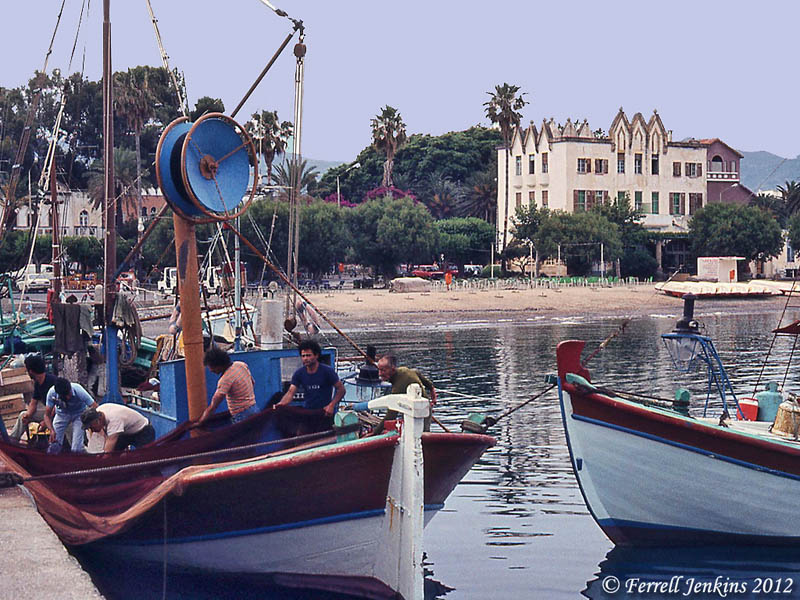
Cos is one of the islands belonging to a group of 12 called the Dodecanese. Patmos is also an island of this group. The Mycenaeans settled Cos in the 15th century B.C. In the centuries to follow the island came under the control of the Persians, the Greeks, and the Romans. In modern times the island has been under Turkish and Italian control, and German occupation. Since 1948 it has been part of Greece. My only visit to Cos was a brief stop en route from Patmos to Rhodes in 1984. Here is one of the photos I made.

The harbor on the Island of Cos in 1984. Photo by Ferrell Jenkins.

The harbor on the Island of Cos in 1984. Photo by Ferrell Jenkins.

In the time of Paul, Cos was noted as the birthplace of Hippocrates, the “father of medicine.” Hippocrates was associated with the Asclepium, ruins of which can still be seen. A Hellenistic gymnasium and some Roman ruins, including portions of a Roman road, may also be seen. There is also an archaeological museum.

Howard F. Vos describes the island with these words:

One of the most beautiful ports of the ancient world, Cos not doubt was most famous as a health resort. It was the site of the first school of scientific medicine and the sanctuary of Asclepius (Esculapius). The island had a healthful climate and hot ferrous and sulfurous springs, which the great Hippocrates (ca 460–377 b.c.), the father of medicine, first used to cure his patients. (The International Standard Bible Encyclopedia, revised.)

James Strahan, in the old Hasting’s Dictionary of the Apostolic Church, says,

It was renowned for its vines and looms, its literature and art, and above all for its temple of Æsculapius and school of medicine, which must have made it especially interesting to St. Luke.

According to Josephus, Herod the Great assisted the people of Cos with grain and other goods. (JW 1:424).

Two Other Good Sources:

Fant, C. E. and M. G. Reddish, A Guide to Biblical Sites in Greece and Turkey.

Wilson, Mark. Biblical Turkey: A Guide to Jewish and Christian Sites of Asia Minor. This book deals with Turkey, but devotes ½ page to Cos as a Sidetrip.

Alexander the Great and the Book of Daniel

Josephus, the late first century Jewish historian, records the visit of Alexander the Great to the city of Jerusalem in the 4th century B.C. He recounts how Alexander “went up into the temple” and “offered sacrifice to God.” He says that the Book of Daniel was shown to Alexander. Alexander assumed, as have many commentators since that time, that Daniel was prophesying of Alexander.

Bust of Alexander in the Istanbul Archaeological Museum. Photo by Ferrell Jenkins.

Bust of Alexander in the Istanbul Archaeological Museum. Photo by Ferrell Jenkins.

Here is a portion of the account from the Antiquities of the Jews. Notice especially section 337.

336 And when he had said this to Parmenion, and had given the high priest his right hand, the priests ran along by him, and he came into the city. And when he went up into the temple, he offered sacrifice to God, according to the high priest’s direction, and magnificently treated both the high priest and the priests.
337 And when the Book of Daniel was showed to him {a} wherein Daniel declared that one of the Greeks should destroy the empire of the Persians, he supposed that himself was the person intended; and as he was then glad, he dismissed the multitude for the present; but the next day he called them to him, and bade them ask what favours they pleased of him;
338 whereupon the high priest desired that they might enjoy the laws of their forefathers, and might pay no tribute on the seventh year. He granted all they desired; and when they entreated him that he would permit the Jews in Babylon and Media to enjoy their own laws also, he willingly promised to do hereafter what they desired:  (Ant 11:336-338)

Read Daniel 8 for more details of the conflict between Alexander, who is compared to a male goat, and the Persian king who is likened to a ram.

As I was considering, behold, a male goat came from the west across the face of the whole earth, without touching the ground. And the goat had a conspicuous horn between his eyes. (Daniel 8:5 ESV)

Monday Meandering — March 19

Greatest Finds. The Israel Ministry of Foreign Affairs has compiled a list of the “Greatest archeological finds in Israel” here with links. Places include Masada, Megiddo, Beit Guvrin-Maresha, Ashkelon, the City of David, Hazor, Dan, Herodion, Khirbet Qeiyafa, and Tel es-Safi (Gath), and others.

The Scale of the Universe 2 here. Fascinating. Requires Flash. Reminds me of two Biblical references.

 When I look at your heavens, the work of your fingers, the moon and the stars, which you have set in place,  4 what is man that you are mindful of him, and the son of man that you care for him? (Psalm 8:3-4 ESV)

For by him all things were created, in heaven and on earth, visible and invisible, whether thrones or dominions or rulers or authorities– all things were created through him and for him.  And he is before all things, and in him all things hold together.  (Colossians 1:16-17 ESV)

Marine Life in the Corinthian Gulf here. Beautiful photos.

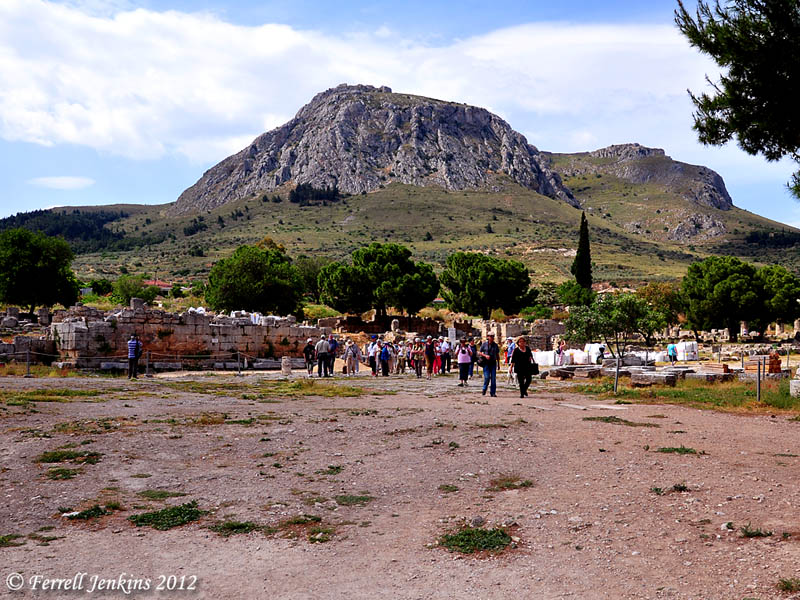
The Acrocorinth. Wonderful, clear view of the mountain above ancient Corinth here. Carl Rasmussen has posted several other nice photos of Corinth recently.

A history of the Roman Empire in 75 seconds here.

The Burnt House. The headline in the Jerusalem Post read “House in Old City as Titus left it.” Leen Ritmeyer includes this and another news article, along with his reconstruction of the Burnt House here.

Geopolitics of Israel. Every student of Bible geography will enjoy the analysis of the geopolitics of Israel by the Stratfor Global Intelligence here.

2,000-year-old Israeli date palm. Has it been trumped by a 32,000-year-old Russian flower? Tom Powers provides some links about the palm which is now about 8 feet tall, here.

HT: Aren Maeir; NT Resources Blog; Corinthian Matters; Luke Chandler’s Blog; Bible Places Blog.

Visual illustrations for Daniel 8

In Daniel’s vision of a ram and a male goat we are given a glimpse of the two world empires following Babylon — the Medo-Persian Empire and the Alexandrian (or Hellenistic/Grecian) Empire.

Daniel sees a ram.

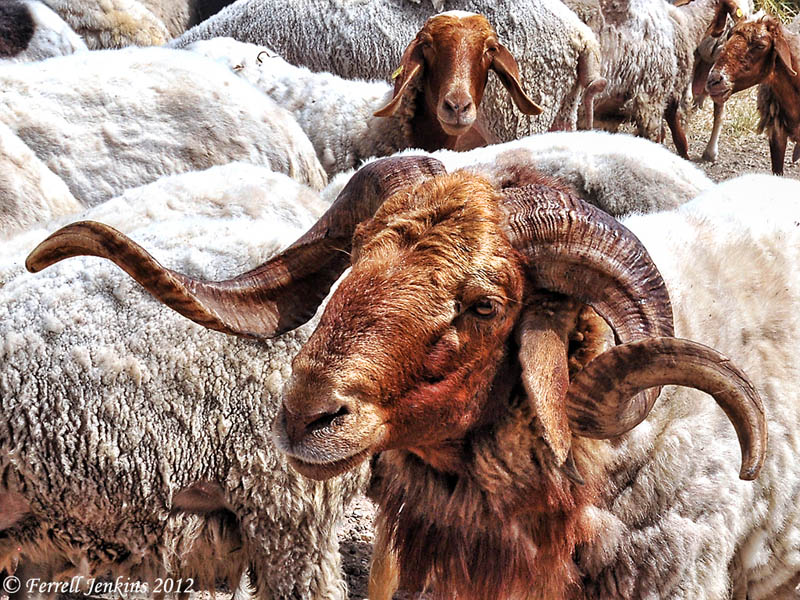
I raised my eyes and saw, and behold, a ram standing on the bank of the canal. It had two horns, and both horns were high, but one was higher than the other, and the higher one came up last. (Daniel 8:3 ESV)

Ram at Socoh. Photo by Ferrell Jenkins.

A ram. With horns like that it is easy to see who is boss. Photo by Ferrell Jenkins.

In apocalyptic literature the visions take liberty with reality. It would require an artist to draw the ram and the male goat exactly as Daniel saw them.

Then Daniel sees a male goat.

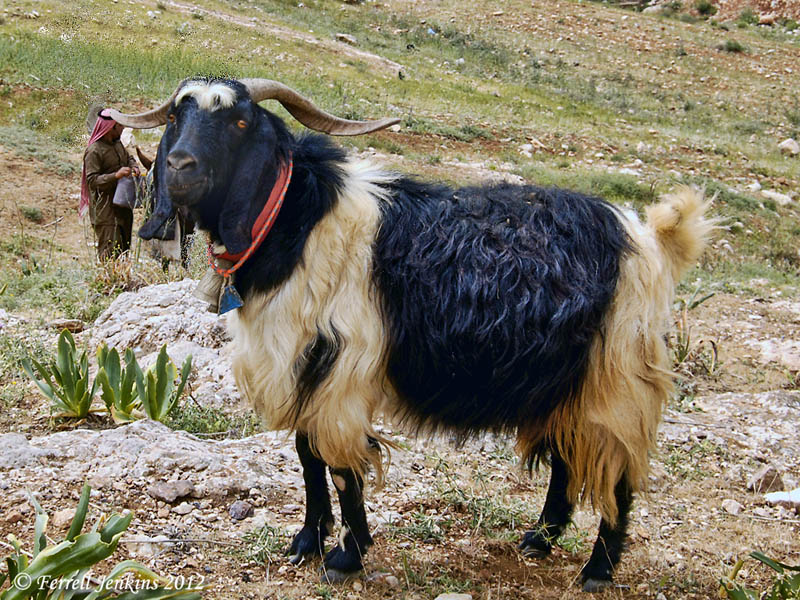
As I was considering, behold, a male goat came from the west across the face of the whole earth, without touching the ground. And the goat had a conspicuous horn between his eyes. (Daniel 8:5 ESV)

A male goat in Gilead (modern Jordan). Photo by Ferrell Jenkins.

A male goat in Gilead (modern Jordan). Photo by Ferrell Jenkins.

The interpretation is easier for us than it was for Daniel before Gabriel gave him an understanding of the vision (vs. 15-16).

As for the ram that you saw with the two horns, these are the kings of Media and Persia.  And the goat is the king of Greece. And the great horn between his eyes is the first king.  (Daniel 8:20-21 ESV)

It will not be difficult to find other uses for photos of the ram and the male goat in Bible lessons (e.g., Genesis 15:9; Leviticus 23:19; 16:5)