Category Archives: Family

The Burnt House destroyed in A.D. 70

Our tour group visited several places in and near Jerusalem today. We began Jaffa Gate and the Tower of David (actually built by Herod the Great). We moved on through the Jewish Quarter to the Wohl Archaeological Museum. For general information about the Jewish Quarter see the informative web site dedicated to the area, here. Information about the Museum, where you may see the ruins of six houses built on the slope between the Upper City of Jerusalem and the Temple Mount, is available here. These houses indicate that some of the wealthiest residents of Jerusalem lived in them – perhaps the priestly class. These houses were destroyed in the Roman destruction of Jerusalem in A.D. 70. Photos are not allowed in the Museum.

Then we went to the Burnt House – a house belonging to the Katros Family, a priestly family that made incense for the temple. This house also burned when Jerusalem was destroyed. The photo below shows the basement area of the house. An informative video describing what life might have been like in the months leading up to the destruction is shown.
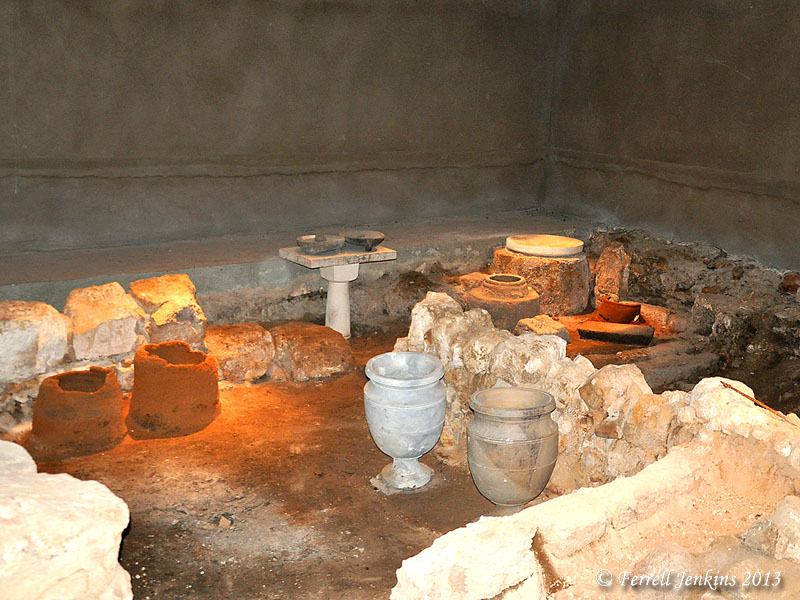
Basement of the Burnt House destroyed by the Romans in A.D. 70. Photo by Ferrell Jenkins.

Basement of the Burnt House destroyed by the Romans in A.D. 70. Photo by Ferrell Jenkins.

The furnishings here also indicate wealth. Notice the stone jars and table. The area on the right side shows evidence that the house was burned.

A small display case displays a collections of small items found in the Burnt House. One of the very interesting items is a weight bearing the inscription “bar katros.”
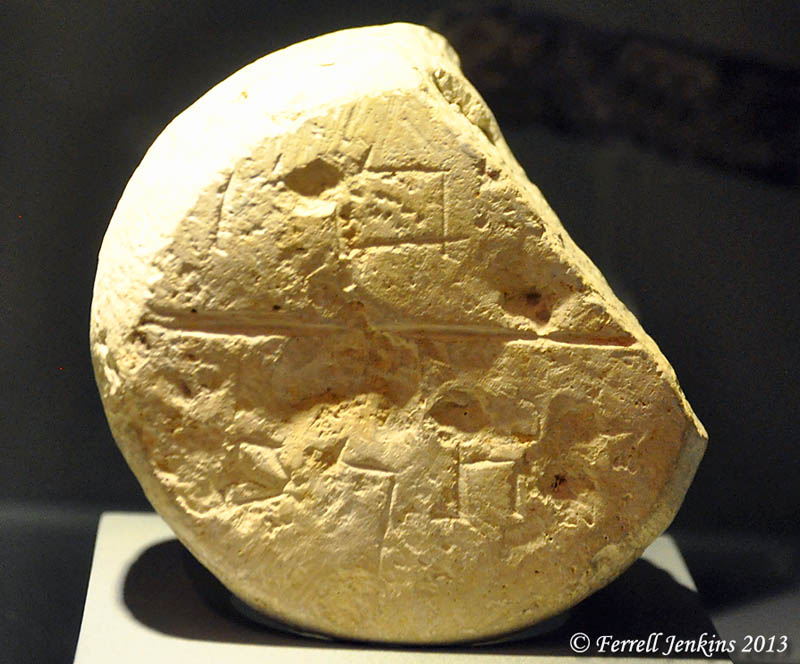
Inscription mentioning the Kathros family. Photo by Ferrell Jenkins.

Inscription mentioning the Katros family. Photo by Ferrell Jenkins.

The Katros family is mentioned in the Talmud as a priestly family that abused their position.

After visiting the Western Wall and the excavations south of the Temple Mount, we went to the Ramat Rachel Hotel for lunch. We only had time to drive by the Herodion before making our way to the Garden Tomb for our appointment.
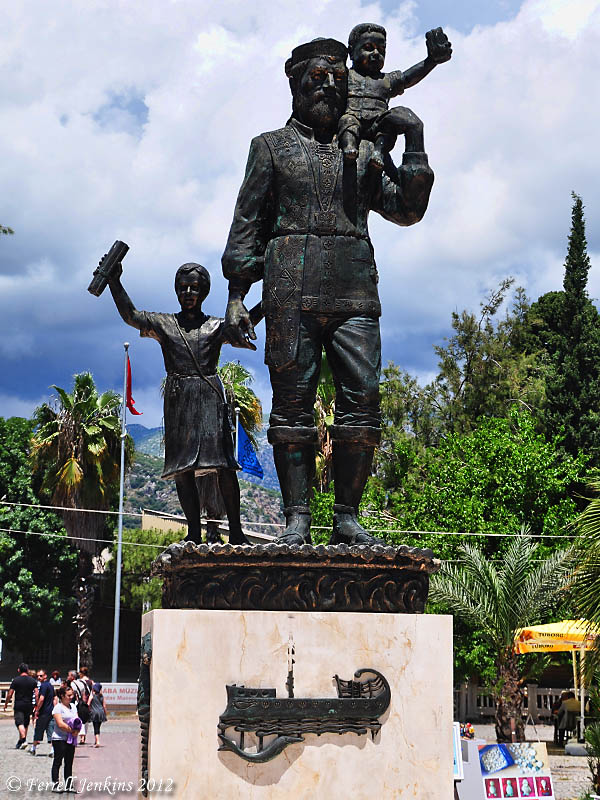
Myra, home of Saint Nicholas

The town Myra is known to students of the New Testament as a place where Paul transferred ships while he was being taken to Rome for trial before Caesar (Acts 27:5).

In the centuries following, Myra became the home of a (Greek Orthodox) bishop known as Nicholas. Born in Patara, Nicholas died December 6, 343. Several legends arose around Nicholas who was noted for giving gifts to the poor and raising the dead.

Highly revered in Greece and Russia, St. Nicholas is known as the patron saint of children, sailors, merchants, and scholars. From his life of piety, kindness, and generosity arose the legendary figure celebrated today as St. Nicholas, Father Christmas, or Santa Claus. (Fant & Reddish, A Guide to Biblical Sites in Greece and Turkey, 256)

The ancient Myra is associated with the modern Turkish town Demre (or Kale). I thought you might enjoy seeing a few pictures related to Saint Nicholas. In the town square is a recent statue showing St. Nicholas with children. The statue was a gift of the Russian government in 2000. Many Russian tourists were visiting the day I was there.

Modern statue of Saint Nicholas at Myra. Photo by Ferrell Jenkins.

Modern statue of Saint Nicholas at Myra. Photo by Ferrell Jenkins.

A few decades ago I saw an older statue near the entrance to the church. It now has a fresh coat of black paint.

Older statue of St. Nicholas near the entrance of the Byzantine church ruins. Photo by Ferrell Jenkins.

Older statue of St. Nicholas near the entrance of the Byzantine church ruins.This statue depicts him carrying a bag of gifts.  Photo by Ferrell Jenkins.

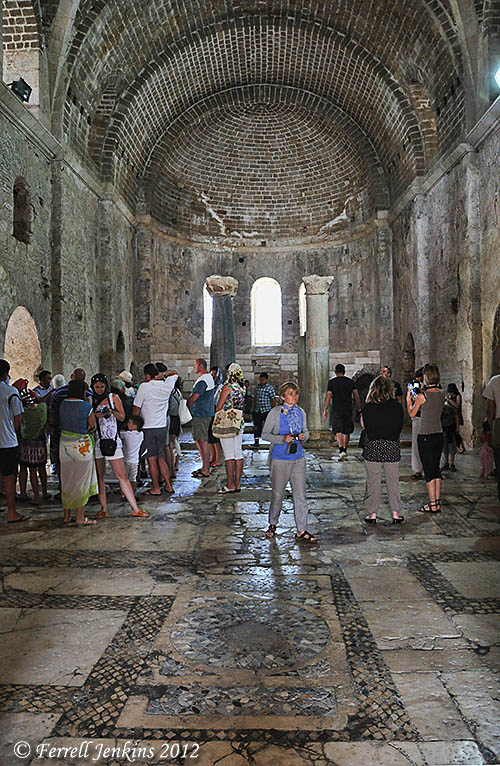
The Byzantine church dates to the 6th century A.D. Several writers point out that the sarcophagus of Nicholas was broken into by Italian merchants in the 1087 A.D., and his bones were taken to Bari, Italy.

Wilson says the church is built like a basilica “in the shape of an orthodox cross” (Biblical Turkey 88).

St. Nicholas Byzantine church, Myra, Turkey. Photo by Ferrell Jenkins.

Ruins of the St. Nicholas Byzantine church, Myra, Turkey. Photo by Ferrell Jenkins.

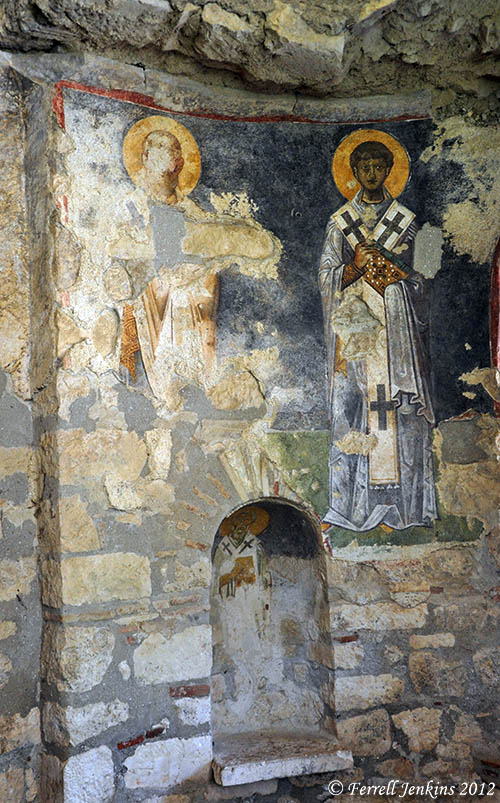
This last photo shows one of the poorly preserved frescoes.

Fresco on the wall of St. Nicholas church in Demre. Photo by Ferrell Jenkins.

Fresco on the wall of St. Nicholas church in Demre. Photo by Ferrell Jenkins.

Tourism seems to be thriving at Myra even though the town is off the beaten track. Whether there are any Christians in the town is doubtful.

For an earlier post about Myra and St. Nicholas, see here.

Thanksgiving today and everyday

Paul’s letter to the saints at Colossae emphasizes that thanksgiving should be a part of continual prayer to God.

Continue steadfastly in prayer, being watchful in it with thanksgiving. At the same time, pray also for us, that God may open to us a door for the word, to declare the mystery of Christ, on account of which I am in prison– that I may make it clear, which is how I ought to speak. (Colossians 4:2-4 ESV)

The wonderful thing about our national day of Thanksgiving is that it is an 0pportunity for families to be together and reflect on the blessings of life. I trust that your day will be a good one.

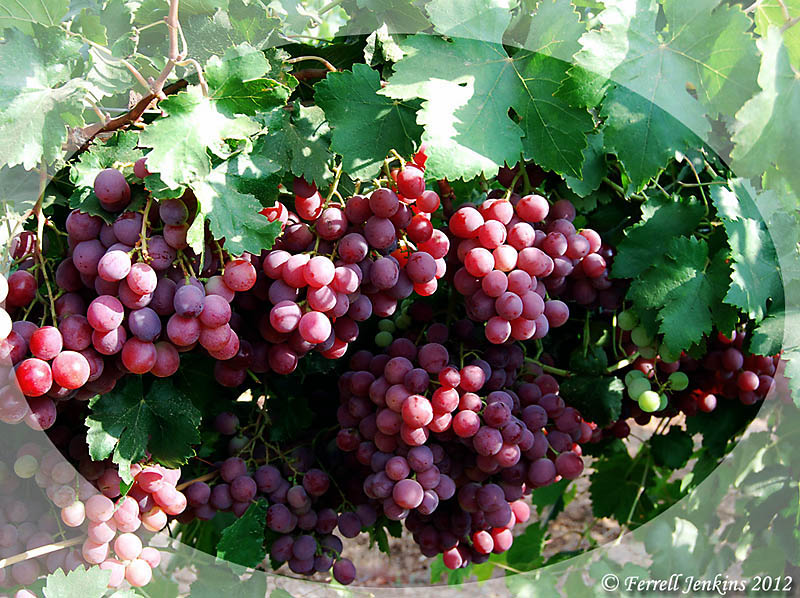
Abundance of the Vineyards at Lachish. Photo by Ferrell Jenkins.

The Abundance of the Vineyards at Lachish. Photo by Ferrell Jenkins.

Veterans Day and the Memphis Belle

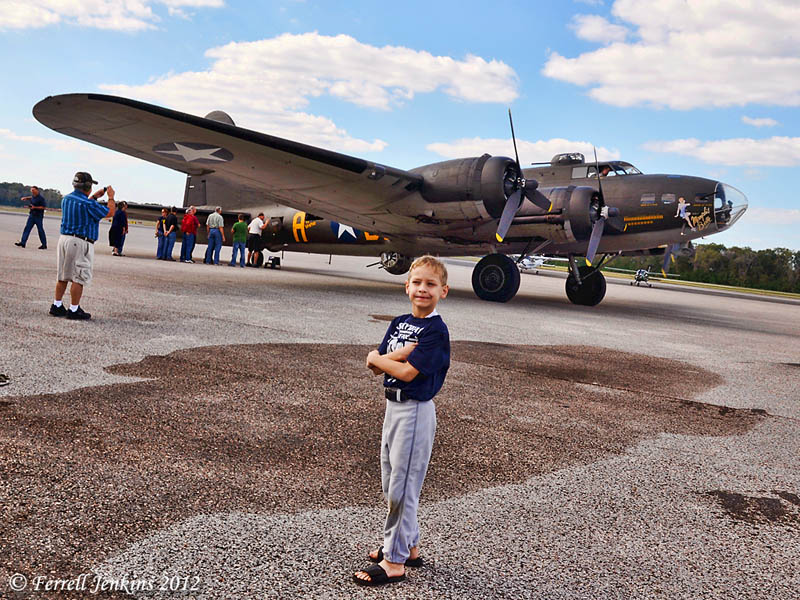
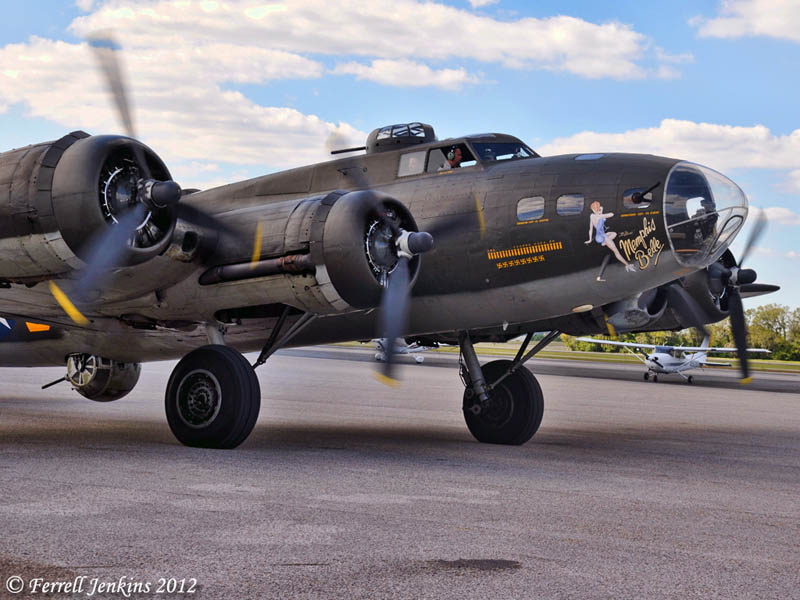
The Memphis Belle, a B-17 bomber built in 1945, is at the Tampa Executive Airport near us Saturday and Sunday. A recent promotional article at TBO.com tells some about the significance of the plane.

“The B-17 is the iconic World War II bomber,” he said. Between 1935 and 1945, nearly 13,000 B-17s were built.

“About 4,300 of them went down and each carried a 10-man crew,” he said. “We are quite honored to fly this airplane.”

Our grandson had a baseball game near us Saturday morning. At lunch I told him about the Memphis Belle. I told him that Grandmother and I were about his age when the plane was built, and that I would like for him to see it.

It was a beautiful day in Tampa, and we enjoyed seeing the B-17 land and take off while we were at the airport.

Passengers line up to take a short $450 ride on the Memphis Belle. Photo by Ferrell Jenkins.

Passengers line up to take a ride on the Memphis Belle. Photo by Ferrell Jenkins.

An older gentleman who was a gunner on the B-17 during WWII was among the visitors at the airport while we were there. There may have been others.

Memphis Belle - B-17 - at Tampa Executive Airport. Photo by Ferrell Jenkins.

Memphis Belle – B-17 – at Tampa Executive Airport. Photo by Ferrell Jenkins.

Seeing the Memphis Belle was a good reminder of the historic importance of the B-17 “flying fortress” in the history of our country, and of the men who have served.

This plane was featured in the 1990 movie by the same name.

Ponies and Sea Horses

Barely settling in at home after weeks of travel we are engrossed in the beginning of a week of birthday activities for our grandson. His other grandparents are in town. We always enjoy visiting with them, going to two Pony League baseball games, making a special visit or two, and eating together. Last year our special visit was a visit to see Winter, the famous tailless dolphin. This year we visited the Florida Aquarium in Tampa, Florida.

The Leafy Dragon is one of the most unusual sea creatures we saw at the Aquarium.

Leafy Dragon at the Florida Aquarium, Tampa, FL. Photo by Ferrell Jenkins.

Leafy Dragon at the Florida Aquarium, Tampa, FL. Photo by Ferrell Jenkins.

The posted information at the Florida Aquarium says,

In the cool waters off the coast of south Australia, forests of kelp hide rare sea dragons. They move through the waving fronds of seaweed with stately grace, festooned with their own leafy camouflage.

Despite their fabulous foliage, leafy sea dragons are fish, relatives of seahorses and pipe fish. Like their kin, dragons have tube-like mouths and a gender-bending approach to reproduction.

In one of those baseball games our little guy hit his first home run and received the game ball. He is having a great birthday celebration and we are pleased to share it.

Some thoughts on Father’s Day 2012

About three years ago I wrote a personal post on the occasion of the 30th anniversary of my father’s death. I wanted to share this with new readers who might find it interesting and encouraging.

B. M. JenkinsIt took me about six months to get over being downcast after his death. It wasn’t that I did not not have hope. There were two major factors. (1) It was just the sense of loss that I felt. I could recall our time together, but we would no longer be able to talk and discuss matters of common interest. (2) I began to think of my life. If I lived only to the age of 65 what would I do with these few remaining years? Even though I have passed 65 by several years, I still think about this question.

My father was an intelligent man, but not a formally educated man. He finished the eighth or ninth grade, but he knew how to work and make sound financial decisions for his family. My father spent my earliest years living on the farm where my grandfather was a share-cropper. It was hard on farms in those post-depression years. My father was a good mechanic and carpenter. In 1943 he drove about 60 miles each week from Harvest, Alabama, to Tullahoma, Tennessee. There was some type of building project in progress. After his death I found a receipt showing that he had earned about $13 for the week. From that he paid his gas expenses, stayed in a boarding house for four nights, and paid 13 cents in Old-Age Benefits. This program, now called Social Security, was set up by the Federal government in 1937 to provide retirement benefits. He evidently had enough left to provide whatever store-bought food, and other things, our family needed.

My paternal grandfather was named Joseph Frank. My grandmother was named Mary Magdalene. They had 12 children, and each of them was given a Bible name. My father’s name was Bartholomew (Matthew 10:3). He had no middle name, so he just made up the middle initial when he needed a middle name. His friends called him B.M., or Barley, or Bolly. And, yes, he had brothers named Philip, Thomas, James, Matthew, and John. He had sisters named Ruth, Mary Magdalene, Eunice, Naomi, and Elizabeth. One sibling died young. Only three [two] are still living. My grandfather heard my second sermon. (It was the same as my first one.)

Most of the members of this family had a spirit of independence and entrepreneurship. Several of them ran small businesses and none of them ever got involved with “big business.”

My Father set a good spiritual example for his family. Sometime when I was between six and ten we walked about two miles on a country road to meet with other Christians to worship. One Sunday morning some family members drove up about the time we were to leave for church. They had come from across the county to see us. My Dad invited them to go to church with us. When they demurred, he told them to make themselves at home until we got back. The next time they came in the afternoon.

Dad served for a short time as an elder in a local church, but when the others began to advocate practices he thought were wrong, he resigned and began to worship with brethren who thought as he did.

Perhaps I should somehow relate this post to travel. I was able to take my mother to the Bible lands twice after my Father’s death. About the time I told them that I was going a third time [more than 40 years ago], my Dad said, “Don’t you think you have been enough?” I wish he could have gone with me.

He taught me a lot. I think of him almost daily.

As a father shows compassion to his children, so the LORD shows compassion to those who fear him.   For he knows our frame; he remembers that we are dust. (Psalm 103:13-14 ESV)

Free Kindle book on the Sermon on the Mount

DeWard Publishing Company is offering a free Father’s Day Kindle download for a limited time.

Invitation to a Spiritual Revolution (Studies in the Sermon on the Mount) by Paul Earnhart is available for free download from this link.

Paul Earnhart has served as minister at the Douglass Hills Church of Christ, Louisville, Kentucky, for many years. He is recognized for both his scholarly and practical approach to Biblical subjects.

The Sermon on the Mount (Matthew 5-7) is the seminal announcement of the teaching of Jesus.

This is a great book for any father, or anyone else interested in spiritual matters.

Thanks to DeWard Publishing Company for this gracious gift. Take a look at their other publications.

Why were shepherds detestable to Egyptians?

A readers asks about Joseph’s instruction to his family when they moved to the land of Goshen in Egypt.

“When Pharaoh calls you and says, ‘What is your occupation?’ you shall say, ‘Your servants have been keepers of livestock from our youth even until now, both we and our fathers,’ that you may live in the land of Goshen; for every shepherd is loathsome to the Egyptians.”  (Genesis 46:33-34 NAU)

Why was every shepherd loathsome (an abomination, disgusting, abhorrent, detestable) to the Egyptians. Here are some suggestions.

G. J. Wenham says,

Shepherds are detestable to the Egyptians probably reflects a common distrust of nomadic peoples by urban dwellers (cf. attitudes to gypsies and ‘travellers’ in modern society). (The New Bible Commentary)

The IVP Bible Background Commentary says,

It is unlikely that native Egyptian herdsmen would be detested by other Egyptians. Joseph’s advice to his father is both a warning about Egyptian attitudes toward strangers and a piece of diplomacy in that they would claim independent status (they had their own herds to support them) and show they were not an ambitious group who wished to rise above their occupation as shepherds.

Derek Kidner likes the explanation of J. Vergote:

A more likely explanation is that of J. Vergote, that this is only the perennial antipathy of the town-dweller for the nomad or the gipsy [gypsy]. Joseph saw the importance of emphasizing this, to ensure that Pharaoh’s goodwill would be to the family’s real benefit, not to their detriment by drawing them into an alien way of life at the capital. ( Tyndale Old Testament Commentaries)

Howard Vos says,

The reason for Joseph’s concern was that Egyptians considered shepherds an abomination. Settlement in Goshen would separate them from the Egyptian cattlemen of the Nile Valley and thus reduce friction with Egyptians and preserve their distinctiveness as a people. (Genesis in Everyman’s Bible Commentary)

John T. Willis points out that the term livestock (or cattle; Hebrew, miqneh) is “a comprehensive term including cattle, sheep, goats, and the like” (Genesis in The Living Word Commentary on the Old Testament).

The biblical Land of Goshen, where Israel settled, is the eastern portion of the Nile Delta. This was the home of the Israelites for many years.

Joseph went and told Pharaoh, “My father and brothers, with their flocks and herds and everything they own, have come from the land of Canaan and are now in Goshen.” (Genesis 47:1 NAS)

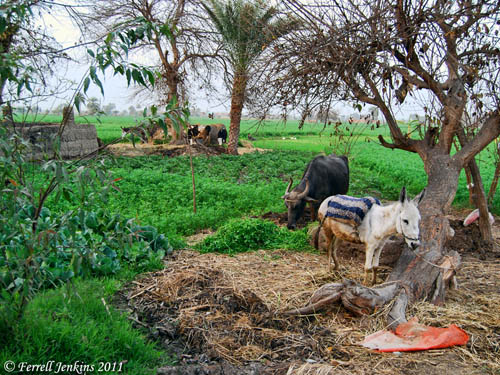
A typical scene in the Eastern Nile Delta. Photo Ferrell Jenkins.

A typical scene in the Eastern Nile Delta near Tel Daba. Photo Ferrell Jenkins.

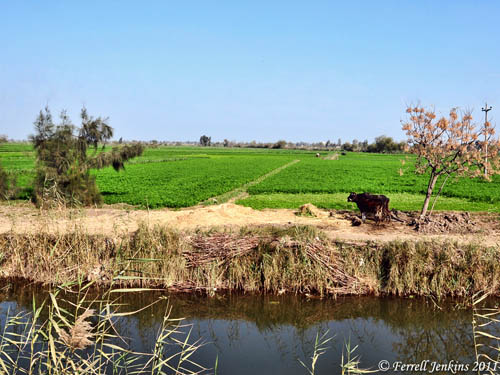
To think of the stereotypical view of Egypt as a pyramid in the desert is to misunderstand the area where Israel settled.  Goshen is a flat, fertile, area, situated along the Pelusiac branch of the Nile River. That branch has now been replaced by a canal that runs generally along the same course. Cattle, including sheep, are common in the Eastern Nile Delta today. The canal in the photo below is one of the numerous smaller canals providing water to the farm land of the region.

The land of Goshen near ancient Tanis. Photo by Ferrell Jenkins.

The land of Goshen between ancient Tanis and Tel Daba. Photo by Ferrell Jenkins.

I enjoy the vividness of The Five Books of Moses by Everett Fox. Fox translates Genesis 46:34 as follows:

Then say: Your servants have always been livestock men, from our youth until now, so we, so our fathers—
in order that you may settle in the region of Goshen.
For every shepherd of flocks is an abomination to the Egyptians.

This will give you something to consider. Hopefully it will be helpful. We have mentioned Goshen several times in this blog. Put the word goshen in the search box to locate them.

Traveling in the land of Goshen

We spent the entire day traveling in Egypt’s eastern delta region, known in the Bible as the land of Goshen. The photo below shows a typical scene of flat, fertile, black land with lush vegetation, cattle, some sheep, and canals.

Typical scene in the land of Goshen.

Typical scene in the land of Goshen. Photo by Ferrell Jenkins

This is the land where Joseph placed his family when they came to Egypt for food.

You will live in the land of Goshen, and you will be near me– you, your children, your grandchildren, your flocks, your herds, and everything you have. I will provide you with food there because there will be five more years of famine. Otherwise you would become poor– you, your household, and everyone who belongs to you.”‘ (Genesis 45:10-11 NET)

Traveling ancient roads together

Fifty six years ago today I married a wonderful young lady who has been by my side all this time. She wasn’t always able to travel with me, especially when our children were young, but she has shared many trips with me. She often comments about how important it is for couples to travel when they are young. That, of course, is the most difficult time for those with children. We still enjoy the memories we made on our first trip to Rome, Athens/Corinth, Egypt, Lebanon, Damascus, Jordan, and Israel in 1967.

How can you stay together for fifty six years? We made a commitment to each other and to God when we exchanged our vows. That’s it.

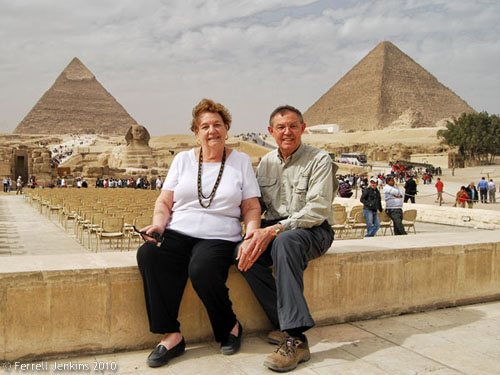
Ferrell and Elizabeth Jenkins at the Giza Pyramids.

Ferrell and Elizabeth Jenkins at the Giza Pyramids in 2009.