Category Archives: Egypt

Painting the eyes

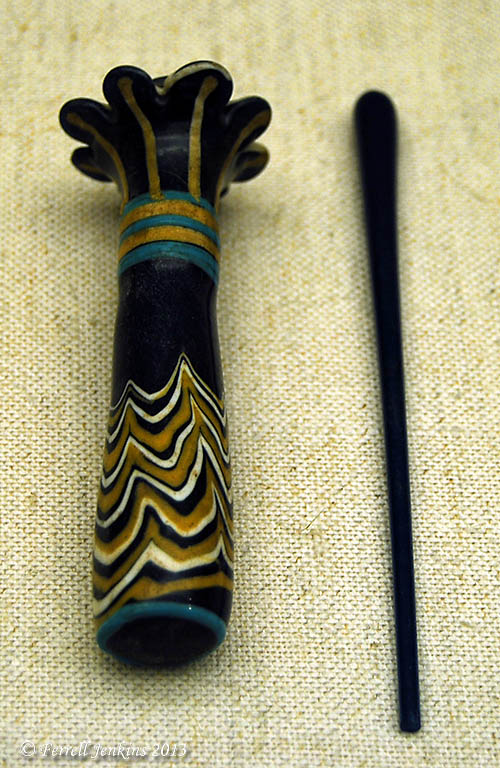
Cosmetics and the painting of one’s eyes is nothing new. The photo below shows a Palm-column flask and kohl stick displayed in Boston’s Museum of Fine Arts. The item is said to date between 1386 and 1212 B.C. Information with the item says,

The palm-column flask is one of the best represented types of glass vessels from the New Kingdom. It served as a container for the cosmetic kohl, or eyepaint, made of ground galena mixed with fat or resin and applied to the lids with the slender glass rod.

Palm-column flask and kohl stick. Museum of Fine Arts, Boston. Photo by Ferrell Jenkins.

Palm-column flask and kohl stick. Museum of Fine Arts, Boston. Photo” Ferrell Jenkins.

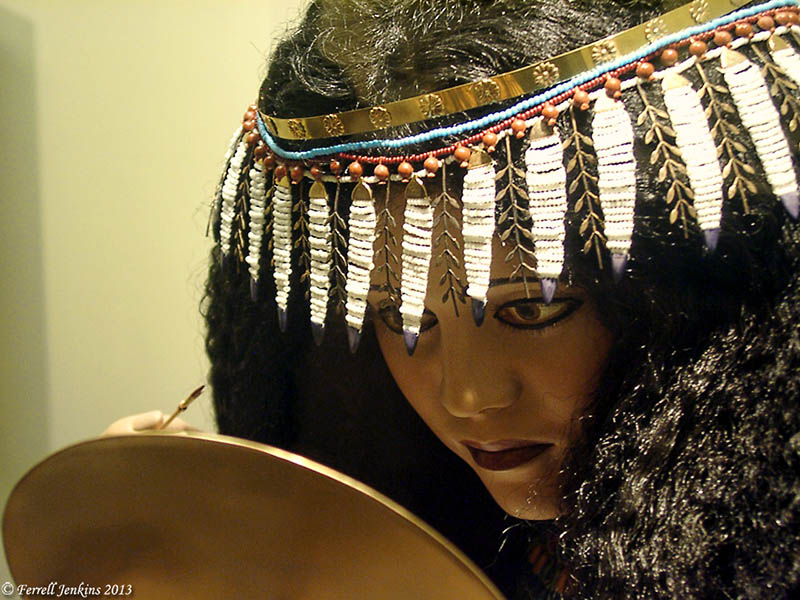
It was centuries later when Jehu came to see Jezebel at Jezreel. Jezebel, the widow of King Ahab, wanted to make a good appearances on Jehu.

When Jehu came to Jezreel, Jezebel heard of it. And she painted her eyes and adorned her head and looked out of the window. (2 Kings 9:30 ESV)

Perhaps Jezebel did not know that she was preparing herself for her death.

Royal Ontario Museum exhibit showing an Egyptian woman painting her eyes. Photo by Ferrell Jenkins.

Royal Ontario Museum exhibit showing an Egyptian woman painting her eyes. Photo by Ferrell Jenkins.

The prophets also spoke of this practice, but not in a complimentary way, in Jeremiah 4:30 and Ezekiel 23:40.

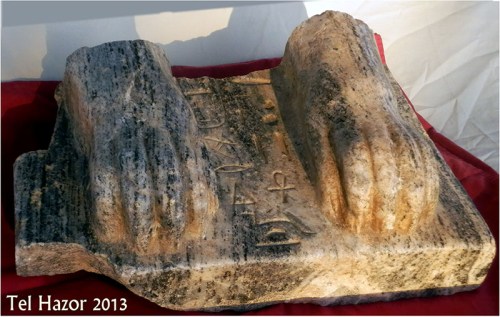
Egyptian sphinx fragment found at Hazor

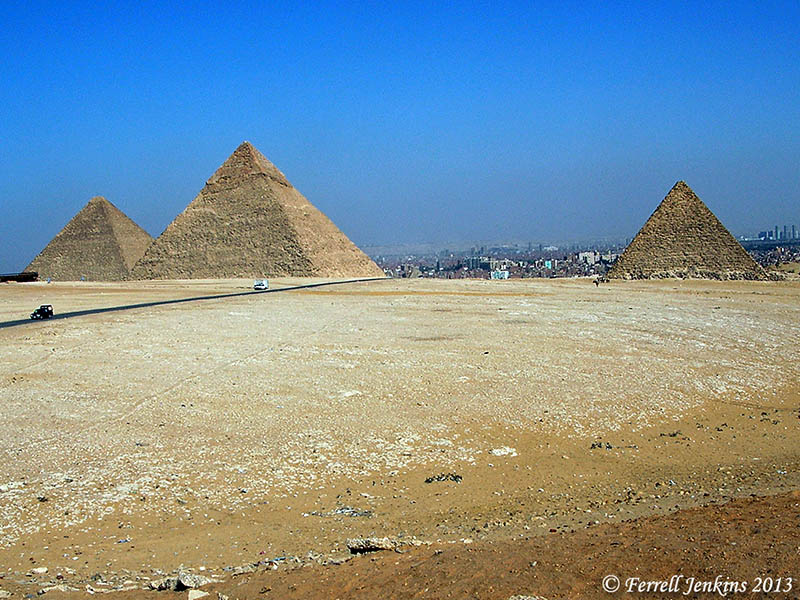
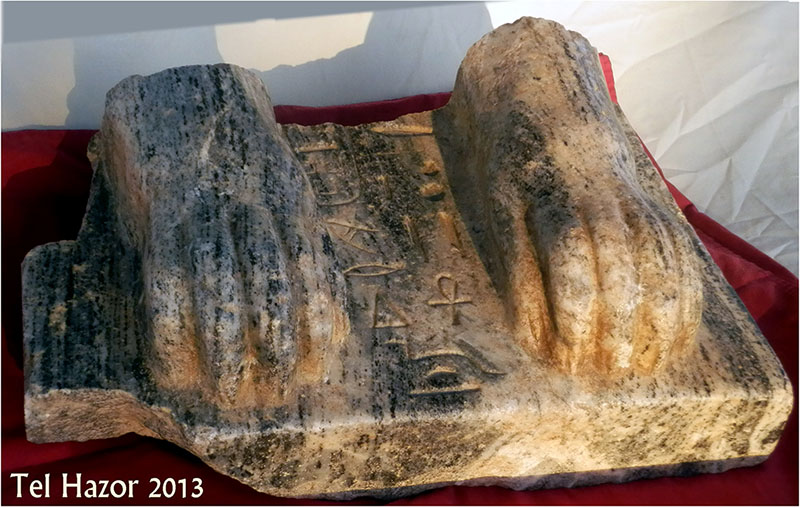
The Hebrew University of Jerusalem announced today the discovery at Hazor of a sphinx fragment of Pharaoh Mycerinus. Mycerinus is the builder of the smallest of the three great pyramids of Giza in Egypt. The photo below was made facing east toward the Nile Valley. The pyramid of Mycerinus is on the right. The pyramid, built about 2500 B.C., is 204 feet high.
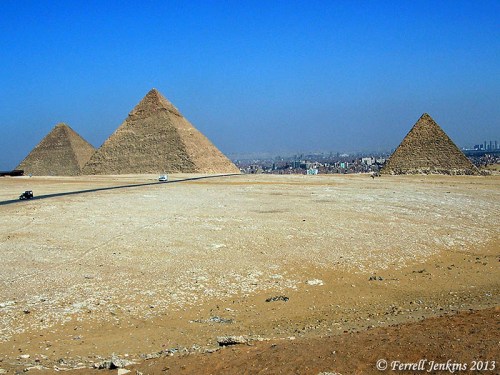
The pyramids of Giza" Cheolps, Chephren, and Mycerinus (left to right). Photo by Ferrell Jenkins.

Pyramids of Giza: Cheops, Chephren, & Mycerinus (left to right). Photo: Ferrell Jenkins.

The press release from Jerusalem says,

At a site in Tel Hazor National Park, north of the Sea of Galilee, archeologists from the Hebrew University of Jerusalem have unearthed part of a unique Sphinx belonging to one of the ancient pyramid-building pharaohs.

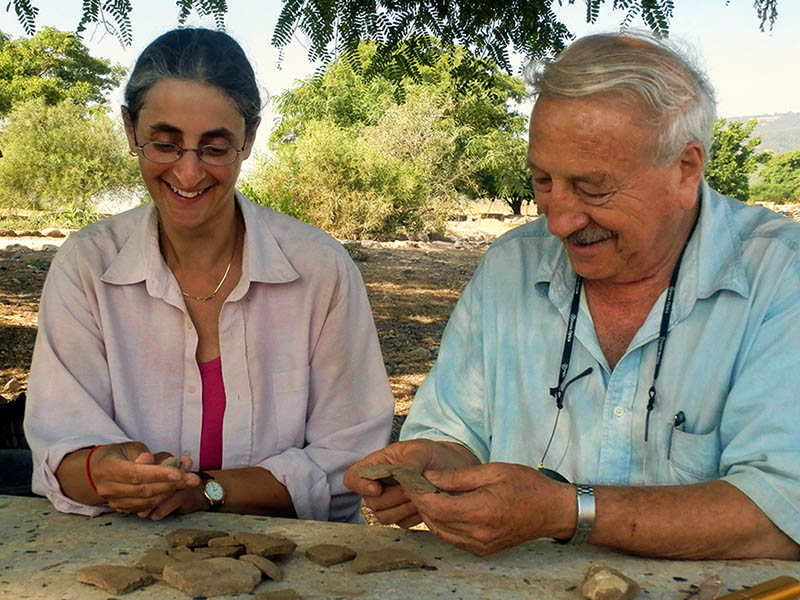
The Hazor Excavations are headed by Prof. Amnon Ben-Tor, the Yigael Yadin Professor in the Archaeology of Eretz Israel at the Hebrew University’s Institute of Archaeology, and Dr. Sharon Zuckerman, a lecturer at the Hebrew University’s Institute of Archaeology.
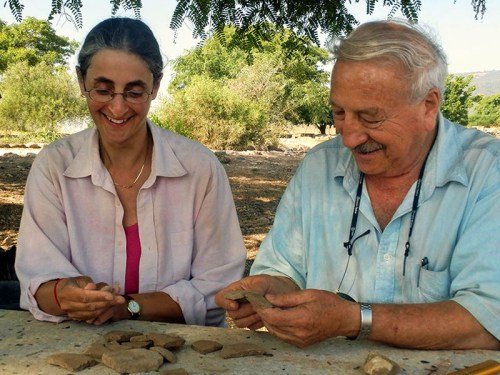
Prof. Amnon Ben-Tor and Dr. Sharon Zuckerman of the Hebrew University’s Institute of Archaeology, who are leading the Hazor Excavations (Photo courtesy archaeologists Prof. Amnon Ben-Tor and Dr. Sharon Zuckerman)

Prof. Amnon Ben-Tor and Dr. Sharon Zuckerman of the Hebrew University’s Institute of Archaeology, who are leading the Hazor Excavations (Photo courtesy archaeologists Prof. Amnon Ben-Tor and Dr. Sharon Zuckerman)

Working with a team from the Institute of Archaeology, they discovered part of a Sphinx brought over from Egypt, with a hieroglyphic inscription between its front legs. The inscription bears the name of the Egyptian king Mycerinus, who ruled in the third millennium BCE, more than 4,000 years ago. The king was one of the builders of the famous Giza pyramids.

As the only known Sphinx of this king discovered anywhere in the world — including in Egypt — the find at Hazor is an unexpected and important discovery. Moreover, it is only piece of a royal Sphinx sculpture discovered in the entire Levant area (the eastern part of the Mediterranean).

Along with the king’s name, the hieroglyphic inscription includes the descriptor “Beloved by the divine manifestation… that gave him eternal life.” According to Prof. Ben-Tor and Dr. Zuckerman, this text indicates that the Sphinx probably originated in the ancient city of Heliopolis (the city of ‘On’ in the Bible), north of modern Cairo.

The Sphinx was discovered in the destruction layer of Hazor that was destroyed during the 13th century BCE, at the entrance to the city palace. According to the archaeologists, it is highly unlikely that the Sphinx was brought to Hazor during the time of Mycerinus, since there is no record of any relationship between Egypt and Israel in the third millennium BCE.

More likely, the statue was brought to Israel in the second millennium BCE during the dynasty of the kings known as the Hyksos, who originated in Canaan. It could also have arrived during the 15th to 13th centuries BCE, when Canaan was under Egyptian rule, as a gift from an Egyptian king to the king of Hazor, which was the most important city in the southern Levant at the time.

Hazor is the largest biblical-era site in Israel, covering some 200 acres, and has been recognized as a World Heritage Site by UNESCO. The population of Hazor in the second millennium BCE is estimated to have been about 20,000, making it the largest and most important city in the entire region. Its size and strategic location on the route connecting Egypt and Babylon made it “the head of all those kingdoms” according to the biblical book of Joshua (Joshua 11:10). Hazor’s conquest by the Israelites opened the way to the conquest and settlement of the Israelites in Canaan. The city was rebuilt and fortified by King Solomon and prospered in the days of Ahab and Jeroboam II, until its final destruction by the Assyrians in 732 BCE.

Documents discovered at Hazor and at sites in Egypt and Iraq attest that Hazor maintained cultural and trade relations with both Egypt and Babylon. Artistic artifacts, including those imported to Hazor from near and far, have been unearthed at the site. Hazor is currently one of Israel’s national parks.

The Hebrew University began the Hazor excavation in the mid-1950s and continued them in the late 1960s. Excavations at the site were resumed in 1990 by Prof. Amnon Ben-Tor, who was joined in 2006 by Dr. Sharon Zuckerman, as part of the Selz Foundation Hazor Excavations in Memory of Yigael Yadin. The present excavation area is managed by Shlomit Becher, a doctoral student of the Hebrew University’s Institute of Archaeology, and is sponsored by the Israel Exploration Society (IES) in cooperation with the Israel Antiquities Authority and the Israel Nature and Parks Authority.
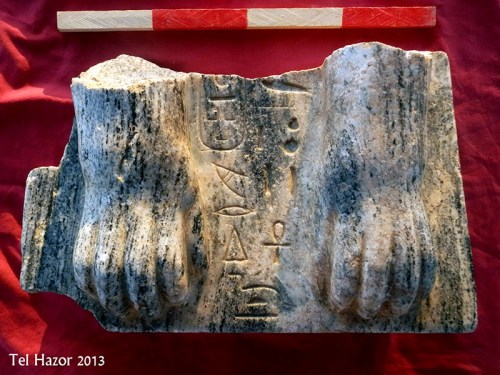
Two views of a Sphinx statue fragment found by Hebrew University of Jerusalem archaeologists at the Tel Hazor excavations north of the Sea of Galilee in Israel. An inscription ties the Sphinx to Mycerinus, an Egyptian king and pyramid  builder, circa 2500 BCE. This is the only known statue bearing this pharaoh's name. (Photo courtesy archaeologists Prof. Amnon Ben-Tor and Dr. Sharon Zuckerman)

Two views (above and below) of a Sphinx statue fragment found by Hebrew University of Jerusalem archaeologists at the Tel Hazor excavations north of the Sea of Galilee in Israel. An inscription ties the Sphinx to Mycerinus, an Egyptian king and pyramid builder, circa 2500 BCE. This is the only known statue bearing this pharaoh’s name. (Photo courtesy archaeologists Prof. Amnon Ben-Tor and Dr. Sharon Zuckerman)
hu130709_hazor_sphinx2t

Thanks to Prof. Ben-Tor and Dr. Zuckerman for making available these nice photos. We understand better what we are able to see.

HT: Joseph I. Lauer

Following the news in the Bible World

Beginning with the Six Day War (June 5-10, 1967) I have tried to keep alert to the situation in the countries that are often called the Bible lands or the Bible World. This phrase is given to the countries of Iran, Iraq, Turkey, Syria, Lebanon, Jordan, Israel, Egypt, Greece, et al. where the events of the Bible transpired. Over the past 47 years I have traveled in all of these countries, some extensively, except Iran.

The current news coming out of Egypt is not good, and it is sad to see the conditions there. I wish for peace and justice for the people of Egypt, and the other countries mentioned above. I wish it also for those who would like to travel to these ancient lands to better learn the history, both secular and biblical.

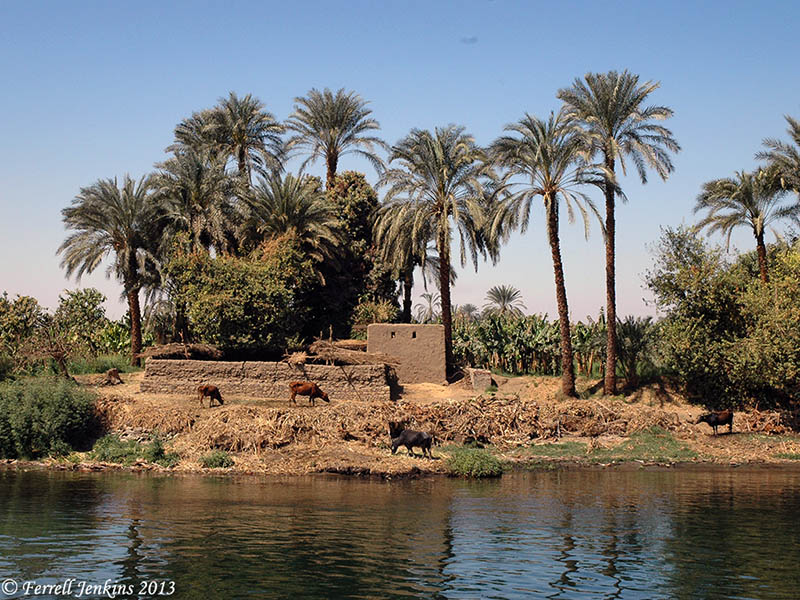
A scene on the Nile River in Upper Egypt. Photo by Ferrell Jenkins.

A scene on the Nile River in Upper Egypt. Photo by Ferrell Jenkins.

The photo above was made from the Nile River in Upper Egypt, near the ancient town of Edfu. When I look at it I am reminded of the Genesis account of the seven lean cows and seven plump cows that Joseph saw coming up out of the Nile (Genesis 41).

Facebook site for Tell el-Amarna

Some archaeological projects have Facebook pages. Check out this one on the Egyptian site of Tell el-Amarna here.

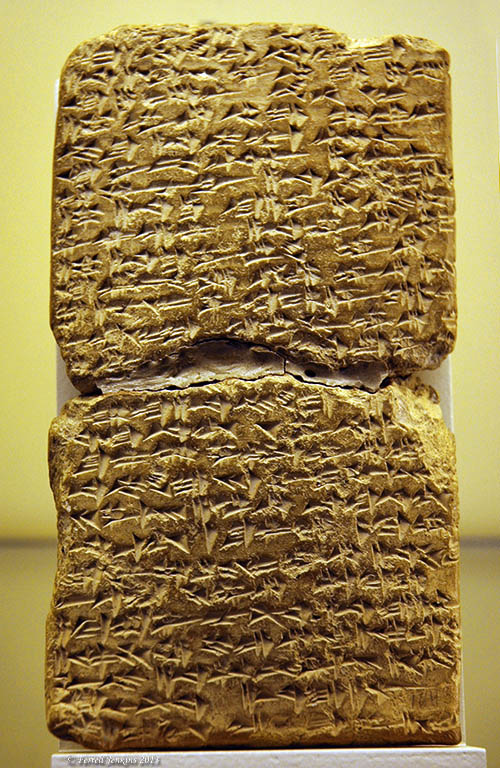
Amarna Letter from the Egyptian ruler of Jerusalem to Amenophis III. Pergamum Museum, Berlin. Photo by Ferrell Jenkins.

Amarna Letter from the Egyptian ruler of Jerusalem to Amenophis III. Pergamum Museum, Berlin. Photo by Ferrell Jenkins.

This letter dates to the reign of Amenophis III (1391-1353 B.C.).

“Extinct” frog alive and well in Hula Valley

The Hula painted frog was declared extinct in 1996. But, an Israeli park ranger recently found one. Researchers have caught a total of 14 of these frogs since then. Read the story in the Smithsonian’s Smart News here.

There is no word whether this might have been the frog mentioned  in the account of the plagues the LORD sent on Egypt (Exodus 8). 🙂

He sent swarms of biting insects against them, as well as frogs that overran their land. (Psalm 78:45 NET)

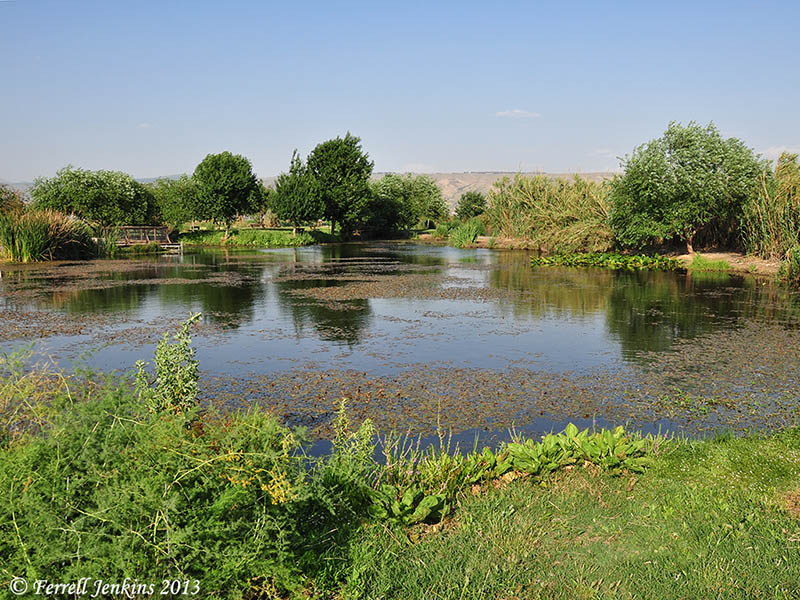
A portion of the Hula Lake/Agamon Lake restoration project. Photo by Ferrell Jenkins.

A portion of the Hula Lake/Agamon Lake restoration project. Photo by Ferrell Jenkins.

See here for more info on the Lake Hula restoration project.

HT: Alan Cornett

Fort Babylon in Old Cairo

Daily News Egypt carried a brief article about the Roman ruins in Old Cairo here. The article says,

The fort was built on the southern end of the old Pharaonic town Per-Hapi-On, or ‘The river house of On’. According to some historians the mispronunciation of the name by the Romans led to the name Fort Babylon but others claim it was named after a number of captives brought there from Babylonia during the time of Sesostris.

Roman Emperor Diocletian built the fort in 300 C.E. as the stronghold of three legions in charge of securing Egypt. The garrison of Fort Babylon vowed to secure ships on the Nile and a canal that passed through the town connecting the Nile with the Red Sea. This canal was first established by the Pharaohs, and was restored and enlarged by the Roman Emperor Trajan. The fort was renovated and fortified by the Roman Emperor Arcadius.

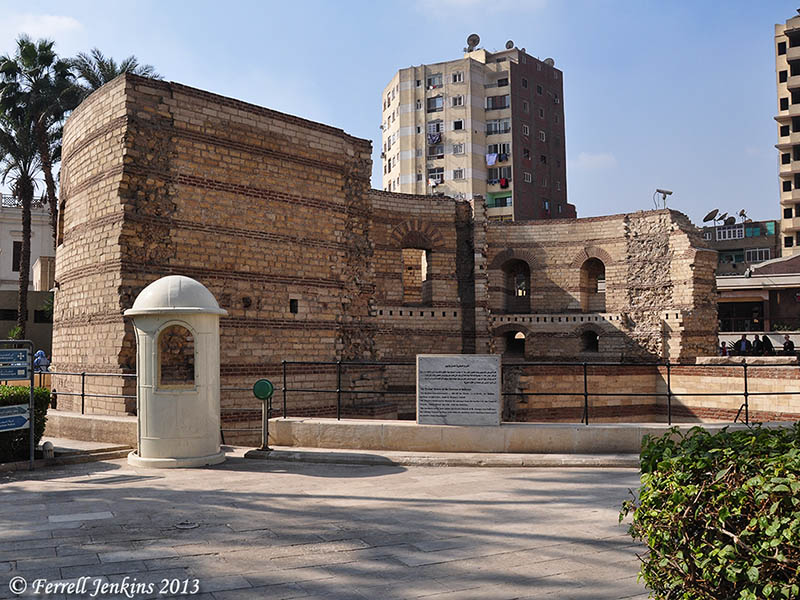
Our photo shows ruins of the Roman fort that was known as Fort Babylon in Roman times. At that time the Nile River flowed beside the Fort, but has since changed its course. New building of Old Cairo dwarf the old structure.

Roman Tower (Fort Babylon in Old Cairo. Photo by Ferrell Jenkins.

Roman Tower (Fort Babylon in Old Cairo). Photo by Ferrell Jenkins.

The sign in front of the structure says that it was constructed by Diocletian (c. A.D. 300) to fortify the Roman harbor of Old Cairo built by Trajan (c. A.D. 110).

HT: Agade List

Photos worth 1000 words (or more)

Locusts

Shmuel Browns, Israel guide and photographer, has posted the best photo of a locust that I have seen. And the photos of flowers in the Judean Desert are something most tourists never get to see. Look here.

From the top of the Great Pyramid

Carl Rasmussen, at his HolyLandPhoto’s blog, calls attention to some photos made by some Russians from the top of one of the Great Pyramid of Giza here. There you will find links to the Mail Online (British) and English Russia.

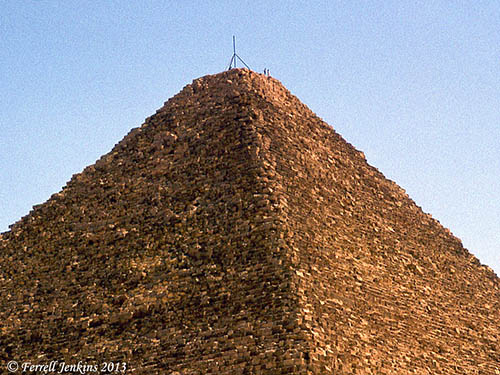
I suppose I never wished to climb the Great Pyramid, but I had two men with me in 1978 who wanted to do so. In the photo below you might be able to make out two men (Jim Puterbaugh and Bob Lyman) to the right of the marker showing the original height of the structure. Click on the photo for a larger image.

Two climbers on top of the Great Pyramid in 1978. Photo by Ferrell Jenkins.

Two climbers on top of the Great Pyramid in 1978. Photo by Ferrell Jenkins.

The Great Pyramid of Cheops (or Khufu) was constructed about 2500 B.C. No, not by the Israelites. That is even earlier than the biblical Patriarchs. It is said to contain more than 2,300,000 blocks of stone, each weighing an average of 2½ tons. The height was originally 479 feet, but now is 449½ feet.

It is April 1, but this is no joke.

Jerusalem Panorama

Look at this great high resolution panorama of Jerusalem from the Mount of Olives here. Spend some time with it. (HT: Bible Places Blog.)

Locusts video from Israel

Recently we mentioned the plague of locusts that devastated crops in Egypt. The southern portion of Israel might have been affected except for the effective use of pesticides.

When Joel Kramer, Executive Director of SourceFlix, learned that the locusts were in the southern part of Israel he drove from Jerusalem through the Negev and wilderness to photograph the locusts near the Egyptian border. He shares this with us in a high quality video here.

Joel includes wording from the book of Exodus 10 to remind us of the biblical plague of locusts in the time of Moses.

The writer of Proverbs describes the locusts this way:

 the locusts have no king, yet all of them march in rank; (Proverbs 30:27 ESV)

In studying the book of Revelation, I am impressed at the way in which locust plagues, which were (and still are) common in the Middle East, are used in the sounding of the fifth trumpet (Revelation 9:1-11). The comparison between the locusts and a literal army in their movement and damage is impressive.

 In appearance the locusts were like horses prepared for battle: on their heads were what looked like crowns of gold; their faces were like human faces,
8 their hair like women’s hair, and their teeth like lions’ teeth;
9 they had breastplates like breastplates of iron, and the noise of their wings was like the noise of many chariots with horses rushing into battle.
10 They have tails and stings like scorpions, and their power to hurt people for five months is in their tails. (Revelation 9:7-10 ESV)

HT: Bible Places Blog.

Locusts still plague the Bible lands

References to locusts in the Bible are scattered from the time when the Israelites were in Egyptian bondage to the book of Revelation. Several Hebrew terms are used to describe locusts, perhaps of different species, or because of the various stages through which the locusts grow.

The prophet Joel uses the illustration of a locust invasion upon the land.

What the cutting locust left, the swarming locust has eaten. What the swarming locust left, the hopping locust has eaten, and what the hopping locust left, the destroying locust has eaten. (Joel 1:4 ESV)

Was he speaking of literal locusts, or of the invasion of a foreign enemy?

The prophet Amos speaks of the punishments brought by the LORD upon the northern kingdom of Israel prior to the Assyrian invasion.

“I struck you with blight and mildew; your many gardens and your vineyards, your fig trees and your olive trees the locust devoured; yet you did not return to me,” declares the LORD. (Amos 4:9 ESV)

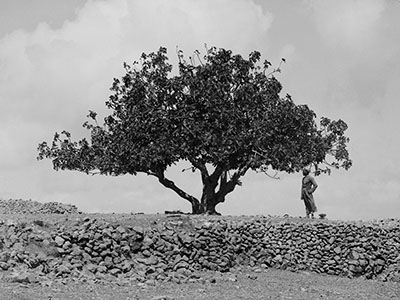
Notice that Amos makes specific reference to the fig trees and the olive trees. We have examples of this same thing happening during the 1915 locust plague. It was documented for National Geographic magazine by the photographs of Lewis Larson with a descriptive article by John D. Whiting. Here is a fig tree prior to the Locust plague.

Fig tree before the 1915 locust plague.

Fig tree before the 1915 locust plague.

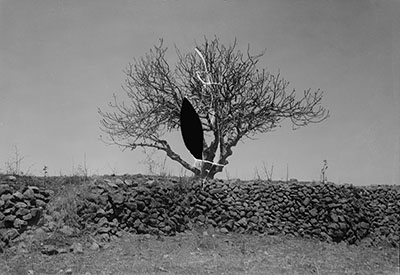
And here is the way the same tree looked after the plague.

Fig tree after the 1915 locust plague.

Fig tree after the 1915 locust plague.

These two images are from the collection of 4,000 high-resolution photographs taken by resident photographers at the American Colony in Jerusalem from 1898 to the 1940s. The full set is available at Life in the Holy Land here. In addition to the photos in the collection, the photos are included in PowerPoint presentations. Descriptive information is included with many of them.

Several articles have appeared in the past week or so about a modern locust plague that affected Egypt and southern Israel. See here for Egypt. Some Jews, especially those from Yemen, gathered the photos [it was late; I meant locusts] for eating (see here). Some rabbis warned that the locusts may not be kosher (see here).

Just a reminder that some species of locusts were acceptable for the Israelites to eat.

Of them you may eat: the locust of any kind, the bald locust of any kind, the cricket of any kind, and the grasshopper of any kind. (Leviticus 11:22 ESV)

I know you can’t forget the diet of John the Baptist.

Now John wore a garment of camel’s hair and a leather belt around his waist, and his food was locusts and wild honey. (Matthew 3:4 ESV)

Seth Rodriquez provides more info about the 1915 plague here.

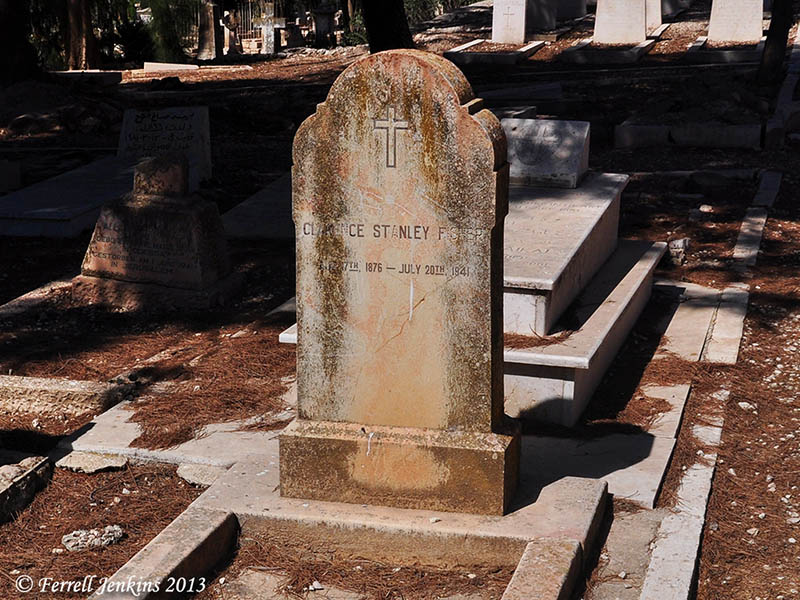
Clarence Stanley Fisher — Armageddon

Clarence Stanley Fisher was trained as an architect at the University of Pennsylvania in his hometown of Philadelphia. He became involved in archaeology at Nippur, Iraq (the region of ancient Sumer). Later he worked with George Andrew Reisner at Giza, Egypt, and then at Samaria from 1908 to 1910. This expedition, sponsored by Harvard, was the first American excavation in Palestine. After a short time back at Giza, he excavated at Beth Shan (Beit She’an), a dig sponsored by the University of Pennsylvania.

Fisher received an invitation from the University of Chicago to work at Megiddo, a work funded by the Rockefeller family. This excavation continued from 1933 to 1939, but fisher stopped working at the site after two years because of bad health.

The Megiddo excavations were recounted by Fisher under the title The Excavation of Armageddon, a work published by the University of Chicago Press with a foreword written by James Henry Breasted. This work is available at Google Books.

From 1936 to the time of his unexpected death in 1941, Fisher served as Professor of Archaeology at the American Schools of Oriental Research in Jerusalem (now the Albright Institute).

Fisher is buried at the Protestant Cemetery on Mount Zion in Jerusalem.

Grave marker for Clarence Stanley Fisher. Photo by Ferrell Jenkins.

Grave marker for Clarence Stanley Fisher. Photo by Ferrell Jenkins.

The brief information I have included here is summarized from a brief article by Milton C. Fisher in Bible and Spade 6:2 (Spring 1993). I get the impression that Milton is not related to Clarence. Milton Fisher cites two comments about C. S. Fisher that I wish to quote here.

W. F. Albright described Fisher as “an archaeological genius of no mean quality.”

Nelson Glueck wrote the following at the time of his death:

“The company of his friends misses him sorely. The host of those who loved him for his goodness of heart and humility of spirit will cherish the memory of this gentle man, whose last pilgrimage was to Nazareth, and whose final resting place is in Jerusalem.”

I find it fascinating to see so many well-known names associated with Fisher when Americans and American institutions were actively working in the Middle East.