Category Archives: Egypt

Traditions about Abraham at Şanliurfa, Turkey – Part 1

It might be best to begin by saying that Şanlıurfa (Glorious Urfa), often shortened to Urfa, is located in southeastern Turkey about 25 miles north of Haran, the home of Abraham before he went to the land of Canaan (Genesis 11:31). Some writers associate Urfa with Ur, the original home of Abraham. Prior to the 19th century scholars generally were unsure of the location of Ur, whether in the north or south of Mesopotamia.

Since Leonard Wooley identified a site in southern Mesopotamia (modern Iraq) in the 20th century with Ur of the Chaldeans, that site generally been accepted by most scholars. There have been those, however, who argue that the Biblical Ur should be identified with Urfa, or the general area in northern Mesopotamia. This is a site in modern Turkey, and a region we know as biblical Paddan-Aram (Genesis 25:30, et al. Cyrus H. Gordon argued for this position, and Barry Beitzel places Ur in the north in The Moody Atlas of Bible Lands. Others, such as Rasmussen in Zondervan Atlas of the Bible, acknowledge that some place Ur in the north. I leave this discussion for your further study.

Muslim tradition reveres Urfa as the birthplace and early home of Abraham. Abraham is identified prominently among the 28 prophets of the Muslim faith. Much of what is said in the Quran (Koran) about various Old Testament-period characters of the Bible (including Jesus, John the Baptist, and Mary) is taken from the Jewish Talmud and Christian apocrypha — books not accepted as part of the biblical canon. Geisler and Saleeb cite W. St. Clair-Tisdall’s The Sources of Islam to show the direct dependence of some of these stories.

The influence of the Jewish  apocrypha can be seen on the Qur’anic stories of Cain and Abel, Abraham and the idols, and the Queen of Sheba. [see pages 11-30 and 39-45] The direct influence of Christian apocrypha can be seen in the story of seven sleepers and the childhood miracles of Jesus. (Geisler, Norman L., and Abdul Saleeb. Answering Islam: The Crescent in Light of the Cross. 2nd ed. Grand Rapids, MI: Baker Books, 2002.)

Clair-Tisdall’s book is available at Google books. The story of Abraham and the idols is found in Sura 21 of the Quran, but it does not include the legendary story about the fish that we will recount below.

The Lonely Planet volume on Turkey (13th edition) succinctly explains the story. [For a number of years I have recommended the Lonely Planet guide books to my tour members. I find them very helpful, especially for the independent traveler.]

Legend had it that Abraham (Ibrahim), a great Islamic prophet, was in old Urfa destroying pagan gods one day when Nimrod, the local Assyrian king, took offence at this rash behaviour. Nimrod had Abraham immolated on a funeral pyre, but God turned the fire into water and the burning coals into fish. Abraham himself was hurled into the air from the hill where the fortress stands, but landed safely in a bed of roses.

The picturesque Gölbaşhi area of Urfa is a symbolic re-creation of this story. Two rectangular pools of water (Bahkll Göl and Ayn-i Zeliha) are filled with supposedly sacred carp, while the area west of the Hasan Padisah Camii is a gorgeous rose garden. Local legend has it that anyone catching the carp will go blind. Consequently, these appear to be the most pampered, portly fish in Turkey. (p. 565).

As with many “Jewish” and  “Christian” sites we speak of the traditional location of this or that. Sometimes, when there is little evidence to suggest the historical nature of such, we refer to something as a legendary account. Such would be the case with this story of Abraham and Nimrod.

Şanlıurfa is a beautiful small city and a pleasure to visit. I have had the opportunity to do so three times. The Gölbaşhi park in the historic area is easy to visit. Our photo below shows a plan of the area on one side and the aforementioned story of Abraham on the other.
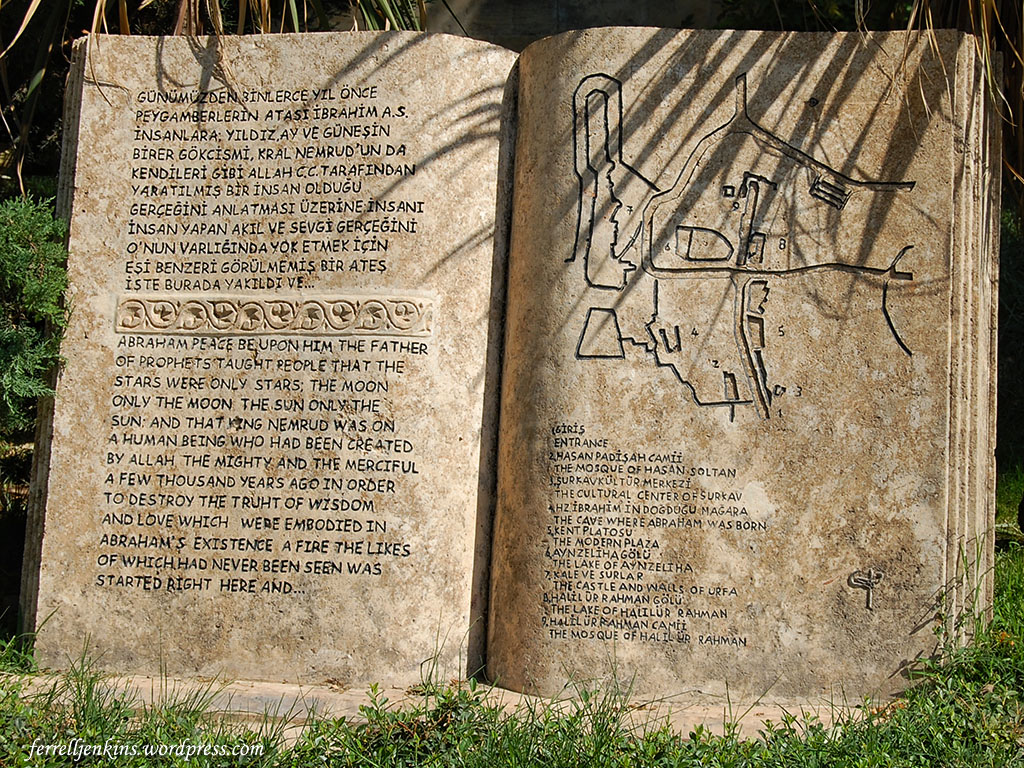
The legend of Abraham's association with Urfa. Photo by Ferrell Jenkins.

The legend of Abraham’s association with Urfa. Photo by Ferrell Jenkins.

Pool in the Gölbaşhi area of Urfa. My friend Gene, wearing the Florida State shirt and holding the camera at ready, bought extra bowls of food for the little boy so we could get photos of him feeding the fish.

Children enjoy feeding the sacred carp in the pool. Photo by Ferrell Jenkins.

Children enjoy feeding the sacred carp in the pool. Photo by Ferrell Jenkins.

A look at some of these fish illustrate why the Lonely Planet writer said they appear to be “the most pampered, portly fish in Turkey.”

The sacred carp of Urfa rush to get the food. Photo by Ferrell Jenkins.

The sacred carp of Urfa rush to get the food. Photo by Ferrell Jenkins.

A word of explanation is in order. I had never met a Muslim until my first trip to the Bible lands in 1967. In Cairo, Egypt, we sat on the floor of the Mohammad Ali mosque and listened as our guide explained about the mosque and the Muslim religion. He then answered as many questions as we wanted to ask. Through the past half century I have made many friends among the Muslims, including visiting in some homes, and I have had the opportunity to travel widely in the Middle East. I have good Muslim neighbors.

In Part 2 we will visit the cave identified as the birthplace of Abraham.
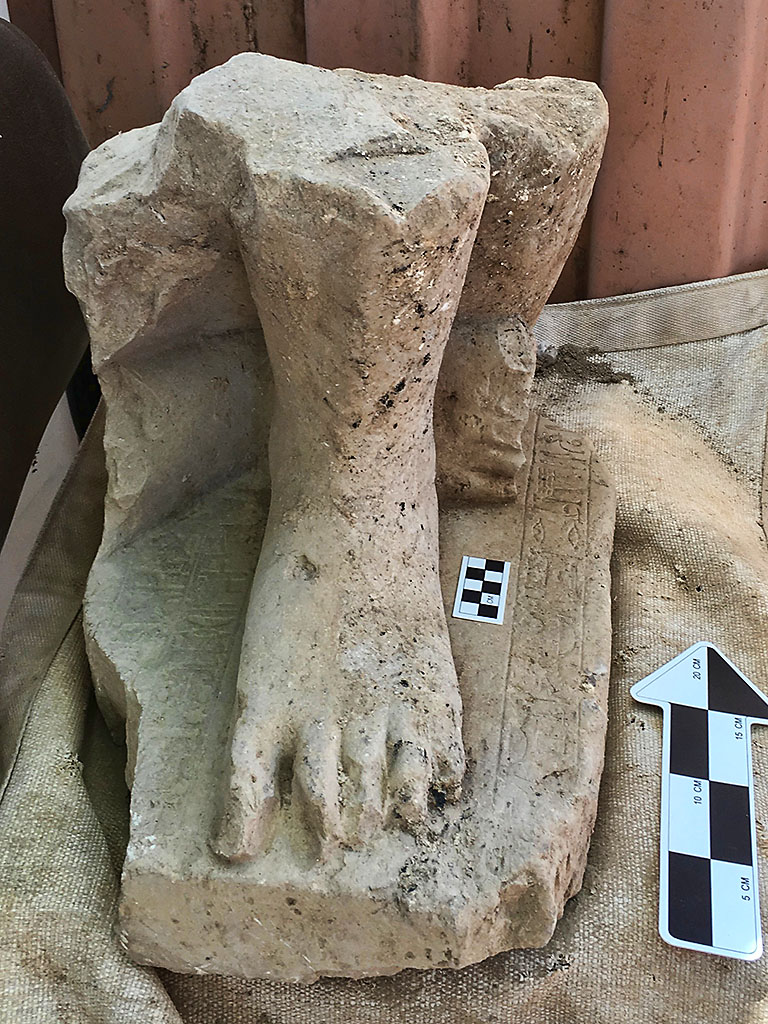
Statue of an Egyptian official found at Hazor

Hebrew University announces this morning the discovery of a statue of an Egyptian official at Tel Hazor.

— “ —

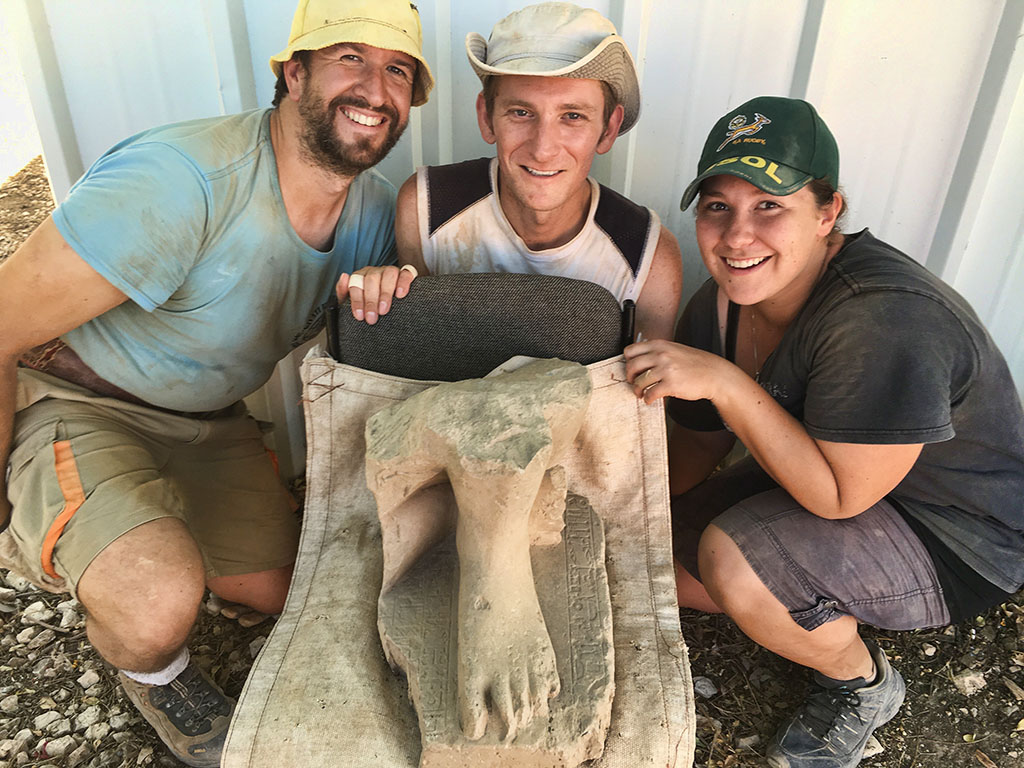
Jerusalem, July 25, 2016 — In a historic find, a large fragment of an Egyptian statue measuring 45 X 40 centimeters [about 18 x 16 inches], made of lime-stone, was discovered in the course of the current season of excavations at Tel-Hazor, north of the Sea of Galilee in Israel. Only the lower part of the statue survived, depicting the crouching feet of a male figure, seated on a square base on which a few lines in the Egyptian hieroglyphic script are inscribed.

The archaeologists estimate that the complete statue would equal the size of a fully-grown man. At present only a preliminary reading of the inscriptions has been attempted, and the title and name of the Egyptian official who originally owned the statue, are not yet entirely clear.

The statue was originally placed either in the official’s tomb or in a temple – most probably a temple of the Egyptian god Ptah – and most of the texts inscribed on the statue’s base include words of praise to the official who may have served and most probably practiced his duties in the region of Memphis, the primary cult center of the god Ptah. They also include the customary Egyptian funerary formula ensuring eternal supply of offerings for the statue’s owner.

The monumental Egyptian statute of a high official from the Middle Kingdom in Egypt, found in the administrative palace at Hazor, north of the Sea of Galilee in Israel. (Photo credit: Shlomit Bechar)

The monumental Egyptian statute of a high official from the Middle Kingdom in Egypt, found in the administrative palace at Hazor, north of the Sea of Galilee in Israel. (Photo credit: Shlomit Bechar)

This statue, found this year, together with the sphinx fragment of the Egyptian king Mycerinus (who ruled Egypt in the 25th century B.C.E.) discovered at the site by the research team three years ago, are the only monumental Egyptian statues found so far in second millennium contexts in the entire Levant.

The discovery of these two statues in the same building currently being excavated by the research team, indicates the special importance of the building (probably the administrative palace of the ruler of the city), as well as that of the entire city of Hazor.

The three volunteer excavators who found the statue, from left to right: Valentin Sama-Rojo from Spain, Bryan Kovach from the United States, and Elanji Swart from South Africa. (Photo credit: Shlomit Bechar)

The three volunteer excavators who found the statue, from left to right: Valentin Sama-Rojo from Spain, Bryan Kovach from the United States, and Elanji Swart from South Africa. (Photo credit: Shlomit Bechar)

According to Prof. Amnon Ben-Tor of the Institute of Archaeology at the Hebrew University of Jerusalem, who has been conducting excavations at Tel-Hazor for over 27 years, Hazor is the most important site from the Biblical period. Shlomit Bechar, a doctoral student at the Institute of Archaeology who has been excavating at Hazor for a decade, is co-director of the Hazor excavations and director of the main excavation area.

In the course of close to 30 years of excavation, fragments of 18 different Egyptian statues, both royal and private, dedicated to Egyptian kings and officials, including two sphinxes, were discovered at Hazor. Most of these statues were found in layers dated to the Late Bronze Age (15th-13th centuries B.C.E.) – corresponding to the New Kingdom in Egypt. This is the largest number of Egyptian statues found so far in any site in the Land of Israel, although there is no indication that Hazor was one of the Egyptian strongholds in Southern Canaan nor of the presence of an Egyptian official at Hazor during the Late Bronze Age.

Interestingly, most Egyptian statues found at Hazor so far date to Egypt’s “Middle Kingdom” (19th-18th centuries B.C.E), a time when Hazor did not yet exist. It thus seems that the statues were sent by an Egyptian king in the “New Kingdom” as official gifts to the king of Hazor, or as dedications to a local temple (regardless of their being already “antiques”). This is not surprising considering the special status of the king of Hazor who was the most important king in Southern Canaan at the time. The extraordinary importance of Hazor in the 15th-13th centuries B.C.E. is indicated also by the Biblical reference to Hazor as “the head of all those kingdoms” (Joshua 11:10).

All the statues at the site were found broken to pieces and scattered over a large area. Clear signs of mutilation indicate that most of them were deliberately and violently smashed, most probably in the course of the city’s final conquest and destruction sometime in the 13th century B.C.E. The deliberate mutilation of statues of kings and dignitaries accompanying the conquest of towns, is a well-known practice in ancient times (I Samuel 5:1-4; Isaiah 11:9) as well as in our time.

The Hazor excavations, which began in the mid 1950 (under the direction of the late Prof. Yigael Yadin), are carried out on behalf of the Hebrew University of Jerusalem. The excavations were resumed in 1990 – still on behalf of the Hebrew University, and the Israel Exploration Society, and are named “The Selz Foundation Hazor Excavations in Memory of Yigael Yadin”. The excavation takes place within the Hazor National Park, in full support and cooperation with the National Parks Authority.

Hazor is the largest biblical-era site in Israel, covering some 200 acres, and has been recognized as a World Heritage Site by UNESCO. The population of Hazor in the second millennium BCE is estimated to have been about 20,000, making it the largest and most important city in the entire region. Its size and strategic location on the route connecting Egypt and Babylon made it “the head of all those kingdoms” according to the biblical book of Joshua (Joshua 11:10). Hazor’s conquest by the Israelites opened the way to the conquest and settlement of the Israelites in Canaan. The city was rebuilt and fortified by King Solomon and prospered in the days of Ahab and Jeroboam II, until its final destruction by the Assyrians in 732 BCE.

Documents discovered at Hazor and at sites in Egypt and Iraq attest that Hazor maintained cultural and trade relations with both Egypt and Babylon. Artistic artifacts, including those imported to Hazor from near and far, have been unearthed at the site. Hazor is currently one of Israel’s national parks.

—”—

The archaeological season for the major excavations is closing down and interesting reports are coming in almost daily.

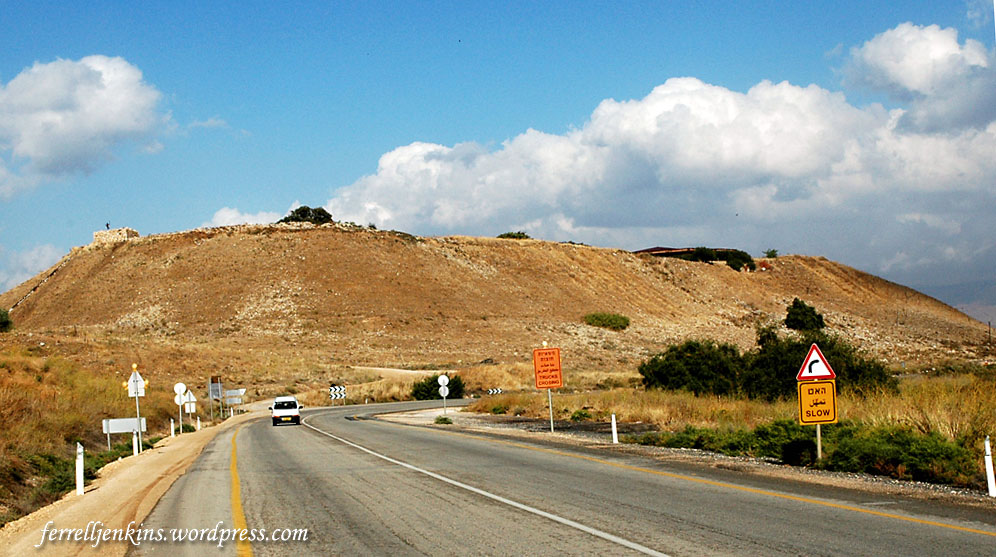
Tel Hazor (upper mound) from the south. Photo by Ferrell Jenkins.

Tel Hazor (upper mound) from the south. Photo by Ferrell Jenkins.

Sunset on the Nile

In this photo we catch a sunset on the Nile River a short distance from Luxor.

Sunset on the Nile River. Photo by Ferrell Jenkins.

Sunset on the Nile River. Photo by Ferrell Jenkins.

The harbor at Joppa (Jaffa, Yafo)

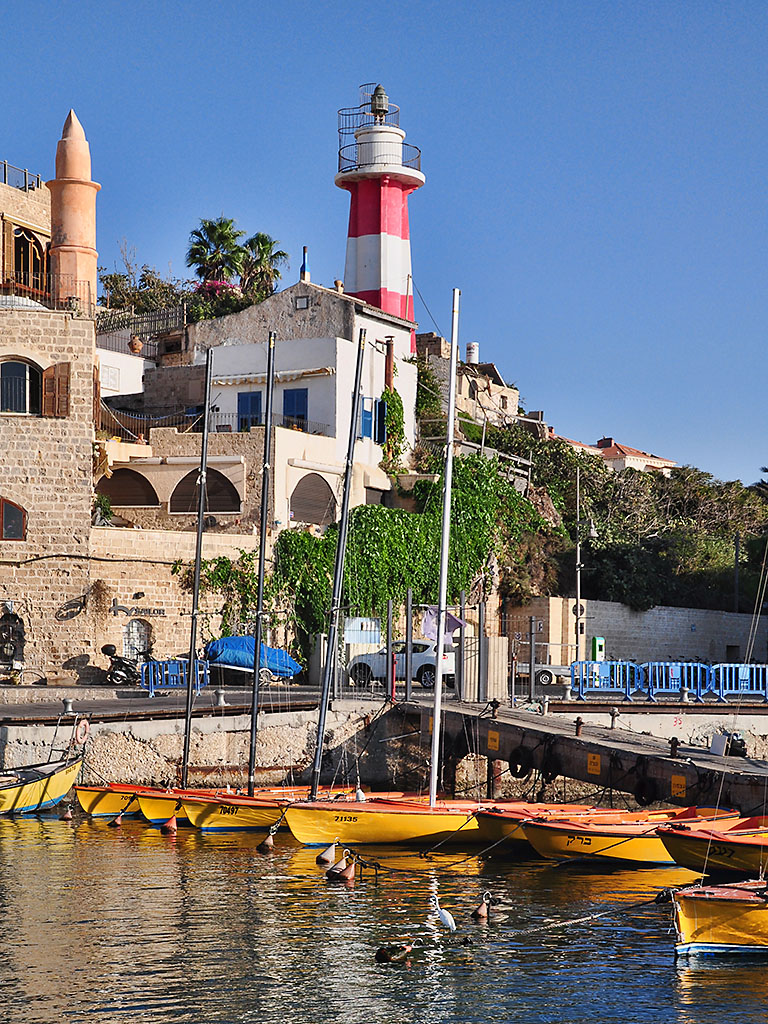
The harbor at Joppa/Jaffa/Yafo was once a much more significant harbor, but never an adequate one. Only a small leisure harbor remains today. Our late afternoon photo shows the lighthouse rising above some of the buildings of the city.

The leisure harbor at Joppa/Jaffa. Photo by Ferrell Jenkins.

The leisure harbor at Joppa/Jaffa. Photo by Ferrell Jenkins.

Joppa is located in the Plain of Sharon and served as the seaport for Jerusalem which is about 35 miles away. The city is now called Jaffa, or Yafo. Joppa was a walled town as early as the reign of Pharaoh Thutmose III (1490-1435 B.C.) who mentions Joppa in his town lists.

Here are a few of the biblical highlights for Joppa.

  • Joppa was assigned to the tribe of Dan, but was not controlled by the Israelites till the time of David (Joshua 19:46).
  • Hiram of Tyre floated cedar from Lebanon to Joppa for Solomon’s Temple (2 Chronicles 2:16).
  • Jonah sought a ship for Tarshish at Joppa to avoid going to Nineveh (Jonah 1:3).
  • Cedars from Lebanon again were floated to Joppa for the rebuilding of the temple (520-516 B.C.; Ezra 3:7). The port of the city is behind St. Peter’s Church.
  • Tabitha (Dorcas) lived in Joppa. When she died the disciples sent for Peter who was a Lydda. He came to Joppa and raised Dorcas (Acts 9:36-42). (Acts 10:6).
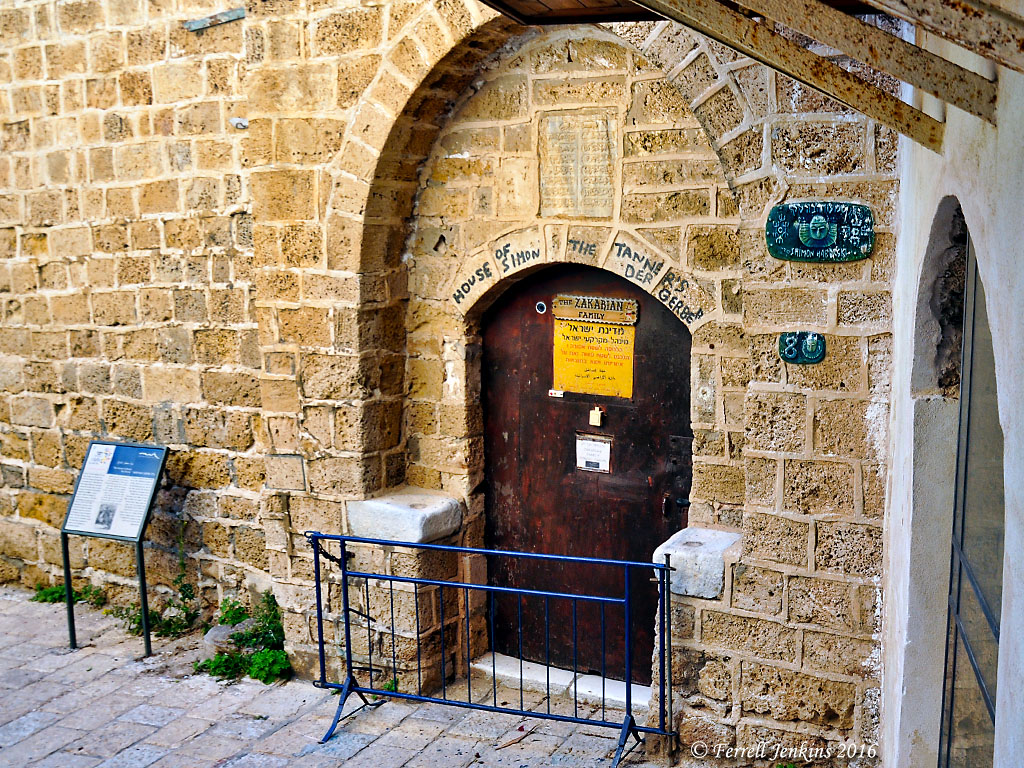
  • Peter stayed many days in Joppa with Simon the tanner (Acts 9:43). His house was by the sea (Acts 10:6). A house near the port is shown as the house of Simon, but there is no way to know this with certainty.
  • Peter received the housetop vision and learned that he was to go to Caesarea to preach the gospel to the Gentiles at the house of the Roman centurion Cornelius (Acts 10:23).
The traditional house of Simon the Tanner at Joppa. Photo by Ferrell Jenkins.

The traditional house of Simon the Tanner at Joppa. Photo by Ferrell Jenkins.

“A land flowing with milk and honey”

The promise made to the descendants of Abraham that they would receive “A land flowing with milk and honey” was made to them while they were in bondage in Egypt (Exodus 3:8; 13:5) and during the forty years of wilderness wandering (Leviticus 20:24; Deuteronomy 11:9).

Joshua and the prophets Jeremiah and Ezekiel affirmed that the LORD gave Israel a land flowing with milk and honey (Joshua 5:6; Jeremiah 32:22; Ezekiel 20:15).

You kept the promise that you swore on oath to their ancestors. You gave them a land flowing with milk and honey. (Jeremiah 32:22 NET)

The term honey (debash) is used in the Old Testament Scriptures 53 times. According to the Theological Wordbook of the Old Testament 17 of these are in the “land flowing with milk and honey.” The BDB lexicon says the term is used of “honey both of fruits and of bees.”

“Honey was among the products Jacob sent to Egypt for grain (Gen 43:11). It was even more prized then than today because, since they had no sugar, it was their chief sweetener” (TWOT).

The manna in the wilderness tasted like “wafers made with honey” (Exodus 16:31).

In a battle with the Philistines, Jonathan found honey dripping from the trees of the forest, ate some of it, and “had renewed energy” (1 Samuel 14:26-27 CSB).

The records we have in the Old Testament indicate that the bees of the land made their honey in the trees and rocks (Psalm 81:16).

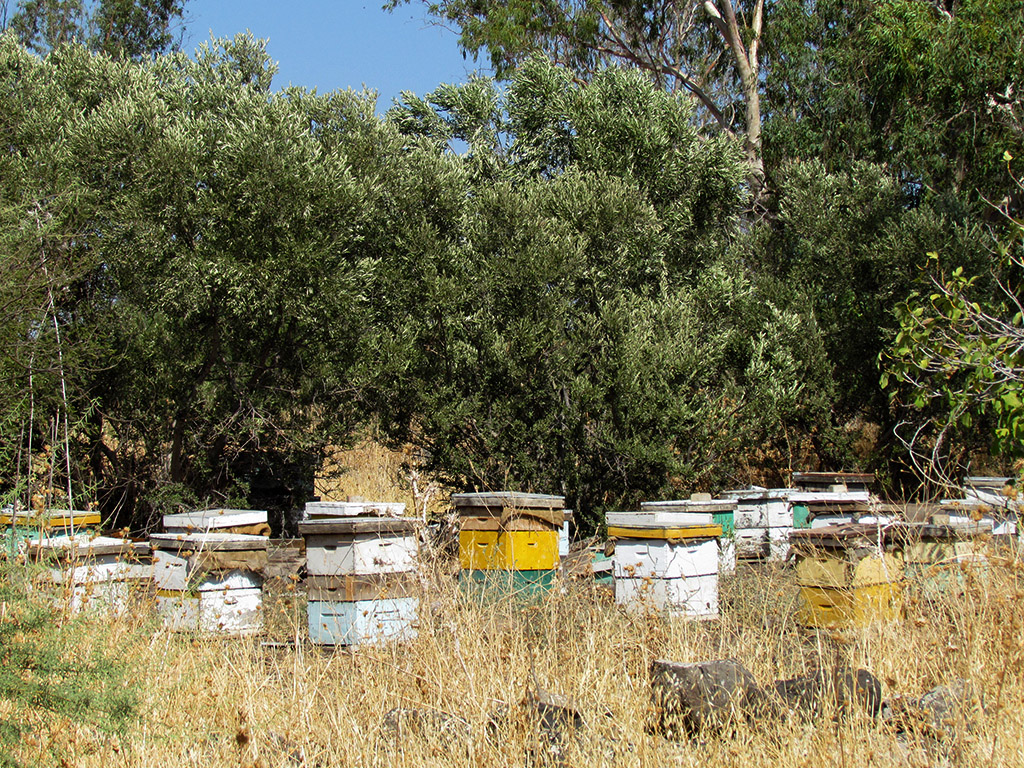
Today, we see beehives throughout Israel. On one of our tours Rebekah Reeder Dutton asked if we could stop for a photo of some beehives. Her father maintains an apiary and she wanted some photos to show him. Since this was off the main highway we had plenty of space to stop for the photo. Rebekah kindly granted me permission to use one of her photos.

Bee hives in the Jordan River Park near Tel Bethsaida. Photo by Rebekah Dutton.

Beehives in the Jordan River Park near Tel Bethsaida. Photo by Rebekah Dutton.

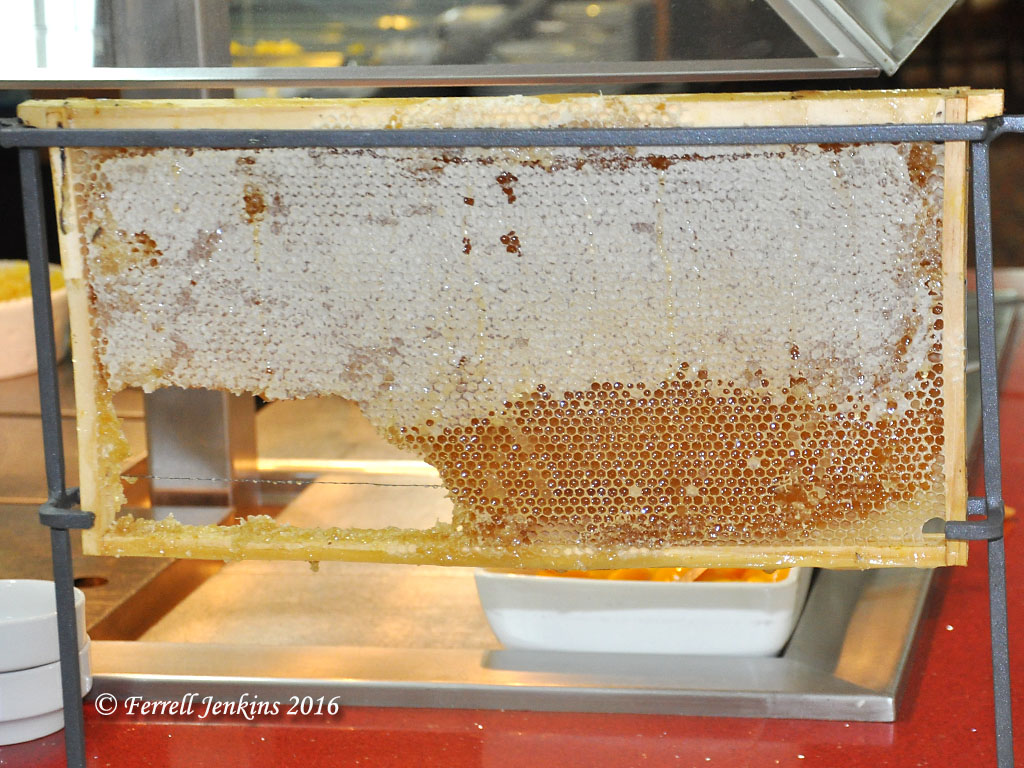
The Ron Beach Hotel on the north side of Tiberias, at certain times of the year, has a honeycomb each morning for breakfast. Delicious.

Honey comb at the Ron Beach Hotel breakfast bar. Photo by Ferrell Jenkins.

Honeycomb at the Ron Beach Hotel breakfast bar. Photo by Ferrell Jenkins.

This honeycomb brings to mind several Biblical references. David describes the judgments of the LORD:

They are of greater value than gold, than even a great amount of pure gold; they bring greater delight than honey, than even the sweetest honey from a honeycomb.  (Psalm 19:10 NET)

The wise man urged the young man to eat honey, making the application that wisdom is sweet.

Eat honey, my child, for it is good, and honey from the honeycomb is sweet to your taste.  Likewise, know that wisdom is sweet to your soul; if you find it, you will have a future, and your hope will not be cut off. (Pro 24:13-14 NET)

xxxxx

Sinuhe takes a trip through Canaan

The earliest description of Canaan comes from an Egyptian literary text. In The Story of Sinuhe (see-NUU-hay) written in the 20th century B.C., a traveler tells of his pleasant stay in northern Canaan (possibly the Beka Valley of Lebanon). He describes the land as follows:

Figs were in it, and grapes. It had more wine than water. Plentiful was its honey, abundant its olives. Every (kind of) fruit was on its trees. Barley was there, and emmer. There was no limit to any (kind of) cattle. (qtd. in Pritchard, Ancient Near Eastern Texts, 19)

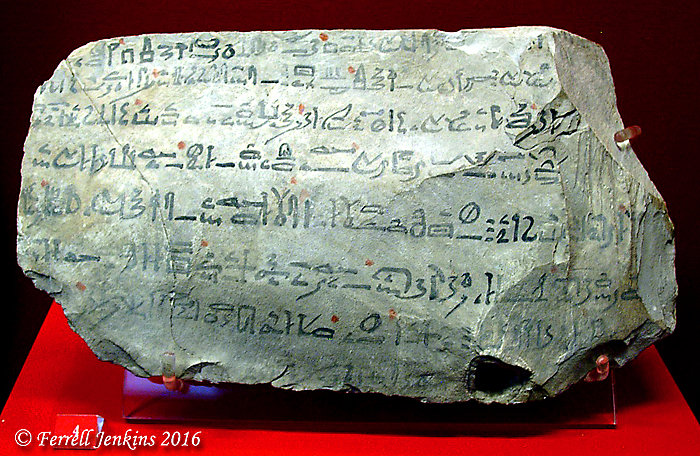
This description reminds one of the promise God made to the Israelites to bring them into a land flowing with milk and honey (Exodus 3:8). A copy of The Story of Sinuhe written on stone is on display in the Ashmolean Museum, Oxford, England. The stone below, now in the British Museum, contains the final stanza of the Story or Tale.

A portion of the Tale of Sinuhe. British Museum. Photo by Ferrell Jenkins.

A portion of the Tale of Sinuhe. British Museum. Photo by Ferrell Jenkins.

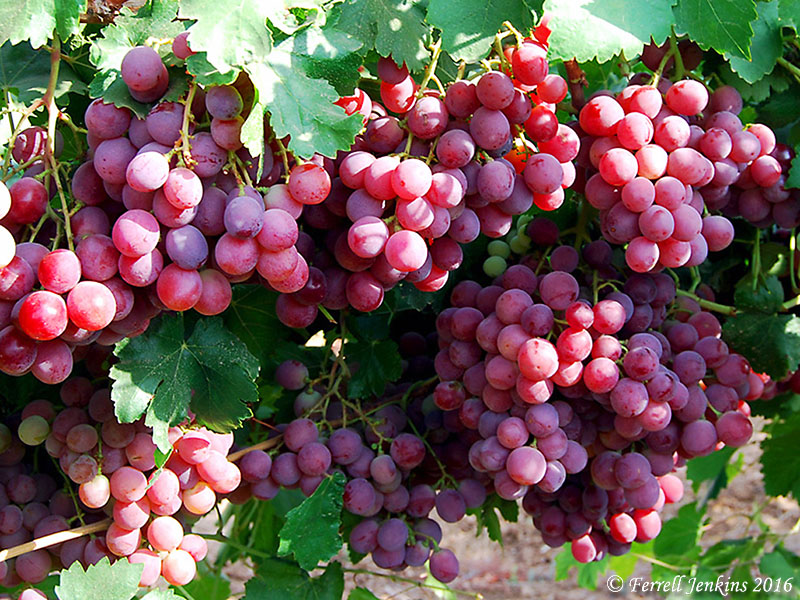
The photo of grapes from Lachish reminds us of the abundance of the land through which Sinuhe traveled.

Ripe grapes near Lachish in the Shephelah. Photo by Ferrell Jenkins.

Grapes on the vine near Lachish in the Shephelah. Photo by Ferrell Jenkins.

Measuring the Nile and your taxes

We have often heard the adaptation of Herodotus’ statement that Egypt is the gift of the Nile. The flooding of the Nile in ancient times was the key to the prosperity of the Nile Valley.

All along the Nile there are still examples of the Nile-o-meters that were used to measure the flooding. The higher the flood water, the more taxes that would be paid into the temple coffers.

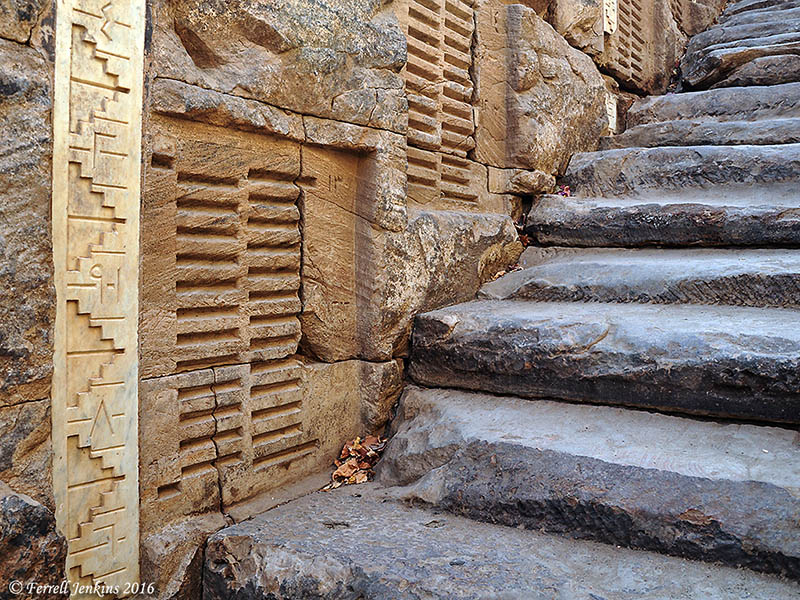
In the photo below we see the meter on the Nile at Elephantine Island at Aswan. Notice the water lines along the rock structure. Entrance to the Nile-o-meter is from above, or from the opening to the right of center.

Elephantine Island at Aswan, Egypt. Photo by Ferrell Jenkins.

Nile-o-meter on Elephantine Island at Aswan, Egypt. Photo by Ferrell Jenkins.

The photo below provides a better view of the Nile-o-meter.

Nile-o-meter and steps on Elephantine Island at Aswan, Egypt. Photo by Ferrell Jenkins.

Nile-o-meter and steps on Elephantine Island at Aswan, Egypt. Photo by Ferrell Jenkins.

The principle is the same today. We pay taxes based on the amount we have earned within a year.

Therefore one must be in subjection, not only to avoid God’s wrath but also for the sake of conscience. For because of this you also pay taxes, for the authorities are ministers of God, attending to this very thing. Pay to all what is owed to them: taxes to whom taxes are owed, revenue to whom revenue is owed, respect to whom respect is owed, honor to whom honor is owed. (Romans 13:5-7 ESV)

Turning from idols to serve the living God

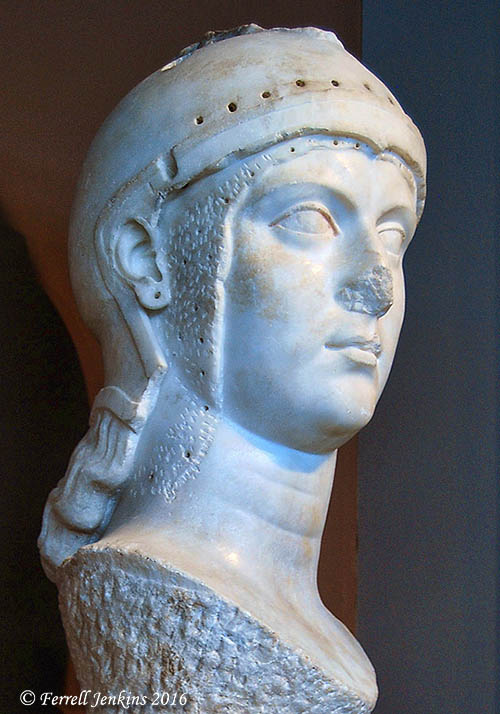
Recently I was browsing through photos made in the Archaeological Museum of Thessaloniki (Salonica, Thessalonica), Greece, in 2008. I was impressed with the images of various gods and goddesses that were known in the city in the first century A.D. There were statues and busts of Egyptian gods such as Isis, Serapis, and Harpokrates/Horus. Greek gods and goddesses such as Dionysus, Hades, Apollo, Athena, Aphrodite, Demeter, and the mother of the gods often associated with Kybele (Cybele) were known. And there were others.

Athena. Archaeology Museum of Thessaloniki. Photo by Ferrell Jenkins.

Athena. Archaeology Museum of Thessaloniki. Photo by Ferrell Jenkins.

Immediately my mind was drawn to Paul’s commendation of the saints at Thessalonica in the middle of the first century A.D.

 6 And you became imitators of us and of the Lord, for you received the word in much affliction, with the joy of the Holy Spirit,
7 so that you became an example to all the believers in Macedonia and in Achaia.
8 For not only has the word of the Lord sounded forth from you in Macedonia and Achaia, but your faith in God has gone forth everywhere, so that we need not say anything.
9 For they themselves report concerning us the kind of reception we had among you, and how you turned to God from idols to serve the living and true God,
10 and to wait for his Son from heaven, whom he raised from the dead, Jesus who delivers us from the wrath to come.  (1 Thessalonians 1:6-10 ESV)

But there were other “gods” known to the Thessalonians. The deified Alexander, considered a son of Zeus, was represented in the museum. Another significant form of idolatry was the Cult of the Emperor of Rome. A sign associated with one display says,

The cult of the emperor was both an instrument of imperial policy propaganda and a means for the transmission of Roman culture. The image of the emperor gives a concrete form to the abstract idea of the Empire. Whether a full-length statue or a bust, it makes his presence felt everywhere: in outdoor and indoor spaces, in fora, in villas, and in libraries.

Here is a statue of Octavian Augustus, the first emperor of Rome (27 B.C. – A.D. 14). Augustus was emperor at the time of the birth of Christ (Luke 2:1).

Statue of Augustus, Archaeology Museum of Thessaloniki. Photo by Ferrell Jenkins.

Statue of Augustus, Archaeology Museum of Thessaloniki. Photo by Ferrell Jenkins.

Claudius, Vespasian, Titus, and other emperors were represented in the museum displays.

An interesting temporary exhibition was about the discovery of an important archaeological site known as Kalindoia. The site is located about 48 km (30 miles) southeast of Thessalonica. Paul traveled a few miles north of Kalindoia when he went from Philippi, via Amphipolis and Apollonia, to Thessalonica (Acts 17:1). Below is the drawing of the chamber of the imperial cult. A temple for imperial worship was located here from the 1st century B.C. to the 3rd century A.D.

Artist conception of the chamber of the Imperial Cult. Photo by Ferrell Jenkins.

Artist conception of the chamber of the Imperial Cult. Photo by Ferrell Jenkins.

The sign associated with this drawing states that there were pedestals for statues here. “One of them was the statue of Emperor Octavian Augustus.” The Cult of the Emperor was especially pervasive in the eastern part of the Roman Empire and may have some bearing on understanding the man of lawlessness (sin) in 2 Thessalonians 2. It is certainly helpful in understanding the background of the book of Revelation.

But that’s not all. Another sign mentions the eponymous local heroes such as war heroes, deified mythological figures, or the heroized dead “were also worshipped.”

The gospel of Christ has power to touch the hearts of men and inform them about the difference between idols made of “gold or silver or stone, an image formed by the art and imagination of man,” and the God who does not dwell in temples made by man (Acts 17:29 ESV).

Unique Hadrian exhibit at the Israel Museum

The Roman Emperor Hadrian (Publius Aelius Hadrianus) ruled the Empire from A.D. 117 to 138. Numerous statues of him are displayed in museums spread across the region. Most of them are made of stone, but there are three unique bronze statues of the Emperor. These are on display at the Israel Museum in Jerusalem until June. They come from the Israel Museum, the Louvre, and the British Museum.

Ilan Ben Zion says that Hadrian,

…was venerated by contemporary Roman historians as one of the Five Good Emperors: a just ruler, a peacemaker and great architect of the empire. The wall he famously constructed along the border with Scotland bears his name to this day. But in Jewish memory, Hadrian is best known as a brutal dictator who crushed the Bar Kochba revolt in 135, slaughtered hundreds of thousands of Jews, rebuilt Jerusalem as a pagan city, banned circumcision, and changed the name of Judaea to Palaestina. (The Times of Israel, Dec. 22, 2015)

I have seen all three of these pieces, but look forward to seeing them displayed together in the spring.

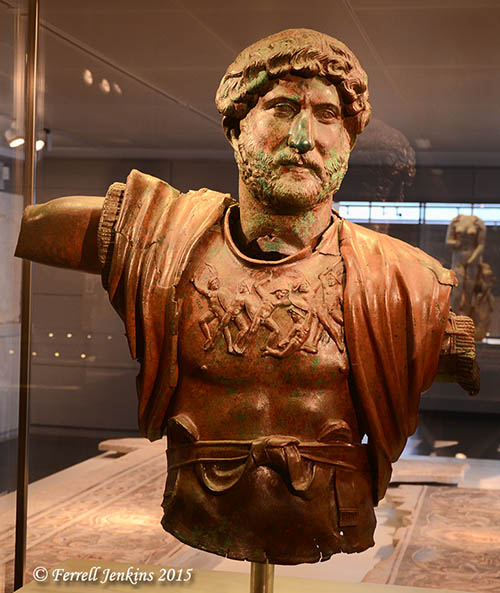
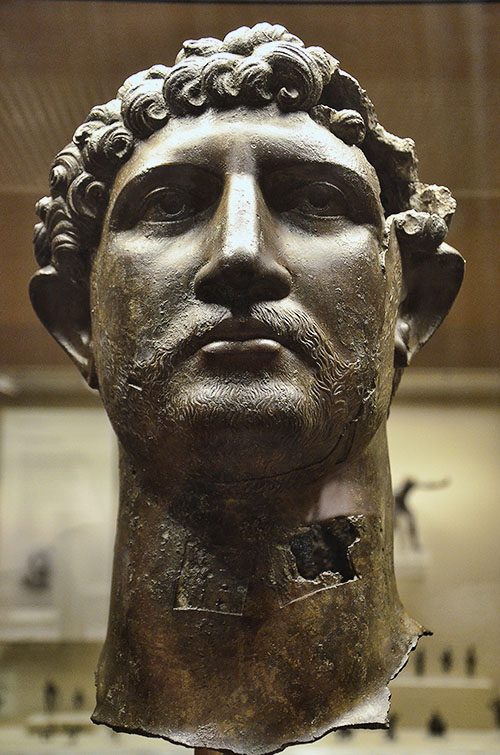
The most magnificent statue is the one of Hadrian discovered at Tel Shalem (Shalim) a few miles south of the Beth Shean (Beit She’an) in the Jordan Valley. Tel Shalem is thought to be the Salim mentioned in John 3:23.

Bronze statue of Hadrian discovered in a Roman army camp of the Sixth Roman Legion. He is portrayed as the supreme military commander. Photo by Ferrell Jenkins.

Bronze statue of Hadrian discovered in a Roman army camp of the Sixth Roman Legion at Tel Shalem. He is portrayed as the supreme military commander. Photo by Ferrell Jenkins.

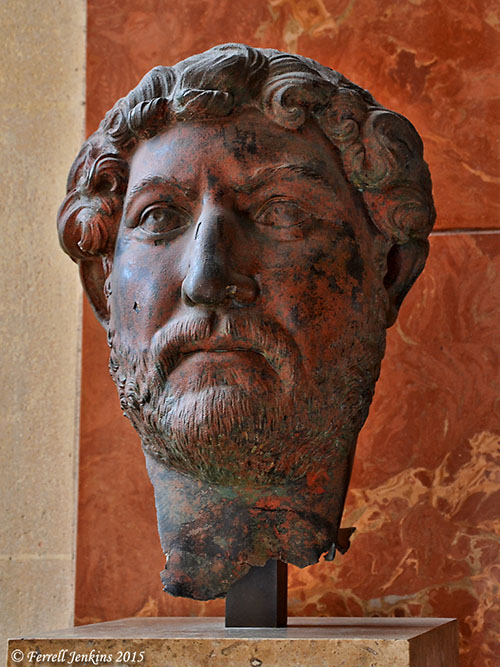
Only the head remains of the other two statues. The first of these was acquired by the Louvre in 1984.

Bust of Hadrian thought to have come from Egypt. Louvre. Photo by Ferrell Jenkins.

Bust of Hadrian thought to have come from Egypt. Louvre. Photo by Ferrell Jenkins.

The next bronze head comes from a larger than life-size statue that is thought to have stood in a public area of Roman London. It commemorates Hadrian’s visit to Britain in A.D. 122. It was found in the River Thames near London Bridge in 1834. This head is displayed in a room of Roman statues in the British Museum, but I have never known it to be open. I arranged to visit the room one time and have a photo but it is not as sharp as I prefer. This photo comes from Following Hadrian here. I refer you to that blog and Twitter feed for everything Hadrian.

Bronze Head of Hadrian. Following Hadrian.

Bronze head from a statue of the Emperor Hadrian, Romain Britain, British Museum
Carole Raddato CC BY-SA

Richard Batey writes about Hadrian’s relation to Jerusalem:

Hadrian visited Jerusalem in A.D. 129–130 and rebuilt the city on the plan of a Roman military camp. On the Temple Mount he erected a temple dedicated to Jupiter Capitolinus and nearby a second temple honoring the goddess Aphrodite. Hadrian renamed Jerusalem Aelia Capitolina, a designation that combined one of his names with Rome’s Capitoline triad: Jupiter, Juno and Minerva. Hadrian’s actions and policies provoked a second revolt by the Jews in A.D. 132. Led by Bar Kokhba, the Jewish troops succeeded in taking control of Jerusalem briefly but were soon (A.D. 135) crushed by the superior Roman army. After this decisive defeat it became a capital offense for a Jew to set foot in Jerusalem. (Batey, R. A. “Jerusalem.” Ed. Craig A. Evans and Stanley E. Porter. Dictionary of New Testament background: a compendium of contemporary biblical scholarship 2000 : 561. Print.)

Shmuel Browns, Israel Tour Guide, includes a beautiful photo of the Tel Shalem bust currently on display (outside the case?), and he presents another opinion about the rebuilding of the city. He also includes a list of some other things related to Hadrian that can be seen in and around Jerusalem. See his post here.

Information about the exhibit at the Israel Museum may be found here.

Life in Memphis, Egypt

Memphis is said to have been founded as early as 3000 B.C. At times it was among the greatest cities of the world. The prophet Ezekiel foretold the fall of Memphis and of Egypt as a world power.

This is what the sovereign LORD says: I will destroy the idols, and put an end to the gods of Memphis. There will no longer be a prince from the land of Egypt; so I will make the land of Egypt fearful. (Ezekiel 30:13 NET)

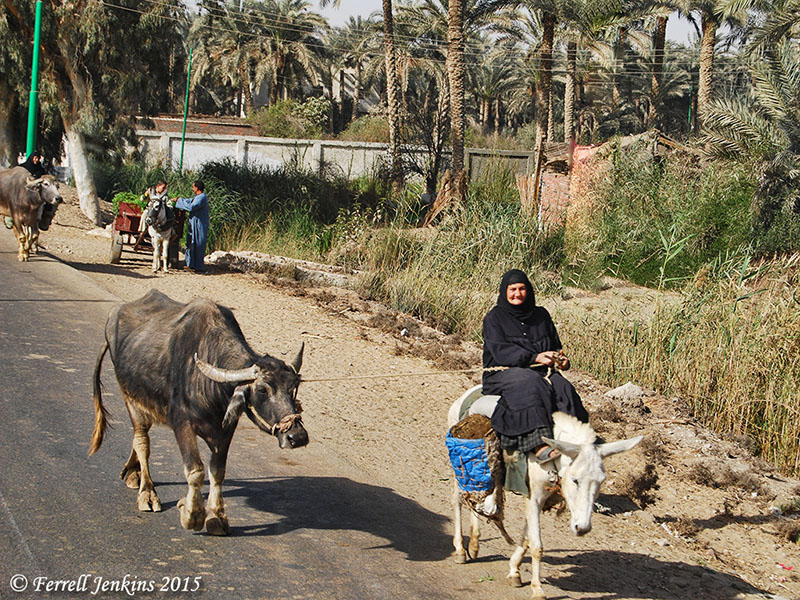
I wish to share a typical picture of native life in Memphis today.

A typical scene from Memphis, Egypt. Photo by Ferrell Jenkins.

A typical scene from Memphis, Egypt. Photo by Ferrell Jenkins.