Category Archives: Egypt

Finally got the photo uploaded

I was unable to upload one of the photos about goats in the Sinai peninsula earlier. Finally got it uploaded. If you missed seeing the photo of the nanny goat caring for the newborn kid, please take a look now.
Goats in the Bible world

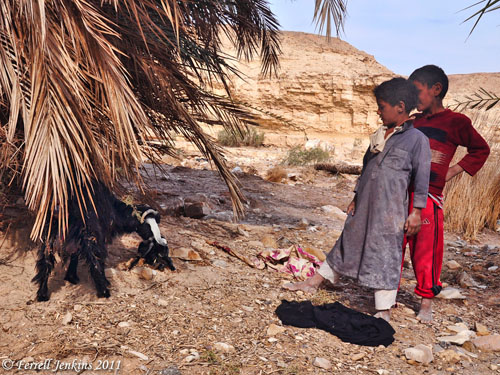
Travel in the Middle East provides many illustration similar to life in Bible times. We are more likely to see these illustrations where we have less modernization. The photos I wish to share today come from the Sinai peninsula. Last January we stopped at a Bedouin settlement on the way from the Suez Canal to Mount Sinai. Our timing was good. A goat had just given birth to a kid. While the nanny was keeping the kid moving around, two of the Bedouin boys were standing by keeping watch. Remembering my own childhood on a farm, I am sure the boys could hardly contain themselves from helping the kid. They had probably been told many times that it would be a big mistake to do so.

Bedouin boys keeping watch over a goat and newborn kid. Photo by Ferrell Jenkins.

Bedouin boys keeping watch over a goat and newborn kid. Photo by Ferrell Jenkins.

The earliest biblical reference to the goat is in Genesis 15:9, the account of Abraham’s sacrifice after the giving of the land covenant. A three year old female goat was among the animals offered. The LORD later commanded Israel to offer goats in their sacrifices.

This photo shows the nanny’s care for the still-wet newborn.

Mother goat cares for newborn kid in the Sinai Peninsula. Photo by Ferrell Jenkins.

Mother goat cares for newborn kid in the Sinai Peninsula. Photo by Ferrell Jenkins.

Goats were used for food. In Rachel’s attempt to have Isaac bless Jacob she prepared “delicious food” for Isaac.

Now therefore, my son, obey my voice as I command you. Go to the flock and bring me two good young goats, so that I may prepare from them delicious food for your father, such as he loves. And you shall bring it to your father to eat, so that he may bless you before he dies. (Genesis 27:8-10 ESV)

Goats’ hair and goatskins were used In the construction of the Tabernacle (Exodus 25:4-5 et al.).

The goat was among the clean animals that could be eaten (Deuteronomy 14:4).

One of the wise sayings of Solomon mentions goats’ milk for food.

There will be enough goats’ milk for your food, for the food of your household and maintenance for your girls. (Proverbs 27:27 ESV).

Photos that are worth 1000 words each

Photos can be used effectively to illustrate Bible lands and customs. Otherwise dull presentations can come to life with the use and explanation of appropriate photos.

Pictorial Library of Bible Lands. We have suggested frequently that every Bible teacher needs access to Todd Bolen’s Pictorial Library of Bible Lands. Todd publishes a Newsletter every few months in which he gives away a few excellent photos already in PowerPoint format. If you don’t receive the Newsletter I suggest you download the November issue here. It contains several panoramic photos that give you the opportunity to see and understand a lot at once. And while you are there you should sign up to receive the Newsletter when it is published. Also take a look at the BiblePlaces Blog and the BiblePlaces.com web site. See also LifeintheHolyLand.com. BiblePaces is now availabe in French at BibleLieux.com and Spanish at LugaresBiblicos.com.

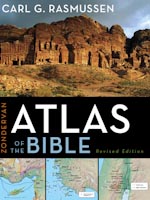
Holy Land Photos. Carl G. Rasmussen, author of the revised Zondervan Atlas of the Bible, is now posting the photos used in the Atlas at his Holy Land Photos site. Begin here. You will find thousands of useful photos at this site. These photos will be especially helpful to those seeking to teach Bible geography or to incorporate geographical information into lessons. These photos are in PowerPoint format. You also need the have and study the Atlas. Also check the HolyLandPhotosBlog for more recent photos and updates.

Order the Zondervan Atlas of the Bible from Amazon (currently $26.12).

David Padfield has a large number of photos of Bible lands available for free download here. Thanks to these men who have devoted much time and money to acquiring the photos and preparing them for others to use. I have used the work of all three in my presentations in recent years.

The Tischendorf letter at Saint Catherine’s Monastery

Reader Ted Weis wrote,

Do you happen to have a photo of the letter that von Tischendorf wrote, saying that he would return codex Sinaiticus?

Well…, yes and no. A picture. But not a good one. There is now a museum or display area of a few small rooms in the Monastery near Moses’ Well. Signs are posted to restrict photography. A photo that I have from this year is too blurry to make sense of. A copy of the letter is posted on one wall and a sign about Codex Sinaiticus (in Greek, English, and Arabic), reads this way:

Codex Sinaiticus

The Codex Sinaiticus dates to the middle of the fourth century, and is possibly one of the fifty copies of the Holy Scriptures sent to Constantine the Great by Eusebius of Caesarea. This same manuscript was likely donated to the Monastery of Sinai at its foundation, where it was preserved until the middle of the nineteenth century. It was seen in the library of the Monastery by the German scholar Constantine Tischendorf on his visits in 1844 and 1859. The first folios that he took, he presented to the University of Leipzig. The rest he gave to the Emperor of Russia, folios he had received as a loan so that they might be published, secured with lying promises to the monks. In Russia they remained until 1933, when they were sold by the Soviet Union to the British Library in London, where they are to this day. In 1975, certain folios of the Codex came to light among the New Finds in the tower of Saint George. The monks of Sinai have never ceased in their justified request for the return of their Codex.

The photo below shows the sign on the right and a copy of the Tischendorf letter on the left.

Sinaticus Sign and Tischendorf Letter at Saint Catherine's Monastery. Photo by Ferrell Jenkins.

Tischendorf letter & sign at Saint Catherine's Monastery. Photo by Ferrell Jenkins.

I remember visiting the Monastery library on two previous occasions. At that time we were taken into the library during the visit. I saw a copy of the Tischendorf letter and an English translation. Here is a scan of a slide I made in 1986. Click on image for a larger photo.

Tischendorf Letter at Saint Catherine's in 1986. Photo by Ferrell Jenkins.

Tischendorf Letter at Saint Catherine's in 1986. Photo by Ferrell Jenkins.

The letter on the left is written in Greek. James Bentley says it was “bad Greek” and that the translation is “not very competent.” Here, he says, is what Tischendorf wrote:

I the undersigned, Constantin von Tischendorf, sent at present to the East by orders of Alexander, Tsar of All Russias, testify by the present letter that the Holy Confraternity of Mount Sinai, in accordance with the letter of His Excellency Ambassador Lobanov, has handed over to me, as a loan, an ancient manuscript of both Testaments, being the property of the aforementioned monastery and consisting of 346 folia and a small fragment. These I wish to take with me to St Petersburg in order that I may compare the original with the copy made by me when that is printed.

This manuscript is entrusted to me under the conditions laid down in the aforementioned letter of Mr Lobanov, dated 10 September 1859, numbered 510. I promise to return it, undamaged and in a good state of preservation, to the Holy Confraternity of Mount Sinai at its first request.

Several years ago I read James Bentley’s Secrets of Mount Sinai: The Story of the World’s Oldest Bible — Codex Sinaiticus (Doubleday, 1986). It is an interesting book and may still be available. The foreword is by James H. Charlesworth.

Sorry I can’t do better, but I hope this will be helpful to those who are interested in the history of Codex Sinaiticus, the oldest complete manuscript of the New Testament.

The largest part of Codex Sinaiticus is now in the British Library, but there are portions in three other places including Saint Catherine’s. The available pages of the manuscript are available online at the Codex Sinaiticus website.

The “Burning Bush” in Saint Catherine’s Monastery

Bible students are familiar with the Exodus account of Moses and the burning bush. Note these verses.

Now Moses was keeping the flock of his father-in-law, Jethro, the priest of Midian, and he led his flock to the west side of the wilderness and came to Horeb, the mountain of God.  2 And the angel of the LORD appeared to him in a flame of fire out of the midst of a bush. He looked, and behold, the bush was burning, yet it was not consumed.  3 And Moses said, “I will turn aside to see this great sight, why the bush is not burned.”  4 When the LORD saw that he turned aside to see, God called to him out of the bush, “Moses, Moses!” And he said, “Here I am.”  5 Then he said, “Do not come near; take your sandals off your feet, for the place on which you are standing is holy ground.”  (Exodus 3:1-5 ESV)

There are later biblical references to this event. Deuteronomy 33:16 speaks of “Him who dwelt in the bush.” Jesus called attention to the account in his answer to the questions about the resurrection.

And as for the dead being raised, have you not read in the book of Moses, in the passage about the bush, how God spoke to him, saying, ‘I am the God of Abraham, and the God of Isaac, and the God of Jacob’? (Mark 12:25 ESV)

Both Mark and Luke use the Greek term batos for the bush. This word describes a thorn bush or a bramble bush. Luke’s account of Stephen’s speech also mentions the “burning thorn bush” (Acts 7:30, 35). Josephus also refers to a “thorn bush” (Ant. 2:266).

for a fire fed upon a thornbush, yet did the green leaves and the flowers continue untouched, and the fire did not at all consume the fruit branches, although the flame was great and fierce.

From this event follows the commissioning of Moses to go to Pharaoh to bring God’s people out of oppression in Egypt. When Moses has brought the people out of Egypt he is to “serve God on this mountain” (Exodus 3:12).

Brown-Driver-Briggs define the Hebrew word seneh as “a thorn bush, perh. black-berry bush.”

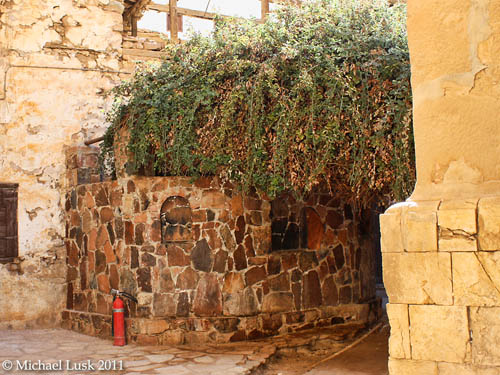
Another of the traditions associated with Saint Catherine’s Monastery is the burning bush. I am using another of the photos by Michael Lusk. Our visit to the Monastery was in the morning — a time when the lighting was bad for a photo of this bush. Michael went a little later than I did and his phot0 is better. I think the fire extinguisher is a nice touch.

The "burning bush" in Saint Catherine's Monastery. Photo by Michael Lusk.

The "burning bush" in Saint Catherine's Monastery. Photo by Michael Lusk.

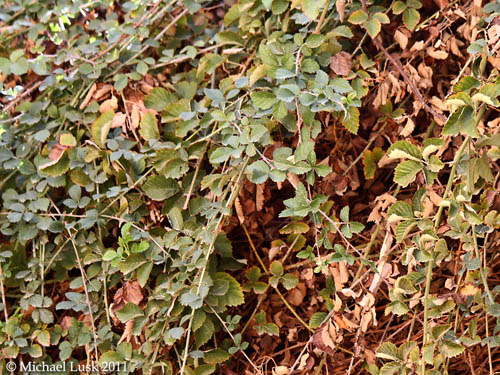
I have no idea about the specific kind of bush mentioned in Exodus. Here is a close up of the bush in Saint Catherine’s Monastery. A careful look reveals that this bush has small thorns on it.

Close up of "burning bush" in St. Catherine's Monastery. Photo by Michael Lusk.

Close up of "burning bush" in St. Catherine's Monastery. Photo by Michael Lusk.

The “Well of Moses” at Saint Catherine’s Monastery

In addition to the unique setting deep in the granite mountains of the Sinai peninsula, Saint Catherine’s Monastery is significant because it marks some important traditions relating to biblical characters and events. Geographers and other scholars make numerous suggestions for the location of Mount Sinai where the law was given to Moses and Israel. I am not entering that discussion at the moment, but am writing about the traditions associated with Saint Catherine’s Monastery.

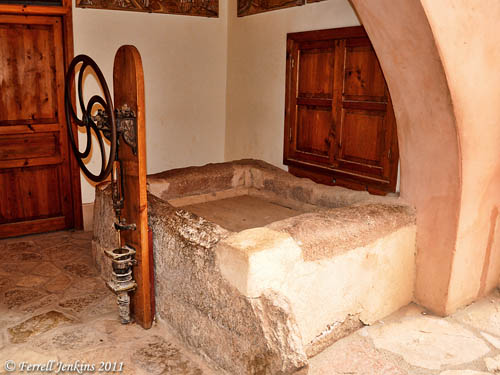
The well pictured below is shown as the Well of Moses and related to the biblical event described in Exodus.

When Pharaoh heard of it, he sought to kill Moses. But Moses fled from Pharaoh and stayed in the land of Midian. And he sat down by a well. Now the priest of Midian had seven daughters, and they came and drew water and filled the troughs to water their father’s flock. The shepherds came and drove them away, but Moses stood up and saved them, and watered their flock. (Exodus 2:15-17 ESV)

Moses Well at Saint Catherine's Monastery. Photo by Ferrell Jenkins.

Moses Well at Saint Catherine's Monastery. Photo by Ferrell Jenkins.

R. Alan Cole says the location of the land of Midian is uncertain, but that it could be somewhere in the Sinai peninsula.

The location is quite uncertain, but clearly it was somewhere beyond the Egyptian frontierposts, and to the east. Somewhere in the Sinai peninsula, or the Arabah (the area south of the Dead Sea), or that part of Arabia east of the gulf of Aqaba, would suit. (Cole, R. A. (1973). Vol. 2: Exodus: An introduction and commentary. Tyndale Old Testament Commentaries (66). Downers Grove, IL: InterVarsity Press.)

We have no way to know with certainty that Moses was at this specific place. The best we can say is that he may have been here.

Saint Catherine’s Monastery

The Monastery of St. Catherine is located at an altitude of about 4925 feet in the Wadi el-Deir at the foot of Gebel Musa. Tradition identifies this as the site where Moses tended the flocks of Jethro and saw the burning bush (Ex. 3:1-4:17). The Monastery was built near the middle of the sixth century A.D. during the reign of the emperor Justinian. It is dedicated to Saint Catherine of Alexandria and is the oldest continuously inhabited monastery in the Christian world. Through the centuries many monks have lived there; today it houses fewer than a dozen Greek Orthodox monks. The monastery became a great center of over 3000 old manuscripts and over 2000 icons. Only the Vatican library has more manuscripts.

Here is a new photo of the Monastery that I made in January.

View of St. Catherine's Monastery. Photo by Ferrell Jenkins 2011.

View of St. Catherine's Monastery. Photo by Ferrell Jenkins 2011.

The bedouin who work at the Monastery are called Jabaliye (Arabic for People of the Mountain).

“According to their tradition they are descendants of Christian slaves who were brought here by Emperor Justinian from Wallachia, today Rumania [Romania], as builders of the monastery and later its guards. In the course of time, when Sinai came under strict Moslem rule they were compelled to embrace Islam” (Vilnay, The Guide to Israel, 564).

There is a mosque within the monastery walls.

The location of Mount Sinai

Horeb is probably the range of mountains (cf. Exodus 17:6), and Sinai the peak. The terms are used interchangeably in several passages (cf. Acts 7:30,38 with Exodus 3:1ff.). Several sites have been suggested for Mount Sinai. Here are the major ones.

1. Some have suggested the Land of Midian because of what appears to be volcanic action (Exodus 19:18). It is argued that there has been no volcanic activity in the Sinai Peninsula, but that there has been in Midian. The Bible says, “the Lord descended upon it in fire.” This was miraculous activity.

2. Mt. Serbal at Wadi Feiran. There is no plain large enough for the encampment of Israel. This tradition goes back to Eusebius (4th century A.D.).

3. The traditional site is a peak known as Jebel Musa (Mount Moses). The elevation is 7,519 feet. The plain of el-Raha (Arabic for the Rest) at the foot of Jebel Musa has enough water for an encampment of considerable duration. G. Ernest Wright says, “we are left with the traditional location of Mt. Sinai as still the most probable” (20th Century Encyclopedia of Religious Knowledge, 1033). Grollenberg comments more from emotion than from reason:

“A visit to the traditional Mount Sinai suffices to dispel all these doubts. The huge granite formations are an awe-inspiring spectacle. The atmosphere, the light and the colours, the incredible stillness, all conspire to make the scene an unforgettable setting for the meeting of God with man” (Atlas of the Bible, 48).

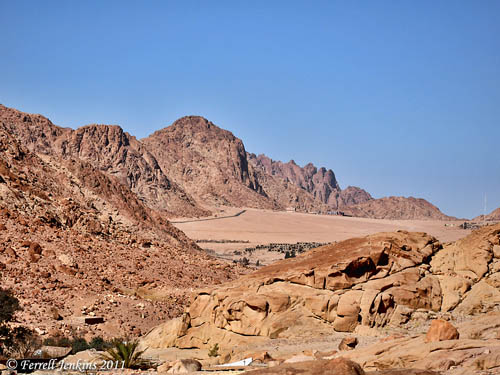
The photo below was made above Saint Catherine’s Monastery with a view toward el-Raha, the Rest.

View of el-Raha, the Rest, at Jebel Musa. Photo by Ferrell Jenkins.

View of el-Raha, the Rest, at Jebel Musa. Photo by Ferrell Jenkins.

4. Some scholars have suggested sites much further north in the Sinai peninsula.

There is no way to know for certain the location of Mount Sinai, but the traditional site fits well with much of the biblical evidence. Rasmussen says the “meeting of Moses and Aaron at the ‘mountain of God’ could well have been this spot (Exod. 4:27)” (Zondervan Atlas of the Bible Revised Edition. 105).

Click on the photo for an image suitable for use in teaching presentations.

“Come up in the morning to Mount Sinai”

After the original tables of stone containing the Ten Commandments written by the finger of God were broken, Moses was told to be ready and “come up in the morning to Mount Sinai.”

Be ready by the morning, and come up in the morning to Mount Sinai, and present yourself there to me on the top of the mountain. (Exodus 34:2 ESV)

The Christian martyr Stephen reminded his audience that Moses received living oracles on Mount Sinai.

He received living oracles to give to us. (Acts 7:38 ESV)

Perhaps this is one of the reasons so many persons put forth the effort to approach the top of a mountain presumed to be Mount Sinai.

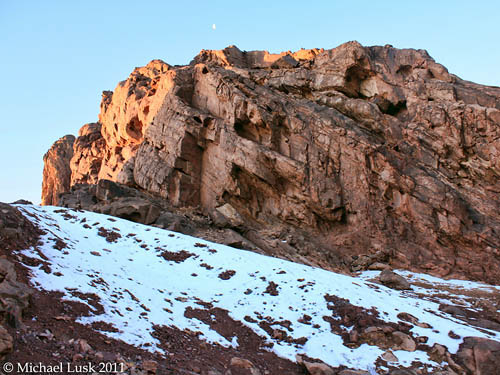
We began telling you about Michael’s trek to the top of the mountain on the morning of January 26, 2011. As he approached the top of the 7,519 feet high Jebel Musa he recorded several instances of snow.

Snow near summit of Jebel Musa, Jan. 26, 2011. Photo by Michael Lusk.

Snow near summit of Jebel Musa, Jan. 26, 2011. Photo by Michael Lusk.

One can never be sure about weather conditions. Reader Beverly Sansom left this comment yesterday:

Yes, we climbed the same mountain in mid-March 2011. Our view of the sunrise was but a sliver due to clouds, but the mountain grandeur was breathtaking. At the top were other Christians singing “How Great Thou Art” in a foreign language. We joined in!

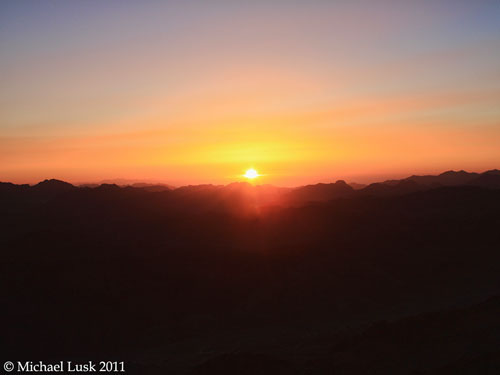
Michael had a good morning from the perspective of a photographer. Here is one of his sunrise photos.

Sunrise from top of Jebel Musa - Traditional Mount Sinai

Sunrise from top of Jebel Musa, January 26, 2011. Photo by Michael Lusk.

Thanks to Michael for sharing these photos with our readers.

Jebel Musa — the traditonal Mount Sinai

If you have followed this blog for several months you may recall that I had a group leaving Egypt the evening before the Egyptian Revolution began on January 25, 2011. Five members of our party had made arrangements to visit the Sinai peninsula, including a visit to Jebel Musa, the traditional Mount Sinai, following the tour.

The group of five left for Sinai on the morning of January 25 with no knowledge of the situation in Cairo. After one night at Saint Catherine and a visit to Saint Catherine’s Monastery three of the tours members (a couple from Indiana and a single man from Florida) returned to Cairo. The couple went directly to the airport and departed that evening. I am not sure that they had any indication of a problem in Cairo. The younger man had made arrangements to visit Abu Simbel and some other places in Egypt that we had not visited during the tour. My wife and I continued through the Sinai to Taba and crossed into to Israel at Eilat.

The single man, Michael Lusk, was the only member of our party to climb to the top of Jebel Musa. Michael was anxious to get up early and make the two and one half hour climb to the top in time for the sunrise. I don’t recall the temperature that morning, but it was cool at the hotel during the night and early morning. When I climbed the mountain in April of 1986 I wore jeans over pajamas, an undershirt covered by a T-shirt, a flannel shirt, and the thick jacket. By the way, Michael made it out of Egypt on the last Delta flight to leave after the Revolution began. He left his hotel early due to the curfew and spent all night in the airport awaiting the flight.

When I asked Michael, a former student, if he would allow me to run a few of his photos here, he was pleased to do so. This first photo shows Jebel Musa (the Mountain of Moses), traditional Mount Sinai. A small building can be seen on top of the mountain just to the right of center. There has been a small chapel on the summit of the mountain since the 4th century A.D. A church was built here by Emperor Justinian (early 6th century A.D.) and a new chapel was built on the ruins in 1934.

It was here, according to the 1500 year old tradition, that Moses met the LORD and received the Ten Commandments.

The LORD came down on Mount Sinai, to the top of the mountain; and the LORD called Moses to the top of the mountain, and Moses went up. (Exodus 19:20 NAU)

This photo would have been made on the return from the top. Note the camel and rider in the bottom right of the photo.

Jebel Musa, traditional Mount Sinai. Photo by Michael Lusk.

Jebel Musa, traditional Mount Sinai. Photo by Michael Lusk.

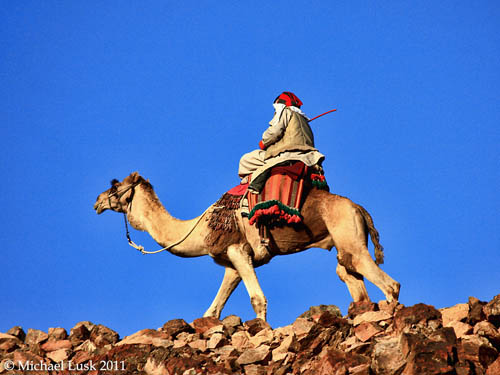
The next photo shows one of the camel drivers (leaders) waiting for someone to hire him to take them back to the monastery. It is possible to hire the camel to take you up the winding slope to where the 3,000 granite steps begin. Notice also his heavy clothing for the cold January nights.

A camel waiting to take a tired walker back to the monastery. Photo by Michael Lusk.

A camel waiting to take a tired walker back to the monastery. Photo by Michael Lusk.

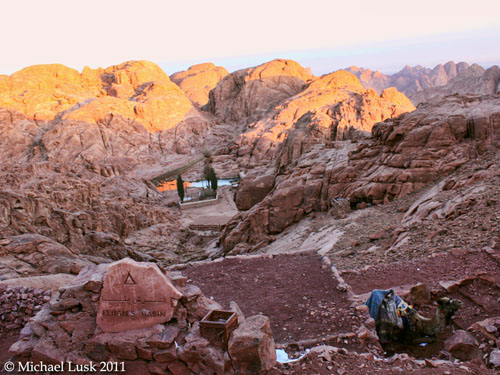
Seven hundred and fifty steps below the summit one comes to a site called Elijah’s Basin. This, according to the tradition, is where the prophet Elijah came when he fled from the wrath of Jezebel after the defeat of the prophets of Baal. Here, the prophet received instructions from the LORD to return and complete his work.

So he arose and ate and drank, and went in the strength of that food forty days and forty nights to Horeb, the mountain of God. (1 Kings 19:8 NAU)

Elijah's Basin on Mount Sinai. Photo by Michael Lusk.

Elijah's Basin on Mount Sinai. Photo by Michael Lusk.

This photo shows the morning light beginning to illuminate portions of the mountain peaks. In the basin you will see some snow. I think the red (orange) glow may be caused by the light striking the area.

In a future post we will share, thanks to Michael, the sunrise from the summit.