Category Archives: Culture

The Nabateans of Petra and their successors

The Nabateans have been described as “one of the most gifted and vigorous peoples in the Near East of Jesus’ time” (Wright, Biblical Archaeology 229). They exacted high tolls from the caravans which passed their way. The greatest king of the Nabateans was Aretas IV (9 B.C. to A.D. 40). His rule extended as far north as Damascus during the last part of his reign; this was at the time Paul escaped from Damascus (2 Corinthians 11:32).

The Nabateans are still remembered for their numerous carvings we see at Petra in Jordan.

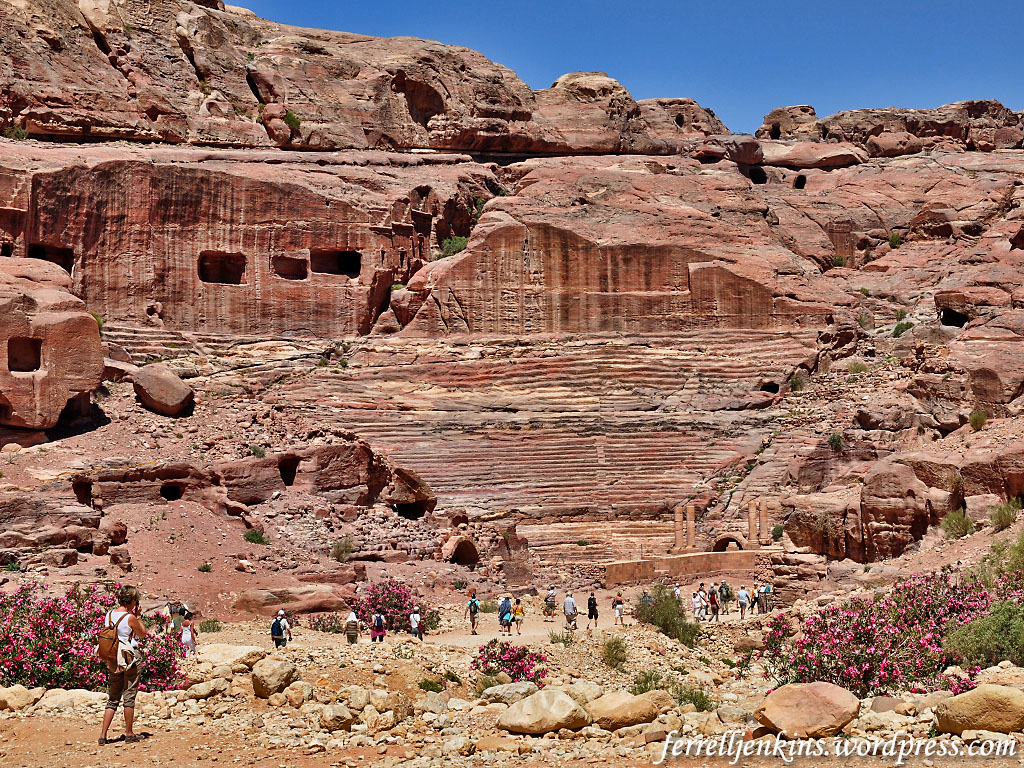
The theater at Petra, dating to the first century A.D., is carved from solid rock. Photo by Ferrell Jenkins.

The Roman theater at Petra, dating to the first or early second century A.D., is carved almost entirely from solid rock. Click on the photo for a larger image. Photo by Ferrell Jenkins.

The Roman emperor Trajan conquered Petra in A.D. 106 and converted it into the province of Arabia. The Romans continued the rock sculpturing of the Nabataeans but added a theater, a street with colonnades, etc. Some have speculated, on the basis of Galatians 1:17, that Paul spent time at Petra after his conversion to Christ.

Archaeologists locate Idumean Palace or Temple in the Lachish region

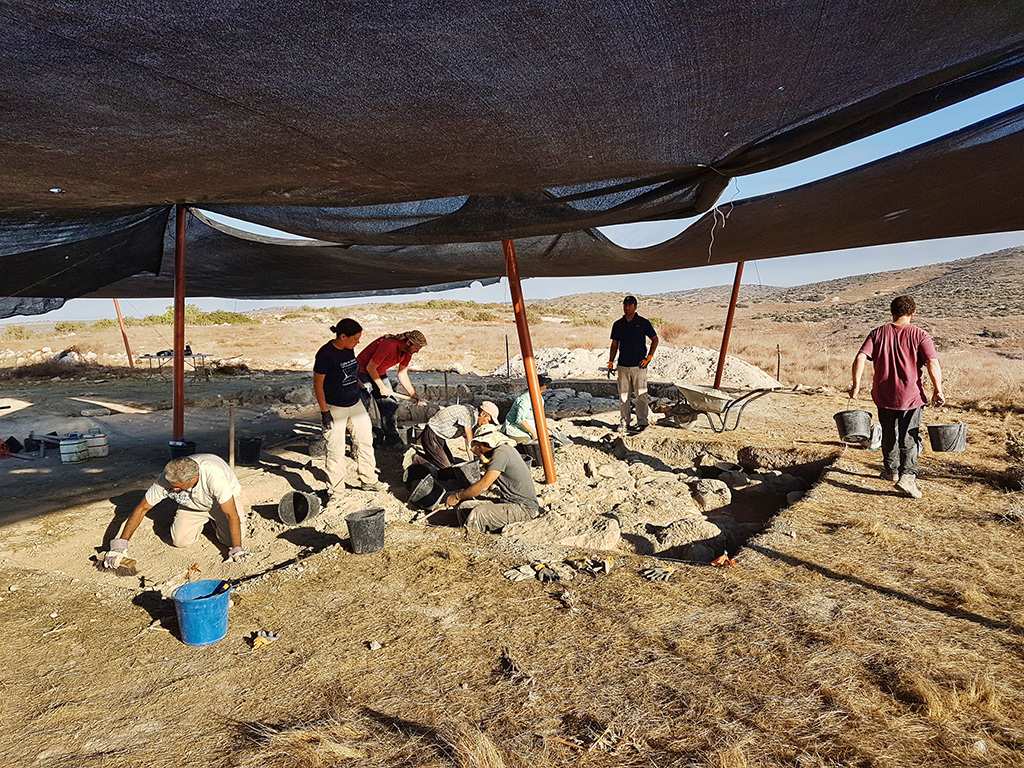
Archaeologists working with the Israel Antiquities Authority and Hebrew University have uncovered an Idumean palace or temple in the Lachish region of the Judean Shephelah. I understand the news release to place this discovery south of the Beit Guvrin/Maresha National Park, and east of Lachish, in a military area. This area was allotted to the tribe of Simeon, but by the second century B.C. it had become part of Idumea, the residence of ancient Edomites who were pushed out of the area of Edom (the location of Petra in Jordan) by the Nabateans.

Herod the Great was an Idumean. Some have suggested Maresha as his hometown. He ruled over the Jews from 47 to 4 B.C., and his dynasty continued throughout most of the first century A.D. Herod was known for his fabulous building program that included the temple, the temple platform and the surrounding wall (John 2:20). He was a cruel ruler who sought to destroy the infant Jesus (Matthew 2:16).

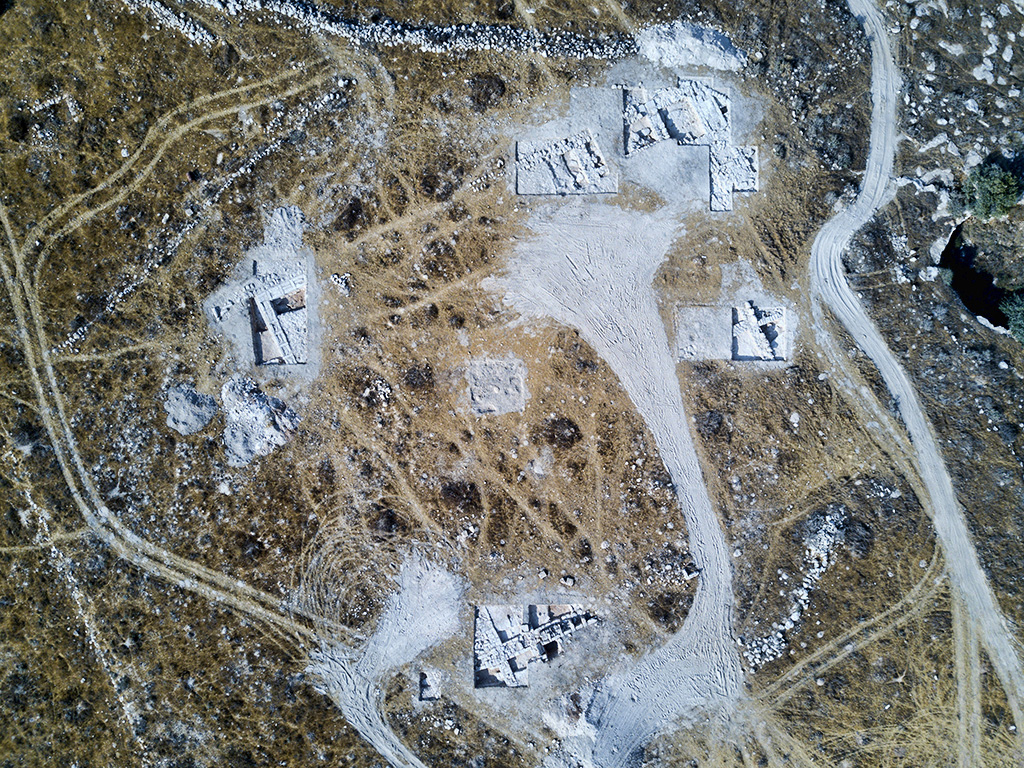
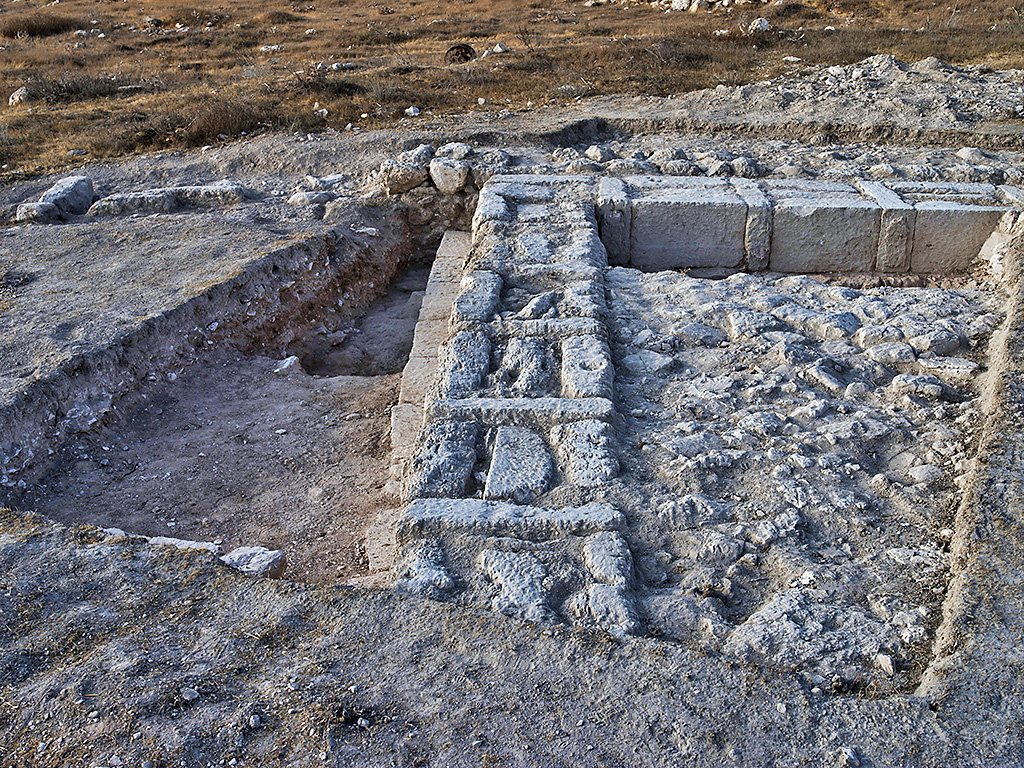
The drone photo below shows portions of the large structure recently discovered.
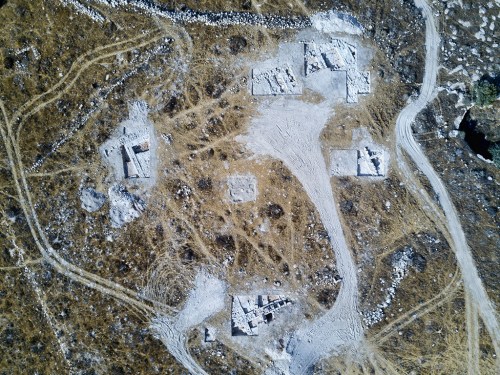
Area of the large structure, possibly a temple or palace, uncovered in the dig – aerial photograph (photo: Dane Christensen)

Area of the large structure, possibly a temple or palace, uncovered in the dig – aerial photograph (photo: Dane Christensen)

The scholars working on the project say this is a 2200-year-old structure that was “apparently dismantled intentionally, perhaps during the Hasmonean conquests of the region.”

The release continues,

— “ —

An impressive 2200-year-old (Hellenistic period) structure, possibly an Idumean palace or temple, was uncovered during Sukkot in archaeological excavations at the site of Horvat ‘Amuda, situated at the heart of a military training area in the Lachish region.
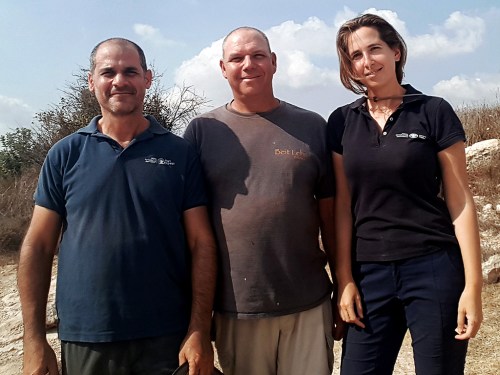
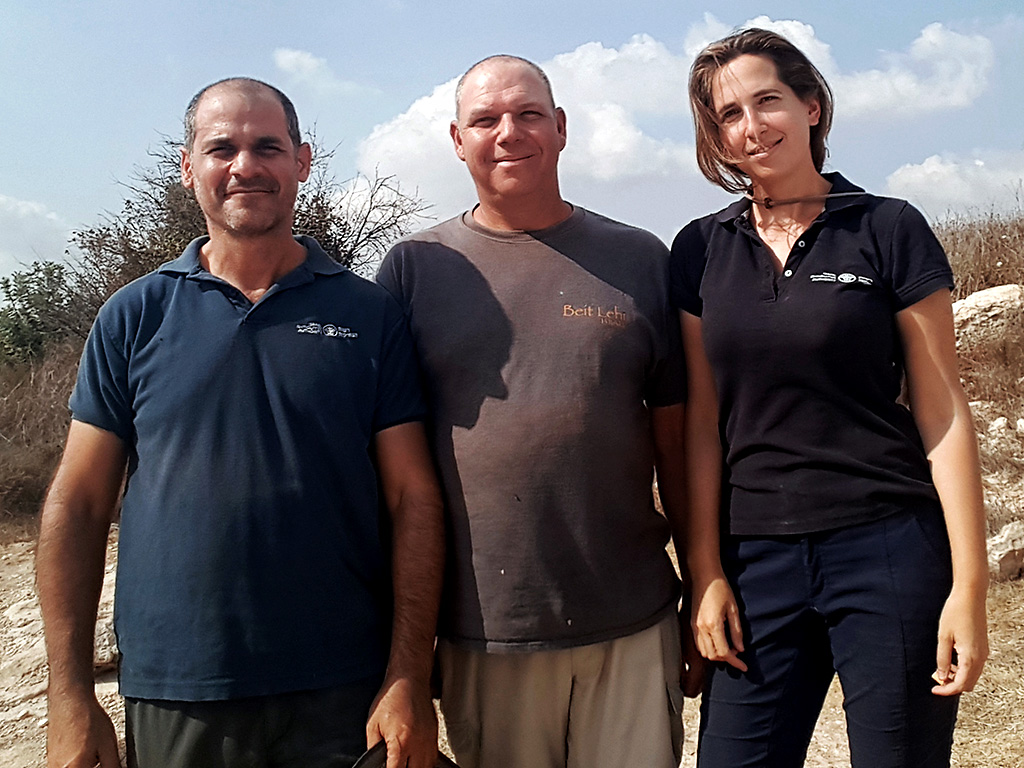
The excavation directors (from right to left): Dr. Oren Gutfeld, Michal Haber, and Pablo Betzer (photo: Israel Antiquities Authority)

The excavation directors (from right to left): Dr. Oren Gutfeld, Michal Haber, and Pablo Betzer (photo: Israel Antiquities Authority)

According to the excavation directors, Dr. Oren Gutfeld of the Hebrew University, and Pablo Betzer and Michal Haber of the Israel Antiquities Authority: “If this was indeed an Idumean palace or temple, it is a rare and exciting find – similar structures in this country can be counted on the fingers of one hand. It seems that the building was intentionally dismantled, possibly during the Hasmonean conquest of the region.”
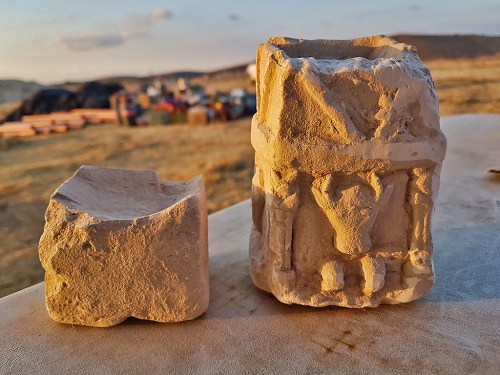
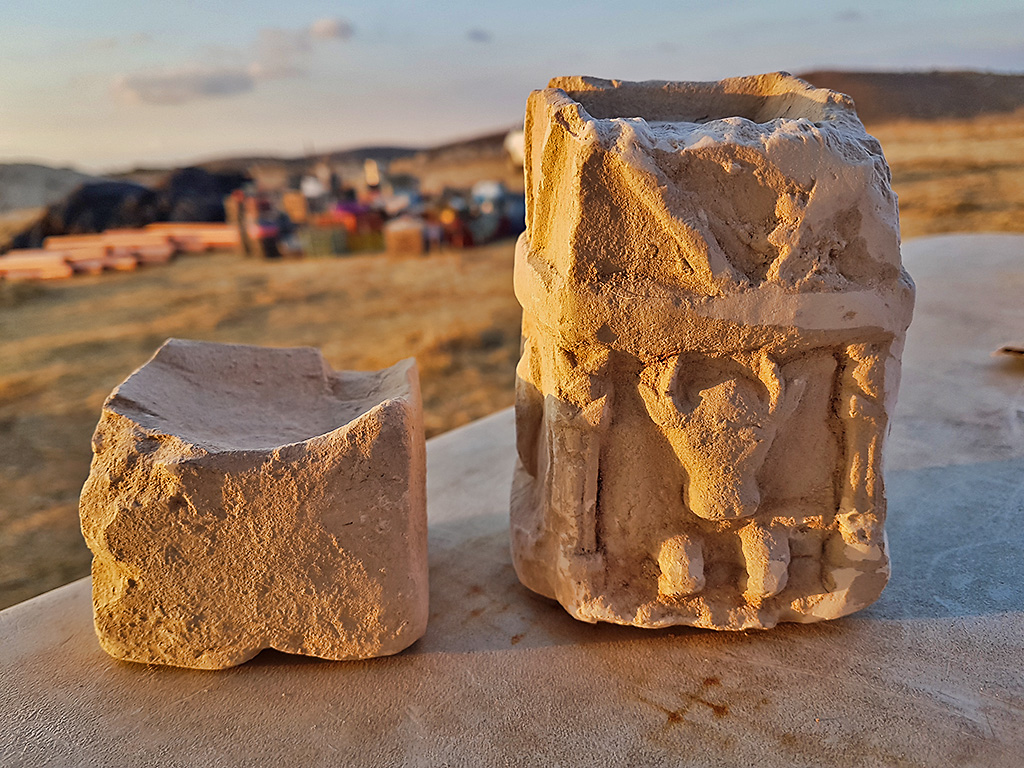
Two cultic incense altars found in one of the rooms of the structure (photo: Michal Haber, Israel Antiquities Authority)

Two cultic incense altars found in one of the rooms of the structure (photo: Michal Haber, Israel Antiquities Authority). These altars are small enough to be held in one’s hand.

Two stone incense altars were discovered in one of the rooms. One of them, bearing the carved image of a bull, is depicted as standing in what is apparently the façade of a temple adorned with magnificent columns. According to the archaeologists, the altar is “a unique and rare find in terms of its decoration.” The bull, they say, “may have symbolized a deity worshipped by the Idumeans.” In addition to the incense altar, delicate pottery vessels were also uncovered, including painted bowls, juglets and oil lamps.

Also found at the site are numerous underground spaces, used as quarries or to house ritual baths (miqvaot), oil presses and dovecotes. Hiding tunnels from the time of the Jewish revolts against the Romans were also discovered; one of these contained an intact cooking pot from the time of the Bar Kokhba Revolt (132–135 CE).
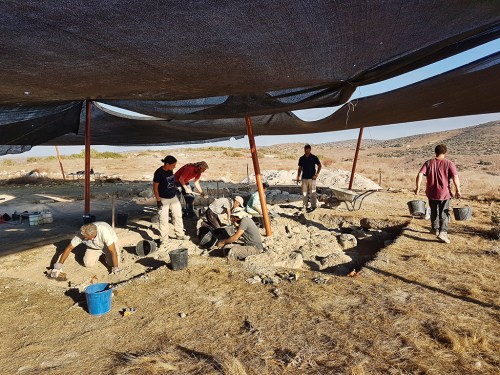
Uncovering the structure (photo: Michal Haber, Israel Antiquities Authority)

Uncovering the structure (photo: Michal Haber, Israel Antiquities Authority)

The new discovery came to light with the help of camera-equipped drones – technology that has become part of the archaeologists’ tool box in recent years. As part of an extensive archaeological research project of the area between Bet Guvrin and Maresha in the north and Moshav Amatzia in the south, the drone cameras photographed the archaeological remains from high above, subsequently revealing hints of the structure now under excavation. Calling the discovery a research breakthrough, the archaeologists say: “This technology helped us choose where to focus our excavation probes, and, indeed, it very quickly emerged that this was in fact a unique discovery. We hope that our continued excavation of the site in the spring will uncover more of the story told here.”
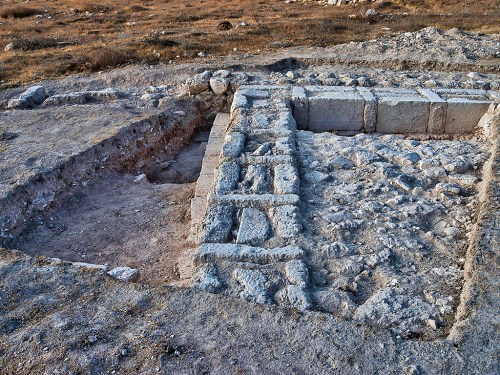
Remains of the structure indicate that it was intentionally dismantled, possibly by the Hasmoneans (photo: Dane Christensen)

Remains of the structure indicate that it was intentionally dismantled, possibly by the Hasmoneans (photo: Dane Christensen)

The excavation at Horvat ‘Amuda, which was funded by the Beit Lehi Foundation and the Israel Antiquities Authority, was carried out with the participation of archaeology students from the Hebrew University, Bar-Ilan University, as well as a group of volunteers from the United States.

During the Hellenistic period Horvat ‘Amuda was apparently one of the agricultural satellite settlements of Maresha, which had by now become the Idumean district capital (today it is part of Bet Guvrin-Maresha National Park). Prior to that, in the fifth century BCE (the Persian period), the Idumeans – a Semitic people originating in southern Jordan – settled in the Judean Shephelah (foothills). After the area was conquered by the Hasmoneans in 112 BCE, the Idumeans converted and subsequently blended into the Judean population.

— ” —

HT: Joseph Lauer

A Psalm for thanksgiving

1 Make a joyful noise to the LORD, all the earth!
2 Serve the LORD with gladness! Come into his presence with singing! 3 Know that the LORD, he is God! It is he who made us, and we are his; we are his people, and the sheep of his pasture. 4 Enter his gates with thanksgiving, and his courts with praise! Give thanks to him; bless his name! 5 For the LORD is good; his steadfast love endures forever, and his faithfulness to all generations. (Psalm 100 ESV)

The psalmist reminds his readers why they should praise the LORD. It is because He is God, the one who made them, and the one to whom they belong.

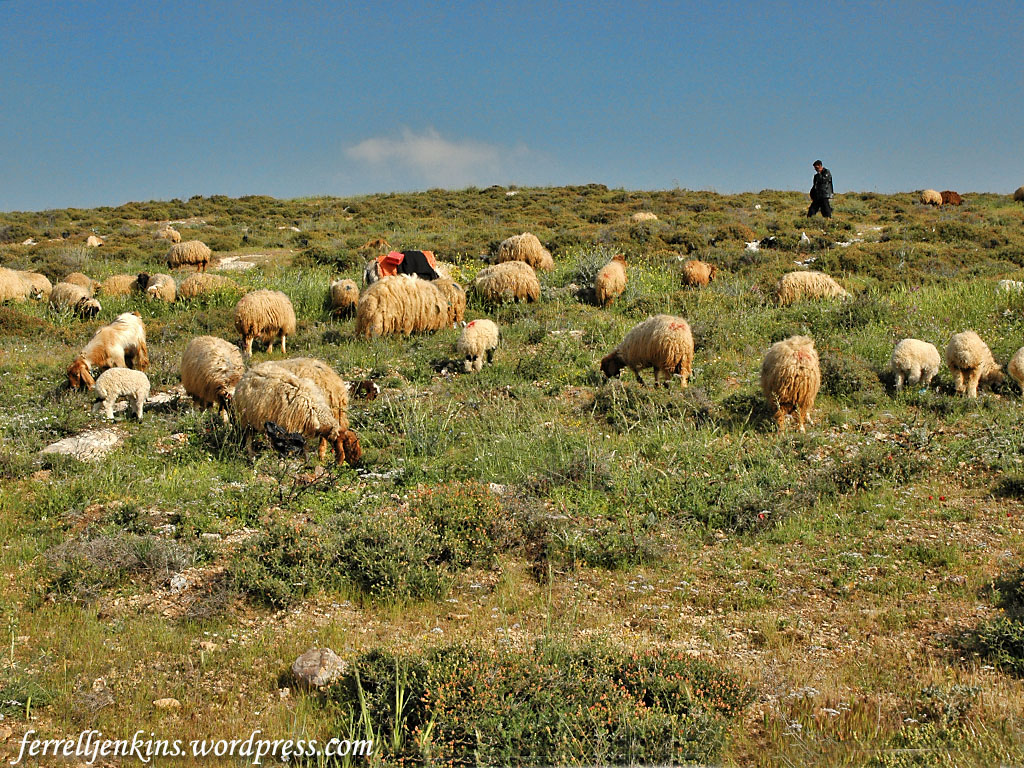
“We are his people, and the sheep of his pasture.” Perhaps a few photos will help us visualize this Psalm.

A shepherd with his sheep near Heshbon in Jordan. Photo by Ferrell Jenkins.

A shepherd with his sheep near Heshbon in Jordan. Photo by Ferrell Jenkins.

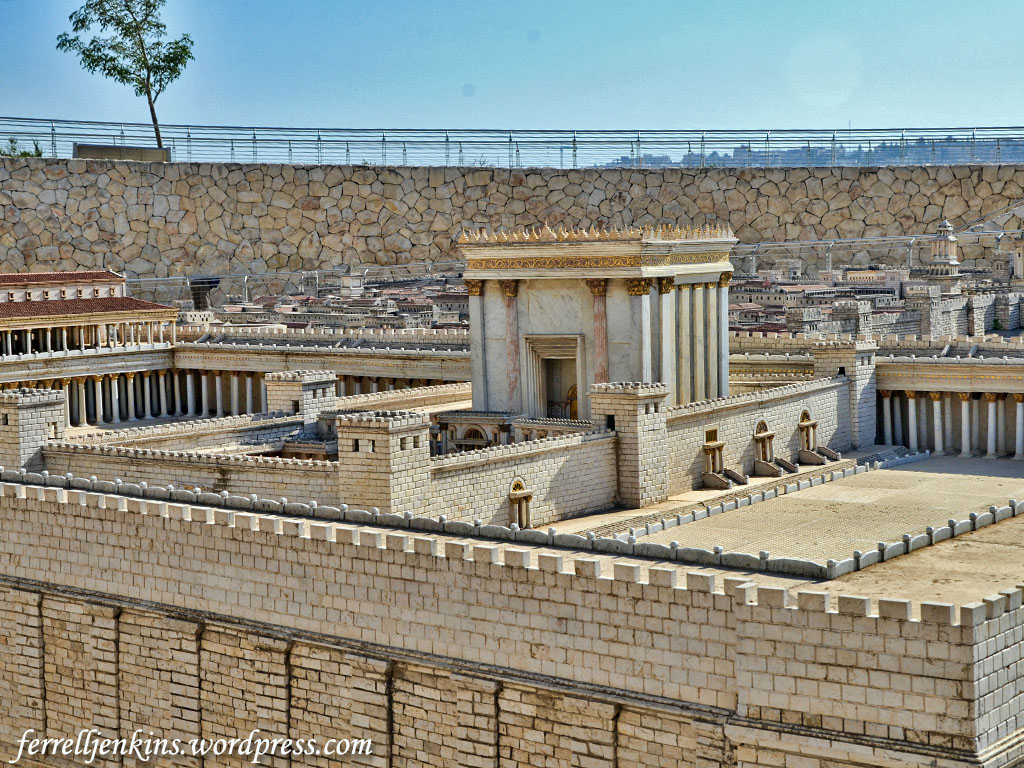
The ancient Israelites were urged to “enter his gates with thanksgiving. Give thanks to him; bless his name!”

This photo of the second temple model at the Israel Museum shows the south side of the temple precinct. We see gates that led to the temple. Photo by Ferrell Jenkins.

This photo of the second temple model at the Israel Museum in Jerusalem shows the south side of the temple mount.. We see steps and gates that led to the temple. Photo by Ferrell Jenkins.

Enter “his courts with praise!”

In this photo of the temple model we see various courts that were part of the temple precinct. Photo by Ferrell Jenkins.

In this photo of the temple model we see various courts that were part of the temple precinct. Photo by Ferrell Jenkins.

“For the LORD is good; his steadfast love endures forever, and his faithfulness to all generations.”

Shofar announces the Jewish new year

Our Jewish friends are currently celebrating Rosh Hashanah, the Jewish new year. The ram’s horn is blown leading up to the celebration.

The ram’s horn was important in the history of Israel. One of the words often used for the horn is shofar (or shophar).

  • A long blast on the ram’s horn was used to alert the Israelites when they could approach Mount Sinai (Exodus 19:13).
  • The ram’s horn was sounded at the beginning of important feast days (Leviticus 25:9). On the first day of the seventh month of the Jewish calendar trumpets were to be blown (Numbers 29:1). This festival was known as the Feast of Trumpets.
  • After Israel marched around Jericho they would hear a long blast on the ram’s horn (Joshua 6:5). The word horn in this verse is qeren, but the word shofar is translated trumpet.

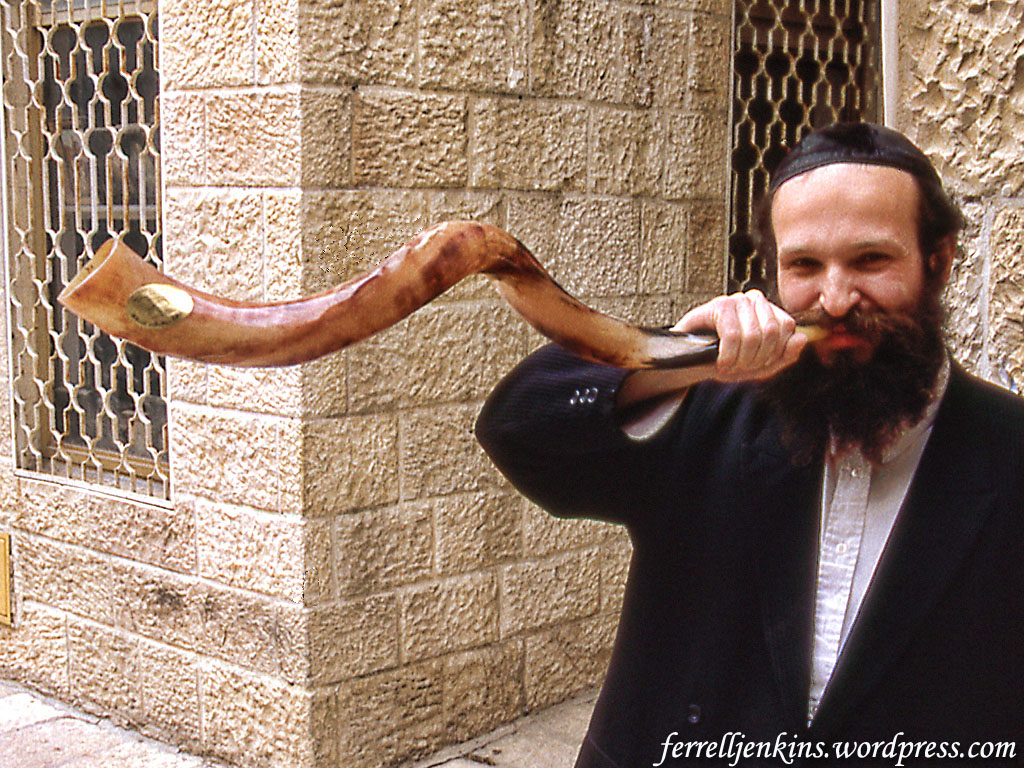
Sometimes in the Jewish Quarter of Jerusalem one of the shopkeepers will demonstrate the sounding of the shofar in hopes of attracting customers. That beautiful horn was a little above my budget. I do not know the animal from which it came. It may be a Yemenite shofar made from the horn of an African kudu.

Shofar sounded by a shopkeeper in the Jewish Quarter, Jerusalem. Photo by Ferrell Jenkins 1993.

Shofar being sounded by a shopkeeper in the Jewish Quarter, Jerusalem. Photo by Ferrell Jenkins 1993.

Silver trumpets were also to be blown on certain occasions (Numbers 10:1).

I have observed that shepherds are proud of the ram of the flock. This photo was made in northern Jordan not very far from Ramoth in Gilead and the border with Syria.

Ram with large horns. Photo made in northern Jordan near ancient Ramoth Gilead, near the Syrian border. Photo by Ferrell Jenkins.

Ram with large horns. Photo made in northern Jordan near ancient Ramoth Gilead, near the Syrian border. Photo by Ferrell Jenkins.

Christians of the Apostolic period, even Gentiles, studied the Old Testament (Hebrew Bible) as a book like 1 Corinthians illustrates. Paul tells the Corinthians that the sound of a trumpet will signal the coming of the Lord and the resurrection.

For the Lord himself will descend from heaven with a cry of command, with the voice of an archangel, and with the sound of the trumpet of God. And the dead in Christ will rise first.  Then we who are alive, who are left, will be caught up together with them in the clouds to meet the Lord in the air, and so we will always be with the Lord.  Therefore encourage one another with these words. (1 Thessalonians 4:16-18 ESV)

Behold! I tell you a mystery. We shall not all sleep, but we shall all be changed, in a moment, in the twinkling of an eye, at the last trumpet. For the trumpet will sound, and the dead will be raised imperishable, and we shall be changed. (1 Corinthians 15:51-52 ESV)

An excellent Logos Pre-pub ready soon

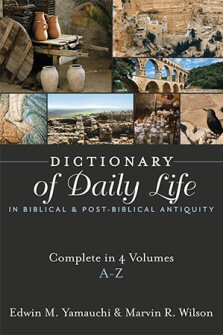
A nice feature of Logos Bible Software is the occasional pre-publication offer. Last April I choose to place an order for Dictionary of Daily Life in Biblical and Post-Biblical Antiquity. I already had the first two volumes in the print edition and was considering buying the final two volumes.

Then came the offer from Logos to purchase all four volumes in the digital format. This means that I would be able to search all four volumes with one click on my computer. I ordered for $50.99. Today I received an Email telling me that the material would be ready to deliver on October 3, 2017.

When I looked this afternoon I saw that the 4-volume set was still available for the pre-pub price. Go to Logos and search for the book by title. On the home page you will see that you may download a free Basics set including 17 books. Sure, its a way to get you hooked, but a lot of us have been hooked for years and find Logos Bible Software to be a wonderful tool in our study and work. Many of the books in my collection have been bought on pre-pub. I can’t say how long this offer will remain before the price goes up to the regular digital price. So far as I know Logos is only for the PC. Now who’s bragging?

There is just one bad thing about my telling you about this material.  You may stop reading my blog and start reading it. But wait, I still have better photos.

Dictionary of Daily Life in Biblical and Post-Biblical Antiquity, 4 volume set.

Dictionary of Daily Life in Biblical and Post-Biblical Antiquity, 4 volume digital set in Logos format.

For those who would like to read more about this publication, here is information provided by Logos.

— “ —

Dictionary of Daily Life in Biblical and Post-Biblical Antiquity (4 vols.) by Edwin Yamauchi and Marvin R. Wilson

The Dictionary of Daily Life in Biblical and Post-Biblical Antiquity is a unique reference work that provides background cultural and technical information on the world of the Hebrew Bible and New Testament from 2000 BC to approximately AD 600.

Written and edited by a world-class historian and a highly respected biblical scholar, with contributions by many others, this unique reference work explains details of domestic life, technology, culture, laws, and religious practices, with extensive bibliographic material for further exploration. Articles range from 5-20 pages long. Scholars, pastors, and students (and their teachers) will find this to be a useful resource for biblical study, exegesis, and sermon preparation.

In the Logos edition, this volume is enhanced by amazing functionality. Important terms link to dictionaries, encyclopedias, and a wealth of other resources in your digital library. Perform powerful searches to find exactly what you’re looking for. Take the discussion with you using tablet and mobile apps. With Logos Bible Software, the most efficient and comprehensive research tools are in one place, so you get the most out of your study.

— ” —

This has been a Bible student service announcement.

The solar eclipse of June 15, 763 B.C.

I watched the solar eclipse on TV. Now you might enjoy going to the link I mention below.

Carl Rasmussen has posted an interesting article on his HolyLandPhotos’Blog here about “A Solar Eclipse and Old Testament Chronology.” He says,

But did you know that the solar eclipse of June 15, 763 B.C. holds the key to the chronology of the Old Testament (Hebrew Bible)?

He continues to explain how we are able to know the date for certain Old Testament kings and events. We are all dependent on the work of scholars such as the late Edwin R. Thiele (1895-1986) and his The Mysterious Numbers of the Hebrew Kings.

How are we to convert the relative dates given in the Bible (e.g., “in the fourth year of…”) to absolute dates (e.g., 966 B.C.)?

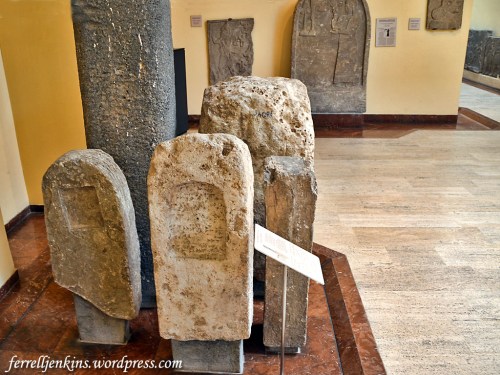
The Assyrians kept records of their kings and various officials on these stone documents called limmus, but in one of them they recorded the eclipse of the sun that occurred June 15, 763 B.C. according to astronomical computation.

Limmu stelae from Asshur. Museum of the Ancient Orient, Istanbul, Turkey. Photo by Ferrell Jenkins.

Limmu stelae from Asshur. Museum of the Ancient Orient, Istanbul, Turkey. Photo by Ferrell Jenkins.

I confess to having made the above photo of the limmu stelae from Asshur, displayed in the Museum of the Ancient Orient in Istanbul, Turkey, but failing to photograph the identifying sign.

Carl’s post and photo was enlightening to me. He explains about the limmu stelae and how Thiele used this material to develop a widely accepted Biblical Chronology. I urge you to read his article, and perhaps Thiele’s book. The book is available from Amazon and other sources.

Now Available: Photo Companion to the Bible

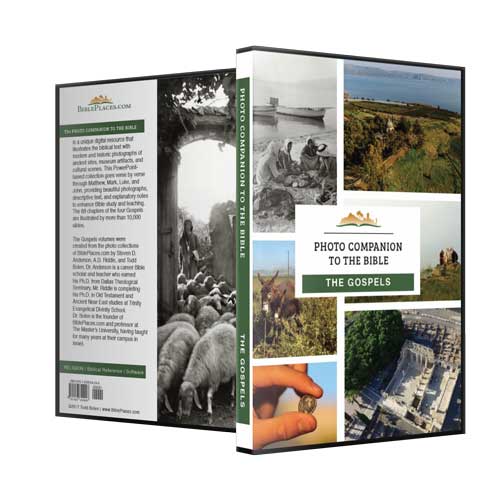
If you received the Bible Places Newsletter today you already know about the Photo Companion to the Bible: The Gospels. For those who may not be subscribed to the Newsletter I wish to direct you to information about this new, highly significant resource.

This PowerPoint-based resource provides illustrations for almost every verse of the text. The advertisement describes the Photo Companion to the Bible this way:

More than 10,000 images illustrating Matthew, Mark, Luke, and John with modern and historic photographs of ancient sites, museum artifacts, and cultural scenes.

Cover of the Photo Companion to the Bible: The Gospels.

Cover of the Photo Companion to the Bible: The Gospels.

You may already own the Pictorial Library of Bible Lands and the Historic Views of the Holy Land. This new resource has photos, including many new ones, organized by chapter and verse for each of the four gospels. In fact, each chapter is illustrated by 40 to 230 photographs. The entire set contains more than 10,000 images.

When I looked through Matthew 4 I was impressed with the large number of illustrations. This means the teacher or preacher will be able to use these PowerPoint images to enhance his or her presentation. The audience will see and understand things about the text that they have never quite understood before.

There is a brief YouTube video illustrating what the Photo Companion to the Bible is and how it works. There are two chapters available for free download.

BiblePlaces.com is offering a deep discount price from now through August 21. I urge you to take advantage of it.

This new resource has been created by a team of professors and scholars under the direction of Dr. Todd Bolen who lived and taught in Israel for a decade or more and has traveled extensively in the Bible Lands. He is now a professor at Master’s University in California.

I have heard very few sermons or classes that could not have been greatly improved by the proper use of these illustrations of Bible lands and customs.

During my years of teaching and preaching I often paid for my own resources, but the positive response from the audience made it worthwhile. I hope to learn that many of you will be ordering this set.

All the information you need to place an order may be found here.

To subscribe to the BiblePlaces Newsletter see here.

To see a copy of the August 14, 2017 BiblePlaces Newsletter click here.

More evidence of Babylonian destruction of Jerusalem

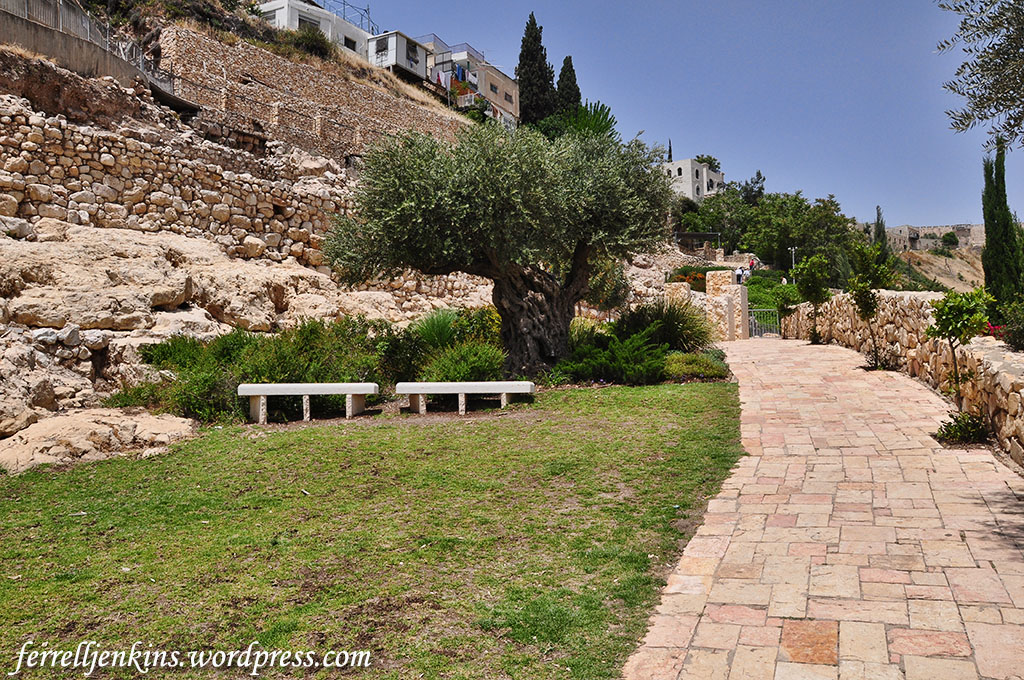
The Israel Antiquities Authority announced an important discovery in the Jerusalem Walls National Park today. Our photo below shows a portion of this park on the east slope of the city of David, overlooking the Kidron Valley. The view is north toward the southeastern corner of the Temple Mount.

Jerusalem Wall National Park on the east slope of the City of David. View North. Photo by Ferrell Jenkins.

Jerusalem Wall National Park on the east slope of the City of David. View North. Photo by Ferrell Jenkins.

I do not know the exact location of the new discovery, but this photo may give you some idea of the area.

Here is the IAA News Release.

— “ —

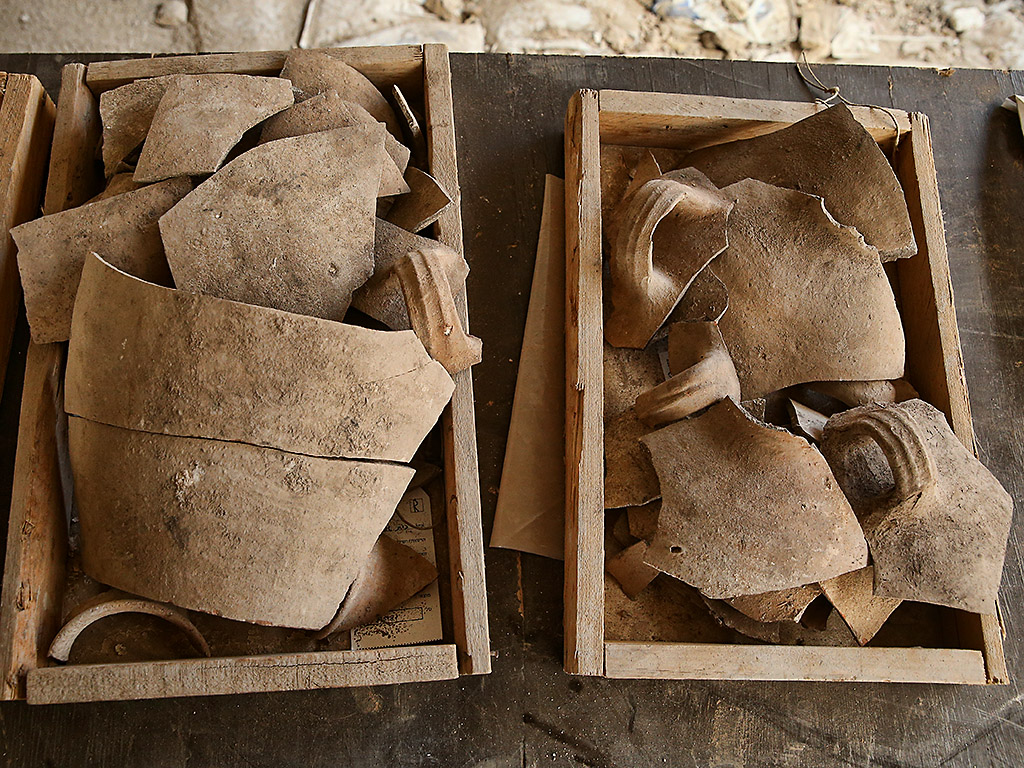
Evidence of the destruction of Jerusalem at the hands of the Babylonians has recently been unearthed in the City of David in excavations conducted by the Israel Antiquities Authority at the Jerusalem Walls National Park, funded by the City of David Foundation (Elad). In the excavations – concentrated on the eastern slope of the City of David, structures dating to more than 2,600 years ago have been unearthed after having been covered over by collapsed layers of stone. Nestled within the collapse, many findings have surfaced: charred wood, grape seeds, pottery, fish scales and bones, and unique, rare artifacts. These findings depict the affluence and character of Jerusalem, capital of the Judean Kingdom, and are mesmerizing proof of the city’s demise at the hands of the Babylonians.

Shattered jugs, attesting to the destruction. Photo: Eliyahu Yani, courtesy of the City of David Archive.

Shattered jugs, attesting to the destruction. Photo: Eliyahu Yani, courtesy of the City of David Archive.

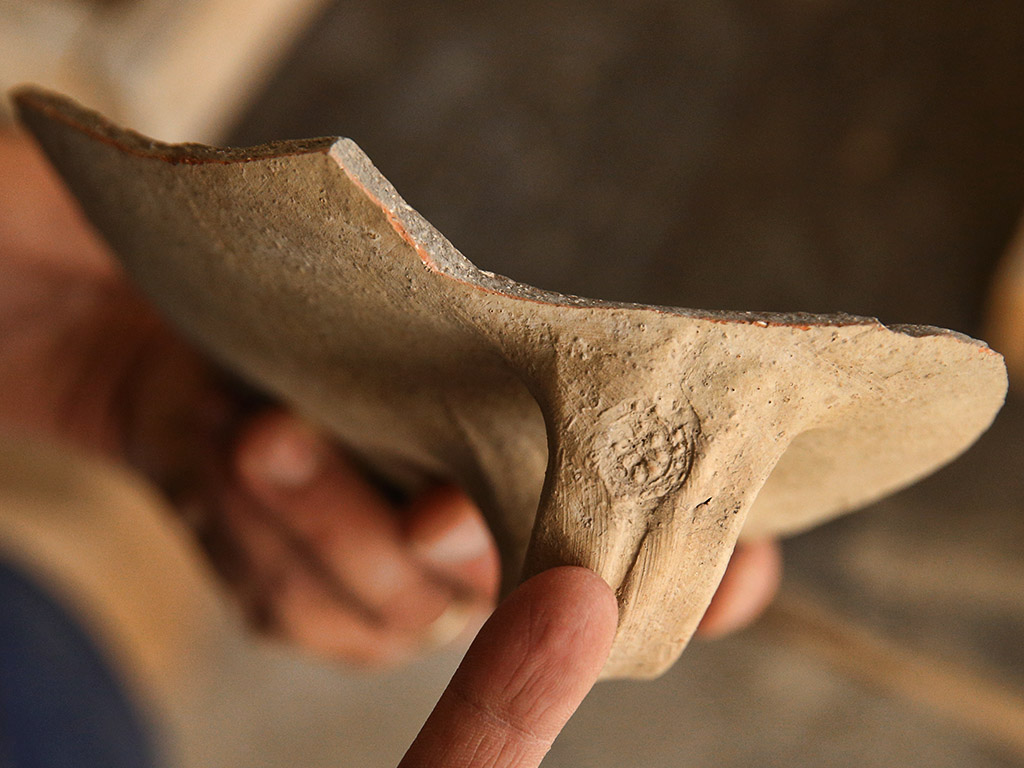
Among the excavation’s salient findings were dozens of storage jars which served to store both grain and liquids, several of which had stamped handles. Several of the seals discovered depict a rosette – a petalled rose. According to Ortal Chalaf and Dr. Joe Uziel, Israel Antiquities Authority excavation directors: “These seals are characteristic of the end of the First Temple Period and were used for the administrative system that developed towards the end of the Judean dynasty. Classifying objects facilitated controlling, overseeing, collecting, marketing and storing crop yields. The rosette, in essence, replaced the ‘For the King’ seal used in the earlier administrative system.”

Jug handles with the rosette seal used by the administrative system at the end of the Judean Kingdom. Picture: Eliyahu Yanai, Courtesy of the City of David Archive

Jug handles with the rosette seal used by the administrative system at the end of the Judean Kingdom. Picture: Eliyahu Yanai, Courtesy of the City of David Archive.

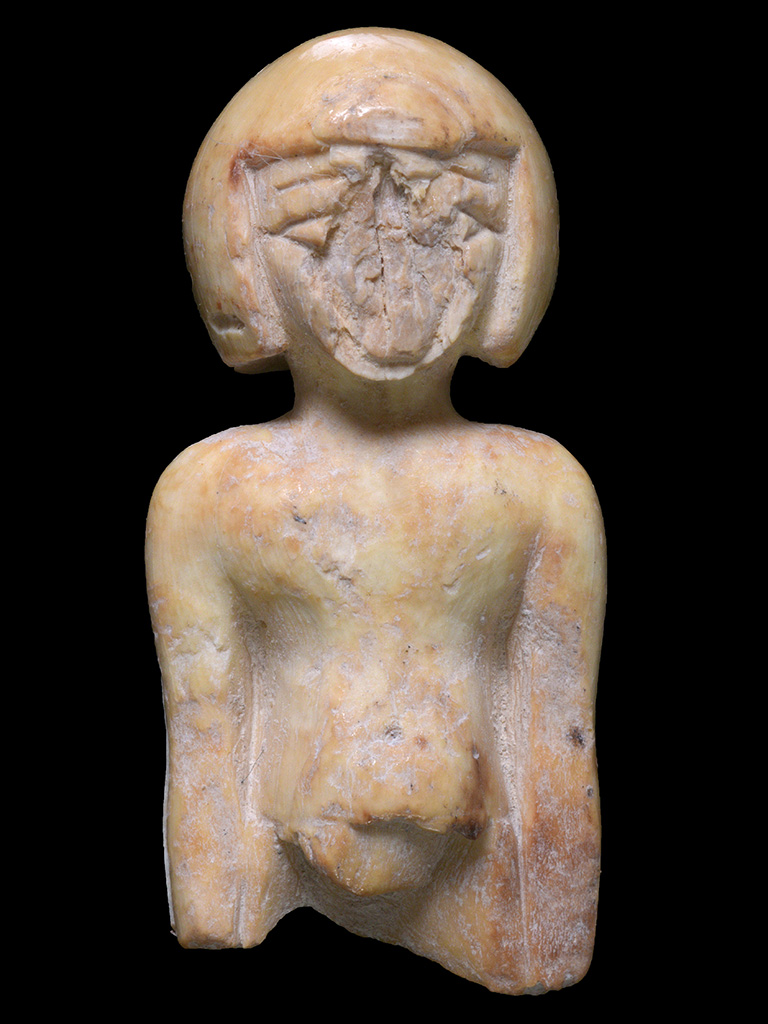
The wealth of the Judean kingdom’s capital is also manifest in the ornamental artifacts surfacing in situ. One distinct and rare finding is a small ivory statue of a woman. The figure is naked, and her haircut or wig is Egyptian in style. The quality of its carving is high, and it attests to the high caliber of the artifacts’ artistic level and the skill par excellence of the artists during this era.

Ivory statue in the image of a woman. Picture: Clara Amit, Israel Antiquities Authority

Ivory statue in the image of a woman. Picture: Clara Amit, Israel Antiquities Authority.

According to Ortal Chalaf and Dr. Joe Uziel, Israel Antiquities Authority excavation directors, “The excavation’s findings show that Jerusalem had extended beyond the line of  the city wall before its destruction. The row of structures exposed in the excavations is located outside beyond the city wall that would have constituted the eastern border of the city during this period. Throughout the Iron Age, Jerusalem underwent constant growth, expressed both in the construction of numerous city walls and the fact that the city later spread beyond them. Excavations carried out in the past in the area of the Jewish Quarter have shown how the growth of the population at the end of the 8th Century BCE led the annexation of the western area of Jerusalem. In the current excavation, we may suggest that following the westward expansion of the city, structures were built outside of the wall’s border on the east as well.”

— ” —

HT: Joseph I. Lauer

The shepherd and the sheepfold

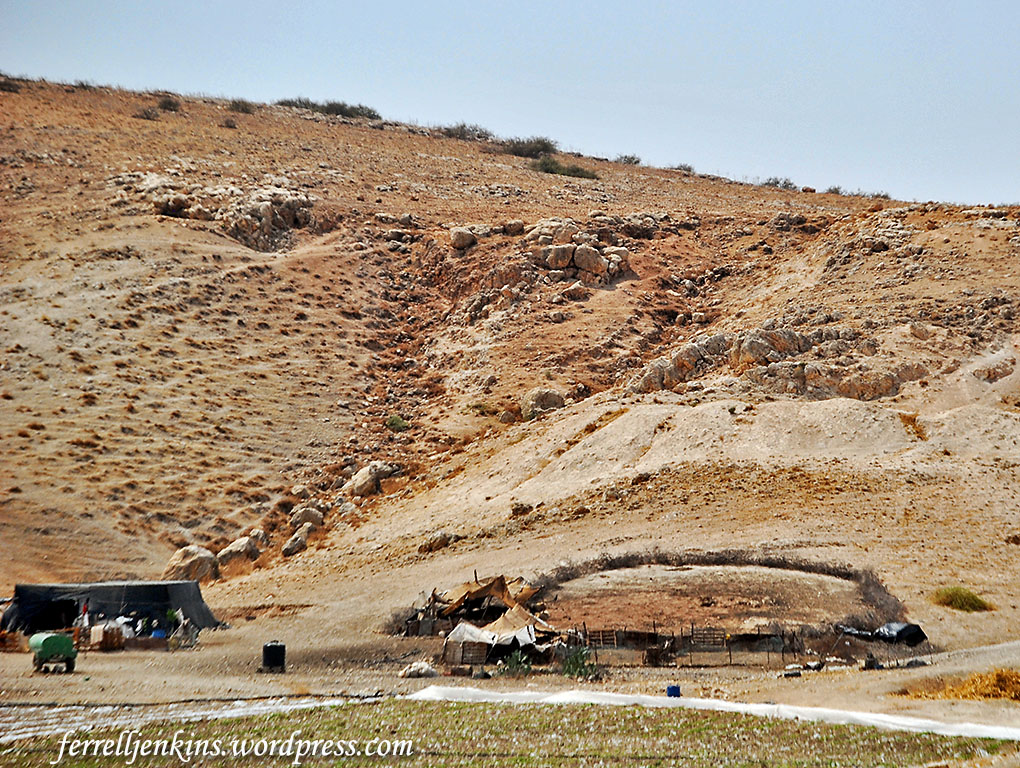
We still see scenes in the Bible world today of shepherds, sheep, and sheepfolds. The scene pictured below was made in the Jordan Valley in late August, a time that is extremely dry in the area.

Bedouin camp and sheepfold in the Jordan Valley in late August. Photo by Ferrell Jenkins.

Bedouin tent and sheepfold in the Jordan Valley. Photo by Ferrell Jenkins.

Scenes such as these remind us of the Biblical patriarchs who moved about from place to place with their flocks. Abraham and Lot provide an example.

And Lot, who went with Abram, also had flocks and herds and tents, (Genesis 13:5 ESV)

There are several biblical references to the sheepfold, or the fold of the sheep (Jeremiah 50:6; Micah 2:12; John 10:1, 16). Jesus used an illustration involving the sheepfold:

Truly, truly, I say to you, he who does not enter the sheepfold by the door but climbs in by another way, that man is a thief and a robber. But he who enters by the door is the shepherd of the sheep. (John 10:1-2 ESV)

Camel caravans carry merchandise and people

Traveling in the Sinai Peninsula is an interesting experience. I recall flying into the Sinai twice, and traveling through the Peninsula by bus or car twice. Thoughts immediately turn to the Israelites traversing this wilderness, stopping at Mount Sinai to receive “the Law of Moses, which the LORD God of Israel” gave to them (Ezra 7:6).

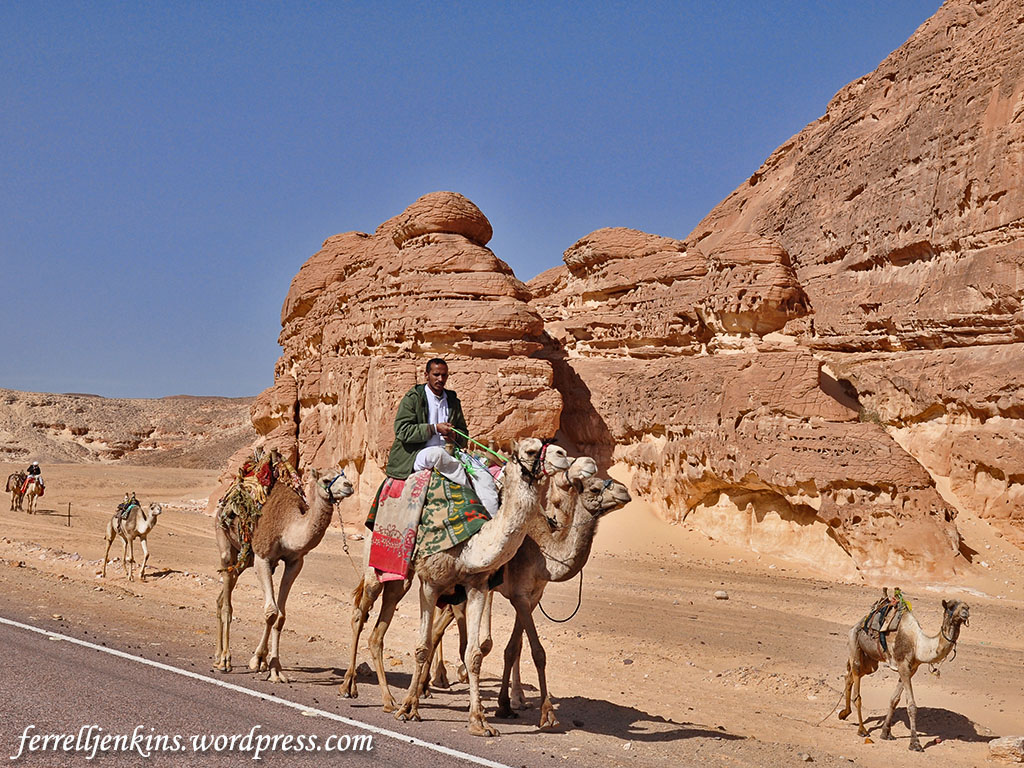
The caravan traveling here in the eastern Sinai is not carrying merchandise, but is on its way to the resort area of the Gulf of Eilat (or Aqaba). The camels seem to be ready with their saddles to entice the tourists to ride. The little camels are ready for the kids.

Camel caravan in the Eastern Sinai Peninsula. Photo by Ferrell Jenkins.

Camel caravan in the Eastern Sinai Peninsula. Photo by Ferrell Jenkins.

Several Biblical stories come to mind. Think of Rachel coming from Padan-Aram to southern Canaan to wed Isaac.

And Rebekah lifted up her eyes, and when she saw Isaac, she dismounted from the camel (Genesis 24:64 ESV)

Or of the sons of Jacob preparing to sell Joseph to a band of Ismaelites.

Then they sat down to eat. And looking up they saw a caravan of Ishmaelites coming from Gilead, with their camels bearing gum, balm, and myrrh, on their way to carry it down to Egypt. (Genesis 37:25 ESV)

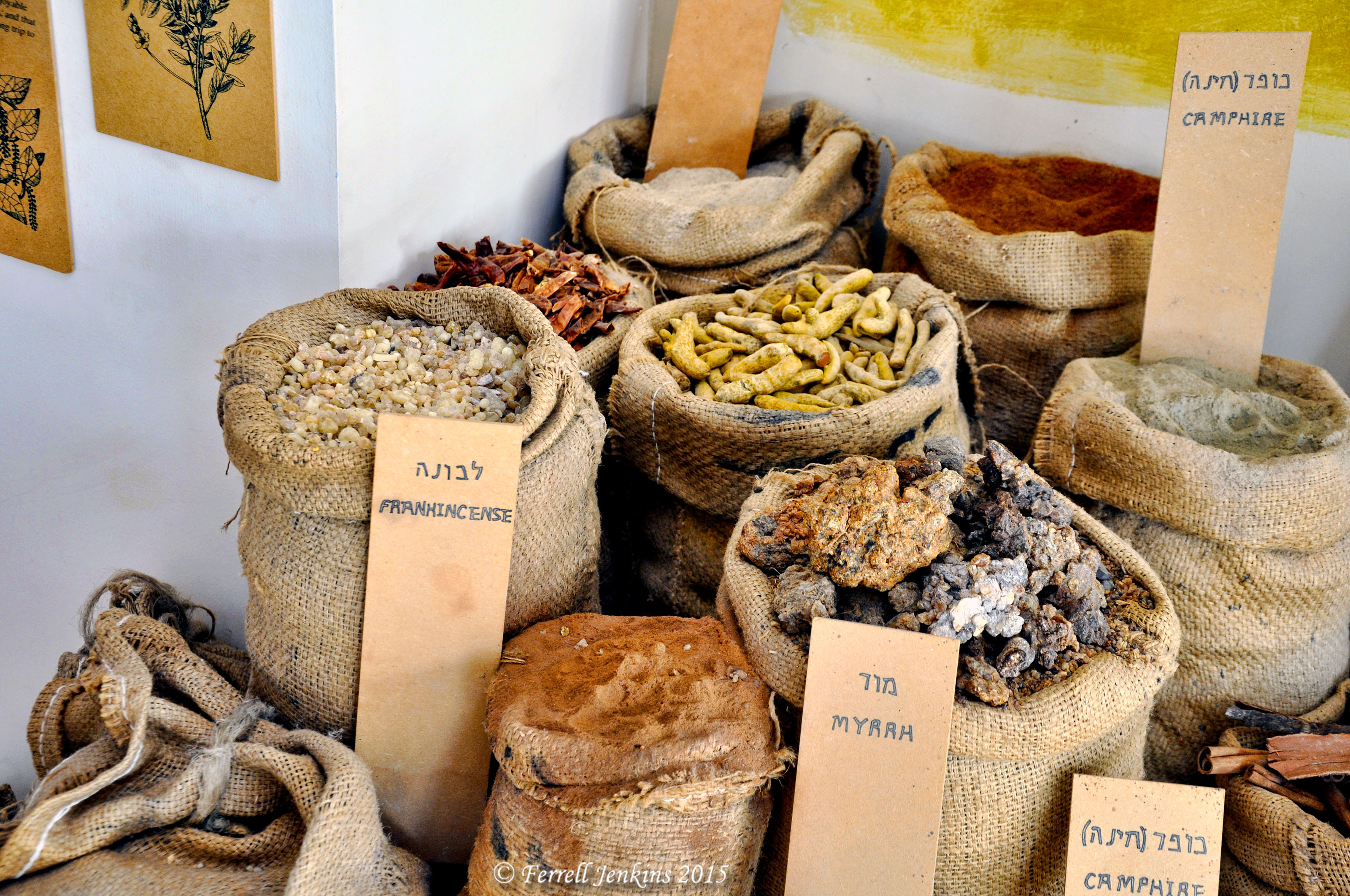
At Avedat in the Negev Highlands of Israel there is a display of the types of goods often transported across the Spice Route by the Nabateans.

Frankincense, Myrrh, and other spices were transported by camel caravans across the famous Spice Route. Photo by Ferrell Jenkins.

Frankincense, Myrrh, Pepper, and other spices were transported by camel caravans across the famous Spice Route. Photo by Ferrell Jenkins.