Category Archives: Culture

Gold earring from Roman-Byzantine period

We noted earlier here about the discovery in Jerusalem of what is thought to be a palace belonging to the first century Queen of Adiabene. Archaeologists working for the Israel Antiquities Authority have found a single earring. The IAA press release describes the earring this way:

The earring, which is made of a coiled gold hoop, has a large inlaid pearl in its center. Connected to the hoop are two identical gold pendants, each of which is adorned with one emerald and pearl. The emerald is held by a kind of gold cap that connects it to the main hoop by means of a small hoop that is also fashioned from gold. Another pearl that is relatively smaller than the one inlaid in the upper hoop is attached to the other side of the emerald. The pearl is fastened to the emerald by means of a gold finding, which passes through a tiny hole that was drilled in it.

The earring was discovered in the ruins of a building dating from the Byzantine period (fourth-fifth centuries A.D.). The excavators say that this jewelry could have been produced sometime between the first century B.C. and the fourth century A.D.
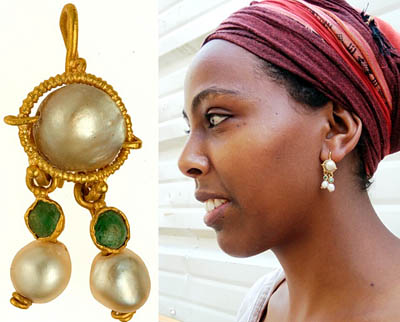
The earring and a model displaying it. IAA Photos.

The earring and a model displaying it. IAA Photos.

I suspect we will see this design in stores soon.

Jesus spoke a parable that illustrates the value of a pearl.

“Again, the kingdom of heaven is like a merchant seeking fine pearls, and upon finding one pearl of great value, he went and sold all that he had and bought it. (Matthew 13:45-46 NASB)
Ask in the next village

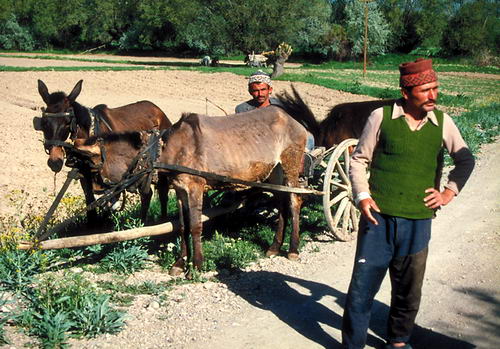
Once while visiting the site of Lystra our group enjoyed some time with local farmers who were working the fields below the tell (huyuk, in Turkey). I asked our guide to ask the men if they had heard of the apostle Paul. When he asked them, a puzzled look came over the face of the farmer who was doing most of the talking. He said, “No, but you might ask in the next village.”

The farmer said, "Ask in the next village." Photo by Ferrell Jenkins.

The farmer said, "Ask in the next village." Photo by Ferrell Jenkins.

Paul visited Lystra on his first journey (Acts 14). On the second journey he came through Lystra where Timothy lived. From that point on Timothy remained a faithful companion and co-worker with Paul in the spread of the gospel throughout the Roman Empire.

Paul came also to Derbe and to Lystra. And a disciple was there, named Timothy, the son of a Jewish woman who was a believer, but his father was a Greek,  2 and he was well spoken of by the brethren who were in Lystra and Iconium.  3 Paul wanted this man to go with him; and he took him and circumcised him because of the Jews who were in those parts, for they all knew that his father was a Greek.  (Acts 16:1-3 NASB)

Is the Apostle Paul known in your village? I mean, is the teaching of Christ and Him crucified known there? (1 Corinthians 2:2).

The Persian background of Iran

The August, 2008, issue of National Geographic has a good article on the Ancient Soul of Iran. The emphasis is on the rich Persian history of the area. The article is online at ngm.com. The article includes many of those fabulous NG photographs. Most of them were shot in low light to evoke the past glory of Iran. There are more photos at the website than in the magazine. You might be able to buy a copy of the magazine at your local bookseller.

Iran is the only major area of the Bible world that I have been unable to visit. Maybe that will change within the next few years. Marguerite Del Giudice says,

In fact, the first thing people said when I asked what they wanted the world to know about them was, “We are not Arabs!” (followed closely by, “We are not terrorists!”

The article features the people of Iran, and not the government. There are some interesting comments on the influence of Zoroastrianism’s teaching.

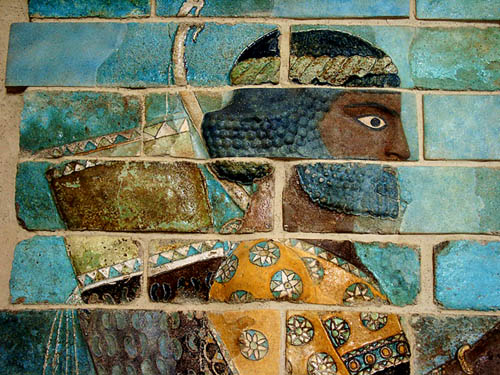
Many of the great museums of the world have ancient Persian artifacts. This is especially true of the Louvre, the British Museum, and the Oriental Institute of the University of Chicago. Here is a photo from the Louvre of one of the Persian archers.

Archer from the Palace of Darius in the Louvre. Photo by Ferrell Jenkins.

Archer from the Palace of Darius in the Louvre. Photo by Ferrell Jenkins.

The Persians played a significant role in the Restoration of the Judeans to their land after the Babylonian Exile. Here are a few highlights.

  • Cyrus, who conquered Babylon, allowed the Jews to return to their land in 536 B.C. See 2 Chronicles 36, and compare the Cyrus Cylinder (in the British Museum).
  • Darius I allowed the Jews to rebuild the temple in Jerusalem (520-516 B.C.; Ezra 6:1-5).
  • Xerxes is the Ahasuerus of the book of Esther.
  • During the reign of Artaxerxes I, the second group of Jews return under the leadership of Ezra (458 B.C.). Nehemiah returned to rebuild the walls of Jerusalem (444 B.C.).

Restricting information

China has been in the news a lot in the past years. Most recently we have seen them assuring us they could resolve a severe pollution problem within weeks. Then there were all of those toys containing lead. One day we told our little grandson to take something from his mouth that he had picked up off the floor. He said, “Why, was it made in China?” We heard that the media in China to cover the Olympics would have free access to the Internet, but then certain sites were blocked.

More serious than all of this are those matters pertaining to human rights and the restriction of religious rights. In 1986 we carried a few Bibles into the country and gave them to individuals or left them where they might be picked up. Several friends who have visited China, or lived there for short periods, have mentioned the restrictions and the secrecy under which Christians meet for study of the Bible and the worship of Christ.

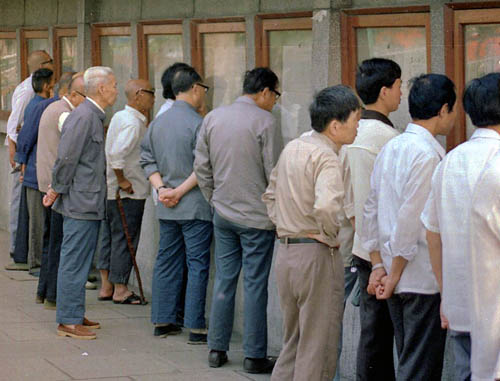
Here is a photo I made in 1986 in one of the cities we visited. The only news the people got was what the government posted for them. Such censorship is deplorable whether in China or elsewhere. It is based on fear. I was in Bangkok when I learned of the Tiananmen Square protests of 1989. The next few days in Hong Kong I saw marches protesting what was happening in mainland China. Several people had copies of newspaper reports about the incident. They wanted us to fax or mail them to their friends in China.

Men lined up to read the news in China in 1986. Photo by Ferrell Jenkins.

Men lined up to read the news in China in 1986. Photo by Ferrell Jenkins.

We hope the time will come when the people of China will have free access to the Bible and all other information so readily available to those who live in freedom.

China, then and now

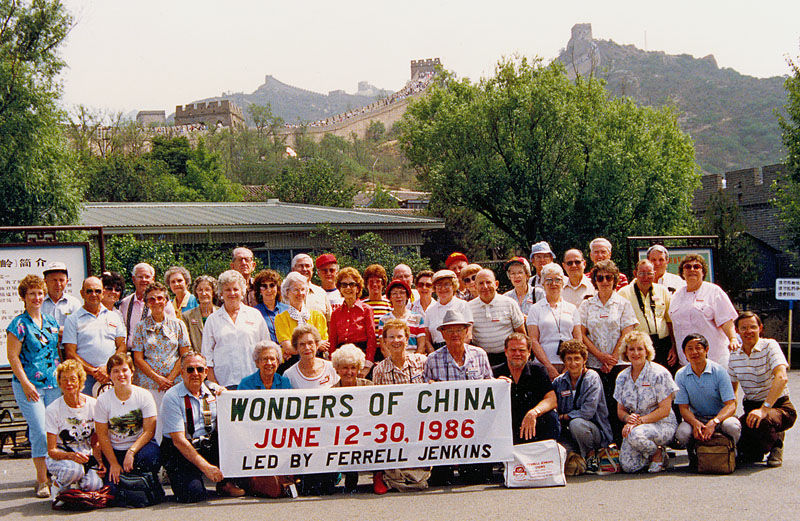
The media, especially NBC, is giving lots of attention to the upcoming Olympic games from China. Many changes have taken places in China over the past few decades. Some good; some not so good. In 1986 we took a tour to China. This morning I dug out a photo of the group that we made before climbing the Great Wall, and thought that some of you might enjoy seeing it.

Wonders of China group led by Ferrell Jenkins at the Great Wall in 1986.

Wonders of China group led by Ferrell Jenkins at the Great Wall in 1986.

If you know some of the folks who have traveled with us in the past you may click on the image to see a larger copy.

Enjoying the local customs

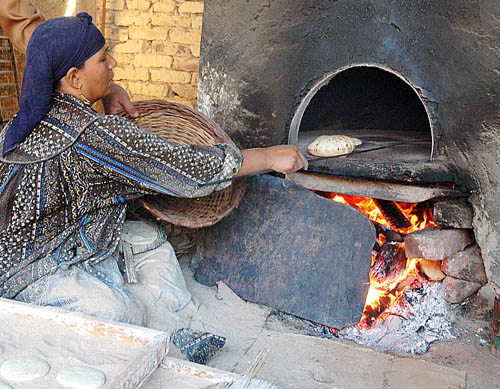
One of the joys of travel is learning about the customs of the local people. Of course, I have a special interest in finding customs that remind us of customs in Bible times. In many places the local entrepreneurs realize that tourist enjoy this so they make it possible for you to see and participate in the customs. This woman at a restaurant near Memphis, Egypt, is baking bread as it has been done for centuries in Egypt. Yes, the bread was delicious.

Perhaps you can recall the episode in Genesis 40 about “the cupbearer and the baker for the king of Egypt.”

U.S. Religious Landscape Survey

Anyone interested in reaching citizens of America with the gospel of Christ should be interested in the Pew Forum report on the Religious Landscape Study. You may read a summary of the key findings here. You may download the 18 page report and/or the full report of 268 in PDF.

According to the report, among Evangelical churches 57% believe many religions can lead to eternal life. Eighty seven percent of mainline Protestant churches believe that. Not far behind 89% of Buddhists. The same view is held by 56% of Muslims in America.

Imagine Jesus saying, “I am the way, and the truth, and the life; no one comes to the Father, but through Me” (John 14:6). “At least that’s what I think 57% of the time.”

One interesting aspect of the report is the percent who see a conflict between religion and modern society. The total of all Americans is 40%. And 42% of these say their values are threatened by Hollywood. You might find the views on abortion and homosexuality surprising, too.

The summary concludes with two paragraphs on the effect of secularization.

The U.S. has largely avoided the secularizing trends that have reshaped the religious scene in recent decades in European and other economically developed nations – but not entirely. The
Landscape Survey documents, for example, that the number of Americans who are not affiliated with a religion has grown significantly in recent decades, with the number of people who today say they are unaffiliated with a religious tradition (16% of U.S. adults) more than double the number who say they were not affiliated with a religion as children (7%).

It remains to be seen how this trend toward secularization will ultimately impact religion in the U.S. But what is clear is that religion remains a powerful force in the private and public lives of most Americans, a fact amply illustrated by the findings of the U.S. Religious Landscape Survey discussed in this report.

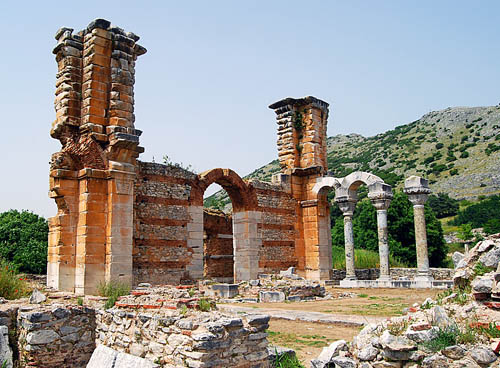
Will the buildings in which we meet one day stand in ruins (physically or spiritually) like this 550 A.D. building, called Basillica B, at Philippi? Read Acts 16 and Paul’s Epistle to the Philippians.

Go read, and learn.

Father’s Day

According to the entry in Wikipedia, Father’s Day was first celebrated in the United Stated in 1908.

In the United States, the first modern Father’s Day celebration was held on July 5, 1908, in Fairmont, West Virginia or on June 19th of the same year, in the state of Washington. Today, Father’s Day is celebrated on the 3rd Sunday of June.

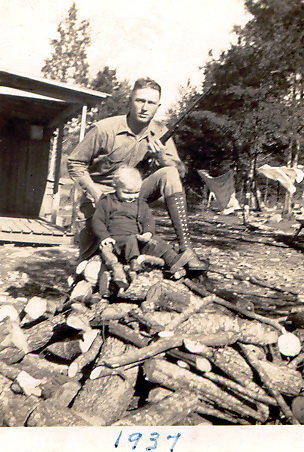
My father was a good man who sought to do the best for his wife and son, his family and the church. He was a faithful Christian who sought to serve the Lord Jesus Christ, as I account him. I am not sure of my earliest memory of my dad, but I am confident that those very early years were important ones. A few years ago one of my cousins sent me some photos she found among her mother’s belonging. Her mother was my father’s sister who became an icon in Huntsville, Alabama, with her Aunt Eunice’s Country Kitchen. If you don’t know about this, just put “Aunt Eunice” in your Google search engine and take a look.

Anyway, this small collection of photos included the earliest photo I have of my father. I was one year old; he was about 23 or 24. This scene shows the back porch of our little frame house, the wood pile, and some clothes hanging on the line. In those years there was no Internet, no telephones, no running water, and no central heating. We would have none of these things until I was about 10 years of age. Yet, I had a good childhood and a firm foundation for future life. My father worked as a farmer, a carpenter, ran a small produce (fruits and vegetable) company, did some hauling, and ran a small grocery. His life was cut too short at the age of 65. I think about him almost every day.

While sharing old family photos I thought I would share one that includes both my mother and my father. This photo was probably made about 1954 in their small neighborhood grocery. Mother is nearing 95 now, but she has not known me for the past few years. My Father never was able to travel with me to the Bible Lands, but Mother was able to join me twice.

I trust that every reader will take heed to the instruction of the Apostle Paul to the saints at Ephesus:

“Honor your father and mother” (this is the first commandment with a promise). Ephesians 6:1 ESV

“You cows of Bashan”

Amos of Tekoa is recognized as a straight forward, no nonsense, prophet (Amos 1:1). He called the women of the northern kingdom of Israel cows. Nothing politically correct about that.

Hear this word, you cows of Bashan who are on the mountain of Samaria, Who oppress the poor, who crush the needy, Who say to your husbands, “Bring now, that we may drink!” (Amos 4:1)

The sn (study note) in the NET Bible is worth reading.

The expression cows of Bashan is used by the prophet to address the wealthy women of Samaria, who demand that their husbands satisfy their cravings. The derogatory language perhaps suggests that they, like the livestock of Bashan, were well fed, ironically in preparation for the coming slaughter. This phrase is sometimes cited to critique the book’s view of women.

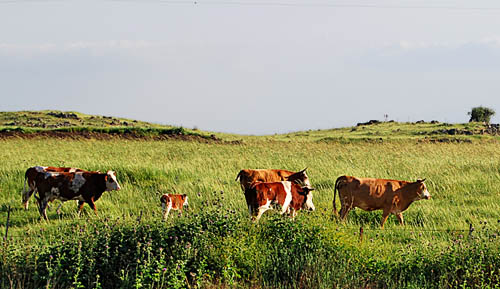
Bashan is in the area we now call the Golan Heights. It is located to the east of the Sea of Galilee and northward. Golan in Bashan was one of the cities of refuge located in the territory of eastern Manasseh (Joshua 20:8). The region was noted as good pasture land.

In the modern state of Israel we notice an attempt to grow crops known from biblical times in the same area where they were grown then. And the same is true of cattle. Here is a photo I made this year of some of the cows grazing in ancient Bashan (modern Golan Heights).

Unleash your inner Indy

Anything Indiana Jones is the fad now since the release of the fourth movie featuring the adventuresome archaeologist. The USA Today Travel Newsletter (May 27, 2007) lists 10 great places to unleash your inner Indy. One of the places mentioned is Petra in Jordan. The article says,

“Hike or ride donkey-drawn carts through a slot canyon to arrive at this ancient city carved out of the sandstone cliffs,” [National Geographic’s Boyd] Matson says. “Petra offers the chance to hook up with nomadic tribesmen and do either a one-day or multi-day camel safari in the desert.” Now a UNESCO World Heritage Site, this once-vibrant Nabataean city was an oasis where Greeks, Romans and Arabs met for caravan trading. visitjordan.com

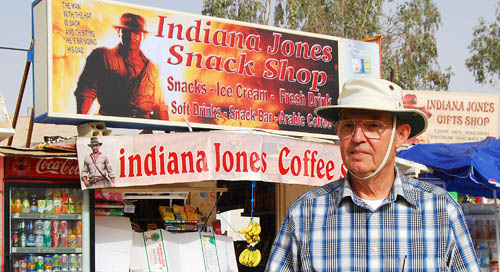
Parts of Indiana Jones and the Last Crusade was filmed at Petra. In this photo we see the snack shop, coffee shop, and gifts shop, all named for Indiana Jones.

The site of Petra is identified as the biblical Sela (rock; 2 Kings 14:7; Isaiah 16:1), and the home of the ancient Edomites (descendants of Esau). From about 300 B.C. the area was inhabited by the Nabataeans from North Africa. G. Ernest Wright once described them as,

one of the most gifted and vigorous peoples in the Near East of Jesus’ time. (Biblical Archaeology, 229).

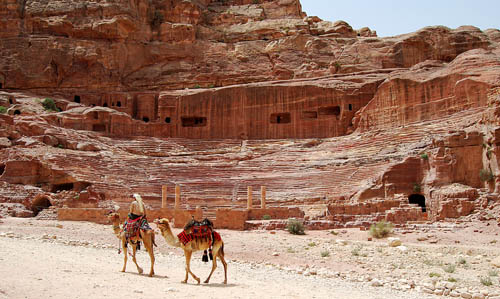
This photo shows the Roman theater at Petra which was cut out of the rock in the 2nd or 3rd century A.D. The theater seated about 3,000.

Several archaeologists have already pointed out that what Indiana Jones does is a far cry from real archaeological work. The real work is sometimes exciting, but always tedious. Bryant Wood is cited here:

“It is rather adventurous in a way, because for the most part, you’re going to some exotic country and delving into their past. But it’s not an adventure with a whip and chasing bad guys and looking for treasure,” said Bryant Wood, an archaeologist with Associates for Biblical Research.

“You’re working at one site tediously, probably for many, many years and spending more time processing the finds and writing reports than you do actually digging at the site. But that wouldn’t make for a very good story, spending 70 percent of the time in a library.”