Category Archives: Culture

The Hasankef Dam on the Tigris River halted

The Biblical Archaeology Review Daily News for June 26, 2009, reports a halt in the building of the dam on the Tigris River in southeastern Turkey. BAR calls attention to an report by the BBC about the halting of the project. Note this portion of the report:

Insurers have suspended their support for a controversial dam project in southeastern Turkey amid concern about its environmental and cultural impact.Export credit insurers in Austria, Germany and Switzerland said on Tuesday they had told suppliers to suspend work on the Ilisu dam on the Tigris river.

They are giving Ankara 180 days to meet standards set by the World Bank. The ancient Hasankeyf fortress is in the area that would be flooded and more than 50,000 people would have to move.

The hydroelectric project near Turkey’s borders with Syria and Iraq is part of a scheme to develop the mainly Kurdish region, which has suffered for decades from poverty, neglect and conflict.

Environmentalists say the dam would destroy archaeological treasures, including Roman remains. The dam consortium plans to create a culture park on the edge of the reservoir and transfer key monuments from Hasankeyf there.

The full (brief) report may be read here. See information about the history of the site here.

I had the opportunity to visit this area in June, 2007. This is one of the most fascinating places I have visited. The site of ancient Nineveh is less than 125 miles south of Hasankef on the Tigris.
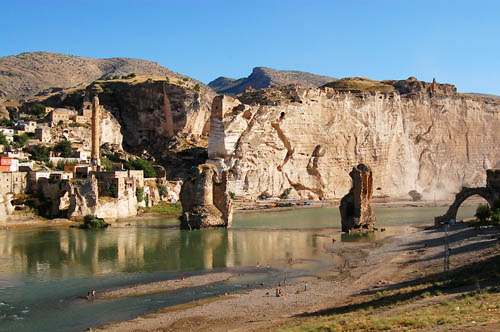
Tigris River at Hasankief. Ruins of Roman bridge. Photo by Ferrell Jenkins.

Tigris River at Hasankef. Note ruins of Roman bridge. Photo by Ferrell Jenkins.

The Tigris River formed the eastern border of Mesopotamia, the land between the rivers (Tigris and Euphrates). It is mentioned by name only twice in the Bible.

  • The Tigris was the third of the rivers flowing from the Garden of Eden. It is said to be east of Assyria (Genesis 2:14). Was this in the north near the source of the river in the mountains of Ararat? Or was it in the south near the Persian Gulf? I don’t know.
  • The prophet Daniel was by the bank of the great river, the Tigris (Daniel 10:4). This would have been further south in present Iraq.
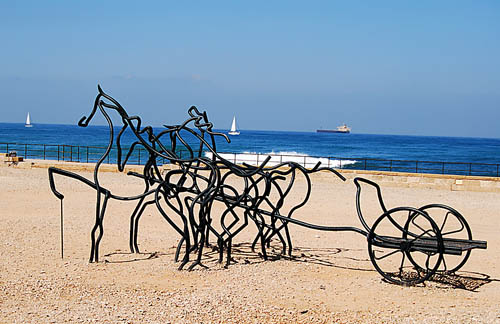
Herod built a hippodrome at Caesarea Maritima

Herod the Great built a hippodrome along the coast at Caesarea Maritima in 10 B.C. to celebrate the opening of the city. In the second century A.D. the south side of the hippodrome was reconstructed as an amphitheater to be used for gladiatorial contests. New sections with beautiful frescoes have been uncovered.

This metal sculpture has been erected on the north end of the hippodrome along the beautiful Mediterranean.

View in the hippodrome at Caesarea Maritima. Photo by Ferrell Jenkins.

View from the hippodrome at Caesarea Maritima. Photo by Ferrell Jenkins.

The theater we showed in the previous post is on the south end of the hippodrome. The harbor built by Herod the Great is a little to the north of the hippodrome. The apostle Paul was in prison at Caesarea for two years between A.D. 58 and 60 (Acts 23:23 – 26:32).

We discussed Paul’s possible use of the charioteer in Philippians 3:12-14 here.

New paintings of the hippodrome mosaics. Photo by Ferrell Jenkins.

New paintings of the hippodrome frescoes. Photo by Ferrell Jenkins.

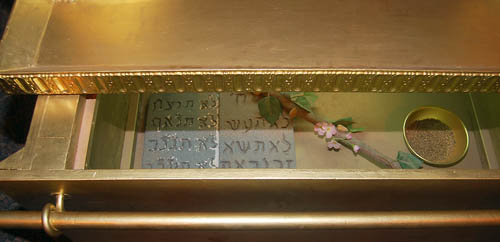
Almond staff in the ark of the covenant

Three items from the period of the wilderness (desert) wandering of the children of Israel were considered significant enough to be included in the ark of the covenant.

Behind the second curtain was a second section called the Most Holy Place, having the golden altar of incense and the ark of the covenant covered on all sides with gold, in which was a golden urn holding the manna, and Aaron’s staff that budded, and the tablets of the covenant. Above it were the cherubim of glory overshadowing the mercy seat. Of these things we cannot now speak in detail. (Hebrews 9:3-5 ESV)

The picture below, made at the model of the Tabernacle in the Wilderness, shows a replica of the Ark of the Covenant with the contents mentioned by the writer of Hebrews. For more information about the model read here.

Replica of Ark of Covenant showing contents. Photo by Ferrell Jenkins.

Replica of the Ark of the Covenant showing contents. Photo by Ferrell Jenkins.

At Jerash in Jordan, young boys were selling small bags of green almonds. Not my preference, but apparently there is a market for them. “Jordan almonds” are famous for use at weddings. The fresh almond is bittersweet in taste, but the sugar coating adds sweetness. The “Jordan almonds” are still “Jordan almonds” even when they come from California!

Green almonds at Jerash, Jordan. Photo by Ferrell Jenkins.

Green almonds at Jerash, Jordan. Photo by Ferrell Jenkins.

Jerash is thought to be the site of Gerasa, one of the cities of the Decapolis (Matthew 4:25). Perhaps it is the city belonging to the country of the Gerasenes (Mark 5:1; Luke 8:26,37).

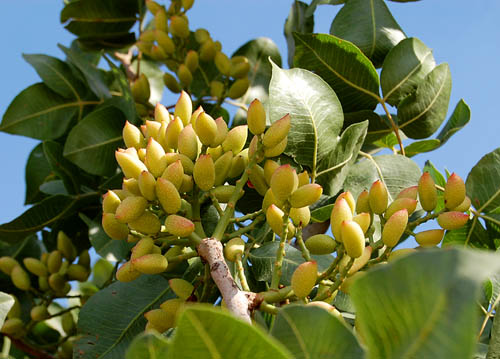
Pistachio nuts among best products of the land

During the days of a severe famine in the land of Canaan, Israel (Jacob) agreed to allow his youngest son Benjamin to go to Egypt at the request of the man who was in charge of dispensing food. That man was Joseph, the son of Israel. Jacob agreed to allow Benjamin to go with his older brothers. He also told the boys to take some of “the best products of the land” including pistachio nuts.

Then their father Israel said to them, “If it must be so, then do this: take some of the best products of the land in your bags, and carry down to the man as a present, a little balm and a little honey, aromatic gum and myrrh, pistachio nuts and almonds. (Genesis 43:11 NAU)

I began thinking about this post while studying John 12.

Mary then took a pound of very costly perfume of pure nard, and anointed the feet of Jesus and wiped His feet with her hair; and the house was filled with the fragrance of the perfume. (John 12:3 NAU)

There are several significant words in this text: perfume (muron), pure (pistikos), and nard (vardos). The Greek word for pure (pistikos)  is difficult to define. Bauer-Danker says it is “variously interpreted, but evidently suggesting exceptional quality.” A comment by William Barclay caught my attention.

Oddly enough, no one really knows what that word means. There are four possibilities. It may come from the adjective pistos which means faithful or reliable, and so may mean genuine. It may come from the verb pinein which means to drink, and so may mean liquid. It may be a kind of trade name, and may have to be translated simply pistic nard. It may come from a word meaning the pistachio nut, and be a special kind of essence extracted from it. In any event it was a specially valuable kind of perfume.

Then I noticed the comments by Keil and Delitzsch on pictachio nuts (sic) in Genesis 43:11.

which are not mentioned anywhere else, are, according to the Samar. vers., the fruit of the pistacia vera, a tree resembling the terebinth, – long angular nuts of the size of hazel-nuts, with an oily kernel of a pleasant flavour; it does not thrive in Palestine now [1875], but the nuts are imported from Aleppo.

Well, that led me to think of photos I made in a pistachio orchard near Carchemish on the Euphrates (Jeremiah 46:2). This is about 65 miles from Aleppo.

Pistachio's growing near Carchemish on the Euphrates. Photo by Ferrell Jenkins.

Pistachio's growing near Carchemish on the Euphrates. Photo by Ferrell Jenkins.

I think this is the only place I have seen pistachio’s growing on a tree. The practical comment by Matthew Henry is worth meditating on for a while.

Note, (1.) Providence dispenses its gifts variously. Some countries produce one commodity, others another, that commerce may be preserved. (2.) Honey and spice will never make up the want of bread-corn. The famine was sore in Canaan, and yet they had balm and myrrh, etc. We may live well enough upon plain food without dainties; but we cannot live upon dainties without plain food. Let us thank God that that which is most needful and useful is generally most cheap and common.

That sort of outlines the rambling of the mind back of this post. It is amazing what one may learn once he begins to track down leads. I still don’t know if pure (pistikos) has anything to do with pistachio nuts! Meditate.

Leeks in the land of Goshen

Israel’s experience in the Sinai wilderness might be summarized by the two words complained and murmured. One such account is given in Numbers 11.

We remember the fish we ate in Egypt that cost nothing, the cucumbers, the melons, the leeks, the onions, and the garlic. But now our strength is dried up, and there is nothing at all but this manna to look at.” (Numbers 11:5-6 ESV)

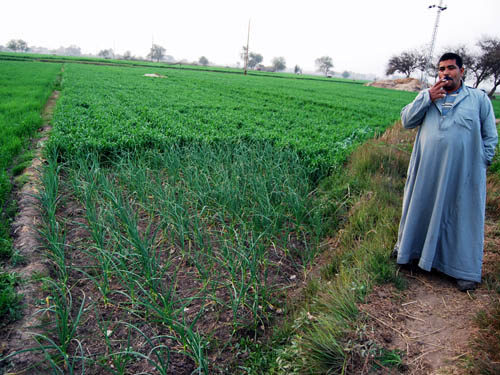
The Land of Goshen, where the Israelites lived, was located in the eastern Nile Delta along the Pelusiac Branch of the Nile. The land is flat and fertile, and their are canals with water. Because water is rare in the wilderness (or desert) crops are also rare.

From the wilderness, the great meals of fish and vegetables in Egypt looked good to the Israelites. The hard days of oppression were overlooked. (A lot like the bondage of sin!) I had an opportunity to be in some of the fields in Goshen. The farmers grow crops for the cattle, but they use the corners of the fields to grow vegetables for their own use. I saw leeks and cabbage.

Field in the land of Goshen. Photo by Ferrell Jenkins.

Field in the land of Goshen. Photo by Ferrell Jenkins.

The white object in the field is one of the pieces of the colossal statue of Rameses that we mentioned in an earlier post. Smoking is widespread in Egypt.

The Samaritans

Samaritan Priest with Samaritan Pentateuch Scroll. Photo by Ferrell Jenkins.

Samaritan Priest with Samaritan Pentateuch Scroll. Photo by Ferrell Jenkins.

“Samaritans use modern means to keep ancient faith” is the title of an informative article about the modern Samaritans on Mount Gerizim at Reuters. A slide show of 10 good photos is included. I especially liked the one showing the priest in the museum with a painting of Jesus and the Samaritan woman at the well.

We recently wrote about the meeting of Jesus with the woman of Samaria at Jacob’s Well here. We wrote about Jesus passing through Samaria here.

Todd Bolen’s article on the Samaritan Passover may be read here.

Years back I made black and white photos for use in publications. This one shows a Samaritan priest displaying a copy of the Samaritan Pentateuch. He said it was the oldest book in the world. Textual scholars think it is no older than the 12th century A.D.

A Reuter’s Blog here gives some additional information about how the reporters got to Mount Gerizim. Check the video at the bottom of the page.

HT: Joseph Lauer; Paleojudaica.

“A new beginning” in the Muslim world

United States President Obama calls for “a new beginning” in the Muslim world in Cairo today.

We watched the presidential inauguration on Al Jazeera in Egypt last January. The Egyptian men were all excited about this change in America. For a day or two afterward we would be greeted with big smiles and chants of  “Obama, Obama.” One camel driver told a member of our group, “I like Obama; he’s my color.”

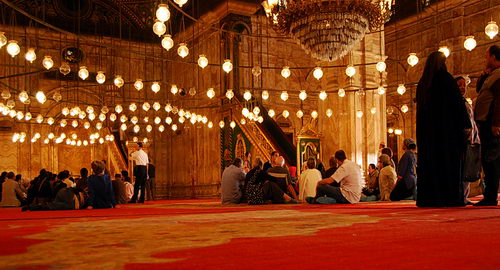
The Obama party is making visits to the pyramids and the Mohammed Ali Mosque. Typical tourist things to do. See our comments about the Mosque and a photo of the exterior of the building here. Below is a photo I made inside the mosque using a tiny tripod (about 6 inches high) on the floor of the mosque. Tourist groups are sitting on the floor listening to the history of the mosque.

Interior of Mohammed Ali Mosque in Cairo. Photo by Ferrell Jenkins.

Interior of Mohammed Ali Mosque in Cairo. Photo by Ferrell Jenkins.

Understanding is good. Let’s hope that this “new beginning” allows freedom for those in the Muslim world who profess Christ.

The full text of President Obama’s speech is available from The Guardian.

Memorial Day 2009

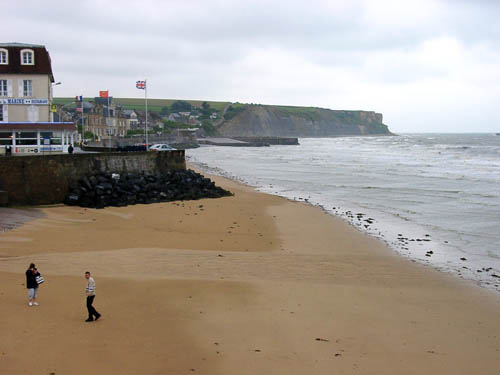
Memorial Day (Monday) honors all the men and women who have died in military service in the defense of our country. There were 1,465 USA deaths in the Battle of Normandy. In addition, 2,700 UK soldiers and 500 Canadian soldiers died. It is estimated that between 4,000 and 9,000 German soldiers died.D-Day, June 6, 1944, is a very important day in American history. Here is one of the photos I made of “Omaha” Beach on a rainy day in 2002. This is where many American soldiers landed.

"Omaha" Beach in Normandy. Photo by Ferrell Jenkins.

"Omaha" Beach in Normandy. Photo by Ferrell Jenkins.

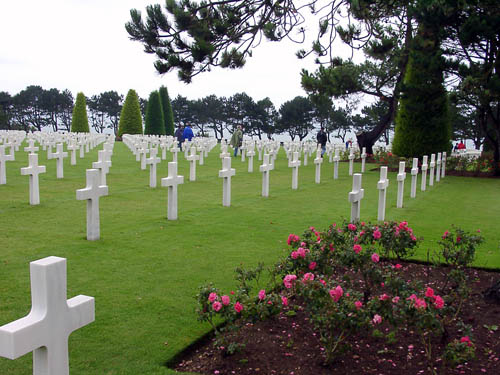
A visit to this area and especially to the American cemetery helps us realize what a great debt we owe to those who gave their lives while fighting for freedom. A few years ago, prior to his death, I visited regularly with a veteran of World War II who was at Normandy. I enjoyed hearing him talk about the war, and asking him questions. I was always encouraged when I left his home.

The American Cemetery at Omaha Beach in Normandy. Photo by F. Jenkins.

The American Cemetery at Omaha Beach in Normandy. Photo by F. Jenkins.

We should not apologize for what happened here. We must never rewrite this history!

The Aladdin Lamp gave light to all in the house

The New Dictionary of Cultural Literacy, provides this information about the Aladdin Lamp:

The subject of a story in the Arabian Nights. The young boy Aladdin acquires a magic lamp that, when rubbed, brings forth a genie, who grants Aladdin’s wishes to win the hand of the sultan’s daughter and to build a palace. The magician who first gave Aladdin the lamp steals it back, but Aladdin regains the lamp, and he and the sultan’s daughter live happily ever after.

The lamp that Americans of the 1930s and 1940s came to know as the Aladdin Lamp was already in use in Germany during the early part of the 20th century. The flat wick kerosene lamp was common in the rural south when I was a youngster, but the Aladdin Lamp provided much more light because the flame heated a frameless mantle that hung over the flame. We had one Aladdin Lamp which we kept in the “big room” where both my parents and I slept until during my earliest grammar school years. This was literally our “living room.”

All of my evening school work was done in the light of the bright Aladdin Lamp. I thought that was the brightest light I had ever seen at night, and it was.

A few years ago, during a speaking engagement, I stayed with a fine family in Cullman, Alabama. They had the largest collection of Aladdin Lamps I have seen. Many of them have been refitted with electric fittings to make them usable today, like the one in our photo. I asked if he knew how much “wattage” one of the original lamps provided. He told me that it was about 60 watts.

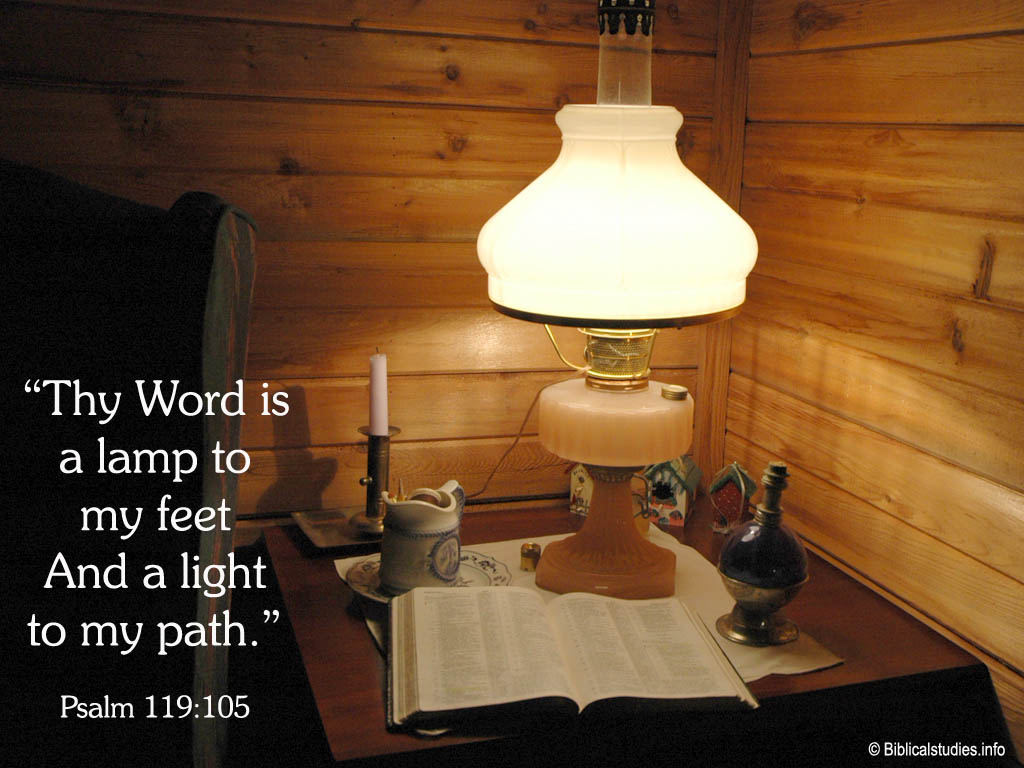
The Aladdin Lamp provided light for all in the house. Photo by Ferrell Jenkins.

The Aladdin Lamp provided light for all in the house. Photo by Ferrell Jenkins.

Lamps like this provide us with a reminder of the wonderful illustration used by Jesus.

Again Jesus spoke to them, saying, “I am the light of the world. Whoever follows me will not walk in darkness, but will have the light of life.” (John 8:12 ESV)

And, we recall the illumination and guidance provided by the LORD and His word.

Your word is a lamp to my feet And a light to my path. (Psalm 119:105 NAS)

This photo has been prepared in a size large enough to be used in PowerPoint presentations by my preaching/teaching friends. Just click on the image for a larger one.

Jacob’s Well — from Jacob to Jesus

Jesus came to Sychar, a city of Samaria, near the piece of land Jacob had owned (John 4:5; Genesis 33:19). The territory was apportioned to the descendants of Joseph, and Joseph was buried there at Shechem (Joshua 24:32). It was a place of great historic importance.

We are not able to speak with certainty regarding the location of Sychar. Some scholars associate the site with Shechem; others think it should be identified with the village of Askar which is located a short distance north. The traditional Jacob’s Well is located at Shechem in the valley between Mount Gerizim and Mount Ebal. The modern town of Nablus now fills this valley.

André Parrot says,

“Of all the ‘holy places’ of Palestine, none has more reason to be considered authentic than Jacob’s well. Indeed, there is no reason why its authenticity should be questioned” (Land of Christ 65).

Parrot describes the water as “cool and pleasant-tasting…drawn from a depth of 128 feet.” I have drunk the water several times, but in the past couple of decades my guides have advised against it due to pollution in the area.

The Samaritan woman said, “the well is deep” (John 4:11). Parrot reports the well is 128 feet deep. Murphy-O’Connor says it is 22.5 meters deep (about 74 feet). McGarvey cites several measurements mentioned in 19th century writers and reminds us that the well became filled with stones cast in by travelers trying to hear how long it would take a stone to hit the bottom (Lands of the Bible 283). He reports that the well was often dry.

There are numerous springs in the area of Shechem. Jacob, as a late-comer to the region, might have found it necessary to dig a well to assure water for his family and cattle.

A church was erected over the well about A.D. 380. The Crusaders built another church on the site in the 12th century. The property came under the control of the Greek Orthodox church in 1860. By the end of the 19th century the Greeks began a new church, but construction was halted during World War I. The last time I was at Jacob’s well (2000) construction had resumed and Murphy-O’Connor reports completion in 2007.

It has been difficult for groups to visit Jacob’s Well in recent years due to the situation in Nablus.

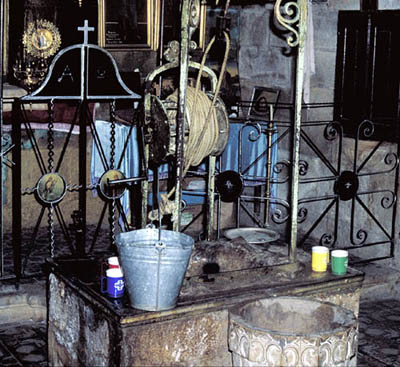
Jacob's Well. Most likely the well where Jesus met the woman of Samaria (John 4). Photo by Ferrell Jenkins.

Jacob's Well. Most likely the well where Jesus met the woman of Samaria (John 4). Photo by Ferrell Jenkins.

With this information, I leave it to you to study the great lessons of John 4. They are deep, too.