Category Archives: Culture

Major revision of the Pictorial Library of the Bible Lands

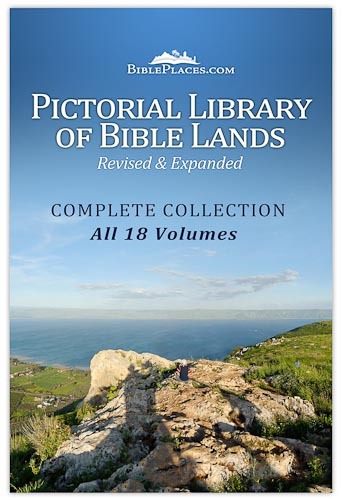
Todd Bolen announces the release of a total revision of the Pictorial Library of Bible Lands. This revised and expanded edition is the culmination of 9 years of work. The previous version contained 6000 photographs in 10 volumes. According to the announcement,

This new edition consists of 18 volumes with nearly 18,000 photographs, adding hundreds of new sites and re-visiting the old favorites.

Here are just a few features of the new edition of the Pictorial Library of Bible Lands.

  • Eight new volumes: (Lebanon, Eastern and Central Turkey, The Greek Islands, and more. New subjects include Cultural Images, Signs, and Trees, Plants, and Flowers.
  • New Photos: For example, more than 1000 new photos have been added to the Jerusalem volume.
  • New Photographers. In addition to the photos by Todd Bolen, the work of more than 40 photographers are included in this new set.
  • New Maps. New, original maps have been created to identify the sites.
  • New Indexes. Every photograph is indexed in a list of more than 400 pages.
  • You get the hi-res photos and the photos already in PowerPoint. You can use the presentation as it is or include individual slides in your own lesson.
  • And more…
Pictorial Library Complete Collection. BiblePlaces.Com.

Front cover of the new Pictorial Library Complete Collection.

For those who already own the previous collection, Bible Places is offering the new 18-volume set for the upgrade price of $179. The entire set for new purchasers is $389.

Would you prefer to make your own photos? Try buying a good digital SLR camera starting at about $1500, flying to Israel (not to mention Lebanon, Egypt, Turkey, Greece, the Greek Islands, Italy, et al.), renting a car for a few weeks, buying the gas. Oh, and don’t forget to hire a private plane for a few hours so you can get some good aerial photos. That might cost at least $389. 🙂 And what if the lighting conditions were not right for a good photos the day you were at a site? What if you don’t have time to get your photos organized and write a description of each one? Need I go on to make a point? Did I mention that living and teaching in Israel for a decade helps?

Every church should have a set of this material for the teachers to use in their teaching. Over the years I have found that some short-sighted groups (churches) will not make such an expenditure. The other choice is to buy the set for yourself.

I hear several lessons a week, and every one of them could be improved by the use of photos from this wonderful collection.

Learn more about the new Pictorial Library of Bible Lands in the following places:

Charles Savelle has a good interview with Todd Bolen at the BibleX blog here.

I have profited much from the work of Todd Bolen and am delighted to count him as a friend and to recommend this collection of photographs to every teacher of the Bible.

Follow the BiblePlaces.com Blog here.
The looting of Sardis

Finally, Greece and Turkey can agree on something. They wish they had back the archaeological treasures that have been taken to other countries in the past. Greece wants back the Elgin marbles taken from Athens to the British Museum. Turkey wants back the treasures taken from Sardis in September 1922, the days of unrest during the fall of the Ottoman Empire. According to the article by John Leonard in Athens News, the port city of Smyrna (modern Izmir) was burning when John Horton sent crates of antiquities to the United States.

Numerous Turkish artifacts, including some real big ones (in size and importance), are displayed in the British Museum, and in the Pergamum Museum in Berlin.

It is a fascinating story with two sides. Read Leonard’s article here.

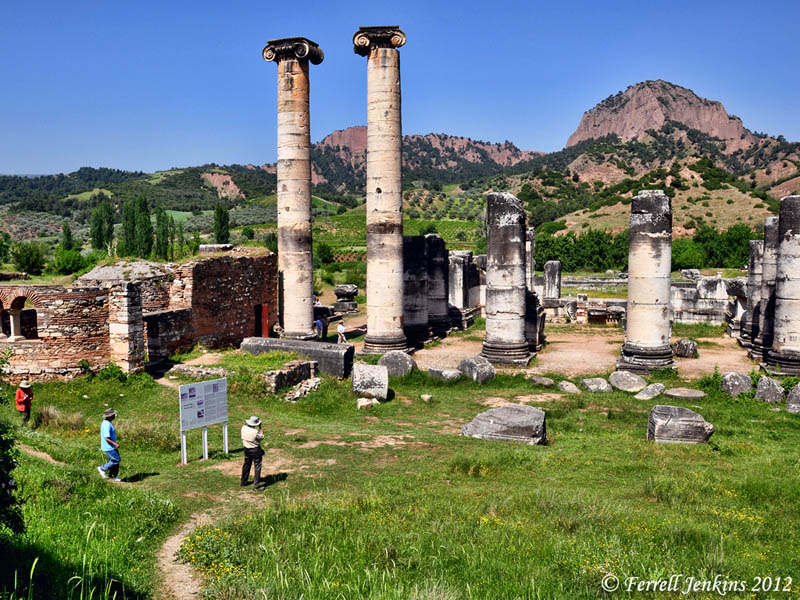
The photo below is one I made at Sardis earlier this month. The view is West over the ruins of the Temple of Artemis. One of the Ionic capitals is in the Metropolitan Museum in New York. The temple dates back to at least the 6th century B.C., but was destroyed in 499 B.C., and then underwent three rebuilding phases. The columns seen here date to the third rebuilding phase (ca. A.D. 150). Ruins of a restored Byzantine church from the fourth century A.D. may be seen in the left corner of the photo.

Sardis. Temple of Artemis. View West. Photo by Ferrell Jenkins.

Sardis. View west over the Temple of Artemis. Photo by Ferrell Jenkins.

Sardis is mentioned in the Bible only in Revelation (Apocalypse) 1:11 and 3:1-6.

saying, “Write what you see in a book and send it to the seven churches, to Ephesus and to Smyrna and to Pergamum and to Thyatira and to Sardis and to Philadelphia and to Laodicea.”  (Revelation 1:11 ESV)

Another post about efforts to retrieve artifacts from foreign museums may be read here.

HT: Jack Sasson

Memorial Day 2012

Memorial Day, originally called Decoration Day, is a day of remembrance for those who have died in our nation’s service. There are many stories as to its actual beginnings, with over two dozen cities and towns laying claim to being the birthplace of Memorial Day. (Memorial Day History)

When I was a kid, growing up in the American South, the day we now call Memorial Day was called Decoration Day. Families went to the local cemeteries to clean up the grave sites of relatives and leave fresh flowers. If it was known that there were no family members left in the community, those graves also were cleaned. I don’t recall when I first began to hear, or think, that the day was intended to honor those fallen in war.

Like many holidays, the original purpose has changed. Memorial Day, Independence Day, Labor Day, Christmas, Easter, and other holidays, have become times for picnics, trips, vacations, and assorted non-related practices. Every holiday has become a time for stores to have sales.

I like the idea of Memorial Day. I am pleased to join in the remembrance of troops fallen in battle, and all of the dead who have played a significant role in my life.

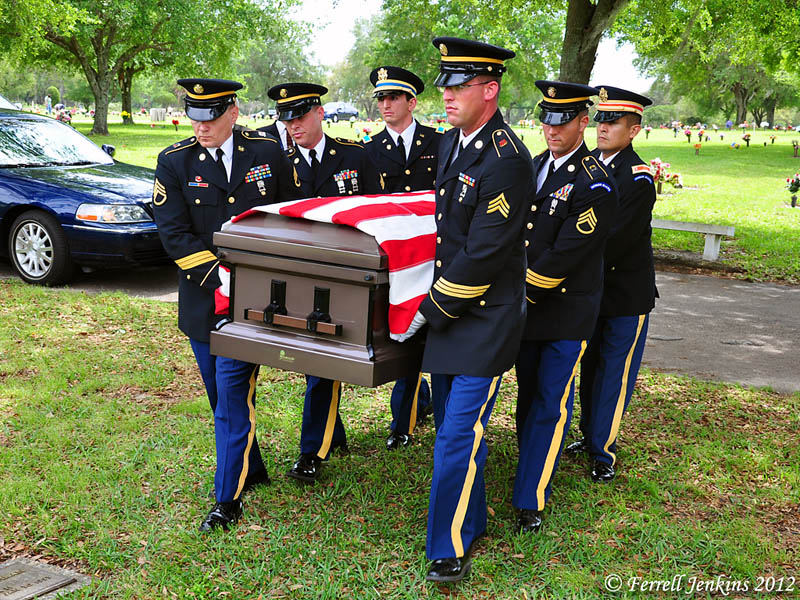
The photo below is one I made at the funeral of a long-time friend, earlier this year.

Military Honor Guard Funeral of B. R. Baker. Photo by Ferrell Jenkins.

Military Honor Guard Service for Barney Ross Baker, SSGT, U.S. Army (Retired), Tampa, Florida, March 31, 2012. Photo by Ferrell Jenkins.

The beginning comments are repeated from 2010 and 2011.

Eisenbrauns 2012 Mug announced

Scholarly book publisher Eisenbrauns announces the Eisenbrauns 2012 Mug.

Eisenbrauns 2012 Mug

Eisenbrauns 2012 Mug
A Hittite Proverb

Eisenbrauns, Forthcoming June 2012
14 ounces, Hittite and English
Ceramic
Your Price: $7.50
www.eisenbrauns.com/item/EISMUG2012

If you want to know what the Hittite proverb says, click on the link to Eisenbrauns.

Just something on the lighter side for you to enjoy while I make my way across the Atlantic.

Black Sea coastal town of Sinop

We drove the 100 miles from Samsun to Sinop today. The distance on the road map is deceptive. about one half of the distance is in serious mountain territory. The drive took three hours each way. We had a 6:15 p.m. flight from Samsun to Istanbul, so our time was limited. The drive was educational and helped us to understand some things we had only read about before.

I don’t have the time to explain the reasons for going to this town, except to say that it is in the region of the ancient Roman province of Pontus (1 Peter 1:1).

Later I hope to show you some photos and explain the importance of the town to the study of Peter’s epistles.

Homeward bound tomorrow after a great (nearly) four weeks in Turkey, Greece, and Cyprus.

Pontus and Peter’s Epistles

Pontus is mentioned only three times in the New Testament.

  • Devout Jews were present in Jerusalem from Pontus on the day of Pentecost (Acts 2:9). Some of these individuals who accepted the message of Peter on Pentecost might later have been the recipients of his letters.
  • Aquila was a native of Pontus. He had moved to Rome, but being ordered to leave by the Emperor Claudius he came to Corinth where he, along with his wife Priscilla, met Paul (Acts 18:2).
  • Peter addressed his epistles to Christians residing in five different Roman provinces, including Pontus.

Peter, an apostle of Jesus Christ, To those who reside as aliens, scattered throughout Pontus, Galatia, Cappadocia, Asia, and Bithynia, who are chosen (1 Peter 1:1 NAU)

Scholars suggest that the order of the Roman provinces is indicative of the order in which Peter’s epistle was delivered by the messenger. Colin Hemer argues for Amasus (Amisos) as the starting point on the Black Sea coast for the messenger. Amisos is now identified with the Turkish city of Samsun, a prosperous town of over half a million inhabitants (“The Address of 1 Peter.” Expository Times, 89:239-243). Mark Wilson agrees (Bibical Turkey, 338).

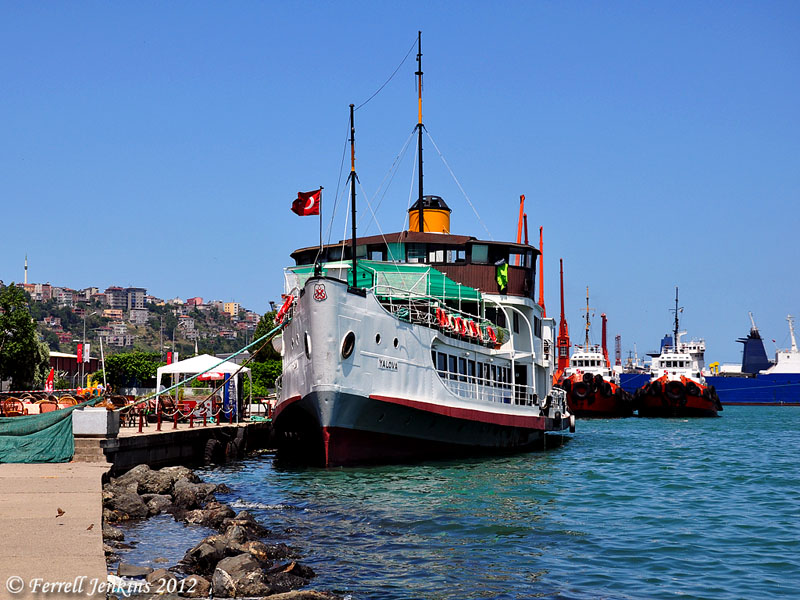
The photo below was made from the harbor of Samsun. The hill in the distance marks the ancient acropolis of Amisos.

Harbor at Samsun with acropolis of ancient Amisos. Photo by Ferrell Jenkins.

Harbor at Samsun with acropolis of ancient Amiisos, Photo by Ferrell Jenkins.

Even the Romans brought their armies to this region of Asia Minor through the ancient port city of Amisos. This was much easier than traveling overland.

Amisos is mentioned under the same Sampsames in the Apocrypha book of 1 Maccabees 15:23 (RSV).

Tomorrow we hope to visit the Pontic city of Sinop (Sinope), about 100 miles west of Amisos.

1400 year old olive press excavated

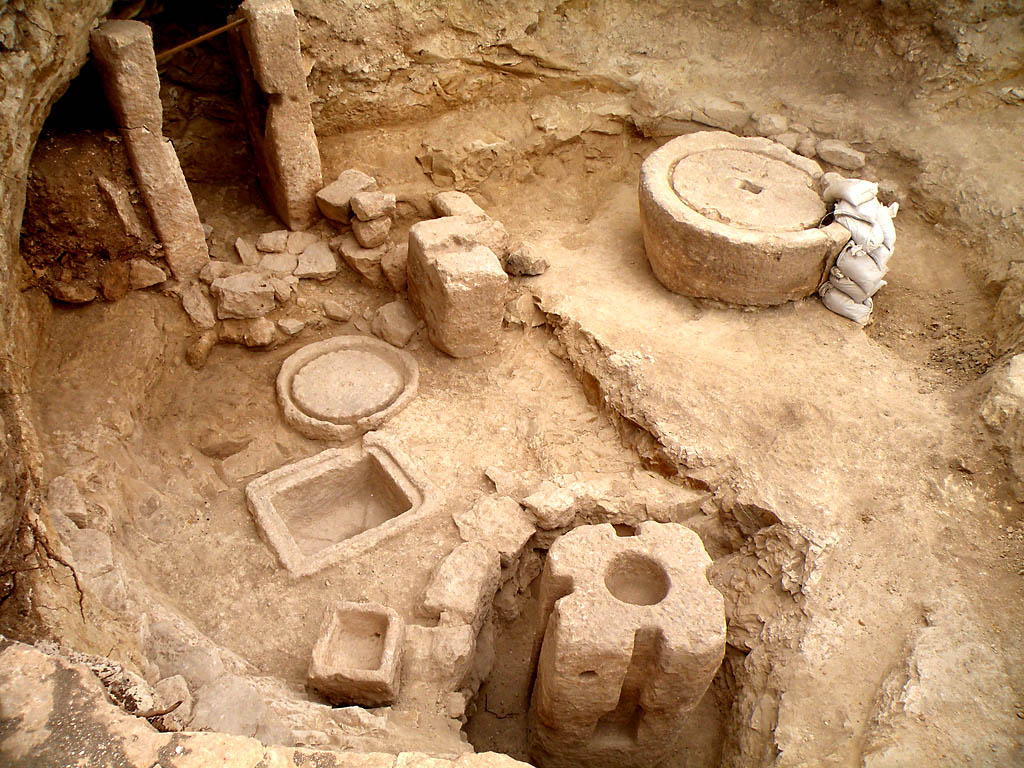
The Israel Antiquities Authority announces the discovery of a 1400 year old olive press at Modi’in. According to a brief article in Arutz Sheva,

A statement by the IAA called the press the grandest and most complete one found so far.

Archaeologist Hagit Torgë, who is directing the dig, said the press, which was used to produce industrial quantities of oil for food and light, about 1,400 years ago, “was preserved surprisingly intact with all its components.”

1400 year old olive press at Modi'in. Credit: Hagit Torgë, Israel Antiquities Authority.

Olive press at Modi’in. Credit: Hagit Torgë, Israel Antiquities Authority.

Click on the photo for a hi-res image.

Olives are mentioned in the Bible from Genesis (8:11) to Revelation (18:13), and are still important in many parts of the world.

HT: Joseph Lauer

Paul preached in Athens

Our cruise ship, the Louis Cristal, arrived in Athens early this morning. After breakfast we disembarked and met our local tour operator and guide. Andi has guided my groups several times over the years, and I am pleased to have her with us. She divides her time each year between the USA and Greece.

We drove by the usual historical places in Athens, and stopped at the old Olympic stadium before going to the Acropolis.

Syntagma (Constitution) Square was clean and orderly; not at all the way it has been portrayed on American TV lately. I am not saying that the things shown on TV never happened, but that when the same video clips are shown over and over for many days it leaves the wrong impression.

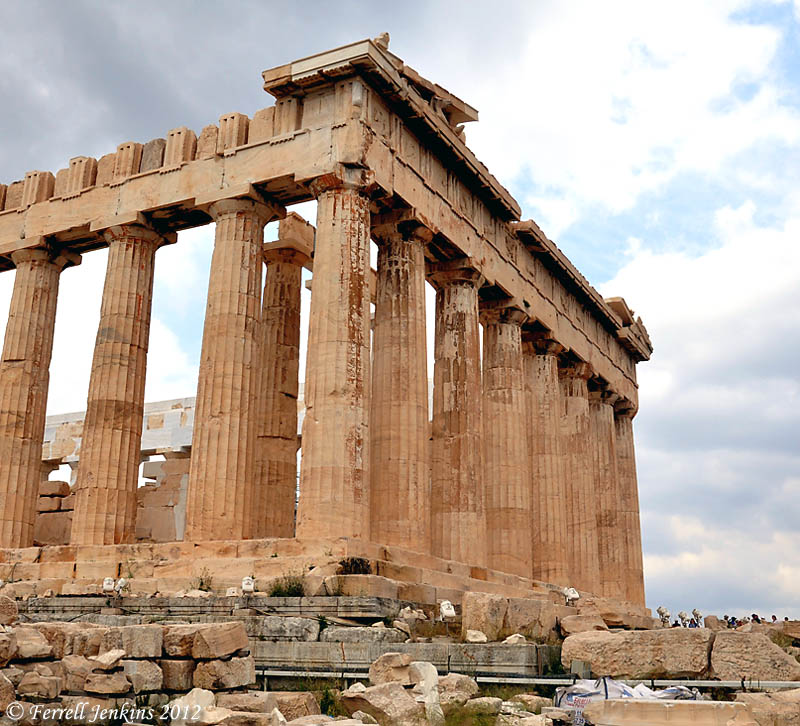
I had hoped that the scaffolding and cranes used in the restoration of the Parthenon would be gone. Such was not the case. The only place I could get a photo without showing these things was from the back.

The back of the Parthenon in May, 2012. Photo by Ferrell Jenkins.

The back of the Parthenon in May, 2012. Photo by Ferrell Jenkins.

The Parthenon, where the virgin goddess Athena was worshiped, was built between 447 and 438 B.C. It is still quite a building.

We also visited the Areopagos (Mar’s Hill), possibly the place where Paul delivered his speech on the Unknown God (Acts 17).

While the group went with the guide looking at some highlights in the Athens National Museum, I made some photos of the nice collection of Roman Emperors.

Below is a photo of the portrait head of the Emperor Claudius (A.D. 41-54) in Pentelic marble.The museum sign says,

The head is crowned with the corona civica (a wreath of oak leaves and acorns) tied with a ribbon.

The Roman Emperor Claudius in the Athens National Museum. Photo by Ferrell Jenkins.

The Roman Emperor Claudius in the Athens National Museum. Photo by Ferrell Jenkins.

Paul’s visit to Athens and Corinth was during the reign of Claudius. In fact, the emperor is mentioned in Acts 18:2.

And he found a Jew named Aquila, a native of Pontus, recently come from Italy with his wife Priscilla, because Claudius had commanded all the Jews to leave Rome. And he went to see them,

The great famine mentioned in Acts 11:28 also took place during the reign of Claudius.

We have plans to visit Corinth tomorrow.

Smyrna — a city that came back to life

Our group arose early this morning in Istanbul in order to make our flight to Izmir. Izmir is a beautiful city on the Aegean coast of Asia Minor about 35 miles north of Ephesus. It is known as the location of the Biblical city of Smyrna.

Smyrna is mentioned only twice in the New Testament as the location of one of the seven churches addressed in the Book of Revelation (1:11; 2:8-11).

“And to the angel of the church in Smyrna write: The first and the last, who was dead, and has come to life, says this: ‘I know your tribulation and your poverty (but you are rich), and the blasphemy by those who say they are Jews and are not, but are a synagogue of Satan. ‘Do not fear what you are about to suffer. Behold, the devil is about to cast some of you into prison, so that you will be tested, and you will have tribulation for ten days. Be faithful until death, and I will give you the crown of life. He who has an ear, let him hear what the Spirit says to the churches. He who overcomes will not be hurt by the second death.’ (Revelation 2:8-11 NAU)

The earliest city of Smyrna was founded in the first half of the third millennium B.C. at Bayrakli, a few miles from the present city of Izmir. In 600 B.C. the city was captured and utterly destroyed by King Alyattes of Lydia. During the 5th and 4th centuries B.C. the city was insignificant.

All of this changed after the time of Alexander the Great when a new city was founded on the slopes of Mount Pagos.

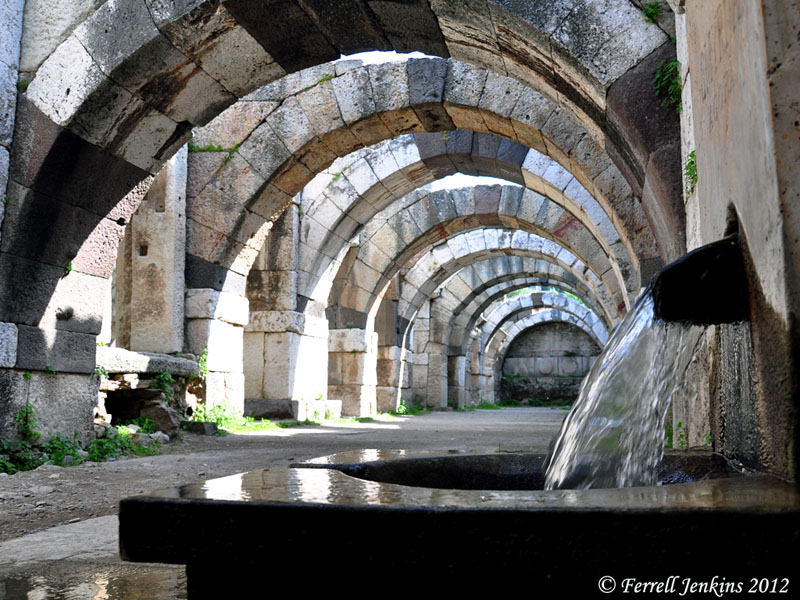
Our visit today included Mount Pagos. From there we had a magnificent view of the city and the harbor. We also visited the Roman Agora, and two archaeological museums.

This photo shows the great arches in the lower level of the three story civic agora dating to the second century A.D., and a powerful spring of water that was discovered only a few years ago.

Lower level of the agora of Smyrna and a powerful spring. Photo by Ferrell Jenkins.

Grinding grain in Bible times

The grinding of grain was an important part of the life of people in Bible times. After the grain was gathered from the fields it had to be threshed. This was done by running a threshing sledge over the stalks of grain on the threshing floor (2 Samuel 24:22). The stalks, now cut into small pieces, was then winnowed with “shovel and fork” to separate the chaff from the good grain (Isaiah 41:16; Ruth 3:2; Luke 3:17; Psalm 1:4). Next came the sifting of the grain to further removed small pieces of debris. Jesus makes reference to this practice when he predicts Peter’s denial:

“Simon, Simon, pay attention! Satan has demanded to have you all, to sift you like wheat, (Luke 22:31 NET)

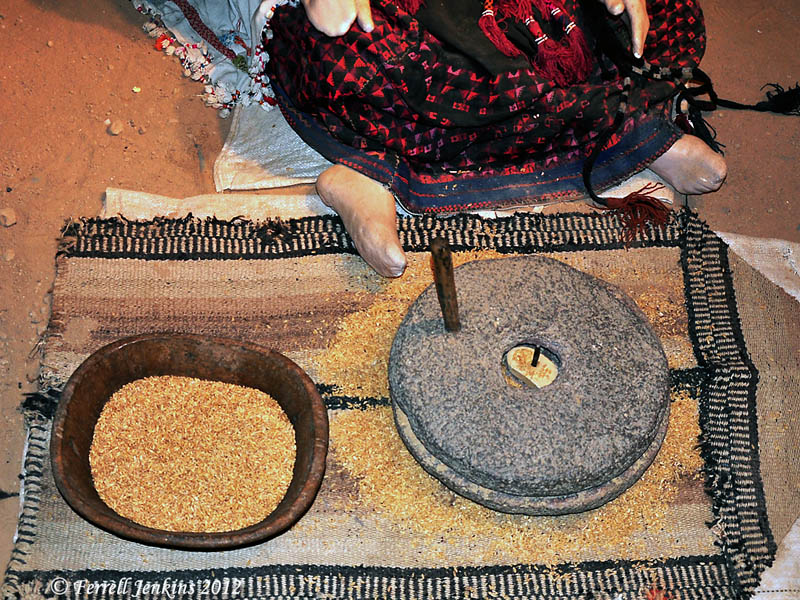
After that, there was still hard work to be done. The grain had to be ground between two millstones. The photo, below taken at The Museum for Bedouin Culture at Kibbutz Lahav in the Negev, shows the process.

Grinding grain. Exhibit at Museum of Bedouin Culture at Kibbutz Lahav. Photo by Ferrell Jenkins.

Grinding grain. Exhibit at The Museum of Bedouin Culture at Kibbutz Lahav in the Negev. Photo by Ferrell Jenkins.

There will be two women grinding grain together; one will be taken and the other left. (Luke 17:35 NET)

There was still the necessary kneading before the bread could be baked and eaten.

I am worn out. I think I will run down to the store and get a loaf of bread.