Category Archives: Culture

Restoration of historic sections of Izmir (biblical Smyrna)

Izmir is looking for local input on a restoration plan of the historic areas of Kadifekale and the agora.

On my last visit to Izmir I could see new work underway, especially in the area of the agora. The city now is developing a plan to restore an area of the city to make it more desirable for local citizens as well as tourists.

An article in Hurriyet Daily News (here) reports,

Municipal authorities in İzmir are calling for public participation amid an ambitious new project to redevelop some of the Aegean province’s most famous tourists sites in a bid to draw more visitors.

“We want to share ideas with scientists and the residents of İzmir. If we cannot get the support of citizens, it will not be possible to realize this project,” İzmir Metropolitan Mayor Aziz Kocaoğlu said.

Our first photo shows a portion of the Roman agora. The arches which appear to be at ground level are actually the lower level of a two-story building.
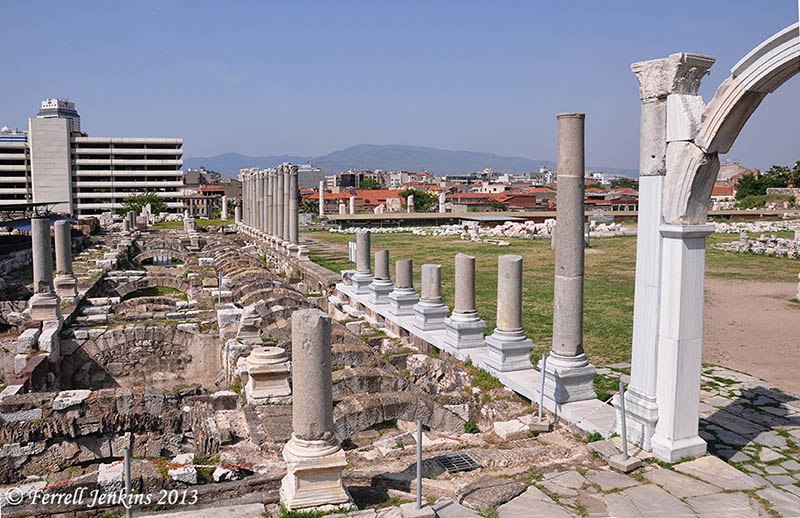
The Roman agora of Izmir, biblical Smyrna. Photo by Ferrell Jenkins.

The Roman agora of Izmir, biblical Smyrna. Photo by Ferrell Jenkins.

The second photo was made from the agora, with a view of Kadifekale. The word Kadifekale means velvet castle. In ancient times this hill was called Mount Pagos. The article mentions plans to include a restored area on the mountain, including the theater which was built on the hillside. Mark Wilson says the ancient theater, now build over by houses, seated 16,000 persons (Biblical Turkey, 312).
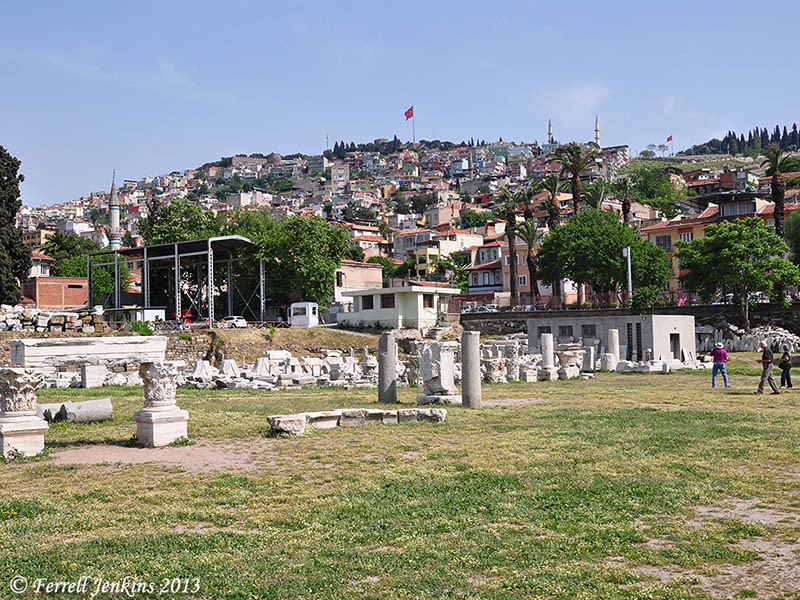
A view of Kadifekale (Mount Pagos) from the agora. Photo by Ferrell Jenkins.

A view of Kadifekale (Mount Pagos) from the agora. Photo by Ferrell Jenkins.

Smyrna is mentioned in the Bible as the location of one of the Seven Churches addressed in the book of Revelation (the Apocalypse).

“And to the angel of the church in Smyrna write: ‘The words of the first and the last, who died and came to life. (Revelation 2:8 ESV; see also 1:11)
Here’s hoping for a speedy and accurate restoration of the ancient city.
HT: Jack Sasson

“Rejoice and be glad” you are not in Jerusalem

U.S. President Barack H. Obama plans a visit to Israel, the West Bank, Jordan, beginning Wednesday. Preparations are already under way. Arutz Sheva 7 reports here on the problems already evident.

In addition to the fact that Jerusalem is now one of the most difficult cities to navigate (my opinion based on 47 years of travel experience), the Passover is approaching. Jewish families must make many special preparations.

The President will be staying at the famous King David Hotel. If you planned to visit the Herodian Family Tomb behind the hotel, just forget it for a few days.

Over 5,000 police will be directly involved in providing security for Obama and his entourage, while hundreds of others will be helping out in indirect ways. For example, over 100 officers will be added to the police help line specifically to deal with issues called in by citizens relating to the Obama visit. Police will keep citizens updated on all aspects of the visit by phone and through social media.

Over 1,000 police alone will be deployed around the King David Hotel, where Obama will be staying, and will follow Obama around as he pays visits to people and institutions during his three day visit here.

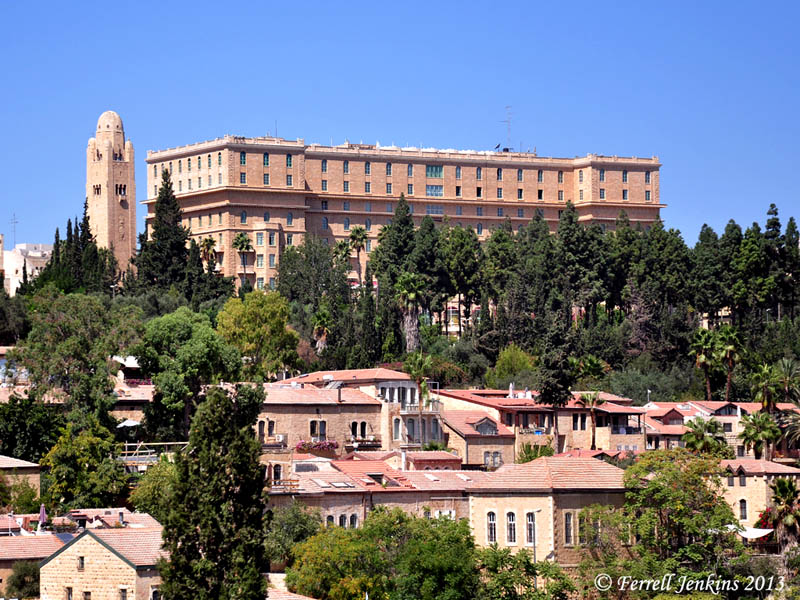
Here is a photo of the King David Hotel from across the western part of the Hinnom Valley. It was taken either from the Protestant Cemetery, the Campus of Jerusalem University College, or a few meters to the north of that.

King David Hotel from the slope of Mount Zion. Photo by Ferrell Jenkins.

King David Hotel from the slope of Mount Zion. Photo by Ferrell Jenkins.

Take a look at some of the traffic problems.

Already on Sunday, long before Obama arrives, traffic in Jerusalem was extremely choked, as police began setting up barricades, and many Jerusalemites took to the road to finish their Passover shopping while the roads are still open.

Among the roads to be closed sporadically during Obama’s visit will be Road 1, between Ben Gurion Airport and the entrance to Jerusalem, as well as main Jerusalem thoroughfares such as Herzl Boulevard and Derech Hevron [Hebron Road]. Police said they will make every effort to ensure that roads are closed only of absolutely necessary.

Several years ago I was in Jerusalem when President Clinton came to visit. Our hotel was far from the Old City, but policemen were stationed about a block apart. Nations normally enjoy these high level visits, but I am not sure this current one means very much, but it keeps Air Force One running. (O.K., you have a right to your opinion.)

HT: Barry Britnell

Video about King Herod exhibit

CBN.tv has a nice brief video about the King Herod exhibit at the Israel Museum. This video features the exhibit as well as commentary by James Snyder, Israel Museum Director, and Dr. Sylvia Rozenberg, the Senior Curator. Here you will learn the rationale behind the million dollar exhibit that emphasizes Herod as a builder.

Click here for the short video.

For previous links to King Herod and this exhibit click here, or type the word Herod in the Search Box.

HT: the Book & the Spade.

Locusts still plague the Bible lands

References to locusts in the Bible are scattered from the time when the Israelites were in Egyptian bondage to the book of Revelation. Several Hebrew terms are used to describe locusts, perhaps of different species, or because of the various stages through which the locusts grow.

The prophet Joel uses the illustration of a locust invasion upon the land.

What the cutting locust left, the swarming locust has eaten. What the swarming locust left, the hopping locust has eaten, and what the hopping locust left, the destroying locust has eaten. (Joel 1:4 ESV)

Was he speaking of literal locusts, or of the invasion of a foreign enemy?

The prophet Amos speaks of the punishments brought by the LORD upon the northern kingdom of Israel prior to the Assyrian invasion.

“I struck you with blight and mildew; your many gardens and your vineyards, your fig trees and your olive trees the locust devoured; yet you did not return to me,” declares the LORD. (Amos 4:9 ESV)

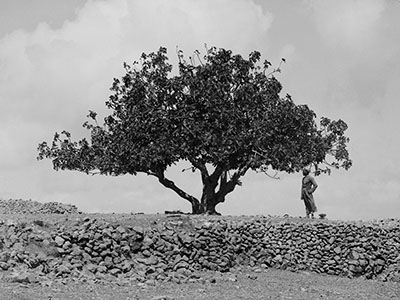
Notice that Amos makes specific reference to the fig trees and the olive trees. We have examples of this same thing happening during the 1915 locust plague. It was documented for National Geographic magazine by the photographs of Lewis Larson with a descriptive article by John D. Whiting. Here is a fig tree prior to the Locust plague.

Fig tree before the 1915 locust plague.

Fig tree before the 1915 locust plague.

And here is the way the same tree looked after the plague.

Fig tree after the 1915 locust plague.

Fig tree after the 1915 locust plague.

These two images are from the collection of 4,000 high-resolution photographs taken by resident photographers at the American Colony in Jerusalem from 1898 to the 1940s. The full set is available at Life in the Holy Land here. In addition to the photos in the collection, the photos are included in PowerPoint presentations. Descriptive information is included with many of them.

Several articles have appeared in the past week or so about a modern locust plague that affected Egypt and southern Israel. See here for Egypt. Some Jews, especially those from Yemen, gathered the photos [it was late; I meant locusts] for eating (see here). Some rabbis warned that the locusts may not be kosher (see here).

Just a reminder that some species of locusts were acceptable for the Israelites to eat.

Of them you may eat: the locust of any kind, the bald locust of any kind, the cricket of any kind, and the grasshopper of any kind. (Leviticus 11:22 ESV)

I know you can’t forget the diet of John the Baptist.

Now John wore a garment of camel’s hair and a leather belt around his waist, and his food was locusts and wild honey. (Matthew 3:4 ESV)

Seth Rodriquez provides more info about the 1915 plague here.

Horses in the Golan Heights

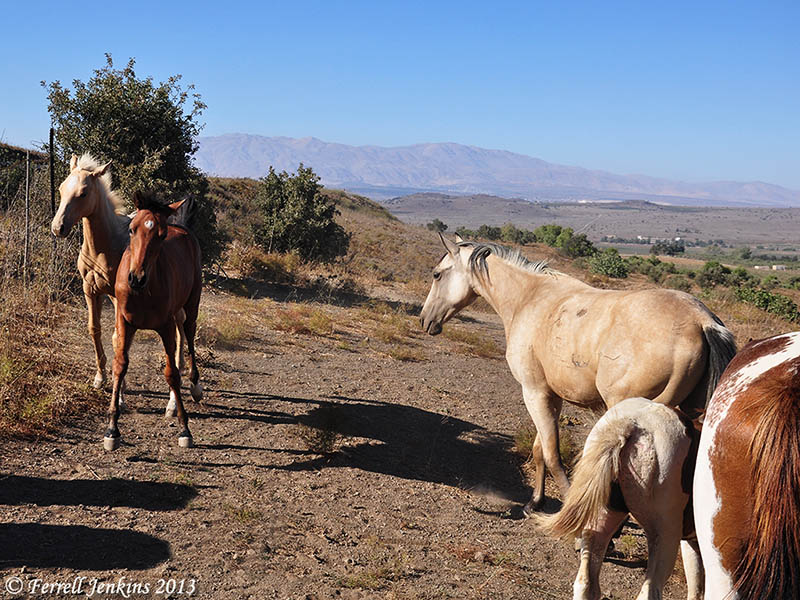
Last September we stopped in the Golan Heights at the overlook east to Kuneitra, Syria. A few horses were being pastured in the area. Mount Hermon is visible to the north.

Horses in the Golan Heights. Mount Hermon in the distance. Photo by Ferrell Jenkins.

Horses in the Golan Heights. Mount Hermon in the distance. Photo by Ferrell Jenkins.

This area is included in the description of the victories of the Israelites.

Now these are the kings of the land whom the people of Israel defeated and took possession of their land beyond the Jordan toward the sunrise, from the Valley of the Arnon to Mount Hermon, with all the Arabah eastward: (Joshua 12:1 ESV)

Conrad Schick — architect, explorer, model builder

Conrad Schick was born in Switzerland and first came to Jerusalem with a group of men who planned to teach the local young people vocational trades. This group soon disintegrated, and Schick eventually married Friederike Dubler, a German missionary.

Schick became well known as an architect and city planner. He also became involved with some of the late 19th century explorers. He surveyed significant parts of the Old City, and built models of the temple mount and other structures in Jerusalem to use in teaching.

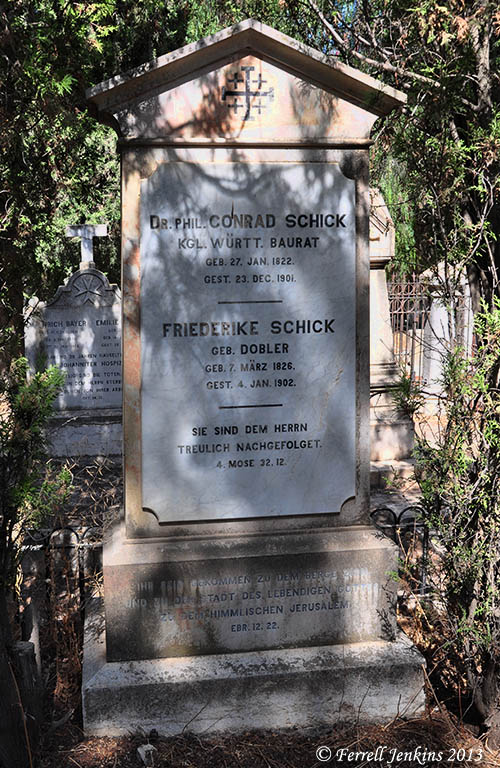
Schick and his wife are buried in the Protestant Cemetery on Mount Zion.

Grave marker for Conrad and Frederike Schick. Photo by Ferrell Jenkins.

Grave marker for Conrad and Frederike Schick. Photo by Ferrell Jenkins.

Epitaphs are often fascinating. This grave stone includes two Scriptures in German.

… for they have wholly followed the LORD (Numbers 32:12)

But you have come to Mount Zion and to the city of the living God, the heavenly Jerusalem … (Hebrews 12:22)

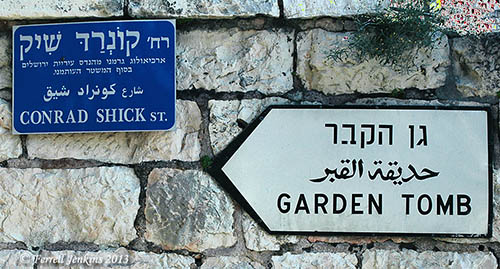
The short lane leading from Nablus Road to the Garden Tomb is named for Conrad Shick [Schick].

Conrad Schick Street leads to the Garden Tomb. Photo by Ferrell Jenkins.

Conrad Shick Street leads to the Garden Tomb. Photo by Ferrell Jenkins.

Tom Powers has prepared an article about Conrad Schick, and I have made use of it in this post. The entire paper is fascinating. See here.

There is also a page devoted to Schick here.

Special Note: If you have any interest in the American Colony, and other people buried in this cemetery, please take a look at the comments by Tom Powers (Outremer) following the two earlier posts about the Spaffords.

The Spafford grave in the Protestant Cemetery

How the Spaffords came to make Jerusalem their home is an interesting story, but I will leave it for you to read in Bertha Spafford Vester, Our Jerusalem: An American Family in the Holy City 1881–1949. It may be difficult to locate a copy of the book for a reasonable price, but it is available in Kindle format for $8.39. Click here: Our Jerusalem.

The members of the American Colony lived under a series of governments — the Turks, British, Jordanians, and Israelis. Horatio died in 1888 during the Turkish rule. The American Colony had secured a place for burials on the south eastern slope of the traditional Mount Zion overlooking the Hinnom Valley.

Before I can show you the grave marker of Horatio Spafford I should tell you about the desecration of his original grave. Toward the end of the 19th century, when the members of the American Colony needed a grave site, they learned that earlier burials had been removed and the remains placed “temporarily” in a large pit. After much effort, permission was granted by various ruling authorities for the bones to be gathered, and a small plot was granted for the burial of the American Colony members.

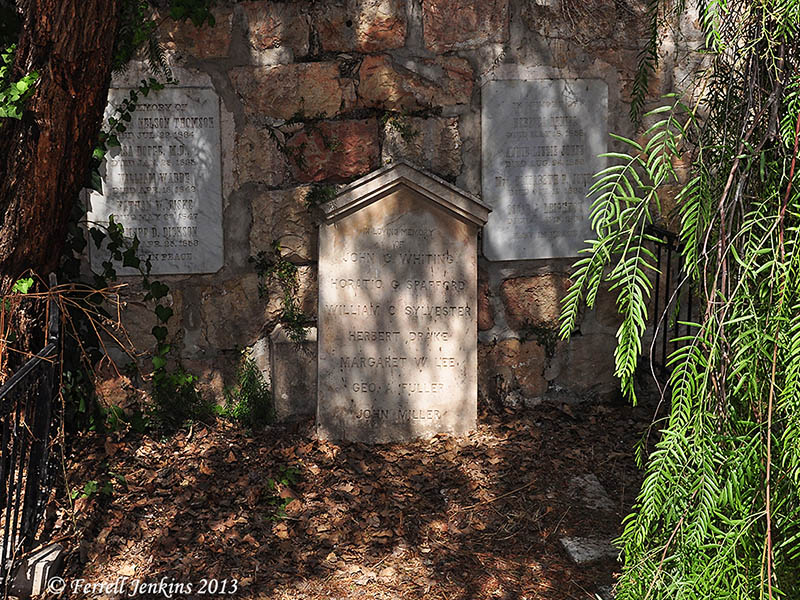
That small plot is pictured below. It is immediately inside the gate to the cemetery. The large marker identifies seven members of the American Colony whose remains were recovered: John C. Whiting; Horatio G. Spafford; William C. Sylvester; Herbert Drake; Margaret W. Lee; Geo. A. Fuller; John Miller. I have noticed at least four of these names in Vester’s Our Jerusalem. Whiting was also from Chicago. He and his family came to Jerusalem with the Spaffords, as did Margaret Lee.

Grave stone for Spafford and other members of the American Colony in the Protestant Cemetery on Mount Zion. Photo by Ferrell Jenkins.

Grave stone for Spafford and other members of the American Colony in the Protestant Cemetery on Mount Zion. Photo by Ferrell Jenkins.

The two smaller markers in the wall identify others whose bones were recovered and buried in the common grave.

In 1896 a group of 37 Swedish farmers left Nås, Sweden, and made their way to Jerusalem. They took up residence at the American Colony. (Vester says there were 38, including 17 children, and a babe in arms. Perhaps the infant was born after leaving Sweden.) The Swedes mostly engaged in farming in the nearby Kidron Valley. I think you would enjoy reading the comment to the last post written by reader Erik Wold. You may see his photographs of Nås and read his Norwegian comments here (use Google Translate if you do not read Norwegian). The Swedish writer Selma Lagerlöf won a Nobel prize for her novel called Jerusalem, which was based on the American Colony. Bertha Vester says that her mother, Anna Spafford, “is the heroine in her book and is called Mrs. Gordon.”

Something else that has fascinated me is the fact that Eric Matson and the American Colony photographers worked from this location. About 40 years ago I edited a series of Bible Class literature called Truth in Life. We used some of Eric Matson’s wonderful Bible land photographs in the series. For more information about the work of Matson and the other photographers see Life in the Holy Land. I think Matson was the heir of one of the settlers from Sweden.

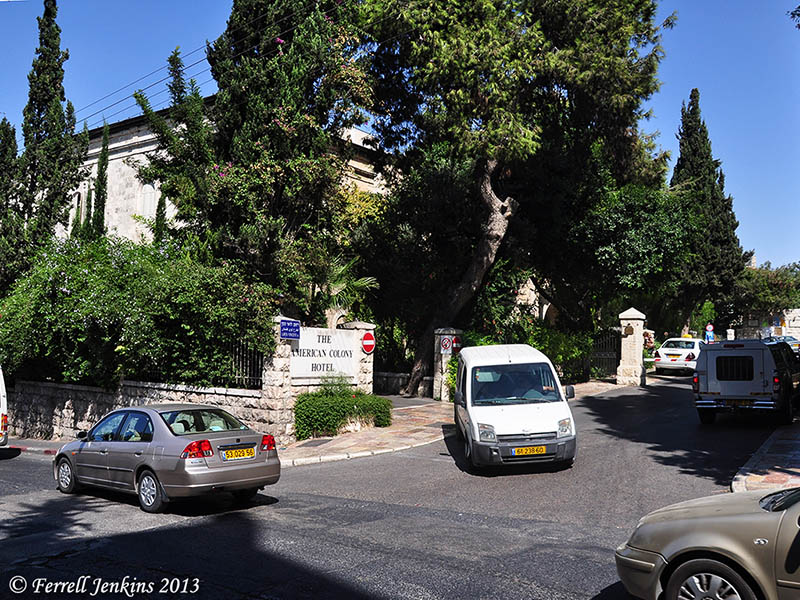
I do not know anything about the present ownership of the American Colony Hotel, but it is a prestigious 5-star luxury hotel.

Entrance to the American Colony Hotel, Jerusalem. Photo by Ferrell Jenkins.

Entrance to the American Colony Hotel, Jerusalem. Photo by Ferrell Jenkins.

Would you like to see more photographs from the Protestant Cemetery?

Green pastures

David, in describing the LORD as his shepherd, pictures himself as a sheep.

The LORD is my shepherd; I shall not want. He makes me lie down in green pastures. He leads me beside still waters. (Psalm 23:1-2 ESV)

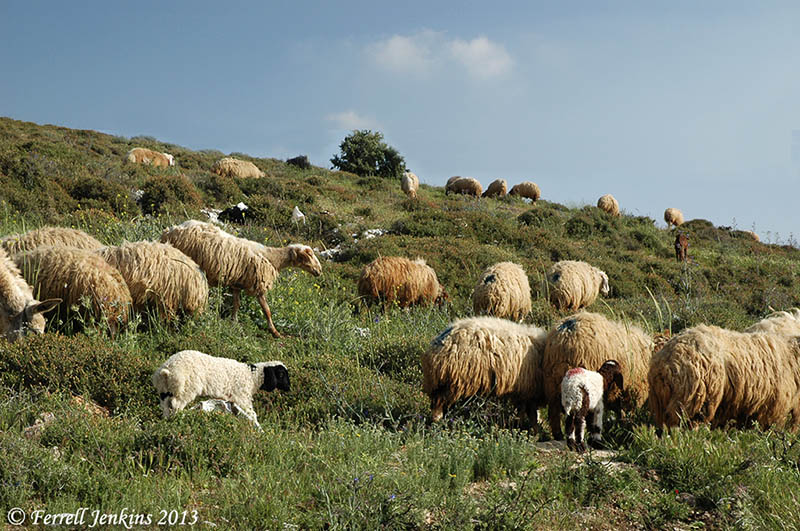
The picture below was made near Heshbon on the Transjordan plateau. It is rare in Israel or Jordan to see sheep in such an abundance of grass.

Sheep near Heshbon in Trans-Jordan. Photo by Ferrell Jenkins.

Sheep near Heshbon in Trans-Jordan. Photo by Ferrell Jenkins.

The Hebrew term mishor describes “level country, table-land, plain … specifically of the elevated plateau or table-land between the Arnon and Heshbon” (Brown, Driver, Briggs). Take a look at Joshua 13:17 in several English translations. Most of the popular English versions use the term plain. The NIV and the CSB use the term plateau.

We describe the area east of the Jordan Valley, now in the Hashemite Kingdom of Jordan, as Transjordan (the area across the Jordan). There are many hills, even mountains, in Transjordan, but the entire area is a plateau. In Israel there is a central mountain range between coastal plains and the Jordan Valley.

Like a cluster of henna…

Henna is mentioned only twice in the Bible, both in the Song of Solomon (or Canticles). The Shulammite girl describes her beloved.

My beloved is to me a cluster of henna blossoms in the vineyards of Engedi. (Song of Solomon [Canticles] 1:14 ESV; see also 4:13)

Scholars are divided about the meaning of the Hebrew term used here. Is this woman named Shulamith? Is she from the Jezreel Valley town of Shunem? Is she described as “the Perfect One” (NET Bible)? Or, is there some other plausible explanation?

Tristram mentions finding the “camphire of Engedi” at the site (cf. KJV transliteration of the Hebrew kopher).

The camphire of Engedi, mentioned in the Book of Canticles, we identified in a pretty shrub, with bunches of graceful pink-white blossoms, which was already in flower in some sheltered nooks, and called El-Henna by the Arabs, from which they procure the Henna dye—the Lawsonia alba of botanists. (The Land of Israel: A Journal of Travels in Palestine, Undertaken With Special Reference to Its Physical Character, 294-95).

Some small plants identified as henna can be seen at Neot Kedumim in the low hill country between Modi’in and Tel Aviv. Both they and the Fauna and Flora of the Bible identify it with the Lawsonia inermis. I don’t know how to sort out this name and the Lawsonia alba that Tristram mentions.

Henna growing at Neot Kedumim. Photo by Ferrell Jenkins.

Henna growing at Neot Kedumim. Photo by Ferrell Jenkins.

Henna is used by women of many societies on their hands, and other parts of the body. In several places I have seen local women painting designs on those who wished to try it.

One of the young ladies of my tour got henna tatoos from the Nubians in southern Egypt. Photo by Ferrell Jenkins.

Stacy got henna tattoos from a Nubian lady in southern Egypt near Aswan. She says it lasted about three weeks. Photo by Ferrell Jenkins.

Stacy tells me that the henna caused quite a stir when she returned to work. She says,

I talked with my hands. I gestured during a meeting and it stopped the meeting cold. Everyone stared. I said, “not to worry … it will disappear in 3 weeks” and continued on with the point I was making. 🙂

Life is fun.

Some suggested reading…

Wayne Stiles has a nice blog in which he connects the Bible and its Lands to life. He has suggested five other blogs for his readers here. I am honored to be included in his list. I appreciate these introductory words.

Where biblical events took place are more than throwaway mentions in the pages of Scripture. Often, they have significant bearing on God’s participation in the lives of His people.

Unfortunately, because we’re unfamiliar with geography we often miss these nuggets. I have found a lot of help in several Holy Land blogs that open up the Bible’s lands to my understanding.

Take a look at his list here. How many of them do you read?

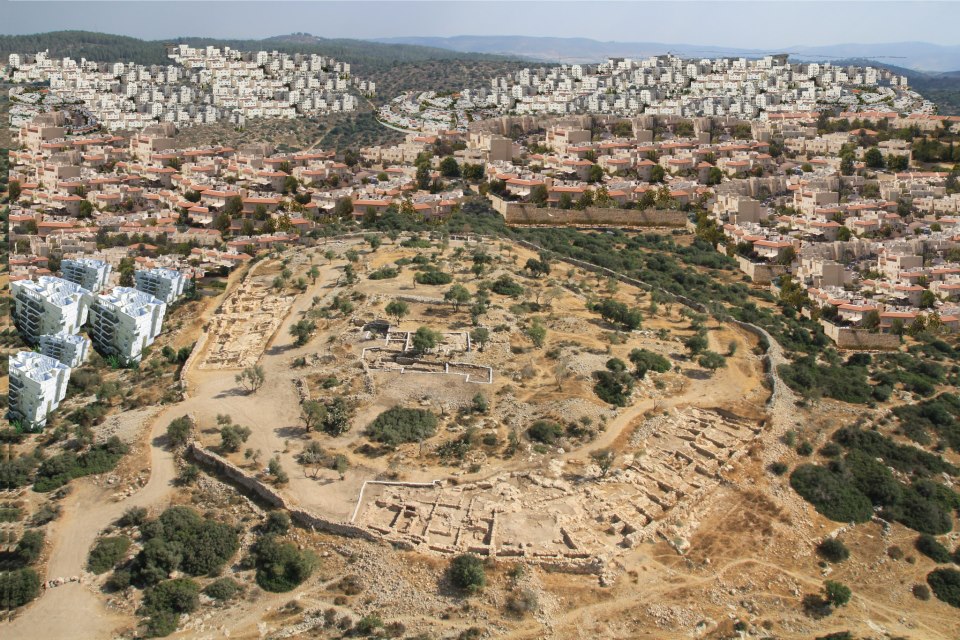
My friend and neighbor Luke Chandler has participated in the archaeological excavations at Khirbet Qeiyafa for at least three years. Qeiyafa is a city overlooking the Valley of Elah. Luke reported recently that a massive building program at the nearby town of Beit Shemesh would bring new residential buildings “no more than 20 meters from Qeiyafa’s western gate and wall.” At the present time the entire area from Qeiyafa eastward is without housing. The houses that have been drawn in show the proposed construction. Progress is sometimes good, but this is sad.

Proposed construction at Khirbet Qeiyafa.

The current plan for the expansion of Beit Shemesh. Some buildings are no more than 20 meters or so from the casemate wall and gate. The likelihood of damage to the site during and after construction would be significant. (Comment by Luke Chandler)

You can read Luke’s comments and see others photo here. Visit the Khirbet Qeiyafa: Save King David’s City Facebook page here. You will find more photos and diagrams.