Category Archives: Culture

“You shall not steal…You shall not covet”

“You shall not steal. “You shall not bear false witness against your neighbor. “You shall not covet your neighbor’s house; you shall not covet your neighbor’s wife, or his male servant, or his female servant, or his ox, or his donkey, or anything that is your neighbor’s.” (Exodus 20:15-17 ESV; cf. Romans 13:9)

The Ten Commandments, given to the nation of Israel, were clear about the attitude one should take toward the property belonging to others. Coveting causes one to desire the wife, or the property, of another man.

The reason the donkey and ox of another was not to be coveted or stolen was because these were the man’s means of income. How could he work without his donkey or ox?

A loaded donkey at Seleucia. Photo by Ferrell Jenkins.

A loaded donkey at Seleucia. Photo by Ferrell Jenkins.

It may be that none of my readers own a donkey or an ox, but the principle is clear. You shall not take that which belongs to another person. When I was teaching I had to deal with this issue a few times. I am confident that it happened other times, but I did not know about it at the time.

When a student turns in a report or paper that was written by another student he/she is stealing the work of another and pretending that it is his own. Occasionally a student will look over and take an answer that another person has given to a question. That is stealing.
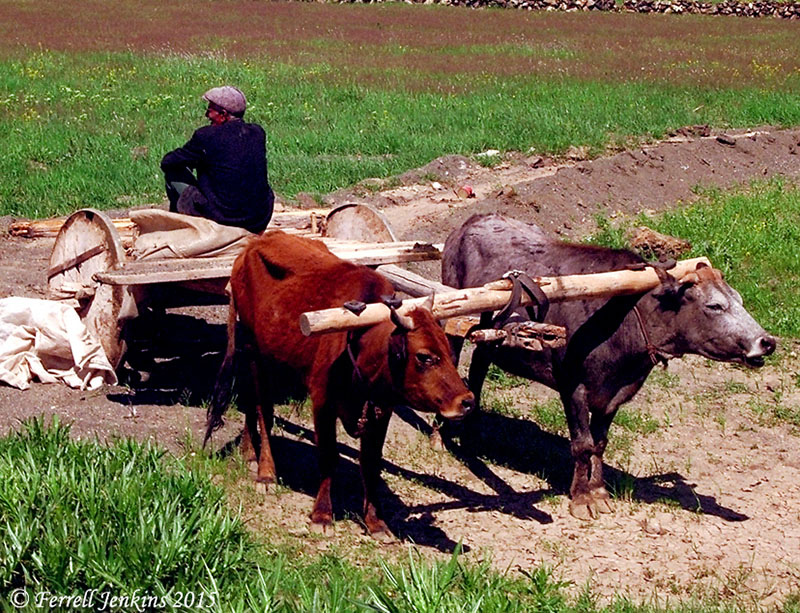
Oxen hitched to a small wagon near Mount Ararat in Turkey. Photo by Ferrell Jenkins.

Oxen hitched to a small wagon near Mount Ararat in Turkey. Photo by Ferrell Jenkins.

There is such a thing as intellectual property. The government of the United Kingdom describes intellectual property as “the words you’ve written.” It includes “things you write, make or produce.” Like photos, for example.

A student once told me that there was a student on campus who would make a CD of ten of your favorite songs for $1 for each song.  What if a person spends literally several thousand of dollars to purchase equipment, travel a long distance and make photos. Would it be o.k. to take that property and treat it as one’s own.

Several years ago I had a young person to copy some of my posts without permission and post them on his own web site. He cropped the photos to cut off the copyright notice. He said he didn’t know. His web site was closed down.

Recently someone living in a fashionable neighborhood in another country registered a internet site using my name. (I could post a photo of his house from Google earth!) He had this entire web site posted on his new domain, but he made it impossible for readers to reach me. All Email was directed to him (or her?).

There are strict laws governing this sort of thing. In the USA we have the DMCA (Digital Millennium Copyright Act). I have learned that some (perhaps most or all) of the hosting companies take this seriously. The DMCA “implements the 1996 treaties of the World Intellectual Property Organization (WIPO)” (Wikipedia, here), to which most of the nations in the United Nations subscribe. Once I got to the correct company, the offending web site was closed very quickly.

Even the Code of Hammurabi (ruled 1728-1686 B.C., according to Pritchard) contained numerous laws containing the penalties for stealing. Law 8 says,

If a seignior stole either an ox or a sheep or an ass or a pig or a boat, if it belonged to the church (or) if it belonged to the state, he shall make thirtyfold restitution; if it belonged to a private citizen, he shall make good tenfold. If the thief does not have sufficient to make restitution, he shall be put to death. (ANET).

I think that most of us are pleased when someone finds our material useful and even wants to share it with others. But stealing one’s property is another matter.

Our PHOTO PERMISSION page is liberal regarding private and classroom non-commercial use of our photos as long as credit is given.

Thanks for reading this blog. I hope you find it helpful in your own study and teaching.
The Other Bethlehem – Part 2

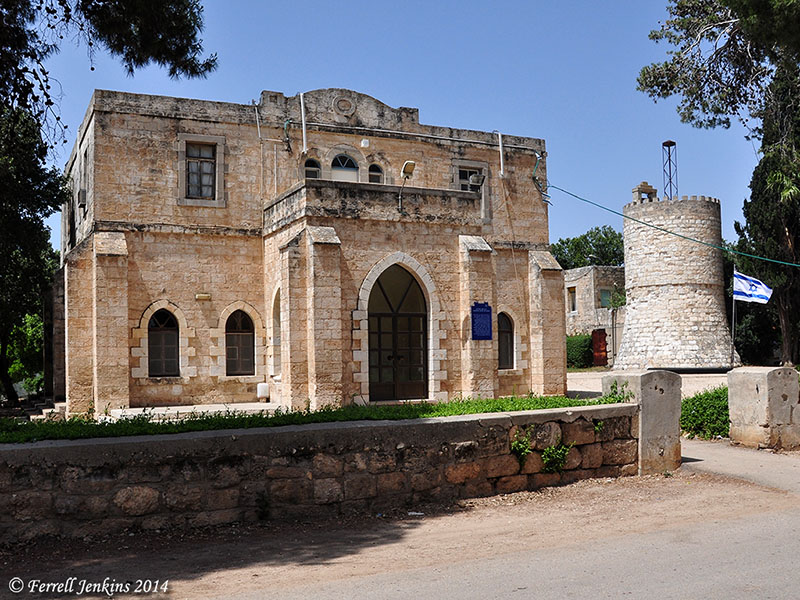
The unique buildings we now see in the little village of Beit Lehem HaGlilit (Galilean Bethlehem) were erected in the 1930s by a group of German nationals. A 2008 article by Lydia Aisenberg in the Jerusalem Post explains the origin and dispersion of the group. Aisenberg says that Beit Lehem HaGlilit and the nearby town of Waldheim (now Alonei Abba)…

…were built by the Templars [or Templers], a German-Christian sect and Nazi sympathizers who were rounded up by the British in 1939 and deported out of Mandate Palestine. Some chose to return to Germany, but the majority of the Templar community’s members emigrated to Melbourne, Australia.

The sect originated in southern Germany and carried a holy mission known as the Tempel Gemeinde, or Tempelgesellschaft. The sect’s name was later shortened to just “Templars,” often confused with another group, the Crusader-era Templer Knights.

The Templars arrived in the Ottoman controlled Holy Land in mid-l880 and began to build communities in different parts of the country: Haifa, Jaffa, Jerusalem, Sarona (Tel Aviv), as well as the two communities Beit Lehem HaGlilit and Waldheim in the Jezreel Valley.

After World War I, the British sent the Templars packing, but members of the sect were later allowed to return. They were banished for a second and final time when their Nazi connections were discovered in the late 1930s.

Templar youth from Palestine had been sent to attend “educational” youth activities and family visits in Germany, where they met with top Nazi officials. Photographs on display at the Beit Lehem HaGlilit home of the Fleischman family depict Templar sect members wearing swastika armbands and congregating in one of the large courtyards between the two-story buildings and outhouses.

The Templars of Beit Lehem HaGlilit (Galilean Bethlehem) and neighboring Waldheim (meaning “Forest Home” in German) were eventually rounded up by the British and sent to detention camps until their deportation, after which British Mandate soldiers and police were billeted in the Templars’ former homes.

When Jewish refugee families later moved into the Templar houses in Beit Lehem HaGlilit and Alonei Abba, they discovered hidden Templar belongings that attested the sect’s support of Adolf Hitler and the Nazi regime. Items discovered in the community’s homes included Nazi party pennants, badges, banners, pamphlets and flags, in addition to photographs.

The stone house below, built by the Templars, served as a community house for the German nationals who lived in Galilean Bethlehem in the 1930s.

The Community House at Beit Lehem HaGilit. Photo by Ferrell Jenkins.

The Community House at Beit Lehem HaGilit. Photo by Ferrell Jenkins.

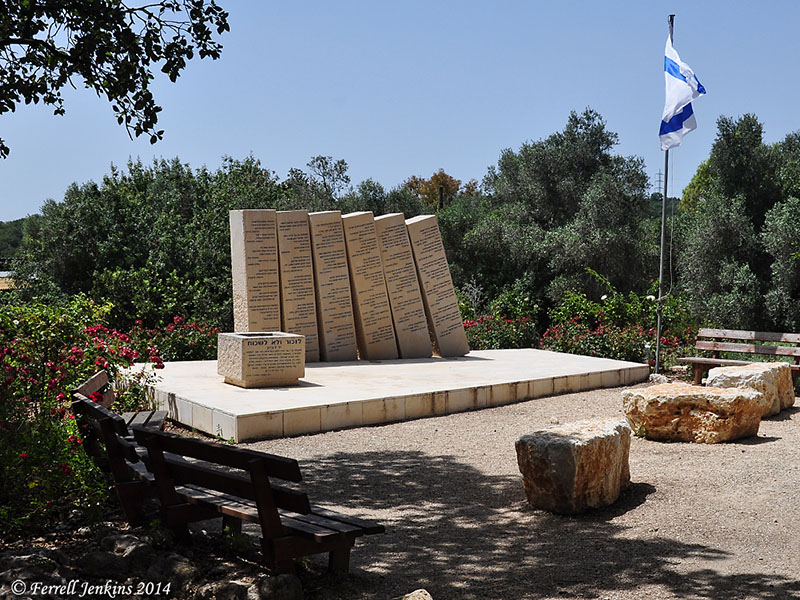
The next photo is of the Holocaust memorial erected by the residents of the town in 2007. Aisenberg explains the significance of the monument.

Its six large marble slabs lean forward, as if struggling to keep their pride and stay erect under the heaviest of loads.

Engraved on the memorial are the names of Jews snatched from their homes, transported and murdered by the Nazis. The names of the European towns and villages in which they had lived for generations are also etched deep in the stones, which seem to strain under the weight of memorializing so many thousands of murdered Jews and their annihilated communities.

The victims whose memories are honored on the six marble blocks, unveiled last year, are extended family members of today’s residents of the pleasant, upscale community of Beit Lehem HaGlilit.

A smaller block of marble at the side of the memorial boasts an inscription reading: “Erected by the community of Beit Lehem HaGlilit, second generation since the Holocaust, in recognition of our parents who survived the Holocaust, made aliya to Eretz Israel, participated in the founding of the state and amongst the founders of Beit Lehem HaGlilit, our home and in memory of our family members who were murdered by the Nazis in Europe during the years of 1939-1945.”

Monument to Holocaust Victims at Beit Lehem HaGelit. Photo by Ferrell Jenkins.

Monument to Holocaust Victims at Beit Lehem HaGelit. Photo by Ferrell Jenkins.

The complete article by Lydia Aisenberg may be read here.

After Part 1 was posted, Erik Wold left a comment and link that is pertinent at this point. The Dec. 26, 2014 issue of the London Mirror carried an article entitled “Is this secret Nazi enclave the REAL Bethlehem where Jesus Christ was born?” here.

The authors of the article claim that the settlement in Galilean Bethlehem was an effort by Hitler and Himmler “to show that Jesus was born an Aryan, not a Jew.”

This is home to a secret Nazi sect waiting for the Second Coming in the heart of the Holy Land.

And behind it all is an anti-Semetic [Semitic] fantasy dreamed up by Adolf Hitler and Heinrich Himmler to show that Jesus was born an Aryan, not a Jew.

It may seem stranger than fiction but it all really happened in Bethlehem of Galilee, nine miles west of Nazareth.

The article also advances the theory of Dr Aviram Oshri that Jesus was born in Galilean Bethlehem, while acknowledging that the Israel Antiquities Authority “dismiss his claim as ‘worse than a joke.'”

As a result of something I read in the Mirror article I was led to Heidemarie Wawrzyn’s Nazis in the Holy Land 1933-1948. She says that the German colonies were used to aid Arab rebels. All of this came to a head about 1938 and resulted in the expulsion of the settlers.

I do not claim much knowledge about the Templars or the German settlement at Bethlehem, but I do find all of this intriguing as a prelude to the founding of the State of Israel in 1948.

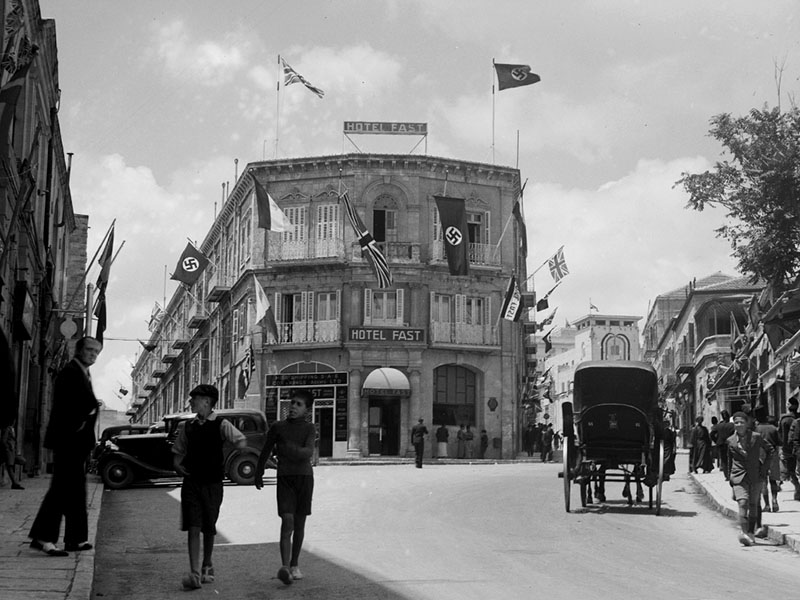
Added Note: See the comment below by Tom Powers. Here is a copy of the photo he mentions. Use Tom’s link for the original at the Library of Congress.

Photo taken on Coronation Day of King George VI in 1937. The Fast Hotel, on lower Jaffa Road, was owned by a Templer family.

Photo taken on the Coronation Day of King George VI in 1937. The Fast Hotel, on lower Jaffa Road, was owned by a Templer family. Notice both Nazi Flags and the Union Jack.

Bock Responds to the Newsweek attack

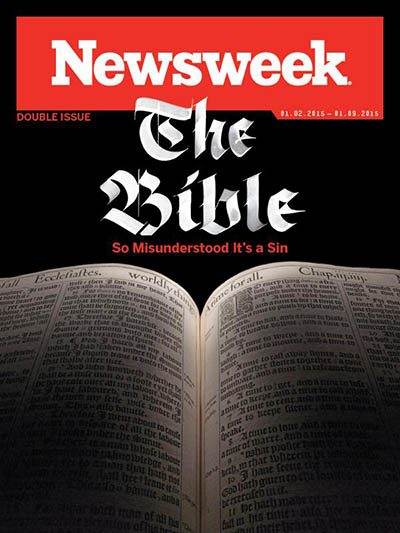
Newsweek on The Bible

Newsweek on The Bible

It almost always happens around Christmas and Easter. The print and film media launches a critical attack on the Bible, Judaism, and Christianity. This time it is Newsweek, in an article called “The Bible So Misunderstood It’s a Sin” (here) by Kurt Eichenwald.

Dr. Darrell L. Bock, Senior Research Professor of New Testament Studies at Dallas Theological Seminary, is writing a response to Newsweek’s take on the Bible. Part I deals with the Base Biblical Text, answering the question “Do we really know what we have?”

This response is available on bock’s blog here. Pass this along to your friends.

HT: Brooks Cochran

Jesus visited Jerusalem during Hanukkah

The Gospel of John records more visits to Jerusalem by Jesus than any other of the Gospels. John is the only one to record the visit during the Feast of Dedication.

At that time the Feast of Dedication took place at Jerusalem. It was winter,  and Jesus was walking in the temple, in the colonnade of Solomon. (John 10:22-23 ESV)

BDAG translates the Greek term egkainia as “festival of rededication.” The feast is also known as Hanukkah and the Feast of Lights.

What is he Feast of Dedication? This feast, observed on the 25th of Kislev (roughly our December), had its origin in the period between the testaments. The desecration of the temple by the Seleucid ruler Antiochus Epiphanes took place in 168 B.C. The climax of the Maccabean revolt was the removal of all evidences of pagan worship from the temple. An eight day feast of dedication was observed in 165 B.C., and continued to be observed annually by the Jews.

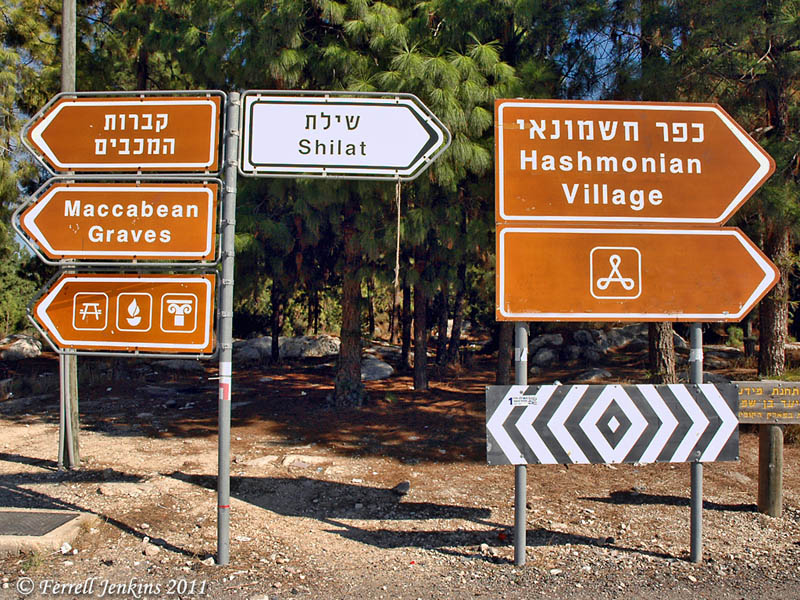
At Modin, a village north-west of Jerusalem, on the way from Jerusalem to Lod, the Syrians tried to force an old priest by the name of Mattathias to offer a pagan sacrifice. The priest refused but another Jew volunteered to offer the sacrifice. Mattathias killed his fellow Jew and the Syrian officer. As word spread, Mattathias became a national hero. He was of the family of Hasmon (or Asmoneus). Thus began the Hasmoneans.

The discovery of a burial cave at Modin thought to have been used by the Maccabees and/or their descendants was reported in November, 1995. There are Israeli scholars who argue that this is not the true grave of the Maccabees. An article in Haaretz says,

Amit Re’em, an archaeologist of the Israel Antiquities Authority says all the evidence points to the fact that these graves are of Christians and pagans and that this burial site actually belongs to an ancient monastery.

Read the Haaretz article here.

Near Modin, signs point to the Maccabean Graves. Photo by Ferrell Jenkins.

Near Modin, signs point to the Maccabean Graves. Photo by Ferrell Jenkins.

Even though the Feast of Dedication was not a feast authorized by the Mosaic Law, it became part of the Jewish heritage, and Jesus came to Jerusalem at that time — at least once.

Jesus cleansed the Temple on two distinct occasions. The first time is recorded in John 2:14-22. The second account is recorded in Matthew 21:12-13; Mark 11:15-18; and Luke 19:45-48.

• This is a golden oldie from December 24, 2011.

Index of articles on Bethlehem and the Birth of Jesus

Bethlehem and the Birth of Jesus.  Our total number of posts has now grown to more than 1700 and this makes it difficult to locate a post you may need. This index is prepared to assist you in your study of the birth of Jesus in ancient Bethlehem. Most, if not all, of the posts include at least one photo illustrating the lesson.

Other places near Bethlehem. Most of the links below are related to Herod the Great and the fortress he built near Bethlehem. I see that I have normally used the spelling Herodium, but sometime Herodion.

Historical Connections to Modern Christmas Celebrations. These post are post-biblical, historical references to customs associated with Christmas.

When other posts on this subject are written I will try to remember to update the list.

Tabgha (Heptapegon) – a good place for fishing

Mendel Nun describes Tabgha as “The Fishermen’s Suburb of Capernaum.” Tabgha is a corrupted form of the name Heptapegon which means “seven springs.” Why would someone who lived at Capernaum, like Simon Peter and Andrew (Matthew 4:13-20), think of going west 1½ miles to fish?

Nun explains the importance of Tabgha for fishing.

The springs of Tabgha have great economic importance. In the winter, the warm water draws schools of warmth-loving musht, tropical in origin, to the vicinity. The waters of the springs were once used to operate several flour mills. The Capernaum fishermen stayed in this area during winter and early spring, making Tabgha an important industrial suburb of Capernaum. A small harbour which served the millers and fishermen was found in the nineteen seventies. (The Sea of Galilee and Its Fishermen in the New Testament, 14).

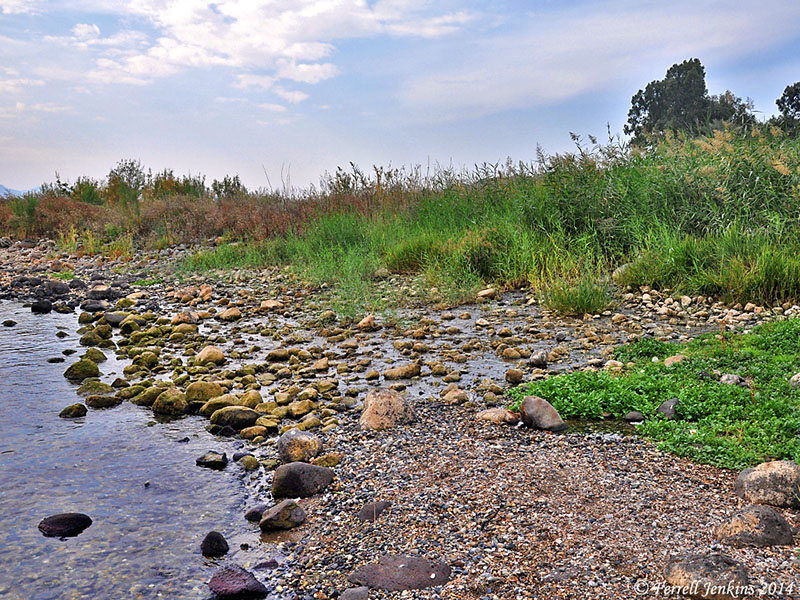
Just a few yards west of the Church of the Primacy, which we showed in the previous post, one of the seven warm springs was flowing freely during our 1992 visit to the site. When the water is high one would not notice this spring.

One of the seven springs at Heptapegon (Tabgha). Photo by Ferrell Jenkins.

One of the seven springs at Heptapegon (Tabgha). Photo by Ferrell Jenkins.

We are not told where Peter and Andrew were fishing when Jesus called them, but Tabgha certainly would be a good place.

As he was walking by the Sea of Galilee he saw two brothers, Simon (called Peter) and Andrew his brother, casting a net into the sea (for they were fishermen). (Matthew 4:18 NET)

As he went along the Sea of Galilee, he saw Simon and Andrew, Simon’s brother, casting a net into the sea (for they were fishermen). (Mark 1:16 NET)

And this would be a good place for the events of John 21, or the earlier account recorded in Luke 5:1-11. Rousseau and Arav (Jesus and His World, 97) conflate these two accounts into one and conclude that John “was written by a different author or editor.” A reading of both texts shows that the one in Luke is at the beginning of the ministry of Jesus when He calls the disciples, and the one is John is at the close of His earthly ministry after His resurrection (21:14).

It would be common for fishermen to stand on the shore or in the edge of the water and cast a net into the warm water where the fish gathered.

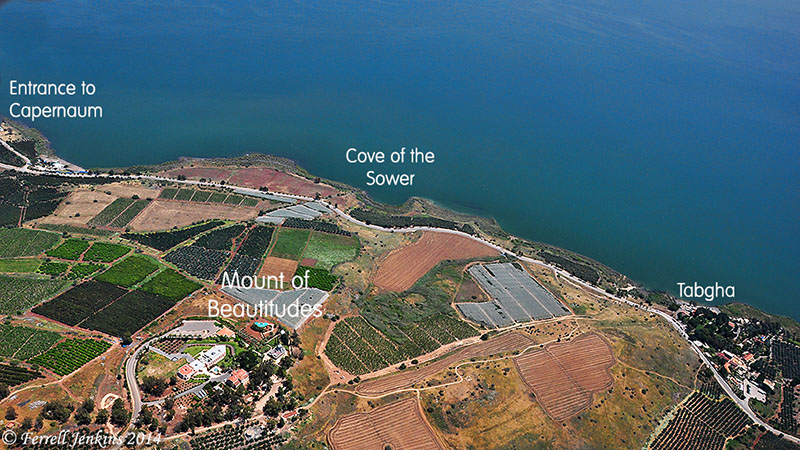
Our final photo this time is an aerial view showing the north shore of the Sea of Galilee from Tabgha on the right (west) to the entrance to Capernaum on the left (east). The traditional Mount of Beatitudes is on the hill above. The distance from the entry to Capernaum to Tabgha is 1.25 mile on a straight line. Add another .4 mile to reach the archaeological site of Capernaum.

North shore of the Sea of Galilee from Capernaum to Tabgha. Photo by Ferrell Jenkins.

North shore of the Sea of Galilee from Capernaum to Tabgha. Photo by Ferrell Jenkins.


Fish of the Sea of Galilee

In 1993 Mendel Nun published an article in Biblical Archaeology Review entitled “Cast Your Net Upon the Waters: Fish and Fishermen in Jesus’ Time.” Nun, now deceased, explains the meaning of his name:

For more than 50 years, I have lived at Kibbutz Ein Gev on the shore of the Kinileret [Kinneret], the Sea of Galilee. For much of that time, I have been a fisherman. The Hebrew letter nun (N) means fish in Aramaic. My former name—I was born in Latvia—began with an N. When I became a fisherman, I simply took that first letter as my new surname. (BAR 19:06 (Nov/Dec 1993)

Nun explains that he was continually surprised “at how accurately the New Testament writers reflect natural phenomena on the lake.”

A more detailed source of information by Nun is his 1989 The Sea of Galilee and Its Fishermen in the New Testament.

Nun says there are 18 species of indigenous fish in the Sea of Galilee, and that 10 of those are important commercially. The edible fish are classified as follows:

  • Musht. This group includes the popular Tilapia Galilea, commonly called Saint Peter’s fish.
  • Biny (Barbels). “This group consists of three species of the Carp family.” The two most common species are the Barbus longiceps and the Barbus Canis. Both are used by Jews for Sabbath meals and feasts.
  • Kinneret Sardine. “At the height of the fishing season, tens of tons of sardines are caught every night.” In New Testament times these fish were preserved by pickling. Magdala was known as the center of this industry.

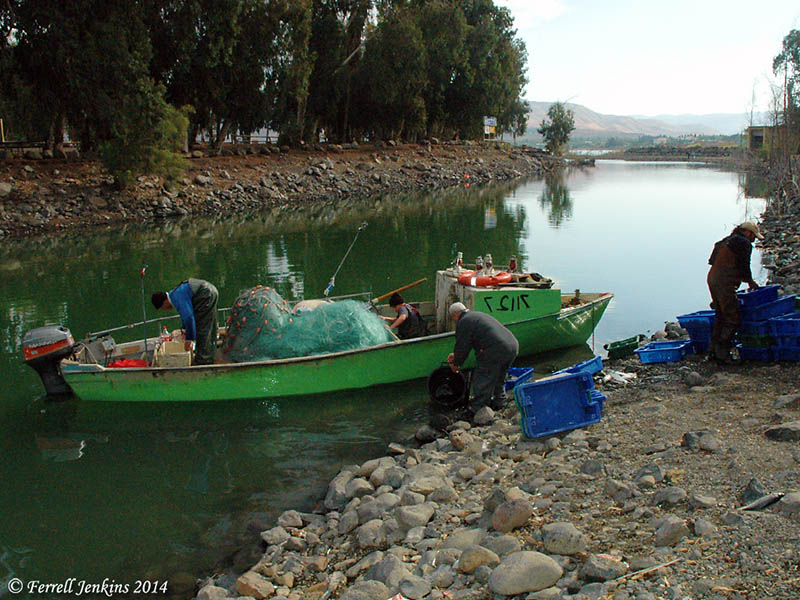
Our first photo shows fishermen unloading their catch of Musht early in the morning. This photo was made where the Jordan River exits from the south end of the Sea of Galilee.

Fishermen coming in from a night of fishing. Photo by Ferrell Jenkins.

Fishermen coming in from a night of fishing. Photo by Ferrell Jenkins.

Fish are unloaded to be taken to restaurants and markets in the area. I have seen this fish for sale in the Old City of Jerusalem.

Fishermen unloading their catch at the outlet of the Jordan River from the Sea of Galilee. Photo by Ferrell Jenkins.

Fishermen unloading their catch at the outlet of the Jordan River from the Sea of Galilee. Photo by Ferrell Jenkins.

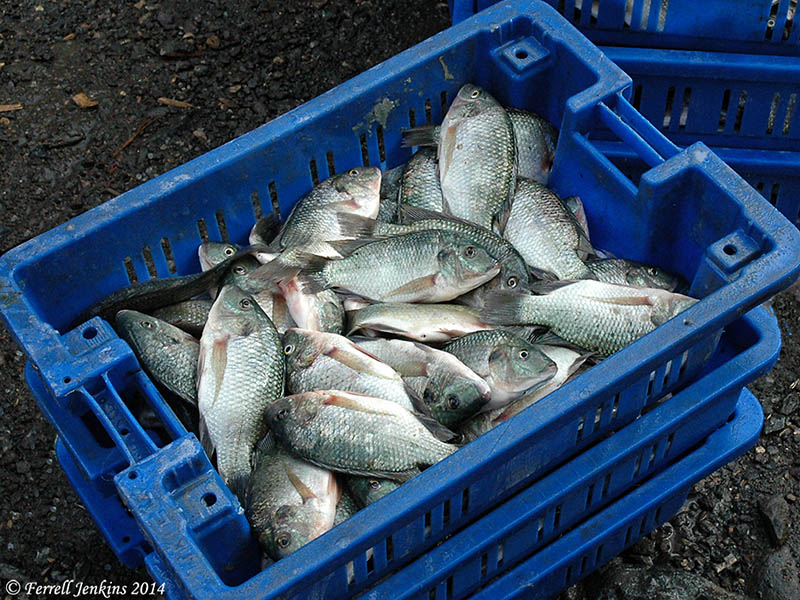
Here is a closeup of one of the containers of Saint Peter’s fish. You can see that these fish would be ideal of pan frying.

Musht (Saint Peter's fish) from the Sea of Galilee. Photo by Ferrell Jenkins.

Musht (Saint Peter’s fish) from the Sea of Galilee. Photo by Ferrell Jenkins.

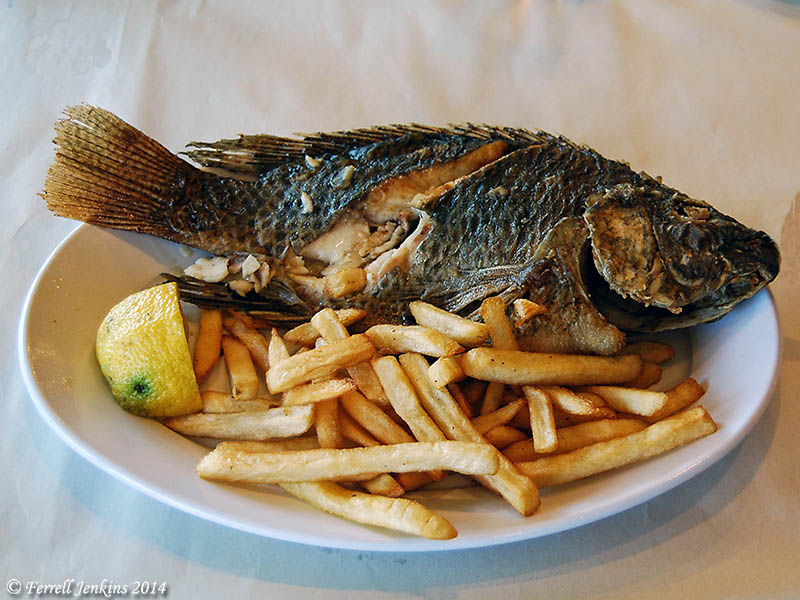
Tourists may have eaten these fish at lunch during their tour of the Galilee region. It makes a good meal, but some tourists use a napkin to cover the eyes while they enjoy eating the fish.

Saint Peter's fish is a common meal at restaurants around the Sea of Galilee. Photo by Ferrell Jenkins.

Saint Peter’s fish is a popular meal at restaurants around the Sea of Galilee. Photo by Ferrell Jenkins.

The next photo, also early in the morning, shows the catch of Biny, a much larger fish than the Musht. The Biny reaches a weight of 6 or 7 kilo (13-15 pounds).

Fisherman at Tiberias Port unloading the catch of Biny. Photo by Ferrell Jenkins.

Fisherman at Tiberias Port unloading the catch of Biny. Photo by Ferrell Jenkins.

In 2010 Israel announced a two year ban on fishing in the Sea of Galilee (see here). I don’t know how vigorously this ban was enforced. I know that in previous years I would see numerous boats heading to port after a night of fishing, but in the past few years this has not been so. Today’s Haaretz reports that the two-year fishing ban has been cut to a four-month annual break.

Instead of a blanket moratorium on fishing in the lake for two years, fishing will be barred only from April 15 to August 15, the spawning season of the lake’s tilapia populations.

The full article may be read here.

Hopefully we will return with some more information about fishing at the time of Jesus and a brief look at some of the New Testament episodes that involve fishing.

Thoughts for today and everyday

I will give thanks to the LORD with my whole heart; I will recount all of your wonderful deeds. I will be glad and exult in you; I will sing praise to your name, O Most High. (Psalm 9:1-2 ESV)

Wheat at En Dor. Photo by Ferrell Jenkins.

Wheat at En Dor. Photo by Ferrell Jenkins.

Do not be anxious about anything. Instead, in every situation, through prayer and petition with thanksgiving, tell your requests to God. (Philippians 4:6 NET)

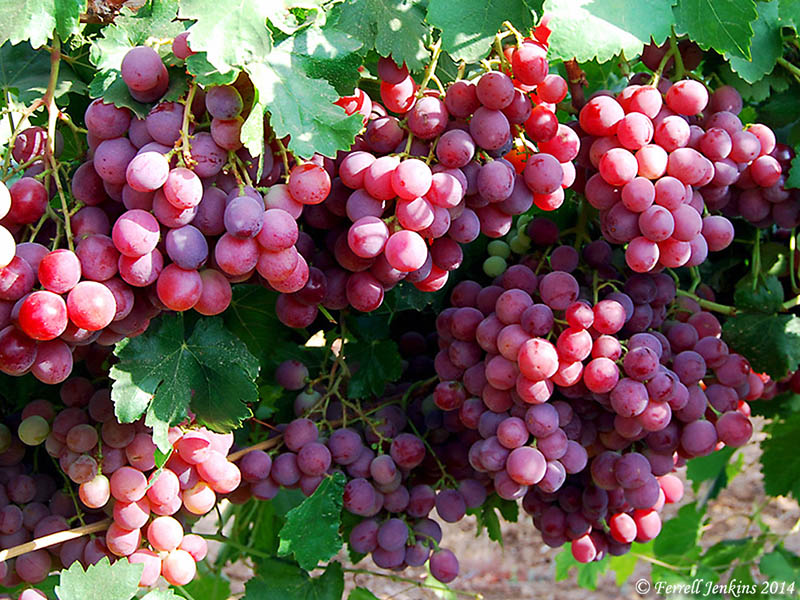
Grapes at Lachish. Photo by Ferrell Jenkins.

Grapes at Lachish. Photo by Ferrell Jenkins.


Restoration in the Protestant Cemetery in Jerusalem

A little more than a year ago we wrote a few posts about the Protestant Cemetery in Jerusalem where several well know persons are buried. These include Horatio Spafford, the author of “It is Well With My Soul,” and several famous archaeologists. See here. Use the search box to locate more articles about the cemetery.

We also reported on the vandalism of the cemetery here. In most instances this consisted of crosses being broken from their base.

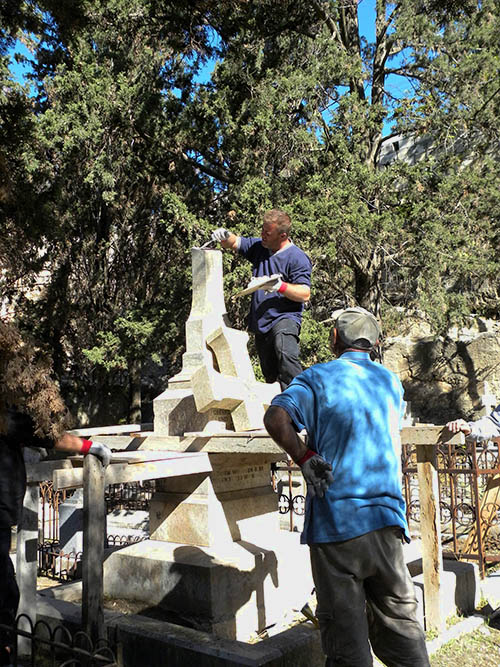
The Jerusalem University College, on whose campus the cemetery is situated, reports now that the Society for the Preservation and Restoration of Israel Heritage Sites recently restored the grave markers. See their Facebook page with more photos here.

Restoring damaged tomb stones in the Protestant Cemetery.

Restoring damaged tomb stones in the Protestant Cemetery.

HT: Rebekah Dutton

The Berlin Wall — 1961-1989

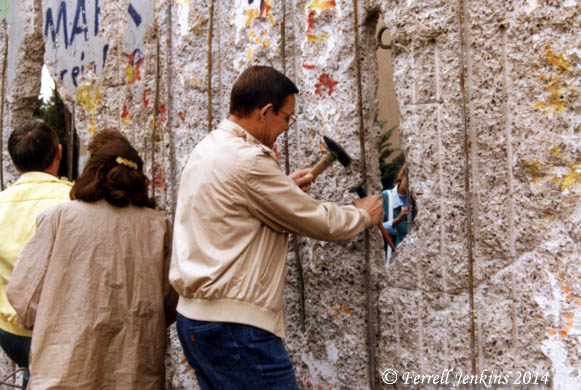
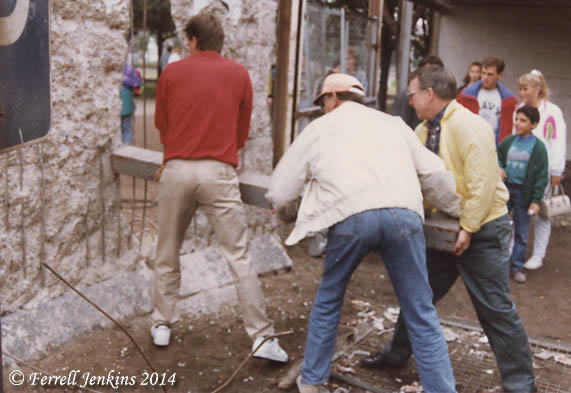
The Berlin Wall was erected August 13, 1961 as a dividing line between East and West Berlin. As soon as East Germans began to cross into the west people began to make an effort to tear down the wall. I crossed from West Berlin into East Berlin on several occasions when the wall stood in order to see the Pergamum Museum. In 1990 I joined others in my group in trying our hand at chiseling a few piece of the wall as souvenirs. The little hammer and chisel I “rented” from an entrepreneur didn’t do much to the hardest concrete I had ever seen.

Trying to chisel a piece of the Berlin Wall in 1990.

Trying to chisel a piece of the Berlin Wall in 1990.

Some of our guys decided to go after the wall with a large concrete post.

American tourist use a concrete post to dry to break through the Berlin Wall. Photo by Ferrell Jenkins.

American tourists use a concrete post to dry to break through the Berlin Wall. Photo by Ferrell Jenkins.

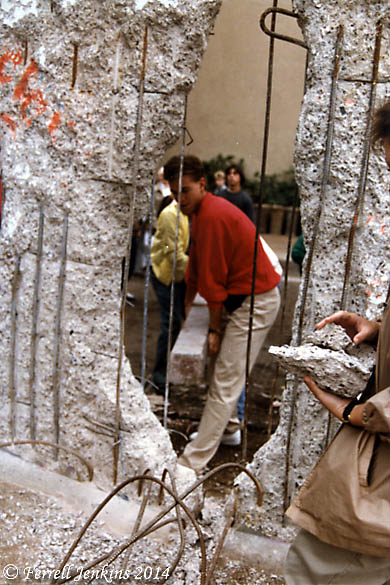
Here is how it looked from the East Berlin side. Notice the rebar in the wall and  the lady holding souvenir pieces of the wall.

Trying to make a breakthrough to East Berlin. Photo by Ferrell Jenkins.

Trying to make a breakthrough to East Berlin. Photo by Ferrell Jenkins.

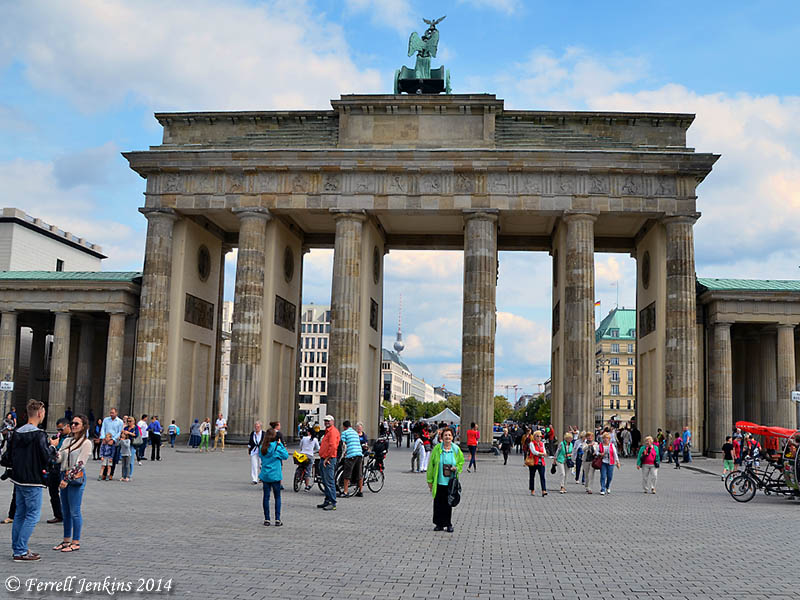
Before the wall came down we always went to the wall in West Berlin where we could see the top of the Brandenburg Gate above the 15-foot-high wall. In August my wife and I visited the beautiful gate as did numerous other tourist that day. The view is toward the former East sector and the famous Unter den Linden street.

The Brandenburg Gate in August, 2014. Photo by Ferrell Jenkins.

The Brandenburg Gate in August, 2014. Photo by Ferrell Jenkins.

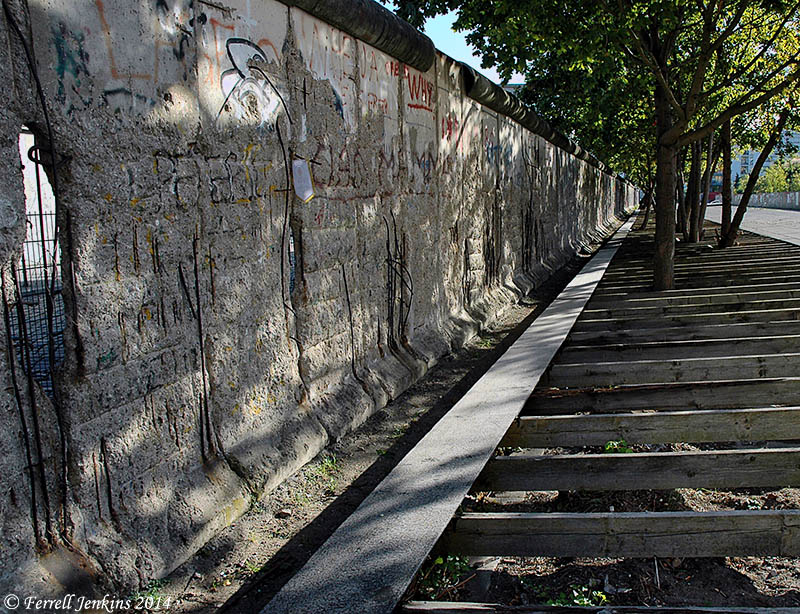
A short portion of the wall has been left as a reminder of the wall that once divided Berlin into East and West.

A portion of the Berlin Wall was left as a reminder of a sad time in the history of the city. Photo by Ferrell Jenkins in 2004.

A portion of the Berlin Wall was left as a reminder of a sad time in the history of the city. Photo by Ferrell Jenkins in 2004.

Sunday, November 9, the city of Berlin is celebrating the 25th anniversary of the opening, and ultimate tearing down, of the Berlin Wall.

Would that all men could be free from oppression with the opportunity to pursue their dreams.