Category Archives: Culture

The Resurrection of Jesus

A Roman period tomb cut from stone with a rolling stone.  This tomb is located near the Jezreel Valley in Israel. Photo by Ferrell Jenkins.
A Roman period tomb cut from stone, using a rolling stone to cover the opening.

The following text is taken from the Gospel of John, chapter 20.

Now on the first day of the week Mary Magdalene came to the tomb early, while it was still dark, and saw that the stone had been taken away from the tomb. So she ran and went to Simon Peter and the other disciple, the one whom Jesus loved, and said to them, “They have taken the Lord out of the tomb, and we do not know where they have laid him.” So Peter went out with the other disciple, and they were going toward the tomb. Both of them were running together, but the other disciple outran Peter and reached the tomb first. And stooping to look in, he saw the linen cloths lying there, but he did not go in. Then Simon Peter came, following him, and went into the tomb. He saw the linen cloths lying there  and the face cloth, which had been on Jesus’ head, not lying with the linen cloths but folded up in a place by itself. Then the other disciple, who had reached the tomb first, also went in, and he saw and believed; for as ye they did not understand the Scripture, that he must rise from the dead. Then the disciples went back to their homes. (Jn. 20:1-10 ESV)
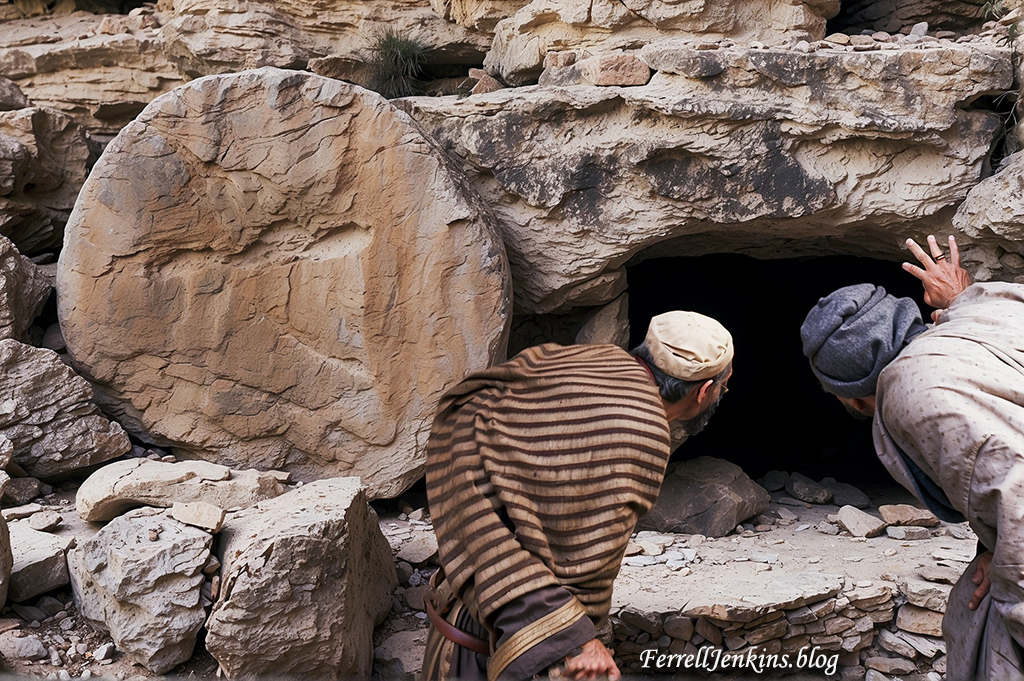
Imagine the emotions of the disciples of Jesus, both women and men, when they were told that the tomb that had been so carefully secured on Friday was found empty on the first day of the week, with only the grave clothes and the cloth that covered the head still in the tomb.

[The second photo showing the disciples of Jesus at the open tomb was made in Leonardo AI. David Padfield assisted me in this project.

Subscribe

Go back

Your message has been sent

Warning
Warning
Warning.

1–2 minutes

Girding up the loins of your mind

The Apostle Simon Peter followed Jesus during His personal ministry. It is not surprising that some of the illustrations he uses come from this experience. In 1 Peter 1:13 the apostle wrote,

Therefore gird up the loins of your mind, be sober, and rest your hope fully upon the grace that is to be brought to you at the revelation of Jesus Christ; (1 Peter 1:13 NKJ).

The Louw-Nida Lexicon says that the Greek phrase used in 1 Peter 1:13 is “(an idiom, literally ‘to bind up the loins of the mind’) to prepare oneself for learning and thinking – ‘to get one’s mind ready for action, to be ready to learn and to think, to be alert.” The Greek phrase is translated this way: ‘so then, have your minds ready for action.1 Peter 1:13.” (27:55)

In The IVP Bible Background Commentary, Craig Keener writes,

Men wore long robes and would tuck them into their belt, “gird up their loins,” so they could move more freely and quickly. Although the image also occurs elsewhere in the Old Testament, here Peter may specifically allude to the Passover (Exodus 12:11): once God’s people had been redeemed by the blood of the lamb (1 Peter 1:19), they were to be ready to follow God forth until he had brought them safely into their inheritance (cf. 1:4), the Promised Land.”

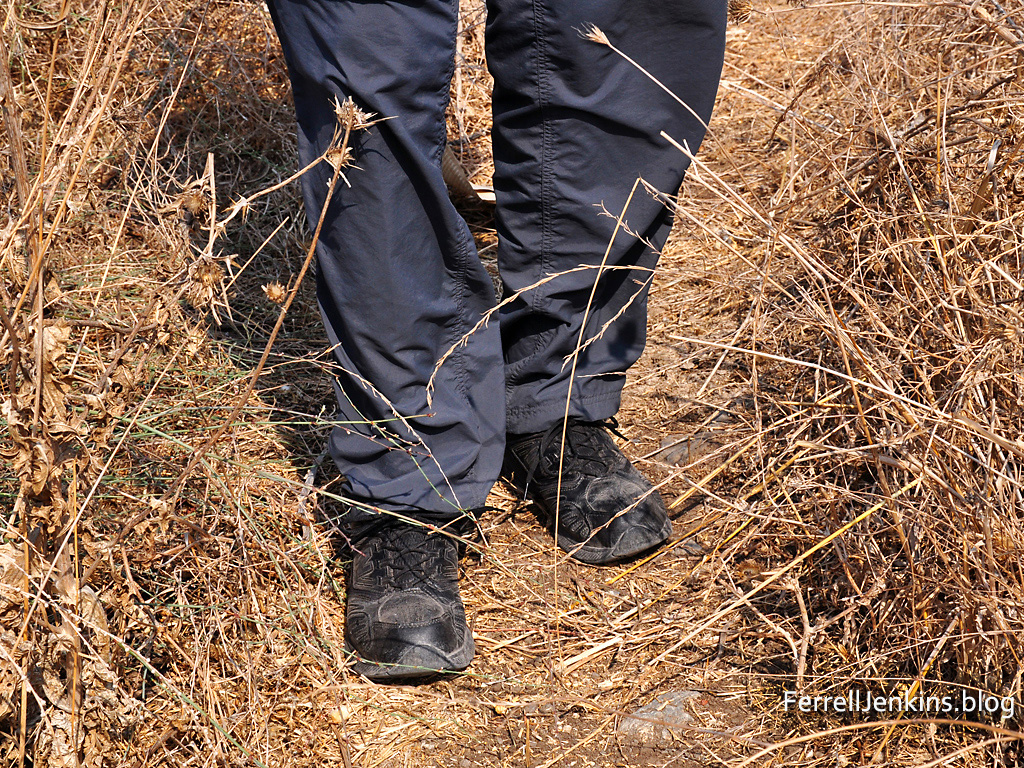
Even though I have never worn a long, flowing robe I could illustrate this over and over from my years of travel in Israel. Take a look at this photo made at Horbat Adumim in upper Galilee.

Walking through thistles.
Walking across fields to get a desired photo often brings one in contact with thistles, as happened at Horbat Adumim.

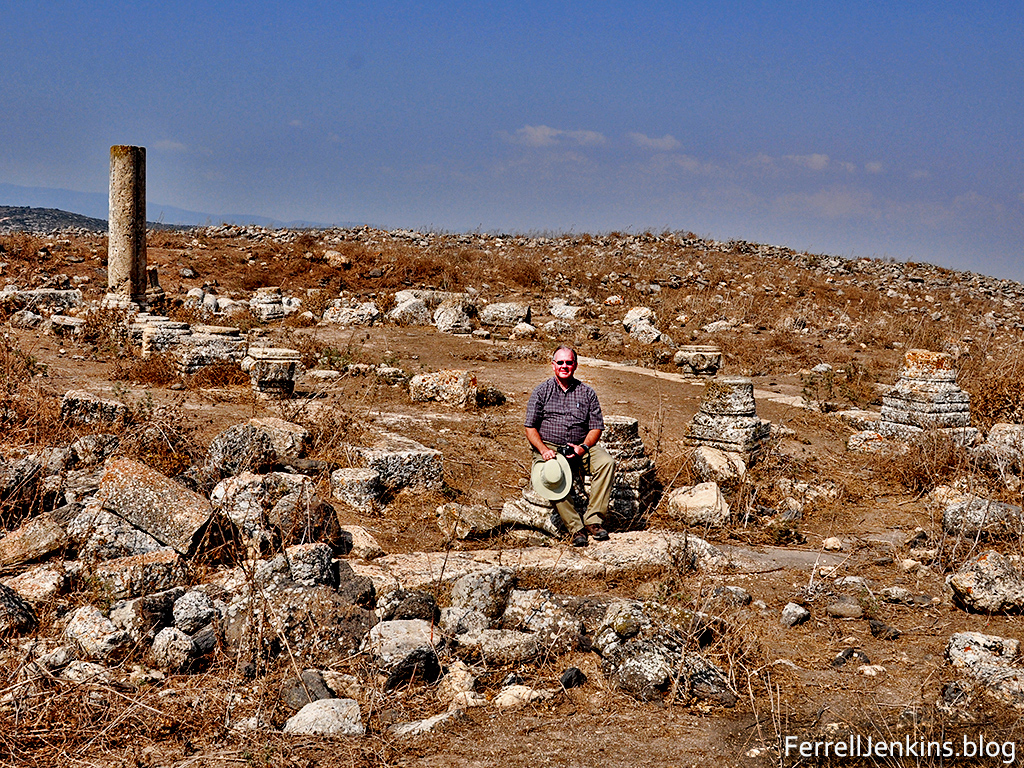
Horbat Adumim is a national park in Israel, the site of an the ruins of an ancient synagogue. My frequent traveling companion on private study tours is Leon Mauldin. Leon is seen here seated at the entrance to the old synagogue.

I have used this text from 1 Peter various times in discussing the need to avoid those things that hinder us in service to God. Gird up the loins of your mind.

, , , , , , , ,

The Potter

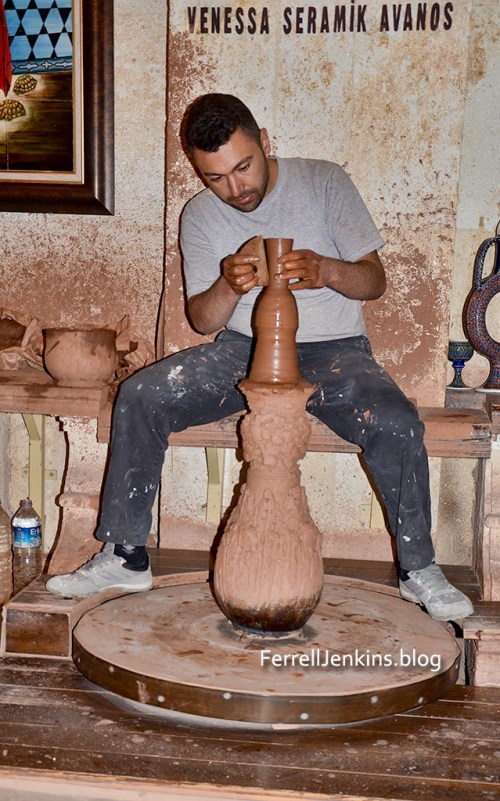
Throughout the modern lands that we often refer to as the Bible World groups are taken to a shop where they see a potter at work making pottery typical of ancient pottery. The resulting pottery is often decorated, etc. to make it sell for more than a simple pot. The town of Avonos, Turkey, is noted for it potters. In our photo you see the potter molding the clay into the vessel of his choice.

The prophet Isaiah reminds us all that the LORD God is the potter and we are the clay. He has given us free will and this means that we must choose to allow Him to make us as he wishes.

But now, O LORD, you are our Father; we are the clay, and you are our potter; we are all the work of your hand (Isaiah 64:8).

 An experience with AI.

AI is all the rage in our society. Well, today WordPress allowed AI [Artificial Intelligence] to tell me how I should have written this blog. I thought of some of the things suggested in the AI comment, but had specifically chosen not to write that way. I am hoping that I will classify as not a complete dummy. But I thought you might enjoy reading the AI suggestions.

AI Assistant


The content explains the process of pottery making and relates it to the analogy of God being the potter and us being the clay. The use of the photo is a nice visual addition. However, the feedback could be improved by adding more depth and analysis to the topic. Here are some suggestions to enhance the content:

1. Provide more historical context: Explain the significance of pottery in ancient cultures and how it was an essential part of their daily lives.

2. Elaborate on the analogy: Explore the deeper meaning behind the analogy of God as the potter and us as the clay. Discuss how this relates to our relationship with God and the concept of surrendering to His will.

3. Include biblical references: In addition to Isaiah 64:8, reference other passages in the Bible that highlight God’s role as the potter and how it is relevant to our lives today.

4. Offer personal reflections: Share personal anecdotes or stories that illustrate the transformative power of God working in our lives and shaping us according to His purpose.

5. Connect with the reader: Provide practical insights on how readers can allow God to mold them and align their lives with His plans.

By expanding on these points, the content will become more engaging and insightful for the readers.

– – – – – – – – – – – – – – – – – – – – – –

Now, for those who read through the additional AI comments, you can let me know which you prefer today. Leave a brief comment to say if you liked FJ or AI.


A Beautiful View

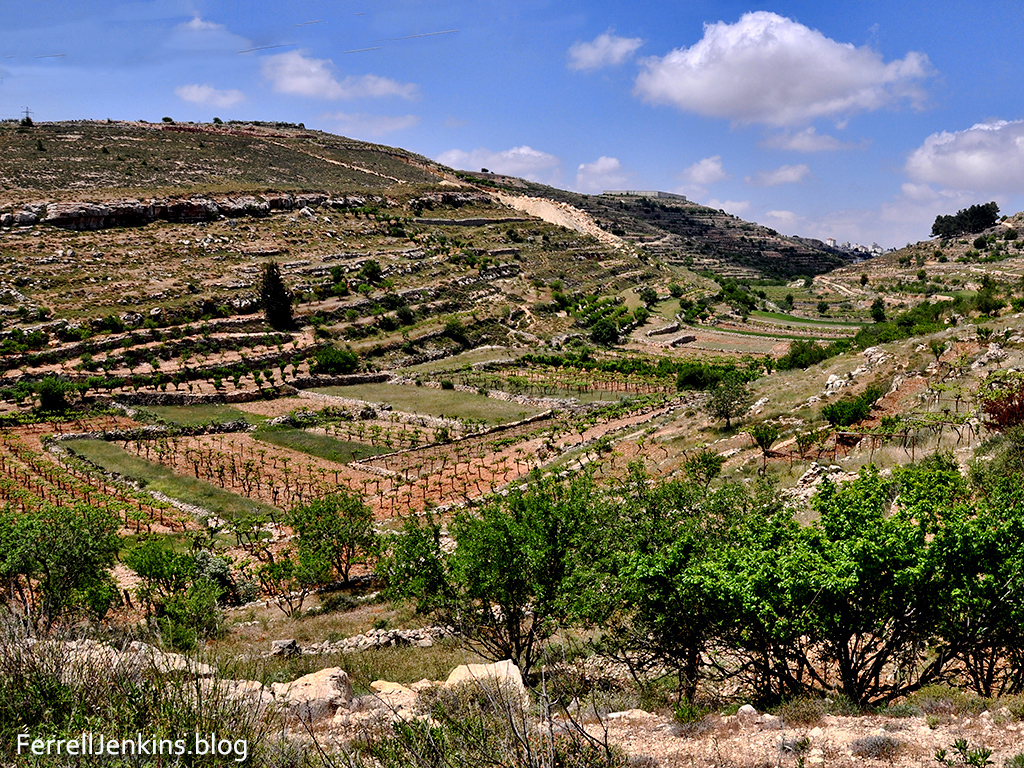
Along the central mountain road between Bethlehem and Hebron. There are many beautiful views. This one shows examples of the continued fertility of the land that was promised to the ancient Israelites. It illustrates the use of valleys to collect water during the rain season to provide water for the plants. The hillsides illustrate the terracing used as far back as the Biblical Iron age (around 1000 B.C.).

View of beautiful, fruitful hillsides along the road between Bethlehem and Hebron. Photo by Ferrell Jenkins.
View of hillsides and valleys along road between Bethlehem and Hebron. Photo by Ferrell Jenkins.

How Much Territory Does the Madaba Map Cover?

After the previous post I was ask how far the map extended. I have seen the map several times, but much of my detailed info comes from an article by Victor R. Gold: “The Mosaic Map of Medeba.” This article first appeared in Biblical Archaeologist, XXI.3 (Sept. 1958), pp.59-71. It was included in a 3-volume set called The Biblical Archaeologist Reader, vol. 3.

Here is a section on the extent of the Map:

“Except for the [third century] Tabula Peutingeriana [road map of the world], the Madeba map is the only map of ancient Palestine still in existence. The large remaining section extends from Aenon in the Jordan valley, or near it, in the north, to the Canobic branch of the Nile in the south. Not even this section is complete, however, the footing of one of the columns rests over a section of Judea from Eleutheropolis (Beit Jibin) to Ashdod and Beersheba.” (Campbell, Edward F., and David N. Freedman, editors. The Biblical Archaeologist Reader 3. First ed., vol. 3, Doubleday and Company, 1970, pp. 359-65, 3 vols.

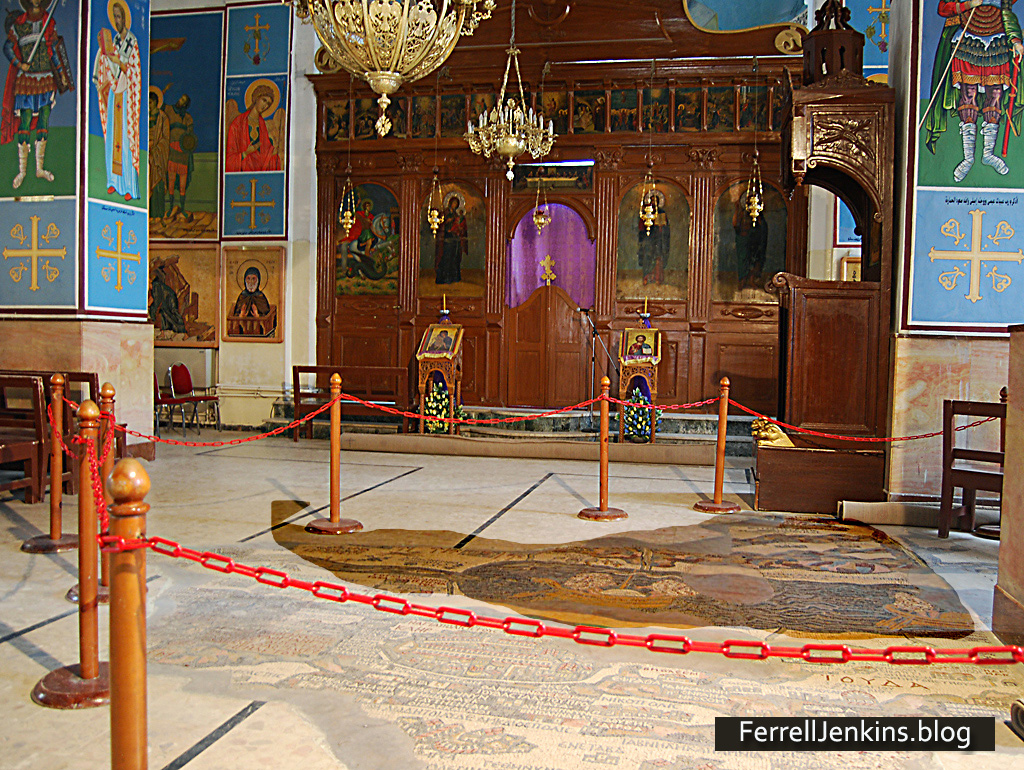
I am including a photo showing the actual size of the map in the church building floor at Madaba, Jordan. I have darkened the portion of the map that has been reconstructed there. We are not seeing all that is known to have existed. I have noted a small portion of the Nile Delta, and coastal towns such as Ashkelon and Ashdod. In my photos I can see mountains of Moab to the east, and Aenon in the northern Jordan Valley.

For the benefit of those who might like to see the size of the map in the Madaba church, I have darkened the map in the area that is cordoned off.

Interior of the Madaba, Jordan, church that protects the map. Photo by Ferrell Jenkins.
The Madaba Map is shown darker in the church floor to allow one to see the size of the map there.

The Madaba Map is an amazing piece of work. It would be nice if we had one in the vestibule where I meet with Christians.

Articles on Bethlehem and the birth of Jesus

Recent readers may not have noticed our header having a link on Indexes (Indices). If you go there you will find an Index of articles on Bethlehem and the Birth of Jesus. At this time of the year when many are thinking about the birth of Jesus and it’s meaning for all mankind I thought it would be good to call attention to these articles and photos. There have been several good comments and discussions about the date of the birth of Jesus.

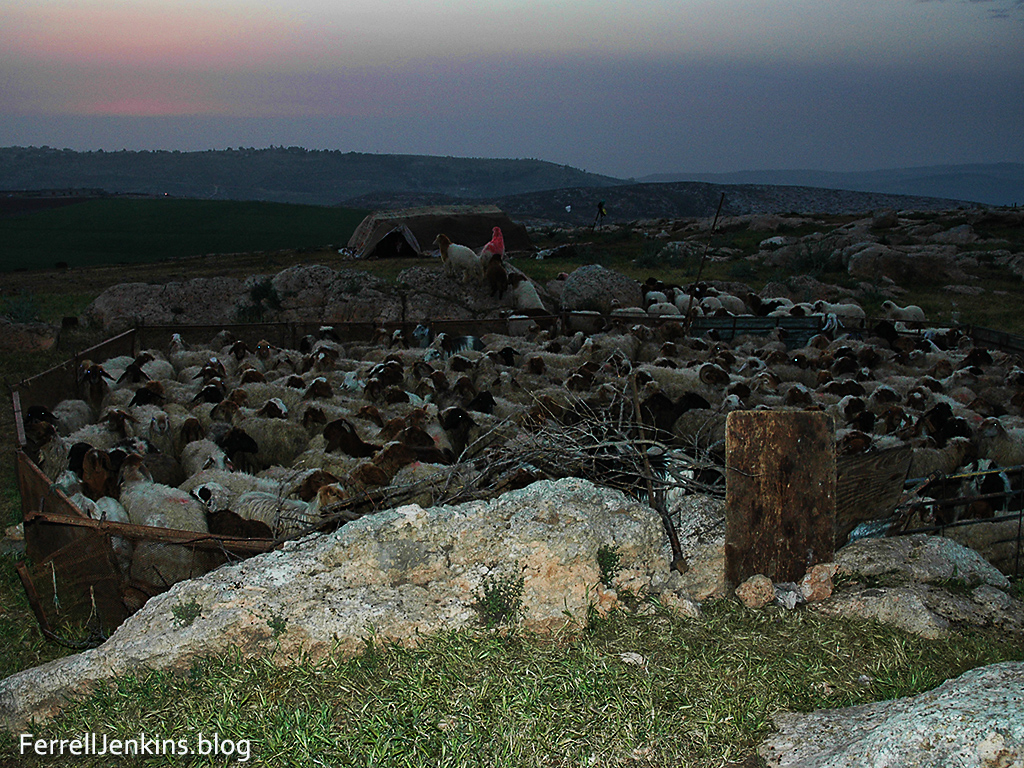
I have many photos of shepherds and sheep, but not one of shepherds watching their sheep by night in the vicinity of Bethlehem. I do have some photos of shepherds with their sheep in the sheepfold at Heshbon in Jordan. I had been at Heshbon one afternoon visiting with the shepherds and making photos. When I saw their makeshift sheepfold I asked if I could come back in the evening and make some photos. The photo here is one made a dusk after the sheep had been gathered into the sheepfold. The shepherd and his family live in the tent. Heshbon was a former Moabite town given to the tribe of Reuben after the Israelites captured the Trans-Jordan tableland (Numbers 32:37).

Shepherds watching their sheep by night at Heshbon in Jordan.
Shepherds at Heshbon watching their flock at night.

To access the articles on Bethlehem click through here.

The Cupbearer in Bible Times

Cupbearers were important servants in the ancient Near East. In the Bible we read about the cupbearer in Egypt in the time of Joseph (Genesis 40-41). Some English translations use the term butler.

The only person mentioned by name in the Bible as a cupbearer is Nehemiah (Nehemiah 1:11).

“O Lord, let your ear be attentive to the prayer of your servant, and to the prayer of your servants who delight to fear your name, and give success to your servant today, and grant him mercy in the sight of this man. “Now I was cupbearer to the king.” (Nehemiah 1:11 ESV)”O Lord, let your ear be attentive to the prayer of your servant, and to the prayer of your servants who delight to fear your name, and give success to your servant today, and grant him mercy in the sight of this man. “Now I was cupbearer to the king.” (Nehemiah 1:11 ESV)

A source that I enjoy and use frequently is the IVP Bible Background Commentary: Old Testament. The comment about the cupbearer is brief but full of significant facts.

“The cupbearer in the ancient Near Eastern court held a very important position. He had direct access to the king and thus had great influence. Texts and reliefs describe cupbearers in Assyrian and Persian courts. The cupbearer was in close proximity to the king’s harem and thus was often a eunuch, although there is no evidence that this was the case with Nehemiah. Later sources identify the cupbearer as the wine taster. In addition he was the bearer of the signet ring and was chief financial officer.”

Have you visited the Bible Land Museum in Jerusalem? The museum is located across the parking lot from the Israel Museum. There is a separate entry fee for this smaller museum. It contains many artifact from a private collection. It is a good place to make photos that are useful in teaching the Bible. This rhyton or cup from the Persian Empire is one good example. This is likely the type of cup used by Nehemiah in his function as cupbearer to the king.

Phyton or cup from ancient Persia.
Inscribed just within the rim in cuneiform is “Ampirish, king of Samati, son of Dabala” Silver, gilt bitumen. From Iran, Early 6th century BCE, On loan from Cindy and David Sofer. From the Bible Land Museum, Jerusalem.

Shearing Sheep in Bible Times

An Illustration from the life of David

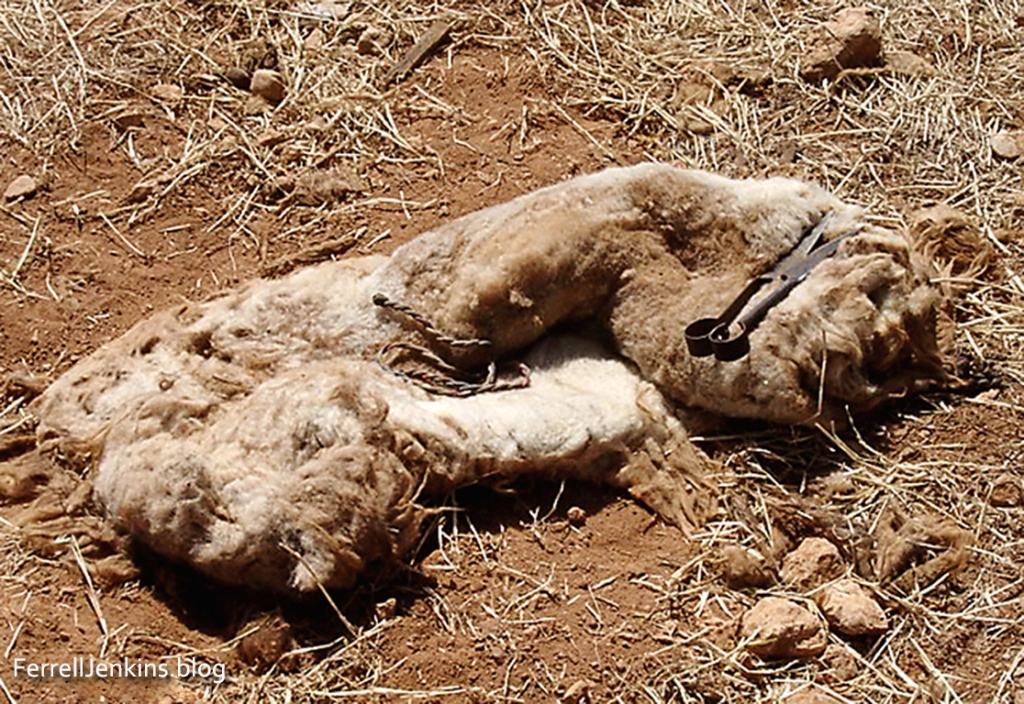
The wool from one sheep at shearing time. This photo was made in Syria near the ancient site of Kadesh where the famous battle between the Egyptians and the Hittites took place.

David is well known as a shepherd. An interesting episode from his life is recorded in 1 Samuel 25.

4 David heard in the wilderness that Nabal was shearing his sheep.
5 So David sent ten young men. And David said to the young men, “Go up to Carmel, and go to Nabal and greet him in my name.
6 And thus you shall greet him: ‘Peace be to you, and peace be to your house, and peace be to all that you have.
7 I hear that you have shearers. Now your shepherds have been with us, and we did them no harm, and they missed nothing all the time they were in Carmel. (1 Sam. 25:4-7 ESV)

A common expression among the Jews was that goats were kept for milk, hens for eggs, and sheep for wool. The wool could be converted into clothing for the family. I have seen Bedouin milking sheep.

Shepherd family living in tents in northwest Syria. Note the woman milking the sheep from the rear.

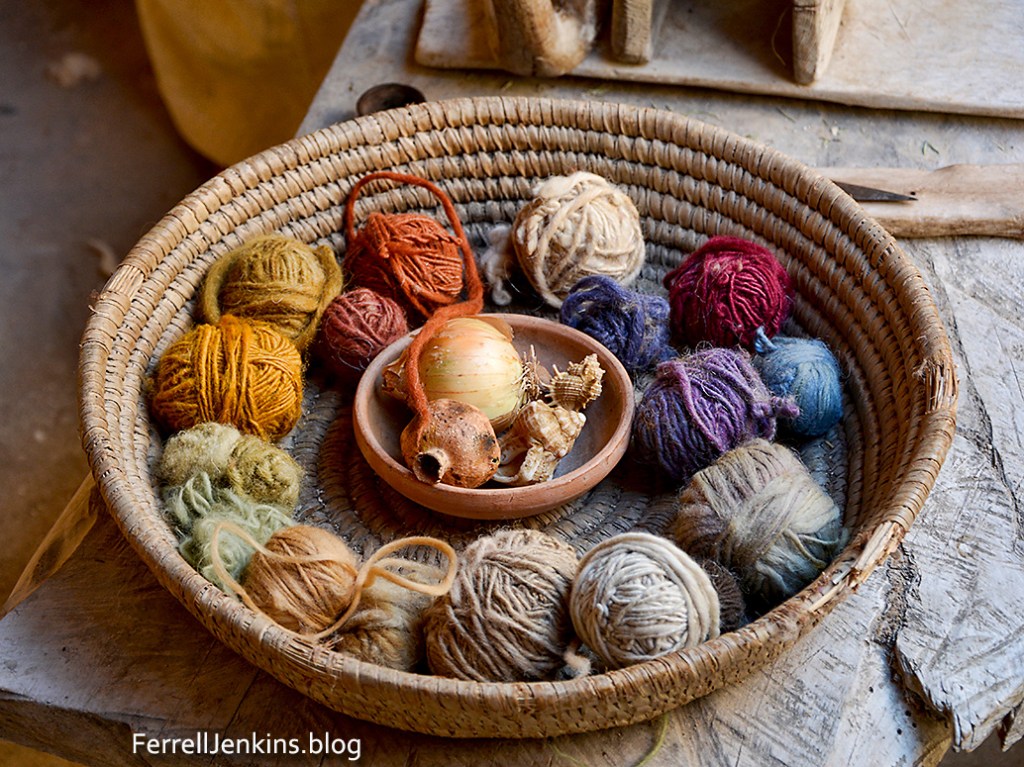
The wool was converted to yarn, primarily by the women of the village, to be used in the making of clothing for the family.

This yarn has been dyed to be used for making clothing by the women at Nazareth Village.

The Stadium in New Testament Times

Aphrodisias, located in southwest Turkey, was an ancient city of Caria in Asia Minor. It is not mentioned in the Bible, but is close to the cities of Laodicea, Hierapolis and Colossae. Robert F. Tannenbaum, an ancient historian, describes the location of the city this way:

A quiet, fertile valley folded into the Mediterranean hills, clear streams, tall poplars, ancient ruins more than 1,400 years old—a picture of pastoral quiet. (Biblical Archaeology Review, Sept/Oct 1986)

BibleMapper_Aphrodisiash

The map above is cropped from the set of BibleMapper maps now available at
https://biblemapper.com/blog//. Aphrodisias is clearly marked.

The site has been excavated since 1966, beginning under the direction of Kenan Erim of New York University. Marble was readily available at a nearby quarry and the excavation has brought to light a multitude of marble inscriptions and statues from the Roman period including a statue of the Emperor Domitian. Buildings include a theater, an agora, a bath, temples, and a well-preserved stadium.

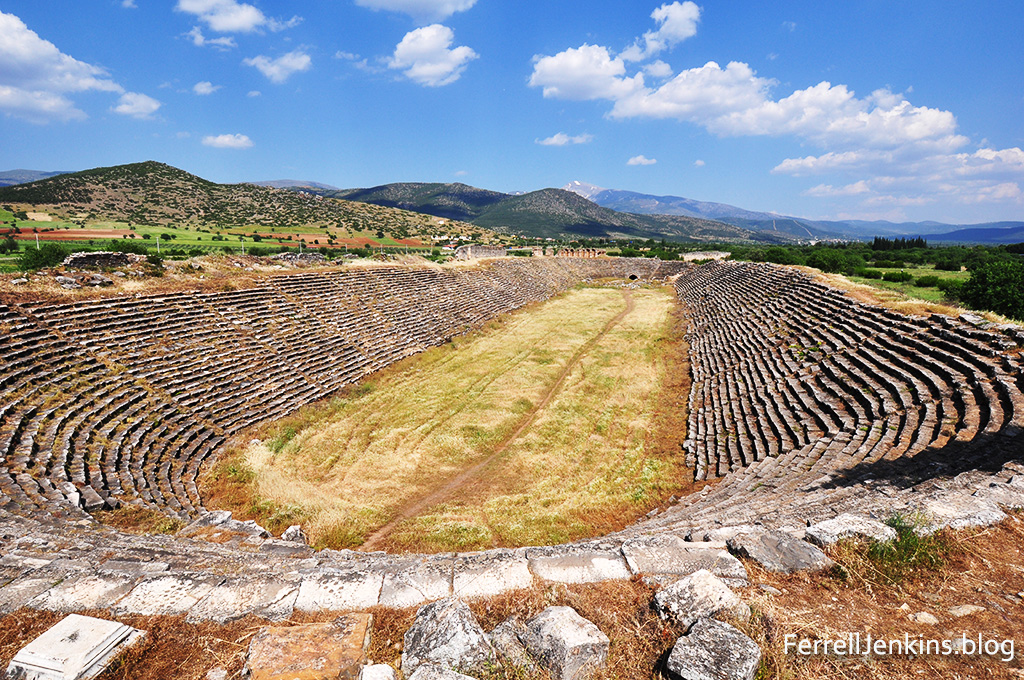
Louw-Nida describes a stadium as an “open, oval area (frequently including a racetrack) around which was built an enclosed series of tiers of seats for those who came to watch the spectacles – arena, stadium.” When Paul spoke of running the race in 1 Corinthians 9:24, he used the Greek term stadion. The term was also used as a measure of distance and is found in John 6:19. It was about one-eighth of a Roman mile. Most large Greek and Roman cities had a stadium. The figure of the stadium is in mind in Hebrews 12:1-2, where a host of witnesses watch as we run the race.

Therefore, since we are surrounded by so great a cloud of witnesses, let us also lay aside every weight, and sin which clings so closely, and let us run with endurance the race that is set before us,
2 looking to Jesus, the founder and perfecter of our faith, who for the joy that was set before him endured the cross, despising the shame, and is seated at the right hand of the throne of God.
(Hebrews 12:1-2 ESV)

The stadium at Aphrodisias is the best preserved I have seen and I wanted to share with you the photo I made in 2012. Picture yourself in the stadium.

Aphrodisias

Thank you

Paulette and I appreciate every comment and “like” that has been left on either https://ferrelljenkins.blog or Facebook. We had a lot of fun with our friends at church in the weeks leading up to the marriage. So many wanted to know when we were getting married, who would be present, where we would go for the honeymoon, etc. We kept everyone in suspense and pulled it off without anyone decorating our vehicle or crashing the wedding.

We stayed at home the first night, then spent a few days in the Sarasota, FL, area. No need to go far when one already lives in a tourist paradise. We enjoyed visiting the mall, eating at some famous restaurants like Yoder’s Amish Restaurant and the Columbia at Saint Armands Circle. At the latter we enjoyed the famous Cuban sandwich with Spanish Bean soup followed by an order of flan.

Topping off a great meal with the Columbia’s famous flan.

We had a little setback last week when we both tested positive for the Covid virus. We both have been fully vaccinated and I have survived trips to both Turkey and Israel without any problem. We have tried to trace our activities and determine where we might have picked up the Covid. We think it was either at church or at one of our favorite eating places but there is no way to be certain.

Even though I think of this as a lite case of the virus it is a jolt to the body. Along with isolation we have been taking Paxlovid medication. I have one more dose today and Paulette has one more day to go. We are seeing improvements each day.

Don’t throw away your masks too soon.