Category Archives: Church History

Busy day in Istanbul

We had a full day of sightseeing in Istanbul today. Tomorrow we have to get up early to make our flight to Izmir (Biblical Smyrna, Revelation 2). I made several nice photos, but not enough time to prepare them for the blog. Maybe by tomorrow night we will be able to post a photo or two.

Two young ladies on the tour are writing blogs. Both have traveled with us before. You might enjoy reading what they write.

The Other Side of the World. Here is the link to today’s post. You will be able to locate the others from there.
http://stacyjobe.blogspot.com/2012/05/14-istanbul-day-two.html

Jessica’s Jaunts: http://jessicarice.wordpress.com/

Steps of Paul and John in Turkey and Greece

We’re off to visit Turkey and Greece for the next few days. Visiting all of the sites where Paul and John traveled would be impossible in a few weeks. Our tour in Turkey, which we have conducted several times since 1968, is limited to the area of the Seven Churches of Revelation (1:4, 11), and a few cities associated with Paul’s ministry (Ephesus, Acts 19; Colossae and Hierapolis, Colossians 4:13; Miletus, Acts 20). The entry point into the country is Istanbul, the former Constantinople, a city that was significant in the early post-apostolic history of the church.


In the Aegean Sea we visit Patmos (Revelation 1:9), Rhodes (Acts 21:1), and Crete (Acts 27; Titus 1:5).

Our stops in Greece are limited to Athens, Corinth and Cenchreae (Acts 17-18).

We don’t promise to be as thorough as we might while in the comfort of the study at home, but we will try to post a few photos of interest as we move along.

We arrived in Istanbul this morning, collected the luggage, cleared customs and had our luggage loaded on the bus by noon. After a stop for lunch near the Hagai Sophia and the Blue Mosque, we continued with some general sightseeing of the city and a boat ride on the Bosporus. I think everyone is looking forward to a good night of sleep and a full day of sightseeing in the city tomorrow.

A touch of Ireland

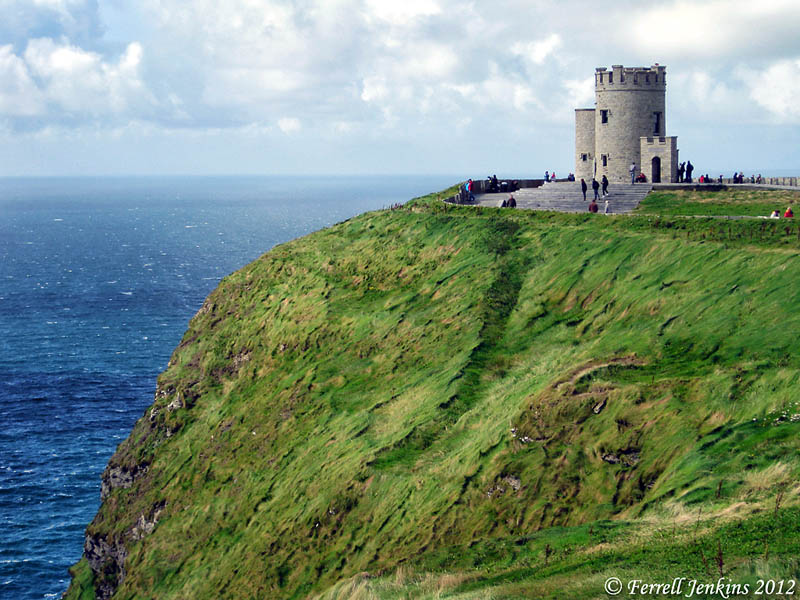
For today I wanted to share a little something from the Emerald Isle. The first photo was made at the Cliffs of Moher on the western coast of Ireland in County Clare.  It certainly illustrates why Ireland is referred to as the Emerald island. The tower is known as O’Briens Tower.

A nice web site about the Cliffs of Moher may be viewed here.

At the Cliffs of Moher, western coast of Ireland. Photo by Ferrell Jenkins.

The next photo comes from Wicklow County in the south eastern corner of Ireland. Glendalough served as a Christian monastic center for about 500 years from the sixth century A.D.

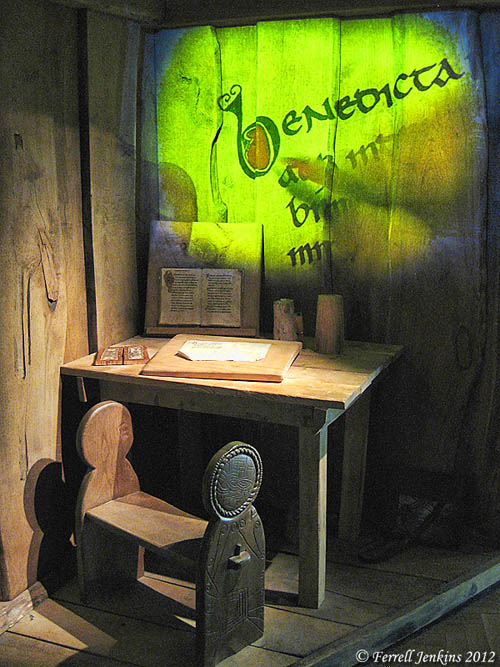
One of the educational exhibits at Glendalough involves the work of the scribe in copying the Scriptures and writing ecclesiastical works.

Scribe Exhibit at Glendalough, Ireland. Photo by Ferrell Jenkins.

Scribe Exhibit at Glendalough, Wicklow County, Ireland. Photo by Ferrell Jenkins.

Click on Monastic Chapters from a web site about Glendalough and Wicklow County here.

The James Ossuary Exhibition in Toronto

Biblical Archaeology Review cover above the James Ossuary.The existence of an ossuary bearing an Aramaic inscription, “Ya’akov bar Yosef akhui diYeshua” [James the son of Joseph the brother of Jesus] was announced at a press conference conducted by Hershel Shanks, editor of Biblical Archaeology Review, October 21, 2002. In the feature article of the November-December issue of Biblical Archaeology Review, Professor Andre Lemairé gives details about the ossuary and its inscription. An ossuary was used to house the bones of the deceased after the decay of the body. An ossuary need be only as large as the longest bones. The ossuary under consideration is about 20 inches long, 12 inches high, and 10 inches wide. They were commonly used by the Jews for secondary burial in the first century A.D.

The James Ossuary was placed on display at the Royal Ontario Museum in Toronto, Canada, from November 15th through December 29, 2002. It was displayed in a third floor room by itself in a well-lighted case. The walls of the room were filled with information about James, ossuaries, Jewish burial customs, and the James ossuary. The ossuary was cracked in transit from Israel to Canada but was been restored by the museum staff. The ROM has a good selection of material from the ancient Mediterranean world. The exhibition of the James Ossuary was arranged to coincide with the annual meetings of the American Schools of Oriental Research, the American Academy of Religion, and the Society of Biblical Literature. About eight thousand professors of religion and Biblical studies from around the world attend these meetings.

“No Ordinary Box of Bones”

The Society of Biblical Literature (SBL) planned a special session under the title “No Ordinary Box of Bones” for a learned discussion about the ossuary. The panel included the following scholars:

André Lemairé, the epigrapher from the Sorbonne who recently published the ossuary inscription in the Biblical Archaeology Review.

John Painter, author of a book on James, from Charles Stuart University in Australia.

Steve Mason, a Josephus scholar, from York University, Toronto. He put the quotation about James in Josephus in its proper context.

Eric Meyers, an archaeologist and scholar of Judaism at Duke University.

Hershel Shanks, editor of Biblical Archaeology Review.

Adele Reinhartz, of Wilfred Laurier University, served as chair of the panel.

Lemairé summarized the material from his BAR article. He responded to some recent charges that the second half of the inscription [brother of Jesus] is different from the first part [James the son of Joseph]. Evidence from paleography places the Aramaic inscription near the middle of the first century AD, prior to AD 70.

Eric Myers, a former president of ASOR, stated that he had concern about the existence of such a panel in light of the fact that the ossuary was “looted” and sold on the illegal antiquities market. He said the owner had been questioned by the police in Israel about the ossuary.
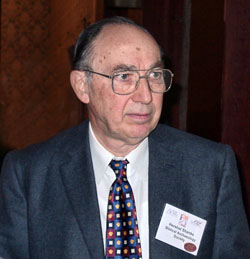
Herschel Shanks at SBL in Toronto, 2002.

Herschel Shanks in Toronto, 2002.

Herschel Shanks took exception to several statements made by Myers. Shanks publishes artifact which belong to private collectors. Both Shanks and Lemairé emphasized that the Dead Sea Scrolls fall into the same category. Shanks said there are good collectors and bad collectors. Good collectors allow their material to be published and share it with the world. Bad collectors keep their artifacts in their basements for personal enjoyment.

Mason put the quotation about James from Josephus in proper historical context. Josephus was dealing with the character of High Priests and mentioned, incidentally, that one of the people put to death was the brother of Jesus, the so-called Christ.

The quotation from Josephus, perhaps written in the last decade of the first century A.D., reads this way:

…when, therefore, Ananus was of this disposition, he thought he had now a proper opportunity [to exercise his authority]. Festus was now dead, and Albinus was but upon the road; so he assembled the Sanhedrin of judges, and brought before them the brother of Jesus, who was called Christ, whose name was James, and some others, [or some of his companions]; and, when he had formed an accusation against them as breakers of the law, he delivered them to be stoned: (Ant 20:200)

Painter mentioned the tradition that the throne of James (as Bishop of Jerusalem) and his burial in the Church of Saint James, an Armenian church in Jerusalem. He also cited other traditions about the death and burial of James from Clement of Alexandria, Hegesippus, and Eusebius.

A portion of the quotation from Eusebius, from the early 4th century A.D., reads,

These things are related at length by Hegesippus, who is in agreement with Clement. James was so admirable a man and so celebrated among all for his justice, that the more sensible even of the Jews were of the opinion that this was the cause of the siege of Jerusalem, which happened to them immediately after his martyrdom for no other reason than their daring act against him.

Josephus, at least, has not hesitated to testify this in his writings, where he says, “These things happened to the Jews to avenge James the Just, who was a brother of Jesus, that is called the Christ. For the Jews slew him, although he was a most just man.” (Ecclesiastical History 2 23:19-20)
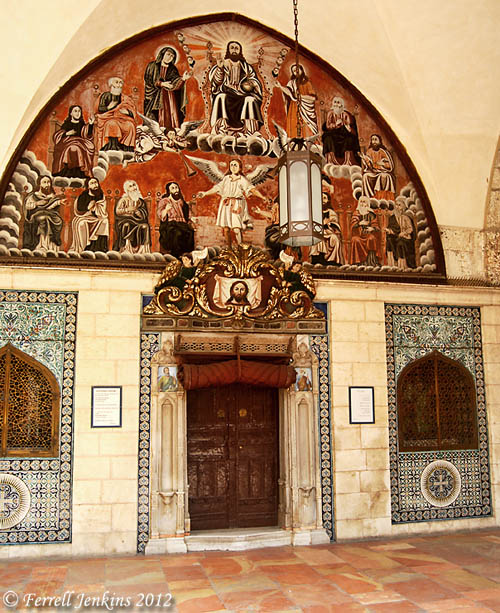
Entrance to St. James Cathedral in the Armenian Quarter of Jerusalem. Photo by Ferrell Jenkins.

Entrance to St. James Cathedral in the Armenian Quarter in the Old City of Jerusalem. Photo by Ferrell Jenkins.

When the panelists finished their presentations, time was allowed for only two or three questions from the audience of about 800 persons. I was seated directly in front of the podium about 4 or 5 rows from the front and rose to ask the first question. The owner of the ossuary, Mr. Oded Golan, was present for the session. I stated that we would like to hear him say how long the ossuary had been in his possession and whether the inscription was on it when he obtained it. Mr. Golan went to the platform and stated that he obtained the ossuary in the 1970s and that the inscription was on it when he obtained it. He is 51 years of age, and has been collecting ossuaries and other antiquities since he was 8 years old. He stated that one item from his collection had been published by the late Yigael Yadin.
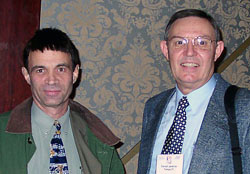
Oden Golan and Ferrell Jenkins at SBL, Toronoto, 2002.

Oden Golan and Ferrell Jenkins at SBL, Toronoto, 2002.

It may sound strange to Americans that a young boy would be collecting ossuaries and other antiquities. We must remember that ancient artifacts are everywhere in Israel (and the West Bank) and that archaeology is a sort of past-time for many people who live there. As a boy growing up in north Alabama I picked up Indian arrowheads from the cotton fields. I have visited several homes in which the host would bring out numerous boxes of artifacts that they had collected from Indian mounds.

Well, I trust this will give our readers a little perspective on the initial presentation of the James Ossuary. You may read more about the trial which has been going on since December, 2004, here.

James the Lord’s Brother

In anticipation of the “James Ossuary” verdict which is scheduled to be announced March 14, I decided to provide some background material. First, here is a brief discussion of the identity of James, and his relation to Jesus.

— • —

The name James was a common name in New Testament times. Several people bearing that name are mentioned in the New Testament. Two apostles bore that name: James the son of Zebedee (Matthew 4:21; 10:2), and James the son of Alphaeus (Matthew 10:3). James, the son of Zebedee, and brother of the apostle John, was put to death by Herod Agrippa I before A.D. 44 (Acts 12:1-2). There was also James, the brother of Jesus. Paul refers to him, along with Cephas [Peter] and John as men who were reputed to be pillars among the brethren (Galatians 2:9). Paul identifies James as “the Lord’s brother” in Galatians 1:19.

The New Testament mentions the brothers and sisters of Jesus in Mark 6:3 and Matthew 13:55-56. Roman Catholics make every effort to evade the plain meaning of “brother.” Roman Catholics hold the non-biblical doctrine of the perpetual virginity of Mary. They claim that the brothers of Jesus were really half-brothers or cousins. The inscription on the James ossuary has opened this issue anew, but more about that at another time (see Matthew 1:25). The New Testament indicates that James and the others listed were the uterine brothers of Jesus. James, the Lord’s brother, is generally thought to be the author of the Epistle of James. Jude, another brother of Jesus, wrote a short book in which he says that he is “a bond-servant of Jesus Christ, and brother of James.” This last expression indicates that Jude was not as well known as James.

The brothers of Jesus did not believe in him during His public ministry (John 7:5), but after the resurrection they are mentioned among the disciples (Acts 1:14). Paul informs us that Jesus made an appearance to James (1 Corinthians 15:7). At least some of the brothers of Jesus seem to be preachers of the gospel (1 Corinthians 9:5). It appears that the brothers of Jesus were convinced by the resurrection. James proved to be influential among the brethren both in Jerusalem and in other places (Galatians 2:11-13; Acts 15; 21:17-26). We’ll leave this matter for another time.

Josephus, the Jewish historian, makes a reference to “the brother of Jesus, who was called Christ, whose name was James” (Ant. Xx.9.1). Eusebius, the early church historian, records the martyrdom of “James, the brother of the Lord” in his Ecclesiastical History (2.23). He cites the earlier accounts by Hegesippus, Clement of Alexandria, and Josephus. This would have been shortly after the death of Festus, procurator of Judea, in A.D. 61.

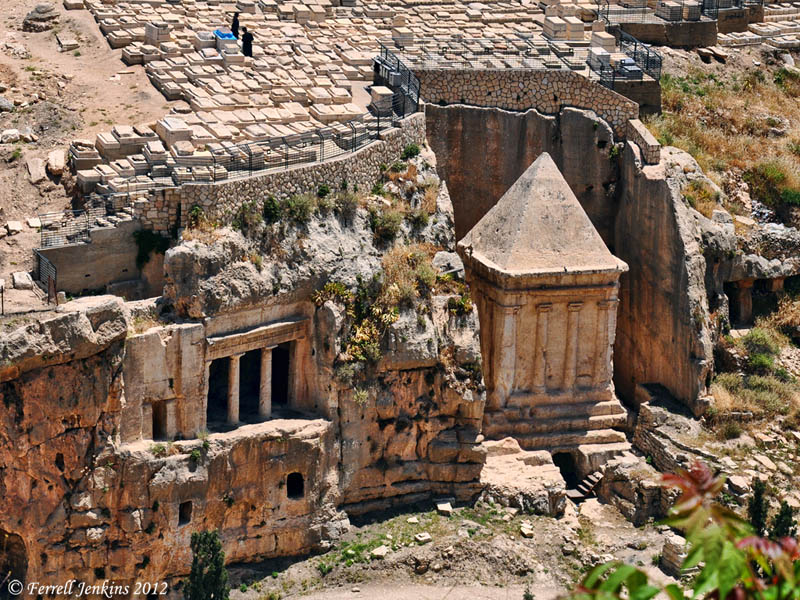
The photo below shows two of the monumental tombs in the Kidron Valley between the Old City of Jerusalem and the Mount of Olives, south of the so-called Tomb of Absalom (see here). Modern Jewish tombs are visible on the slopes of the Mount of Olives above the older monuments.

The tomb on the right is known as the Tomb of Zachariah. The tomb on the left, with a porch and two Doric columns is the Tomb of Beni Hezir from the latter half of the second century B.C. (the Maccabean Period). It is incorrectly identified as the Tomb of James.

Bene Hezir (traditional James) Tomb and Tomb of Zachariah. Photo by Ferrell Jenkins.

Bene Hezir (traditional James) Tomb and Tomb of Zachariah. Photo by Ferrell Jenkins.

We have pointed out before that many structures have been incorrectly identified with specific biblical characters over the centuries. The tomb identified with James belonged to a priestly family named Hezir. Perhaps this Hezir was a descendant of a priest mentioned in 1 Chronicles 24:15. The name appears again in Nehemiah 10:20. The connection with James was a mistaken idea.

Zacharias asked for a writing tablet

When John was born, the neighbors and relatives thought they would call the child “Zacharias, after his father.” His mother, Elizabeth, said that he should be called John. The guests made signs to the mute Zacharias to have him say what he wanted the child called. Luke says,

He asked for a writing tablet and wrote, “His name is John.” And they were all amazed.  (Luke 1:63 NET)

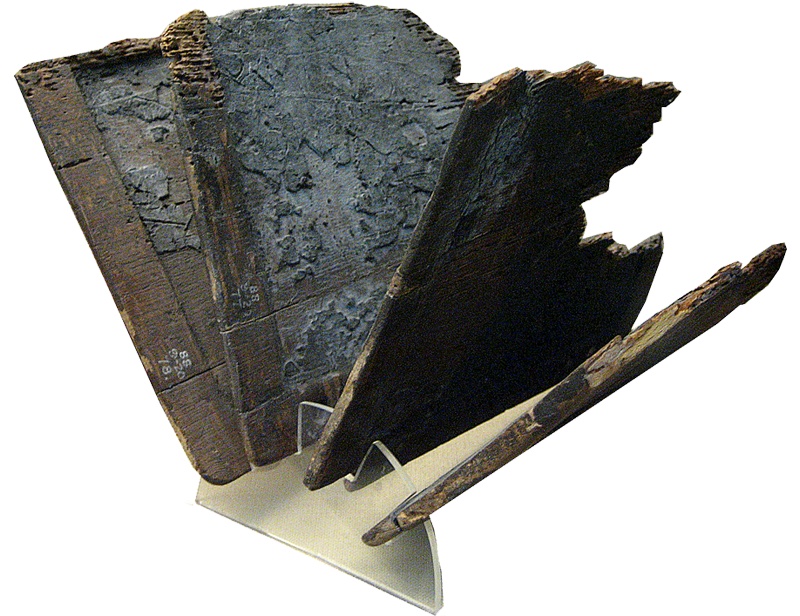
The Greek word Luke used for tablet is pinakidion. It is used only here in the New Testament. BDAG Lexicon says the term is used of a “little (wooden) tablet esp. of a writing-tablet for notes.”  Louw-Nida says the word describes “a small writing tablet (normally made of wood).” The Study Note in the NET Bible points out that “The writing tablet requested by Zechariah [Zacharias] would have been a wax tablet.”

Four leaves of a wooden writing tablet. Roman period from Hawara, Egypt. British Museum.

Wooden writing tablet (Roman period from Egypt). British Museum. Photo by F. Jenkins.

Ralph Earle comments on the tablet:

It was a wax-coated, small, wooden “writing tablet” (NIV)—something quite different from a “writing table” (KJV). — Word Meanings in the New Testament.

A little insight into the culture of the time makes the Bible come alive.

Origen, c. 185–c. 254, comments on this verse in his Commentary on Matthew Bk. XIII.

Earliest evidence of a New Testament verse in stone

In two previous posts we have mentioned the so-called Tomb of Absalom in the Kidron Valley here and here. We noted that the horizontal inscription on the south side of the monument reads,

This is the tomb of Zacharias, martyr, very pious priest, father of John.

We know from Luke 1 that Zacharias was a priest and the father of John (the Baptist). Whether the monument was actually used as the tomb of Zacharias is a matter of conjecture, but the inscription does show what the common belief in the 4th century A.D. about Zacharias and John.

We noted that there are two inscriptions on the Absalom monument. The horizontal inscription is the one mentioned above. The vertical inscription is the one we wish to mention in this post. (In fact, there is a third inscription consisting of a cross and the words “The nephesh.”)

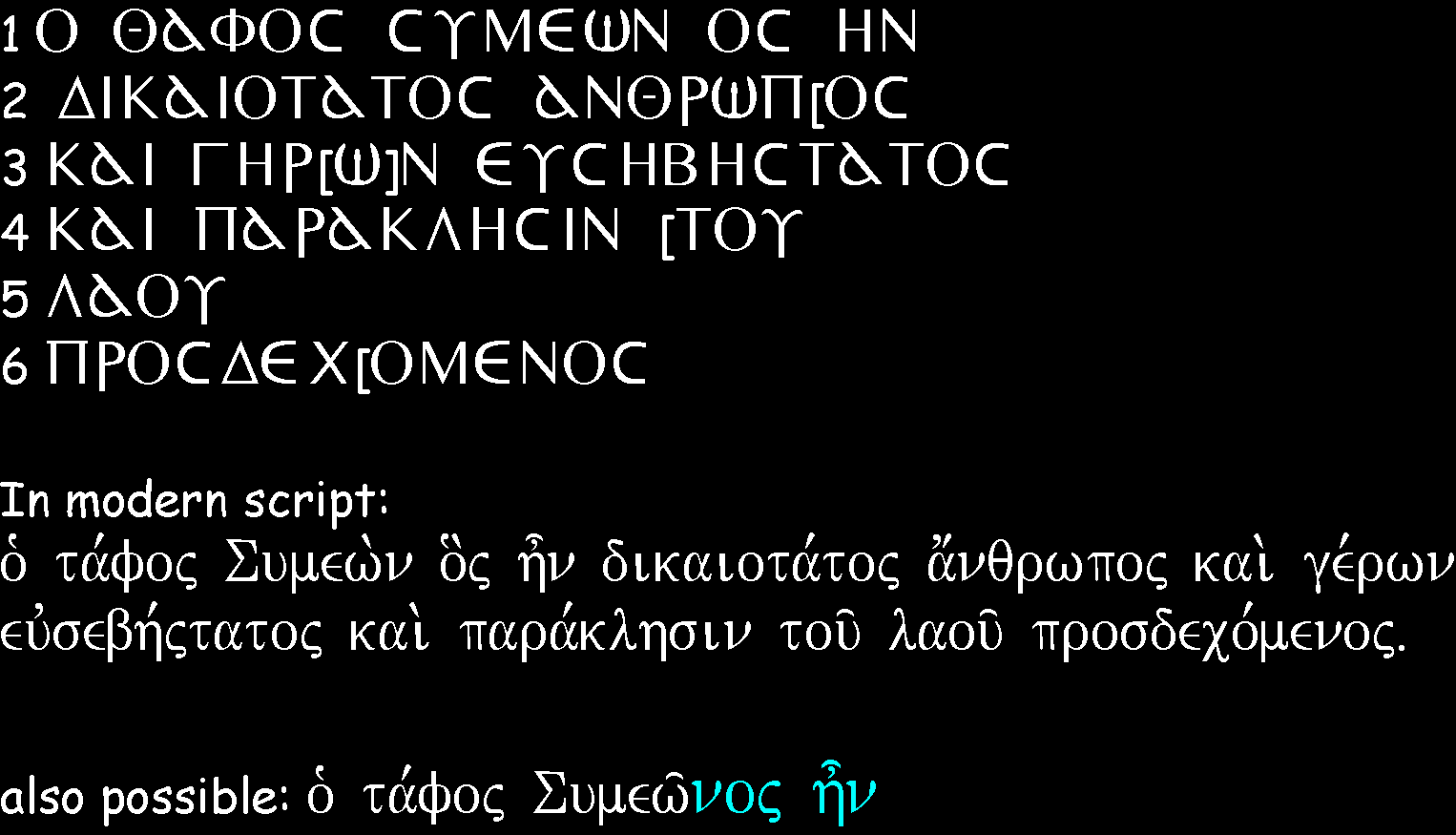
The long vertical inscription consists of the five lines in Greek. Puech translates them as follows,

The tomb of Simeon who was
a very just man
and a very devout el(der)
and (who was) waiting for
the consolation of
the people.

After considerable study, the scholars thought it was clear “that the scribe had engraved the main part of a verse from a gospel, Luke 2:25.” The drawing below shows the six lines of the inscription and the same in modern Greek. Click on the image for a larger, clearer one.

Inscription on south side of Absalom Monument.

Inscription on south side of Absalom Monument.

Luke 2:25 is part of the account of the presentation of Jesus in the Temple by Mary. Verse 25 reads,

And there was a man in Jerusalem whose name was Simeon; and this man was righteous and devout, looking for the consolation of Israel; and the Holy Spirit was upon him. (Luke:25 NAU)

The word Israel is changed in the inscription to read people.

Puech and Zias comment about the use of Luke 2:25 in the stone inscription.

So, the inscriptions on the tomb bear witness to the written traditions from the Byzantine period as well as those of the early church fathers. Moreover, the inscription from the Gospel of Luke is identical to that found in the Codex Sinaiticus, dated to the second quarter of the fourth century, prior to a correction according to the text of the Codex Vaticanus (εὐσεβὴς prima manu instead of εὐλαβὴς) around the middle of the sixth century, thus showing that the local Palestinian text was widely accepted as authoritative by the early church of Palestine….

Thus this inscription is the earliest evidence for a New Testament verse engraved in stone, and it fits Palestinian tradition (Puech and Zias 2004: 572).

Most of my information comes from Near Eastern Archaeology, Dec. 2005.

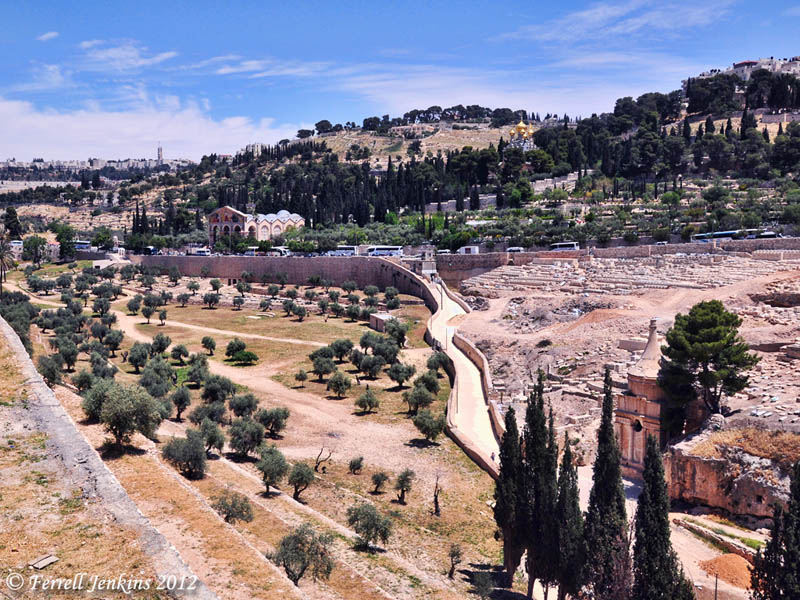
The photo below shows the Kidron Valley. The Mount of Olives is visible in the upper right of the photo. The tomb of Absalom is visible in the lower right. The view is to the northeast. The low hill with buildings in the distant left is Mount Scopus.

View of Kidron Valley from SE corner of Temple Mount. Photo by Ferrell Jenkins.

View of Kidron Valley from SE corner of Temple Mount. Photo by Ferrell Jenkins.

One never knows where the next significant discovery will be made.

Interesting Nativity Scenes

It is true that no date for the birth of Jesus is given in the New Testament. The celebration of his birth arose centuries after the actual birth. Many traditions have arisen as men seek to honor Christ. The Nativity Scene is one of those traditions.

Earlier this week my wife and I enjoyed a few days at the Gaylord Palms hotel in the Disney World area with our grandson. We took him to see the ICE creations and the Dream Works Experience.

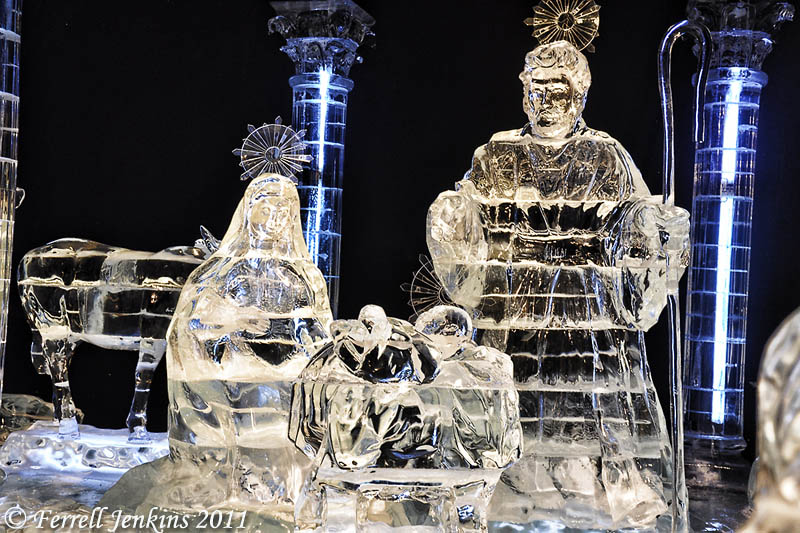
In addition to the Dream Works characters (Shrek, Fiona, Donkey, Alex, Julian, Po, et al.) carved in ICE, we were surprised to see a large nativity scene of ICE. I thought you might enjoy seeing a small portion of the scene. To see all of the characters, animals, etc., you must visit ICE.

Portion of the Nativity Scene at ICE, Gaylord Palms. Photo by Ferrell Jenkins.

Portion of the Nativity Scene at ICE, Gaylord Palms. Photo by Ferrell Jenkins.

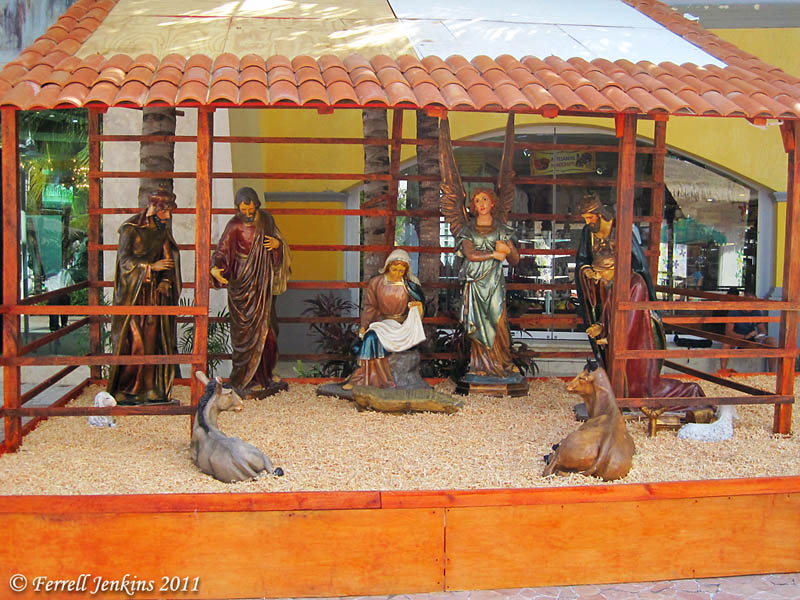
Last month my wife and I took a cruise in celebration of our 57th wedding anniversary. The Nativity Scene was already displayed in the market square at Cozumel, Mexico.

Nativity Scene at Cozumel. Photo by Ferrell Jenkins.

Nativity Scene at Cozumel. Photo by Ferrell Jenkins.

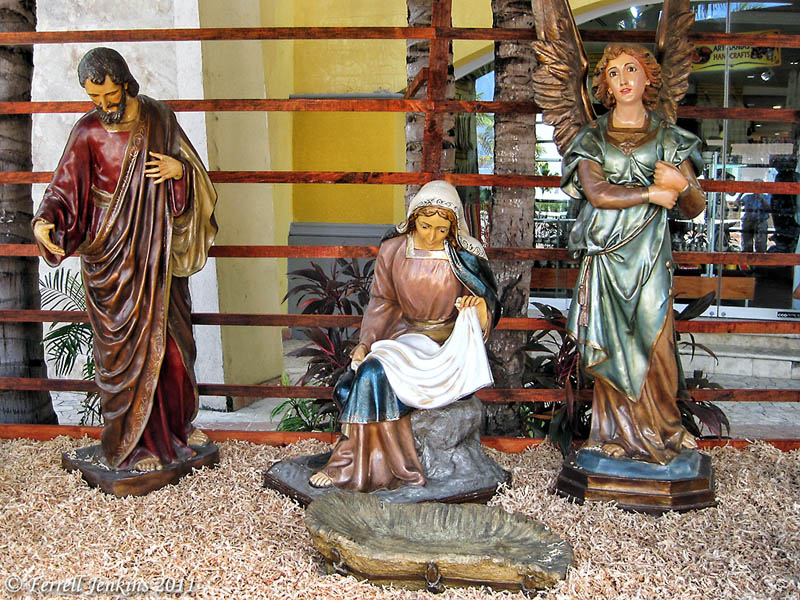
Do you detect anything wrong in the traditional scene? Take a closer look.

Cozumel Nativity Scene. Photo by Ferrell Jenkins.

Cozumel Nativity Scene without Jesus. Photo by Ferrell Jenkins.

Perhaps they got the account of the birth of Jesus (Luke 2: 1-20) confused with Jesus being left behind in the temple (Luke 2:41-52). Or, maybe it was just vandalism by a modern day Herod.

The specific date (month and day) for the birth of Jesus is not important. The Apostle Paul stated the importance of His birth in the Epistle to the Galatians.

But when the fullness of time had come, God sent forth his Son, born of woman, born under the law,  to redeem those who were under the law, so that we might receive adoption as sons. (Galatians 4:4-5 ESV)

The Tischendorf letter at Saint Catherine’s Monastery

Reader Ted Weis wrote,

Do you happen to have a photo of the letter that von Tischendorf wrote, saying that he would return codex Sinaiticus?

Well…, yes and no. A picture. But not a good one. There is now a museum or display area of a few small rooms in the Monastery near Moses’ Well. Signs are posted to restrict photography. A photo that I have from this year is too blurry to make sense of. A copy of the letter is posted on one wall and a sign about Codex Sinaiticus (in Greek, English, and Arabic), reads this way:

Codex Sinaiticus

The Codex Sinaiticus dates to the middle of the fourth century, and is possibly one of the fifty copies of the Holy Scriptures sent to Constantine the Great by Eusebius of Caesarea. This same manuscript was likely donated to the Monastery of Sinai at its foundation, where it was preserved until the middle of the nineteenth century. It was seen in the library of the Monastery by the German scholar Constantine Tischendorf on his visits in 1844 and 1859. The first folios that he took, he presented to the University of Leipzig. The rest he gave to the Emperor of Russia, folios he had received as a loan so that they might be published, secured with lying promises to the monks. In Russia they remained until 1933, when they were sold by the Soviet Union to the British Library in London, where they are to this day. In 1975, certain folios of the Codex came to light among the New Finds in the tower of Saint George. The monks of Sinai have never ceased in their justified request for the return of their Codex.

The photo below shows the sign on the right and a copy of the Tischendorf letter on the left.

Sinaticus Sign and Tischendorf Letter at Saint Catherine's Monastery. Photo by Ferrell Jenkins.

Tischendorf letter & sign at Saint Catherine's Monastery. Photo by Ferrell Jenkins.

I remember visiting the Monastery library on two previous occasions. At that time we were taken into the library during the visit. I saw a copy of the Tischendorf letter and an English translation. Here is a scan of a slide I made in 1986. Click on image for a larger photo.

Tischendorf Letter at Saint Catherine's in 1986. Photo by Ferrell Jenkins.

Tischendorf Letter at Saint Catherine's in 1986. Photo by Ferrell Jenkins.

The letter on the left is written in Greek. James Bentley says it was “bad Greek” and that the translation is “not very competent.” Here, he says, is what Tischendorf wrote:

I the undersigned, Constantin von Tischendorf, sent at present to the East by orders of Alexander, Tsar of All Russias, testify by the present letter that the Holy Confraternity of Mount Sinai, in accordance with the letter of His Excellency Ambassador Lobanov, has handed over to me, as a loan, an ancient manuscript of both Testaments, being the property of the aforementioned monastery and consisting of 346 folia and a small fragment. These I wish to take with me to St Petersburg in order that I may compare the original with the copy made by me when that is printed.

This manuscript is entrusted to me under the conditions laid down in the aforementioned letter of Mr Lobanov, dated 10 September 1859, numbered 510. I promise to return it, undamaged and in a good state of preservation, to the Holy Confraternity of Mount Sinai at its first request.

Several years ago I read James Bentley’s Secrets of Mount Sinai: The Story of the World’s Oldest Bible — Codex Sinaiticus (Doubleday, 1986). It is an interesting book and may still be available. The foreword is by James H. Charlesworth.

Sorry I can’t do better, but I hope this will be helpful to those who are interested in the history of Codex Sinaiticus, the oldest complete manuscript of the New Testament.

The largest part of Codex Sinaiticus is now in the British Library, but there are portions in three other places including Saint Catherine’s. The available pages of the manuscript are available online at the Codex Sinaiticus website.

Saint Catherine’s Monastery

The Monastery of St. Catherine is located at an altitude of about 4925 feet in the Wadi el-Deir at the foot of Gebel Musa. Tradition identifies this as the site where Moses tended the flocks of Jethro and saw the burning bush (Ex. 3:1-4:17). The Monastery was built near the middle of the sixth century A.D. during the reign of the emperor Justinian. It is dedicated to Saint Catherine of Alexandria and is the oldest continuously inhabited monastery in the Christian world. Through the centuries many monks have lived there; today it houses fewer than a dozen Greek Orthodox monks. The monastery became a great center of over 3000 old manuscripts and over 2000 icons. Only the Vatican library has more manuscripts.

Here is a new photo of the Monastery that I made in January.

View of St. Catherine's Monastery. Photo by Ferrell Jenkins 2011.

View of St. Catherine's Monastery. Photo by Ferrell Jenkins 2011.

The bedouin who work at the Monastery are called Jabaliye (Arabic for People of the Mountain).

“According to their tradition they are descendants of Christian slaves who were brought here by Emperor Justinian from Wallachia, today Rumania [Romania], as builders of the monastery and later its guards. In the course of time, when Sinai came under strict Moslem rule they were compelled to embrace Islam” (Vilnay, The Guide to Israel, 564).

There is a mosque within the monastery walls.