Category Archives: Church History

Acts 15 — Photo Illustrations

James, the Lord’s brother, is one of the prominent characters in Acts 15. In fact, Paul later refers to the events of Acts 15, and speaks of James, Cephas,and John.

and when James, Cephas, and John, who had a reputation as pillars, recognized the grace that had been given to me, they gave to Barnabas and me the right hand of fellowship, agreeing that we would go to the Gentiles and they to the circumcised.  (Galatians 2:9 NET)

In the Armenian Quarter of the Old City of Jerusalem we find the Cathedral of St. James. Murphy-O’Connor says,

Facts and legend are juxtaposed as casually as are artistic creations of different talents and periods. The church is dedicated to St. James the Great, son of Zebedee, who was executed by king Herod Agrippa I in 44 (Acts 12:1-3).

But the building also claims to hold the “patriarchal throne of St James the Less, the brother of the Lord…” (Murphy-O’Connor). This is the James of Acts 15. (It is sometimes difficult for readers to keep all of those named James, John, and Mary, separate when reading the New Testament — not to mention Herod.)

Photos were not allowed inside the building when I was there to observe a service. This photo shows the entrance to the Cathedral.
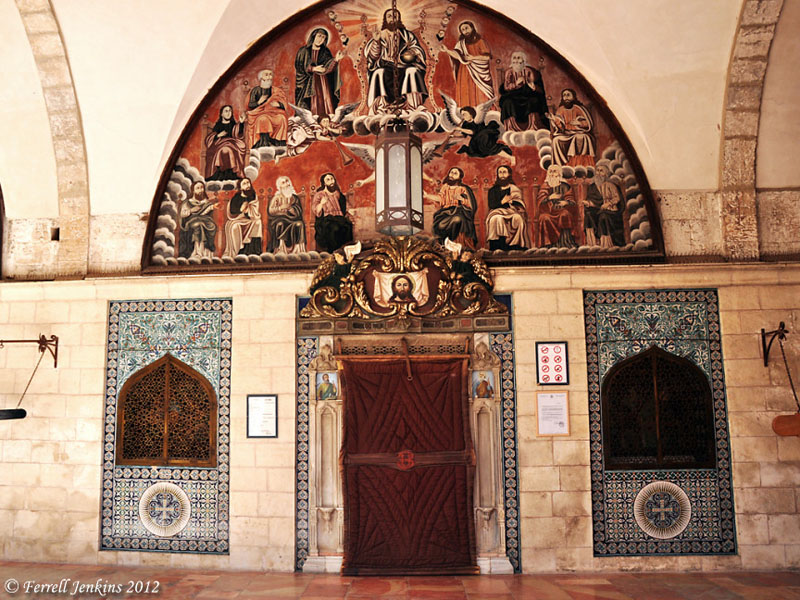
Entrance to St. James Cathedral in the Armenian Quarter of Jerusalem. Photo by Ferrell Jenkins.

Entrance to St. James Cathedral in the Armenian Quarter. Photo by Ferrell Jenkins.

In one of the quietest places in the Old City one comes upon St. James Street.
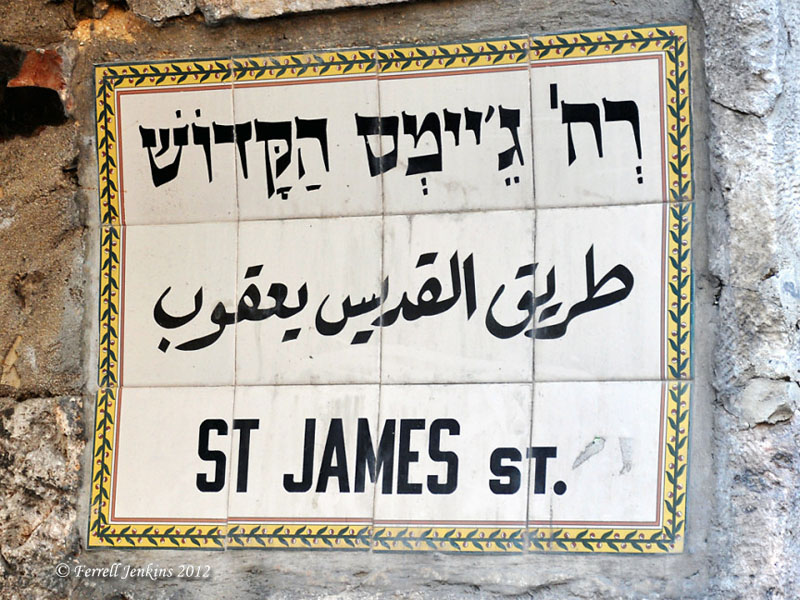
St. James Street in the Armenian Quarter. Photo by Ferrell Jenkins.

St. James Street in the Armenian Quarter. Photo by Ferrell Jenkins.

Other names of interest in the Armenian Quarter include St. Mark’s Street and Ararat Street. A century ago the Armenians had a large presence in eastern Turkey, where the Mountains of Ararat are located.
The “wife of Christ”

Reminds me of a preaching brother in the Ohio Valley a few decades back who had trouble pronouncing the letter “L”. As a result, he often spoke of the “wife of Christ.” True story. Like the Europeans who says “elewator” in stead of “elevator.”

Having been out of the country for three weeks and still delayed in New York, I have been unable to mention the recent spate of media attention to the claim of a document in which Jesus mentions His wife.

For those who are interested in reading some reliable responses to this nonsense, I call attention to two posts by Todd Bolen at the Bible Places Blog.

In the first one, Bolen briefly summarizes his response to the story under the title “Somebody Once Believed That Jesus Had a Wife” here.

In the second one, here,  he lists a summary of more than a dozen articles worth reading.

Don’t go to church Sunday morning without being prepared. Someone is sure to mention one of the brief reports they heard on TV.

Visiting the Old City of Jerusalem

We left the hotel this morning at 7:15 in order to be at the security line going to the Temple Mount platform as soon as it opened. After that visit we followed the traditional Via Dolorosa. After a visit to the Church of the Holy Sepulchre we went to the Jewish Quarter to see the Broad Wall, the Burnt House (from A.D. 70), and the Herodian Mansion (or perhaps the house of priests).

We came down to the Western Wall Plaza to visit the Western Wall, then the Davidson Center excavations.

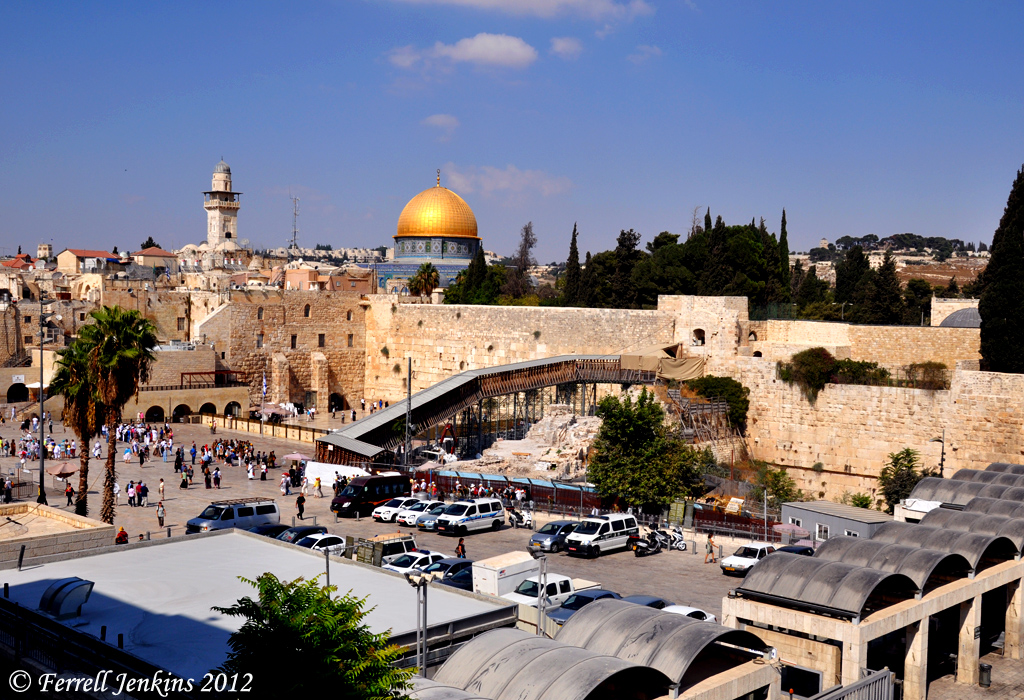
This photo of the Western Wall and Temple Mount platform was made from the southwest. You can see a portion of the Western Wall, the Mughrabi (temporary) Bridge, and the Dome of the Rock (where the biblical Temple once stood).

Temple Mount in Jerusalem from the SW. Photo by Ferrell Jenkins.

Temple Mount in Jerusalem from the SW. Photo by Ferrell Jenkins.

On the right side of the photo, in the distance, can be seen the hill between Mount Scopus and the Mount of Olives. I think this is where the Augusta Victoria Hospital is located.

It was a full day.

Logos Book of the Month — Psalms and Hymns of Isaac Watts

Pick up almost any book of hymns and you will note several songs by Isaac Watts (1674-1748), a native of Southhampton, England. The Dictionary of the Christian Church says,

Watts deservedly holds a very high place among English hymn-writers. His hymns reflect his strong and serene faith and did much to make hymn-singing a powerful devotional force, especially in Nonconformity… [especially nonconformity to the Church of England at the time, but used of nonconformity to any Established Church]

Logos is offering The Psalms and Hymns of Isaac Watts free to Logos users for the month of September. See details here.

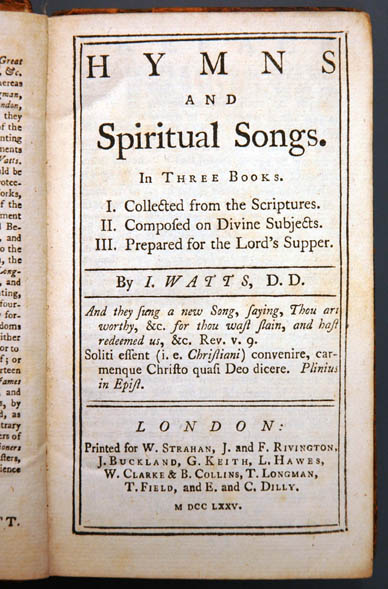
A 1775 edition of a book by Isaac Watts. U. of Otago.

I have Logos Bible Software 4 open now to a hymn based on Galatians 6:14. The title is “Crucifixion to the world by the cross of Christ.” We probably know this song by the first words, “When I survey the wondrous cross.”

Crucifixion to the world by the cross of Christ.
(Gal. 6:14)

 When I survey the wondrous cross
On which the Prince of glory died,
My richest gain I count but loss,
And pour contempt on all my pride.

Forbid it, Lord, that I should boast,
Save in the death of Christ my God!
All the vain things that charm me most,
I sacrifice them to his blood.

See from his head, his hands, his feet,
Sorrow and love flow mingled down!
Did e’er such love and sorrow meet,
Or thorns compose so rich a crown!

[His dying crimson, like a robe,
Spreads o’er his body on the tree:
Then am I dead to all the globe,
And all the globe is dead to me.]

Were the whole realm of nature mine,
That were a present far too small;
Love so amazing, so divine,
Demands my soul, my life, my all.

Watts, I. (1998). The Psalms and hymns of Isaac Watts. Oak Harbor, WA: Logos Research Systems, Inc.

Don’t expect modern shaped notes. And if you know nothing of the Meters that were used in Watts’ time, you may simply use the book for devotional readings.

Notice the vivid fourth stanza describing the dying Christ which is often left out of modern hymn books.

Acts 13 — Photo Illustrations

How long would it take to provide photo illustrations for Acts 13? Here are some of the places and persons we might consider.

  • Syrian Antioch
  • Seleucia
  • Cyprus
  • Salamis, Cyprus
  • Paphos, Cyprus
  • Barnabas
  • Sergius Paulus
  • Perga in Pamphylia
  • Pisidian Antioch
  • Iconium

Not to mention the historical references in Paul’s sermon in the synagogue at Pisidian Antioch. (You can find posts about most, if not all, of the above list by using the Search box.)

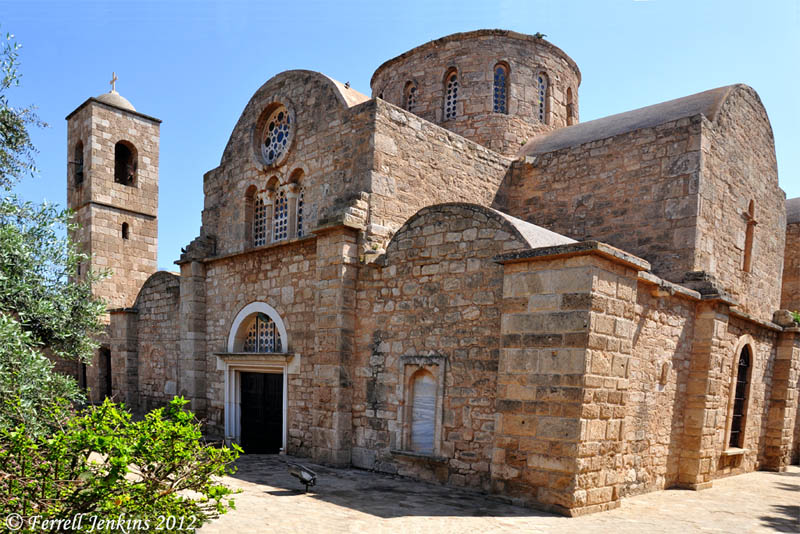
For today, I have chosen to call attention to Barnabas and his association with Cyprus. The first stop made by Barnabas, Saul, and John Mark on Cyprus was at the eastern port of Salamis. A few miles west of the harbor and ancient city we now have the Monastery and Church of St. Barnabas. Salamis, and this building, are now located in the Turkish Republic of Norther Cyprus. The folks in the south, the Republic of Cyprus, speak of the north as occupied territory. (I leave the politics of the issue for others.) The monastery and church, erected in A.D. 477, now houses an icon museum and a small archaeological museum.

Tradition has it that Barnabas was martyred by Jews on Cyprus, but we have no evidence to back up this assertion.

Church of St. Barnabas at Salamis, Cyprus.

Late 5th century church of St. Barnabas at Salamis, Cyprus. Photo by Ferrell Jenkins.

Acts 4:36 informs us that Joseph was also called Barnabas by the apostles. The name Barnabas means Son of Encouragement or Exhortation. He must have been an eloquent speaker, especially good at exhorting and encouraging others. He was generous with his property, a good man, full of the Holy Spirit and of faith (Acts 11:24).

Barnabas was of the tribe of Levi and a native of the island of Cyprus. He later introduced Saul of Tarsus (Paul) to the brethren in Jerusalem (Acts 9:26-27) and preached in Antioch (Acts 11:22-30). Barnabas, and his cousin John Mark (Colossians 4:10), joined Saul for the first preaching journey (Acts 13-14).

After a sharp disagreement between Barnabas and Paul, Barnabas took Mark with him to Cyprus (Acts 15:39). One wonders if Mark also was a native of Cyprus.

Acts 11 & 13 — Photo Illustrations

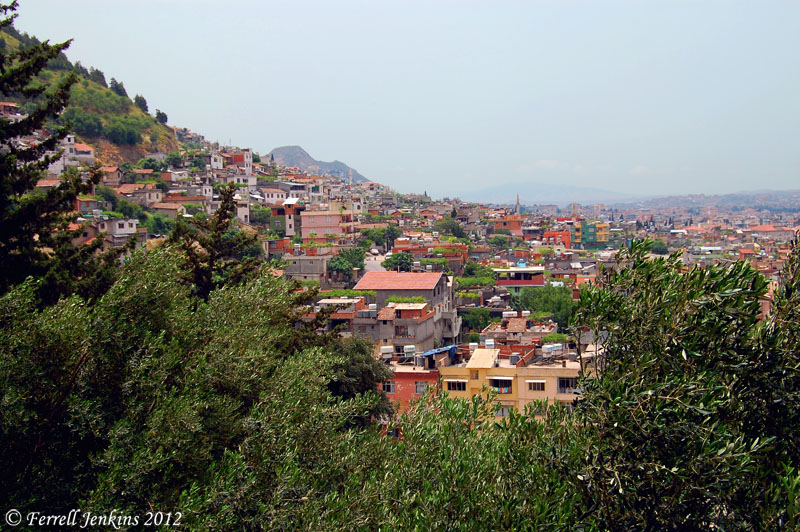
Antioch was founded on the Orontes River by Seleucus I Nicator in 300 B.C. The city is about 18 miles from the sea and is the most famous of 16 Antiochs built by Seleucus and named for his father Antiochus. Four of these cities are mentioned in the New Testament (Antioch of Syria, Pisidian Antioch, Seleucia, and Laodicea). Antioch continues today as Antakya, Turkey, with a population of more than 200,000.

Antakya, Turkey (biblical Antioch of Syria). View south from slopes of Mt. Silpius. Photo by Ferrell Jenkins.

Antakya, Turkey (biblical Antioch of Syria). View south from slopes of Mt. Silpius. Photo by Ferrell Jenkins.

The Romans came in 64 B.C. and put an end to Seleucid rule. Antioch became the capital of the new province of Syria. It became the third greatest city of the Roman empire after Rome and Alexandria. Some have estimated that in New Testament times the population of the city neared a half million. Even Herod the Great assisted Augustus and Tiberias in beautifying the city.

Seleucus I Nicator, King of Syria (358-280 B.C.). Louvre. Photo by Ferrell Jenkins.

Seleucus I Nicator, King of Syria (358-280 B.C.). Seleucus was the founder of Antioch. Displayed in the Louvre. Photo by Ferrell Jenkins.

After Jerusalem, Antioch was the second great center of Christianity in New Testament times. When the disciples were scattered from Jerusalem after the stoning of Stephen, some came to Antioch from Cyprus and Cyrene (area of modern Lybia) and preached to Greeks as well as Jews (Acts 11:19-21). Nicolas, a proselyte of Antioch, had been one of the seven chosen to serve in Jerusalem (Acts 6:5). When the church at Jerusalem, some 300 miles away, heard of the new work they sent Barnabas. When the work became too much for him he left for Tarsus to look for Saul. The two of them labored at Antioch for a whole year and the disciples of Christ were called Christians first at Antioch (Acts 11:22-26).

Acts 2 — Photo Illustrations

Acts 2 is one of those highly significant chapters of the Bible. It is a pivotal point, or as the late James D. Bales called it in one of his books, “The Hub of the Bible.” The reason is because so many Old Testament prophecies looked forward to their fulfillment in the events of Acts 2 (e.g., Isaiah 2, Joel 2, Daniel 2), and because many New Testament texts look back to the beginning of the gospel in that chapter (e.g., Ephesians 2). In fact, Peter refers to the events of Pentecost as “the beginning” (Acts 11:15).

The prophet Isaiah said,

Now it will come about that In the last days The mountain of the house of the LORD Will be established as the chief of the mountains, And will be raised above the hills; And all the nations will stream to it. And many peoples will come and say, “Come, let us go up to the mountain of the LORD, To the house of the God of Jacob; That He may teach us concerning His ways And that we may walk in His paths.” For the law will go forth from Zion And the word of the LORD from Jerusalem. (Isaiah 2:2-3 NAU)

From the beginning of His ministry, Jesus spoke of the establishment of the kingdom during the lifetime of some of those who heard him (Mark 1:14-15; 9:1).

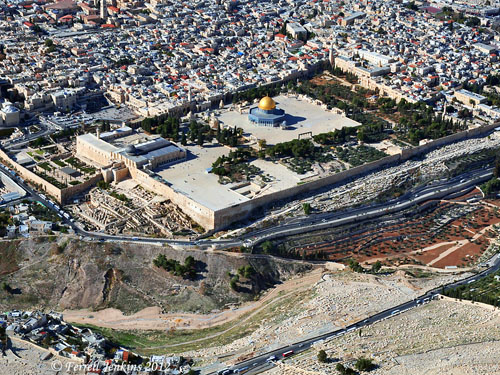
Our aerial photo shows the enclosed Islamic sanctuary area that is commonly called the Haram es-Sherif. Benjamin Mazar says that this area is about 40 acres. He points out that Josephus and the Mishna give smaller dimensions, and says that they apparently refer to “the Soreg or sacred enclosure” (The Mountain of the Lord, 119-120). Other writers say the area is 36 acres in size. Certainly large enough for the crowds who came to Jerusalem for festivals such as the Passover and Pentecost.

Solomon’s temple stood on Mount Moriah (2 Chronicles 3:1). Centuries later Herod the Great built the large platform and enclosure walls. Stones from that wall can still be seen in many places around this vast enclosure. The picture shows the southern wall and the eastern wall (the long one). The Kidron Valley and a portion of the slope of the Mount of Olives is visible in the bottom of the photo.

Aerial view of the temple precinct from the time of Herod the Great. Today the area is occupied by Moslem shrines, Al Aksa Mosque and the Mosque of Omar (Dome of the Rock). Photo by Ferrell Jenkins.

Aerial view of the temple precinct from the time of Herod the Great. Today the area is occupied by Moslem shrines, Al Aksa Mosque and the Mosque of Omar (Dome of the Rock). Photo by Ferrell Jenkins.

Click on the photo for an image suitable for use in teaching.

The New Testament (Greek) makes a distinction between the entire temple precinct, courts and all (Greek, hieron), and the sanctuary where only the priests were allowed (Greek, naos). John 2:14-15 uses hieron. John 2:19-21 uses naos.

Hieron is the term used in Acts 2:46. The new converts met in the temple precinct. They most likely assembled in one of the large porticoes built around the inside of the enclosure wall (cf. Acts 3:11; 5:12).

Day by day continuing with one mind in the temple, and breaking bread from house to house, they were taking their meals together with gladness and sincerity of heart,  praising God and having favor with all the people. And the Lord was adding to their number day by day those who were being saved. (Acts 2:46-47 NAU)

It also was within this precinct that the large crowd of devout Jews “from every nation under heaven” assembled on Pentecost. Here, Peter preached the gospel of the death, burial, and resurrection of Jesus for the first time.

Persecution of Christians in Pontus

Pliny. Pliny was the governor of the Bithynia and Pontus. According to The Dictionary of the Christian Church he was born c. 61 and died c. 112. He exchanged a series of letters with the Roman Emperor Trajan (98-117 A.D.). I have done some browsing in the older Loeb edition (revised by Hutchinson) of Pliny Letters. I see references to the Black Sea cities of Heraclea (now Eregli), Amastris (now Amastra), Sinope (now Sinop), and Amisus (now Samsun). I mention this to emphasize that Pliny was familiar with the cities of Pontus. He writes of Sinope being ill supplied with water and suggests a solution to the Emperor.

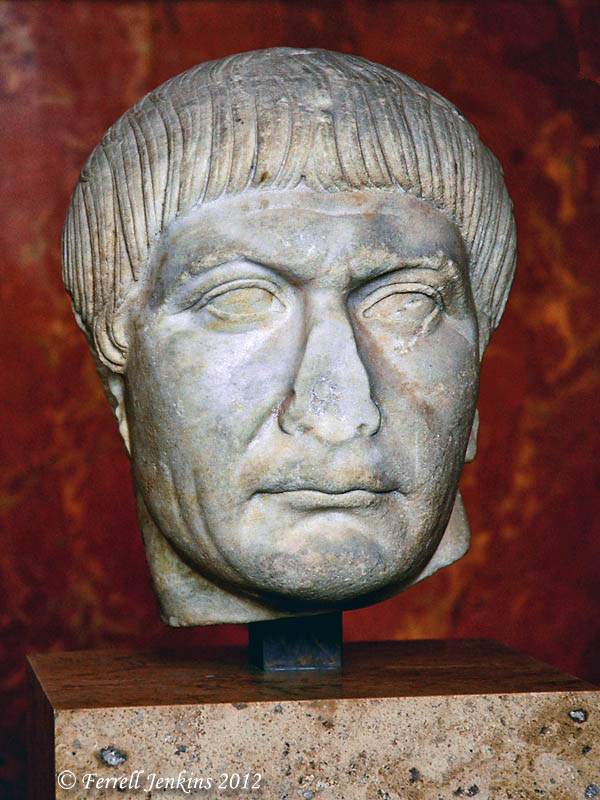
Roman Emperor Trajan in the Louvre. Photo by Ferrell Jenkins.

Roman Emperor Trajan in the Louvre. Photo by Ferrell Jenkins.

Pliny wrote to the Emperor saying that he was uncertain about how to deal with the Christians in his province. He said that he had not been present at any of the trials of Christians. He explains his procedure to the Emperor:

In the meanwhile, the method I have observed towards those who have been denounced to me as Christians is this: I interrogated them whether they were Christians; if they confessed it I repeated the question twice again, adding the threat of capital punishment; if they still persevered, I ordered them to be executed. (X.xcvi).

The Christians were ordered to offer wine and incense to the image of the Emperor. Pliny had been told that those who are really Christians would not make such an offering. Some of those who were questioned said they had quit serving Christ as much as 25 years earlier. Think about that date (about 85 A.D.). This gets us close to the date of Peter’s epistles (1 Peter 1:1).

Trajan answered Pliny:

The method you have pursued, my dear Pliny, in sifting the cases of those denounced to you as Christians is extremely proper. (X.xcvii)

He said that no search should be made for the Christians. If a Christian repented and demonstrated his repentance by “adoring the Gods” [offering the wine and incense to the image of the Emperor] they should be pardoned. I think this is the type of worship mentioned in the book of Revelation which was written a few years earlier to the churches of the Roman province of Asia (Revelation 13; 14:9-11).

Phil Harland comments on the charges brought against the Christians.

The addressees were faced with “suffering” primarily in the form of verbal abuse: they were spoken against, blasphemed, reviled, and falsely called “wrongdoers” (1 Peter 2:12; 3:9, 15-17; 4:3-5; 5:9). The reasons for this suffering stemmed from the Christians’ failure to participate in religious life in the same way as they had before: the Gentiles “are surprised that you do not now join them in the same wild profligacy, and they abuse you” (1 Peter 4:4 [RSV]). Persecution of Christians, which was local and sporadic, was more often than not a consequence of denying the gods and goddesses of others, along with the social implications of non-participation in the rituals that honoured these deities

For more along this same line see Phil Harland’s post about Bithynia and Pontus here.

My intention is to turn next to the specific question of the route of travel taken by the messenger who delivered Peter’s epistles throughout Pontus, Galatia, Cappadocia, Asia and Bithynia.

More famous Sinopeans

In addition to Diogenes and Serapis, Sinop in Pontus was the home of several other well known people in early church history.

Aquila. (Not the Aquila of Acts 18:2.) This Aquila, a native of Sinop in Pontus, is said to have been a relative of the Emperor Hadrian (A.D. 117-138). He was converted to Christianity during a visit to Jerusalem, but was rejected because he refused to give up his studies of astronomy. Later he became a proselyte to Judaism.

Having become a disciple of the Rabbis, from whom he learned Hebrew and the rabbinical method of exegesis, he used his knowledge to make a revision of the Septuagint, bringing it into line with the official Hebrew text. It was soon adopted by Greek speaking Jews in preference to the LXX, which was used by the Christians. His translation, which was finished probably c. 140, was extremely literal, attempting to reproduce individual Hebrew words and phrases exactly. This procedure frequently obscured the sense; but the fidelity of Aquila’s version to the Hebrew original was admitted by the Fathers most competent to judge, such as Origen and Jerome. (Dictionary of the Christian Church, ed. Cross & Livingstone, 94).

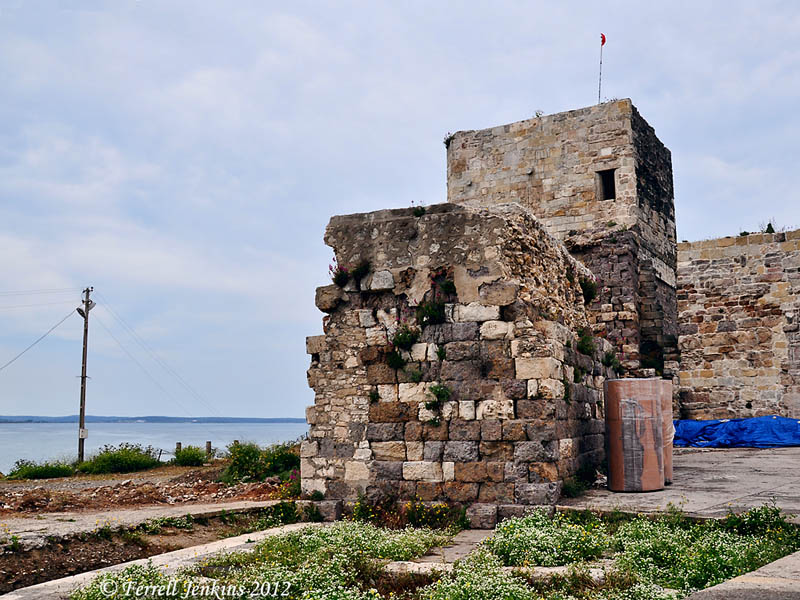
Tower and wall on the Black Sea at Sinop, Turkey. Photo by Ferrell Jenkins.

Tower and wall on the Black Sea at Sinop, Turkey. Photo by Ferrell Jenkins.

Marcion (died c. 160 A.D.). We rarely read or hear the name Marcion without the word heretic attached to it. None of his writings have survived, but his success can be seen by the many early Fathers who spoke of him. (For a list of these see Bercot, ed., A Dictionary of Early Christian Beliefs.) This influential ship master of Pontus rejected the God of the Old Testament who he described as evil and vengeful. According to him, the Christian gospel was a message of love, and the Father of Jesus was not the God of the Old Testament. Many of his views were similar to those of Gnosticism. Marcion accepted only the Gospel of Luke among the Gospels, and the writings of Paul.

Marcion went to Rome about A.D. 140, but within 4 years he was excommunicated from the church. From Rome he spread his teachings all over the Empire.

Phocas (Phokas). Phocas was martyred at Sinop in A.D. 117 during the reign of the Roman Emperor Trajan.

According to the Dictionary of the Christian Church (1282), a different man named Phocas “the Gardener” was martyred  during the persecution by the Roman Emperor Diocletian in A.D. 303. I haven’t determined if he was associated with the port city of Sinop. Wilson seems to confuse these two persons (Biblical Turkey, 342).

The Sinop Gospels is not a person, but should be mentioned in connection with the Black Sea port of Turkey. This parchment document was dyed purple and written in gold ink. The uncial manuscript 023 contains 43 pages of the gospel of Matthew. The manuscript was discovered in Sinop in the late 19th century is thought to have originated in Syria or Mesopotamia in the 6th century A.D. It is now in the Bibliothèque Nationale in Paris.

A brief description in French, and a small image of two pages of the manuscript may be found here. The manuscript features small drawings to illustrate the biblical text. The displayed page shows Jesus healing a blind man.

More about Hierapolis

After a period of worship this morning we began our touring day in Pamukkale (ancient Hierapolis). From there we continued to Aphrodisias, a Roman city that gives an impression of the reality of life in the period when Christianity was first being spread across the Empire. From there we continued to our hotel on the Aegean Sea.

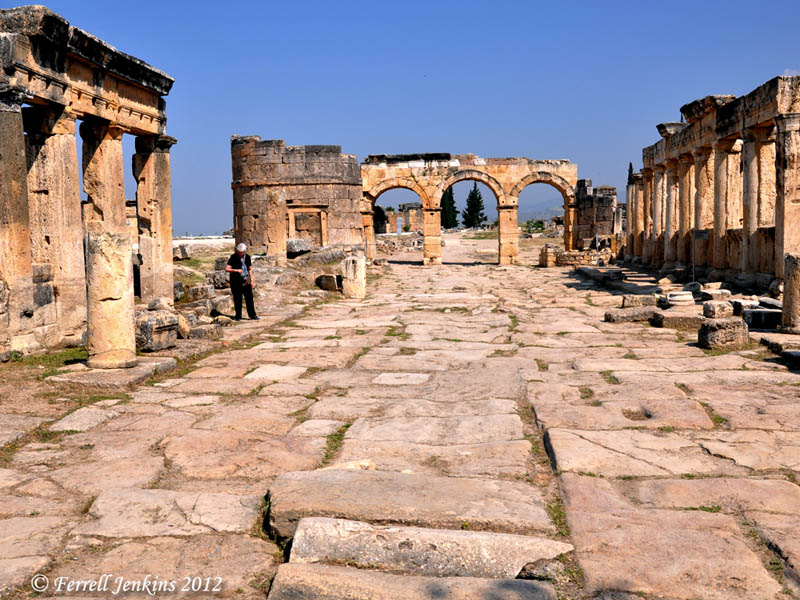
The photo below was made at Pamukkale, Turkey (ancient Hierapolis). We are standing on the colonnaded Roman road, and the monumental gateway behind us is the Arch of the Emperor Domitian (A.D. 81-96). It was constructed in A.D. 82-83.

It was during the reign of Domitian, or shortly thereafter, that the book of Revelation was written by the Apostle John.

Arch of Domitian at Pamukkale (ancient Hierapolis). Photo by Ferrell Jenkins.

Arch of Domitian at Pamukkale (ancient Hierapolis). Photo by Ferrell Jenkins.

Hierapolis was the home of Papias (c. A.D. 60 to c. A.D. 130). He was a disciple of the apostle John and a companion of Polycarp. There are some traditions associating Philip (apostle?, evangelist?) with the city.

The city of Hierapolis is one of the three cities of the Lycus River valley named in the New Testament.

For I testify for him that he has a deep concern for you and for those who are in Laodicea and Hierapolis. (Colossians 4:13).

Tomorrow we hope to visit Ephesus and Miletus.