Category Archives: Book Review

Mark Wilson’s book on Biblical Turkey

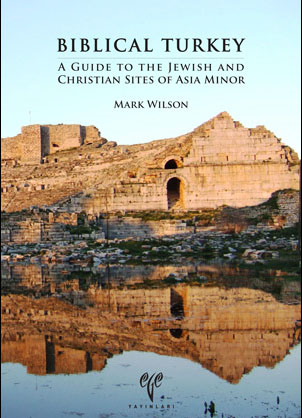
Mark Wilson’s book on Biblical Turkey: A Guide to the Jewish and Christian Sites of Asia Minor is now available through Amazon. Use this Amazon link to order.
Biblical Turkey: A Guide to Jewish and Christian Sites of Asia Minor

A little over two months ago I started a post about Wilson’s book, intending to write a brief review. I see now that A. D. Riddle has written a review over at the Bible Places Blog. I direct our readers to that post for more info about the book.

Since 2003 we have had A Guide to Biblical Studies in Greece and Turkey by Fant and Reddish. Now we have a book by Mark Wilson that is superior in several ways. Wilson includes sites not mentioned by Fant and Reddish, and his book contains an abundance of color photos. Every person who plans a trip to Turkey to visit Biblical sites should study both books.

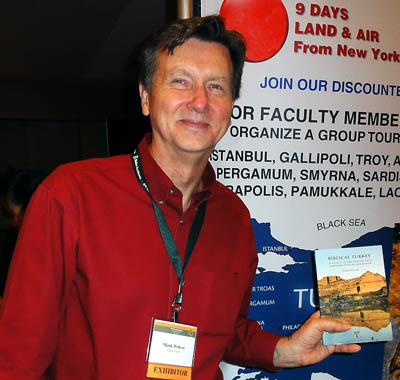
Dr. Wilson proudly displayed his book at the SBL meeting in Atlanta last November. Mark loves Turkey and its biblical sites. For several years he has spent at least half his time studying and exploring in Turkey. If you wish to know about the biblical sites of Turkey, you will enjoy this book.

Mark Wilson shows his new book at SBL in Atlanta. Photo by Ferrell Jenkins.

Mark Wilson shows his book at SBL in Atlanta. Photo by F. Jenkins.

Dr. Wilson spoke to one of my groups in Izmir in 2008. See here.

Still not using Logos Bible Software?

From time to time I am requested to spend some time with a younger preacher (intern/trainee). I always ask if he is using Logos Bible Software. But, I find many older preachers who seem to know nothing of the program. A little over a year ago I commented on buying Bible software here. I said,

Every young preacher should stop buying junk, ready-mixed pabulum, and get some real tools. Another advantage is that you will have no books to loan!

The thing that stirred me up today is the eNewsletter I received from Rejoice Christian Software. They are offering the Essential IVP Reference Collection 3.0 for $89.95 through October 23. They say this is a saving of 88% off the print list price.

The collection includes over 12,000 pages including…

  • Dictionary of Jesus and the Gospels
  • Dictionary of Paul and His Letters
  • Dictionary of the later NT and its Developments
  • Dictionary of New Testament Background
  • IVP Bible Background Commentary: Old Testament
  • IVP Bible Background Commentary: New Testament
  • New Bible Dictionary (2nd ed.)
  • New Bible Commentary: 21st Century Ed.
  • Dictionary of Biblical Imagery
  • New Bible Atlas
  • New Dictionary of Biblical Theology
  • New Dictionary of Theology
  • And several other works.

Did I mention that you can buy the Thomas Nelson Bible Study Library for $29.95? I am not saying that any of these books are the best, but I am sure they will be useful.

If you look up the Essential IVP Reference Collection at Rejoice Christian Software it shows a retail price of $190, with their price being $115. The special this week is $89.95, but you must order here. You will probably pay $3 or $4 for shipping. Give up some frivolity for the next few weeks and get this set of books.

Did I mention that you can search the entire collection at one time?

Only today and tomorrow

Todd Bolen is offering the Picturesque Palestine 4-volume set of photos and engravings for only $20 with free shipping. That price is available only today and tomorrow.

He also tells you how to get his current Bible Places Newsletter, and I can tell you that it offers a great slide show on Samaria that you can download.

Get details here.

A new Bible atlas

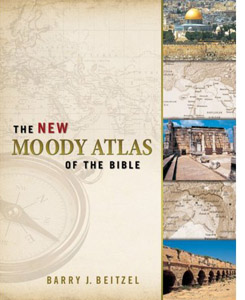
For the past three weeks I have had the opportunity to consult The New Moody Atlas of the Bible by Barry J. Beitzel.
The New Moody Atlas of the Bible
This work is a revision of The Moody Atlas of the Bible, published in 1985. This edition is a worldwide co-edition organized and produced by Lion Hudson in Oxford, England. You surely have seen some of their beautiful work in other publications. The USA edition is published by Moody Publishers. Many high quality books today are printed in the Orient. This one was printed in China. Amazing, isn’t it.
I don’t intend this as a review, but I am impressed with the clarity with which Beitzel discusses controversial material. In “The Route of the Exodus” he clearly discusses the historical background, the geographical setting, searching for Mt. Sinai in Saudi Arabia/South Jordan, searching for Mt Sinai in the northern Sinai peninsula, and searching for Mt. Sinai in southern Sinai. Pros and cons of the various positions are briefly set forth. No, I won’t tell!
This atlas sells for $49.99. I wish the publisher would sell it for $50. Does that one cent difference make anyone think they are getting a bargain? Amazon currently has the book for $31.49 (there we go again) from this link: The New Moody Atlas of the Bible.
Beitzel, with degrees from Dropsie, Fuller, and the University of Pennsylvania, is professor of Old Testament and Semitic Languages at Trinity Evangelical Divinity School.

Dan Brown’s novels: Fact or Fiction?

On the plane from Rome last week I noticed someone reading The Lost Symbol. I think the Today Show made a lot of the book a few weeks ago. I gave some attention to The Da Vinci Code here, but don’t plan to do the same for this new book.

The Telegraph, in an article by Tom Chivers, mentions 50 factual errors in the two books by Dan Brown.

Dan Brown’s new novel The Lost Symbol opens with a bold word: FACT. “All rituals, science, artwork, and monuments in this novel are real”, it says.

The Da Vinci Code, his previous bestseller, began in a similar fashion. “All descriptions of artwork, architecture, documents, and secret rituals in this novel are accurate”, Brown says before the prologue.

Chivers discusses the categories of History, Geography, Science, Symbols, Religion and Mythology, Language, and Miscellany.

Swiss Guard at the Vatican. Photo by Ferrell Jenkins.

Swiss Guard at the Vatican. Photo by Ferrell Jenkins.

Here is one of the mistakes that would not matter much except for the fantastic claim that everything in the books are true.

Langdon says the Swiss Guard’s outfits were “designed by Michelangelo himself.” This is an urban myth: Michelangelo had nothing to do with them. The current uniforms were designed by Commandant Jules Repond between 1910 and 1921.

The Vatican’s official web site says,

The colours which make the uniform so attractive are the traditional Medici blue, red and yellow, set off nicely by the white of the collar and gloves. The blue and yellow bands give a sense of lightness as they move over the red doublet and breeches. The Guard’s every-day uniform is completely blue. With the passing centuries there have been a few minor changes, but on the whole the original dress has been maintained. It is commonly thought that the uniform was designed by Michelangelo, but it would seem rather that he had nothing to do with it. However, Raffaello certainly did influence its development, as he indeed influenced fashion in general in Italy in the Renaissance, through his painting.

I wondered how I would ever use this good photo of a Swiss Guard at the Vatican.

HT: Biblical Paths

200th issue for Biblical Archaeology Review

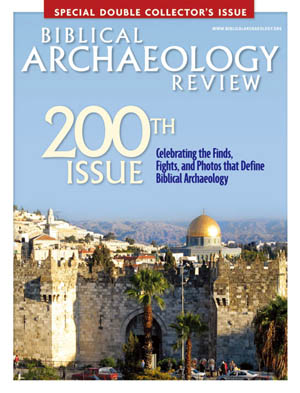
bar_200_35040c100l-tYesterday I received the 200th issue of Biblical Archaeology Review. I have all issues of the magazine since that first small single color issue in March, 1975. When I bought the earlier issues in Libronix format for the computer I gave my paper copies to a young teacher.

Not everyone likes BAR. It has been a controversial magazine. No wonder. Editor Herschel Shanks has been controversial. But, I have enjoyed it all the way. I first met Herschel and his right hand gal, Suzanne Singer, at the ASOR meeting in New Orleans in 1979. I ate at the same round table with them, Prof. David Ussishkin, and Prof. William Sanford LaSor. Still, every time I see Herschel. I have to go through the introduction process.

Before BAR, unless we attended the annual meeting of the American Schools of Oriental Research, we had to depend on the reports in Biblical Archaeologist for popular articles on archaeology. My recollection is that the magazine was often late and the photography poor. Agree or disagree about Shanks and the magazine, one thing is for sure. It has made biblical archaeology a popular topic.

More information about this issue, with an opportunity to buy and subscribe, may be found at the magazine web site: Biblical Archaeology Review.

This special issue of BAR contains the following features:

  • A first personal article by Gabriel Barkay on “The Riches of Ketef Hinnom.” It was during this excavation that Iron Age tombs were found, one of which contained the tiny silver plaque with the oldest known text of a Bible reference.
  • Photos by the late photographer David Harris.
  • Ten top discoveries.
  • BAR’s Crusades, like the one to get the Dead Sea Scrolls published.
  • Letters we loved.
  • Much more.

In typical Shanks fashion, we are told that “The best is yet to come!”

ESV Study Bible online free (for a while)

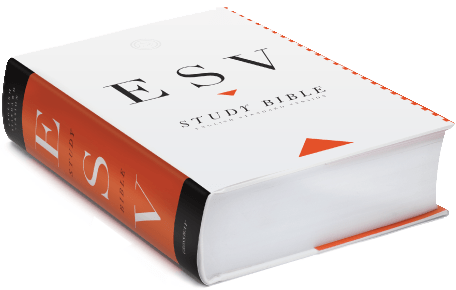
Recently I received a copy of the ESV Study Bible from the publisher, Crossway Books and Bibles, for review. Hopefully I will be able to get to this in the next week or two.

Meanwhile, you have the opportunity to use the ESV Study Bible online free of charge until March 31, 2009. The Bible has been available online and in several computer Bible programs for some time. The Study Bible has many additional features such as explanatory notes, charts, maps, diagrams, etc. This will give you a few weeks to read some passages you may be studying and check the additional resources.

Check the ESV Bible Blog for complete information.

ESV Study Bible

ESV Study Bible

Or, you may go to this link, create a login and password and begin using all features of the ESV Study Bible.

McGarvey’s Land of the Bible

J. W. McGarvey was one of the best scholars of the 19th century Restoration Movement. He was president of the College of the Bible in Lexington, KY. One of my first books was his practical New Commentary on Acts of Apostles (1892). He had earlier (1868) written A Commentary on Acts of Apostles dealing with some of the critical issues of the book. McGarvey addressed some of the critical questions of the day in The Authorship of Deuteronomy, Jesus and Jonah, and Biblical Criticism.

McGarvey visited Palestine in 1879. His former students paid for the trip [I like that!], with the understanding that he would write a book. They would get their money back from the sale of the book. His book, Lands of the Bible, was published by J. B. Lippincott & Co., London and Philadelphia, in 1881. The title page indicates that 15,000 copies were printed. Impressive for a book on that subject.

J. W. McGarvey’s Lands of the Bible is available at the Restoration Movement pages here. For other works by McGarvey and other Restoration leaders begin with the home page here.

When I led my first group to the Bible Lands in 1967, one friend in the group had studied McGarvey’s book carefully. He took a tape measure with him. When we came to certain sites he took out the tape to take measurements. He wanted to be sure he was at the same place McGarvey visited.

Chapter IX in McGarvey’s book is titled “Argument from the Agreement of the Land and Book.” I have an outline of this material in my Introduction to Christian Evidences [OP], and use some of this material in my Daily Life in Bible Times series. One would be mistaken not to move beyond McGarvey, Thompson, Robertson, and the other early explorers. On the other hand, it would be amiss to dismiss what these scholars wrote.

What prompted all of this? Todd Bolen recently wrote a post on The Acoustics of Mounts Gerizim and Ebal in which he quotes from one of McGarvey’s letters here. I urge you read his post now. Also follow the link to the Biblical Studies and Technology Tools post showing the valley between Ebal and Gerizim using digital mapping tools.

I wanted to contribute something to this study by including here a scan of the plate from my original edition of Lands of the Bible (opposite page 288).
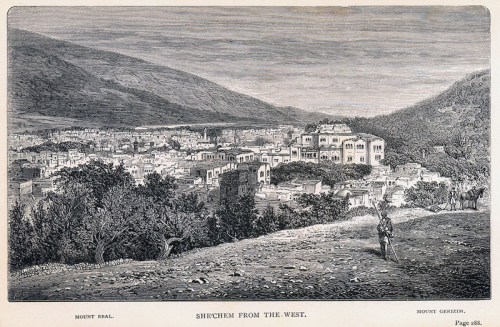
Shechem from the West. McGarvey, Land of the Bible.

Shechem from the West. McGarvey, Land of the Bible.

Todd Bolen has a great photo of Mount Ebal from Mount Gerizim. I would like to add the other side of the valley. Here is a photo showing Mount Gerizim from above Mount Ebal. It is an aerial shot made for me by the well known photographer Zev Radovan.
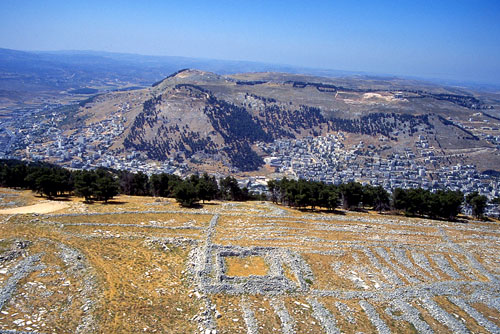
View of Mount Gerizim from above Mount Ebal.

View of Mount Gerizim from above Mount Ebal.

Maybe later we will discuss some of the important biblical events that took place in this area. For not let us note that this is where the blessings and curses of the law were read after the children of Israel entered the promised land (Deuteronomy 11:19). Here is the account of that event:

All Israel with their elders and officers and their judges were standing on both sides of the ark before the Levitical priests who carried the ark of the covenant of the LORD, the stranger as well as the native. Half of them stood in front of Mount Gerizim and half of them in front of Mount Ebal, just as Moses the servant of the LORD had given command at first to bless the people of Israel. Then afterward he read all the words of the law, the blessing and the curse, according to all that is written in the book of the law.  There was not a word of all that Moses had commanded which Joshua did not read before all the assembly of Israel with the women and the little ones and the strangers who were living among them. (Joshua 8:33-35 NASB)

Review: Views That Have Vanished

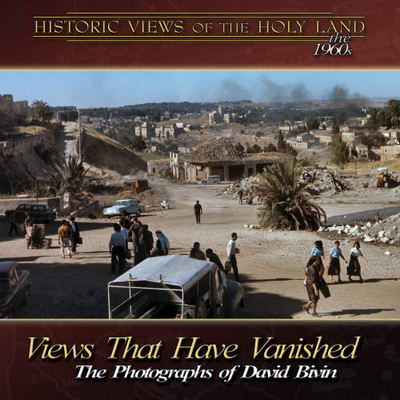
Todd Bolen, BiblePlaces.com, has released an extremely valuable CD that will be helpful to all students of the Bible lands. Views That Have Vanished is a collection of more than 700 high resolution photographs made by David Bivin beginning in 1963.

Views That Have Vanished - Photos of the 1960s.

Views That Have Vanished - Photos of the 1960s.

These photographs were made with one of the best cameras available at the time with the intent to be able to share them with family and friends who were unable to visit Israel, Jordan, Egypt and Greece. Bivin has now lived in Israel more than 30 years. Many of the places he visited in the 1960s have changed since then because of natural erosion. Some of the changes occurred because of archaeological activity, and the normal deterioration that takes place once a site is uncovered. Primarily the sites have changed because of the building activities of man.

My first visit to the Middle East was in 1967. Since then I have returned nearly 40 times and I have observed the tremendous changes made. Some sites, in preparation for visitors, are necessarily changed. Other sites are neglected and become dangerous for all but the most intrepid explorers to visit. Bivin had the wonderful opportunity live in Israel and record his experience in full color. I observe that many of the landscape photographs he made have a beautiful clear sky. Perhaps the sky was clearer 40 years ago. But, this is the advantage of living in the country and being able to go out when the weather is just right.

Everyone who has old photographs and slides knows that they begin to deteriorate after a few years. This happened to some of Bivin’s photographs. Todd Bolen has scanned these old negatives with high quality equipment. In many instances the color has been restored.

The photographs are available in high-resolution (1600 x 1200 or higher) in jpg format and also in PowerPoint with explanatory notes. I was especially impressed with the large number of photographs of some of the well known archaeologists of the past (Glueck, Yadin, et al.) and some historic views such as people in Jerusalem mourning the death of Anwar Sadat, president of Egypt.

Views That Have Vanished is a great addition to the already long list of photographic materials published by BiblePlaces. The CD belongs in the library of every church and every person who teaches Bible classes with an emphasis on the land in which these historical events took place. Frequently I say to my groups, “I wish you could have seen this before….” Now, you can see it through these photographs.

The CD is available for only $20 during October. Take a look here. If you would like to see some examples of Views then and now, take a look here.

Man of Galilee now available

The Man of Galilee by Atticus G. Haygood is a small book that should be read by every person interested in the identity of Jesus of Galilee. The book was first published in 1889, and has been republished several times. I published it as part of Evidence Quarterly in 1963. It has been available at our Biblical Studies Info Page for a number of years. Now DeWard Publishing Company has published The Man of Galilee in an attractive paperback edition of 108 pages. This book will make an excellent gift to any young person who is of an age to be thinking about the Jesus of the New Testament.

Melvin Curry comments about this book:

Some big books need to die; this little one needs to live. Haygood’s Man of Galilee is a profound argument about the uniqueness of Jesus.

Dan Petty says,

Haygood discusses the truly unique and universal quality of the character of Jesus in a manner that is thoughtful, thorough, and logical. It is presented in terms that the student will find interesting, refreshing, and in the end, compelling.

Order The Man of Galilee.

I wish to commend DeWard Publishing Company for making this book available. Take a look at their web page.