Category Archives: blog

Did someone say “Free”?

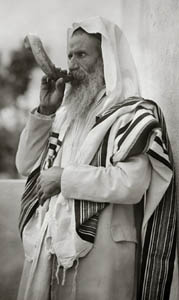
Yemenite Rabbi blowing shofar.

Yemenite Rabbi blowing shofar.

Todd Bolen is giving away a PowerPoint presentation, and the associated jpg images, of Jewish People in the Early 1900s. These photos are part of the The American Colony and Eric Matson Collection that Todd has made available.

We have recommended the entire collection here.

For the free presentation or the images, click here. The photo to the right is a miniature of one showing a Yemenite Rabbi blowing a shofar. It dates to between 1934 and 1939. Shofar is the Hebrew word often translated trumpet (2 Kings 9:13) or ram’s horn (Leviticus 25:9) in English versions of the Bible.

BiblioBlogger rankings for March

The Top 50 BiblioBlogger rankings for March are posted here. Thanks to our readers for moving us into 10th place. This list is based on the Alexa traffic rank.

Scholarship or theft?

Someone unknown to me has copied numerous of my posts and posted them at their own site here.

I am delighted for others to use my material with a credit line, but this source includes no indication of the source of the material. It cost me many thousands of dollars to obtain the photos that I use on this page. Gaining permission to use material is not that difficult, and a credit line is certainly required.

You shall not steal. (Exodus 20:15 NAU)

He who steals must steal no longer; but rather he must labor, performing with his own hands what is good, so that he will have something to share with one who has need. (Ephesians 4:28 NAU)

Update Regarding Ethical and Legal Violations (March 27, 2010)

I knew that the person back of the actions mentioned above had done something unethical (sinful, according to the Hebrew Bible and the New Testament). I knew they were in violation of copyright law. After doing a little check, I learned that the practice is an infringement of the agreement made with WordPress, and a violation of the DMCA (Digital Millennium Copyright Act).

After checking the archives of the web site, I learned that this practice has been going on since December, 2009. The owner has used my photos with the same or similar captions, but has removed “Photo by Ferrell Jenkins” or other credits that I included. Outrageous, isn’t it?

Update (March 29, 2010): In response to my letter stating that my material had been plagiarized, WordPress has notified me that the offending web site “has been removed.” Thank you, WordPress. You are a great service.

Update # 2 (March 29, 2010): Soon after the single post that I reported to WordPress was taken down, others were moved to the top of the blog. Later, I reported 40 of my blogs that were copied. Late this afternoon I received this note: “The entire blog has now been removed, as per these multiple reports.”

ArchaeologyExcavations taken down from WordPress.

Earthquake hits Eastern Turkey

The earth seems to be shaking a lot in recent months. This morning we have reports of an earthquake which measured 6.0 on the Richter scale hit the mainly Kurdish region of eastern Turkey.

A powerful earthquake in eastern Turkey on Monday buried villagers as they slept in mud-brick houses, killing at least 57 and injuring dozens more, officials said.

The quake, which measured 6.0 on the Richter scale, struck at 4:32 am (0232 GMT) at a depth of five kilometres, with an epicentre near the Karakocan town in Elazig province, the Istanbul-based Kandilli observatory said.

Rescuers struggled to dig survivors from the rubble after the quake tore down mud-brick houses in several mountainous villages in the mainly Kurdish area, killing whole families in their sleep.

The report may be read in its entirety here.

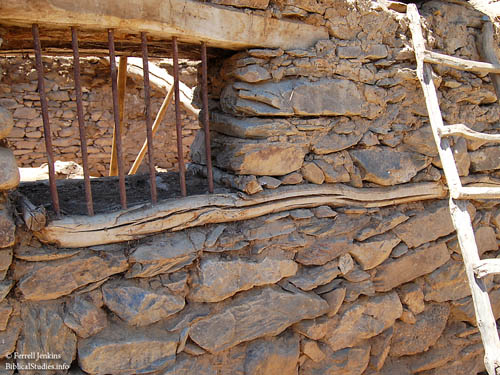
In January I wrote about some preparations for earthquakes that I saw in eastern Turkey here.

Preparations for earthquake in Eastern Turkey

Preparing for an earthquake in Eastern Turkey. Photo by Ferrell Jenkins.

Several other blogs about earthquakes and the Bible World are here, and here, and here.

  • Earthquakes common in the Bible World here.
  • Earthquakes still a problem in the Middle East here.
  • Philadelphia (Revelation 3) – Church with an open door here.
  • Earthquake felt in Israel, Syria, and Lebanon here.

Earthquakes were so common in the Bible World that they are often used to provide imagery for the direct action of God. John uses this symbolism to describe what happened when the Lamb (Christ) broke the sixth seal (Revelation 6:12-17). A few words from the Dictionary of Biblical Imagery will give us something to think about today.

Some references to earthquakes appear to be bald statements of historic fact and seem to have little, if any, symbolic value (Amos 1:1, cf. Zech 14:5; Acts 16:26). Most references, however, particularly in the poetic parts of the Bible, accord a high degree of symbolism to earthquakes. Earthquakes in Scripture are often seen as manifestations of the direct action of God’s power. The example that is probably alluded to most is the earthquake at the giving of the law at Sinai (Ex 19:18). In their poetic reviews of the Exodus, later writers seem to have emphasized this element (Ps 68:8; 77:18; 114:4–7) and broadened its scope to cover the whole exodus event. Matthew’s linkage of the earthquake at Jesus’ crucifixion with the rending of the temple veil (Mt 27:54) is thus far more than a statement of physical cause and effect: it is profoundly symbolic. (225)

Biblioblog rankings for February

The Biblioblog rankings for February are posted at Free Old Testament Audio Website Blog here. Our rankings, based on the Alexa numbers, is 12 in the list of 362 blogs. Thanks to each of you for coming our way.

Todd Bolen’s Bible Places Newsletter

The February issue of the Bible Places Newsletter has been released. If you do not receive the Newsletter, I suggest you check it now (here). When you reach the bottom of the page you will see a link that allows you to subscribe.

The current issue of the Newsletter features photo from the Early 20th-Century History, the seventh volume in The American Colony and Eric Matson Collection. You will be able to download a PowerPoint presentation featuring these historic photos.

The entire album of more than 400 historic photos is available at the discounted price of $15. The entire 8-volume collection is on sale for $99. This is a great and important collection. Read about it at Life in the Holy Land.

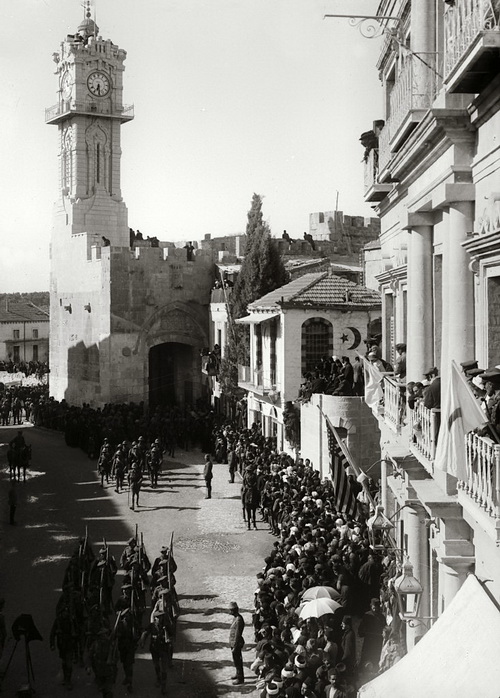
Palestine was under the control of the Turkish Ottoman Empire from 1517 to 1917. The photo below shows General Allenby and the British troops entering Jerusalem through the Jaffa Gate, Dec. 11, 1917.

General Allenby enters Jerusalem through Jaffa Gate - 1917.

General Allenby enters Jerusalem through Jaffa Gate - 1917.

Exposé of top 50 biblical history list

Perhaps you have seen several blogs claiming to be listed in the Top 50 Biblical History Blogs. Todd Bolen, whose ranking needs no such help, thinks he has figured out how this list works. If interested, read here.

Professors often receive notification that they have been named to a certain biographical book. The notice is from an unknown organization, but the intent is to sell a copy of the book and a framed certificate to the pride-filled recipient. Tricky, eh?

Topping 300,000 and the BiblioBlog rankings

On Friday evening, January 22, at 11:24 p.m. (EST) I checked the counter on this blog. The total number of visitors registered since May, 2007, was 300,004. Today the count has topped 305,000.

The first post on Ferrell’s Travel Blog was May 2, 2007, in anticipation of a tour to central Turkey. The intention was to keep the families of the tour members informed about what we were doing. A total of 575 persons visited the blog that month. In December, 2009, we averaged 593 hits each day. This month the average will be near 630 per day.

One friend (SC) who has been a reader since the first month wrote about a week ago,

I just checked your WordPress for today’s message – lo and behold – you have gone over 300,000 reads! Congratulations! (I can’t remember when you started this service, but obviously we all love it – please keep it up!)

I am thankful for the loyal followers, and for everyone who drops by from time to time. Originally I had no plan to make this blog a near-daily project. I plan to continue as long as I enjoy doing it and think it is a good expenditure of my time.

My wife keeps telling me that the title, Ferrell’s Travel Blog, causes people to think that the blog is just about my travels. Had I envisioned the future back in May, 2007, I suppose I would have chosen a different name. The ratings now are too high to make a change!

Almost every day I am tempted to comment on a number of things, but I usually resist and keep the focus on the Bible Lands, biblical archaeology, and Bible-related places and events.

What is a BiblioBlog?

What is a BiblioBlog? I suppose it is a blog that in some way deals with the Bible.

The Alexa Ranking for the third week for the month of January shows Ferrell’s Travel Blog to be number 11 out of more than 358 BiblioBlogs. Normally these rankings are published monthly. Our blog has been in the top 20 several times, and as high as 5 for the month of July, 2009. We are thankful to our loyal readers who find the material we publish to be useful.

Jeremy Thompson of Free Old Testament Audio has volunteered to post these rankings on a monthly basis, but he is trying some new things and decided to make a weekly posting. The full list of BiblioBlogs is here. The list is somewhat arbitrary and it may not show the ranking of some significant blogs, but it interesting to follow.

My blog has never been intended as part of a competition, but I enjoy seeing it move up in the rankings. I see every visitor as someone who is potentially informed and/or edified by what he/she reads.

Thanks to WordPress

Thanks to the kind folks at WordPress who make possible this opportunity. I hope they are making lot’s of money (from others!).  If you have something worth saying get a blog. WordPress is a good place to begin.

Blogging at 36,000 feet

Delta wants all Internet users to try their gogo wireless service while in flight. Since this will likely be my last Delta flight of the year I thought I would try to service. After logging in with the promotional code I see that the service is fast.

While in Israel my friend and I shared an Air Card we rented. Several times I checked Email while we were out on the road. We actually located the field road to get to Ziklag with the use of Google Earth while driving in the area. I don’t think I will ever leave home without it.

My, how things have changed.

On USA soil

If being in the Atlanta airport qualifies, I am on USA soil. The flight from Israel was scheduled for 13 1/2 hours (longer than I mentioned in the previous blog), but we had a good wind and made it in 13 hours. From touchdown it took a full hour and a half to make it through passport control, customs, luggage collection, Atlanta security to enter the airport, etc. In Israel we arrived at the airport and started through the security process about three hours ahead of departure. That makes a total of 17 1/2 hours, and I still have a flight home (about 2 hours counting collecting luggage). Add in the wait here and that makes another 2 1/2 hours. Total time is now at 20 hours. Don’t forget getting to/from the airport. Travel is fun! But I have time to blog.

Israeli security has a deserved reputation as being the best in the world, but I did not have to remove my shoes.

We flew Delta for this trip. I think every seat was full on the return. Flights were departing Tel Aviv for Philadelphia and New York about the same time last night. This is not the most popular time for travel to Israel. We saw a few American groups, but there were several Asian and Indian groups.

The comments left on the blog, and Emails from friends are appreciated. I did note, however, that almost every friend who wrote also made a request. Sorry I did not have time to answer. Don’t expect one tomorrow, either! I will do my best. Several Emails came from folks who were unaware that I was in Israel. That is a sure giveaway that they do not follow the blog. Shame! Shame!

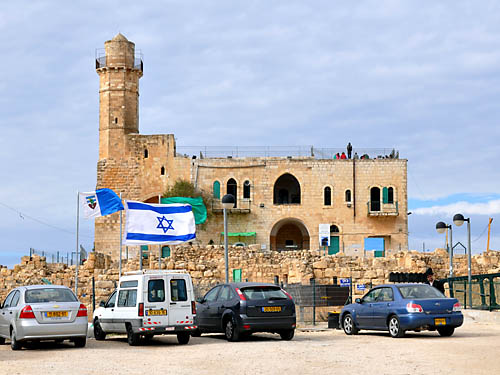
Yesterday we went to Nabi Samwil (or Nebi Samwil), the traditional burial place of Samuel the prophet. According to the Bible Samuel was buried at Ramah, a short distance from Nebi Samwil.

Now Samuel had died, and all Israel had mourned for him and buried him in Ramah, his own city. And Saul had put the mediums and the necromancers out of the land. (1 Samuel 28:3 ESV)

We know from the Old Testament that Samuel anointed both Saul and David as kings of Israel. Both Old and New Testaments acknowledge the importance of Samuel as a prophet.

And all Israel from Dan to Beersheba knew that Samuel was established as a prophet of the LORD. And the LORD appeared again at Shiloh, for the LORD revealed himself to Samuel at Shiloh by the word of the LORD. (1 Samuel 3:20-21 ESV)

And all the prophets who have spoken, from Samuel and those who came after him, also proclaimed these days. (Acts 3:24 ESV)

Traditional Burial Place of Samuel at Nabi Samwil. Photo by Ferrell Jenkins 2009.

Traditional Burial Place of the prophet Samuel at Nabi Samwil. Photo by Ferrell Jenkins 2009.