Category Archives: Biblical Studies

Evil-merodach (562-560) graciously freed Jehoiachin

Evil-merodach came to power in Babylon upon the death of his father Nebuchadnezzar in 562 B.C. There are only two references to him in the Bible, and these are parallel accounts. Evidence suggests that Jehoiachin (Jeconiah, Coniah), the king of Judah who was taken to Babylon in 597 B.C., was treated like a king in exile during most, or all, of his time in Babylon. The kindness of Evil-merodach receives special attention.

27 And in the thirty-seventh year of the exile of Jehoiachin king of Judah, in the twelfth month, on the twenty-seventh day of the month, Evil-merodach king of Babylon, in the year that he began to reign, graciously freed Jehoiachin king of Judah from prison. 28 And he spoke kindly to him and gave him a seat above the seats of the kings who were with him in Babylon. 29 So Jehoiachin put off his prison garments. And every day of his life he dined regularly at the king’s table, 30 and for his allowance, a regular allowance was given him by the king, according to his daily needs, as long as he lived.  (2 Kings 25:27-30 ESV; cf. Jeremiah 52:31-34)

It is interesting that we have a biblical record mentioning Evil-merodach’s treatment of Jehoiachin (about 560 B.C.), and we have archaeological evidence of similar treatment at an earlier period. Four tablets mentioning Jehoiachin and his sons date to the period 595–570 B.C.

These tablets record rations that were given to the exiled king, his sons, and eight men of Judah. The one shown here is usually displayed in the Museum of the Ancient Near East (Vorderasiatische Museum), also called the Pergamon Museum, in Berlin (VAT 16378).
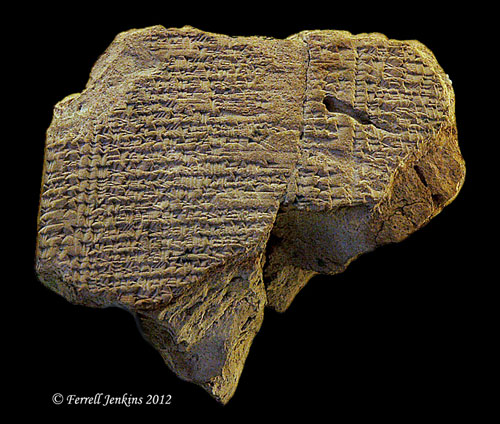
Babylonian ration tablet naming Jeconiah. Berlin. Photo by Ferrell Jenkins.

Babylonian ration tablet naming Jeconiah. Pergamum Museum. Photo by Ferrell Jenkins.

A trip to Berlin is worthwhile for many reasons, but one of the best is to visit the Museum of the Ancient East. Even though it could stand some revisions, you should find my Biblically Related Artifacts in the Museums of Berlin helpful. It is available in PDF here.

Here  is what I wrote about this tablet:

“Jehoiachin (Jeconiah, Coniah) was the young king of Judah who was taken captive to Babylon by Nebuchadnezzar in 597 BC. (2 Kings 24:15). The date of the capture of Jerusalem (March 16, 597 BC) was learned in 1955 when Donald J. Wiseman, then of the British Museum,  read a cuneiform tablet from Babylon. About 300 cuneiform tablets, dating between 595 and 570 BC, were found near the Ishtar Gate in Babylon. They contain lists of rations such as barley and oil paid to the captives and craftsmen. Persons from various countries are mentioned: Egypt, Philistia, Phoenicia, Asia Minor, Judah, etc. Some Biblical names are included: Gaddiel, Semachiah, and Shelemiah (a name mentioned prominently in Jeremiah 36-37). The most interesting name is Yaukin, king of the land of Yahud (Judah), along with five royal princes. The name, pronounced Yow-keen, is known to be an abbreviation for Jehoiachin. One document in which his name occurs is dated to 592 BC. These tablets show that the Babylonians continued to regard Jehoiachin as the legitimate king of Judah and gave him special treatment while he was in captivity (2 Kings 25:27-30; Jeremiah 52:31-34). The tablets were read by E. F. Weidner in the basement of the Kaiser Friedrich Museum, Berlin, after 1933.

[For those with access to this type of material:] Some Sources: Albright, BA 5 (1942), 49-55; ANET, 308 for translation; DOTT, 84-86; JFLAP, 225-227; IDB, II:811-13; Werner Keller, The Bible as History, 285-287;  Wiseman, Illustrations from Biblical Archaeology, 73 for photo [showing both the reverse and the obverse of the photo above].”

More Recent Source: Fant, Clyde E. and Mitchell G. Reddish, Lost Treasures of the Bible, 217-220.
“Some Places You May Never Visit”

“Some Places You May Never Visit” is the title I have chosen for a presentation Tuesday (12 noon in Puckett Auditorium) as part of the Florida College Annual [Bible] Lectures, Temple Terrace, FL. This is where I taught for 25 years, and it is always a pleasure to participate in the program. Usually I make a presentation dealing with archaeology and Bible history, archaeological artifacts in famous museums, or one of the places I have had the opportunity to visit.

Last years I spoke on “Roads Less Traveled.” The presentation this year will be about four places in Israel that are difficult to get to. I won’t give away the places now, but hopefully will be able to share some information about them in the weeks to come.

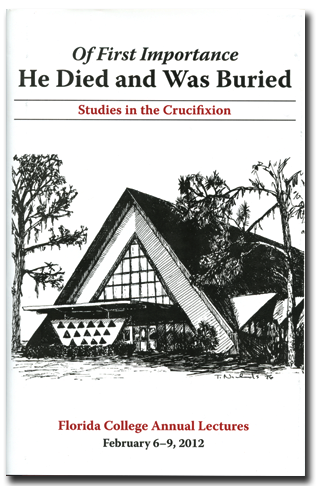
Florida College Annual Lectures 2012The main program this year, consisting of 15 lectures, is entitled Of First Importance: He Died and Was Buried. Information is available on the website of the college bookstore here. There are also links to an eBook edition  which is available in a variety of formats for only $9.99. Dr. David Edwin Harrell, respected historian, spoke Monday evening to a packed auditorium (around 1500, I estimate).

Free Ebook on Ephesians

Baker Academic announces a series of ebook shorts from Robert H. Gundry. Last week the Commentary on Mark was given away. Today only, the Commentary on Ephesians is available free. Baker Academic E-NOTES says,

Baker Academic is proud to announce new ebook shorts from Robert H. Gundry.

In these verse-by-verse commentaries taken from Commentary on the New Testament, Robert Gundry offers a fresh, literal translation and a reliable exposition of every book of the New Testament.

Students and scholars will welcome Gundry’s nontechnical explanations and clarifications, and readers at all levels will appreciate his sparkling interpretations. Priced from $1.99 to $5.99 these affordable and convenient resources are available wherever ebooks are sold.

As we celebrate the release of this series, Baker Academic will be making selected entries from this commentary series free for one day only.

This will be followed by other selections for free download on January 16th and 23rd.

Here is the direct link to the free ebook.

Do you need a Kindle? Click on the link below to check the selections.
Kindle Fire, Full Color 7″ Multi-touch Display, Wi-Fi.

Wallace-Ehrman debate on the reliability of the text of the New Testament

The following announcement comes from the Center for the Study of New Testament Manuscripts web site here:

On October 1, 2011 Dr. Bart D. Ehrman and CSNTM’s Executive Director, Dr. Daniel B. Wallace, debated the reliability of the text of the New Testament at Southern Methodist University. This was the largest debate over the text of the New Testament in history. A professional film crew recorded the debate, which is now available to you. In this exciting dialogue you have the opportunity to listen to two leading scholars talk about this issue from opposing viewpoints. Can we trust the text of the New Testament? You decide.

The DVD is priced at only $15.50 plus shipping and handling. Currently only the USA format (NTSC) is available. Pick yours up today.

The DVD is copyrighted by CSNTM; please do not replicate or distribute it.

Click here to order the DVD.

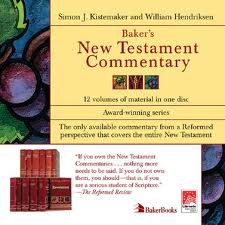
A special offer for Baker N.T. Commentary

Baker N.T. Commentary

Baker N.T. Commentary

Rejoice Christian Software makes some of the best offers on software of any seller that I know about. From now until September 22 they are offering the 12 volume Baker New Testament Commentary software program for the incredibly low price of $49.95. I think you will pay $2.95 for shipping in the USA. This means that for $53 you will have the software program covering all 27 books of the New Testament. These book are written by Presbyterian scholars William Hendriksen and Simon Kistemaker.

Read more about the commentary set here. Note that the price there is $79.95 (already a bargain), but you must go to this link to get the $49.95 price.

The Libronix software program needed to access the books is included.

Even if you have a few of the print volumes you can give them to someone who refuses to use a computer and still have a great deal for yourself.

I do not own stock in this company, and I already have the set on my computer. The deal is so good I am tempted to order again. 🙂

Be sure you sign up for the RCS newsletters.

A beautiful day in Galilee

Sunrises on the Sea of Galilee can be extremely beautiful. I know that I have posted several photos of the sunrise, but I wanted to share another one from this morning.

Sunrise on the Sea of Galilee. Photo by Ferrell Jenkins - 09-04-11

Sunrise on the Sea of Galilee. Photo by Ferrell Jenkins - 09-04-11

Much of the ministry of Jesus was conducted on and around the Sea of Galilee. One of the important events recorded in Scripture is the calling of disciples.

Passing alongside the Sea of Galilee, he saw Simon and Andrew the brother of Simon casting a net into the sea, for they were fishermen. (Mark 1:16 ESV)

We went to Nazareth this morning to worship with the church there. Afterwards we spent a good bit of time in Mash’had, a small Arab town between Nazareth and the traditional site of Cana,  trying to locate the tell where the ancient city of Gath Hepher, the home of the prophet Jonah,  is thought to be located. Hopefully we will be able to tell you more about that experience later.

In May I wrote about locating and walking on a portion of the Roman Road near Golani Junction here. I wanted to share this experience with Leon, so we returned there.

There were some other things, but this will be enough for today.

It is hot at this time of the year, and especially when tramping around over hill and vale.

Monday meandering — August 8

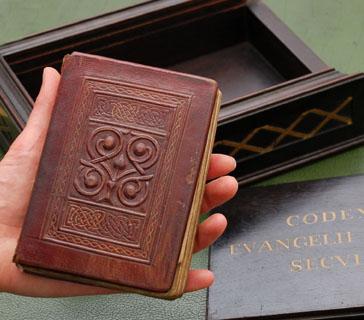
St Cuthbert Gospel. © British Library Image.

St Cuthbert Gospel. Copyright British Library Image.

British Library launches a campaign to raise $14.3 million for a 1300 year old copy of the Gospel of John. St. Cuthbert’s Gospel is said to be Europe’s oldest book. The Latin book is also called the Stonyhurst Gospel.

Information about the small bound book may be read here. The British Library has a nice video about the book, including clear images, may be viewed here. (HT: Paleojudaica).

Latin works such as this one play an important role in the history of the English Bible.

……

Wood used in the Roman siege of Masada came from other areas, according to a study by scientists at the University of Haifa.

First, the researchers examined the amount of wood that exists today in the Judean Desert and in the wadi deltas in the vicinity of Masada, and thereby were able to estimate the amount and types of wood that the desert could supply. Next, they calculated the amount of timber and firewood that would have been needed for the inhabitants of Masada, from 150 BCE, when it was a small fortress, through the Herodian period, when the fortress as we know it was constructed, and up to the siege, which ended in 73 CE. According to the researchers, in those times, timber was mostly used for construction, heating and cooking. Based on accepted evaluations of wood consumption for these purposes in traditional societies, on the conservatively estimated number of Masada inhabitants in each time period, the harsh climatic conditions in the desert and Masada’s topography, the researchers were able to conclude that by the time the Romans arrived at Masada and began their siege (73 CE), the entire area was void of timber and firewood, due to 2,220 years of massive exploitation of the immediate environment up to that point. The Romans would have had no choice but to import wood from other areas for their weapon machinery, ramparts and basic living requirements.

The brief report may be read here. (HT: Joseph Lauer)

……

C. S. Lewis and the Devil. John A. Murray has a fascinating article on “C. S. Lewis and the Devil” in The Wall Street Journal. Read the complete article here. Here is a small excerpt.

As Lewis explained, “There is no uncreated being except God. God has no opposite. . . . The proper question is whether I believe in devils. I do. That is to say, I believe in angels, and I believe that some of these, by the abuse of their free will, have become enemies to God. . . . Satan, the leader or dictator of devils, is the opposite, not of God, but of Michael.”

In his original preface written from Magdalen College at Oxford on July 5, 1941, Lewis warned of what he called “the two equal and opposite errors into which our race can fall about the devils.” One error “is to disbelieve in their existence. The other is to believe and to feel an excessive and unhealthy interest in them.” Lewis concluded that the devils “are equally pleased by both errors, and hail a materialist or a magician with the same delight.”

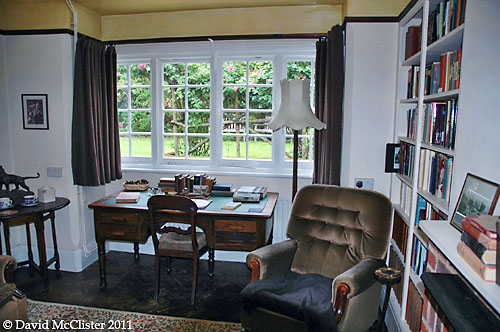
Dr. David McClister, Bible professor at Florida College, visited Oxford during his summer break. He shares one of his photos of Lewis’s study at the Kilns.

C. S. Lewis Study at the Kilns. Photo by David McClister.

C. S. Lewis Study at the Kilns. Photo by David McClister.

No wonder Lewis accomplished so much. No phone. No computer. If you are a fan of any of Lewis’s work, you might enjoy our earlier photos and info here.

HT: Bible X.

Ebla and the Ebla Tablets

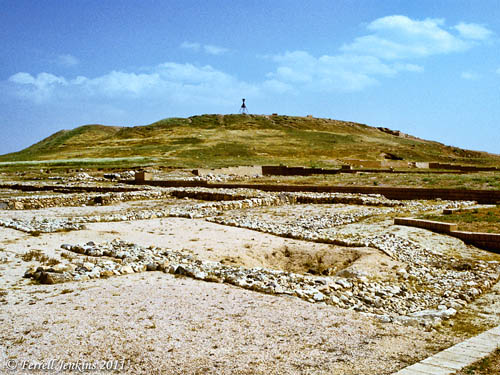
The Ebla tablets were discovered by an Italian team of excavators at Tell Mardikh in Syria (about 30 miles S of Aleppo) in 1975. More than 17,000 cuneiform tablets were discovered. They date to the mid-third millennium B.C. when Ebla was the capital of a great Canaanite empire. Scholars state that there are important affinities between the Eblaite language and biblical Hebrew, both being members of the Northwest Semitic family.

Ebla - Tell Mardikh - Syria. Photo by Ferrell Jenkins. May, 2002.

Tell Mardikh (Ebla) in Syria. Photo by Ferrell Jenkins, May 2002.

Numerous articles have appeared in the popular press and in scholarly journals stating that the names of Sodom and Gomorrah appear in the Ebla tablets. At one point it was even being said that all five cities of the plain (Gen. 14), and perhaps the name of one of the kings, were mentioned in the tablets. Much controversy has surrounded this discussion. Infighting between the excavator (Paolo Matthiae), the epigrapher (Giovanni Pettinato), and other scholars, along with some political implications, clouded the whole issue.

The late Mitchell Dahood (died 1982), an expert in Ugaritic literature, claimed that the cities of Sodom and Zeboim “may have counterparts” in the Ebla tablets (Giovanni Pettinato, The Archives of Ebla, 287). Pettinato was the first to read and interpret tablets from the Ebla archives and the first to identify the Northwest Semitic language in which they are written. Paolo Matthiae, the archaeologist, says the rumors that there is proof of the historical accuracy of the Bible patriarchs, references to Sodom and Gomorrah, etc. “are tales without foundation” (Ebla: An Empire Rediscovered, 11). One scholar states, “the initial enthusiasm about the light the tablets would shed on the early stages of biblical culture is now mostly seen as exaggerated. Clearly, no biblical personages can be identified in the tablets … ” (Harper’s Bible Dictionary, [1985] 235). Dahood, in the Afterword of Pettinato’s book, commented on the pessimism of one university professor with this classic put down:

How a savant can determine how relevant to the Bible a new discovery may be before the tablets have been published must remain a mystery. (Pettinato, The Archives of Ebla, 273).

Dahood says that the people of Ebla spoke a dialect of Canaanite and that their principal god was Dagan the Canaanite or the Lord of Canaan. This indicates that Canaan extended much further north than previously thought (Pettinato, 272). Dahood cites several biblical passages in which he believes a parallel exists between the Hebrew and Eblaite words (271-321). Numerous names in Genesis find parallel in the Ebla tablets. I had the opportunity to hear Dahood speak on this subject at a professional meeting in Dallas years ago.

Ebla Tablet at Bible Land Museum Jerusalem. Photo by Ferrell Jenkins shortly after the BLMJ opened and photos were permitted.

An Ebla Tablet. BLMJ. Originally the museum allowed photos. Photo by Ferrell Jenkins.

At this point scholars are not agreed on the proper reading of some of the Eblaite words. Perhaps in time we will know more about this. For the present we must wait patiently. Numerous articles about Ebla have appeared in Biblical Archaeologist and Biblical Archaeology Review, as well as other journals.

Word comes regarding the death of Professor Giovanni Pettinato at the age of 77. Details here. HT: Bible Places Blog.

Lead books or lead balloons?

In the past 24 hours I have received a couple of Emails about the “new” “ancient” lead codices. The best photos I have seen are in the Mail Online here. The account from Yahoo News is here. Put a few words in Yahoo or Google and you will have numerous links.

First Impressions. My first impression, based on the limited information, is that this may be another of those spectacular claims with no substance. I was busy with appointments earlier today and was delighted when I had time to check the blogs to see that Todd Bolen had written a good summary of information at the Bible Places Blog here. There is no reason for me to try to rehash this material. I urge you to take a look at Todd’s summary. He says, “Personally I am inclined to believe that this find is genuine.” My first inclination leans the other way. I know it is not much of a argument, but this report lacks the “ring of truth.” I remember that F. F. Bruce said that second thoughts are best. With more information my thoughts may change. Let’s be patient.

The Sealed Book in Revelation. There is no reason at this point to  link these lead books with the sealed book of Revelation 5-7. Revelation is an apocalyptic book of symbols. Other ancient sealed books have been found in modern times. Examples: some of the Elephantine papyri, a papyrus document from Wadi Daliyeh near Jericho had seven seals still in place (Jenkins, Studies in the Book of Revelation, 18).

Jim Davila has posted numerous notes about the lead codices at Paleojudaica over the past few weeks. Follow all of Todd Bolen’s links and you will know about as much as can be known for the moment.

Bauckham on the Gospels as Histories

Last Wednesday I went to the Reformed Theological Seminary near Orlando to hear a lecture by Prof. Richard Bauckham. Bauckham was the speaker for the annual Kistemaker Academic Lecture Series. His general topic was The Gospels as Histories: What sort of history are they? I suspect that he was reading chapters that will eventually be published in a new book.

I found Bauckham, Professor Emeritus at St. Andrews University, difficult to understand during the lecture because of the his accent, but I was able to keep up with the general thread of his argument.

If you would like a little taste of Bauckham’s argument about Jesus and the Eyewitnesses I suggest you watch this short video by StJohnsNottingham (other interesting videos also available).

I was delighted to pick up a copy of Jesus and the Eyewitnesses: The Gospels as Eyewitness Testimony at the bookstore and have it autographed by Prof. Bauckham.

Richard Bauckham signs a book. Photo by Ferrell Jenkins.

Richard Bauckham autographs a book. Photo by Ferrell Jenkins.

Order Jesus and the Eyewitnesses from Amazon.
Jesus and the Eyewitnesses: The Gospels As Eyewitness Testimony

Bauckham’s material speaks clearly to the common misconception that the “Church” compiled the Gospels decades, even centuries, after Jesus lived.