Category Archives: Bible Study

Visual illustrations for Daniel 8

In Daniel’s vision of a ram and a male goat we are given a glimpse of the two world empires following Babylon — the Medo-Persian Empire and the Alexandrian (or Hellenistic/Grecian) Empire.

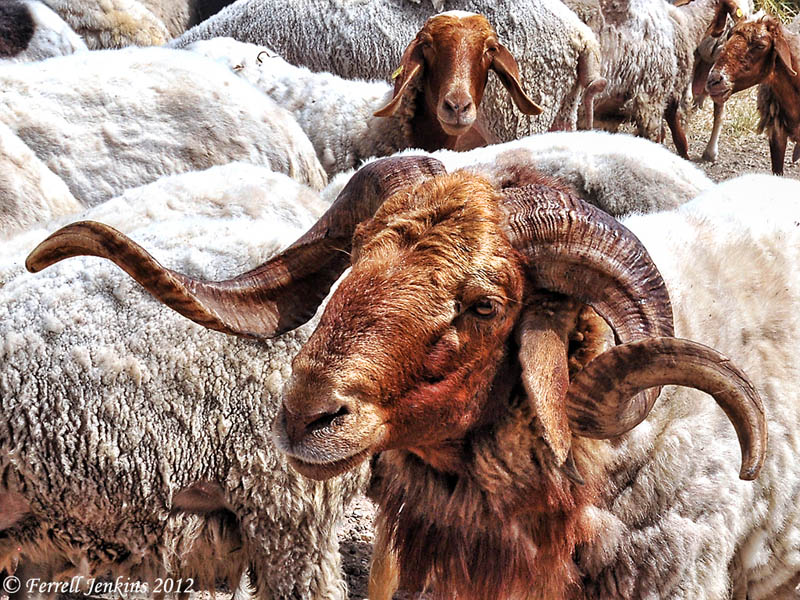
Daniel sees a ram.

I raised my eyes and saw, and behold, a ram standing on the bank of the canal. It had two horns, and both horns were high, but one was higher than the other, and the higher one came up last. (Daniel 8:3 ESV)

Ram at Socoh. Photo by Ferrell Jenkins.

A ram. With horns like that it is easy to see who is boss. Photo by Ferrell Jenkins.

In apocalyptic literature the visions take liberty with reality. It would require an artist to draw the ram and the male goat exactly as Daniel saw them.

Then Daniel sees a male goat.

As I was considering, behold, a male goat came from the west across the face of the whole earth, without touching the ground. And the goat had a conspicuous horn between his eyes. (Daniel 8:5 ESV)

A male goat in Gilead (modern Jordan). Photo by Ferrell Jenkins.

A male goat in Gilead (modern Jordan). Photo by Ferrell Jenkins.

The interpretation is easier for us than it was for Daniel before Gabriel gave him an understanding of the vision (vs. 15-16).

As for the ram that you saw with the two horns, these are the kings of Media and Persia.  And the goat is the king of Greece. And the great horn between his eyes is the first king.  (Daniel 8:20-21 ESV)

It will not be difficult to find other uses for photos of the ram and the male goat in Bible lessons (e.g., Genesis 15:9; Leviticus 23:19; 16:5)

The big three: Nabonidus, Belshazzar and Daniel

Earlier this month we wrote about the significant kings of the Neo-Babylonian Empire. Here is a list of the articles in chronological order.

  • Nabopolassar, father of Nebuchadnezzar, destroyed Nineveh here.
  • The Kings of Babylon and Bible History here.
  • Nebuchadnezzar, king of Babylon here.
  • Evil-merodach (562-560) graciously freed Jehoiachin here.
  • Nabonidus, the last king of Babylon here.

What about Belshazzar?

Belshazzar is called king several times in the Book of Daniel (5:1,9,30; 7:1; 8:1). He is referred to as the son of Nebuchadnezzar in Daniel 5:21-22. There may be many things we still do not know about the historical setting of Daniel, but we understand from Babylonian records that Nabonidus was the king of Babylon at this time (556–539 B.C.). How can it be said that Belshazzar is king, and how can Daniel be third in the kingdom (Daniel 5:7,16,29)?

Perhaps no book of the Old Testament has come under critical attack more than Daniel. As far back as the third century A.D. a Phoenician philosopher named Porphyry claimed the book of Daniel was written about 165 B.C. This is at the time of the oppression of Israel by the Seleucid ruler Antiochus Epiphanies. By dating the book which reports events of the 6th century B.C. to the second century, most of the prophetic elements are removed. This view has been followed by many liberal scholars. I recall learning it first from Robert H. Pfeiffer’s Introduction to the Old Testament (1941/48; pp. 748-781).

Even though information comes to light that suggests the feasibility of the biblical account, rarely do critical scholars acknowledge it.
An article by Dr. Alan R. Millard dealing with these issues appeared in Biblical Archaeology Review, May/June, 1985. At the time of this article, Millard was Rankin Senior Lecturer in Hebrew and Ancient Semitic Languages at the University of Liverpool in England. He explains the discovery of clay cylinders in southern Iraq by J. G. Taylor. Sir Henry Rawlinson was able to read the Babylonian cuneiform.

The inscriptions had been written at the command of Nabonidus, king of Babylon from 555 to 539 B.C. The king had repaired the temple tower, and the clay cylinders commemorated that fact. The inscriptions proved that the ruined tower was the temple of the city of Ur. The words were a prayer for the long life and good health of Nabonidus—and for his eldest son. The name of that son, clearly written, was Belshazzar!

Millard explains the significance of this discovery:

Here was clear proof that an important person named Belshazzar lived in Babylon during the last years of the city’s independence. So Belshazzar was not an entirely imaginary figure. This prayer, however, speaks of Belshazzar only as the king’s eldest son, not as king.

Professor Millar asks, “What, exactly, was Belshazzar’s position?”

Since 1854 several more Babylonian documents have been unearthed that mention Belshazzar. In every case, however, he is the king’s son or the crown prince; he is never given the title “king” in Babylonian. Although most scholars now admit that the author of the Book of Daniel did not invent Belshazzar, they still assert that, nevertheless, the Biblical author made a major mistake in referring to him as king.

Yet even that may not be quite right. In legal deeds from the sixth century B.C. the parties swear oaths by the gods and the king, according to a well-known and longstanding practice. In some of these deeds from the reign of Nabonidus, we find that the parties swear by Nabonidus and by Belshazzar, the king’s son. This formula, swearing by the king and his son, is unattested in any other reign in any documents yet uncovered. This suggests that Belshazzar may have had a special status. We know that during part of his father’s reign, Belshazzar was the effective authority in Babylon. The Babylonian texts reveal that Nabonidus was an eccentric ruler. While he did not ignore the gods of Babylon, he did not treat them in the approved way, and gave very considerable attention to the moon god at two other cities, Ur and Harran. For several years of his reign, Nabonidus did not even live in Babylon; instead he stayed at the distant oasis of Teima in northern Arabia. During that time, Belshazzar ruled in Babylon. According to one account, Nabonidus “entrusted the kingship” to Belshazzar. — BAR 11:03 (May/June 1985).

The small cuneiform foundation cylinder shown below, now in the British Museum, ends with a prayer in the name of Nabonidus and his son, Belshazzar.

Clay foundation cylinder naming Nabonidus and Belshazzar. British Museum ME 91128. Photo by Ferrell Jenkins.

Fant & Reddish provide this translation of the significant portion:

“As for me, Nabonidus, king of Babylon, save me from sinning against your great godhead and grant me as a present a life of long days, and as for Belshazzar, the eldest son my offspring, instill reverence for your great godhead (in) his heart and may he not commit any cultic mistake, may he be sated with a life of plenitude” (Lost Treasures of the Bible, 233).

Belshazzar was already second in the kingdom, serving as a co-regent with his absent father. He could offer Daniel nothing greater than “third ruler in the kingdom.”

A 1977 article by Millard, published in Evangelical Quarterly 49:2 (April-June 1977), is available on the BiblicalStudies.org.uk website here.

Numerous scholars have sought a harmony between the Babylonian and Biblical records in their introductory surveys and commentaries. These works should not be overlooked.

Luxor in Egypt has a long history

Luxor was known as Thebes in Old Testament times. Both Jeremiah and Ezekiel prophesied the Lord’s judgment of the city. Jeremiah says,

The LORD of hosts, the God of Israel, says, ‘Behold, I am going to punish Amon of Thebes, and Pharaoh, and Egypt along with her gods and her kings, even Pharaoh and those who trust in him’” (Jeremiah 46:25; see also Ezekiel 30:14-16 NET).

A visit to the ruined and unoccupied temples of Karnak and Luxor, where Amon (or Amun) was worshiped as a great god, certainly convinces us of the fulfillment of this prophecy. Shortly after the time of Jeremiah (about 586 B.C.), Egypt and Thebes began to decline as a world power.

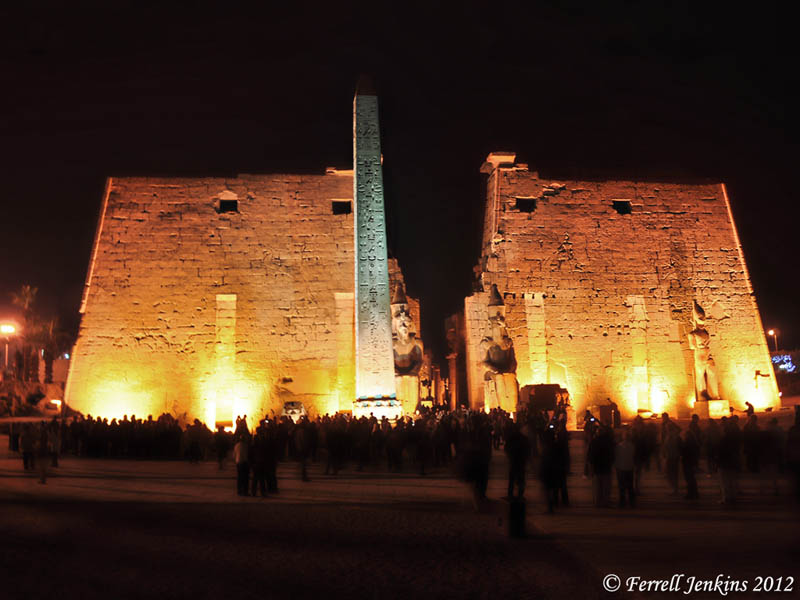
Luxor Temple facade at night. Photo by Ferrell Jenkins.

Luxor Temple facade at night. Photo by Ferrell Jenkins.

In 663 B.C. the Assyrian king Ashurbanipal had already conquered Thebes (Hebrew, No Amon). The prophet Nahum, in prophesying the fall of Nineveh, calls attention to this event (3:8ff.).

Jeremiah and Ezekiel prophesied during the Babylonian period of world dominance. Darius the Great (521-486 BC), who befriended the Judeans, helping them rebuild the temple in Jerusalem, depicted himself as a Pharaoh on a shrine door now displayed in the British Museum.

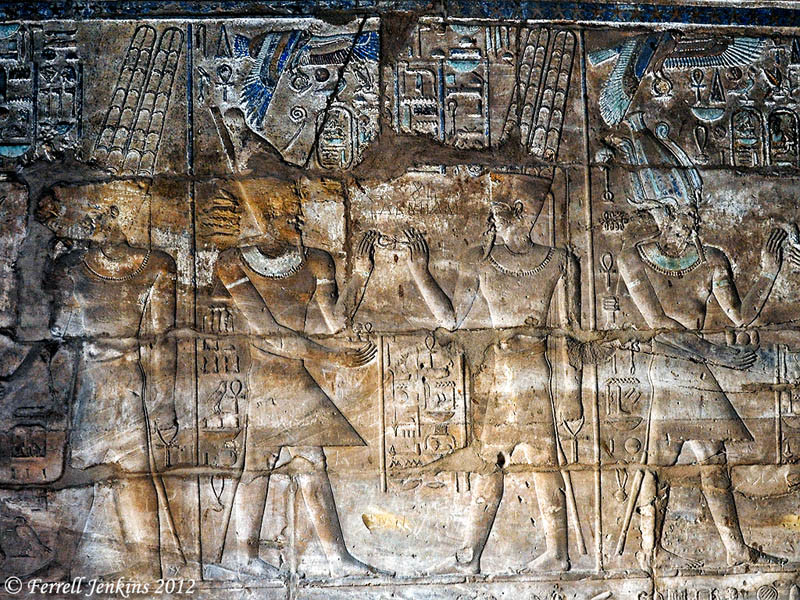
The young Alexander of Macedon came to Thebes in 336 BC and left reliefs of himself portrayed as a Pharaoh making offerings to the god Amon. Cassander rebuilt the city in 315 B.C. The later Ptolemaic kings who succeeded Alexander built temples to the gods at Edfu and Kom Ombo and regularly pictured themselves as worshiping the gods of Egypt. Likewise, the Roman emperors built temples beside the ancient temples of the Pharaoh. The temple of Philae has a small temple to the Roman Emperor Augustus ( 30 B.C. to A.D. 14) and another to Emperor Trajan (A.D. 98-117).

The photo below is from the chapel of Alexander the Great in the Karnak Temple. It was originally built by Thutmose III, and later decorated with these reliefs by Philip Arrhidaeus, the brother of Alexander the Great.

Relief of Alexander making an offering at Karnak. Photo by Ferrell Jenkins.

Relief of Alexander making an offering at Karnak. Photo by Ferrell Jenkins.

If a reader can provide more specific information about this relief, I would appreciate it.

Photo of Abel Beth Maacah

If you would like to see a hi-res photo that I made of Abel Beth Maacah, take a look at the announcement (here) of the new excavation scheduled for this summer.

My recent posts about the important site in northern Israel may be seen here and here.

I suppose my name is just too hard to spell.

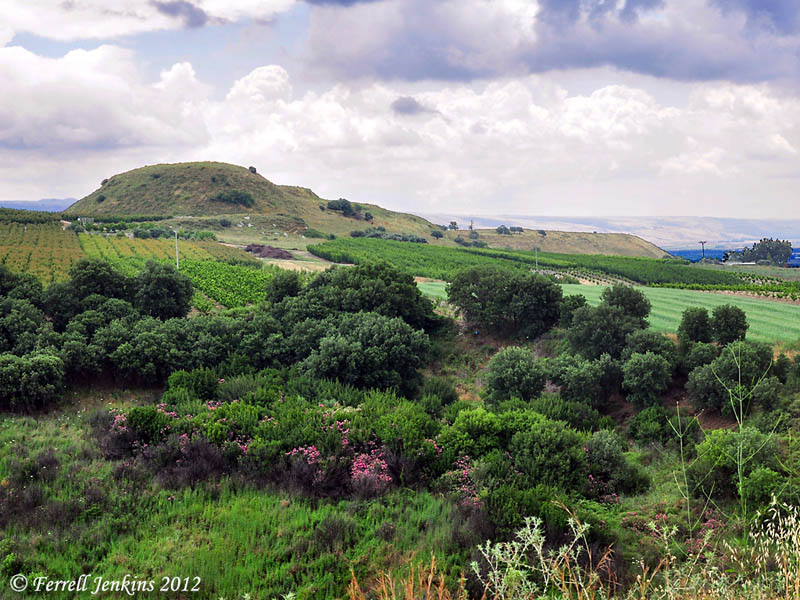
Abel Beth Maacah. Photo by Ferrell Jenkins.

Abel Beth Maacah. View to the east. Photo by Ferrell Jenkins.

Israel government plans to preserve Tel Shiloh

Haaretz announces that the “Israeli government allocates NIS 5 million to preserve Tel Shiloh in West Bank.” According to the article, a large tourist center is planned at the site.

This is a precedent-setting decision, since Israeli governments up to now have not allocated funds for renovation and preservation of the site, located within the area of the Binyamin Regional Council. The committee’s decision to embark on the project states that “Tel Shiloh is a unique heritage asset” for the Jewish people, and mention was made of the fact that work at the site will be backed by supplementary funds totaling some NIS 10 million, to be provided by private sources.

The full article may be read here. For our US readers, 5 million NIS [New Israeli Shekels] equals approximately $1,338,000.

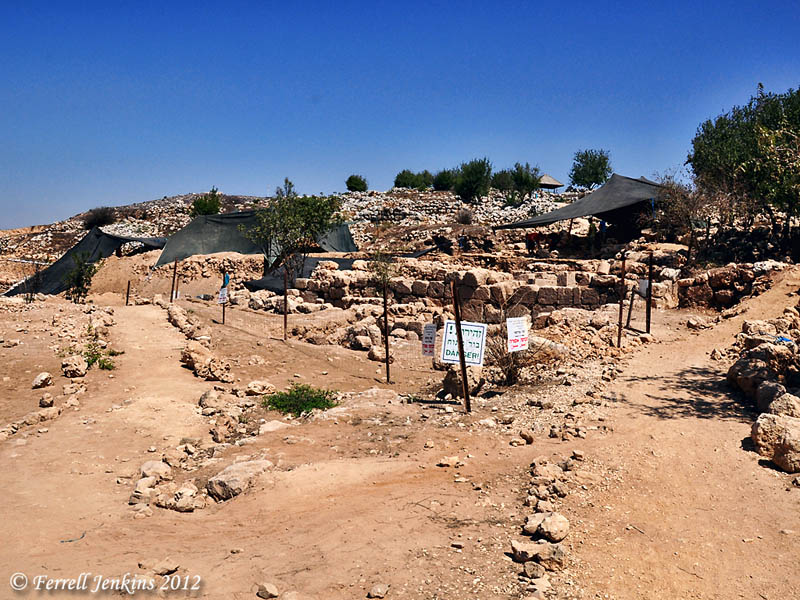
Some archaeological work was already underway last September when Leon Mauldin and I visited Tel Shiloh. The new excavation at the base of the mound dates to the Byzantine and Islamic period.

Tel Shiloh. New excavations at the base of the mound. Photo by Ferrell Jenkins.

Tel Shiloh. New excavations at the base of the mound. Photo by Ferrell Jenkins.

Shiloh is highly significant in Biblical history.

  • The tabernacle was set up at Shiloh, and it was here that the final division of the land among the tribes took place (Joshua 18).
  • Shiloh is located in specific terms.

However, there is an annual festival to the LORD in Shiloh, which is north of Bethel (east of the main road that goes up from Bethel to Shechem) and south of Lebonah.” (Judges 21:19 NET)

  • The Israelites took the ark of the covenant to the battle field near the coastal plain (1 Samuel 4). The ark never returned to Shiloh.
  • Shiloh was the home of Samuel (1 Samuel 1-3).

More info about Shiloh, with earlier photos, may be seen here.

HT: Joseph Lauer

Neil MacGregor: 2600 years of history in one object

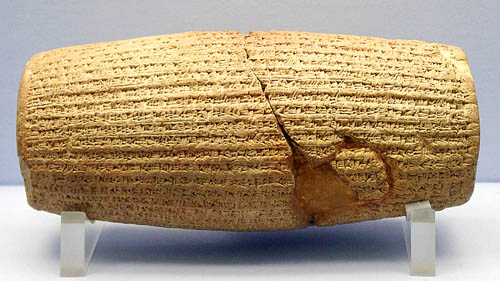
A friend just forwarded a link to a fascinating talk by Neil MacGregor, Director of the British Museum, about the Cyrus Cylinder. MacGregor took the Cyrus Cylinder from the British Museum to Iran when it was loan to the museum in Tehran.

What I learned was the use made of the Cyrus Cylinder by the Jews at the time of the Balfour Declaration, and the use made of it by the Shah of Iran.

MacGregor speaks of the Cyrus Cylinder as a “major player in the politics of the Middle East.”

Follow this link. The film is about 20 minutes old.

Now in the first year of Cyrus king of Persia, that the word of the LORD by the mouth of Jeremiah might be fulfilled, the LORD stirred up the spirit of Cyrus king of Persia, so that he made a proclamation throughout all his kingdom and also put it in writing:  “Thus says Cyrus king of Persia, ‘The LORD, the God of heaven, has given me all the kingdoms of the earth, and he has charged me to build him a house at Jerusalem, which is in Judah. Whoever is among you of all his people, may the LORD his God be with him. Let him go up.'” (2 Chronicles 36:22-23 ESV)

The Cyrus Cylinder in the British Museum. Photo by Ferrell Jenkins.

The Cyrus Cylinder in the British Museum. Photo by Ferrell Jenkins.

Check some of our previous links to the Cyrus Cylinder here and here. Use the search box to locate others.

Cooking at 4th century Qatzrin

Golan in Bashan is first mentioned in the Bible in connection with the priestly cities of refuge that were appointed to Israel east of the Jordan (Deuteronomy 4:43; cf. Joshua 20:8; 1 Chronicles 6:71).

After modern Israel captured the Golan Heights from Syria in 1967, considerable efforts was made to identify Jewish villages that may have existed in the area. One such village was Qatzrin (pronounced kats-REEN). Archaeologist Anne Killebrew spent a decade or more working at the site and directing the reconstruction of the site which included a synagogue and several houses.

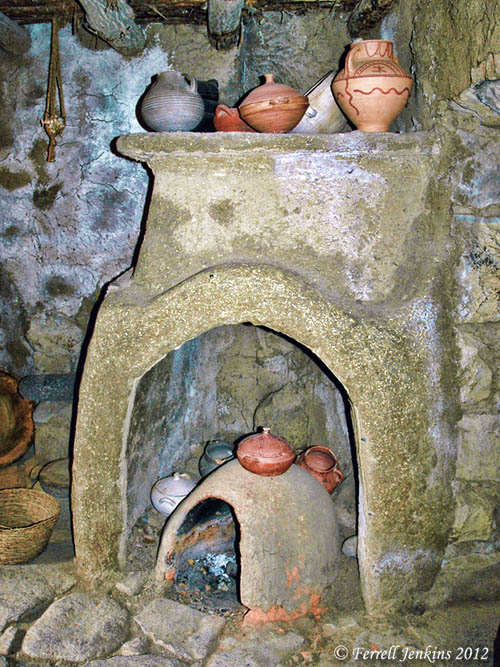
Qatzrin was originally built in the 4th century A.D. and remained in use till the mid-8th century. I wanted to show you the oven that we have from that village. The photo below shows a small clay oven placed within a mud-brick chimney. The chimney took the smoke out of the house and provided heat for the second floor bed room as well as for the kitchen. Not quite a microwave, but it wasn’t terribly different from the wood-burning stoves I knew as a child. (No, not in the 4th century!)

An oven inside a chimney at Qatzrin. Photo by Ferrell Jenkins.

An oven inside a mud-brick chimney at Qatzrin. Photo by Ferrell Jenkins.

Killebrew and Steven Fine wrote about “Qatzrin—Reconstructing Village Life in Talmudic Times” in Biblical Archaeology Review 17:03 (May/June 1991). The reconstruction of the oven and chimney are explained in a sidebar to the article.

The kitchen of the House of Rabbi Abun, seen on our cover, can be understood as a microcosm of the painstaking effort that went into the reconstruction of the whole house. The small domed oven at center stands within a mudbrick chimney. Excavated remains of this indoor oven—employed both for heating the house and for cooking in bad weather, when outdoor cooking was difficult—indicated the size and shape of the oven, a type still used by the Druze (a Moslem sect residing in the area). A portion of the chimney exits the roof in the corner, behind the period pottery on the chimney’s mantle, and rises high enough above the roof to create a draw that effectively pulls smoke out of the house. No remains of the original chimney were found, but the reconstruction was built, as was the rest the house, by Druze workmen using traditional styles and methods. Experiments have shown that this chimney works well.

Both Matthew and Luke record the statement of Jesus,

But if God so clothes the grass of the field, which today is alive and tomorrow is thrown into the oven, will he not much more clothe you, O you of little faith? (Matthew 6:30; cf. Luke 12:28 ESV)

The Greek word for oven or furnace (in a few English versions) is klibanos. According to BDAG it is used of “an oven (made of pottery),” exactly what you see in the photo.

Louw-Nida explains further:

a dome-like structure made of clay, in which wood and dried grass were burned, and then after being heated, was used for baking bread – ‘oven.’… ‘the grass of the field which is alive today and tomorrow is cast into the oven’ Mt 6.30. The function of klibanos may be described as ‘a place heated for baking bread,’…

After one gets the fire going with grass or other kindling, it was often kept going with dung cakes. See Ezekiel 4:15 for a biblical example.

Baking bread in Bible times

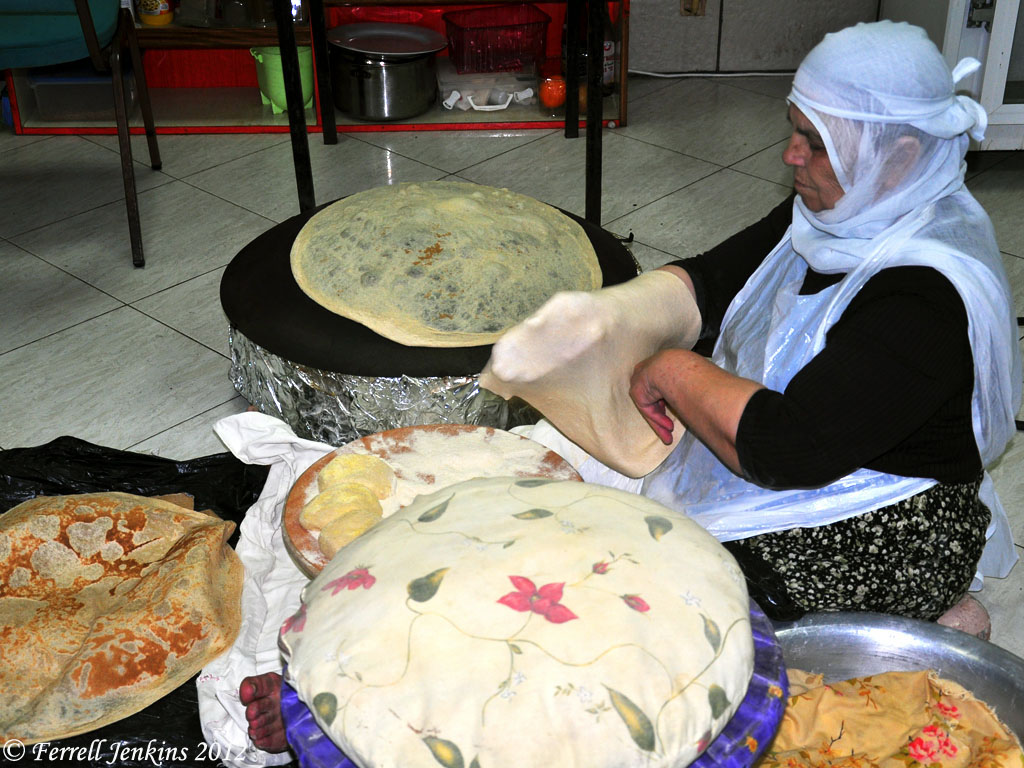
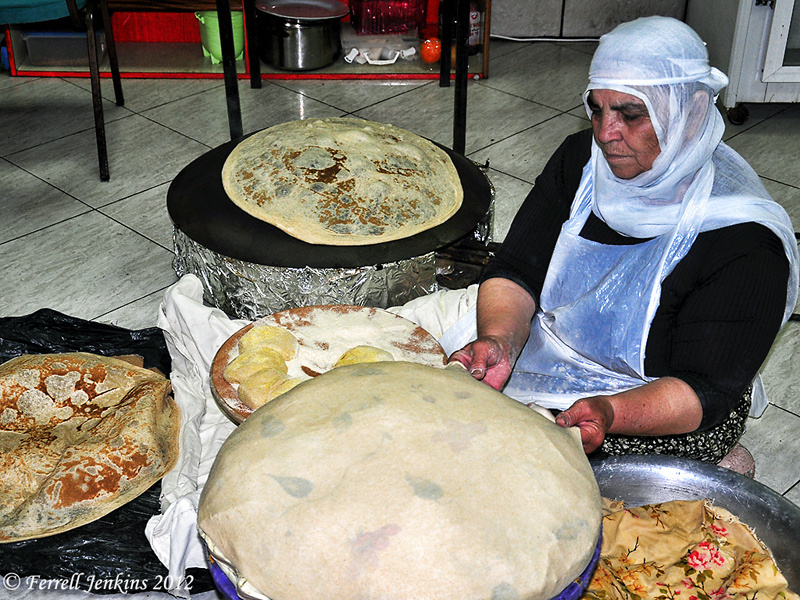
The Druze are especially noted in Israel for baking bread on a convex griddle. There are Druze villages on Mount Carmel and in the Golan Heights where the border with Israel and Syria come together. The photo below slows a woman preparing the dough for baking at a restaurant in the north of the Golan Heights at Birket Ram.

Druze woman preparing bread for baking at Birket Ram. Photo by Ferrell Jenkins.

Druze woman preparing bread for baking at Birket Ram. Photo by Ferrell Jenkins.

She will first place the dough on a rounded cushion which looks like a pillow (at the bottom of the photo).

After that she will turn it over on the griddle at the top of the photo. There you see bread cooking. To the left there is bread that has been taken from the griddle. Your chosen ingredients of meal and/or vegetables will be rolled in the thin bread.

Druze woman preparing bread for baking at Birket Ram. Photo by Ferrell Jenkins.

Druze woman preparing bread for baking at Birket Ram. Photo by Ferrell Jenkins.

I certainly am not an expert on cooking, nor even an expert on how this type of cooking might compare with some bread baking in Bible times. Ovens were often used by people of the Bible world, but some bread was cooked on a plate or griddle made of clay or iron.

King and Stager say,

“When a griddle (mahabat) of clay or iron (Ezek. 4:3) was used, it was set on stones over a pit in which a fire was kindled; then the dough was baked directly on the griddle” (Life in Biblical Israel, 66).

There are a few biblical references in which this type of griddle seems to be in mind.

And if your offering is a grain offering baked on a griddle, it shall be of fine flour unleavened, mixed with oil. (Leviticus 2:5; see also 6:21; 7:9 ESV)

For a visual aid, Ezekiel was told to take an iron griddle (plate, frying pan) and use it as an iron wall between himself and the city.

And you, take an iron griddle, and place it as an iron wall between you and the city; and set your face toward it, and let it be in a state of siege, and press the siege against it. This is a sign for the house of Israel. (Ezekiel 4:3 ESV)

Holladay’s Hebrew lexicon defines the Hebrew word for griddle as “(metal) plate, griddle for roasting & frying.”

I would write more, but I think I will go eat.

Florida College Lectures on Logos Pre-pub

Yesterday I explained a little about Logos Bible Software and their Community Pricing and Pre-publication Specials. Today I want to tell you about a set of Pre-pub books that are of special interest to me.

Florida College is an accredited (by the Southern Association) private liberal arts college that for decades has offered four years of Bible. The college does not accept funds from churches, but the board, administration and faculty are members of Churches of Christ that are often designated as non-instiutional.

Accreditation as a junior college was granted to Florida College in the mid-1950s, but the college continued to offer four years of Bible studies. Biblical Studies was the first accredited Bachelor’s degree to be offered in 1997.

Since its beginning in 1946, Florida College (earlier named Florida Christian College) conducted an annual Bible lecture program. Beginning in 1974 the main lessons in these lectureships were published in book form from the manuscripts of invited speakers. The speakers were teachers and ministers associated with Churches of Christ.

Melvin Curry followed Homer Hailey as chair of the Bible department after Hailey’s retirement in 1973. Nineteen of the volumes were edited by Curry. After that, it came my turn to edit ten volumes while I served as chair of Biblical Studies. Since my retirement in 2001, Daniel Petty has served as department chair and edited the annual lecture book.

FC Lectures 1996

One of the volumes in the Logos digital set.

There are a total of 38 volumes (1974–2011) in the series. Some of these volumes have been out of print for several years.

The Logos web site offers the following overview of the lecture books:

The Florida College Annual Lectures (1974–2011) brings you thirty-eight years of the college’s annual lectures series in complete written form. Prior to the first published lecture series in 1974, only content outlines were available.

Each volume includes fifteen or more lectures from contributors from various biblical fields, and focus on a specific theme. These themes deal with modern issues and are supported by recent scholarship. Learn what true worship entails. Discover how God can restore your life. Challenge yourself to share the gospel message. The Florida College Annual Lectures (1974–2011) (38 vols.) contains both informative and stimulating topics that allow you to apply the biblical principles found in its lectures to your daily walk with Christ.

With Logos, every word is essentially a link! Scripture references are linked directly to the Bibles in your library—both the original language texts and English translations. Logos Bible Software allows you to quickly move from the table of contents to your desired content and search entire volumes and collections by topic, title, or Scripture reference, making Logos the perfect software to expand your understanding of the Word.

How Pre-publication works. Books on Pre-pub will not be produced until Logos sees that there are enough orders to make the publication feasible. Interested customers lock in the pre-pub price. You must set up an account with Logos, but your card is not charged until the book or set is ready to deliver. You will be notified when the book is ready. At that time you have a choice to continue or cancel. You may have to wait 6 months or more until the work is ready.

The deal is great. This 38 volume set of Florida College Lectures is available on Pre-pub for $74.95. This set is scheduled to sell for $174 when it is published. Even that is a bargain.

Think about these 38 volumes for $75. There are more than 600 lectures. That’s about 12 cents per lecture. Even mine are worth that. The entire collection is searchable, along with all other works you have in your Logos collection. When a Scripture reference appears, simply mouse over it and the Scripture is visible in your preferred version of the Bible.

In a previous post here I have explained that you must have a Logos base package, or already have Logos on your computer. During the recent Florida College lectures, Logos offered a 15% discount on any base package. Just use the coupon code LECTURE2012.

Logos Bible Software is the premier digital publishing format for books dealing with Biblical Studies. If you are serious about Bible study, you need to investigate Logos.

In a future post, hopefully soon, I plan to explain why those not associated with Churches of Christ should find this set of books useful.

Meanwhile. Go to the Logos web site and place your Pre-pub order NOW. The sooner Logos publishes, the sooner we can begin to utilize the search features in this entire set. You can always get to the information by going to Logos.com. Look under Products for the Pre-publication Specials. The direct link to info about the Florida College Annual Lectures, with a list of every lecture, is here.

Great deal for Logos (or Libronix) users

Logos has a feature called Community Pricing. It works like this. A book (or set) is chosen for publication. Interested persons are asked to place a bid on the completed digital publication. When there are enough bids to pay for publication the book is published. After the initial publication, the price goes up. I have purchased many Logos publication using Community Pricing and Pre-Publication Specials.

To use the Community Pricing or Pre-Pub specials you must already have Logos (or Libronix) on your computer. You may purchase a base package from Logos, or buy a relatively inexpensive set of books from someone like Rejoice Christian Software. I suggestion you buy something like the  Baker New Testament Commentary ($50 here), the Norman Geisler Apologetics CD-Rom Library ($25 here), or one of the other great specials they offer.

Back to the Community Pricing. The Travels through Bible Lands Collection (15 vols.) is now available for $15 (and it might go lower if more people purchase before noon Friday). I bid $20 several months ago. Just saved $5.

Travel through Bible Lands collection. Only in digital format.

Travel through Bible Lands collection. Only in digital format.

Here is some info about the set of nearly 7,000 pages. Just the four volumes by Tristram and Layard are worth far more than the asking price. The works are all old, but sometimes old is good.

The Dead Sea. Bethlehem. The Sea of Galilee. Jericho. Babylon. Cairo. These are but a few of the places visited by these courageous writers in the Travels through the Bible Lands Collection (15 Vols.). During the turn of the nineteenth century, traveling to and across the Holy Land was a dangerous and arduous journey for a Westerner. These diverse explorers—missionaries, writers, cartographers, theologians, ethnographers, diplomats, archeologists—risk the danger to trek the deserts between Egypt and Turkey, survey the caves of the Dead Sea, dig in the dirt of Babylon, fight disease in Beirut, spread the gospel in Turkey, and stand in awe of the pyramids of Egypt.

These fifteen volumes embody some of the best travel writing of the nineteenth century. After two failed expeditions, Henry Baker Tristram finally gets his chance to explore the east shore of the Dead Sea with the help of a prominent sheik and his armed men. Charles Warner chronicles his winter-long voyage through Egypt, culminating in an unforgettable Christmas spent on the Nile River. Austen Henry Layard and his team survive a perilous journey to The Holy Land, and make historical discoveries at the ruins of Nineveh and Babylon for their efforts. Ella Sykes, exploring the alleyways of Tehran and the beauty of the Indian desert, becomes one of the first European women to travel across Persia. William Wittman, a British surgeon, battles unfamiliar diseases as he treats patients from Turkey to Egypt on his long expedition with the British Army.

Each volume in this collection is rich with Scriptural landmarks, highlighting some of the most significant places from the Bible. Full of adventure and inspiration, Travels through Bible Lands Collection (15 Vols.) is a fascinating window into history that is perfect for any Logos collection.

Logos is also giving away a free book each month. The free one for February is The Works of B. B. Warfield, Vol. 1: Revelation and Inspiration.

To check out either offer, just go to Logos.com, and then click on the appropriate tab.