Category Archives: Bible Study

6 year old palm from 2000 year old seed

A few date palm seed were uncovered by Professor Yigael Yadin during his excavation of Masada. Six years ago one of these seed was planted at the Arava Institute in Israel. The seed sprouted, and has grown into a nice little six year old palm.

Yishai Fleisher of EyeOnZionTV interviews Dr. Elaine Solowey at the Arava Institue about this seed and plant. In addition to the information about the palm, I especially like the way Dr. Solowey refuses to fall for some of the speculative journalistic questions.

The photo below shows one of the modern date palms on the southwestern shore of the Sea of Galilee.

Date Palm growing near the Sea of Galilee. Photo by Ferrell Jenkins.

Date Palm growing near the Sea of Galilee. Photo by Ferrell Jenkins.

Jericho is mentioned as “the city of palm trees” in Deuteronomy 34:3.

The righteous are compared to the palm tree.

The righteous flourish like the palm tree and grow like a cedar in Lebanon. (Psalm 92:12 ESV)

HT: Jack Sasson

Acts 15 — Photo Illustrations

James, the Lord’s brother, is one of the prominent characters in Acts 15. In fact, Paul later refers to the events of Acts 15, and speaks of James, Cephas,and John.

and when James, Cephas, and John, who had a reputation as pillars, recognized the grace that had been given to me, they gave to Barnabas and me the right hand of fellowship, agreeing that we would go to the Gentiles and they to the circumcised.  (Galatians 2:9 NET)

In the Armenian Quarter of the Old City of Jerusalem we find the Cathedral of St. James. Murphy-O’Connor says,

Facts and legend are juxtaposed as casually as are artistic creations of different talents and periods. The church is dedicated to St. James the Great, son of Zebedee, who was executed by king Herod Agrippa I in 44 (Acts 12:1-3).

But the building also claims to hold the “patriarchal throne of St James the Less, the brother of the Lord…” (Murphy-O’Connor). This is the James of Acts 15. (It is sometimes difficult for readers to keep all of those named James, John, and Mary, separate when reading the New Testament — not to mention Herod.)

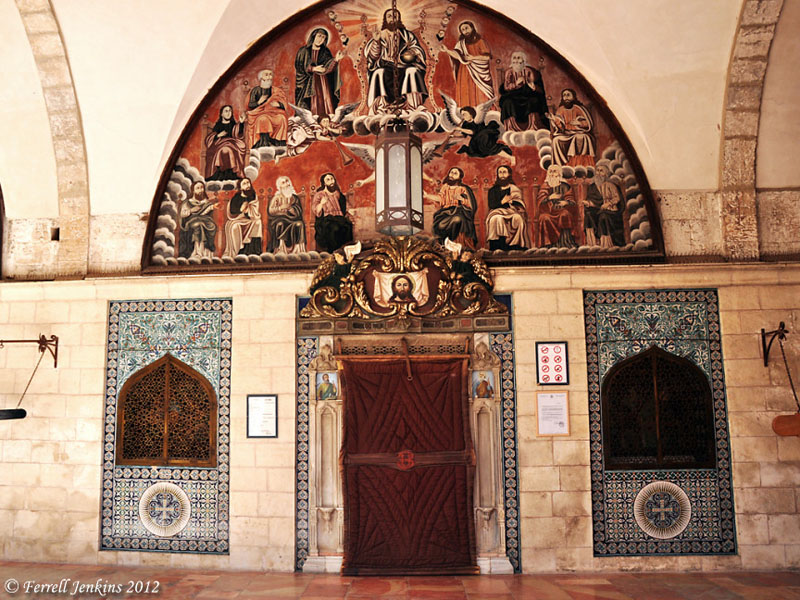
Photos were not allowed inside the building when I was there to observe a service. This photo shows the entrance to the Cathedral.

Entrance to St. James Cathedral in the Armenian Quarter of Jerusalem. Photo by Ferrell Jenkins.

Entrance to St. James Cathedral in the Armenian Quarter. Photo by Ferrell Jenkins.

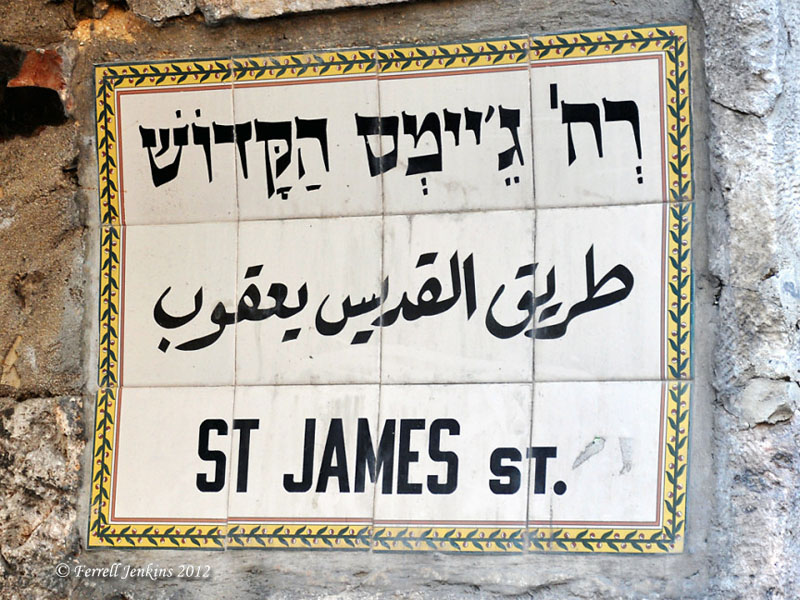
In one of the quietest places in the Old City one comes upon St. James Street.

St. James Street in the Armenian Quarter. Photo by Ferrell Jenkins.

St. James Street in the Armenian Quarter. Photo by Ferrell Jenkins.

Other names of interest in the Armenian Quarter include St. Mark’s Street and Ararat Street. A century ago the Armenians had a large presence in eastern Turkey, where the Mountains of Ararat are located.

“From the Land of Black Tents”

In his book The Apostle: A Life of Paul, noted biographer John Pollock begins his book with information about Paul’s background at Tarsus. He calls the first chapter, “From the Land of Black Tents.”

His father most likely was a master tentmaker, whose craftsmen worked in leather and in cilicium, a cloth woven from the hair of the large long-haired black goats that grazed (as they still do) on the slopes of the Taurus. The black tents of Tarsus were used by caravans, nomads, and armies all over Asia Minor and Syria.

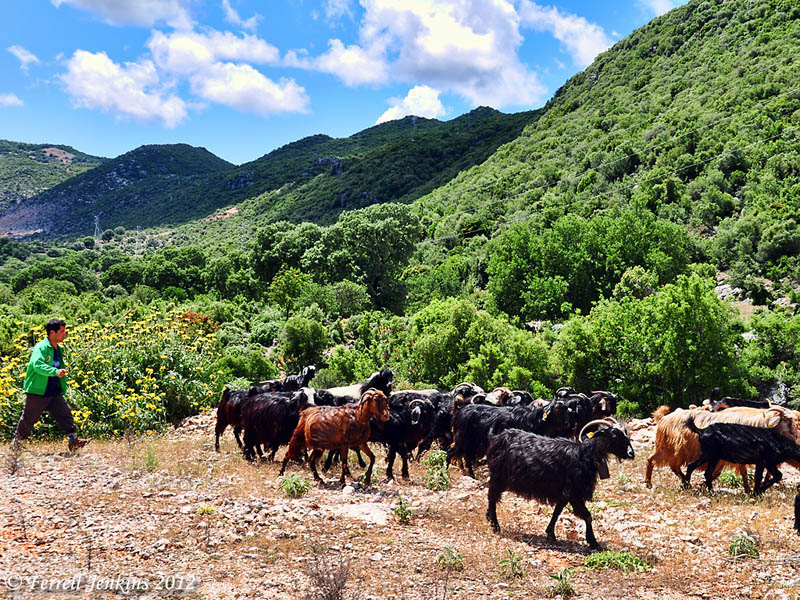
We still see these herds of long-haired black goats in many parts of Turkey. The photo below was made east of Myra near the Mediterranean coast of Turkey.

Goats with long black hair, east of Myra, Turkey. Photo by Ferrell Jenkins.

Goats with long black hair east of Myra, Turkey. Photo by Ferrell Jenkins.

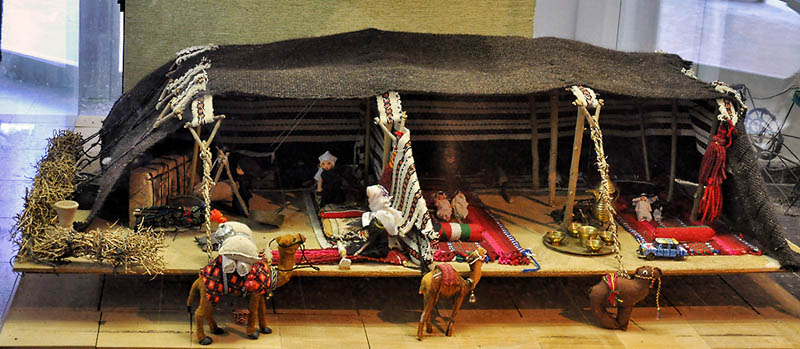
The Museum for Beduin Culture at Kibbutz Halav in the Negev of Israel displays a small model of a beduin (bedouin) tent. This museum intends to preserve the memory of the original bedouin life that is quickly being replaced by a permanent life and housing.

Bedouin Tent Model displayed at the Museum for Beduin Culture. Photo by Ferrell Jenkins.

Tent Model displayed at the Museum for Beduin Culture. Photo by Ferrell Jenkins.

Paul said,

But Paul said, “I am a Jew of Tarsus in Cilicia, a citizen of no insignificant city; and I beg you, allow me to speak to the people.” (Acts 21:39 NAU)

Acts 14 — Photo Illustrations

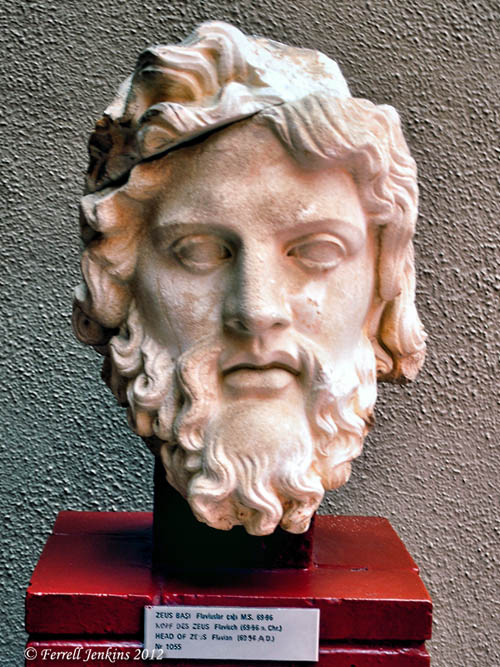
G. Walter Hansen comments on the religious life of Galatia and the importance of Zeus and Hermes to the people who lived there.

Zeus was the most widely worshipped god in Galatia; temples to Zeus were ubiquitous. Zeus was often linked with other gods. In the territory of Lystra there are carvings and inscriptions which show Zeus accompanied by Hermes. An inscription found near Lake Sugla is a dedication to Zeus of a sundial and a statue of Hermes. The names of the dedicators are Lycaonian. A stone altar near Lystra is dedicated to “the Hearer of Prayer [presumably Zeus] and Hermes.” A relief near Lystra depicts Hermes with the eagle of Zeus. In Lystra a stone carving shows Hermes with two other gods, G and Zeus. (Gill and Gempf, The Book of Acts in its First Century Setting, Vol. 2: Graeco-Roman Setting, 393)

This evidence, says Hansen, provides the setting for the events of Paul and Barnabas at Lystra. Luke describes the reaction of the Lystrans when they saw Paul heal a lame man.

When the crowds saw what Paul had done, they raised their voice, saying in the Lycaonian language, “The gods have become like men and have come down to us.”  And they began calling Barnabas, Zeus, and Paul, Hermes, because he was the chief speaker.  The priest of Zeus, whose temple was just outside the city, brought oxen and garlands to the gates, and wanted to offer sacrifice with the crowds.  (Acts 14:11-13 NAU)

Bruce reminds us that “Zeus was the chief god in the Greek pantheon; Hermes, the son of Zeus by Maia, was the herald of the gods” (The Book of the Acts, NICNT, 292).

Our photo of Zeus is of a bust displayed in the archaeological museum at Ephesus.
Image

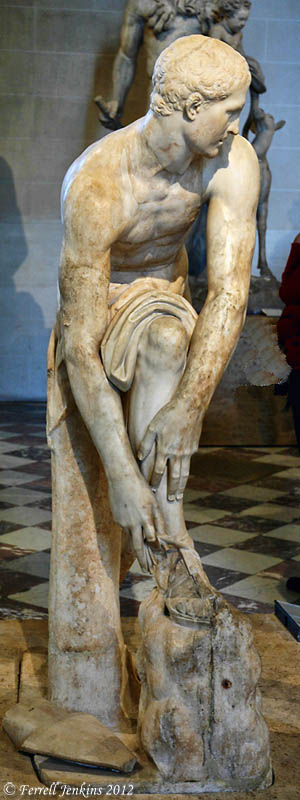
Paul was called Hermes because he was the chief speaker. Hermes was the messenger of the gods. How appropriate that our word hermeneutics, coming from the name Hermes, is used to describe the important work of interpreting the Scriptures. I have heard some speakers make fun of the word and then proceed to say that a certain phrase in the Scripture means … ! The photo below shows Hermes tying on his sandal in preparation for delivering a message. Some may recognize Hermes as the Latin Mercury, who is used as the symbol for the floral industry.

Image

The King James Version used the Latin terms Jupiter and Mercurius in Acts 14:12. Bruce says this is “due to an old and foolish fashion of replacing Greek proper names by their Latin equivalents in English translations from the Greek.”

This post is reprinted from December 1, 2011, with improved photos.

Thomson’s “The Land and the Book” on Logos community pricing

William Thomson’s 3-volume set, The Land and the Book, is now on community pricing at Logos.

http://www.logos.com/product/26753/the-land-and-the-book

Thomson - The Land and the Book

The Land and the Book

This set of books was published by Harper & Brothers between 1880 and 1886.

Thomson spend many years living in Beirut and traveling throughout the region. This is one of the excellent books telling of travel in those days, and of the then-current understanding of the location of various sites.

I am delighted that this book is now on community pricing for $18. If enough people place a bid the price could be lower. Place your bid today.

HT: Brooks Cochran

Acts 13 — Photo Illustrations # 2

During the trip to Israel I got a little behind in the photo illustrations for the chapters of Acts.

When we come to Acts 13 and 14, there are so many places to consider that it could take weeks to cover them all in detail. In fact, if you use the search box you will see that we have posts on most of the places mentioned in these chapters.

It seems that Paul and Barnabas did not stop to preach in Perga on the outgoing portion of the first journey. The text says, almost casually, that “going on from Perga, they arrived at Pisidian Antioch” (Acts 13:14).

Here we have one of the longer sermons of the book of Acts — Paul’s sermon in the Jewish synagogue. While it appears that we have a vibrant Jewish community in Pisidian Antioch, we also find a receptive Gentile audience. When the Jews rejected the message of the risen Christ, Paul and Barnabas said,

“we are turning to the Gentiles.” (Acts 13:46 ESV)

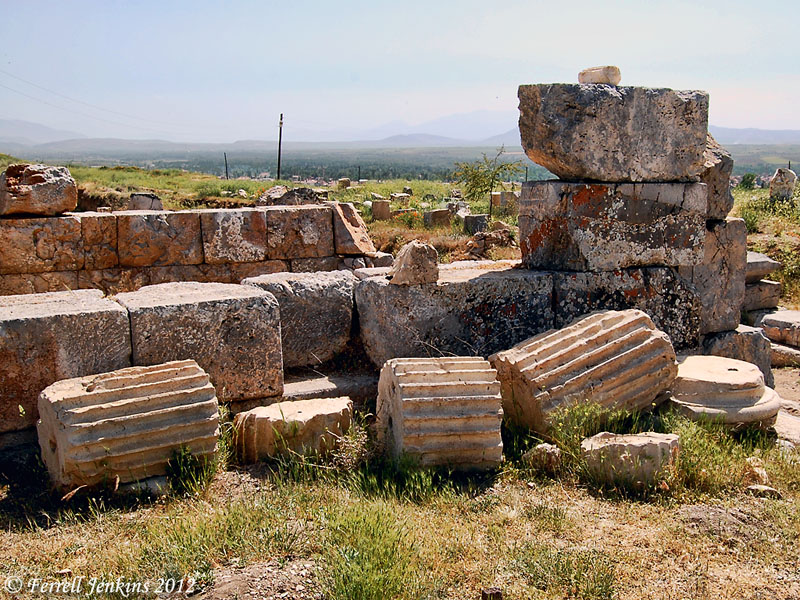
Pisidian Antioch was a city of numerous idol temples. There was a sanctuary or temple dedicated to the Emperor Augustus (30 B.C. – A.D. 14) built by Tiberias (A.D. 14-37).

Ruins of the Augustus Imperial Sanctuary at Pisidian Antioch. Photo by Ferrell Jenkins.

Ruins of the Augustus Imperial Sanctuary at Pisidian Antioch. Photo by Ferrell Jenkins.

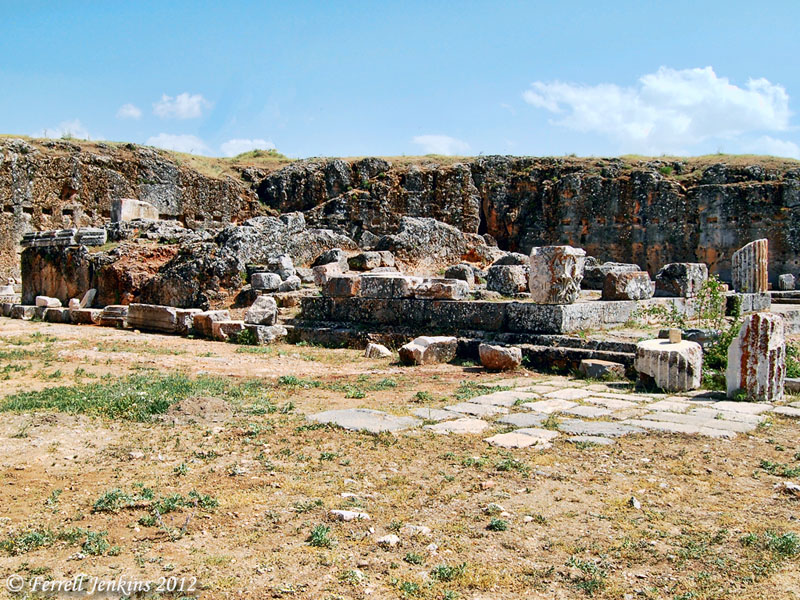
The foundation of the sanctuary is cut from the solid bedrock.
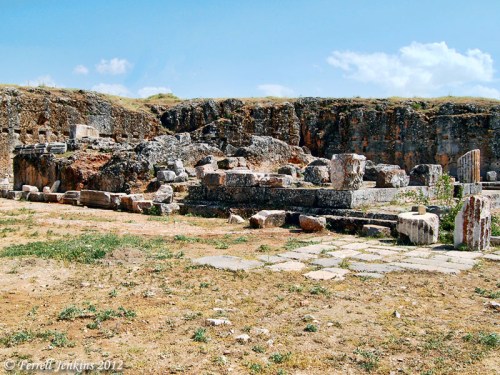
The Augustus Imperial Sanctuary at Pisidian Antioch. Photo by Ferrell Jenkins.

The Augustus Imperial Sanctuary at Pisidian Antioch. Photo by Ferrell Jenkins.

Peter Walker describes the temple,

Beyond the propylon was a large, semicircular courtyard, surrounded by colonnades, the eastern part of which was cut out from the hill-side’s rock. And standing in the centre, towards the back, was the sanctuary of Augustus’ temple. Though quite small – some 15 by 30 feet (4.5 x 9 m) – it was set on a high foundation of natural rock and approached by a further twelve steps. Antioch’s residents were expressing in impressive fashion their gratitude to the emperor for their city’s increased prestige under his rule. However, for Paul it demonstrated the daunting challenge ahead. What room would there be for his own message, focused on a rival world-ruler, in a city where this imperial cult was evidently growing at such a pace? (In the Steps of Paul, 87,89).

Maps. In your study of Acts you might enjoy the use of the Digital Map of the Roman Empire available here. This map, based on the Barrington Atlas, includes the road system. Because the maps show the terrain, you can get some concept of the difficulties encountered by Paul and his companions as they traveled from place to place.

Thanks to Dr. Rasmussen for the lead to this map.

The Magdala synagogue and table

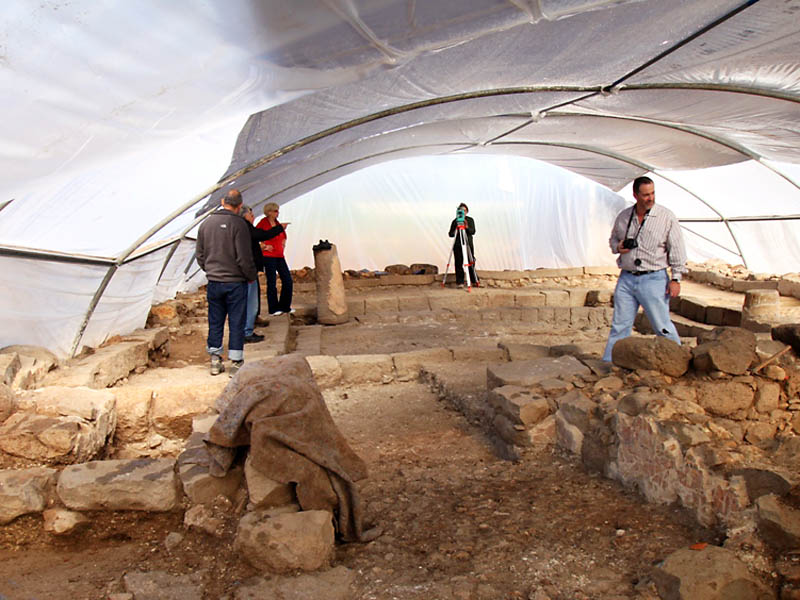
Several times in the past few years we have called attention to the site of Magdala (Migdal). In September, 2009, we noted the announcement by the Israel Antiquities Authority of the discovery of a synagogue from the Second Temple period (50 BCE—100 CE).

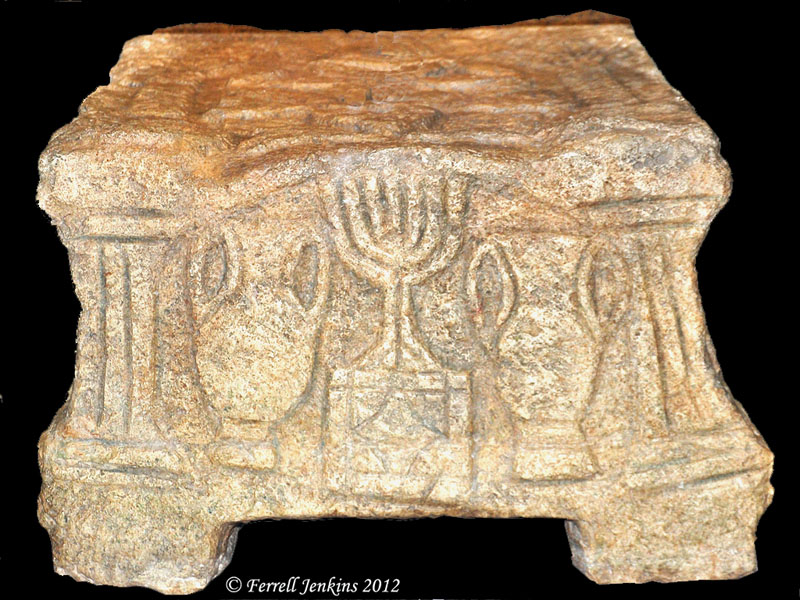
A synagogue from the Second Temple period (50 BCE—100 CE) was exposed in archaeological excavations the Israel Antiquities Authority is conducting at a site slated for the construction of a hotel on Migdal [Magdala] beach, in an area owned by the Ark New Gate Company. In the middle of the synagogue is a stone that is engraved with a seven-branched menorah (candelabrum), the likes of which have never been seen. The excavations were directed by archaeologists Dina Avshalom-Gorni and Arfan Najar of the Israel Antiquities Authority.

The town of Magdala is not mentioned in the Bible, but Mary Magdalene is mentioned a total of 12 times in the four gospels. This place may have been her birthplace or her home. A few late manuscripts mention Magdala (Matthew 15:39 KJV), but earlier manuscripts read Magadan. Magdala is located about 4 miles north of Tiberias on the western shore of the Sea of Galilee.

The Hebrew word Magdala means tower. In New Testament times the city had become Hellenized and bore the Greek name Tarichea because of the importance of the salted-fish industry there. Mendel Nun located a harbor at the site. He says,

“In ancient times, pickled sardines were an important element of diet throughout the country–especially for those who lived near the lake” (BAR, Nov/Dec 1993).

Josephus had his headquarters at Magdala during the first Jewish Revolt against Rome (A.D. 66-70). He was able to get a group of at least 230 boats to go from Magdala to Tiberias (Jewish Wars 2.635-637). Vespasian attacked the town from the sea and destroyed it.

We visited the site on the most recent tour, but everything is covered in a way that make it difficult or impossible to make sense of it. We are fortunate to have a photo made by Jim Joyner a few years ago.

The Magdala/Migdal Synagogue. Photo by Jim Joyner.

The Magdala/Migdal Synagogue. Photo by Jim Joyner.

There is a replica of the “table” that was found in the synagogue at the site. The glare on the case was bad, but I followed the tip of Dr. Carl Rasmussen (Holy Land Photo’s Blog), I went to the Notre Dame Hotel and made a photo of the replica there. Since his photo, the table has been put in a case. Notice the menorah.

Magdale Synagogue Table - Notre Dame Hotel, Jerusalem.

Magdala Synagogue Table – Notre Dame Hotel, Jerusalem. Photo by Ferrell Jenkins.

We were told at the site that the original is now in the Rockefeller Museum. Whether on display or being examined by the IAA, I do not know.

The “wife of Christ”

Reminds me of a preaching brother in the Ohio Valley a few decades back who had trouble pronouncing the letter “L”. As a result, he often spoke of the “wife of Christ.” True story. Like the Europeans who says “elewator” in stead of “elevator.”

Having been out of the country for three weeks and still delayed in New York, I have been unable to mention the recent spate of media attention to the claim of a document in which Jesus mentions His wife.

For those who are interested in reading some reliable responses to this nonsense, I call attention to two posts by Todd Bolen at the Bible Places Blog.

In the first one, Bolen briefly summarizes his response to the story under the title “Somebody Once Believed That Jesus Had a Wife” here.

In the second one, here,  he lists a summary of more than a dozen articles worth reading.

Don’t go to church Sunday morning without being prepared. Someone is sure to mention one of the brief reports they heard on TV.

Understanding the Land

Charles Savelle, over at Bible X calls attention to a Wall Street Journal article on the importance of geography in understanding world affairs. Read the article here. It might help you to understand better some of the situations going on in Russia, China, Iran, and Syria.

Later, Charles quotes from a new book on Joshua about the same subject and adds his comments about the importance of geography here. I want to share the paragraph he cites from Coleson’s commentary on Joshua in the Joshua, Judges, Ruth (Cornerstone Biblical Commentary)

“Because humans live on the surface of the earth, geography is always important. Because every ancient Israelite, humble or great, lived in close and intimate relationship with the land, if we wish to understand ancient Israel, we need to learn ancient Israel’s geography. Canaan was the Land of Promise God gave to Israel through the events recorded in Joshua; if we want to understand the message of Joshua, we need to study both the physical and the human geography of ancient Israel God’s grand plan of redemption for the human race may transcend both time and space, but God has so far worked it out in a very definite, limited place through a sequence of events in history. To understand God’s plan and its fulfillment, it helps to understand the timeline and the map” (Joshua, Judges, Ruth, p. 33).

I could not agree more.

David — the sweet psalmist of Israel

As a young man, David played the harp (lyre, Hebrew kinnor) for King Saul.

So it came about whenever the evil spirit from God came to Saul, David would take the harp and play it with his hand; and Saul would be refreshed and be well, and the evil spirit would depart from him. (1 Samuel16:23 NAU)

Later, David is called the “sweet psalmist of Israel.” We have many examples in the collections of Psalms.

Now these are the last words of David. David the son of Jesse declares, The man who was raised on high declares, The anointed of the God of Jacob, And the sweet psalmist of Israel, (2 Samuel 23:1 NAU)

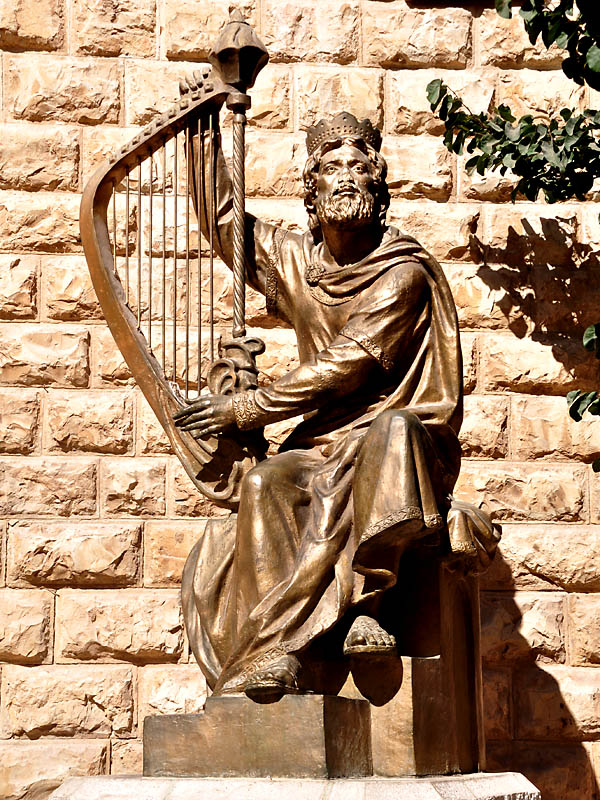
On traditional Mount Zion, near the traditional Tomb of David there is a statue of King David playing the harp (lyre).

Statue of King David on Mount Zion, Jerusalem. Photo by Ferrell Jenkins.

Statue of King David on Mount Zion, Jerusalem. Photo by Ferrell Jenkins.

Our time in the Bible World has come to an end once more. It has been a profitable trip. I still learn something each time I come to this part of the world. Looking forward to next year in Jerusalem.

Our numbers have been extremely good during the past three weeks. I hope that you will continue to check the blog from time to time. Why not subscribe and receive a notification each time we post something new?