Category Archives: Bible Study

In search of Barnabas

A recent article (here) in the York [Pennsylvania] Daily Record features the research of Messiah College professor Dr. Michael Cosby. Cosby received a Fulbright Grant to do this research in Cyprus, a place associated with the life of Barnabas.

Barnabas is best known to most of us because of his association with the Apostle Paul on the first missionary journey. He is mentioned more than 20 times in the Book of Acts. Other than that, he is mentioned 3 times in Galatians 2, and once each in 1 Corinthians and Colossians.

We understand from Luke’s account that Barnabas, also known as Joseph, was a Levite of Cyprus (Acts 4:36). The first stop on the First Journey was at Salamis on the eastern end of the Mediterranean island of Cyprus (Acts 13:1-5). There the preachers spoke in the synagogue of the Jews, and later on the western end of the island at Paphos.

When Paul and Barnabas had a dispute prior to the Second Journey, Barnabas took his cousin Mark and went to Cyprus (Acts 15:36-41).

Nothing else is mentioned in the Bible about Barnabas and the island of Cyprus. But a great amount of tradition has grown up on the island. It is this tradition that Prof. Cosby studied, and he researched the association of the tradition to the modern Greek Orthodox Church of Cyprus, and the privileges granted to the Cypriot archbishops.

Having just visited Cyprus last year I find this a fascinating article. Perhaps you will enjoy it.

According to a tradition dating back to 488 A.D., the sepulcher of Barnabas was discovered by Anthemios, the Archbishop of Constantia and placed in a church he built near the tomb. The photo below shows the now-empty church near the ruins of Roman Salamis.
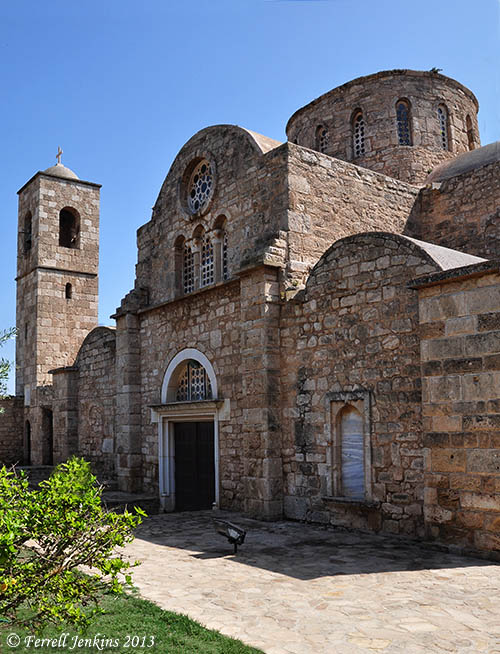
The Church of Barnabas at Salamis. Photo by Ferrell Jenkins.

The Church of Barnabas at Salamis. Photo by Ferrell Jenkins.

Salamis is now located in the the Turkish Republic of Northern Cyprus, or as the folks in the south of Cyprus say, “the occupied territory.”
Clarence Stanley Fisher — Armageddon

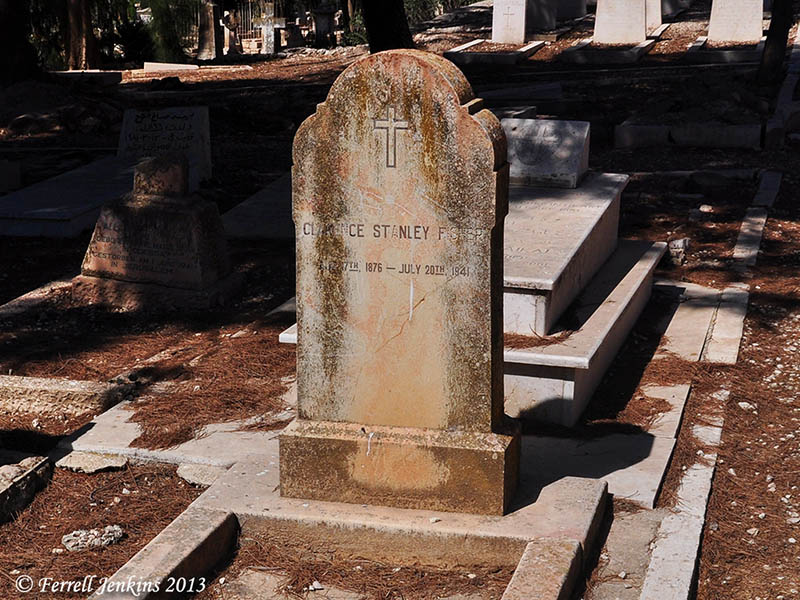
Clarence Stanley Fisher was trained as an architect at the University of Pennsylvania in his hometown of Philadelphia. He became involved in archaeology at Nippur, Iraq (the region of ancient Sumer). Later he worked with George Andrew Reisner at Giza, Egypt, and then at Samaria from 1908 to 1910. This expedition, sponsored by Harvard, was the first American excavation in Palestine. After a short time back at Giza, he excavated at Beth Shan (Beit She’an), a dig sponsored by the University of Pennsylvania.

Fisher received an invitation from the University of Chicago to work at Megiddo, a work funded by the Rockefeller family. This excavation continued from 1933 to 1939, but fisher stopped working at the site after two years because of bad health.

The Megiddo excavations were recounted by Fisher under the title The Excavation of Armageddon, a work published by the University of Chicago Press with a foreword written by James Henry Breasted. This work is available at Google Books.

From 1936 to the time of his unexpected death in 1941, Fisher served as Professor of Archaeology at the American Schools of Oriental Research in Jerusalem (now the Albright Institute).

Fisher is buried at the Protestant Cemetery on Mount Zion in Jerusalem.

Grave marker for Clarence Stanley Fisher. Photo by Ferrell Jenkins.

Grave marker for Clarence Stanley Fisher. Photo by Ferrell Jenkins.

The brief information I have included here is summarized from a brief article by Milton C. Fisher in Bible and Spade 6:2 (Spring 1993). I get the impression that Milton is not related to Clarence. Milton Fisher cites two comments about C. S. Fisher that I wish to quote here.

W. F. Albright described Fisher as “an archaeological genius of no mean quality.”

Nelson Glueck wrote the following at the time of his death:

“The company of his friends misses him sorely. The host of those who loved him for his goodness of heart and humility of spirit will cherish the memory of this gentle man, whose last pilgrimage was to Nazareth, and whose final resting place is in Jerusalem.”

I find it fascinating to see so many well-known names associated with Fisher when Americans and American institutions were actively working in the Middle East.

Conrad Schick — architect, explorer, model builder

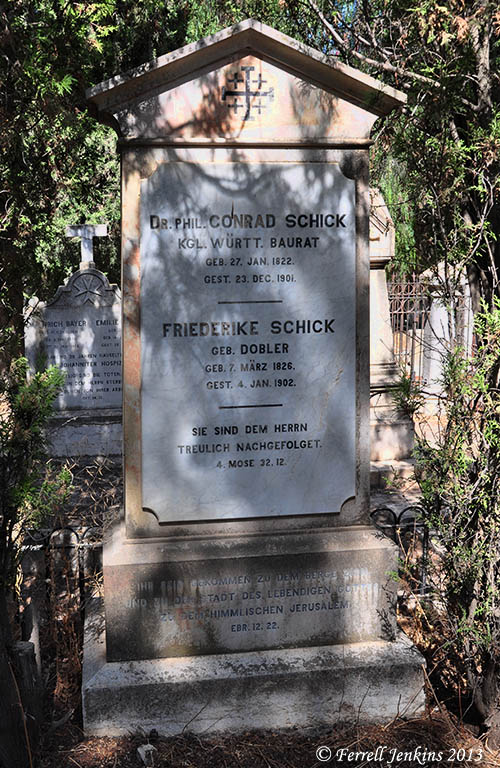
Conrad Schick was born in Switzerland and first came to Jerusalem with a group of men who planned to teach the local young people vocational trades. This group soon disintegrated, and Schick eventually married Friederike Dubler, a German missionary.

Schick became well known as an architect and city planner. He also became involved with some of the late 19th century explorers. He surveyed significant parts of the Old City, and built models of the temple mount and other structures in Jerusalem to use in teaching.

Schick and his wife are buried in the Protestant Cemetery on Mount Zion.

Grave marker for Conrad and Frederike Schick. Photo by Ferrell Jenkins.

Grave marker for Conrad and Frederike Schick. Photo by Ferrell Jenkins.

Epitaphs are often fascinating. This grave stone includes two Scriptures in German.

… for they have wholly followed the LORD (Numbers 32:12)

But you have come to Mount Zion and to the city of the living God, the heavenly Jerusalem … (Hebrews 12:22)

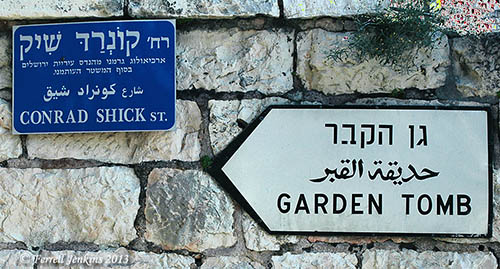
The short lane leading from Nablus Road to the Garden Tomb is named for Conrad Shick [Schick].

Conrad Schick Street leads to the Garden Tomb. Photo by Ferrell Jenkins.

Conrad Shick Street leads to the Garden Tomb. Photo by Ferrell Jenkins.

Tom Powers has prepared an article about Conrad Schick, and I have made use of it in this post. The entire paper is fascinating. See here.

There is also a page devoted to Schick here.

Special Note: If you have any interest in the American Colony, and other people buried in this cemetery, please take a look at the comments by Tom Powers (Outremer) following the two earlier posts about the Spaffords.

James Leslie Starkey, excavator of Lachish

James Leslie Starkey was born in London January 3, 1895. He became interested in ancient history by reading books such as Layard’s Nineveh and Its Remains. He took a course in Egyptology and came in contact with Flinders Petrie. Later he worked with Petrie in Egypt.

Starkey joined Petrie in the excavation at Tell Jemmeh, then at Tell el Far’ah (South) in southern Palestine, where he directed the dig during the final season.

In 1932 Starkey began his own dig at Tell ed-Duwer, identified as biblical Lachish. During his six years at the site, one of the more significant finds was the Lachish Letters which date to the period of the end of the Babylonian conquest of Judah, during the time of the prophet Jeremiah.

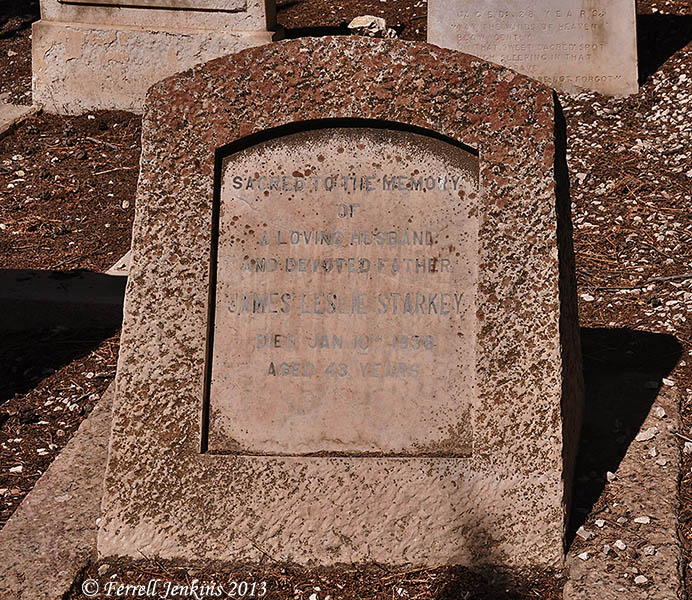
While on his way to Jerusalem in January 1938, for the opening of the new Palestine Archaeological (Rockefeller) Museum, Starkey was shot in an ambush.

Starkey was buried in the Protestant Cemetery on Mount Zion. Four years later the body of his former mentor, Flinders Petrie, was laid to rest a few yards away.

Tomb of James Leslie Starkey, excavator of Lachish. Photo by Ferrell Jenkins.

Tomb of James Leslie Starkey, excavator of Lachish. Photo by Ferrell Jenkins.

I found that information about Starkey is somewhat limited. Much of the info here has been gleaned from a page about Starkey on The Palestine Exploration Fund web site here. There you will see a photograph of Starkey with Petrie, and Olga Tufnell who spent twenty years to complete the four volumes of the Lachish Excavation Reports.

Herod the Great in the Israel Museum

Are you planning a visit to Jerusalem during the upcoming months? I suggest you visit the Israel Museum. There is much to see that is of importance to Bible students. We called attention to some of the archaeological artifacts several times.

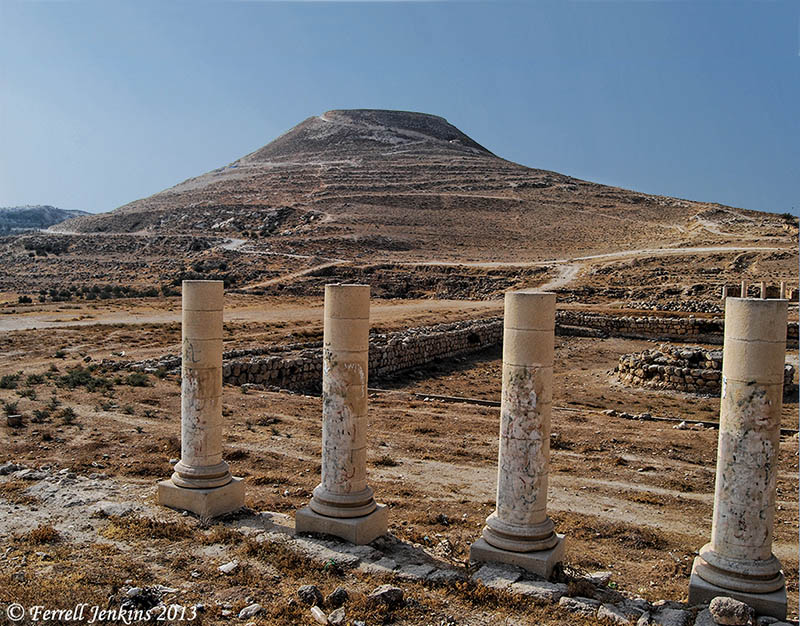
We have written about the Herodium here, here, here, here, and here (and perhaps a few other places) in this blog.

View of the Herodium toward the east. Photo by Ferrell Jenkins

View of the Herodium toward the east. Photo by Ferrell Jenkins

The Israel Museum recently opened a new exhibition called Herod the Great: The King’s Final Journey. The exhibition includes a reconstruction of the tomb and sarcophagus of the King from the Herodium. I suggest you begin by reading the article about the exhibition in The New York Times here.

Shmuel Browns, a tour guide in Israel, and a fellow-blogger, is quoted in the article. Please take a look at the beautiful photos and descriptions of the new exhibition by Browns.

Carl Rasmussen calls attention to the articles by Browns, and includes a nice photo of the large model of what Prof. Netzer thought the monumental tomb of Herod might have looked like here.

I’m looking forward to seeing this exhibition in a few weeks.

Green pastures

David, in describing the LORD as his shepherd, pictures himself as a sheep.

The LORD is my shepherd; I shall not want. He makes me lie down in green pastures. He leads me beside still waters. (Psalm 23:1-2 ESV)

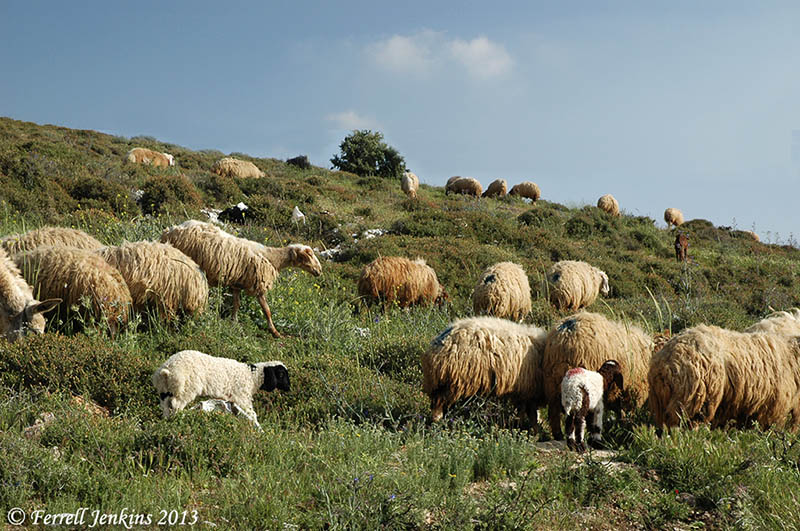
The picture below was made near Heshbon on the Transjordan plateau. It is rare in Israel or Jordan to see sheep in such an abundance of grass.

Sheep near Heshbon in Trans-Jordan. Photo by Ferrell Jenkins.

Sheep near Heshbon in Trans-Jordan. Photo by Ferrell Jenkins.

The Hebrew term mishor describes “level country, table-land, plain … specifically of the elevated plateau or table-land between the Arnon and Heshbon” (Brown, Driver, Briggs). Take a look at Joshua 13:17 in several English translations. Most of the popular English versions use the term plain. The NIV and the CSB use the term plateau.

We describe the area east of the Jordan Valley, now in the Hashemite Kingdom of Jordan, as Transjordan (the area across the Jordan). There are many hills, even mountains, in Transjordan, but the entire area is a plateau. In Israel there is a central mountain range between coastal plains and the Jordan Valley.

Like a cluster of henna…

Henna is mentioned only twice in the Bible, both in the Song of Solomon (or Canticles). The Shulammite girl describes her beloved.

My beloved is to me a cluster of henna blossoms in the vineyards of Engedi. (Song of Solomon [Canticles] 1:14 ESV; see also 4:13)

Scholars are divided about the meaning of the Hebrew term used here. Is this woman named Shulamith? Is she from the Jezreel Valley town of Shunem? Is she described as “the Perfect One” (NET Bible)? Or, is there some other plausible explanation?

Tristram mentions finding the “camphire of Engedi” at the site (cf. KJV transliteration of the Hebrew kopher).

The camphire of Engedi, mentioned in the Book of Canticles, we identified in a pretty shrub, with bunches of graceful pink-white blossoms, which was already in flower in some sheltered nooks, and called El-Henna by the Arabs, from which they procure the Henna dye—the Lawsonia alba of botanists. (The Land of Israel: A Journal of Travels in Palestine, Undertaken With Special Reference to Its Physical Character, 294-95).

Some small plants identified as henna can be seen at Neot Kedumim in the low hill country between Modi’in and Tel Aviv. Both they and the Fauna and Flora of the Bible identify it with the Lawsonia inermis. I don’t know how to sort out this name and the Lawsonia alba that Tristram mentions.

Henna growing at Neot Kedumim. Photo by Ferrell Jenkins.

Henna growing at Neot Kedumim. Photo by Ferrell Jenkins.

Henna is used by women of many societies on their hands, and other parts of the body. In several places I have seen local women painting designs on those who wished to try it.

One of the young ladies of my tour got henna tatoos from the Nubians in southern Egypt. Photo by Ferrell Jenkins.

Stacy got henna tattoos from a Nubian lady in southern Egypt near Aswan. She says it lasted about three weeks. Photo by Ferrell Jenkins.

Stacy tells me that the henna caused quite a stir when she returned to work. She says,

I talked with my hands. I gestured during a meeting and it stopped the meeting cold. Everyone stared. I said, “not to worry … it will disappear in 3 weeks” and continued on with the point I was making. 🙂

Life is fun.

Some suggested reading…

Wayne Stiles has a nice blog in which he connects the Bible and its Lands to life. He has suggested five other blogs for his readers here. I am honored to be included in his list. I appreciate these introductory words.

Where biblical events took place are more than throwaway mentions in the pages of Scripture. Often, they have significant bearing on God’s participation in the lives of His people.

Unfortunately, because we’re unfamiliar with geography we often miss these nuggets. I have found a lot of help in several Holy Land blogs that open up the Bible’s lands to my understanding.

Take a look at his list here. How many of them do you read?

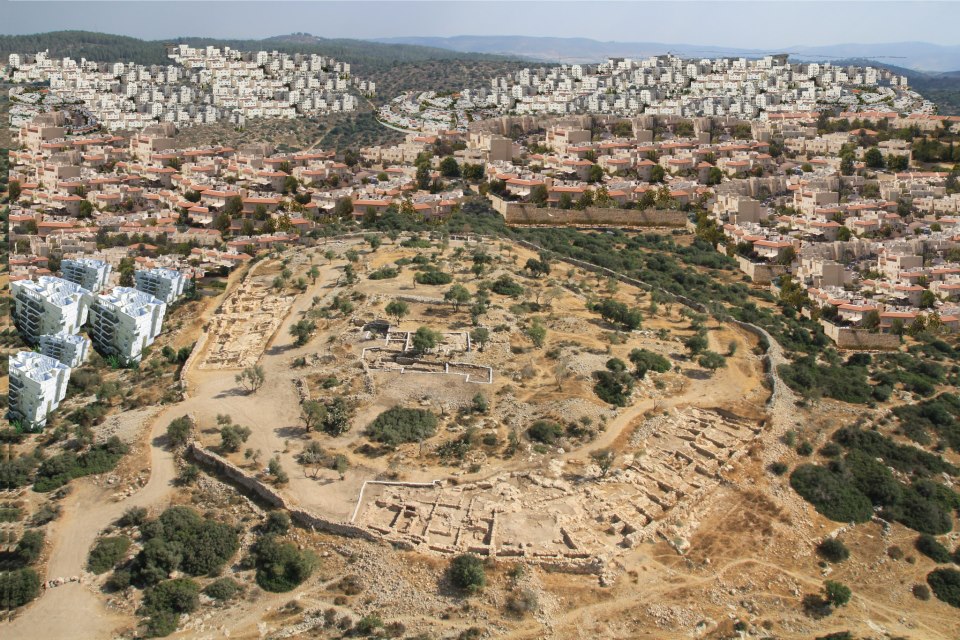
My friend and neighbor Luke Chandler has participated in the archaeological excavations at Khirbet Qeiyafa for at least three years. Qeiyafa is a city overlooking the Valley of Elah. Luke reported recently that a massive building program at the nearby town of Beit Shemesh would bring new residential buildings “no more than 20 meters from Qeiyafa’s western gate and wall.” At the present time the entire area from Qeiyafa eastward is without housing. The houses that have been drawn in show the proposed construction. Progress is sometimes good, but this is sad.

Proposed construction at Khirbet Qeiyafa.

The current plan for the expansion of Beit Shemesh. Some buildings are no more than 20 meters or so from the casemate wall and gate. The likelihood of damage to the site during and after construction would be significant. (Comment by Luke Chandler)

You can read Luke’s comments and see others photo here. Visit the Khirbet Qeiyafa: Save King David’s City Facebook page here. You will find more photos and diagrams.

The Great Pool at Gibeon

There are two references in the Bible to the pool of Gibeon. The first is in the account of a conflict between Abner and those aligned with King Saul, and Joab and the servants of David (2 Samuel).

Abner the son of Ner, and the servants of Ish-bosheth the son of Saul, went out from Mahanaim to Gibeon.  And Joab the son of Zeruiah and the servants of David went out and met them at the pool of Gibeon. And they sat down, the one on the one side of the pool, and the other on the other side of the pool.  (2 Samuel 2:12-13 ESV)

Arnold’s entry in The Anchor Yale Bible Dictionary says,

This “pool” undoubtedly refers to the impressive water system uncovered at el-Jib during recent archaeological excavations” [by Pritchard in the 1950s].

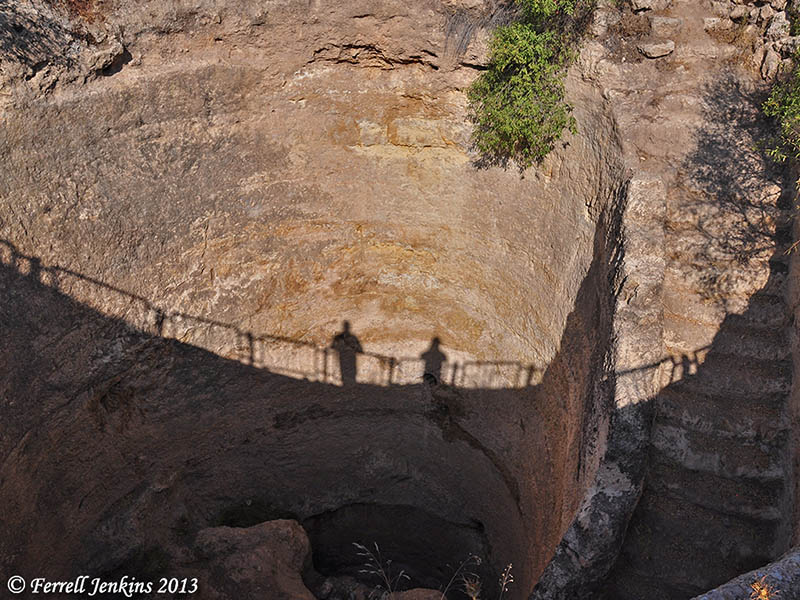
The pool had been constructed in the late 12th or early 13th century B.C. At first, it was thought to be a reservoir intended to hold water. Later it was learned that it served as a stairway leading to a source of water underneath the city.

After the destruction of Jerusalem by the Babylonians, the king of Babylon   made Gedaliah governor over the land. A rebellion led by a man named Ishmael killed Gedaliah at Mizpah (Jeremiah 41). The followers of Gedaliah and the men of Ishmael met at the great pool in Gibeon.

they took all their men and went to fight against Ishmael the son of Nethaniah. They came upon him at the great pool that is in Gibeon. (Jeremiah 41:12 ESV)

The great pool of Gibeon, cut from rock, measures 37 feet in diameter and 35 feet deep. Photo by Ferrell Jenkins.

The great pool of Gibeon, cut from rock, measures 37 feet in diameter and 35 feet deep. The steps led to the source of water located underneath. Photo by Ferrell Jenkins, whose shadow is visible, along with Leon Mauldin, standing at ground level.

For more information see James B. Pritchard’s Gibeon Where the Sun Stood Still (1962). For a ground level photo of the pool, see here.

Speaking at Florida College Annual Lectures

Tuesday morning at 10 a.m. I am scheduled to present an illustrated lecture on Biblical Coastal Towns of Turkey in Puckett Auditorium at the Florida College Annual Lectures. Normally in these sessions, in which I have participated in for many years, I present material on lesser-visited places that are important to Bible study.

There are several important coastal towns in Turkey that are mentioned in the Bible, mostly in connection with the journeys of Paul. These include Troas, Assos, Ephesus, Miletus, Patara, Myra, Attalia, Perga, and Seleucia. I have chosen to discuss two Black Sea cities (Sinope and Samsun) that are related to the discussion of the route of delivery of the Epistles of Peter, and to two cities on the Mediterranean Sea (Patara and Myra). I was able to visit all of these cities during the past year.

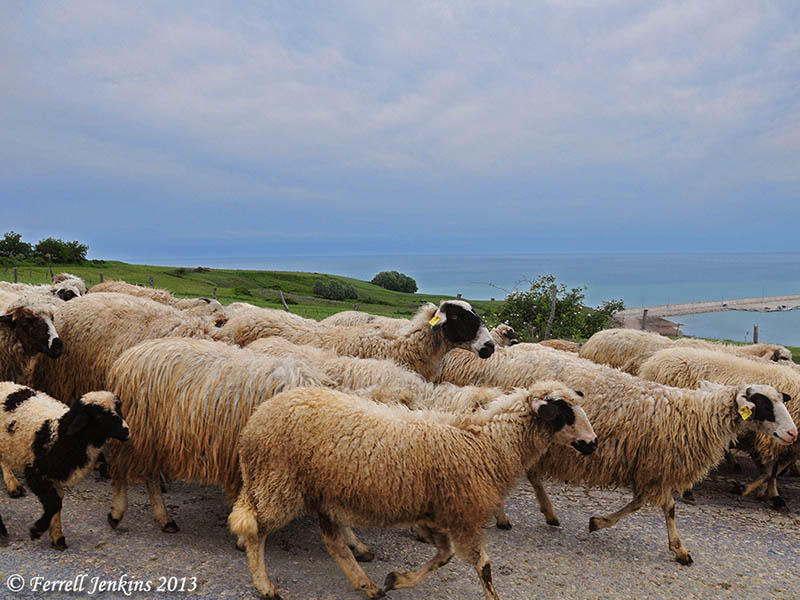
The photo below was made a few miles east of Sinope along the Black Sea (ancient Euxine). The territory is mountainous and the road is often far enough inland that the sea is not visible. Here the road runs along the sea, but still considerably above it. To the south, the mountains are much higher.

Sheep on the road east of Sinope, above the Black Sea. Photo by Ferrell Jenkins.

Sheep on the road east of Sinope, above the Black Sea. Photo by Ferrell Jenkins.