Category Archives: Bible Study

Pictures of Adam?

The title could be misleading. It could be like all of those drawings showing John the Baptist pouring water over the head of Jesus. The Adam we speak of is a place mentioned in the account of the Israelite crossing of the Jordan River.

the waters which were flowing down from above stood and rose up in one heap, a great distance away at Adam, the city that is beside Zarethan; and those which were flowing down toward the sea of the Arabah, the Salt Sea, were completely cut off. So the people crossed opposite Jericho. (Joshua 3:16)

Our fellow-blogger over at Aantekeningen bij de Bijbel in the Netherlands asks,

Do you have also pictures from the Jordan in the neighbourhood of Adam? The place where the Jordan was halted for some time?

To my knowledge It is not possible to approach the Jordan except an area between the Sea of Galilee and Beth-shan, and at Bethany Beyond the Jordan. Photos are not allowed at the various military check points.

The best I can do is to show you a photo I made in November of 2005. This photo is looking east toward the mountains of Gilead. I think the rift to the right of the middle of the photo is the Jabbok Valley. Adam would be located somewhere to the right in this photo. If some other reader can be more specific I would be happy to know.
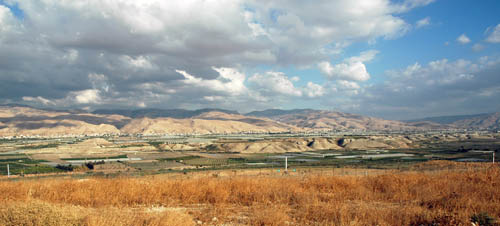
The fence in the foreground of the photo is the boundary between Israel (West Bank area) and Jordan. I often describe the Jordan River as being shy. All along the Jordan Rift, one only sees the River at a place or two. The Jordan flows in the green area in the bottom of the rift. All of the white horizontal lines in the photo are hot houses use for growing agricultural produce.
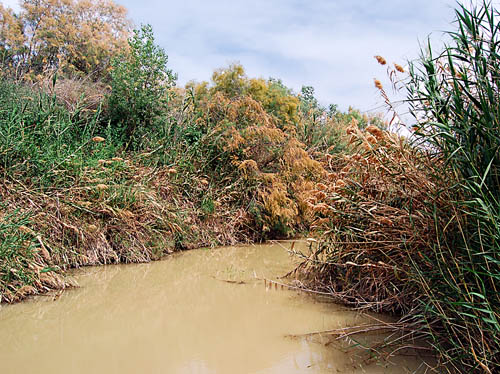
The Jordan River

The distance from the principal source of the Jordan at the foot of Mt. Hermon to the northern end of the Dead Sea is about 135 miles, but the serpent-like Jordan flows over 200 miles. At the source, the elevation is about 1150 feet above sea level. By the time the river reaches the Sea of Galilee it is about 700 feet below sea level, and when it reaches the Dead Sea it is more than 1300 feet below sea level. These and other unusual physical characteristics make the Jordan a significant river. To the Bible student the importance of the river is found in the events which transpired in it.

Israel crosses the Jordan. The children of Israel crossed the Jordan when the water was out of all its banks during the time of harvest (Josh. 3:15). An American reader might think of this as the fall of the year, but actually it was in the spring, at the time of the latter rain (Joel 2:23). As spring approached in Bible times the Jordan would overflow its banks due to the heavy latter rains (about early April) and the melting snows of Mount Hermon. Conditions are different in modern times. Water that once flowed south from the Sea of Galilee and from tributaries such as the Yarmuk River is now used for irrigation. This makes the Jordan much smaller than in earlier times. The crossing of the Jordan by the Israelites provided the imagery for our hymn, “On Jordan’s Stormy Banks I Stand.”

Elijah and Elisha. Both of these oral prophets crossed the Jordan on dry ground prior to Elijah=s being taken up by a whirlwind into heaven. Elisha later used the mantle of Elijah which had fallen upon him to smite the Jordan so that he was able to return (2 Kings 2:8-14).

Naaman the leper. Naaman, captain of the army of the king of Aram, was told by the prophet Elisha to wash seven times in the Jordan to be cleansed of his leprosy. For a reason not explicitly given, Naaman complained that the Abanah and Pharpar, the rivers of Damascus, were better than all the waters of Israel. When he eventually obeyed the Lord, he was made clean (2 Kings 5:1-14). We understand that it was not in the properties of the water but by the power of the Lord that Naaman was made clean through his obedience.

John and Jesus. John immersed in the Jordan River (Mt. 3:1-6). The last important biblical event and the crowning glory of the Jordan was the baptism of Jesus (Mt. 3:13-17).

Photographs of the Jordan south of the Sea of Galilee have been difficult to make since 1967 because the river has served, more or less, as the boundary between Israel (or the occupied West Bank) and Jordan. This photograph was made at the site across from Jericho that may be identified as “Bethany beyond the Jordan” (John 1:28), where John the Baptist baptized at first (John 10:40).

Where in the world?

Many of you probably saw the Today Show this morning. This is the week for Matt Lauer’s “Where in the world…” series. We have always enjoyed these programs because they remind us of so many places we have visited on our tours.

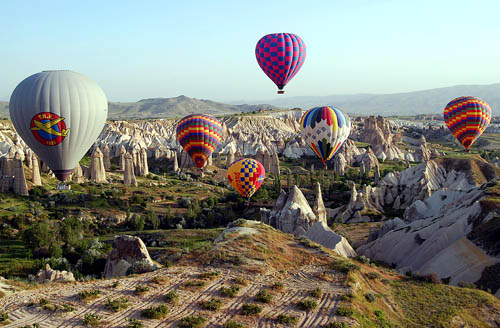
This morning Matt was in Istanbul, Turkey. We will be heading there in a few days to begin our Steps of Paul and John tour. There were a few scenes from other places in Turkey, including Ephesus and Cappadocia. We visited Cappadocia last summer on our Ancient Crossroads tour of historical and biblical Turkey. Here is a photo I made during a hot air balloon over the mysterious landscape of Cappadocia. Note the cultivated vineyards in the foreground below our balloon.

Two of the New Testament epistles were addressed to saints living in Cappadocia.

Peter, an apostle of Jesus Christ, To those who reside as aliens, scattered throughout Pontus, Galatia, Cappadocia, Asia, and Bithynia, who are chosen. (1 Peter 1:1).

All of the places mentioned in 1 Peter 1:1 are located in modern Turkey. It is a fascinating place to visit.

The first attempt on the life of Jesus

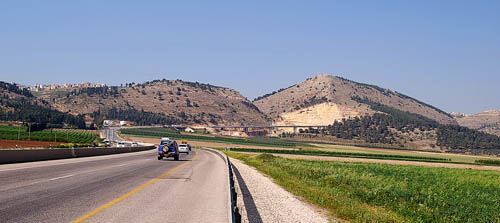
Nazareth is located in the hills of Lower Galilee, where the elevation is about 2000 feet above sea level. These hills lie on the north side of the Valley of Jezreel (Esraelon, or Megiddo).

In this photo some of the buildings of upper Nazareth can be seen to the left. The hill on the right, with the scaring from quarrying, is popularly called the hill of precipitation. If this is correct, and we have no certain evidence, then this would be the the hill spoken of in Luke’s account of Jesus speaking in the synagogue at Nazareth.

And they rose up and drove him out of the town and brought him to the brow of the hill on which their town was built, so that they could throw him down the cliff. (Luke 4:29, ESV)

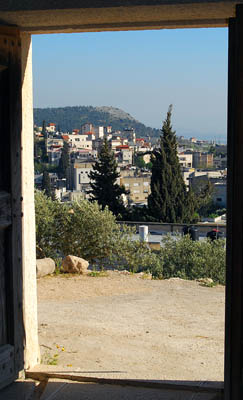
A synagogue, similar to the one that might have existed in Nazareth during the time of Jesus, has been built at the Nazareth Village. The photo shows the view from the door of the synagogue. The hill of precipitation can be seen. Jesus was brought up in a small town that was located near the heart of all important travel through the land of Israel (Canaan, Palestine).

“I press on toward the goal…”

Paul’s admonition to the brethren at Philippi is often used in sermons.

Not that I have already obtained it or have already become perfect, but I press on so that I may lay hold of that for which also I was laid hold of by Christ Jesus. Brethren, I do not regard myself as having laid hold of it yet; but one thing I do: forgetting what lies behind and reaching forward to what lies ahead, I press on toward the goal for the prize of the upward call of God in Christ Jesus. (Philippians 3:12-14)

Most often we hear speakers compare what Paul said to the effort put forth by individuals running in a race. This is certainly not inappropriate. However, many years back I ran across a statement by E. M. Blaiklock that changed my thinking. Blaiklock was a noted classicist. This particular comment comes from Cities of the New Testament.

One mark of the Roman colony is perhaps to be detected in the letter which Paul wrote, over ten years later, to the Macedonian church which he had come to love. It is a hidden metaphor from the chariot race. Exhorting his Philippians to effort and single-minded endurance, Paul writes: ‘This one thing I do-forgetting the things behind, and stretching out to those before, I make for the mark, the prize of the upward calling’.

Commentators generally have not marked the fact that Paul appears to have in mind, not the athletic contests of the Greeks, from which he commonly drew illustration, but the chariot racing of Rome. He was writing to a Roman colony. He was writing also from Rome itself, and never was there such rivalry of racing colours, and circus fever than at that time. The common talk of the soldiers of the soldiers was of the chariot racing, and Paul would gain a vivid impression of this most perilous of sports.

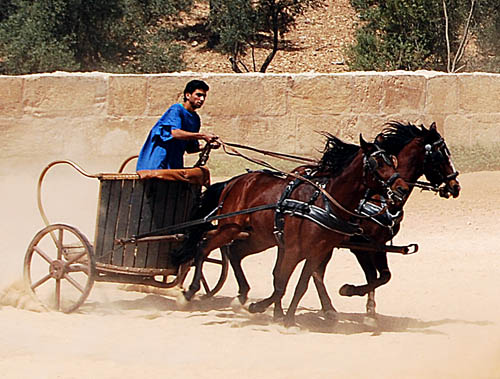
Such a race as that which forms the substance of Paul’s figure is described well in Ben HUR. The charioteer stood on a tiny platform over sturdy wheels and axle. His knees were pressed against the curved rail, and his thighs flexed. He bent forward at the waist, stretching out hands and head over the horses’ backs. This is surely what he means by ‘stretching out to the things before’. The reins were wound round the body, and braced on the reins the body formed a taut spring. It can easily be seen how completely the charioteer was at the mercy of his team’s sure feet and his own fine driving skill. Euripides, in his Hippolytus, tells how the hero fell and was killed in such conditions. Ovid describes the same disaster in Book XV of his Metamorphoses. In his intense preoccupation the driver dare not cast a glance at ‘the things behind’. The roaring crowd, crying praise or blame, the racing of his rivals, all else had perforce to be forgotten. One object only could fill the driver’s eye, the point to which he drove at the end of each lap.

Here is a photo that might help to illustrate what Blaiklock said. It was made at the RACE show (Romy Army and Chariot Experience) at Jerash, Jordan.

My grandparents went to Israel …

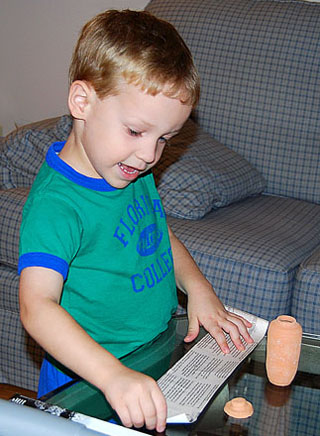
… and all I got was this little Dead Sea Scroll jar. (Of course, anyone acquainted with his grandmother knows differently!) After Grandmother read him the Mystery of the Dead Sea Scrolls, he promptly hid his jar in a secret place [behind the easy chair].

What a wonderful thing to learn about at his age. The Dead Sea Scrolls, discovered in 1947, are of great value to biblical studies.

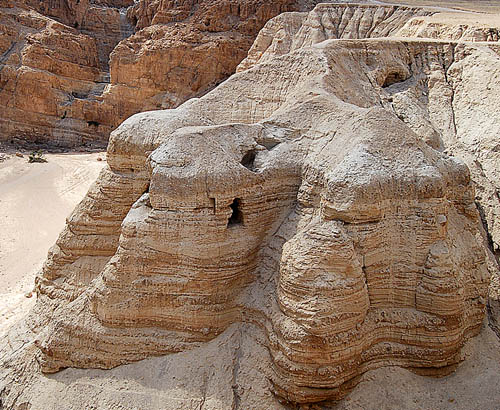
Below is a photograph of Cave 4 at Qumran, on the shores of the Dead Sea. Numerous fragments of the first five books of the Old Testament (Torah) were found in this cave. Qumran was in Jordan at the time of the initial discovery of the scrolls. Some of the scrolls are now displayed at the Shrine of the Book in Jerusalem.

The stadium at Aphrodisias

Aphrodisias, located in southwest Turkey, was an ancient city of Caria in Asia Minor. It is not mentioned in the Bible, but is close to the cities of Laodicea, Hierapolis and Colossae. Robert F. Tannenbaum, an ancient historian, describes the location of the city this way:

A quiet, fertile valley folded into the Mediterranean hills, clear streams, tall poplars, ancient ruins more than 1,400 years old—a picture of pastoral quiet. (Biblical Archaeology Review, Sept/Oct 1986)

The site has been excavated since 1966, beginning under the direction of Kenan Erim of New York University. Marble was readily available at a nearby quarry and the excavation has brought to light a multitude of marble inscriptions and statues from the Roman period including a statue of the Emperor Domitian. Buildings include a theater, an agora, a bath, temples, and a well-preserved stadium.

Louw-Nida describes a stadium as an “open, oval area (frequently including a racetrack) around which was built an enclosed series of tiers of seats for those who came to watch the spectacles – arena, stadium.” When Paul spoke of running the race in 1 Corinthians 9:24, he used the Greek term stadion. The term was also used as a measure of distance and is found in John 6:19. It was about one-eighth of a Roman mile. Most large Greek and Roman cities had a stadium. The figure of the stadium is in mind in Hebrews 12:1-2, where a host of witnesses watch as we run the race.

Therefore, since we have so great a cloud of witnesses surrounding us, let us also lay aside every encumbrance and the sin which so easily entangles us, and let us run with endurance the race that is set before us, fixing our eyes on Jesus, the author and perfecter of faith, who for the joy set before Him endured the cross, despising the shame, and has sat down at the right hand of the throne of God. (Hebrews 12:1-2)

The stadium at Aphrodisias is the best preserved I have seen and I wanted to share it with you in the photo I made in 2006. Picture yourself in the stadium.

This article, with minor changes, was published in Biblical Insights, September, 2006.

Domitian, a hated emperor

One coin at a time is Brett Telford’s blog about coins. He has a marvelous photo of a silver Tetradrachm showing the image of Domitian. It was struck in Tarsus about A.D. 93-95. Please take a look.

Telford says,

The portrait reveals an emperor weary from insecurity and suspicion of conspiracy in the later years of his reign. His gaze bears witness to the demons that incited his paranoia. Domitian’s reign of terror began at around AD 93 and lasted until his death in AD 96… about the same time that this coin was struck.

After an interesting discussion of Ethelbert Stauffer’s theory that the titles of Domitian equal 666, Telford comments on the coincidence that this coin was minted at Tarsus, home of the apostle Paul.

This coin isn’t without its own Biblical reference. Tarsus, the city in which this coin was minted, was the birthplace of the Apostle Paul. Isn’t it ironic then, that a coin of the purported Biblical “Beast” was struck in the very city that brought us the most notable of early Christian missionaries.

Previously I have called attention to my books on Revelation. I failed to mention another brief publication about Domitian. Several years back Arthur M. Ogden and I wrote a series of exchanges. This publication, Did Domitian Persecute Christian? is available free in PDF at BibleWorld.

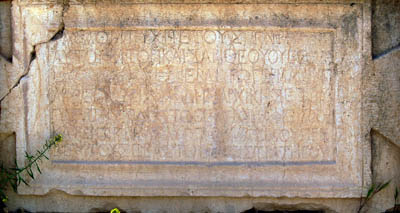
I have seen various inscriptions on which the name of Domitian has been scratched off. It means that he was a person of damnable memory. Recently on our trip to Jerash in Jordan we saw two inscription discovered when the theater was being restored. Here is a photo of one of them.

The inscription, which dates to the year A.D. 90/91, bears the title of the Emperor Domitian, but his name has been erased. The emperor is said to be the son of “divine (theou) Vespasian.” At the moment I can’t put my hands on it, but I recall that a translation of both inscriptions is included in the Newsletter of the American Schools of Oriental Research, Oct., 1974. Inscriptions like this definitely need to be in a controlled environment rather than outside in the weather.

On our upcoming Steps of Paul and John tour the name of Domitian will be used often.

HT: Georg S. Adamsen, Revelation Resources.

Sound a ram’s horn

The ram’s horn was important in the history of Israel. One of the words often for the horn is shophar.

  • A long blast on the ram’s horn was used to alert the Israelites when they could approach Mount Sinai (Exodus 19:13).
  • The ram’s horn was sounded at the beginning of important feast days (Leviticus 25:9).
  • After Israel marched around Jericho they would hear a long blast on the ram’s horn (Joshua 6:5). The word horn in this verse is qeren, but the word shophar is translated trumpet.

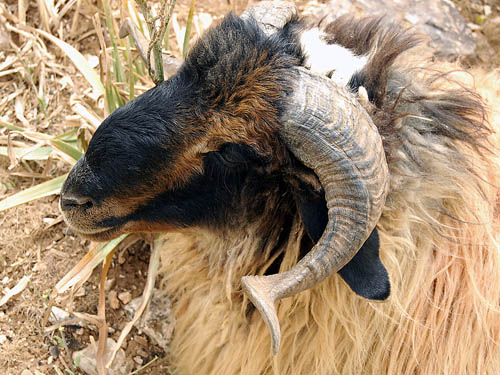
I have observed that shepherds are proud of the ram of the flock. This photo was made last week in northern Jordan not very far from Ramoth in Gilead and the border with Syria.

Wells of water

Without water it is impossible for men to survive. Many disputes throughout history have been about water and water rights. The importance of water during the time of the the biblical patriarchs is prominent in several Bible accounts.

  • Abraham made a covenant with Abimelech. He said, “I dug this well” (Genesis 21:30). This covenant was made at Beersheba (well of seven).
  • Isaac had to dig again the wells of water dug by Abraham because the Philistines had filled them with debris (Genesis 26:15-18).
  • The scene around the well where the servant of Abraham selected the bride for Isaac is especially impressive (Genesis 24).
  • The meeting of Jesus with the Samaritan woman at Jacob’s well (John 4).

The well was so important that the wise man used it as a euphemism to teach sexual purity.

Drink water from your own cistern And fresh water from your own well. (Proverbs 5:15)

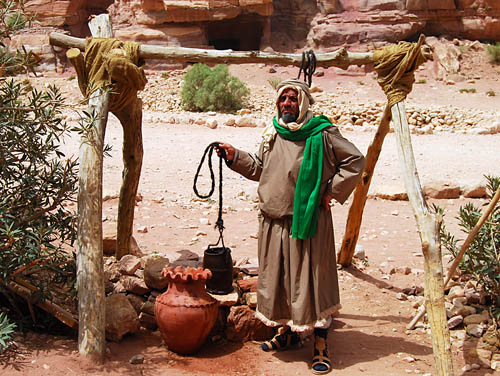
At Petra in Jordan, men dressed in antique costumes demonstrate life among the Bedouin. Here we have a man at the well. This may seem ancient to younger people, but I drew water from a well when I was a youngster (and it was not in the patriarchal period!).

A Bedouin at Petra, Jordan, illustrates the importance of the well. Photo by Ferrell Jenkins.